一汽

Search documents
固态电池供应商备战2027:目标定好了,路线还在争
经济观察报· 2026-01-10 04:56
Core Viewpoint - The solid-state battery supply chain faces significant challenges in achieving mass production by 2027, with key materials still in the experimental stage and core equipment shortages hindering progress [1][5]. Material Aspects - The solid-state battery's core materials are divided into three categories: cathode, anode, and electrolyte, with the anode materials currently following two main technical routes: silicon-carbon and lithium metal [11][12]. - Sulfide solid electrolytes are gaining traction, with a current output of approximately 20 tons in 2025, and the price per ton reaching several million yuan [3][4]. - The competition between oxide and sulfide electrolytes is a focal point, with oxide electrolytes being easier to mass-produce but having lower ionic conductivity compared to sulfide electrolytes [12][14]. Industry Trends - Investment interest in solid-state batteries is returning, driven by orders from cell manufacturers and the potential for profitability within the supply chain [2][3]. - The industry is targeting 2027 as a pivotal year for mass production, with many companies aiming to complete product development or testing by 2026 [4][5]. Equipment Challenges - The lack of mature mass production equipment is a significant barrier, with some materials still requiring production in vacuum glove boxes, limiting scalability [16][20]. - The solid-state battery production line requires high-precision equipment and a clean environment, which increases costs and complicates the manufacturing process [19][20]. Technical Uncertainties - The uncertainty in technical routes complicates equipment adaptation, as different companies have varying core technologies, making it difficult to establish standardized production systems [20][22]. - The rapid pace of technological iteration and the absence of economies of scale further exacerbate cost pressures in the solid-state battery sector [22][24]. Talent and Collaboration - The solid-state battery sector is experiencing a talent shortage, with many skilled professionals concentrated in supplier roles, leading to higher salaries compared to the liquid battery sector [25][26]. - Companies are increasingly collaborating with industry leaders to provide comprehensive solutions, including material supply and technical guidance [26].




2026仅1家目标销量翻倍,车企不再“放卫星”
Feng Huang Wang Cai Jing· 2026-01-08 08:26
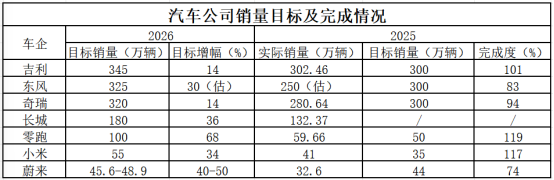
Core Viewpoint - The Chinese automotive market, particularly in the new energy vehicle (NEV) sector, is transitioning from rapid growth to a more cautious approach, with manufacturers setting more conservative sales targets for 2026 compared to previous years [1] Group 1: Sales Targets and Growth Rates - Geely has set the highest sales target for 2026 at 3.45 million units, representing a 14% increase from 2025, with a goal of 2.22 million units in NEV sales, a 32% year-on-year growth [3] - Dongfeng aims for a total sales target of 3.25 million units in 2026, with an estimated growth rate exceeding 30% based on projected 2025 sales of approximately 2.5 million units [3] - Chery has announced a target of 3.2 million units for 2026, reflecting a 14.03% increase from 2025 [3] - Leap Motor is the only manufacturer aiming for a doubling of sales, targeting 1 million units in 2026, up from 500,000 units in 2025 [1][2] Group 2: Performance and Adjustments - Longhua's 2025 cumulative sales were 1.32 million units, with a significant adjustment in their 2026 target from at least 2.49 million units down to 1.8 million units, indicating a 36% growth from the previous year [4] - NIO has set a sales target for 2026 between 456,000 and 489,000 units, aiming for a growth rate of 40-50% from the previous year [6] - Xiaomi has also set a target for 2026 that exceeds a 30% increase from its previous year's sales, with plans to launch a new generation of vehicles [6] Group 3: Market Dynamics - The implementation of a 50% reduction in NEV purchase tax and adjustments to subsidy policies are creating new variables in the domestic automotive market [1] - Traditional automakers are adopting more cautious growth targets, while new entrants remain optimistic but have tempered their previous aggressive growth statements [1]

零跑汽车(9863.HK):一汽溢价入股助力零跑新征程
Ge Long Hui· 2026-01-07 04:34
Core Insights - Leap Motor celebrated its 10th anniversary on December 28, 2025, and announced a strategic partnership with FAW, acquiring a 5% stake for approximately 3.74 billion yuan, aiming to become a world-class automaker [1][2] - The company reported a total sales volume of 597,000 units for 2025, marking a significant milestone with expectations for its first annual profit [1][2] - Leap Motor's long-term goals include achieving sales of 1 million units by 2026 and 4 million units in the future, supported by a new vehicle cycle and strategic collaborations [1][3] Company Development - From 2015 to 2025, Leap Motor transitioned from an IT cross-border player to a leading new energy vehicle manufacturer, with cumulative deliveries exceeding 1.2 million units and a peak monthly sales of over 70,000 units [2] - The company has established 17 major component factories, achieving a 65% self-manufacturing ratio for core components, which provides a cost advantage of approximately 10% compared to external procurement [2] - The LEAP platform allows for high component commonality, significantly reducing R&D and manufacturing costs for models like C10 and C16 [2] Strategic Partnerships - FAW's investment highlights strategic recognition of Leap Motor, with funds allocated for R&D, operational capital, and brand development [2] - A collaboration agreement was signed between FAW and Leap Motor for joint development of powertrains, with the first model expected to be produced in 2026 [3] Future Outlook - Leap Motor aims to transition from a follower to a leader in the automotive industry, with a focus on technology leadership, product matrix expansion, and a cooperative ecosystem [3] - The company plans to host annual technology days starting in 2026 to enhance supply chain integration and factory construction [3] Financial Projections - Adjusted sales forecasts for 2025-2027 are 600,000, 1,040,000, and 1,420,000 units respectively, with revenue projections of 68.3 billion, 123.5 billion, and 168.8 billion yuan [3] - The net profit estimates for the same period are 660 million, 5.11 billion, and 8.25 billion yuan, reflecting a significant adjustment in expectations [3] - The target price for Leap Motor is set at 83.69 HKD, reflecting a 30% premium on the estimated valuation due to anticipated growth and profitability [3]

车市进入高销量低增长周期,行业从拼价格转向拼价值
Bei Jing Ri Bao Ke Hu Duan· 2026-01-06 00:34
Group 1 - The core viewpoint of the articles highlights the transformation and challenges in the Chinese automotive market, emphasizing a shift from price competition to value-driven growth, with a focus on innovation and technology integration [1][5][8] - In 2025, China's automotive market is expected to achieve record production and sales, driven by policies such as trade-in incentives and tax exemptions for new energy vehicles, indicating sustained consumer demand [1][6] - The competition landscape is evolving, with companies like BYD surpassing Tesla in electric vehicle sales, marking a shift towards systematic competition based on cost, supply chain, and product matrix [2][3] Group 2 - The industry is witnessing a significant shift towards "boundaryless integration," with companies exploring new technologies and markets beyond traditional automotive manufacturing, such as AI and robotics [3][4] - The year 2025 is anticipated to be a turning point for intelligent driving technology, with advancements making high-level autonomous driving features more accessible to the broader market [3][4] - The automotive sector is facing increasing pressure from regulatory changes and market dynamics, leading to a decline in profit margins and a need for companies to focus on value creation through innovation and quality [5][7] Group 3 - The outlook for 2026 suggests a transition to a phase of high sales but low growth, with expectations of stable annual sales around 30 million vehicles, and a significant increase in exports, particularly in the new energy vehicle segment [6][8] - Capital operations within the automotive industry are becoming more active, with several companies successfully listing on stock exchanges, indicating a trend towards consolidation and value reassessment [7][8] - The competitive environment is expected to intensify, with companies needing to accelerate their transition to new energy and global markets to survive the anticipated market shakeout [8]
车市进入高销量低增长周期行业从拼价格转向拼价值
Zheng Quan Shi Bao Wang· 2026-01-06 00:07
Core Insights - Despite challenges, the Chinese automotive market is expected to achieve record production and sales in 2025, with a total of 31.23 million vehicles produced and 31.12 million sold in the first eleven months of the previous year, both showing over 11% year-on-year growth [1] - The industry is transitioning from extensive competition to value-driven high-quality development, supported by factors such as over 50% penetration of new energy vehicles and advancements in autonomous driving technology [1][3] Industry Trends - 2026 is anticipated to be a watershed year for automakers, entering a new cycle characterized by high sales but low growth, with consumers benefiting from advanced features at lower prices [3] - The competition is shifting from individual models to a systematic approach focusing on cost, supply chain, and product matrix, as evidenced by BYD surpassing Tesla in electric vehicle sales [4] - New energy vehicle companies are approaching profitability, with Leap Motor achieving a 103% year-on-year increase in deliveries, while NIO aims for breakeven by Q4 2025 [4] Market Dynamics - The differentiation among automakers is widening, with companies like Li Auto facing challenges in meeting delivery targets during their transition to electric vehicles [5] - Companies are exploring "boundaryless integration," venturing into AI and robotics, indicating a shift towards a more technology-driven and ecosystem-oriented approach [5] - The automotive industry is expected to play a crucial role in driving technological innovation, with advancements in semiconductors and AI being applied at scale [6] Competitive Landscape - The industry is moving away from price wars towards value creation, with a focus on safety and quality as competitive advantages [7] - The market is projected to stabilize with annual sales around 30 million vehicles from 2026 to 2030, with significant growth in exports, particularly in new energy vehicles [8] Capital and Investment - A surge in IPOs within the automotive sector is noted, with companies like Chery and Seres successfully listing, indicating a robust capital operation environment [10] - Traditional automakers are actively restructuring and seeking value reassessment, with state-owned enterprises enhancing their market positions [10] Future Challenges - The automotive market is expected to face intensified competition in 2026, with potential policy rollbacks and rising costs posing significant challenges [11] - The industry is likely to undergo a rapid consolidation phase, with resources concentrating on high-quality enterprises as the market matures [11]
车市进入高销量低增长周期 行业从拼价格转向拼价值
Zheng Quan Shi Bao· 2026-01-05 18:38
Group 1 - The Chinese automotive market is expected to set new records in production and sales in 2025, with a cumulative completion of 31.23 million vehicles produced and 31.12 million sold in the first 11 months of the previous year, both showing an increase of over 11% year-on-year [1] - The industry is transitioning from extensive competition to high-quality development, driven by factors such as over 50% penetration of new energy vehicles and the rollout of L3 autonomous driving [1] - The year 2026 is anticipated to mark a turning point for automakers, entering a new cycle characterized by high sales but low growth, with consumers benefiting from advanced features at lower prices [1] Group 2 - BYD has surpassed Tesla in annual sales of pure electric vehicles, indicating a shift in the competitive landscape towards a focus on cost, supply chain, and product matrix [2] - New energy vehicle companies like Leap Motor and XPeng are approaching profitability, while NIO aims for breakeven in Q4 2025, highlighting a significant differentiation among automakers [2] - The competition is expected to evolve from mere delivery races to comprehensive assessments of cash flow, gross margins, and channel efficiency [2] Group 3 - Automakers are exploring "boundaryless integration," with companies like Li Auto and XPeng venturing into AI glasses and flying cars, respectively, indicating a shift towards technology and ecosystem development [3] - The year 2025 is seen as the "year of universal intelligent driving," with advancements in L2 and L3 driving assistance technologies becoming more mainstream [3] - The automotive industry is becoming a core driver of technological innovation, with a growing emphasis on integrating advanced technologies like semiconductors and AI [4] Group 4 - The automotive industry is moving away from price wars towards value creation, with a focus on safety and emotional value for consumers [5] - The market is expected to stabilize with annual sales around 30 million vehicles from 2026 to 2030, indicating a shift towards a more rational competitive environment [5] - The industry is witnessing a recovery in profit margins due to effective policies like the vehicle trade-in program, which has reduced the prevalence of price wars [5] Group 5 - The international market is becoming a crucial growth area, with projections of Chinese automotive exports reaching 8 million units by 2026 and 10 million by 2030, primarily driven by new energy vehicles [6] - Chinese automakers are transitioning from merely exporting products to establishing a comprehensive ecosystem that includes technology and supply chain collaboration [6] Group 6 - The automotive industry is experiencing a surge in IPOs, with companies like Chery and Seres successfully listing, indicating a vibrant capital market for the sector [7] - Traditional automakers are actively engaging in capital operations to enhance their market positions and prepare for intensified competition [7] - The market consensus suggests that 2026 will bring a more brutal competitive environment, with potential for increased consolidation and closures among weaker players [7][8] Group 7 - The automotive industry is expected to undergo rapid resource concentration towards high-quality enterprises, with the performance in 2025 serving as a ticket for the competitive landscape in 2026 [8] - Companies must accelerate their transition to new energy, strengthen technological barriers, and expand into global markets to survive in the upcoming competitive landscape [8]
零跑汽车(09863):一汽溢价入股助力零跑新征程
HTSC· 2026-01-05 06:34
Investment Rating - The report maintains a "Buy" rating for the company [7] Core Insights - The company aims to become a world-class automotive enterprise, targeting sales of 1 million units in 2026 and 4 million units in the long term [4][5] - The company has established a comprehensive self-research and platform-based manufacturing system, achieving a sales volume of approximately 597,000 units in 2025, marking a significant improvement in its fundamentals [2][3] - The strategic investment from FAW Group, acquiring approximately 5% equity for about HKD 3.74 billion, highlights the recognition of the company's long-term strategy [3] Sales and Financial Projections - The company expects to achieve sales of 600,000, 1,040,000, and 1,420,000 units in 2025, 2026, and 2027 respectively, with corresponding revenues of RMB 68.3 billion, RMB 123.5 billion, and RMB 168.8 billion [5][11] - The net profit attributable to the parent company is projected to be RMB 6.6 million, RMB 51.1 million, and RMB 82.5 million for the years 2025, 2026, and 2027 respectively [5][11] Strategic Developments - The company has signed a powertrain cooperation agreement with FAW, focusing on the joint development of range-extended and plug-in hybrid vehicles, with the first model expected to be mass-produced in 2026 [3] - The D-series models, including D19 and D99, are set to launch in 2026, enhancing the company's high-end product lineup [3][4] Market Expansion - The company plans to leverage Stellantis' distribution channels to export over 60,000 vehicles in 2025, entering 35 countries with more than 800 overseas stores [2][4] - The strategic cooperation with FAW and Stellantis is expected to drive growth and profitability during the upcoming new vehicle cycle [4]
突破800万台!
中国能源报· 2026-01-03 13:34
Group 1 - The core viewpoint of the article highlights that in 2025, the railway transportation volume of commercial vehicles in China has exceeded 8 million units, setting a historical record [1] - During the 14th Five-Year Plan period, the China Railway Group has continuously improved the service system for commercial vehicle transportation, with the volume reaching 751.81 thousand units in 2024, representing a growth of 20.83% compared to the end of the 13th Five-Year Plan [1] - The China Railway Group's subsidiary, China Railway Special Cargo Logistics Co., Ltd., has deepened cooperation with major automotive manufacturers such as FAW, SAIC, BYD, and Geely, with large customer volume accounting for nearly 92% in 2025 [1] Group 2 - In the field of cross-border transportation, efforts are being made to build a dual-channel international logistics corridor of "railway export + sea-rail intermodal transport," facilitating the export of "Made in China" vehicles [2] - Utilizing key ports such as Horgos, Manzhouli, and Alashankou, multiple regular railway routes for commercial vehicle exports have been established, with stable operation of cross-border trains on the China-Laos Railway, aiding direct access to the Southeast Asian market [2] - Collaboration with coastal ports like Shanghai and Guangzhou has been enhanced to optimize the "rail + sea" connection process, achieving seamless integration of commercial vehicles being transported directly to ports and loaded onto ships, improving transportation efficiency by 10% to 15% and reducing overall logistics costs by approximately 8% [2]

2025年铁路商品汽车运输量突破800万台
Ren Min Ri Bao· 2026-01-01 22:10
Core Insights - The China National Railway Group has announced that railway transportation of automobiles is expected to exceed 8 million units by 2025, marking a historical high [1] - During the 14th Five-Year Plan period, the railway system is enhancing its automobile transportation service framework, with a projected increase of 20.83% in automobile transport volume to 7.5181 million units in 2024 compared to the end of the 13th Five-Year Plan [1] Group 1: Domestic Transportation - The China Railway Group's subsidiary, China Railway Special Cargo Logistics Co., is deepening collaborations with major automotive manufacturers such as FAW, SAIC, BYD, and Geely [1] - A dedicated service team is being established to provide comprehensive services, with large clients expected to account for nearly 92% of the transport volume by 2025 [1] Group 2: Cross-Border Transportation - The company is developing a dual-channel international logistics pathway combining "railway exports + sea-rail intermodal transport" to facilitate the export of Chinese-made automobiles [1] - Key ports such as Horgos, Manzhouli, and Alashankou are being utilized to establish regular railway routes for automobile exports, with stable operations of cross-border trains on the China-Laos Railway aiding access to Southeast Asian markets [1] - Collaborations with coastal ports like Shanghai and Guangzhou are optimizing the "rail + sea" connection process, achieving seamless integration for automobile transport to ports, improving transport efficiency by 10% to 15%, and reducing overall logistics costs by approximately 8% [1]
国标公示:取消“半固态电池”分类
高工锂电· 2025-12-31 11:56
Core Viewpoint - The article discusses the establishment of a national standard for solid-state batteries in China, which aims to clarify the definitions and classifications of solid-state and semi-solid batteries, thereby providing a unified framework for the industry [3][4][9]. Group 1: National Standard Development - On December 31, 2025, China's first national standard for solid-state batteries for electric vehicles entered the public consultation phase, marking a significant step in the standardization of this technology [3]. - The standard will provide a unified definition, classification methods, and quantitative indicators to determine whether a battery qualifies as a solid-state battery [4][8]. - The drafting committee includes over 30 organizations from the entire supply chain, including major battery manufacturers and automotive companies, indicating a broad consensus among key industry players [5][6]. Group 2: Classification and Testing Criteria - The standard introduces a three-part classification system for batteries: liquid, mixed solid-liquid, and solid-state, eliminating the independent categories of "semi-solid" and "fully solid" batteries [10][12]. - A weight loss rate test with a threshold of 0.5% is established to determine if a battery can be classified as solid-state, with specific testing procedures outlined [14][15]. - The classification will also consider the type of solid electrolyte, ion conduction type, and application scenarios, allowing for differentiated product development in various fields [13][17]. Group 3: Industry Implications - The introduction of this standard is expected to accelerate the industrialization of solid-state batteries, with major automotive companies planning to validate and produce these batteries by 2026 and 2027 [19]. - The solid-state battery concept index has seen a nearly 60% increase this year, reflecting strong market interest and investment in this technology [20]. - The standard aims to provide a common language for academic research and technology development, set baseline expectations for product marketing, and establish conditions for future performance and safety standards [22][24].