
茅台

Search documents
天风证券晨会集萃-20250716
Tianfeng Securities· 2025-07-15 23:46
Group 1: Urbanization and City Renewal - The core focus of the new urbanization strategy is people-oriented, differentiated policies, and urban renewal, aiming to enhance the urbanization rate to 70% within five years [23][24] - Urban renewal encompasses the reshaping of urban functions, improvement of living quality, and preservation of historical culture, with current tasks emphasizing the renovation of old communities and infrastructure enhancement [23][25] - The report suggests paying attention to sectors related to interior design, building materials, underground pipelines, elevators, urban planning, and smart cities [25] Group 2: Economic and Market Insights - The report indicates that the A-share market has shown resilience, with major indices experiencing increases, particularly the CSI 500 and Shenzhen Composite Index, which rose nearly 2% [28] - In June, social financing continued to increase year-on-year, supported by government bonds and improved credit issuance, reflecting positive economic factors [32][34] - The report highlights a significant increase in M1 year-on-year, attributed to seasonal fiscal efforts and improved consumer confidence due to easing external trade tensions [35] Group 3: Coal Industry Analysis - The coal industry has undergone significant supply-side reforms, with over 10 billion tons of outdated capacity eliminated by the end of 2020, resulting in a reduction of coal mines to below 4,700 [11] - The current environment reflects a situation of high operating rates leading to internal competition, rather than a traditional oversupply scenario [11][40] - The report suggests that controlling operating rates may be a key strategy for the coal industry to mitigate excessive competition [40] Group 4: Semiconductor and Electronics Sector - The semiconductor sector is expected to maintain optimistic growth, driven by AI demand and domestic market expansion, with a focus on storage and design segments [18][19] - The report emphasizes the importance of domestic substitution in the semiconductor supply chain, particularly in the context of geopolitical risks [19] - Companies like Jiangbo Long are highlighted for their potential growth due to favorable market conditions and technological advancements [18]
酒鬼酒与胖东来联名产品即将上线,新零售如何重塑酒水格局?
Nan Fang Du Shi Bao· 2025-06-30 12:39
Core Viewpoint - The collaboration between Jiugui Liquor and Pang Donglai has generated significant market interest, leading to a surge in Jiugui's stock price and market capitalization, indicating strong investor confidence in the potential success of their joint product launch [2][5]. Company Summary - Jiugui Liquor's stock price reached a limit up on June 30, closing at 43.99 yuan per share, resulting in a market value increase of 920 million yuan in one day [2]. - The partnership with Pang Donglai aims to enhance Jiugui's market presence and product innovation, with plans for deep collaboration in retail channel expansion and product promotion [5]. - Jiugui's revenue fell by 49.7% year-on-year, and net profit plummeted by 97.72%, highlighting the urgent need for revitalization through strategic partnerships [5]. Industry Summary - The collaboration represents a trend of traditional liquor companies partnering with retail platforms, reshaping distribution channels and power structures within the industry [4]. - The rise of new retail, particularly instant retail, is transforming the liquor market, with significant sales growth observed during events like the 618 shopping festival, where liquor sales on instant retail platforms surged dramatically [7][11]. - The industry is witnessing a shift towards direct sales models, with leading liquor companies increasing their direct-to-consumer strategies to enhance profit margins and control over distribution [10][13].


高盛:京东,小米,白酒,旅行OTA等最新观察
Zhi Tong Cai Jing· 2025-06-20 07:48
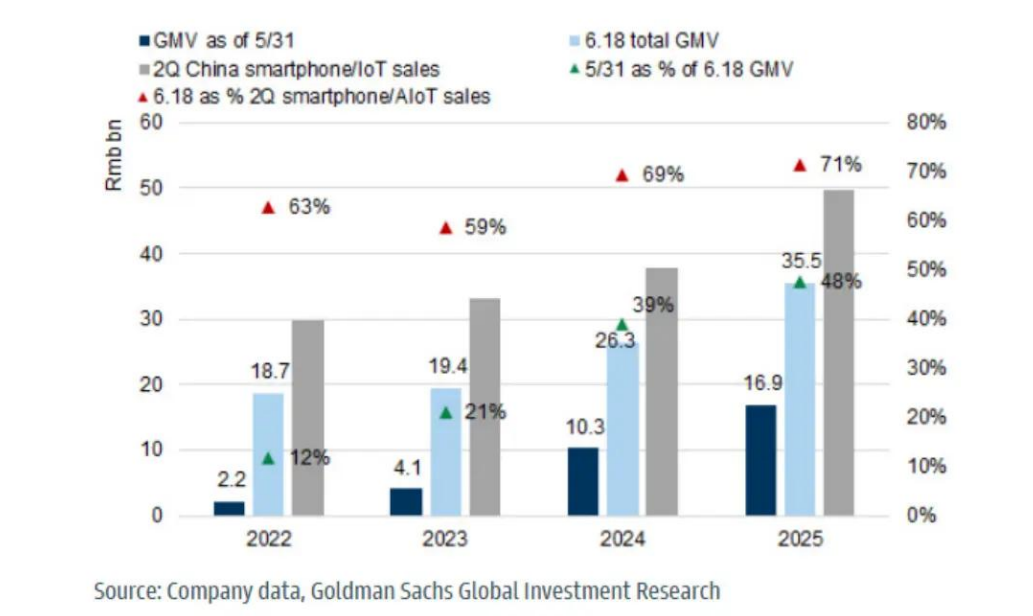
Group 1: JD.com Performance - JD.com achieved record sales during the 618 shopping festival, exceeding expectations with a projected 13% year-over-year revenue growth for Q2 2025 [1] - The number of active users increased by 100% year-over-year, significantly outperforming industry averages, with total orders reaching 2.2 billion [1] - JD.com founder outlined a long-term strategic plan focusing on domestic retail and six new business areas, including food delivery and logistics, alongside a three-year zero-commission strategy [1] Group 2: Online Travel Agency (OTA) Strategy - JD.com announced a three-year zero-commission policy for hotels joining the "JD Hotels + Membership" program, aiming to strengthen its supply chain [3] - The company is actively cross-selling to its existing user base of 80 million individuals and 800,000 small and medium enterprises [3] - Competitors like Ctrip and Tongcheng have ceased sharing hotel inventory with JD.com, leading to a reduction in available hotel listings on the platform [3] Group 3: Xiaomi Performance - Xiaomi reported a GMV of 35.5 billion RMB during the 618 shopping festival, reflecting a 35% year-over-year increase, aligning with expectations [4] - This GMV represents 71% of Goldman Sachs' projected revenue for Q2 2025 from China's smartphone and AIoT sectors [4] - Upcoming product launches include new models in automotive, smartphones, smart devices, and home appliances [4] Group 4: Chinese Baijiu Market Insights - Sales in the baijiu sector have faced a short-term demand shock due to anti-luxury consumption policies, with expected volume declines of 30% to 50% in June [9] - The enforcement of these policies will be a key observation point, particularly during the peak season in August and September [9] - Brand performance is diverging, with Moutai's wholesale price remaining stable while Wuliangye's price has weakened [9] Group 5: Sony Group Outlook - Sony's gaming and network services segment is expected to see sustained profitability due to diversified content acquisition channels [12] - The company aims to enhance user engagement across multiple console generations, mitigating the impact of hardware transitions on profitability [12] - A 12-month target price of 4,600 JPY has been set for Sony, reflecting confidence in its growth trajectory [12]
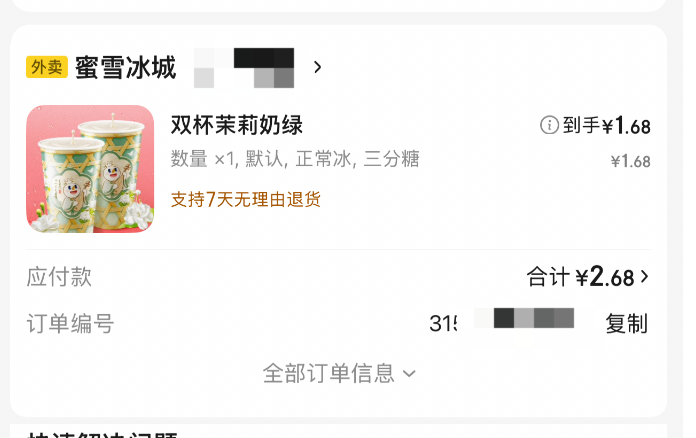
市值超越"白酒巨头"!5元奶茶凭什么?
第一财经· 2025-05-27 11:38
Core Viewpoint - The article highlights the remarkable market performance of Mixue Group, which has surpassed traditional liquor giants in market capitalization, indicating a shift in consumer valuation of beverage brands [1][2]. Group 1: Market Performance - As of May 27, Mixue Group's stock price reached 579 HKD, with a total market capitalization exceeding 219.8 billion HKD, surpassing Luzhou Laojiao and more than double that of Yanghe [1][4]. - Since its listing on March 3, Mixue Group's stock has increased by over 160%, significantly outperforming the Hang Seng Index during the same period [2]. - The company's price-to-earnings (P/E) ratio stands at 45, which is considerably higher than many leading liquor brands, indicating a premium valuation in the market [4]. Group 2: Factors Driving Stock Price - Short-term catalysts for Mixue Group's stock price increase include a competitive subsidy war initiated by major delivery platforms like JD.com, which has boosted same-store sales [6]. - The average daily retail sales per store for Mixue Group showed a slight decline in growth rates, with figures of 4,127.8 CNY and 4,184.4 CNY for 2023 and 2024 respectively, indicating a potential slowdown in sales growth [8]. - Long-term stock price appreciation is attributed to supply chain advantages and a concentrated shareholding structure, with the controlling shareholders holding approximately 82% of the shares, resulting in limited market liquidity [10]. Group 3: Competitive Landscape - Mixue Group has established itself as a leading player in the new tea beverage market, with a significant number of stores globally, surpassing Starbucks to become the largest chain [10]. - The valuation of Mixue Group is compared to that of Kweichow Moutai, a leading liquor brand, suggesting that it is viewed as a premium brand within the tea beverage sector [4].
从全国第1到为小米代工:“中国彩电大王”没落了吗?
Xin Lang Cai Jing· 2025-05-27 11:24
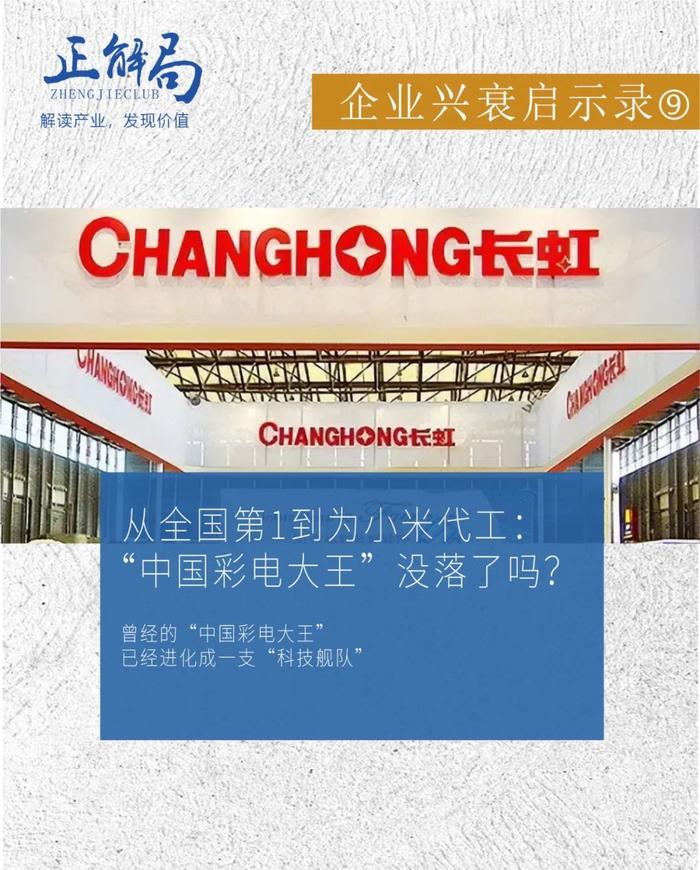
Core Viewpoint - The recent revelation that Xiaomi air conditioners are produced by Sichuan Changhong has sparked widespread discussion, highlighting Changhong's role as a manufacturer for Xiaomi and raising questions about the company's current market position and historical significance [2][3]. Group 1: Changhong's Historical Context - Changhong, once a leading player in the Chinese television market, has seen a significant decline, dropping out of the top four brands in the industry [3][10]. - The company originated from a military background, transitioning to consumer electronics in 1972, focusing on television production due to rising market demand and its technological capabilities [5][6]. - By the mid-1990s, Changhong became the largest television manufacturer in China, achieving a market share of 35% and being recognized as the "King of Color TVs" [8][10]. Group 2: Market Performance and Current Standing - According to a report by Omdia, in 2024, the global television market is expected to reach 208 million units, with brands like Hisense, TCL, and Xiaomi leading the market, while Changhong's presence has diminished significantly [10][11]. - In the Chinese television market, Hisense leads with a shipment of 8 million units (22.5% market share), followed by Xiaomi with 7.1 million units (19.9% market share), while Changhong, along with other brands, accounts for only 495,000 units (13.8% market share) [11][10]. - Changhong's market capitalization has also declined, currently valued at 46 billion, which is significantly lower than its peak of 650 billion in 1998 [10][11]. Group 3: Reasons for Decline - Changhong's decline is attributed to critical technological missteps, particularly its investment in plasma technology, which resulted in over 2 billion in losses, while the liquid crystal television market surged [22][23][24]. - The company also faced commercial failures, including overexpansion and mismanagement of resources, leading to significant inventory issues and financial losses [25][29][37]. - The geographical disadvantage of being located in a third-tier city has hindered Changhong's ability to compete effectively with brands based in major urban centers [41][42]. Group 4: Current Business Diversification - Despite its struggles in the television market, Changhong has diversified its operations, reporting a production of approximately 16.54 million units in 2024, with a revenue of 16.037 billion, reflecting a year-on-year growth of 10.27% [45][47]. - The company has expanded into various sectors, including smart home technology, digital industries, and green energy, positioning itself as a technology group rather than just a consumer electronics manufacturer [45][48]. - Changhong's subsidiaries have achieved significant success in specialized markets, such as being the largest supplier of refrigerator compressors and a key player in lithium battery systems for high-speed magnetic levitation trains [50][52].
蜜雪集团市值超越泸州老窖,5元奶茶如何跑出2000亿港元市值?
Di Yi Cai Jing· 2025-05-27 10:40
Core Viewpoint - The stock price of Mixue Group surged to 579 HKD, reaching a historical high and surpassing the market capitalization of traditional liquor giants like Luzhou Laojiao and Yanghe, indicating a significant shift in valuation within the consumer goods sector [1][3][4]. Group 1: Stock Performance - Since its listing on March 3, Mixue Group's stock has increased by over 160%, significantly outperforming the Hang Seng Index during the same period [2]. - As of May 27, Mixue Group's market capitalization exceeded 219.8 billion HKD, with a price-to-earnings (P/E) ratio of 45, which is considerably higher than many leading liquor brands [1][4]. Group 2: Market Dynamics - The recent rise in Mixue Group's stock price is attributed to a competitive subsidy war initiated by major delivery platforms like JD.com, which has boosted same-store sales [5][7]. - The average daily retail sales per store for Mixue Group showed a slight decline in growth rates, indicating potential challenges in maintaining momentum in a saturated market [7]. Group 3: Ownership Structure - The actual controllers of Mixue Group, Zhang Hongchao and Zhang Hongfu, hold approximately 82% of the company's shares, resulting in a limited float in the market, which can lead to significant price volatility [8][9]. - The company has established a strong operational "moat," with over 46,479 stores globally, making it the largest chain brand in the world, surpassing Starbucks [8].

今年前4个月白酒产量下降;金种子酒回应华润退出传闻
Mei Ri Jing Ji Xin Wen· 2025-05-23 00:47
Group 1: Baijiu Industry Overview - In the first four months of 2025, the production of baijiu decreased by 7.8% year-on-year, totaling 1.308 million kiloliters, with April production down 13.8% year-on-year at 281,000 kiloliters [1] - Despite the decline in production, the wholesale price index for baijiu increased by 8.80% year-on-year in mid-May, indicating a price stabilization strategy among high-end brands [1][2] - The price index for famous baijiu brands rose by 10.86%, reflecting their ability to maintain premium pricing through controlled supply and improved product structure [2] Group 2: Jinzhongzi Wine Company - Jinzhongzi Wine attributed its revenue decline to market consumption environment changes and strategic adjustments, including price increases and reduced promotions [3] - The company is undergoing comprehensive reforms to enhance management and operational efficiency, focusing on strengthening its core products and expanding its brand strategy [3] - Despite efforts to upscale its product line, over 50% of Jinzhongzi's sales come from low-end products, which have a significantly lower gross margin compared to industry averages [3] Group 3: Urumqi Beer Company - Urumqi Beer launched its first low-sugar energy drink named "Dianchi," marking its entry into the energy drink market [4] - The new product features a low-sugar formula and incorporates Tianshan snow lotus extract, with packaging designed to evoke a "charging" sensation [4] - This product launch represents Urumqi's strategy to diversify its offerings and strengthen its market position in Xinjiang while preparing for potential national expansion [4]

新消费的风吹回了A股,下一步呢
Hu Xiu· 2025-05-22 01:37
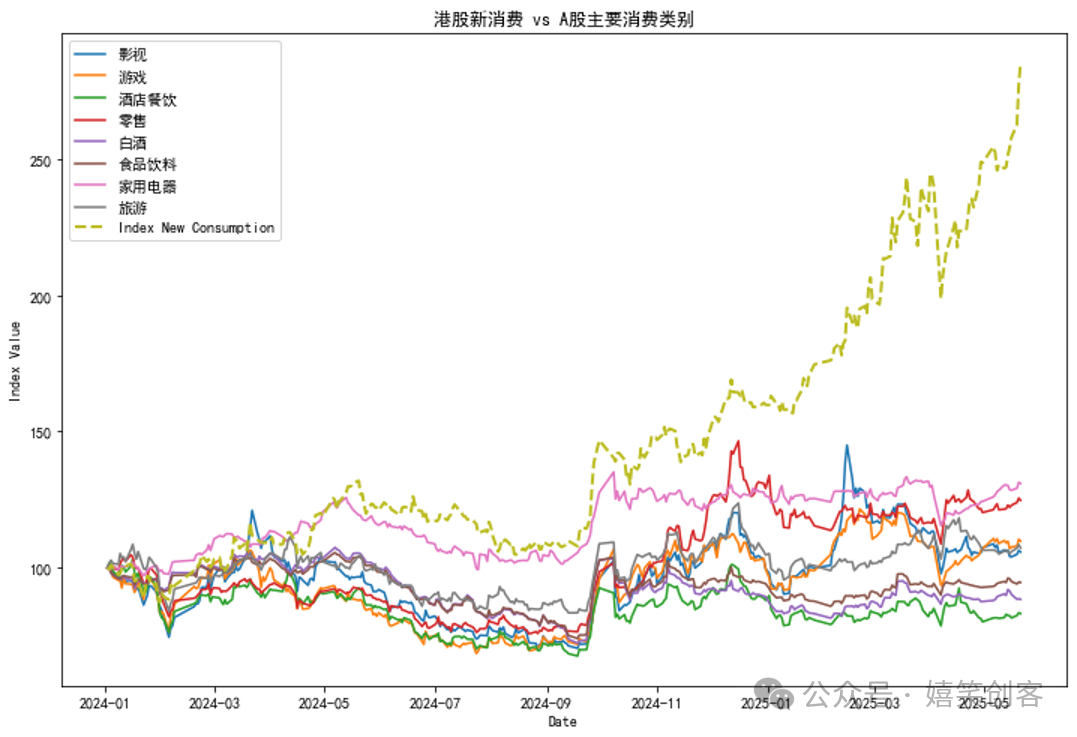
Group 1 - The article discusses the shift of high-quality new consumer assets from the A-share market to offshore markets, questioning whether the guidance and focus on hard technology have resulted in substantial tech assets [2] - A new consumer index is formed by 12 selected Hong Kong stocks that resonate with young consumers, including popular brands and entertainment companies [2][3] - The performance of Hong Kong new consumer stocks shows stable growth compared to the declining revenue growth in various A-share consumption categories, with home appliances and gaming being the few exceptions [7] Group 2 - The rise of new consumption is seen as a natural consequence of young consumers wanting to differentiate from traditional consumption patterns, despite the understanding that new consumption will eventually age [9] - The article reflects on the past four years since the peak of new consumption, noting that many investors have exited the market while some have profited from holding onto their investments [12][13] - The current resurgence of new consumption is viewed as a reasonable value return, emphasizing that consumption remains a timeless theme despite changes in the economic landscape and consumer mindset [15][16] Group 3 - The article highlights the disparity in retail pricing and consumer behavior between different city tiers, indicating that lower-tier cities may not experience the same level of economic downturn as higher-tier cities [17][23] - It critiques the homogenization of shopping malls, which have failed to attract consumers due to lack of diversity and innovation, leading to a decline in foot traffic [19] - The post-pandemic consumer behavior reflects a desire for affordable entertainment rather than luxury spending, indicating a shift in spending priorities [20][26] Group 4 - The article discusses the challenges faced by hard technology investments, noting that many projects struggle to achieve significant revenue and profit, despite high valuations [29][32] - It contrasts the investment landscape in China with that of the US and Europe, where manufacturing and industrial companies often face valuation ceilings [33][34] - The article concludes that while consumption has regained wealth effects in the market, there is a cautionary note about the potential for rapid speculative behavior among investors [35][36]
宁德时代锁定港股市值前十;小米本周发布纯电SUV;特斯拉计划明年推出第二代Dojo超算丨百亿美元公司动向
晚点LatePost· 2025-05-20 13:18
Group 1: Ningde Times IPO - Ningde Times' dark market price has increased by over 9% to 284 HKD ahead of its IPO, leading to a market valuation of 1.3 trillion HKD, ranking it eighth in the Hong Kong stock market [1] - The IPO price is set at 263 HKD, with no significant discount compared to its A-share price, and the company aims to raise 5 billion USD, primarily subscribed by major institutions [1] - The public offering has seen a subscription rate exceeding 120 times, with over 280 billion HKD in funds raised [1] Group 2: Xiaomi's New Product Launch - Xiaomi will hold a strategic product launch on Thursday, introducing the Xiaomi Xuanjie O1 chip, Xiaomi 15S Pro, Xiaomi Pad 7 Ultra, and its first SUV YU7 [2] - The Xuanjie project has seen over 13.5 billion CNY in R&D investment, with a team of over 2,500 people, and an expected R&D expenditure of over 6 billion CNY this year [2] - The Xuanjie O1 chip utilizes second-generation 3nm technology and aims to compete in the flagship experience tier, also being used in other Xiaomi products [2] Group 3: Tesla's Dojo Supercomputer - Tesla plans to launch its second-generation Dojo supercomputer cluster (D2) in 2026, featuring self-developed cloud training chips that are more efficient and cost-effective than the first generation [3] - The performance of the D2 is expected to still lag behind similar products from Nvidia, with a third-generation Dojo planned for 2028 to further close the performance gap [3] - The first-generation Dojo was introduced in 2021, designed with ASIC chips to provide performance and cost advantages over Nvidia's offerings [3] Group 4: Google Search Redefinition - Google CEO Sundar Pichai stated that the company is redefining the search experience to become more predictive and personalized, transitioning from merely responding to user queries [4] - The integration of AI is expected to drive significant advancements in the search domain, with Pichai emphasizing that challenges only arise when viewed as such [4] Group 5: Nvidia's AI Supercomputer Production - Nvidia has announced the mass production of the world's smallest AI supercomputer, DGX Spark, which will be ready in a few weeks [5] Group 6: AI Computing Demand Surge - With the explosion of generative AI applications, there is a significant increase in demand for localized computing power, with predictions that global AI inference computing demand will exceed training computing demand by more than three times by 2025 [6] - The introduction of DGX Spark allows small and medium enterprises and individual developers to access supercomputing capabilities at consumer-level costs, lowering the barriers to AI innovation [6] Group 7: Apple and Alibaba AI Collaboration Scrutiny - Apple is seeking to collaborate with Alibaba to enhance the Apple Intelligence feature for iPhones in China, but this plan is under scrutiny from the White House and Congress due to concerns about boosting Chinese AI capabilities [7] Group 8: Walmart Price Increase Controversy - Walmart announced price increases for its products due to thin retail margins and rising tariffs, which has drawn criticism from former President Trump, who argues that Walmart should absorb the costs [8] Group 9: China's Consumer Spending Growth - In April, China's consumer spending rose by 5.1% year-on-year, with retail sales excluding automobiles increasing by 5.6% [9] - Key sectors leading the growth include communication equipment (+19.9%), furniture (+26.9%), and home appliances (+38.8%) [9] Group 10: Leap Motor's Financial Performance - Leap Motor reported a revenue of 10.02 billion CNY in Q1, a year-on-year increase of 187.1%, with a gross margin of 14.9%, up 16.3 percentage points [10] - The company attributes the gross margin increase to sales growth, cost control, and product structure optimization [10] Group 11: Nvidia and Mercedes-Benz Collaboration - Nvidia is collaborating with Mercedes-Benz to launch a fleet of autonomous vehicles using Nvidia's end-to-end technology, with plans to roll out globally this year [11] - Nvidia's role remains as a technology provider rather than directly operating the autonomous fleet [11] Group 12: Huawei's New Product Launch - Huawei has launched its first HarmonyOS foldable laptop, MateBook Fold, which features an 18-inch display when unfolded and weighs only 1.16 kg [12] - The MateBook Pro starts at 7,999 CNY, while the MateBook Fold is priced from 23,999 CNY [12] Group 13: EU Economic Growth Forecast Revision - The EU has revised its economic growth forecast for this year down to 1.1% from 1.5%, and for next year to 1.5% from 1.8% [13] - The report suggests that easing trade tensions with the US or accelerating trade growth with other countries could support economic growth [13] Group 14: US Debt Concerns and Treasury Yield Increase - Concerns over US debt have led to a sell-off in US assets, with Moody's downgrading the US credit rating, predicting a federal deficit that could reach nearly 9% of GDP by 2035 [14] - The 10-year Treasury yield rose to 4.52%, and the 30-year yield reached 5.00%, indicating a decline in bond prices [14] Group 15: Kweichow Moutai Dividend Announcement - Kweichow Moutai announced a cash dividend of 34.671 billion CNY for shareholders, with a reduction compared to last year's total of 38.786 billion CNY [15] - The company aims for a revenue growth target of 9% this year, following a 15.66% increase last year [16]

招商证券:“酒企煎熬期”已至 底部信号明显
智通财经网· 2025-03-31 23:22
Group 1 - The core viewpoint is that while demand has not shown signs of reversal, there is a clear trend of supply contraction, indicating that the industry is entering a "distress period" for liquor companies [1] - Demand remains weak but is in line with expectations, with companies controlling inventory to maintain prices, leading to improved dealer sentiment [1] - The current market conditions suggest that although the performance of the sector may continue to be under pressure for the next 1-2 quarters, the health of the distribution channels is beginning to improve, signaling a potential bottoming out of stock prices ahead of the fundamentals [1] Group 2 - Liquor companies are adopting a more pragmatic and stable approach to operations, with a notable "Matthew effect" in the industry [2] - Moutai emphasizes the importance of stabilizing the price of its flagship product, while Wuliangye is undergoing necessary reforms to enhance direct consumer engagement [2] - Other companies like Laojiao and Fenjiu are also improving their operational strategies, focusing on digital transformation and enhancing consumer connections to drive sales [2]
