康师傅控股

Search documents
2025年《财富》中国500强峰会即将举办
财富FORTUNE· 2025-10-29 13:06
Core Insights - The next 25 years will be more challenging for developing economies compared to the past 25 years, with high debt burdens, weak investment and productivity growth, and rising climate change costs being significant obstacles [1] - The upcoming Fortune China 500 Summit on November 11 in Shanghai will focus on how leading companies can build sustainable competitive advantages and leverage disruptive technological changes to drive growth [1][6] - The summit will feature discussions on creating a future path that integrates intelligence, resilience, and sustainability [1] Group 1: Summit Details - The theme of the summit is "Harnessing Momentum, Expanding Frontiers: The Next 25 Years of the 21st Century" [6] - The event will gather leaders from the Fortune 500 companies, innovative business leaders, and experts for in-depth discussions [1][6] - Additional events include the MPW Breakfast Meeting focusing on "Breaking Involution and Seeking Increment" and the 40U40 Luncheon celebrating young leaders in various core sectors [2][3] Group 2: Key Discussions - The MPW Breakfast Meeting will address the roots of the phenomenon of involution and share experiences and reflections on overcoming challenges [2] - The 40U40 Luncheon will feature young leaders recognized for their innovative breakthroughs and industry influence across sectors like AI, green technology, and smart manufacturing [2]

行业报告:中国无糖茶行业报告——东方树叶成农夫山泉第一营收品类,果子熟了市占率飙升至第三
3 6 Ke· 2025-10-29 10:50
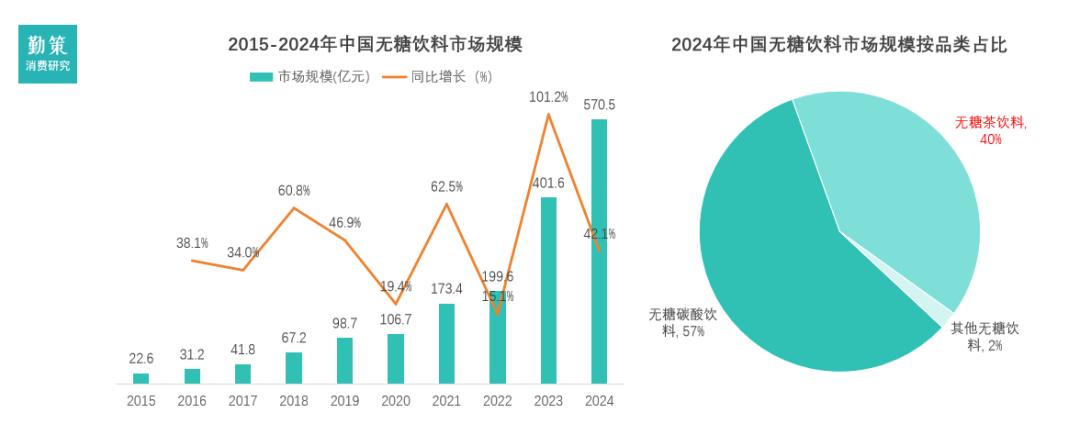
Group 1 - The Chinese sugar-free tea market is experiencing significant growth, with the market size projected to increase from 2.26 billion yuan in 2015 to 57.05 billion yuan by 2024, reflecting a compound annual growth rate (CAGR) of 43.2% [1][3] - Sugar-free tea accounted for 40% of the sugar-free beverage market in 2024, driven by consumer recognition of the natural and healthy attributes of tea beverages and continuous product innovation by tea companies [1][3] - The sales of sugar-free tea are expected to face a decline in 2025, marking the first negative growth after a period of explosive growth from 2023 to early 2024, due to market saturation in first- and second-tier cities and increased competition from alternative beverage categories [3][6] Group 2 - The sales channels for sugar-free tea are predominantly offline, accounting for approximately 81.5% of total sales, with convenience stores contributing 23.5% and supermarkets 20.9% [6] - Online sales, while only 18.5% of the total, have seen rapid growth, with a tenfold increase from 2018 to 2022, driven by digital marketing and the preferences of younger consumers [6][8] - Young consumers aged 30 and below represent 70.8% of the sugar-free tea market, highlighting their dominance in consumption patterns [8][10] Group 3 - The tea beverage market in China is steadily growing, with the market size projected to rise from 114.4 billion yuan in 2018 to 154.5 billion yuan by 2024, reflecting a CAGR of 5.2% [12][15] - The proportion of sugar-free ready-to-drink tea in the overall tea beverage market has been increasing, from 16% in early 2022 to 32% by the end of 2023, although growth is expected to slow down in 2025 [15][17] Group 4 - The competitive landscape of the sugar-free tea market is characterized by a concentration of leading brands, with the top five brands capturing 79.6% of the market share in the first half of 2025 [17][19] - Nongfu Spring's "Oriental Leaf" brand leads the market with a 75% share, while Suntory's Oolong tea holds 10%, indicating a strong competitive position for Nongfu Spring [19][24] - The brand "Guozi Shule" has rapidly increased its market share from 0.32% to 3.03% between 2023 and 2024, showcasing significant growth through differentiated flavors and targeted marketing strategies [25][28]

中国品牌,迈出高质量发展新步伐
Ren Min Ri Bao· 2025-10-29 08:12
Core Insights - The emphasis on developing new productive forces and creating world-class enterprises is highlighted by General Secretary Xi Jinping, indicating a focus on innovation and brand strength in Chinese companies [1] - The 2025 China Top 500 Enterprises list shows a continuous increase in the entry threshold, with the number of billion-dollar companies rising from 222 in 2020 to 267 in 2024, and 15 companies reporting revenues exceeding 100 billion yuan [1] Innovation-Driven Brand Strength - Innovation is recognized as the primary driving force for many Chinese companies, leading to the establishment of brand benchmarks [2] - Significant advancements in technology and independent research capabilities are being made, as seen in projects like the "Energy Storage No. 1" and the achievements of Great Wall Motors in safety testing [3][4] Major Equipment Collaboration - The nuclear technology innovations by China National Nuclear Corporation demonstrate the country's strength in exporting nuclear power equipment to multiple countries [5] - Various high-profile projects, such as the C919 aircraft and the "Dream" deep-sea drilling ship, showcase China's growing capabilities in diverse fields [5] Enhancing Brand Value - Companies like Yili and Master Kong are focusing on product quality and innovation, with Yili leading in global dairy brand value and Master Kong leveraging patents for healthier product lines [8] - The emphasis on local resources and high-quality development is evident in companies like Guyu Biotechnology and Yangtze River Pharmaceutical Group, which are enhancing their brand reputation through innovation [9] Global Expansion of Brand Influence - Chinese brands are increasingly making their mark internationally, with companies like Xifeng Liquor and Haier expanding their reach and enhancing brand recognition through innovative marketing strategies [10] - State-owned enterprises like State Power Investment Corporation are actively participating in international energy cooperation, further solidifying their global presence [10] Social Responsibility and Brand Development - Companies are increasingly integrating social responsibility into their brand missions, with initiatives aimed at improving community welfare and environmental sustainability [11][16] - Financial institutions are developing tailored products to support rural economies and enhance financial accessibility, demonstrating a commitment to social impact [15] Conclusion - The ongoing transformation from "Made in China" to "Created in China" reflects a broader shift towards quality and brand strength, positioning Chinese brands for continued success in the global market [17]
关注有毒“营养土”产业链中的监管责任缺失
Nan Fang Du Shi Bao· 2025-10-29 06:38
Core Viewpoint - The article highlights the alarming issue of unregulated "nutrient soil" being sold online, made from untreated waste materials such as sludge from sewage treatment plants and industrial waste, posing potential health risks to consumers [1][2][3] Group 1: Industry Practices - Numerous well-known companies, including Nanjing Kangshifu and Weigang Dairy, are implicated in supplying sludge for the production of "nutrient soil," which may contain hazardous substances like heavy metals and pesticide residues [1][2] - The production of "nutrient soil" involves the use of industrial sludge, which is classified as "hazardous waste" and must be treated according to strict regulations, yet some manufacturers openly admit their inability to remove heavy metal residues [1][2] Group 2: Regulatory Oversight - In September 2022, the National Development and Reform Commission, Ministry of Housing and Urban-Rural Development, and Ministry of Ecology and Environment issued a plan for the harmless treatment and resource utilization of sludge, mandating full-process information management and traceability of sludge [2] - The article reveals a troubling lack of regulatory enforcement, with local market supervision departments potentially neglecting their responsibilities, leading to compromised consumer rights and safety [3] Group 3: Corruption and Influence - The industry is characterized by a complex supply chain and potential corruption, with some companies suggesting that relationships with local authorities are necessary for business operations [2][3] - The involvement of local power dynamics in the "nutrient soil" industry raises concerns about competition manipulation and the potential for power rent-seeking behaviors [3]

康师傅在上海时装周完成碳中和时装秀
Ren Min Wang· 2025-10-29 01:36
Core Viewpoint - The event marks the first carbon-neutral fashion show at Shanghai Fashion Week, showcasing the integration of sustainability and fashion through the use of food packaging materials to create trendy garments [2][4][7] Group 1: Event Overview - The fashion show titled "Food·Fashion - Plastic Rebirth" is a collaboration between Master Kong and the Donghua University design team, focusing on four key products: Braised Beef Noodles, Fresh Q Noodles, Ice Black Tea, and Jasmine Tea [2][4] - All garments presented were made from recycled packaging materials, demonstrating the concept of "turning waste into fashion" [3][5] Group 2: Design and Themes - The show featured nearly 60 outfits across four series: "Soul of Quality," "Deconstruction Thought," "Energy Supply Station," and "Fresh Breathing," each reflecting Master Kong's brand essence and circular economy principles [4][5] - The designs incorporated innovative techniques such as 3D printing and high-performance recycled fabrics, emphasizing both aesthetics and sustainability [4][5] Group 3: Sustainability Practices - The event achieved carbon neutrality with the support of Carbon Measurement Technology and third-party certification, making it a pioneering example of cross-industry collaboration for sustainability [4][6] - Master Kong's commitment to sustainable development includes initiatives like lightweight packaging, recycling, and the establishment of a circular economy ecosystem [5][6] Group 4: Broader Impact and Future Initiatives - The fashion show serves as a tangible example of how environmental concepts can be transformed into fashionable products, promoting a low-carbon lifestyle among consumers [5][6] - Master Kong's ongoing projects include collaborations aimed at reducing plastic pollution and promoting green agriculture, further enhancing its sustainable living ecosystem [6][7]

中国必选消费品10月成本报告:包材价格上行,啤酒现货成本指数同比上涨
Haitong Securities International· 2025-10-28 15:13
Investment Rating - The report provides various investment ratings for companies in the consumer staples sector, with "Outperform" ratings for companies like China Feihe, Haidilao, and China Resources Beer, while Budweiser APAC is rated as "Neutral" [1]. Core Insights - The report highlights a rise in packaging material prices and an increase in the beer spot cost index by 2.96% year-on-year, indicating upward pressure on costs in the consumer staples sector [1][35]. - The cost indices for six categories of consumer goods monitored by HTI mostly increased, with notable changes in spot and futures indices across beer, frozen food, soft drinks, instant noodles, dairy products, and condiments [35]. Summary by Category Beer - The beer spot cost index is at 116.32, down 0.06% from last week, while the futures index is at 115.68, up 1.2% [13]. - Year-to-date, the spot index has decreased by 0.86%, and the futures index has decreased by 7.13% [14]. Condiments - The condiments spot cost index is at 100.51, down 0.1%, and the futures index is at 101.3, up 1.55% [17]. - Year-to-date, the spot index has decreased by 2.66%, and the futures index has decreased by 7.47% [17]. Dairy Products - The dairy products spot cost index is at 101.25, down 0.13%, and the futures index is at 91.04, up 0.69% [20]. - Year-to-date, the spot index has decreased by 2.89%, and the futures index has decreased by 3.28% [20]. Instant Noodles - The instant noodles spot cost index is at 103.62, down 0.23%, and the futures index is at 102.53, up 0.88% [23]. - Year-to-date, the spot index has decreased by 2.29%, and the futures index has decreased by 5.47% [24]. Frozen Food - The frozen food spot cost index is at 120.39, up 1.02%, and the futures index is at 119.44, up 1.72% [28]. - Year-to-date, the spot index has decreased by 0.17%, and the futures index has decreased by 1.35% [28]. Soft Drinks - The soft drinks spot cost index is at 109.39, up 0.22%, and the futures index is at 109.26, up 0.72% [31]. - Year-to-date, the spot index has decreased by 3.04%, and the futures index has decreased by 9.54% [31].


有毒工业污泥变身“营养土”,业者是不是真的“上面有人”?
Nan Fang Du Shi Bao· 2025-10-28 14:54
Core Viewpoint - The "nutrient soil" industry is facing serious issues as major brands are found to be selling products made from untreated waste materials, posing potential health risks to consumers [1][2][4] Group 1: Industry Practices - Major brands like "Huaxiangni" and "Xiaotianyuan" have been exposed for collaborating with waste disposal factories to produce "nutrient soil" from garbage, industrial sludge, and paper mill waste [1][2] - The raw materials used in the production of these "nutrient soils" include hazardous waste, which should not be utilized without proper treatment [2][3] - The industry is characterized by a lack of compliance with regulations, as some manufacturers openly admit their inability to remove heavy metal residues from their products [2][3] Group 2: Regulatory Oversight - The Chinese government has issued guidelines for the harmless treatment and resource utilization of sludge, emphasizing the need for full-process information management [2] - There are significant gaps in regulatory enforcement, with local market supervision departments potentially failing to act against non-compliant practices [3][4] - The involvement of local authorities in the industry raises concerns about power rent-seeking and the integrity of market competition [3][4] Group 3: Consumer Impact - Consumers who purchase "nutrient soil" for gardening may unknowingly expose themselves to harmful substances, as the products are derived from industrial waste [1][2] - The lack of transparency and accountability in the industry compromises consumer rights and safety [3][4] - The situation highlights the need for a thorough investigation into the industry's practices and regulatory failures to protect public health [4]
中国品牌,迈出高质量发展新步伐(中国品牌 中国故事)
Ren Min Ri Bao· 2025-10-27 22:37
Core Insights - The emphasis on developing new productive forces and creating world-class enterprises is highlighted by General Secretary Xi Jinping, indicating a strong push for innovation and brand recognition in Chinese companies [1] Innovation-Driven Brand Strength - Innovation is identified as the primary driving force for many Chinese companies, focusing on technological advancements and establishing brand benchmarks [2] Research and Development - The "Energy Storage No. 1" project has achieved global records in power capacity, storage scale, and conversion efficiency, showcasing China's capability in key technology breakthroughs [3] - Great Wall Motors has developed an independent testing laboratory that combines active and passive safety testing, breaking international monopolies in key equipment [3] Collaborative Efforts in Major Equipment - China National Nuclear Corporation has exported nuclear power units to eight countries, demonstrating its strength in nuclear technology innovation [4] - Various significant projects, including the C919 aircraft and the "Dream" deep-sea drilling vessel, highlight China's growing capabilities in diverse fields [4] Digital Transformation and Intelligent Upgrades - JD Industrial has addressed long-standing issues in the automotive sector by implementing a digital supply chain solution, achieving domestic substitution within 30 days [5] - Companies like Baidu and China Mobile are integrating AI with traditional industries, enhancing productivity across various sectors [5] Brand Value Enhancement - Chinese companies are increasingly focusing on product quality and brand value, with notable examples including Yili and Kangshifu, which have achieved significant technological advancements [6][7] - The rise of domestic brands is evident as companies like Gu Yu Biotechnology and Yangtze River Pharmaceutical Group expand their product offerings and market presence [7] Global Market Expansion - Haier Group has been recognized in the World Brand Lab's top 500 brands for 21 consecutive years, with a 13% increase in global profit [8] - Companies like State Power Investment Corporation and Hisense are actively participating in international markets, enhancing their global brand influence [8] Social Responsibility and Brand Development - Companies are increasingly integrating social responsibility into their brand missions, with initiatives aimed at improving community welfare and sustainable development [9][12] - The construction sector is focusing on quality and traceability in housing projects, ensuring high standards in delivery and service [13]
东兴证券晨报-20251027
Dongxing Securities· 2025-10-27 12:11
Economic News - The 28th ASEAN Plus China, Japan, and South Korea Leaders' Meeting emphasized the importance of open cooperation and strategic alignment to enhance economic potential through environmental improvement, deepening industrial chain collaboration, and fostering new growth drivers [1] - Canadian Prime Minister Carney announced plans for significant domestic investment and trade diversification, aiming to double exports to non-U.S. markets over the next decade, exceeding CAD 300 billion [1] - From January to September, profits of large-scale industrial enterprises in China increased by 3.2% year-on-year, marking the highest growth rate since August of the previous year [1] - The China Logistics and Purchasing Federation reported that the total demand for food cold chain logistics in the third quarter reached 117 million tons, a year-on-year increase of 4.72% [1] - The International Monetary Fund (IMF) predicts that the U.S. government's debt burden may exceed that of Italy and Greece for the first time this century, with total debt projected to rise over 20% to 143.4% of GDP by the end of the decade [1] Company Insights - Rio Tinto Group and State Power Investment Corporation launched a pilot project for pure electric battery swap mining trucks at the Oyu Tolgoi copper mine in Mongolia, marking the first use of this technology in an open-pit mine [4] - Yongmaotai reported third-quarter revenue of CNY 1.655 billion, a year-on-year increase of 59.65%, with net profit soaring by 6319.92% to CNY 30.41 million [4] - Delin Hai's third-quarter revenue reached CNY 185 million, up 94.96% year-on-year, while net profit surged by 1322.74% to CNY 48.73 million [4] - Knight Dairy's third-quarter revenue was CNY 246 million, down 6.78%, but net profit increased by 189.26% to CNY 22.73 million [4] - Porsche, a subsidiary of Volkswagen Group, reported a third-quarter loss of EUR 966 million (approximately CNY 8 billion), leading to a 99% year-on-year decline in sales profit for the first three quarters [4] Industry Analysis - The 20th Central Committee of the Communist Party of China emphasized the importance of high-quality development and technological self-reliance as core foundations for future growth, aiming to transition from a follower to a leader in the global industrial chain [6][7] - The meeting highlighted the need to build a modern industrial system and strengthen the real economy, with a focus on becoming a manufacturing, quality, aerospace, transportation, and internet power [6] - The report suggests that the technology sector, particularly those related to self-reliance, will be a key area for investment, with a positive outlook for companies in this space [7] - The food and beverage sector is experiencing a shift towards lower-alcohol products to attract younger consumers, as evidenced by the introduction of new low-alcohol products at recent trade fairs [10][11] - The logistics industry is seeing a recovery in single-ticket revenue, with major players like Shentong and Yunda reporting significant increases in revenue per ticket [22][23] Investment Recommendations - The report recommends focusing on technology sectors, particularly those with strong performance indicators, as the market shifts back to fundamentals with the release of quarterly reports [7] - In the food and beverage sector, attention is drawn to leading companies like Guizhou Moutai, which are showing signs of recovery despite short-term price fluctuations [11] - For the chemical industry, investment opportunities are identified in sectors benefiting from improved supply-demand dynamics and those driven by capital expenditure and R&D [27]



数读「无糖茶」:潮涌之后,谁留下?谁离开?
3 6 Ke· 2025-10-27 10:27
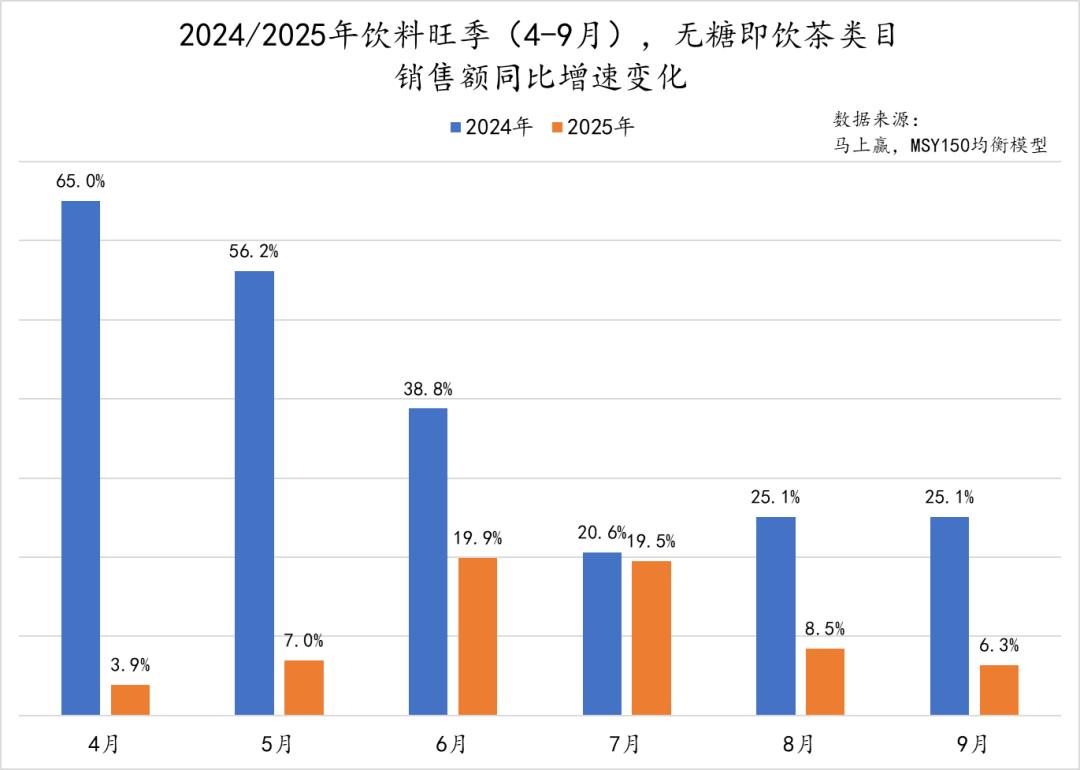
Core Insights - The performance of sugar-free tea in 2025 is not as robust as initially anticipated, with market competition returning to a more rational state [1][4] - Established brands like Nongfu Spring and Suntory are maintaining a steady approach, while emerging brands are showing signs of fatigue amid slowing category growth and price wars [1][4] Group 1: Market Performance - In the 2025 beverage peak season (April to September), the sales growth rate of sugar-free ready-to-drink tea has significantly slowed compared to 2024, with every month showing lower growth rates [4][6] - The average price per unit has increased from 5.1 yuan to 5.6 yuan, indicating that consumers are willing to spend more on larger sizes, reflecting a shift towards quality over price competition [6][10] - The average price per 100ml has shown a decreasing trend, but the decline has slowed down, suggesting a stabilization in pricing and a move away from aggressive price wars [6][10] Group 2: Market Structure - The overall slowdown in category growth is leading to a restructuring of market shares, with established sugar-free tea groups strengthening their market control [11][14] - In the 2025 peak season, established sugar-free tea groups maintained their dominant market position, while the market shares of comprehensive beverage groups and challengers decreased [14][18] - The combined market share of the top three roles exceeded 95%, indicating a high concentration in the category and limited space for new entrants [14][18] Group 3: Tea Type Analysis - Jasmine tea remains the most popular type, with stable market share, while Oolong tea saw fluctuations but rebounded in September [8][28] - The average price of Oolong tea has increased in the 2025 peak season compared to 2024, reflecting a positive trend in consumer acceptance of higher prices [10][28] - The market share of established brands in the Oolong tea segment exceeded 85%, with a notable decline in the market share of comprehensive beverage groups [28][35] Group 4: Consumer Trends - The trend of product diversification through tea blends is becoming increasingly important, with consumers showing interest in both single and blended Oolong teas [26][31] - The market for blended Oolong tea is growing, with challengers capturing a significant share, indicating a shift in consumer preferences towards more diverse flavor profiles [38][42] - Established brands are focusing on maintaining a loyal customer base while challengers aim to attract new consumers through innovative flavor combinations [38][42] Conclusion - The sugar-free tea market is transitioning from growth to maturity, with established brands solidifying their positions while challengers face increasing pressure [25][43] - The emphasis on product quality and brand loyalty is crucial for long-term success in a competitive landscape [43][44]