
华菱钢铁

Search documents
2026年钢铁行业投资策略:反内卷叠加西芒杜投产,产业链利润格局重塑
Shenwan Hongyuan Securities· 2025-11-18 12:27
Group 1 - The steel industry is expected to see improved profitability due to three main factors: declining raw material prices, supply-side adjustments, and resilient demand from manufacturing [3][5][9] - The West Simandou iron ore project is set to commence production in November 2025, significantly increasing iron ore supply and contributing to a downward trend in iron ore prices [3][71] - Government policies aimed at reducing overcapacity and promoting energy efficiency are expected to accelerate the exit of outdated production capacity, leading to a more optimized supply structure in the steel industry [3][16][10] Group 2 - Demand for steel is projected to stabilize in the construction sector, while manufacturing demand remains resilient, particularly for flat steel and special steel products [3][19][25] - The overall steel demand in China is forecasted to decline slightly, with total demand expected to be 9.05 billion tons in 2025, a decrease of 0.11% from 2024 [19][20] - The construction sector's share of steel demand is decreasing, while the manufacturing sector's share is increasing, indicating a shift in consumption patterns [3][19] Group 3 - The report highlights that the profitability of steel companies is recovering, with a stronger performance expected in flat steel compared to long steel products [3][85][82] - The average profit margin for steel companies is projected to improve as cost pressures ease, with a focus on companies with stable demand and low valuations [3][87][90] - Investment recommendations include focusing on companies like Baosteel, Nanjing Steel, and Hualing Steel, which are expected to benefit from the shift towards manufacturing [3][95][94]


国泰海通:维持钢铁供给端收缩预期 行业基本面有望逐步修复
智通财经网· 2025-11-18 05:57
Core Viewpoint - The steel industry is experiencing a decline in demand and inventory, with expectations of a gradual recovery in profitability as supply-side constraints persist [1][3]. Group 1: Demand and Supply Analysis - The apparent consumption of five major steel products was 8.606 million tons, a decrease of 63,300 tons week-on-week; construction materials consumption was 3.0335 million tons, down 40,200 tons; and sheet materials consumption was 5.5725 million tons, down 23,100 tons [1]. - The production of five major steel products was 8.3438 million tons, a decrease of 223,600 tons week-on-week, while total inventory stood at 14.7735 million tons, down 262,200 tons [1]. - The operating rate of blast furnaces at 247 steel mills was 82.81%, a decrease of 0.32 percentage points week-on-week, while electric furnace operating rate was 60.9%, an increase of 1.28 percentage points [1]. Group 2: Profitability Trends - The average gross profit per ton for rebar was 81.4 CNY, an increase of 4.3 CNY week-on-week, while hot-rolled coil showed a negative gross profit of -16.6 CNY, also up by 4.3 CNY [2]. - The profitability rate for 247 steel companies was 38.96%, a decrease of 0.87 percentage points week-on-week [2]. Group 3: Future Outlook - The real estate sector's ongoing decline is expected to reduce its negative impact on steel demand, while demand from infrastructure and manufacturing is anticipated to stabilize [3]. - The steel industry has been in a loss phase since Q3 2022, with nearly 60% of steel companies still reporting losses, indicating a market-driven supply clearance is beginning to occur [3]. - The recently released "Steel Industry Stabilization and Growth Work Plan (2025-2026)" emphasizes continued production reduction policies to promote dynamic supply-demand balance [3]. Group 4: Investment Recommendations - Long-term trends indicate that increased industry concentration and high-quality development will benefit steel companies with product structure and cost advantages [4]. - Key recommendations include Baosteel (600019.SH), Hualing Steel (000932.SZ), and Shougang (000959.SZ) for their leading technology and product structures, as well as CITIC Special Steel (000708.SZ) and Yongjin Co. (603995.SH) for their competitive advantages [4].

险资持续加仓红利资产!标普红利ETF(562060)连续吸金超1.2亿元
Xin Lang Ji Jin· 2025-11-18 03:31
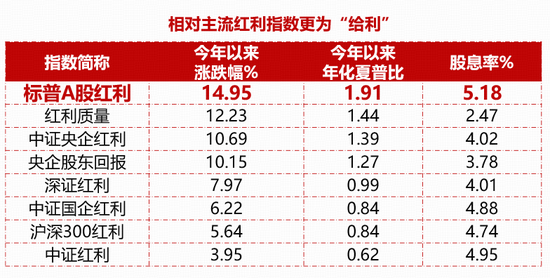
Group 1 - Insurance capital has significantly increased its holdings in the stock market, with a total of 732 listed companies held, amounting to approximately 1,011.3 million shares, an increase of 120.25 million shares from the previous quarter [1] - The preference for high dividend and low valuation stocks is particularly notable, with significant increases in holdings for companies like Agricultural Bank of China, Postal Savings Bank, Industrial and Commercial Bank of China, and Hualing Steel [1] - Insurance capital has expanded its investments in sectors such as banking, steel, real estate, media, and automotive, showing a sustained interest in dividend-paying assets [1] Group 2 - The "slow bull" market in A-shares is positively influencing the investment ecosystem of insurance capital, with a focus on high dividend assets reflecting a pursuit of stable returns and long-term investment value recognition [2] - The S&P China A-Share Dividend Opportunities Index, which tracks 100 high dividend companies, has a current dividend yield of 5.18%, with a yield spread of 3.37 percentage points over the latest 10-year government bond yield [2] - The S&P A-Share Dividend Index has outperformed similar dividend indices this year, with a return of nearly 15% and an annualized Sharpe ratio of 1.91, indicating significant advantages [2][3] Group 3 - The S&P Dividend ETF (562060) has been included as a financing and securities lending target, enhancing trading strategies and liquidity, with an average trading volume of 49.38 million yuan over the last three trading days [4] - Recent market volatility has led to increased capital inflow into the S&P Dividend ETF, with a net inflow of 7.565 million yuan over five days and a total of over 120 million yuan in the last ten days [4] Group 4 - In the context of increasing macroeconomic uncertainty and pressure on fixed-income asset yields, dividend assets are becoming a crucial "defensive shield" and a "ballast" for returns [5] - As the domestic economy transitions to a high-quality development phase, the market's pricing focus is shifting from growth expectations to dividend returns, aligning with trends in mature markets [5] - The long-term allocation of capital and policy support for dividends are establishing a solid foundation for the sustainability of dividend strategies [5] Group 5 - The S&P A-Share Dividend Total Return Index has achieved a cumulative return of 2,596.59% from 2005 to September 2025, with an annualized return of 17.64% [7] - The market may be entering a consolidation phase after the overheated trading in the computing power sector, making the S&P Dividend ETF a valuable asset for a balanced investment strategy [7]




华菱钢铁跌2.14%,成交额2.03亿元,主力资金净流出3198.89万元
Xin Lang Cai Jing· 2025-11-18 03:20
Core Viewpoint - Hualing Steel experienced a decline in stock price by 2.14% on November 18, with a current price of 5.95 CNY per share, despite a year-to-date increase of 45.80% [1] Group 1: Stock Performance - As of November 18, Hualing Steel's stock price is 5.95 CNY, with a market capitalization of 41.106 billion CNY [1] - The stock has seen a net outflow of 31.9889 million CNY in principal funds, with significant selling pressure [1] - Over the past five trading days, the stock has decreased by 1.82%, while it has increased by 8.58% over the past 60 days [1] Group 2: Financial Performance - For the period from January to September 2025, Hualing Steel reported operating revenue of 95.048 billion CNY, a year-on-year decrease of 14.88% [2] - The company achieved a net profit attributable to shareholders of 2.510 billion CNY, reflecting a year-on-year growth of 41.72% [2] Group 3: Shareholder Information - As of September 30, 2025, the number of shareholders for Hualing Steel is 84,200, a decrease of 6.78% from the previous period [2] - The average number of circulating shares per shareholder increased by 7.27% to 82,063 shares [2] - Cumulatively, Hualing Steel has distributed 10.436 billion CNY in dividends since its A-share listing, with 3.934 billion CNY distributed in the last three years [3]
光大证券晨会速递-20251118
EBSCN· 2025-11-18 01:48
Group 1: Macroeconomic Insights - In October, general public budget expenditure turned negative year-on-year, with spending related to "three guarantees" and infrastructure investment showing a decline compared to the previous month, necessitating attention to the effectiveness of incremental fiscal policies since September [2] - Government fund revenues and expenditures are both slowing down, with expectations for improvement once local government debt limits are set and utilized to supplement overall financial capacity [2] - The supply of government bonds for the year is nearing its end, while an increase in fiscal deposits year-on-year in October indicates that there is still room for fiscal funds to be released, which is favorable for future liquidity [2] Group 2: High-end Manufacturing Industry - The controlled nuclear fusion industry is projected to have long-term growth potential, with a recent procurement project exceeding 2 billion yuan, covering areas such as power systems, low-temperature systems, and shielding layers [3] - Key companies to watch in the vacuum chamber and internal components segment include: Hezhong Intelligent, Guoguang Electric, Antai Technology, Yingliu Co., Parker New Materials, and Tiangong International [3] - In the magnet system segment, notable companies include Lianchuang Optoelectronics and Yongding Co., while in the power system segment, focus on Sichuan Chuang Electronics, Wangzi New Materials, and Xuguang Electronics [3] Group 3: Non-ferrous Metals Industry - Supply growth for steel, copper, and aluminum remains constrained, with gold benefiting from the US interest rate cut cycle and central bank purchases [4] - Recommended stocks for steel include Baosteel Co. and Jiuli Special Materials, with attention to companies like Ordos, CITIC Special Steel, and Hualing Steel [4] - For copper, recommended stocks are Zijin Mining and Luoyang Molybdenum, with a focus on Tongling Nonferrous Metals and Western Mining [4] Group 4: Real Estate Market - As of November 16, 2025, new home transactions in 20 cities totaled 674,000 units, a decrease of 10.6% year-on-year, with significant declines in cities like Beijing (-16%) and Shenzhen (-25%) [5] - In the second-hand housing market, transactions in 10 cities reached 667,000 units, an increase of 4.5% year-on-year, with notable growth in Shenzhen (+15%) and Shanghai (+11%) [5] Group 5: Company Research - Electronics - The company is expected to see performance improvement driven by its cellular baseband business, with mobile SoC and ASIC products supporting future growth [6] - Profitability recovery in the IoT business is slower than expected, leading to a downward revision of net profit forecasts for 2025 and 2026 [6] - The company maintains a "buy" rating due to the potential for growth in its mobile SoC product matrix and the high growth of its ASIC business benefiting from the trend of AI localization [6]
一线调研 “现代化产业体系”怎么建
Zhong Guo Qing Nian Bao· 2025-11-17 23:04
Group 1 - The core focus of the article is on the development of a modern industrial system in China during the "14th Five-Year Plan" period, emphasizing the integration of technological and industrial innovation to strengthen the real economy [9][10][12] - The article highlights the importance of traditional industries, such as steel and pharmaceuticals, in driving economic growth and their ongoing transformation through digitalization and automation [12][13][14] - The article mentions that since 2016, companies like Hunan Huazhong Steel have been implementing smart manufacturing solutions, resulting in significant efficiency improvements, such as reducing the steel slab rotation time from 6.7 seconds to 3.93 seconds [12][13] Group 2 - The article discusses the emergence of new and future industries, particularly in sectors like renewable energy, aerospace, and low-altitude economy, as part of the strategic focus for the "14th Five-Year Plan" [15][16] - Companies like Hidi Intelligent Driving Technology are capitalizing on market demands for automation in hazardous environments, such as mining, with significant policy support driving growth in this sector [16][18] - The article notes that the humanoid robot market in China is expected to reach approximately 870 billion yuan by 2030, indicating rapid growth in the robotics sector [17] Group 3 - The article emphasizes the need for collaborative innovation among government, enterprises, and research institutions to create a conducive environment for the development of a modern industrial system [19][20] - It highlights the establishment of over 230 excellent smart factories and 1,260 5G factories in China since the beginning of the "14th Five-Year Plan," showcasing the country's commitment to advancing its manufacturing capabilities [13][19] - The article points out that the value added by the "new economy" is projected to exceed 18% of GDP by 2024, indicating a significant shift towards new industries and business models [18][22]



西芒杜顺利投产,铁矿宽松趋势逐步明朗
Changjiang Securities· 2025-11-17 13:46
Investment Rating - The industry investment rating is Neutral, maintained [10] Core Views - The successful commissioning of the Simandou project and the gradual emergence of a relaxed iron ore trend are significant developments. Despite limited actual supply-demand impact on iron ore by 2025, the project's capacity of 120 million tons and the push for "anti-involution" suggest that global iron ore demand may not see significant growth. The trend towards relaxation in iron ore supply is becoming clearer [2][6] - Current global iron ore cash costs are around $90 per ton, and as the surplus increases, iron ore prices may gradually return to cost support levels. In the short term, high iron output and strong macroeconomic growth expectations at year-end support iron ore prices. However, as Simandou's capacity ramps up next year, prices may begin a smoother downward trend after the seasonal peak in April [2][6] Summary by Sections Section 1: Market Performance - The seasonal effect has deepened, with apparent steel demand continuing to weaken. The apparent consumption of the five major steel products decreased by 3.13% year-on-year and 0.82% month-on-month. The average daily pig iron output increased to 2.3688 million tons, up by 2.66 thousand tons per day [4] - Steel inventory continues to decrease, maintaining a median level. Total steel inventory decreased by 1.88% week-on-week and increased by 20.48% year-on-year. Prices for rebar and hot-rolled steel have also seen slight declines [4] Section 2: Simandou Project - The Simandou iron ore project in Guinea officially commenced operations on November 11, with a total investment exceeding $20 billion. The project includes over 600 kilometers of newly built multi-purpose railway and supporting port facilities, with an annual export capacity of up to 120 million tons [5][6] Section 3: Future Outlook - Looking ahead to 2026, the main trading theme in the steel sector may be "iron ore concessions + the realization of steel production cuts under anti-involution." The profit distribution in the black industry chain shows that iron ore occupies a significant share, indicating ample room for concessions. Major steel companies like Nanjing Steel, Hualing Steel, and Baosteel may see further performance elasticity due to cost relaxation and resilient steel sales prices [7][27]

普钢板块11月17日涨0.01%,杭钢股份领涨,主力资金净流出4486.04万元
Zheng Xing Xing Ye Ri Bao· 2025-11-17 08:41
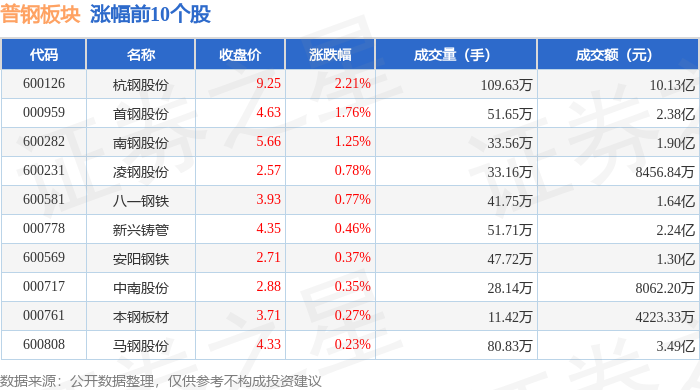
Market Overview - On November 17, the general steel sector rose by 0.01% compared to the previous trading day, with Hangzhou Iron & Steel leading the gains [1] - The Shanghai Composite Index closed at 3972.03, down 0.46%, while the Shenzhen Component Index closed at 13202.0, down 0.11% [1] Individual Stock Performance - Hangzhou Iron & Steel (600126) closed at 9.25, up 2.21% with a trading volume of 1,096,300 shares and a transaction value of 1.013 billion [1] - Shougang Group (000959) closed at 4.63, up 1.76% with a trading volume of 516,500 shares [1] - Other notable performers include Nanjing Steel (600282) up 1.25%, Linggang Steel (600231) up 0.78%, and Baosteel (600581) up 0.77% [1] Fund Flow Analysis - The general steel sector experienced a net outflow of 44.86 million from institutional funds and 90.84 million from speculative funds, while retail investors saw a net inflow of 136 million [2] - Hangzhou Iron & Steel had a net inflow of 15 million from institutional funds, but a net outflow of 69.36 million from speculative funds [3] - Other companies like Hualing Steel (000932) and Shandong Steel (600022) also showed mixed fund flows, with Hualing Steel experiencing a net inflow of 30.44 million from institutional funds [3]


钢铁行业25Q3业绩综述:盈利修复,关注供给侧变革
Yin He Zheng Quan· 2025-11-17 06:07
Investment Rating - The report suggests a positive outlook for the steel industry, indicating a recovery in profitability and a focus on supply-side reforms [4][29]. Core Insights - The steel industry has shown significant improvement in profitability during the first three quarters of 2025, with total profits reaching 96 billion yuan, a year-on-year increase of 190% [4][6]. - The report highlights the implementation of supply-side reforms aimed at optimizing the structure of steel products and controlling production capacity [4][13]. - The demand for steel is expected to benefit from manufacturing upgrades and AI transformation, with a focus on high-end product development [4][29]. Summary by Sections 1. Industry Profit Recovery and Supply-Side Policies - In the first three quarters of 2025, the cumulative operating revenue of key steel enterprises was 4.56 trillion yuan, a year-on-year decrease of 2.36%, while total profits reached 96 billion yuan, marking a significant recovery [4][6]. - The production of crude steel was 746 million tons, down 2.9% year-on-year, while steel consumption fell by 5.7% [4][6]. - The report notes that the sales profit margin increased to 2.1%, up 1.39 percentage points year-on-year [4][6]. 2. Fund Holdings in the Steel Sector - As of September 30, 2025, the number of fund holdings in the steel sector increased to 41, with a total holding value of 21.99 billion yuan, up 22.44% year-on-year [4][17]. - The report indicates that the steel sector's holdings accounted for 0.50% of total fund holdings, with a notable increase in the number of holdings during the first and third quarters [4][17]. 3. Investment Recommendations - The report recommends focusing on leading companies in the ordinary steel sector that are expected to benefit from improved supply-demand dynamics, as well as companies in the special steel sector with strong fundamentals [4][29].



光大证券:供给增长依然受限 看好铜铝钢投资机会
智通财经网· 2025-11-17 05:57
Core Viewpoint - Everbright Securities maintains an "overweight" rating for the steel and non-ferrous metals industries, with a ranking of industry prosperity as follows: copper and aluminum > gold > steel [1][2]. Supply - Supply growth for steel, copper, and aluminum remains constrained. For steel, energy consumption and carbon emissions will continue to restrict supply, with crude steel output facing pressure. Future policies similar to the 2017 supply-side reform need to be monitored [3]. - For copper, Freeport and Teck Resources have lowered their 2026 production guidance, leading to increased disruptions at the mining level, with a projected 0.1% year-on-year decline in global refined copper output for 2026 [3]. - Aluminum production in China is expected to grow by 1.6% in 2026 due to capacity constraints [3]. Demand - Demand recovery will contribute to price elasticity for steel, copper, and aluminum. The real estate market is still expected to stabilize, but the World Steel Association forecasts a 1% year-on-year decline in steel demand in China for 2026 [4]. - For copper, the demand from the new energy sector is anticipated to be the main growth driver, with a projected 1.5% increase in global copper demand for 2026 [4]. - Aluminum demand in China is expected to grow by 1.8% in 2026, driven by manufacturing sectors such as new energy vehicles and electricity, which offset declines in real estate [4]. Gold - The demand for gold is expected to rise due to ETF investments and central bank purchases. The U.S. entering a rate-cutting cycle, combined with increased global uncertainty, is likely to boost gold ETF investment demand [5]. Recommended Stocks - For steel, companies such as Baosteel and Jiuli Special Materials are recommended, with a focus on Erdos, CITIC Special Steel, and Hualing Steel [6]. - In the copper sector, Zijin Mining and Luoyang Molybdenum are recommended, with attention to Tongling Nonferrous Metals, Western Mining, and Jincheng Mining [6]. - For aluminum, China Hongqiao is recommended, with a focus on Yun Aluminum, Shenhuo, and Zhongfu Industrial [6]. - In the gold sector, Zijin Mining is recommended, with attention to Chifeng Jilong Gold Mining and Zijin Gold International [6].
