
科顺股份

Search documents
周期论剑: 中报预判及大宗品下半年的推荐
2025-07-07 00:51
Summary of Conference Call Records Industry or Company Involved - The records primarily discuss the overall market outlook, particularly focusing on the stock market, energy sector, and various industries including steel, chemicals, and real estate. Core Points and Arguments 1. **Market Outlook**: The market is expected to reach 3,700 points in September and October, with July and August being the last opportunity for fund managers to increase their positions this year [1][2] 2. **Geopolitical and Economic Policy Impact**: Recent geopolitical tensions have eased, and the necessity for large-scale economic measures has decreased, impacting market expectations [3] 3. **Mid-Year Reporting Season**: The mid-year reporting season will significantly influence the market, especially with a high number of IPOs and increased selling pressure [5] 4. **Economic Policy Shift**: The Central Financial Committee's focus on reducing "involution" indicates a shift in economic policy towards improving living standards and addressing the issue of revenue without profit [6][7] 5. **Investment Strategy**: Investors are advised to switch between high and low sectors, focusing on electronics, non-ferrous metals, agriculture, and technology growth sectors [9] 6. **Non-Ferrous Metals Sector**: The non-ferrous metals sector is expected to benefit from policies aimed at reducing excessive capacity, particularly in copper and aluminum [10] 7. **OPEC+ Production Increase**: OPEC+ has decided to increase production by 550,000 barrels per day, which aligns with expectations but exceeds market predictions [12] 8. **Impact of the U.S. DAHLMA Act**: The DAHLMA Act is expected to lower costs for oil and gas companies, potentially leading to a short-term rebound in oil prices [13][14] 9. **Chemical Industry Outlook**: The basic chemical industry is anticipated to gradually recover by 2025, with recommendations for specific sectors such as explosives and price-increasing products [15] 10. **Steel Industry Recovery**: The steel sector is projected to enter a bottoming-up cycle over the next two to three years, driven by profit recovery and stable demand [20][22] 11. **Real Estate Market Dynamics**: The real estate sector is experiencing a reduction in land purchases, with major cities seeing significant increases in land sale revenues [25] 12. **Building Materials Sector Changes**: The building materials sector is undergoing significant changes, with expectations of improved profitability in cement and glass industries [27][29] Other Important but Possibly Overlooked Content 1. **Investment Recommendations**: Specific companies in various sectors are highlighted for their strong performance and potential, including Baosteel, China Northern Rare Earth Group, and others in the steel and non-ferrous metals sectors [24][10] 2. **Energy Sector Trends**: The energy sector is expected to see a shift in dynamics due to geopolitical factors and seasonal demand fluctuations, impacting pricing strategies [30][35] 3. **Market Sentiment**: The overall sentiment in the market is cautiously optimistic, with expectations of a balanced approach to investment amid fluctuating economic indicators [9][38] 4. **Long-term Projections**: The long-term outlook for various sectors, including energy and chemicals, suggests a gradual recovery and potential for growth, despite short-term volatility [16][38]
新材料与投资品产业链点评:“反内卷”政策下,能源及材料投资机会梳理-20250706
Shenwan Hongyuan Securities· 2025-07-06 13:50
2025 年 07 月 06 日 "反内卷"政策下,能源及材料投 资机会梳理 看好 ——新材料与投资品产业链点评 本期投资提示: 行 业 研 究 / 行 业 点 评 证券分析师 宋涛 A0230516070001 songtao@swsresearch.com 陆灏川 A0230520080001 luhc@swsresearch.com 马天一 A0230525040004 maty@swsresearch.com 任杰 A0230522070003 renjie@swsresearch.com 郭中伟 A0230524120004 guozw@swsresearch.com 陈松涛 A0230523090002 chenst@swsresearch.com 刘子栋 A0230523110002 liuzd@swsresearch.com 严天鹏 A0230524090004 yantp@swsresearch.com 联系人 赵文琪 (8621)23297818× zhaowq@swsresearch.com 本研究报告仅通过邮件提供给 中庚基金 使用。1 券 研 究 报 告 请务必仔细阅读正文之后的各项 ...
国泰海通建材鲍雁辛-周观点:供给端重现预期 需求端关注升级
Xin Lang Cai Jing· 2025-07-06 10:33
Group 1: Industry Overview - The construction materials industry has seen a significant increase in attention since July 1, driven by unexpected changes on the supply side and a focus on demand upgrades for the end of 2024 [1][2] - The cement industry is experiencing a "de-involution" policy expectation, with a focus on limiting overproduction and improving regulatory oversight [2][10] - The demand side is shifting, with AI-related demand expected to accelerate, positively impacting various segments of the industry [3][27] Group 2: Consumer Building Materials - The consumer building materials sector is witnessing a rare price increase in the waterproofing industry, indicating a potential recovery in profitability [4][5] - Companies like Sanke Tree and Dongfang Yuhong are showing improved profitability through cost reduction and price increases, validating earlier industry reports [4][5] - The outlook for 2025 suggests that profitability recovery will outpace revenue growth, with expectations of reduced price competition and improved cost management [4][5] Group 3: Cement Industry - The cement industry is expected to see a recovery in profitability as supply-side adjustments take effect, with a focus on limiting production and improving cash flow [10][12] - Major companies like Conch Cement and Huaxin Cement are expected to maintain strong cash flow and dividend policies, indicating long-term investment value [11][16][17] - The industry's overall profitability is anticipated to improve as demand stabilizes and production constraints are implemented [12][15] Group 4: Glass Industry - The float glass market is experiencing price fluctuations due to supply-demand imbalances, with expectations of cash losses for many companies [19][20] - Companies like Xinyi Glass and Qibin Group are facing challenges but are expected to maintain stable profitability in their automotive glass segments [21][22] - The photovoltaic glass sector is entering a cash loss phase, prompting accelerated cold repairs and production adjustments [25][26] Group 5: Fiber Industry - The fiberglass sector is seeing stable demand for mainstream electronic yarns, with a focus on high-end products like low-dielectric cloth [27][28] - Companies like China Jushi are expanding production capacity overseas to mitigate trade risks and maintain growth [29][30] - The carbon fiber market is showing signs of recovery in wind power demand, with expectations of improved profitability in Q2 [32]




非金属建材行业周报:挖潜PCB上游新材料,看好AI铜箔+ AI电子布-20250706
SINOLINK SECURITIES· 2025-07-06 08:34
Investment Rating - The report maintains a positive outlook on the PCB upstream new materials, particularly in the fields of electronic cloth and copper foil [2][14]. Core Insights - The report highlights the shift in Nvidia's GB200NVLink design to high-layer, high-frequency low-dielectric PCBs, which is expected to catalyze demand for upstream new materials in AI applications [2][14]. - The report emphasizes the ongoing price increases in the waterproof industry, with major companies like Keshun and Dongfang Yuhong announcing price hikes, reflecting a consensus among industry leaders to combat excessive competition [3][15]. - The report notes the potential for local manufacturing growth in Africa, particularly through companies like Keda Manufacturing, which is integrating into local economies by producing tiles and sanitary ware [4][16]. Summary by Sections 1. Weekly Discussion - The report continues to explore the potential of PCB upstream new materials, focusing on electronic cloth and copper foil, with a significant gap in expectations for high-end copper foil materials [2][14]. 2. Industry Price Changes - The report details the recent price adjustments in the waterproof sector, with companies implementing price increases ranging from 2% to 13% across various product categories [3][15]. - It also provides insights into the cement sector, noting a national average price of 349 RMB/t, a year-on-year decrease of 41 RMB, and an average shipment rate of 43.2% [5][17]. 3. Market Performance - The report indicates that the construction materials index increased by 3.91% this week, with notable performances in glass manufacturing and fiberglass sectors [23][27]. - It highlights the average price of float glass at 1201.02 RMB/ton, with a slight increase of 0.13% compared to the previous week [5][17]. 4. National Subsidy Tracking - The report discusses the government's initiatives to boost consumption, including the organization of new energy vehicle promotions and the issuance of funds for trade-in programs [6][18]. 5. Important Changes - The report notes significant developments, including the central government's emphasis on regulating low-price competition and the announcement of price adjustments by leading waterproof companies [7][22].


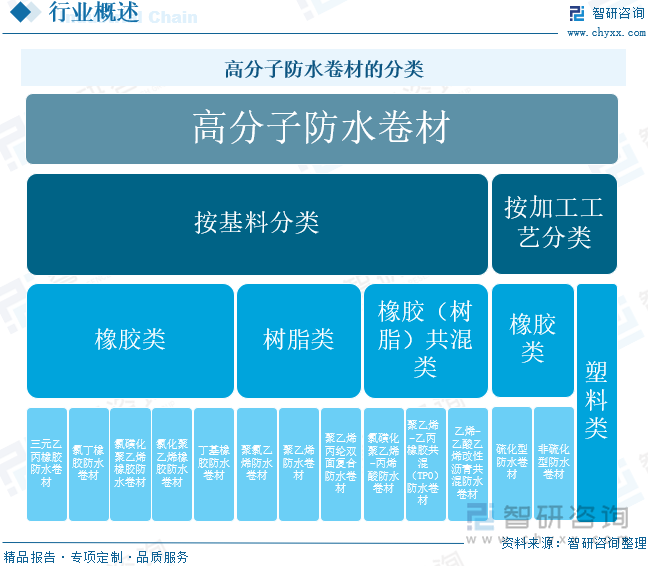
2025年中国高分子防水卷材行业发展历程、产量、市场规模、重点企业及发展趋势研判:高分子防水卷材规模超200亿元,需求推动下市场前景可观[图]
Chan Ye Xin Xi Wang· 2025-07-05 23:44
Industry Overview - Waterproof membranes are essential functional materials in the construction industry, comprising a significant part of the building materials industry. They mainly include SBS/APP modified bitumen waterproof membranes, self-adhesive membranes, and polymer waterproof membranes. Among these, polymer waterproof membranes are rapidly increasing their market share due to their durability, corrosion resistance, environmental friendliness, and ease of construction [1][18] - The market demand for polymer waterproof membranes has seen explosive growth due to accelerated urbanization and continuous investment in infrastructure. The market size for polymer waterproof membranes in China is projected to reach approximately 21.808 billion yuan in 2024 [1][18] Market Dynamics - The production of waterproof materials in China has maintained a steady growth rate of around 10% since 2015, with a significant increase in 2020 due to heightened demand. In 2023, the production of waterproof materials reached 5.81 billion square meters, a year-on-year increase of 19.16%. The production is expected to further increase to approximately 6.525 billion square meters in 2024 [14][15] - The polymer waterproof membrane market is expected to continue growing, supported by government policies favoring green building materials and increasing environmental regulations [1][18] Competitive Landscape - The market for polymer waterproof membranes in China is characterized by low concentration and a large number of companies. Major domestic players include Oriental Yuhong, Beixin Waterproof, and Kairun Building Materials, among others. There are also many small and medium-sized enterprises with varying product quality [21][22] - The competitive landscape is evolving, with larger companies expanding and smaller firms facing pressure, potentially leading to increased market concentration in the future [21] Industry Development Trends - The polymer waterproof membrane industry is expected to accelerate its focus on environmental sustainability, emphasizing the development and application of solvent-free and low-VOC materials. Traditional materials will gradually be replaced by recyclable high polymer materials [27] - Future advancements will focus on enhancing performance, including weather resistance, puncture resistance, and lifespan. Innovations such as self-healing materials and specialized membranes for unique applications will drive the industry towards high-end and professional development [28] - The integration of smart technologies in production and application processes is anticipated, with IoT and AI optimizing quality control and enabling real-time monitoring of material performance [29] - The industry will also prioritize ease of construction, developing products that reduce reliance on skilled labor and streamline installation processes [30]

新一轮“去产能”:成因、方案和给普通人的建议
吴晓波频道· 2025-07-04 17:22
Core Viewpoint - The emergence of "involution" competition in recent years is not merely due to the short-sightedness of companies and employees, but is deeply rooted in macroeconomic backgrounds influenced by economic cycles, institutional issues, and technological development patterns [1][27]. Group 1: Industry Responses to Involution - The automotive industry has been notably active, with a significant "60-day account period revolution" and calls from the National Federation of Industry and Commerce for manufacturers to shorten rebate periods and simplify policies [3][4]. - The pig farming sector is also responding, with major companies being urged to reduce production capacity and stabilize prices, controlling the weight of pigs for market [5]. - The photovoltaic industry is proactively reducing production, with leading glass manufacturers planning a collective 30% cut in output [6]. - The cement industry is undergoing self-examination, with the China Cement Association requiring members to align actual production with registered capacity [7]. Group 2: Historical Context of Capacity Reduction - Historical capacity reduction efforts have typically focused on high-pollution and high-energy-consuming traditional industries, employing methods such as limiting new capacity and eliminating outdated production [16][20]. - The current round of capacity reduction is characterized by a broader scope, including emerging industries like photovoltaics and new energy vehicles, indicating a shift from traditional sectors [21][22]. Group 3: Economic and Policy Factors - The low demand in the domestic market and uncertainties in foreign demand are contributing to the "involution" competition, exacerbated by supply-demand mismatches in certain industries [28]. - Local governments' performance evaluation mechanisms lead to "race-to-the-bottom" competition, distorting industry entry costs and slowing down market adjustments [29]. - Technological advancements often result in structural overcapacity, particularly in emerging industries, as companies invest heavily to adapt to rapid changes [30]. Group 4: Future Directions and Recommendations - To address "involution" competition, authorities should enhance counter-cyclical adjustments to boost domestic demand and reform the income distribution structure to improve labor compensation [34][36]. - Encouraging differentiated competition among enterprises and establishing industry standards can help mitigate excessive competition [38]. - A tailored approach to supply-side guidance based on industry-specific technological development patterns is necessary to support innovation [39]. Group 5: Investment Opportunities - Investors should be aware of the typical patterns of capacity reduction, as stock prices in affected industries may initially drop but can rebound significantly post-adjustment [57]. - Emerging industries such as semiconductors and artificial intelligence, despite current bubbles, present substantial arbitrage opportunities [58].

水泥、光伏玻璃等行业反内卷加速
NORTHEAST SECURITIES· 2025-07-03 14:15
Investment Rating - The report rates the construction materials industry as "Outperform" [1] Core Insights - The cement industry is actively promoting anti-involution measures to stabilize growth and ensure high-quality development, with the China Cement Association urging member companies to align their actual production capacities with registered capacities [2] - In the first half of 2025, the average market price of P.O 42.5 bulk ordinary cement in China was 332 RMB/ton, showing a slight year-on-year increase of 14 RMB/ton [3] - Major domestic photovoltaic glass manufacturers have collectively decided to reduce production by 30% to address market supply-demand imbalances, which is expected to help recover prices and improve profitability [4] - Other building materials, such as waterproofing products, have seen price increases ranging from 1% to 13% as companies adjust to market conditions [5] Summary by Sections Cement Industry - The China Cement Association has issued guidelines to ensure that actual production capacities match registered capacities, aiming for compliance and stability in production [2] - Cement prices have shown a slight recovery, with significant price increases announced by companies in various regions [3] Photovoltaic Glass - Leading manufacturers in the photovoltaic glass sector are implementing a significant production cut of 30% to rectify supply-demand discrepancies, which is anticipated to support price recovery [4] Other Building Materials - Companies in the waterproofing sector are raising prices on various products, indicating a trend of price adjustments across the industry [5]
建材行业定期报告:地产政策延续止跌回稳,看好中报龙头基本面修复
CMS· 2025-07-03 13:33
Investment Rating - The report maintains a "Recommendation" rating for the building materials industry [2] Core Views - The real estate policy continues to stabilize, which is expected to support the recovery of leading companies in the consumption building materials sector [14][15] - The cement market is experiencing continued low demand and overall price decline, with a national average shipment rate of 43.4% [11][21] - The float glass market is facing price declines and weak supply-demand support, with a current average price of 1174 RMB/ton [12][21] - The fiberglass market shows stable pricing for alkali-free roving, while electronic yarn prices remain steady [13] Summary by Sections Industry Dynamics - The cement market saw a price drop of 1.1% this week, with significant declines in various regions, while some areas like Jilin and Henan experienced slight price increases [11][21] - The float glass market's average price decreased by 7.14 RMB/ton, with a total production of 1.0909 million tons this week, reflecting a year-on-year decline of 8.2% [12][21] - The fiberglass market remains stable, with prices for alkali-free roving around 3500-3600 RMB/ton, while electronic yarn prices are expected to remain stable due to tight supply [13] Consumption Building Materials - The real estate policy is expected to drive demand for high-quality building materials, with the "Good House" national standard promoting industry transformation [14][15] - The report highlights the potential for recovery in the consumption building materials sector, particularly for leading companies [15] Recommended Stocks - Key recommended stocks include Weixing New Materials, Keda Manufacturing, Mona Lisa, Beixin Building Materials, Keshun Co., Dongpeng Holdings, with a focus on companies like China National Materials and Tianan New Materials [16][18]

国联民生证券:重视水泥价值修复 关注高端电子布及企业转型机遇
Zhi Tong Cai Jing· 2025-07-03 02:46
Cement Industry - The short-term peak-shifting coordination strength in the cement industry is expected to remain high, supporting continuous price improvement [1] - The average price of cement per ton in April-May 2025 was 390 yuan, showing a year-on-year increase of 24 yuan (+6%) compared to the previous quarter [1] - Medium to long-term policies regarding carbon trading and capacity replacement are expected to drive the elimination of outdated capacity, optimizing the competitive landscape [1] - High dividend returns from some cement companies highlight their long-term investment value [1] Traditional Building Materials - The traditional building materials sector is experiencing continued pressure on downstream demand, leading to intensified market competition [2] - The glass fiber sector is seeing structural price increases due to strong demand from wind power and thermoplastics, although overall demand remains weak [2] - The demand for conventional electronic yarn is at historical low price levels, presenting potential opportunities for improvement [2] High-end Electronic Fabrics - The demand for Low Dk electronic fabrics is expected to remain high due to the surge in AI computing power, driving continuous growth in high-layer CPB demand [3] - Domestic companies are gradually breaking the overseas monopoly in Low Dk electronic fabrics, with some achieving small-scale production of second-generation products [3] - The demand for Low CTE electronic fabrics is also high, benefiting from innovations in advanced packaging technology [3] Mergers and Acquisitions - The new restructuring regulations released by the CSRC on May 16, 2025, are expected to stimulate market-driven mergers and acquisitions in the traditional building materials sector [4] - Companies are actively pursuing asset integration to drive transformation in a challenging demand environment [4] - The optimization mechanisms in the new regulations may accelerate industry consolidation [4] Overall Investment Opportunities - The cement sector is highlighted for its value recovery and long-term investment potential, particularly in regional cement leaders [5] - The high-end electronic fabric sector is recommended for investment, focusing on companies with strong expansion momentum [5] - The transformation prospects driven by asset integration in traditional building materials are also emphasized [5]

“反内卷”政策下,能源与材料有哪些投资机会?
2025-07-02 15:49
"反内卷"政策下,能源与材料有哪些投资机会? 20250702 摘要 国家层面反内卷政策升级,旨在解决低价竞争和产能过剩问题,尤其针 对地方政府不规范行为,以提振工业企业盈利能力,截至 2025 年 6 月 PPI 已连续 33 个月负增长。 光伏产业面临严重产能过剩,需通过供给侧改革盘活市场,并作为中美 关税谈判筹码,通过价格调整避免低价倾销指控,改善产业链盈利状况, 关注硅料价格和股价变化。 光伏行业供给侧改革分两步走:划定落后产能并约束开工率,通过收储 或成立基金消化多晶硅库存,优先关注上游原材料如通威股份,下游组 建环节如晶澳科技、晶科能源。 建材领域反内卷政策执行效果显著,水泥行业预计有 3-4 亿吨熟料厂退 出市场,推荐海螺水泥、华新水泥等;玻璃行业头部企业减产,关注浮 法玻璃及光伏玻璃投资机会。 钢铁行业通过环保限产和落后产能退出优化供给,企业主动调节产量, 利润有望走阔,关注新钢股份、华菱钢铁等估值较低的板材类标的,以 及宝钢股份。 Q&A 反内卷政策的演化脉络是什么? 反内卷政策最早在 2024 年 7 月 30 日的中央政治局会议上提出,当时强调行 业自律,防止内卷式恶性竞争,并畅通低效产 ...