
华鲁恒升

Search documents
化工ETF(159870)涨超2.2%,机构继续看好2026年板块景气度反转
Xin Lang Cai Jing· 2025-12-30 05:33
Group 1 - The core viewpoint is that the chemical sector is expected to reverse next year after four years of bottoming out, driven by anticipated demand recovery following the Federal Reserve's preemptive interest rate cuts [1] - The most significant impact of the anti-involution trend is on PTA and long silk, with a positive outlook for PTA due to major refining companies leading the charge, despite some opposition [1] - Future capacity additions in the PX chain are limited, with recent price increases attributed to maintenance by some companies and production cuts in Indian refineries, ultimately depending on next year's demand recovery [1] Group 2 - Currently, there is a liquidity bull market, with the market seeking outlets for investment, and the chemical sector is one of the areas being positioned for potential opportunities at the bottom [1] - As of December 30, 2025, the CSI Sub-Industry Chemical Theme Index (000813) rose by 2.09%, with significant gains in constituent stocks such as Xin Feng Ming (603225) up 8.56% and Hengli Petrochemical (600346) up 8.52% [1] - The Chemical ETF (159870) increased by 2.22%, with the latest price reported at 0.83 yuan [1] Group 3 - The Chemical ETF closely tracks the CSI Sub-Industry Chemical Theme Index, which consists of seven sub-indices reflecting the overall performance of listed companies in related sectors [2] - As of November 28, 2025, the top ten weighted stocks in the CSI Sub-Industry Chemical Theme Index accounted for 45.41% of the index, including companies like Wanhua Chemical (600309) and Yanhua Co. (000792) [2]
ETF盘中资讯|化工板块强势回归!石化、化肥股领涨,化工ETF(516020)上探1.63%!
Jin Rong Jie· 2025-12-30 03:56
Group 1 - The chemical sector has regained momentum, with the chemical ETF (516020) experiencing a price increase of 1.4% after a low opening, reaching a maximum intraday gain of 1.63% [1] - Key stocks in the sector, including Hengyi Petrochemical, Rongsheng Petrochemical, and Xin Fengming, saw significant gains, with Hengyi Petrochemical rising over 6% and others increasing by more than 5% [1][2] - A recent conference on the high-quality development of the fertilizer industry highlighted the industry's transition towards quality and efficiency, aligning with the "14th Five-Year Plan" and the upcoming "15th Five-Year Plan" [1] Group 2 - According to Huaxin Securities, the chemical industry remains in a weak position overall, with mixed performance across sub-sectors due to past capacity expansions and weak demand, although some sectors like lubricants have exceeded expectations [3] - The chemical ETF (516020) is currently at a price-to-book ratio of 2.57, which is considered relatively reasonable based on historical data, suggesting potential for medium to long-term investment [3] - According to Everbright Securities, the basic chemical industry is expected to see strong demand from new materials, particularly in emerging applications like AI and OLED, which will drive growth in core materials such as photoresists [5] Group 3 - The chemical ETF (516020) tracks the CSI Sub-Industry Chemical Theme Index, covering various sub-sectors and concentrating nearly 50% of its holdings in large-cap leading stocks, which provides an opportunity to capitalize on strong market leaders [5] - The ETF also includes significant positions in sectors like phosphate and nitrogen fertilizers, as well as fluorine chemicals, allowing for a comprehensive approach to investment opportunities in the chemical sector [5]


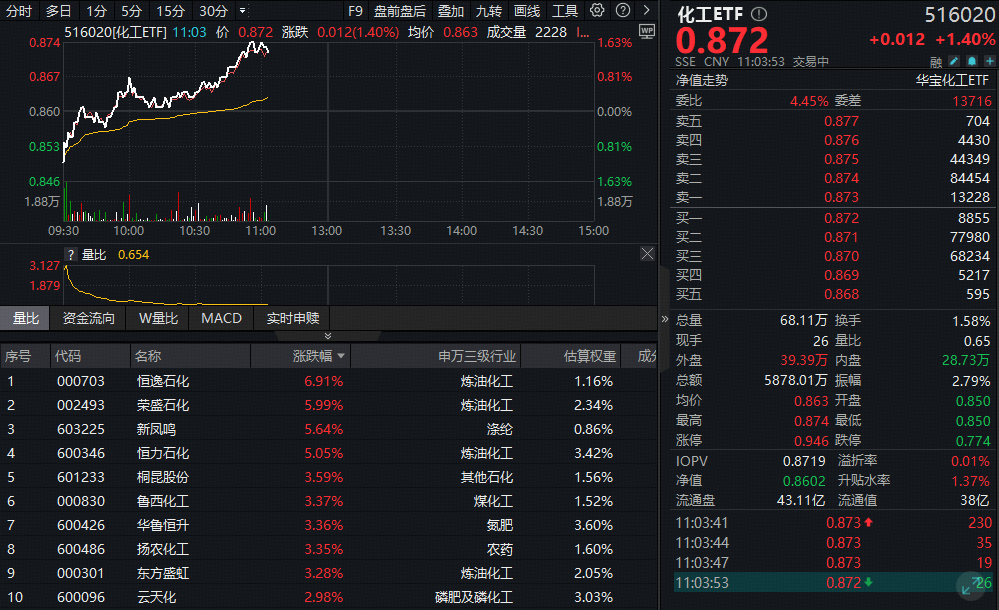
化工板块强势回归!石化、化肥股领涨,化工ETF(516020)上探1.63%!
Xin Lang Cai Jing· 2025-12-30 03:20
Group 1 - The chemical sector has regained momentum, with the chemical ETF (516020) experiencing a maximum intraday increase of 1.63% and closing up 1.4% [1][8] - Key stocks in the sector include Hengyi Petrochemical, which surged over 6%, and other companies like Rongsheng Petrochemical and New Fengming, which rose over 5% [1][8] - The recent high-quality development conference for the fertilizer industry highlighted the transition towards quality and efficiency in the sector, alongside new quota policies for refrigerants that are expected to optimize supply-demand dynamics [10][10] Group 2 - According to Huaxin Securities, the chemical industry remains weak overall, with mixed performance across sub-sectors due to past capacity expansions and weak demand, although some sectors like lubricants have exceeded expectations [3][10] - The chemical ETF (516020) has a price-to-book ratio of 2.57, indicating a relatively reasonable valuation position within the last decade [3][10] - According to Everbright Securities, the basic chemical industry is expected to see significant growth by 2025, driven by strong demand in new materials and emerging applications such as AI and OLED [4][11] Group 3 - The chemical ETF (516020) tracks the CSI sub-sector chemical industry theme index, covering various segments, with nearly 50% of its holdings in large-cap stocks like Wanhua Chemical and Salt Lake Potash [4][11] - Investors can also access the chemical sector through linked funds of the chemical ETF, providing a diversified investment approach [5][11]
新增投产压力加大,出口政策影响市场节奏
Yin He Qi Huo· 2025-12-30 02:51
1. Report Industry Investment Rating No information about the industry investment rating is provided in the report. 2. Core Viewpoints of the Report - In 2026, the supply - side of urea will see accelerated release of new production capacity, with over 6.5 million tons of new capacity expected to be put into operation, increasing the total domestic urea production capacity to 87 million tons by the end of 2026, and the daily output is expected to exceed 225,000 tons and reach a record high of 230,000 tons [5][168]. - The agricultural demand for urea is expected to peak after the Spring Festival and before the first half of the year. Overall, agricultural demand is stable, industrial demand is weak, and exports may become a key marginal variable for demand. The increase in export quotas in 2026 compared to 2025 will be a crucial factor affecting the market rhythm [5][169]. 3. Summaries According to Relevant Catalogs 3.1 First Part: Preface Summary 3.1.1 Comprehensive Analysis - In 2026, on the supply - side, new urea production capacity will continue to be released rapidly. On the demand - side, agricultural demand has a seasonal peak, and exports are a key variable [5]. 3.1.2 Strategy Recommendation - Unilateral trading: Weak before the Spring Festival, strong in the first half of the year, and mainly weak in the second half, with export quotas affecting the market rhythm [6][169]. - Arbitrage: Short - term weakness in inter - period arbitrage, and long - term positive arbitrage opportunities after the Spring Festival [6][169]. - Options: The lower margin is between 1550 - 1600, and the upper margin is between 2100 - 2200 [6][170]. 3.2 Second Part: Fundamental Situation 3.2.1 Market Review - In 2025, the domestic mainstream urea ex - factory price showed an "N" shape. It bottomed out in January, rebounded around the Spring Festival, had short - term rebounds after the release of export quotas in April, and then declined due to weakened demand in July and rebounded again in October [11]. 3.2.2 Supply Analysis - China's urea production capacity entered a de - capacity cycle after peaking in 2015 and started positive growth in 2021 due to new capacity release [34]. - In 2025, the net increase in urea production capacity was 6.5 million tons, and in 2026, it is expected to be about 6.5 million tons, with a production capacity growth rate of 7.9% [37][42]. - In 2025, the average daily urea production reached a new high, and the average daily production in 2026 is expected to exceed 210,000 tons in the second quarter [47][70]. - In 2026, coal prices will fluctuate within a range, and urea production profits will be further compressed. Demand growth may slow down, and high inventory may become normal. Attention should be paid to the winter maintenance of gas - head enterprises [57][67][75]. 3.2.3 Demand Analysis - Agricultural demand accounts for about 70% of urea demand, with seasonal characteristics. In 2025, China's grain production increased, and the demand for high - standard farmland showed steady growth [80][90][100]. - The price of urea has a significant comparative advantage over phosphate and potash fertilizers [103]. - Internationally, the total urea production capacity is expanding. India still has a large demand gap, and China's export quotas are expected to increase in 2026, with international prices affecting the export rhythm [112][121][125]. - The 2025/26 off - season storage policy continues the 2024/25 policy, and it is worth noting whether the rewards and punishments are linked to export quotas [136][140]. - Industrial demand for urea, mainly from the melamine and urea - formaldehyde resin industries, is expected to remain lackluster in 2026 [141][151]. - In 2026, the production of compound fertilizers will first rise and then fall, with different demand characteristics in different seasons [155][161]. 3.3 Third Part: Market Outlook and Strategy Recommendation 3.3.1 Comprehensive Analysis - Similar to the preface, in 2026, the supply - side will see new capacity release, and the demand - side will be affected by agricultural seasons and export quotas [168][169]. 3.3.2 Strategy Recommendation - Unilateral trading: Weak before the Spring Festival, strong in the first half of the year, and mainly weak in the second half, with export quotas affecting the market rhythm [169]. - Arbitrage: Short - term weakness in inter - period arbitrage, and long - term positive arbitrage opportunities after the Spring Festival [169]. - Options: The lower margin is between 1550 - 1600, and the upper margin is between 2100 - 2200 [170].
化工ETF(159870)红盘向上,PX盈利情况率先好转,PTA反内卷可期,聚酯产业链景气度持续上行
Xin Lang Cai Jing· 2025-12-30 02:40
Group 1: Polyester Industry Chain Price Trends - The prices of polyester industry chain products have increased as of December 25, with PX at 7318, PTA at 5040, polyester filament at 6450, polyester bottle chips at 5990, and BOPET at 7475 yuan/ton, reflecting increases of +7.88%, +8.39%, +2.79%, +5.27%, and +1.15% respectively compared to the previous week [1] Group 2: Production Capacity Insights - PX production is currently at 89% capacity, with no new capacity expected before Q4 2024. PTA has a 74% operating rate with significant pressure from 2025, and no new capacity is anticipated for 2026. Polyester filament is stable with a 90% operating rate and an annual expansion of 3-4% [1] Group 3: Demand and Consumption Forecast - From January to November this year, the apparent demand for polyester filament has only increased by 3.5%. Following a proactive inventory accumulation cycle in 2024, a destocking cycle is expected to begin in early 2025. By 2026, a return to an inventory accumulation cycle is anticipated, with consumption growth expected to return to the 5-10% range [1] Group 4: Profitability Analysis - Recent profitability trends show PX recovering from zero to 700 yuan/ton, PTA moving from cash flow losses to break-even, and polyester entering a state of slight losses. By 2026, PX profits are expected to expand further, while PTA is likely to maintain break-even, and polyester is projected to recover to a profit range of 100-200 yuan [1] Group 5: Lithium Battery Materials Sector - The lithium battery materials sector has seen a decline due to rumors of a 15% production cut by CATL in Q1 and speculation about 6F prices dropping below 110,000 yuan. However, ongoing negotiations indicate that pricing discussions are progressing as planned, and CATL's suppliers have stated that a 15% reduction is not feasible without losing market share [2] Group 6: Chemical ETF Performance - As of December 30, 2025, the CSI Sub-Industry Chemical Theme Index (000813) rose by 0.37%, with notable increases in constituent stocks such as Hengyi Petrochemical (000703) up by 5.21% and Hengli Petrochemical (600346) up by 2.95% [2]
电池级碳酸锂、工业级碳酸锂等涨幅居前,建议关注进口替代、纯内需、高股息等方向 | 投研报告
Sou Hu Cai Jing· 2025-12-30 01:17
Group 1 - The core viewpoint of the report indicates that Brent crude oil prices are expected to stabilize around $65 per barrel by the end of 2025, with current prices showing slight increases of 0.28% for Brent and 0.39% for WTI compared to the previous week [1][3] - The report highlights significant price increases in battery-grade lithium carbonate (up 10.79%) and industrial-grade lithium carbonate (up 10.78%), while sulfur and liquid chlorine experienced notable declines of -6.33% and -5.86% respectively [2][4] - The chemical industry is currently facing a weak performance overall, influenced by past capacity expansions and weak demand, although some sub-sectors like lubricants are performing better than expected [4] Group 2 - Investment opportunities are suggested in sectors such as glyphosate, chemical fertilizers, and high-dividend assets, with specific recommendations for companies like Jiangshan Chemical, Xingfa Group, and Yangnong Chemical [4] - The report emphasizes the importance of domestic demand and the potential impact of export uncertainties on the chemical industry, particularly in nitrogen and phosphate fertilizers which have relatively inelastic demand [4] - The report recommends focusing on companies with high asset quality and dividend yields, particularly Sinopec, which stands to benefit from lower raw material costs due to declining oil prices [4]
供给优化-气势升腾-基础化工2026年度投资策略
2025-12-29 15:50
Summary of Key Points from the Conference Call on the Chemical Industry Investment Strategy for 2026 Industry Overview - The chemical industry is undergoing significant changes on the supply side, with European capacity being reduced due to cost pressures and domestic fixed asset investment growth slowing down, which may lead to improved profits in certain sub-industries [1][2] - The China Chemical Price Index (CCPI) and the gross profit margin of the Yangtze Chemical Sector are at historically low levels, indicating a cyclical fluctuation in the industry, with a potential upward cycle on the horizon [1][4] Core Insights and Arguments - The investment strategy for the chemical industry in 2026 can be summarized as "supply optimization, rising momentum," following three years of downturn from 2023 to 2025 [2] - The International Monetary Fund (IMF) predicts a global GDP growth rate of approximately 3.09% for 2026, with China's growth at 4.2%, suggesting resilient external demand [5] - Emerging fields such as new energy, energy storage, and AI infrastructure are positively impacting the demand for chemical products, with significant growth in new energy vehicle production and global energy storage installations [6] Performance of Domestic and Overseas Companies - Domestic chemical leaders experienced a year-on-year decline in performance in the first half of 2025, but overseas companies faced a faster decline, with Europe shutting down 11 million tons of capacity across 21 major production bases [7] - China's market share in the chemical sector increased from less than 10% in 2020 to 43% in 2023 due to the closure of European capacities [7] Policy Impacts - The domestic anti-involution policy is positively influencing the governance of disorderly competition and promoting the exit of outdated capacities, which is expected to enhance industry profitability [8] - Energy consumption dual control and environmental policies are likely to become key drivers for supply optimization, aiming to reduce excess capacity through stricter project approvals and enhanced regulation [9] Sub-Industry Focus - Notable sub-industries include the silicon-based industry chain, polyester industry chain, spandex, soda ash, chlor-alkali, high-demand refrigerants, chromium salts, and phosphate rock industry chain, as well as new materials related to tires and new energy [3][10] - The organic silicon industry is expected to recover from a low point due to limited new supply and collaborative production cuts among companies [11] - The polyester industry chain is nearing the end of its expansion cycle, with downstream demand remaining strong, and leading companies are negotiating to improve profitability [12] Challenges and Opportunities - The soda ash market faces challenges due to its significant exposure to the real estate sector, but long-term demand from photovoltaic glass is expected to rise [15] - The chlor-alkali industry shows stable demand for caustic soda, while PVC demand is fluctuating, with no new PVC capacity expected in 2026 [16] Noteworthy Companies and Investment Opportunities - High-quality companies in the chemical sector include Wanhua (MDI leader), Hualu (coal chemical leader), Longbai (titanium concentrate and titanium dioxide leader), and Huafeng (spandex) [19] - New material companies such as Guocera Songjing (related to solid-state batteries) and Dongcai Shengquan (high-frequency resin) are also highlighted for their growth potential [20][21]



电池级碳酸锂、工业级碳酸锂等涨幅居前,建议关注进口替代、纯内需、高股息等方向
Huaxin Securities· 2025-12-29 14:38
Investment Rating - The report maintains a "Buy" rating for several companies including Xinyangfeng, Senqilin, Ruifeng New Materials, Sinopec, Juhua, Yangnong Chemical, CNOOC, Tongkun, Daotong Technology, and others [10]. Core Viewpoints - The report highlights significant price increases in battery-grade lithium carbonate (up 10.79%) and industrial-grade lithium carbonate (up 10.78%), while sulfur and liquid chlorine experienced notable declines [4][7]. - It suggests focusing on investment opportunities in areas such as import substitution, pure domestic demand, and high dividend stocks, particularly in light of the current geopolitical tensions affecting oil prices [6][18]. - The overall chemical industry remains under pressure, with mixed performance across sub-sectors due to past capacity expansions and weak demand, although some sectors like lubricants are performing better than expected [21]. Summary by Sections Chemical Industry Investment Suggestions - The report recommends paying attention to the glyphosate industry, which is showing signs of recovery with decreasing inventory and rising prices, suggesting potential investment in companies like Jiangshan Co., Xingfa Group, and Yangnong Chemical [21]. - It also emphasizes selecting stocks with strong competitive positions and growth potential, particularly in the lubricant additive sector and coal-to-olefins industry [21]. - The report notes that domestic demand for chemical fertilizers and certain pesticide sub-products remains robust, with companies like Hualu Hengsheng and China Heartlink Fertilizer being highlighted for investment [21]. Price Trends of Chemical Products - The report details recent price movements, with significant increases in battery-grade lithium carbonate and PTA, while products like sulfur and liquid chlorine saw declines [4][5][19]. - It mentions that the international oil price is expected to stabilize around $65 per barrel, which could benefit companies with high dividend yields and those that are sensitive to raw material cost reductions [6][18]. Market Dynamics - The report discusses the impact of geopolitical tensions on oil prices, particularly the situation in Venezuela and the EU's sanctions on Russia, which have contributed to recent price fluctuations [22][23]. - It highlights the weak trading atmosphere in the coal market, with prices declining due to limited demand and cautious market sentiment [29][30]. - The report notes that the polypropylene market is experiencing downward pressure due to weak demand and increased supply, while the PTA market is expected to remain strong due to ongoing inventory reduction [31][35].


煤炭行业周报:11 月用电量继续加速增长,需求端预计 26 年开启上行周期-20251229
Haitong Securities International· 2025-12-29 05:34
11 月用电量继续加速增长,需求端预计 26 年开启上行周期 [Table_Industry] 煤炭 煤炭行业周报 本报告导读: 我们认为煤炭板块周期底部已经确认在 25Q2,供需格局已经显现了逆转拐点,下行 风险充分释放。 投资要点: 股 票 研 究 请务必阅读正文之后的免责条款部分 行 业 跟 踪 报 告 证 券 研 究 报 告 股票研究 /[Table_Date] 2025.12.29 [table_Authors] 2025-12-29 [Table_Summary] 投资建议:从板块推荐角度,依然推荐红利的核心中国神华、陕西煤业、 中煤能源;继续推荐兖矿能源、晋控煤业。 煤价有底,需求是核心,11 月份全社会用电量同比增长 6.2%,再次展 现电煤需求韧性。12 月 24 日,国家能源局发布 11 月份全社会用电量 等数据。11 月份,全社会用电量 8356 亿千瓦时,同比增长 6.2%,1-11 月份,全社会用电量累计 94602 亿千瓦时,同比增长 5.2%,从分产业 用电看,第一产业用电量 1374 亿千瓦时,同比增长 10.3%;第二产业 用电量 60436 亿千瓦时,同比增长 3.7%;第 ...
国际油价持平,MDI价格略跌、醋酸价格上涨 | 投研报告
Sou Hu Cai Jing· 2025-12-29 03:25
Core Viewpoint - The report highlights the stability of international oil prices and suggests focusing on undervalued leading companies in the chemical industry, the impact of "anti-involution" on supply, and the importance of self-sufficiency in electronic materials and certain new energy materials amid price increases [1][7]. Industry Dynamics - During the week of December 22-28, 34 out of 100 tracked chemical products saw price increases, while 32 experienced declines, and 34 remained stable. 55% of products had month-over-month price increases, 35% saw decreases, and 10% remained unchanged [2]. - The average price of WTI crude oil was $56.74 per barrel with a weekly increase of 0.14%, while Brent crude oil was $60.64 per barrel with a 0.28% increase. Geopolitical tensions in Ukraine have affected energy infrastructure [3]. - The average price of pure MDI decreased by 4.23% to 18,100 CNY/ton, while the average price of polymer MDI fell by 2.39% to 14,300 CNY/ton. The demand from downstream industries remains weak [4]. - Acetic acid prices increased by 2.93% to 2,496 CNY/ton, with a production increase of 2.71% to approximately 238,900 tons. The overall operating rate for acetic acid was 72.15% [5][6]. Investment Recommendations - As of December 27, the SW basic chemical sector's P/E ratio is 25.60, and the P/B ratio is 2.33. The SW oil and petrochemical sector's P/E ratio is 13.17, and the P/B ratio is 1.28. The report suggests focusing on undervalued leading companies, the impact of "anti-involution," and the importance of self-sufficiency in electronic materials and new energy materials [7]. - Long-term investment themes include potential demand recovery supported by policies, continuous supply-side optimization, and growth in emerging sectors such as semiconductor materials and new energy materials [7]. - Recommended stocks include Wanhua Chemical, Hualu Hengsheng, and others, with a focus on companies in sectors like fluorochemicals, agriculture, refining, and textiles [7][8].


