宇通客车

Search documents
郑州新能源汽车如何“一路疾驰”
Zheng Zhou Ri Bao· 2025-12-29 00:36
Group 1 - The core viewpoint of the articles highlights the significant growth and international presence of the Zhengzhou automotive industry, particularly in the electric vehicle sector, driven by companies like Yutong and BYD [1][2][7] - Yutong's participation in the Africa Cup of Nations with a fleet of 723 customized buses showcases its commitment to sustainable solutions and long-term operational integration in local markets [2][3] - BYD's Zhengzhou factory has achieved a production milestone of over 1 million vehicles since its launch, contributing more than 170 billion yuan to the local economy and positioning Zhengzhou as a key player in the national electric vehicle landscape [4][8] Group 2 - The automotive industry in Zhengzhou is experiencing a dual-engine growth model, with both Yutong and BYD driving advancements in electric and intelligent vehicle technologies [7][8] - The region's industrial output has seen a notable increase, with the automotive manufacturing sector growing by 19.2% year-on-year, significantly contributing to the overall economic growth of Zhengzhou [8] - Zhengzhou aims to establish a 500 billion yuan industrial cluster by enhancing innovation, supporting leading enterprises, and fostering a more comprehensive automotive supply chain [8]


强产业 开新页
He Nan Ri Bao· 2025-12-28 23:20
Core Viewpoint - The article emphasizes the importance of transforming and upgrading various industries in Henan province, focusing on four categories: "Original," "Old," "New," and "Foreign" brands, to achieve high-quality development and strengthen the foundation for modernization in Henan [1]. Group 1: Original Brands - Henan has a solid foundation in resource industries such as mining, steel, non-ferrous metals, construction materials, and chemicals, which are crucial for economic stability [2][3]. - The province is moving towards green development, with companies like Luoyang Molybdenum Co. adopting smart and eco-friendly mining practices, enhancing resource efficiency and sustainability [2]. - There is a push to move up the value chain, as seen in the aluminum industry in Gongyi, which has become a significant production base for aluminum products through recycling and deep processing [3]. - The province is focusing on developing nine material industry chains to transition from a raw material province to a strong new materials province [4]. Group 2: Old Brands - Traditional industries in Henan, such as food processing and traditional medicine, are being revitalized through product innovation and modernization, as exemplified by companies like Sanquan Foods [5][6]. - The transformation of traditional enterprises into high-tech leaders is highlighted by companies like Luozhou and Zhengzhou Coal Mining Machinery Group, which are adopting smart technologies [6]. - The government is supporting the upgrade of traditional industries through action plans aimed at enhancing manufacturing capabilities and promoting high-end, intelligent, and green transformations [6][7]. Group 3: New Brands - The new industries in Henan, particularly in AI and advanced computing, are rapidly expanding, with companies like Super Fusion leading in AI server manufacturing [8][9]. - The integration of artificial intelligence with the economy is creating new opportunities, as seen with Hanwei Technology's advancements in intelligent robotics [9]. - The province is focusing on key materials for emerging industries, such as lithium battery components, which are essential for the growth of the electric vehicle sector [9][10]. Group 4: Foreign Brands - Henan's enterprises are increasingly engaging in international markets, with companies like Nile River Machinery expanding their operations globally and establishing local facilities [10][11]. - The province achieved over 840 billion yuan in import and export value in the first eleven months of the year, indicating a robust external economic engagement [10][12]. - Efforts are being made to enhance the competitiveness of Henan's products and brands in the global market, supported by government policies aimed at facilitating international trade [11][12][14].

汽车行业 2026 年度投资策略报告:不必悲观,结构存机会-20251227
Guohai Securities· 2025-12-27 13:27
Core Insights - The report maintains a "Recommended" rating for the automotive industry, emphasizing that there are opportunities despite potential challenges in 2026 [1][2] - The automotive sector showed a 20% increase over the past 12 months, outperforming the Shanghai and Shenzhen 300 index, which increased by 16.8% [3] Group 1: Industry Overview - The automotive industry is expected to experience a strong performance in commercial vehicles while passenger vehicles may face challenges in 2026 [4] - The report highlights that the passenger vehicle market in 2025 was supported by trade-in policies, leading to stable performance, but anticipates pressure on total volume in 2026 [4] - The heavy truck segment is projected to see positive growth in 2026, driven by domestic demand recovery and increased exports [4] Group 2: Opportunities in Passenger Vehicles - The report identifies a significant opportunity in the high-end passenger vehicle market, particularly for models priced above 300,000 yuan, which is expected to continue to grow [4][5] - Domestic brands are anticipated to make substantial advancements in the high-end market with new models launching in 2026 [5] Group 3: Heavy Truck Market Insights - The heavy truck market is expected to benefit from a recovery in domestic demand and a favorable export environment, with wholesale volumes projected to grow positively in 2026 [4][5] - The report notes that the penetration rate of electric heavy trucks may stabilize in 2026 after significant increases in 2025, which could positively impact profitability [5] Group 4: Smart Driving and Technology - The report discusses the acceleration of high-level autonomous driving technology penetrating lower-priced models, which is expected to drive volume growth in 2026 [5] - The introduction of new AI-driven cockpit technologies is anticipated to enhance the value of smart cabins, creating additional investment opportunities in related components [5] Group 5: Robotics Sector - The report indicates that the humanoid robotics sector is entering a new phase, with significant growth potential for leading manufacturers and their supply chains [5] - The collaboration between domestic and international manufacturers is expected to enhance production capabilities and technological advancements in humanoid robots [5] Group 6: Investment Recommendations - The report recommends several companies for investment, including Jianghuai Automobile, Top Group, and BYD, highlighting their potential in the evolving automotive landscape [6][9] - Specific recommendations for heavy truck manufacturers include China National Heavy Duty Truck Group and Weichai Power, which are expected to benefit from industry growth [6][9]





在非洲,我看到中国人“悲壮的突围”
创业邦· 2025-12-27 10:33
Core Viewpoint - The article discusses the challenges and costs faced by Chinese companies operating in Morocco, emphasizing the need for adaptation and strategic planning to succeed in a foreign market while navigating high operational costs and cultural differences [5][10][106]. Group 1: Identity - Chinese companies are establishing operations in Morocco to maintain access to European markets, driven by the "China +1" strategy to mitigate risks associated with sourcing from China [11][12][17]. - The geographical proximity of Morocco to Europe, along with favorable trade policies, makes it an attractive location for manufacturing [14][15]. Group 2: Cost Structure - The construction costs in Morocco can be more than double those in China, with local standards leading to higher material costs [20][23]. - Maintenance and repair costs are significantly higher, with examples showing that simple repairs can cost ten times more than in China [25][27]. - Small components, such as screws, can be exorbitantly priced compared to domestic costs, necessitating the import of parts from China despite longer lead times [28][30]. Group 3: Standards - High levels of automation are being adopted in Moroccan factories to compensate for the lack of skilled labor, with some factories operating with significantly fewer workers than traditional setups [37][40]. - The reliance on machines is not only for efficiency but also to ensure stable production in the face of labor challenges [41][42]. Group 4: Adaptation - There is a notable difference in work ethic and reliability between local labor groups, with a preference for hiring Berber workers over Arab workers due to perceived differences in work attitudes [46][50]. - Companies often adopt a mixed hiring strategy, employing local workers for basic roles while retaining skilled Chinese workers for critical positions [51][52]. Group 5: Time - Training local workers to meet industrial standards requires significant time investment, often exceeding initial expectations [58][59]. - The cultural differences in work processes necessitate a patient approach to training, with a focus on building habits over time [56][58]. Group 6: Communication - Language barriers pose significant challenges in production settings, leading to misunderstandings that can affect product quality [61][62]. - Companies are developing internal codes to bypass language issues, creating a shared understanding among workers [66][67]. Group 7: Beliefs - Local cultural and religious practices significantly influence work schedules and employee availability, with many employees prioritizing personal beliefs over work commitments [70][76]. - Understanding and accommodating these cultural factors is essential for effective management in Morocco [78][80]. Group 8: Market - Despite efforts to develop the electric vehicle market, actual sales remain low, with most production aimed at export rather than local consumption [84][88]. - The disconnect between production capabilities and local market demand highlights the challenges of operating in a "production-isolation" environment [86][91]. Group 9: Management - Traditional management practices from China may not be effective in Morocco, where local employees may prioritize personal circumstances over work incentives [95][98]. - Companies must navigate local labor laws and cultural sensitivities to implement effective management strategies [101][102].



2025-2031年中国露营市场发展商机与投资前景分析报告
Sou Hu Cai Jing· 2025-12-27 07:08
Group 1 - The report analyzes the development opportunities and investment prospects of the camping market in China from 2025 to 2031 [2] - It provides a comprehensive overview of the camping industry, including definitions, characteristics, classifications, and key equipment [2][3] - The report outlines the macro environment analysis of the Chinese camping industry, including policy, economic, social, and technological factors [3][4] Group 2 - The report includes a global perspective on the camping industry, detailing its development history, current status, and market trends [4][5] - It highlights the competitive landscape of the global camping market, including key players and mergers and acquisitions [5][6] - The report forecasts the market size and trends for the global camping industry over the next five years [5][6] Group 3 - The analysis of the Chinese camping industry includes a detailed examination of market supply and demand, trade status, and development pain points [6][7] - It discusses the characteristics of registered enterprises in the camping sector, including their distribution and capital structure [7][8] - The report evaluates the competitive situation within the Chinese camping industry, including market concentration and competitive dynamics [7][8] Group 4 - The report provides insights into the camping industry's value chain and associated industries, analyzing cost structures and pricing mechanisms [8][9] - It examines the market for specific camping products, such as tents and RVs, detailing their current status and future trends [9][10] - The report also analyzes consumer behavior and sales strategies within the camping market [10][11] Group 5 - The report includes case studies of representative companies in the Chinese camping industry, detailing their business structures and market strategies [10][11] - It assesses the investment strategies and opportunities within the camping sector, identifying potential areas for growth and development [12][13] - The report concludes with a SWOT analysis and future development forecasts for the Chinese camping industry [16][17]

汽车行业跟踪报告:客车:25年出口高景气,新能源客车出口空间大
ZHESHANG SECURITIES· 2025-12-26 11:58
Investment Rating - The industry rating is "Positive" (maintained) [4] Core Insights - The overall bus export in November was 8,000 units, a year-on-year decrease of 5%, while the cumulative export for the first eleven months was 93,000 units, showing a year-on-year increase of 26%. The export of new energy buses in November was 1,100 units, down 6% year-on-year, but the cumulative export for the first eleven months reached 15,000 units, up 58% year-on-year, indicating a high level of bus export activity and rapid growth in new energy segments [1][11] - The market for fuel buses is expected to remain strong, particularly in regions like the Middle East, Southeast Asia, and Africa, with a projected year-on-year growth of 21% in fuel bus exports before October 2025. The new energy bus market is also expanding, especially in Europe, where the penetration rate is expected to rise significantly [4][30] - The report highlights that the new energy bus export market is expected to grow, with projections indicating that by 2025, the market share of Chinese new energy bus exports could reach over 26%, and by 2027, it could rise to 33%, corresponding to an export scale of 6,000 units [5][40] Industry Data Update - The export of large and medium buses in October was 4,000 units, showing a year-on-year increase of 14%. The export of light buses in October was 5,000 units, up 25% year-on-year, with a cumulative export of 43,000 units for the first ten months, reflecting a year-on-year increase of 43% [1][20] - The domestic sales of large and medium buses in November reached 8,000 units, a year-on-year increase of 16%, with cumulative sales of 54,000 units for the first eleven months [1][22] Company Data Update - Yutong Bus sold 35,000 large and medium buses in the first eleven months, a year-on-year increase of 2%. The company expects to achieve sales of 40,000 units in 2024, a growth of 27% [2][27] - King Long Automobile reported sales of 28,000 large and medium buses in the first eleven months, a year-on-year increase of 1%, with an expected sales target of 29,000 units in 2024, reflecting a growth of 28% [2][29] - Zhongtong Bus sold 11,000 large and medium buses in the first eleven months, a year-on-year increase of 11%, with an expected sales target of 10,000 units in 2024, reflecting a growth of 58% [3][29] Industry Space - The report identifies significant market opportunities for fuel buses in underdeveloped countries, while the new energy bus market is expected to see substantial growth in Europe, Latin America, and Asia, with projections indicating a total demand of 17,000 units by 2024 and 37,000 units by 2027 [4][40] - In Europe, the market for large and medium buses is projected to reach 47,000 units in 2024, with a new energy penetration rate of 16%, expected to rise to 25% by 2027, corresponding to sales of 19,000 new energy buses [4][34] - The report anticipates that by 2027, the export volume of Chinese new energy buses could reach 17,000 units, with a compound annual growth rate of 39% from 2024 [40]


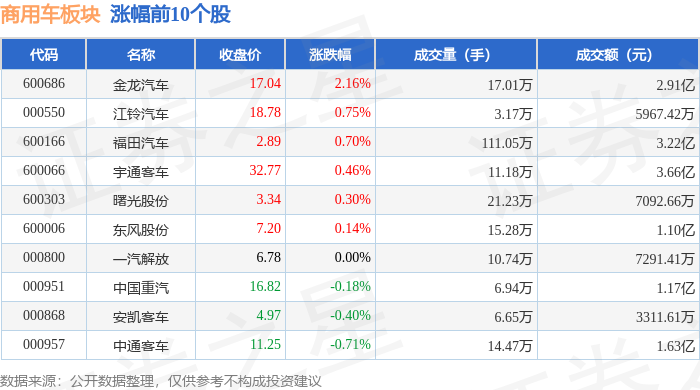
商用车板块12月26日涨0.23%,金龙汽车领涨,主力资金净流出2.26亿元
Zheng Xing Xing Ye Ri Bao· 2025-12-26 09:07
Core Viewpoint - The commercial vehicle sector experienced a slight increase of 0.23% on December 26, with Jinlong Automobile leading the gains, while the overall market indices also showed modest increases [1]. Group 1: Market Performance - The Shanghai Composite Index closed at 3963.68, up 0.1%, and the Shenzhen Component Index closed at 13603.89, up 0.54% [1]. - The commercial vehicle sector's individual stock performances varied, with Jinlong Automobile closing at 17.04, up 2.16%, and China National Heavy Duty Truck down 0.18% at 16.82 [1]. Group 2: Trading Volume and Value - Jinlong Automobile had a trading volume of 170,100 shares and a transaction value of 291 million yuan [1]. - Jiangling Motors recorded a closing price of 18.78 with a trading volume of 31,700 shares, resulting in a transaction value of approximately 5.97 million yuan [1]. Group 3: Capital Flow - The commercial vehicle sector saw a net outflow of 226 million yuan from institutional investors, while retail investors contributed a net inflow of 175 million yuan [2]. - The sector's overall capital flow indicates a mixed sentiment, with institutional investors withdrawing funds while retail investors increased their positions [2]. Group 4: Individual Stock Capital Flow - Jianghuai Automobile had a net inflow of 6.35 million yuan from institutional investors, but a net outflow of 2.91 million yuan from retail investors [3]. - China National Heavy Duty Truck experienced a significant net outflow of 5.06 million yuan from institutional investors, while retail investors contributed a net inflow of 16.72 million yuan [3].




方正证券:26年汽车板块依然具备结构性投资机遇 重点看好新兴科技板块
Zhi Tong Cai Jing· 2025-12-26 01:45
Core Viewpoint - The automotive sector is expected to present structural investment opportunities in 2026 despite a reduction in subsidies, with traditional vehicle and parts exports likely to support sales and profits, alongside emerging technologies like autonomous driving and AI computing [1] Passenger Vehicles - Passenger vehicle wholesale sales are projected to reach 29.38 million units in 2026, a slight decline of 0.7% year-on-year. Export sales are expected to be 6.34 million units, up 13% from 2025, while retail sales are forecasted at 23.05 million units, down 4% [1] - The export market is anticipated to be a key driver for core growth in the automotive sector, with leading companies expected to transition to profit generation from exports in 2026 [1] - The first quarter of 2026 is expected to see a bottoming out of domestic demand, creating a golden window for export strategies, with a focus on identifying "dark horses" domestically and "white horses" in exports [1] Commercial Vehicles - The commercial vehicle market is expected to recover significantly in 2025, with heavy truck sales projected to exceed 1.1 million units, driven mainly by domestic policy support [2] - In 2026, heavy truck sales are expected to remain stable at over 1.12 million units, with domestic sales projected at 750,000 units (down 4%) and exports expected to reach 375,000 units (up 9%) [2] - Bus sales are forecasted to be 580,000 units in 2026, with a growth of 8%, driven by the acceleration of new energy vehicle exports [2] Auto Parts - The focus for auto parts is on export opportunities, intelligent driving, and transformation trends, with three main lines of attention: traditional parts export leaders, core emerging industry trends, and transformation parts [3] - Domestic auto parts companies are expected to face pressure on profitability due to slowing domestic demand, but local production capacity for overseas markets is anticipated to strengthen [3] - The emergence of L3 autonomous driving and the commercialization of L4 are expected to create structural opportunities in the market [3] Robotics - The robotics sector is transitioning from thematic speculation to performance realization, with key policies being implemented to support development [4] - 2026 is seen as a critical year for humanoid robots, with the Optimus Gen3 expected to launch in Q1 and mass production anticipated in H2, potentially leading to significant growth in the automotive segment [4] - China's supply chain advantages in responsiveness, cost, and completeness are expected to position it as a core support for both domestic and global supply chains [4] Related Companies - Key companies to watch include BYD, SAIC Motor, Seres, Yutong Bus, China National Heavy Duty Truck, Weichai Power, Leap Motor, Xpeng Motors, Geely, Great Wall Motors, Fuyao Glass, Songyuan Safety, Sanhua Intelligent Control, Top Group, Yinlun Machinery, and Jieneng Electronics [5]

资配跨年展望(二):大国出海下的“新核心资产”
Guoxin Securities· 2025-12-25 15:28
Group 1 - The report highlights a significant shift in the outbound strategy of A-share companies, moving from simple product exports to a comprehensive system export, including capacity, brand, and management systems by 2026 [1][9] - A total of 2723 A-share companies are involved in outbound business, with 60.96% showing a positive attitude towards international expansion, indicating that going global has become a necessary strategy rather than an optional one [1][16] - The report identifies three key sectors driving outbound activities: high-tech chemical materials, high-end equipment, and electronic components, which are characterized by strong technological barriers and industry clustering [1][2] Group 2 - The report outlines differentiated regional opportunities, emphasizing Europe for high-end manufacturing and green transformation, Southeast Asia as a hub for industrial chain overflow, and the Middle East and Latin America for energy transition and infrastructure needs [2][45] - An "owl-shaped" investment strategy is recommended, balancing stable income from high-dividend, low-valuation assets with growth potential from high-tech, aggressive growth stocks [2][49] - The report emphasizes the importance of focusing on industries with high technological barriers and strong industry clustering for investment opportunities in 2026 [2][32] Group 3 - The report provides a quantitative analysis of A-share companies' attitudes towards outbound strategies, revealing that over 45% of announcements are positive, while negative announcements are negligible [14][16] - The mechanical equipment, pharmaceutical, computer, power equipment, and automotive sectors account for over 44.2% of outbound announcements, indicating their central role in international expansion [19][23] - A unique indicator system is introduced to identify industries with strong global competitiveness, focusing on technological moat, industry clustering, and urgency for outbound investment [27][28] Group 4 - The report discusses the transformation of the global trade landscape, highlighting a shift from a linear trade model to a triangular model involving "connector countries" like Vietnam and Mexico, which facilitate Chinese companies' access to international markets [9][10] - It notes that many A-share companies are transitioning from OEM (Original Equipment Manufacturer) to OBM (Original Brand Manufacturer) models, indicating a shift towards brand and management system exports [12][14] - The report identifies specific industries such as semiconductors, glass fiber, and commercial vehicles as key areas for investment due to their strong global positioning and growth potential [35][38][42]
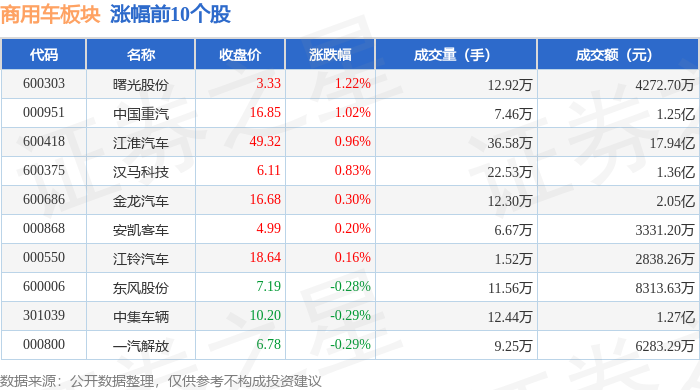
商用车板块12月25日涨0.05%,曙光股份领涨,主力资金净流出3546.76万元
Zheng Xing Xing Ye Ri Bao· 2025-12-25 09:07
Group 1 - The commercial vehicle sector saw a slight increase of 0.05% on December 25, with Shuguang Co. leading the gains [1] - The Shanghai Composite Index closed at 3959.62, up by 0.47%, while the Shenzhen Component Index closed at 13531.41, up by 0.33% [1] - Key stocks in the commercial vehicle sector included Shuguang Co. with a closing price of 3.33, up by 1.22%, and China National Heavy Duty Truck Group with a closing price of 16.85, up by 1.02% [1] Group 2 - The commercial vehicle sector experienced a net outflow of 35.47 million yuan from institutional investors, while retail investors saw a net inflow of 23.6 million yuan [2] - Major stocks with significant net inflows from retail investors included Jianghuai Automobile with 90.02 million yuan and Ankai Bus with 54.19 million yuan [3] - Conversely, stocks like FAW Jiefang and Ankai Bus experienced notable net outflows from institutional investors, with FAW Jiefang seeing an outflow of 8.39 million yuan [3]