理想汽车

Search documents
南向1.41万亿“压舱” 韩国散户“点火”——港股迎来定价权分层时代
Zhi Tong Cai Jing· 2026-02-13 01:53
Core Insights - The Hong Kong stock market is experiencing two distinct but resonant waves of incremental capital from mainland China and South Korean retail investors, with mainland southbound funds achieving a record net purchase of 1.41 trillion HKD, establishing themselves as core builders of pricing power in the market [1][10] - Southbound funds are characterized by long-term value investment, while South Korean retail investors engage in high-frequency trading and narrative-driven investments, creating a diversified funding source and a layered pricing logic in the Hong Kong market [1][10] Funding Scale and Structure - Southbound funds have become the core incremental source and valuation system reshaper for the Hong Kong market, with a cumulative net inflow of 5.11 trillion HKD by the end of 2025, and a market value exceeding 6.3 trillion HKD, accounting for 12.7% of the total market [2] - South Korean retail investors, while having a smaller capital scale, exhibit concentrated trading behavior and significant leverage, particularly impacting specific sectors like new economy IPOs and the semiconductor industry [2][5] Industry Preferences - Southbound funds focus on financials and high-dividend utilities, with significant investments in major banks and state-owned enterprises driven by high dividend yields and low valuation levels, while South Korean investors show minimal interest in these sectors [3][5] - South Korean retail investors heavily invested in Xiaomi and MiniMax-WP, demonstrating a high turnover and narrative-driven trading approach, contrasting with the stable, long-term holdings of Southbound funds [5][8] Trading Behavior and Decision-Making - Southbound funds exhibit a decision-making anchor based on dividend yield, ROE stability, and free cash flow generation, characterized by continuous accumulation and stable holdings, as seen with significant net purchases in major banks [8][9] - South Korean retail investors, on the other hand, are driven by industry narrative strength and social media trends, with a high frequency of trading and a tendency to hold stocks for less than three months, reflecting a stark contrast to the long-term holding strategy of Southbound funds [9][10] Market Dynamics - The influx of South Korean retail investors into the Hong Kong market represents a diversification of the investor base, providing liquidity while also potentially increasing volatility during certain periods [9][10] - The interaction between Southbound funds and South Korean retail investors is creating a new normal in the Hong Kong market characterized by layered pricing and concurrent narratives, necessitating both stable investment strategies and agile trading approaches [10]






智通特供|南向1.41万亿“压舱” 韩国散户“点火”——港股迎来定价权分层时代
智通财经网· 2026-02-13 01:49
Core Viewpoint - The Hong Kong stock market is experiencing two distinct but resonant waves of incremental capital from mainland China and South Korean retail investors, leading to a diversification of funding sources and a layered pricing logic in the market [1][14]. Group 1: Scale and Structure - Southbound funds have established themselves as the core incremental source and revaluation force in the Hong Kong stock market, with a cumulative net inflow of 5.11 trillion HKD by the end of 2025, and a record annual net purchase of 1.41 trillion HKD in 2025 [2]. - The market capitalization of southbound funds has surpassed 6.3 trillion HKD, accounting for 12.7% of the total market capitalization of Hong Kong stocks, indicating their evolution into an "endogenous pricing variable" [2]. Group 2: Trading Behavior of South Korean Retail Investors - South Korean retail investors, while having a relatively limited capital size, exhibit highly concentrated and leveraged trading behaviors, particularly impacting specific sectors such as new economy IPOs and the semiconductor industry [5]. - In early 2026, South Korean retail investors made a net purchase of over 2 million USD in MiniMax-WP, contributing significantly to its IPO, which saw an oversubscription of 1837 times [5]. Group 3: Industry Preferences - Southbound funds focus on financials and high-dividend utilities, with significant investments in companies like China Construction Bank and China Mobile, driven by high dividend yields and low valuation levels [6]. - South Korean investors, on the other hand, show a preference for high-growth sectors, with notable investments in Xiaomi and MiniMax-WP, reflecting a narrative-driven trading strategy [8]. Group 4: Investment Strategies - Southbound funds demonstrate a long-term investment strategy characterized by stable holdings and systematic increases in positions, as seen with China Construction Bank, which saw a net purchase of 7.39 billion shares in 2025 [12]. - South Korean retail investors engage in high-frequency trading with a focus on social media trends and community consensus, leading to a rapid turnover of holdings, with an average holding period of less than three months [13]. Group 5: Market Dynamics - The influx of South Korean retail investors into the Hong Kong market represents a diversification of the investor base, contributing to liquidity while also potentially increasing volatility during certain periods [14]. - The interaction between the long-term positioning of southbound funds and the short-term trading strategies of South Korean investors creates a new normal in the Hong Kong stock market characterized by layered pricing and concurrent narratives [14].
BBA,不能再小步慢行了
3 6 Ke· 2026-02-13 01:41
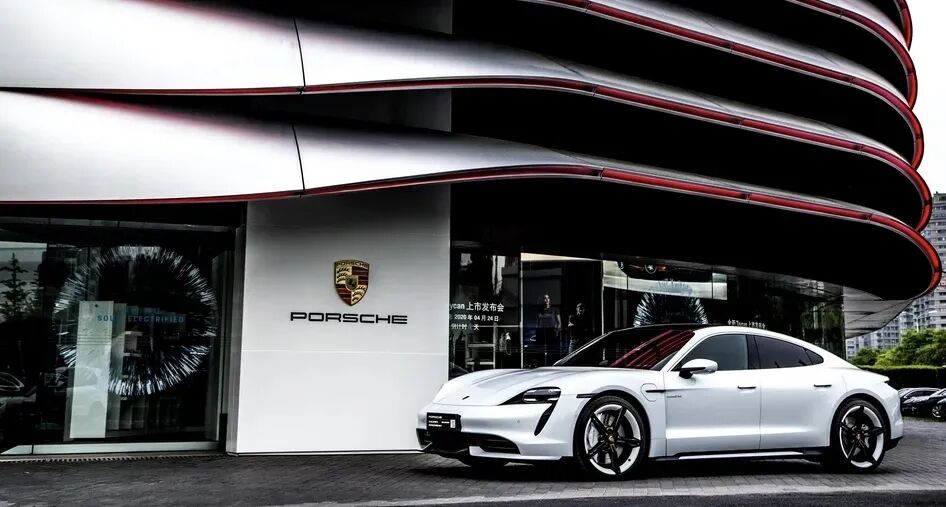
Core Insights - The luxury car market in China is experiencing a significant contraction, affecting major players like Porsche, BMW, Mercedes-Benz, and Audi (collectively known as BBA) [1][3] - BBA's sales in China have declined sharply, with a total drop of approximately 260,000 units, representing a 12.3% decrease year-on-year [3][5] - The market dynamics are shifting, with domestic brands increasingly challenging BBA's dominance, leading to a re-evaluation of the luxury car segment [3][12] Group 1: Market Performance - In 2025, BBA's sales in China fell significantly, with Audi selling 1.623 million units (down 2.9%), Mercedes-Benz 2.16 million units (down 10%), and BMW 2.463 million units (up 0.5%) [5][6] - The decline in the Chinese market for BBA was more pronounced than the global average, indicating a critical shift in their traditional profit center [5][6] - The share of BBA in the Chinese luxury car market has decreased from 80% to around 50%, highlighting a significant loss of market dominance [8][12] Group 2: Structural Changes - The luxury car market is undergoing structural changes, with a notable shift towards lower-priced vehicles, as evidenced by the market share of models priced above 400,000 yuan dropping from 6.3% to 5.2% [12][14] - Consumer preferences are evolving, with a growing inclination towards value-oriented and technologically advanced vehicles from domestic brands, impacting BBA's sales [12][14] - The competitive landscape is intensifying, with new entrants and established domestic brands like BYD and NIO gaining traction in the luxury segment [12][14] Group 3: Strategic Responses - BMW's recent price cuts signal a shift in strategy, moving from maintaining brand premium to aggressively pursuing market share [17][19] - BBA is planning a series of new product launches in 2026, with Mercedes-Benz set to introduce over 15 new and updated models, while BMW aims to release more than 20 new vehicles [19][21] - The year 2026 is viewed as a critical period for BBA to regain market footing and respond to the evolving competitive landscape [21][22]
A股指数集体低开:沪指跌0.44%,贵金属、油气等板块跌幅居前
Feng Huang Wang Cai Jing· 2026-02-13 01:35
凤凰网财经讯 2月13日,三大指数集体低开,沪指低开0.44%,深成指低开0.66%,创业板指低开 0.56%,贵金属、油气、光通信等板块指数跌幅居前。 | | | | | 沪深京重要指数 | | | | | --- | --- | --- | --- | --- | --- | --- | --- | | 名称 *● | 最新 | 涨幅% | | 涨跌 | | | 现手 金额 | | 上证指数 | 4115.92 | -0.44 | -18.10 | 666/1284 | -0.07 | 484 元 | 80.57亿 4847 | | 深证成指 | 14188.35 | -0.66 | -94.65 | 870/1582 | -0.21 | 721万 | 721万 119.20亿 | | 北证50 | 1530.75 | -0.16 | -2.42 | 135/97 | -0.25 | 6.32 7 | 7538 1.78亿 | | 创业板指 | 3309.43 | -0.56 | -18.63 | 425/800 | 0.04 | 185 / | 185万 47.10亿 | 中原证券:维持锂电池行业"强于 ...

金银巨震,美股重挫
Shang Hai Zheng Quan Bao· 2026-02-13 01:03
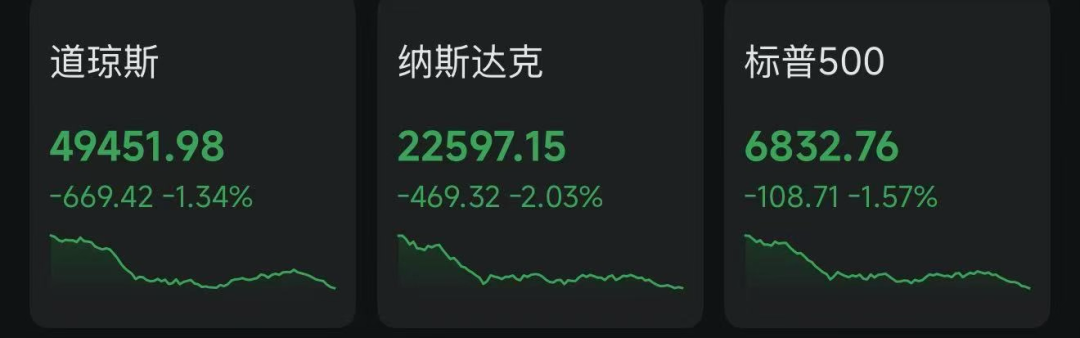
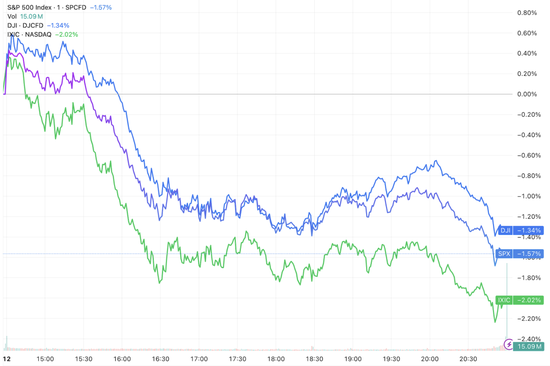
隔夜金银遭遇大规模抛售,伦敦现货白银大跌逾10%,伦敦现货黄金亦跌超3%。今日早间,金银价格有所回升。截至发稿,伦敦现货白银回升至75美元/ 盎司附近,伦敦现货黄金则回升至4940美元/盎司附近。 美股市场同样遭遇了卖盘"洗礼"。截至收盘,道指跌669.42点,跌幅1.34%,报49451.98点;纳指跌469.32点,跌幅2.03%,报22597.15点;标普500指数跌 108.71点,跌幅1.57%,报6832.76点。 北京时间2月13日交易时段,韩国股市开盘不久快速拉升。数据显示,韩国综合指数开盘跌0.16%,随后迅速拉升翻红。 国际局势方面,据新华社消息,美国总统特朗普12日称,他希望美国与伊朗在接下来"一个月左右"达成协议。随后,以色列总理内塔尼亚胡同日提出质 疑,称美国总统特朗普认为能够同伊朗达成协议,但他本人对此表示怀疑。 道指跌破5万点 美东时间周四,美股三大指数集体收跌,道指失守5万点关口。截至收盘,道指跌669.42点,跌幅1.34%,报49451.98点;纳指跌469.32点,跌幅2.03%,报 22597.15点;标普500指数跌108.71点,跌幅1.57%,报6832.76点。 ...
利空突袭!暴跌669点,发生了什么?
天天基金网· 2026-02-13 00:52
Core Viewpoint - The U.S. stock market experienced a significant sell-off, driven by concerns over the disruptive impact of AI, leading to declines across major indices and sectors [2][3][6]. Market Performance - On February 12, the Dow Jones Industrial Average fell by 669 points (1.34%), the S&P 500 dropped by 1.57%, and the Nasdaq Composite decreased by 2.03% [3][4]. - Major tech stocks suffered losses, with Apple down 5%, erasing its gains for the year, and other tech giants like Amazon, Meta, and Tesla also experiencing declines [4][5]. Sector Impact - The financial sector faced substantial declines, with Morgan Stanley dropping over 6% at one point and closing down 4.88%, while Citigroup and Goldman Sachs also saw significant losses [4][5]. - The real estate sector was affected by fears of rising unemployment impacting office space demand, leading to a drop of over 15% for CBRE at one point [5]. - Trucking and logistics stocks were heavily impacted, with the Russell 3000 trucking index falling by 7% and companies like C.H. Robinson experiencing a drop of over 20% [5]. Commodity Market Reaction - Precious metals, including gold and silver, saw sharp declines, with gold dropping over 4% and silver falling by more than 11% at one point [2][6]. - Analysts noted that the sell-off in metals was likely driven by a need for liquidity, as investors exited positions in commodities [7]. Investor Sentiment - Market analysts indicated that the initial driver of stock price increases, namely AI, has now become a source of concern, leading to heightened investor anxiety [6]. - Despite the recent downturn, some analysts remain optimistic about gold's long-term prospects, citing ongoing geopolitical tensions and a shift from traditional assets [7].

苹果大跌5%
Xin Lang Cai Jing· 2026-02-13 00:29
Core Viewpoint - Investors are increasingly concerned about the disruptive potential of artificial intelligence (AI), leading to a decline in major stock indices, with the Nasdaq falling by 2% [1][7]. Market Performance - The Dow Jones index fell by 1.34% to 49,451.98 points, the S&P 500 index dropped by 1.57% to 6,832.76 points, and the Nasdaq index decreased by 2.03% to 22,597.15 points [2][9]. - Defensive sectors saw gains, with Walmart and Coca-Cola shares rising by 3.8% and 0.5%, respectively [2][9]. Sector Impact - The introduction of AI tools has negatively impacted various sectors, including software companies, publishers, and financial services, raising concerns that these tools could replicate business models or erode profit margins [2][9]. - Financial stocks, such as Morgan Stanley, faced pressure due to fears of AI disrupting wealth management [2][9]. - The trucking and logistics sector, exemplified by C.H. Robinson, saw a 14% drop in stock price as AI is expected to optimize freight operations, potentially reducing revenue sources [2][9]. - The real estate sector is also affected, with concerns that higher unemployment rates will reduce demand for office space, leading to declines in stocks like CBRE and SL Green Realty [2][9]. Stock Movements - Major tech stocks experienced declines, with Apple down by 5%, erasing its gains for the year, attributed to delays in the rollout of upgraded AI features for Siri [3][11]. - Other notable declines included Nvidia down by 1.64%, Microsoft down by 0.63%, Google down by 0.63%, Amazon down by 2.20%, and Meta down by 2.82% [4][12]. - Chinese stocks also fell, with the Nasdaq Golden Dragon China Index down by 3%, Alibaba down by 3.40%, and Pinduoduo down by 4.16% [5][12].

浙江华远:紧固件和座椅锁驱动增长,深耕技术持续开拓新品-20260213
Huajin Securities· 2026-02-13 00:25
Investment Rating - The investment rating for the company is "Buy" (首次) [3] Core Views - The company focuses on customized automotive system connectors, primarily producing special fasteners and seat locks, which are widely used in various automotive systems [8][13] - The company has established strong partnerships with major automotive manufacturers and parts suppliers, positioning itself as a key supplier in the automotive fastener and seat lock market [13][14] - The company is actively expanding its product offerings into the new energy vehicle sector and automotive smart electronics, leveraging its R&D and production capabilities [14][15] - Continuous technological development and new product launches are expected to drive long-term business growth [15][16] Financial Data and Valuation - The company’s projected revenues for 2025-2027 are estimated at 784 million, 908 million, and 1,054 million yuan, with year-on-year growth rates of 15.0%, 15.9%, and 16.1% respectively [19] - The projected net profits for the same period are expected to be 111 million, 124 million, and 139 million yuan, with growth rates of 3.6%, 11.8%, and 12.2% respectively [19] - The company’s earnings per share (EPS) are projected to be 0.26, 0.29, and 0.33 yuan for 2025, 2026, and 2027 respectively [19] - The company’s gross margin is expected to remain stable around 30% for the forecast period [19][20] Business Highlights - The company has a strong customer base, being a first-tier supplier to major automotive manufacturers such as Volkswagen China and GAC Honda [14][13] - The company has a market share of approximately 7.45% in the national passenger car seat lock market as of 2023 [14] - The company’s precision components business has seen rapid growth, with a significant increase in the shipment of aluminum precision connectors [15] - The company is expanding its product lines to include electric locks and other innovative solutions for the automotive industry [18]
8点1氪丨美司法部长拒向爱泼斯坦案幸存者道歉;影石CEO回应年会送房;12306新增“低人一等座”提醒
3 6 Ke· 2026-02-13 00:13
Group 1 - In 2025, a total of 6.763 million marriage registrations were recorded in China, an increase of 657,000 compared to the previous year, representing a growth of 10.76% [3][4] - The new marriage registration regulations effective from May 10, 2025, will eliminate regional restrictions and allow nationwide processing of marriage certificates [3][4] - The increase in marriage registrations is particularly notable in cities with high influxes of migrant populations [3] Group 2 - Elon Musk was ranked as the greatest innovator in the Forbes "Innovators 250" list, with Nvidia CEO Jensen Huang placed fifth [4] - The top ten innovators include notable figures such as Jeff Bezos, Bill Gates, and George Lucas [4] - The U.S. stock market saw a collective decline, with major tech stocks like Apple dropping by 5% [4] Group 3 - The CEO of Insta360, Liu Jingkang, announced the distribution of five apartments and several luxury cars as incentives during the company's annual meeting [2][3] - The total value of the cars given away exceeded 10 million yuan, highlighting the importance of material incentives for employee motivation [2] Group 4 - The Chinese market for high-end talent is increasingly influenced by both intrinsic motivations like achievement and extrinsic incentives such as material rewards [2] - The introduction of a "low-quality seat" reminder by the 12306 ticketing platform has sparked discussions among consumers regarding the quality of available seating options [2] Group 5 - Samsung Electronics has begun mass production of HBM4 memory and is actively expanding its production capacity, anticipating a threefold increase in sales compared to 2025 [7] - Nuveen is set to acquire Schroders for £9.9 billion, marking the end of the latter's 200-year independence [7] Group 6 - LV, Dior, and Tiffany were fined over 36 billion KRW in South Korea due to poor management of customer information leading to data leaks [12] - The fines were imposed by the Personal Information Protection Commission, with LV facing the largest penalty of 21.385 billion KRW [12] Group 7 - SoftBank Group reported a net profit increase to 3.1726 trillion yen for the period from April to December 2025, marking a fivefold increase compared to the previous year [20] - Hermes announced a revenue of 16 billion euros for 2025, reflecting a 5.5% year-on-year growth [20] - Siemens reported a net profit of 2.222 billion euros for the first quarter of 2026, a decrease of 43% year-on-year [20]




最长7年,「超长期低息车贷」来了,年轻人有点慌
36氪· 2026-02-13 00:10
Core Viewpoint - The article discusses the changing landscape of car loans in China, highlighting how the increasing accessibility of car ownership for young people is accompanied by longer repayment periods, which significantly impacts personal financial decisions [3][4][6]. Group 1: Car Loan Trends - Since the beginning of 2026, companies like Tesla and domestic brands such as Xiaomi, Li Auto, and Xpeng have introduced extended car loan terms of up to seven years, making it easier for consumers to afford vehicles [5][6]. - The trend of extending repayment periods from three to five and now seven years has become a standard practice in the electric vehicle market, lowering monthly payments and attracting more buyers [6][8]. Group 2: Consumer Perspectives - Many consumers perceive long-term loans as a cost-effective solution, believing that lower monthly payments allow them to invest or save the difference, potentially outpacing inflation [6][8]. - However, there is a growing concern among consumers that long-term loans may lead to financial strain, as they commit to fixed monthly payments that could affect their quality of life and spending decisions [6][8]. Group 3: Personal Experiences with Car Loans - The article shares personal stories of individuals who have taken out car loans, illustrating the complexities and challenges they faced, such as high-interest rates and unexpected total costs [12][18]. - One individual, after a poor initial experience with a high-interest loan, became more informed and cautious in subsequent purchases, emphasizing the importance of understanding loan terms and conditions [14][29]. Group 4: Financial Implications - The article highlights the financial burden of car ownership, including not just loan repayments but also insurance, maintenance, and operational costs, which can add significant pressure on young consumers [8][24]. - The phenomenon of "high interest, high return" in car financing is discussed, where dealerships and banks collaborate to offer attractive loan terms, often leading to consumers believing that loans are cheaper than outright purchases [23][24]. Group 5: Changing Consumer Behavior - The shift towards car loans has altered consumer behavior, with many individuals feeling pressured to reduce discretionary spending to meet monthly loan obligations, impacting their lifestyle choices [20][21]. - The article concludes that while car ownership can enhance convenience, the financial implications of long-term loans require careful consideration and planning [26][31].