南钢股份

Search documents
钢价小幅回落,关注“十五五“规划指引
Minsheng Securities· 2025-10-19 04:05
Investment Rating - The report maintains a "Buy" recommendation for several steel companies, including Hualing Steel, Baosteel, Nanjing Steel, and others [3][4]. Core Insights - Steel prices have slightly declined, with the price of 20mm HRB400 rebar in Shanghai at 3210 CNY/ton, down 50 CNY/ton from the previous week [1][11]. - The report highlights a decrease in steel production and inventory levels, with total production of the five major steel products at 8.57 million tons, a decrease of 63,600 tons week-on-week [2][3]. - The report emphasizes the importance of the upcoming "14th Five-Year Plan" meeting, which is expected to guide long-term economic development and capacity regulation in the steel industry [3][8]. Summary by Sections Price Trends - As of October 17, steel prices have shown a downward trend, with specific price changes for various steel products, including a 120 CNY/ton decrease for hot-rolled steel [1][12]. Production and Inventory - The total inventory of the five major steel products decreased by 23,800 tons to 11.2451 million tons, with a notable reduction in rebar inventory [2][3]. Profitability - Steel margins have decreased, with rebar, hot-rolled, and cold-rolled steel margins down by 36 CNY/ton, 55 CNY/ton, and 17 CNY/ton respectively [1][3]. Investment Recommendations - The report recommends several companies for investment, including Hualing Steel, Baosteel, and Nanjing Steel in the general steel sector, and specific companies in the special steel and pipe sectors [3][4].


双焦价格持续偏强,吨钢利润短期承压
Xinda Securities· 2025-10-18 13:28
Investment Rating - The investment rating for the steel industry is "Positive" [2] Core Viewpoints - The steel sector has faced a decline of 2.62% this week, underperforming the broader market, with specific segments like special steel down 4.47% and long products down 2.47% [10] - Despite current challenges, including supply-demand imbalances and declining profits, the implementation of "stability growth" policies is expected to support steel demand, particularly in real estate and infrastructure [3][10] - The report suggests that the steel industry is likely to maintain a stable supply-demand situation, with potential for value recovery in undervalued companies, especially those with high gross margins and strong cost control [3] Supply Situation - As of October 17, the capacity utilization rate for blast furnaces in sample steel companies is 90.3%, a decrease of 0.22 percentage points week-on-week [24] - The average daily pig iron output is 2.4095 million tons, down 0.59 tons week-on-week but up 78,700 tons year-on-year [24] - The total output of five major steel products is 7.489 million tons, a decrease of 45,200 tons week-on-week [24] Demand Situation - The consumption of five major steel products reached 8.754 million tons as of October 17, an increase of 123,980 tons week-on-week, representing a 16.50% rise [33] - The transaction volume of construction steel by mainstream traders is 97,000 tons, down 1.24 tons week-on-week [33] Inventory Situation - Social inventory of five major steel products is 11.258 million tons, a decrease of 23,200 tons week-on-week, but an increase of 28.51% year-on-year [41] - Factory inventory of five major steel products is 4.564 million tons, down 161,400 tons week-on-week [41] Steel Prices & Profits - The comprehensive index for ordinary steel is 3,415.7 yuan/ton, down 44.57 yuan/ton week-on-week, and down 11.93% year-on-year [47] - The profit for rebar produced in blast furnaces is -66 yuan/ton, a decrease of 44 yuan/ton week-on-week [55] - The profit for electric arc furnace construction steel is -146 yuan/ton, an increase of 6 yuan/ton week-on-week [55] Raw Material Situation - The spot price index for Australian iron ore (62% Fe) is 781 yuan/ton, down 12 yuan/ton week-on-week [69] - The price of coking coal at the port is 1,690 yuan/ton, up 30 yuan/ton week-on-week [69] - The average profit for independent coking enterprises is -13 yuan/ton, down 22% week-on-week [69] Investment Suggestions - The report recommends focusing on regional leading companies with advanced equipment and environmental standards, as well as those with strong growth potential and cost control capabilities [3]
绿色转型与产能优化齐头并进!钢铁行业力稳基本盘
Sou Hu Cai Jing· 2025-10-18 06:45
Core Viewpoint - The Ministry of Industry and Information Technology and other departments have issued the "Steel Industry Stabilization and Growth Work Plan (2025-2026)", providing policy guidance for the development of China's steel industry, which is currently facing significant downward pressure due to oversupply and insufficient effective demand [1][3]. Industry Growth Targets - The plan sets an average annual growth target of approximately 4% for the steel industry's added value over the next two years, aiming for economic benefits to stabilize and recover [3]. - The China Iron and Steel Association indicates that while steel consumption demand is expected to decline in 2025, the reduction in supply will be more significant, optimizing the supply-demand relationship and boosting industry expectations [3]. Structural Improvement - 2024 is projected to be a turning point for the structure of China's steel products, with the output of medium-thick wide steel strips expected to exceed 200 million tons, surpassing rebar for the first time [5]. - The proportion of construction steel and industrial steel is expected to achieve a "50-50" split, reflecting a shift driven by adjustments in the real estate sector and industrial upgrades [5]. Production and Consumption Trends - In 2024, China's crude steel production is forecasted to be 1.005 billion tons, a decrease of 1.7% year-on-year, while domestic consumption is expected to drop by over 4% [6]. - The long-term trend indicates a decline in the demand for ordinary steel, but a slight recovery is anticipated in the coming years after adjustments [6]. Technological Advancements - The steel industry has made significant technological progress, overcoming previous challenges in producing high-end steel products, with 153 new products launched by leading steel companies by 2025 [7]. - The industry has entered a phase of quality leadership, focusing on high-end, intelligent, and green production rather than merely scaling up [6][7]. Environmental Upgrades - The steel industry has made notable advancements in ultra-low emissions, with significant investments leading to improved environmental performance, surpassing global standards [8]. - By the end of 2025, the industry aims to complete ultra-low emission transformations for over 80% of its capacity, reflecting a strong commitment to environmental sustainability [8]. Corporate Transformations - Many steel companies are actively transforming to adapt to changes in steel demand driven by economic restructuring, focusing on high-value-added products [9][10]. - Companies like Shagang and Hualing Steel have successfully shifted from traditional construction steel to manufacturing steel, maintaining stable sales even in a challenging market [10][11]. - Baosteel is leveraging AI technology to optimize processes and reduce costs, demonstrating the industry's embrace of digital transformation [11].


焦点访谈丨我国制造业迈入全要素协同的智能化新阶段
Yang Shi Xin Wen Ke Hu Duan· 2025-10-18 03:05
Group 1: Achievements in Manufacturing and Shipbuilding - During the "14th Five-Year Plan" period, China's manufacturing industry has shown significant growth, with total industrial added value increasing from 31.3 trillion yuan to 40.5 trillion yuan, and manufacturing added value rising from 26.6 trillion yuan to 33.6 trillion yuan [3][4] - The construction of large cruise ships is a comprehensive test of a country's shipbuilding capabilities, with China forming a design and construction capability for large cruise ships and establishing a Chinese standard system for the cruise industry [2] - The successful launch of the domestically produced electromagnetic aircraft carrier Fujian marks a new height in China's naval equipment capabilities, while large LNG carriers have gained a leading position in the global market [2] Group 2: Innovation and Transformation in Manufacturing - Innovation is the primary driving force for China's manufacturing transformation, with R&D expenditure in large-scale manufacturing enterprises exceeding 1.6% of operating income [5] - The transition from "manufacturing" to "intelligent manufacturing" is evident, with over 50% of new industrial robot installations globally occurring in China [8] - The integration of digital and physical economies is a notable feature of high-quality development during the "14th Five-Year Plan," with over 459.8 million 5G base stations established [7][8] Group 3: Role of SMEs and Specialized Enterprises - Over 10,000 specialized and innovative SMEs have been added since the "14th Five-Year Plan," contributing significantly to employment, with over 128 million workers in scale SMEs [11] - Specialized and innovative enterprises are crucial for industrial development and are seen as the backbone of the economy, enhancing the stability and safety of industrial and supply chains [10][11] - The number of registered SMEs in China has exceeded 60 million, with an average annual increase of over 4 million since 2021, indicating a robust growth in this sector [10]
深化改革开放,培育竞争新优势——江苏“十四五”经济社会发展综述之四
Xin Hua Ri Bao· 2025-10-17 23:15
Core Insights - Jiangsu has achieved significant economic milestones during the "14th Five-Year Plan," including a continuous A-level rating for state-owned enterprise reform and a cumulative exploration of over 450 institutional innovations in the free trade zone [1][2] - The province's foreign trade has surpassed 5 trillion yuan, maintaining its position as the second-largest in the country for 22 consecutive years, while actual foreign investment has led the nation for seven years [1][2] Group 1: Economic Strength and Reforms - All 13 prefecture-level cities in Jiangsu are ranked among the top 100 nationwide, with five cities projected to exceed 1 trillion yuan in GDP by 2024 [2] - The per capita GDP in Jiangsu has surpassed 160,000 yuan, ranking first among all provinces for 16 consecutive years [2] - State-owned enterprises in Jiangsu have seen a revenue increase of 5.5% and a profit increase of 9.9% year-on-year [2] Group 2: Private Sector Development - Jiangsu has implemented policies to support private enterprises, including a 20-point measure to address financing, land use, and competition challenges [3] - The added value of the private economy in Jiangsu has increased from 5.1 trillion yuan in 2018 to 7.98 trillion yuan in 2024, contributing over 50% of the province's GDP [3] Group 3: Industrial Collaboration - Jiangsu's industrial economy is transitioning towards high-end and intelligent production, with a 6.8% year-on-year increase in industrial added value from January to August 2025 [4] - Companies like Wuxi Yicai and Suzhou Xinda Biopharmaceuticals are leveraging smart production and regulatory support to enhance product value and accelerate market entry [4] Group 4: Open Economy and Trade - Jiangsu is enhancing its open economy through institutional innovations, with the Wuxi Comprehensive Bonded Zone achieving a 207% year-on-year increase in import-export value [5] - The Taicang Port has seen a significant increase in automobile exports, with a 58.78% year-on-year growth in the first seven months of 2025 [6] Group 5: Foreign Investment and Trust - Jiangsu has become a preferred destination for foreign investment, with over 408 Fortune 500 companies operating in the province and actual foreign investment exceeding 100 billion USD from 2021 to 2024 [7] - The province's foreign investment reinvestment has increased by 1.2 times compared to the entire year of 2020 [7] Group 6: Green Transformation - Jiangsu has invested over 13 billion yuan in environmental upgrades and low-emission transformations, achieving significant cost savings and environmental benefits [10] - The province has established 443 national-level green factories and 51 green industrial parks, leading the nation in green manufacturing systems [10] Group 7: Future Outlook - Jiangsu aims to continue its reform and opening-up efforts, focusing on overcoming challenges and enhancing its economic landscape as it transitions into the "15th Five-Year Plan" [11]
绿色转型与产能优化齐头并进 钢铁行业力稳基本盘
Zheng Quan Shi Bao· 2025-10-17 19:21
Core Viewpoint - The Ministry of Industry and Information Technology and other departments have issued a "Steel Industry Stabilization and Growth Work Plan (2025-2026)" to provide policy guidance for the development of China's steel industry, addressing challenges such as excessive supply and insufficient effective demand [1][2]. Industry Growth Targets - The plan sets an annual average growth target of approximately 4% for the steel industry's added value over the next two years, aiming for economic stability and recovery [2]. - The China Iron and Steel Association expresses confidence in achieving this target due to improving economic conditions and ongoing upgrades in the steel industry [2]. Structural Improvements - 2024 is projected to be a turning point for the structure of China's steel products, with the production of medium-thick wide steel strips expected to exceed 200 million tons, surpassing rebar for the first time [4]. - The ratio of construction steel to industrial steel is expected to reach a balanced "50-50" for the first time, reflecting a shift driven by real estate adjustments and industrial upgrades [4]. Demand and Supply Dynamics - Domestic steel demand has decreased by 160 million tons compared to peak levels, with crude steel production expected to decline to 1.005 billion tons in 2024, a 1.7% decrease from the previous year [4]. - The industry anticipates a gradual stabilization of total steel demand over the next decade, with projections indicating a decline to 880 million tons by 2030 and 820 million tons by 2035 [6]. Technological Advancements - The steel industry has made significant technological progress, with Chinese companies now capable of producing high-end steel products that were previously reliant on imports [7]. - By 2025, leading global steel companies are expected to have launched 153 new steel products, showcasing advancements driven by independent research and development [7]. Environmental Upgrades - The steel industry has made notable strides in achieving ultra-low emissions, with significant investments leading to improved environmental performance [8]. - By the end of 2025, the industry aims to complete ultra-low emission upgrades for over 80% of its production capacity, reflecting a commitment to sustainable development [8]. Corporate Transformations - Many steel companies are actively transforming their product structures to adapt to changing demand, focusing on high-value-added products such as plates and specialty steels [9][10]. - Companies like Shagang and Hualing Steel have successfully shifted from traditional construction steel to manufacturing steel, demonstrating resilience in a challenging market [9][10]. AI Integration - Domestic steel enterprises are increasingly adopting AI technologies to enhance operational efficiency, with Baosteel launching an AI transformation project that aims to cover over 85% of key processes by mid-2025 [11]. - AI applications have proven beneficial in areas such as scrap steel evaluation, showcasing the industry's commitment to innovation and modernization [11].
非凡“十四五”|由“中国制造”到“中国创造” 我国制造业交出亮眼成绩单
Yang Shi Wang· 2025-10-17 13:32
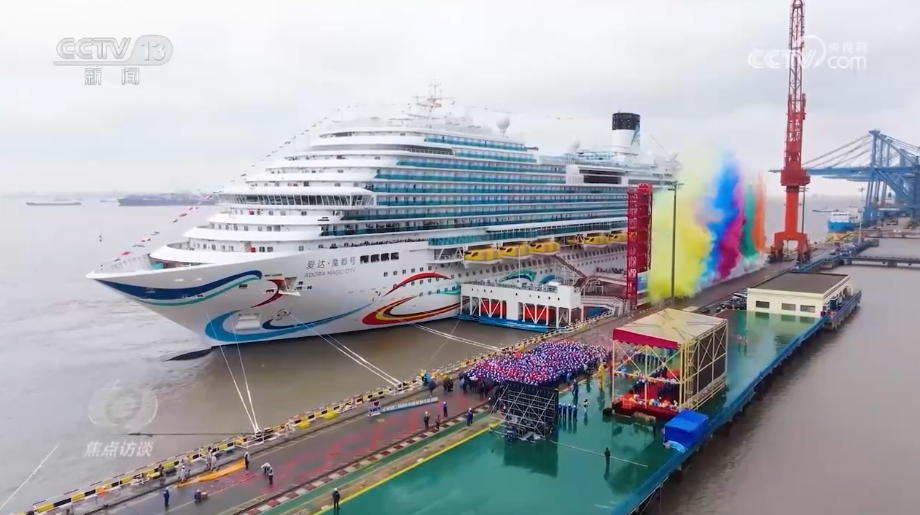
Core Viewpoint - The news highlights the significant achievements of China's manufacturing and shipbuilding industries during the "14th Five-Year Plan" period, showcasing advancements in technology and production capabilities that contribute to national strength and economic development [1][5][7]. Shipbuilding Industry - The successful construction of the second domestically produced luxury cruise ship, "Aida Huacheng," reflects China's growing capabilities in shipbuilding, with delivery expected by the end of 2026 [3]. - The shipbuilding sector has seen a 1:14 multiplier effect on related industries, involving over 500 global suppliers in the design and construction of cruise ships [3]. - The launch of the domestically produced aircraft carrier Fujian marks a new height in China's naval equipment capabilities [5]. Manufacturing Sector - China's total industrial output value increased from 31.3 trillion yuan to 40.5 trillion yuan, while manufacturing output rose from 26.6 trillion yuan to 33.6 trillion yuan during the "14th Five-Year Plan" [7]. - The manufacturing sector's contribution to global growth exceeds 30%, with its output accounting for nearly 30% of global manufacturing [7]. - Innovation has been a driving force, with R&D spending in large manufacturing enterprises exceeding 1.6% of revenue [7]. Advanced Manufacturing - The average annual growth rates for equipment manufacturing and high-tech manufacturing are 7.9% and 8.7%, respectively, with new energy vehicle production surpassing 13 million units last year [9]. - Traditional industries still dominate, accounting for 80% of key manufacturing metrics, emphasizing the need for transformation towards high-end, intelligent, and green manufacturing [9][12]. Smart Manufacturing - The integration of digital and physical economies is exemplified by Nanjing Steel's smart factory, which utilizes AI for efficient production and cost reduction [11][12]. - Over 35,000 basic-level smart factories and 1,260 5G factories have been established, with industrial robots accounting for over 50% of global installations [14]. Specialized Small and Medium Enterprises (SMEs) - The number of specialized and innovative SMEs has exceeded 140,000, contributing significantly to employment and economic vitality [21]. - These SMEs are crucial for enhancing supply chain resilience and driving high-quality economic development [19][21]. - The "14th Five-Year Plan" has seen over 100,000 new specialized SMEs, with a focus on innovation and quality [21].
建信期货焦炭焦煤日评-20251017
Jian Xin Qi Huo· 2025-10-17 06:30
Report Overview - Report Type: Coke and Coking Coal Daily Review [1] - Date: October 17, 2025 [2] - Research Team: Black Metal Research Team [3] 1. Market Performance Summary 1.1 Futures Market - On October 16, the main contracts of coke (J2601) and coking coal (JM2601) futures showed a strengthening trend after fluctuations, recovering most of the losses since September 29. The closing price of J2601 was 1,672.5 yuan/ton, up 2.26%, with a trading volume of 21,965 lots and a position of 42,547 lots (a decrease of 314 lots), and a capital inflow of 0.16 billion yuan. The closing price of JM2601 was 1,185.5 yuan/ton, up 3.36%, with a trading volume of 981,288 lots and a position of 623,751 lots (an increase of 21,901 lots), and a capital inflow of 5.61 billion yuan [5]. 1.2 Spot Market - On October 16, the spot market prices of quasi - first - class metallurgical coke at Rizhao Port, Qingdao Port, and Tianjin Port were all 1,520 yuan/ton, with no change. The prices of low - sulfur main coking coal in different regions such as Tangshan, Lvliang, and Linfen also remained stable [8]. 2. Technical Analysis - On October 16, the daily KDJ indicators of both the coke and coking coal 2601 contracts showed golden crosses. The green bars of the daily MACD of the coke and coking coal 2601 contracts have been narrowing for 2 consecutive trading days [8]. 3. Market Outlook 3.1 News - On October 16, steel mills in Guangdong such as Zhongnan Iron and Steel, Yangchun New Iron and Steel, and Yufeng Iron and Steel issued price - support notices. Sichuan De Sheng and Dazhou Iron and Steel also sent letters to agents to resist the low - price dumping of speculators. - After China's counter - measures in restricting the export of medium and heavy rare earth - related raw materials, equipment, and technology and charging special port fees for US - related ships, the US authorities threatened to impose a 100% tariff on China, but on October 13, they lowered the tone of the Sino - US trade conflict. - BHP has reached an important agreement with Sinomine Resource Group and some Chinese steel manufacturers and traders. Starting from the fourth quarter of 2025, 30% of the amount in BHP's iron ore spot transactions with China will be settled in RMB [10]. 3.2 Fundamentals - **Coke**: As of last week, the coke production of independent coking plants has been slightly declining for 4 consecutive weeks after reaching a new high since late May. The coke production of steel mills has increased significantly after reaching a new low since August 2023 in early September, but the growth rate has narrowed. Port coke inventory has rebounded slightly after falling to a new low since mid - July, while steel mill inventory has started to decline after reaching a new high since late May. Coking plant inventory has rebounded from a new low since late October last year. The profit per ton of coke has turned profitable after 3 consecutive weeks of losses, and the first round of spot price increases for coke was implemented on October 1 [11]. - **Coking Coal**: From January to August, the year - on - year decline in China's coal and lignite imports narrowed by 0.8 percentage points to - 12.2%, and the year - on - year decline in coking coal imports slightly narrowed to - 7.6%. As of last week, the inventory of clean coal and raw coal in mines has dropped significantly in the past 16 weeks, with overall declines of 60.8% and 36.4% respectively. The inventory of independent coking plants has significantly declined from a new high since the end of January, and the inventory of steel mills has declined for 2 consecutive weeks to a new low since late June. Port inventory has rebounded to the level of late July. With the significant inventory reduction of coking plants after restocking, the prices of the main coking coal spot market have continued to be strong [11]. 3.3 Comprehensive Outlook - Geopolitical factors have increased market volatility, but the fundamentals of the coke and coking coal spot markets have supported the futures market. The overall trend of coke and coking coal futures is oscillating strongly. Attention should be paid to the development of Sino - US relations, changes in the supply of the iron ore spot market, the path of steel profit recovery, and the differences in the re - inflation rhythm of precious metals, non - ferrous metals, black metals, and energy and chemical commodities caused by macro - asset allocation [12]. 4. Industry News - According to the latest data from the State Tax Administration, in the first three quarters, the high - quality development of the manufacturing industry continued to advance, with sales revenue increasing by 4.7% year - on - year, accounting for 29.8% of the national corporate sales revenue. The high - end transformation of the manufacturing industry advanced rapidly, with the sales revenue of the equipment manufacturing industry increasing by 9% year - on - year, accounting for 46.9% of the manufacturing industry. In particular, the sales revenue of industries such as computer and communication equipment and industrial mother machines increased by 13.5% and 11.8% respectively year - on - year [13]. - Multiple companies released announcements, including power generation, coal production, and performance forecasts. For example, in the third quarter of 2025, Huaneng International's on - grid power generation decreased by 3.67% year - on - year; Shaanxi Energy's coal production in the third quarter increased by 17.83% year - on - year; Chongqing Iron and Steel expects to reduce losses by 1.12 - 1.14 billion yuan in the first three quarters of 2025 compared with the same period last year [14]. - Shanxi's provincial - owned enterprises have built 137 intelligent coal mines, with advanced coal production capacity accounting for 95%. Enterprises such as Shanxi Coking Coal and Jinneng Holding are piloting the construction of "zero - carbon" mines [14]. - The Jiangsu Provincial Department of Industry and Information Technology issued the "Three - Year Action Plan for Cultivating and Improving the National Advanced Manufacturing Cluster of Southern Jiangsu Special Steel Materials (2025 - 2027)". By 2027, the output value of the cluster's leading industries is expected to reach 1 trillion yuan, the output of special steel and high - end alloys will reach 35 million tons, the R & D investment intensity will be close to 4%, and a series of goals in innovation and enterprise cultivation will be achieved [15]. - On October 14, the US Trade Representative Office (USTR) officially implemented a revised port fee policy, significantly reducing the port fees for Chinese - flagged and Chinese - operated vessels, which alleviated the potential impact on the US coal export industry [15]. 5. Data Overview - The report also presents multiple charts related to the coke and coking coal markets, including spot price indices, production, inventory, and basis, with data sources from Mysteel and the Research and Development Department of CCB Futures [17][21][22][29][30][31]
南钢股份跌2.04%,成交额1.10亿元,主力资金净流出288.58万元
Xin Lang Cai Jing· 2025-10-16 05:26
Core Viewpoint - Nanjing Steel Co., Ltd. (南钢股份) has experienced fluctuations in stock price and trading volume, with a notable increase in revenue and profit in recent periods despite a decrease in overall revenue year-on-year [1][2]. Financial Performance - As of June 30, 2025, Nanjing Steel reported operating revenue of 28.944 billion yuan, a year-on-year decrease of 14.06% [2]. - The net profit attributable to shareholders for the same period was 1.463 billion yuan, reflecting a year-on-year increase of 18.63% [2]. - Cumulative cash dividends since the company's A-share listing amount to 13.436 billion yuan, with 4.954 billion yuan distributed over the last three years [3]. Stock Market Activity - On October 16, 2023, Nanjing Steel's stock price fell by 2.04%, trading at 5.28 yuan per share with a total market capitalization of 32.552 billion yuan [1]. - The stock has increased by 17.70% year-to-date, with a 2.13% rise over the last five trading days, 8.17% over the last 20 days, and 19.70% over the last 60 days [1]. - The company experienced a net outflow of main funds amounting to 2.8858 million yuan, with significant buying and selling activity from large orders [1]. Shareholder Structure - As of June 30, 2025, the number of shareholders increased to 63,700, a rise of 5.10% from the previous period [2]. - The average number of circulating shares per shareholder decreased by 4.85% to 96,856 shares [2]. - The top ten circulating shareholders include various funds and institutions, with notable changes in holdings among them [3].
高股息资产在市场震荡期中更显防御优势,国企红利ETF(159515)红盘上扬
Xin Lang Cai Jing· 2025-10-15 02:40
Core Insights - The China State-Owned Enterprises Dividend Index (000824) has shown a positive trend, with a 0.30% increase as of October 15, 2025, reflecting a shift in investment logic from offshore markets dominated by foreign capital to onshore markets led by domestic capital [1] - High dividend strategies, particularly those involving quality central enterprises, are becoming a core pillar for stabilizing market valuation systems due to their robust profitability and consistent dividend payouts [1] - Dividend investment is viewed as a long-term allocation strategy that transcends style rotations in the A-share market, offering stable cash flow and value appreciation opportunities [1] Index Performance - The China State-Owned Enterprises Dividend Index comprises 100 listed companies selected for their high cash dividend yields and stable dividends, representing the overall performance of high dividend yield securities among state-owned enterprises [2] - As of September 30, 2025, the top ten weighted stocks in the index include COSCO Shipping Holdings (601919), Jizhong Energy (000937), and Lu'an Environmental Energy (601699), with the top ten stocks accounting for 17.15% of the index [2] Stock Performance - Notable stock performances include: - COSCO Shipping Holdings (601919) decreased by 1.01% with a weight of 2.36% - Jizhong Energy (000937) decreased by 0.16% with a weight of 2.00% - Nanjing Steel (600282) increased by 2.62% with a weight of 1.23% [3]