君实生物

Search documents
从“单兵”到“协同”,联合疗法藏着什么玄机?
Ge Long Hui· 2025-12-01 04:26
Core Insights - A paradigm shift in cancer treatment is underway, driven by combination therapies rather than single-agent treatments, as highlighted by Pfizer's strategy to focus on ADC combinations instead of direct comparisons with standard treatments or placebos [1][20] - Combination therapies are emerging as a significant trend in innovative drug development, addressing the limitations of single-agent therapies, such as low response rates and inevitable resistance [1][2] Group 1: Advantages of Combination Therapies - Combination therapies enhance efficacy and response rates, delay the onset of resistance, and maintain durable anti-tumor activity, significantly improving clinical value [2][3] - A notable example is the combination of Osimertinib with chemotherapy, which significantly extended the overall survival (OS) of patients with EGFR-mutant advanced non-small cell lung cancer (NSCLC) [2] Group 2: Market Dynamics and Competitive Landscape - The pharmaceutical industry is experiencing a "combination competition" era, where various combination strategies are being employed across different disease areas, leading to synergistic effects [7][20] - AstraZeneca's Osimertinib, despite being a top-selling drug, faces challenges from competitors and is implementing a comprehensive combination strategy to maintain its market position [5][6] Group 3: Ongoing Research and Development - Numerous clinical trials are underway exploring various combination therapies, including PD-(L)1 inhibitors with chemotherapy and other agents, indicating a robust pipeline in the oncology sector [14][19] - The exploration of combination therapies is not limited to solid tumors; significant advancements are also being made in hematological malignancies, showcasing the broad applicability of this approach [10][12] Group 4: Future Directions - The current landscape of drug development suggests that combination therapies will reshape the research and commercial ecosystem of the pharmaceutical industry, emphasizing the need for companies to adapt to this trend to remain competitive [20]

渤海证券研究所晨会纪要(2025.12.01)-20251201
BOHAI SECURITIES· 2025-12-01 02:07
Macro and Strategy Research - The report highlights a divergence in the Federal Reserve's stance on interest rate cuts, with a 70% market expectation for a cut in December, although the actual impact may be similar whether it occurs in December or January [3][4] - In the U.S., retail sales showed a slowdown, particularly in the automotive sector, while investment in AI-related fields continues to support economic growth [3] - Domestic industrial profits have declined, with a notable drop in profits for mid and downstream industries, while upstream sectors benefited from stable raw material prices [4] Fixed Income Research - The report indicates a downward trend in the average issuance guidance rates for credit bonds in 2025, with a decrease of 151 basis points to 39 basis points compared to 2024 [5][7] - Credit bond issuance in 2025 decreased compared to the previous year, but net financing increased, indicating a shift in market dynamics [7] - The report emphasizes the importance of liquidity in the bond market, with a focus on the "debt and development" narrative, suggesting that credit risk is perceived to be low [7][8] Industry Research - The report discusses the State Council's initiative to promote provincial-level coordination of basic medical insurance, enhancing the system's security capabilities [13][17] - Recent FDA approvals for innovative treatments, such as BeiGene's Sotigalimab for lymphoma, highlight the ongoing advancements in the biopharmaceutical sector [14][15] - The report notes a decline in the SW pharmaceutical index, with a current P/E ratio of 51.78, indicating a significant premium over the CSI 300 index [16] - The report recommends focusing on investment opportunities in the innovative drug sector, particularly in diagnostics, vaccines, and related pharmaceutical companies [16]
医药生物行业周报(11月第4周):地方跟进医疗器械支持政策-20251201
Century Securities· 2025-12-01 01:55
Investment Rating - The report does not explicitly state an investment rating for the industry [2] Core Views - The pharmaceutical and biotechnology sector saw a weekly increase of 2.67%, underperforming the Wind All A index (2.9%) but outperforming the CSI 300 index (1.64%). The raw material drug sector experienced a decline of 4.27%, while chemical preparations and pharmaceutical circulation products increased by 4.18% and 3.71%, respectively [3][8] - Recent policies in Shanghai and Beijing aim to support the high-quality development of the medical device industry, indicating a shift towards innovation and global competitiveness in this sector. The report suggests monitoring the transformation progress of leading companies in the medical device field [3][12] - Flu activity is on the rise, with the percentage of flu-like cases reported by sentinel hospitals in southern provinces reaching 7.8%, up from 6.8% the previous week, and higher than the same period in 2022 and 2024 [3][11] Summary by Sections Market Weekly Review - The pharmaceutical and biotechnology sector increased by 2.67% from November 24 to November 28, 2025, with raw material drugs declining by 4.27% and chemical preparations increasing by 4.18% [8][9] - Individual stock performances included significant gains for Haiwang Biological (38.2%), Yue Wannianqing (36.2%), and Guangji Pharmaceutical (31.7%), while *ST Changyao (-15.3%), Huitai Medical (-9.6%), and Kangwei Century (-8.8%) saw notable declines [11] Industry News and Key Company Announcements Important Industry Events - The report highlights the increase in flu-like illness percentages in both southern (7.8%) and northern (8.6%) provinces, indicating a significant rise in flu activity compared to previous years [11][12] Industry News - Significant approvals were noted, including the NMPA's approval of Xinmeiyue® for treating moderate to severe plaque psoriasis and the FDA's accelerated approval of Sibeprenlimab for IgAN treatment [12][14] Company Announcements - Notable announcements include the FDA approval of a generic injectable drug by Jianyou Co. and the successful completion of a Phase III trial for JS001sc, a subcutaneous PD-1 monoclonal antibody for non-small cell lung cancer [15][16]





医药行业周报:关注吸入制剂在呼吸疾病领域的突破-20251130
Huaxin Securities· 2025-11-30 13:03
证 券 研 究 报 告 行业周报 关注吸入制剂在呼吸疾病领域的突破 医药行业周报 投资评级: 报告日期: 推荐 ( 维持 ) 2025年11月30日 分析师:胡博新 SAC编号:S1050522120002 分析师:吴景欢 SAC编号:S1050523070004 医 药 行 业 观 点 在呼吸疾病领域,如IPF、COPD等,吸入制剂+新靶点组合正取得更多积极的治疗效果。2025年6月10日,Insmed公布其 治疗PAH(肺动脉高压)新药TPIP(曲前列环素棕榈醇吸入粉剂)的临床2b期顶线数据,安慰剂校正的PVR较基线降低35%, LS均值比0.65(p<0.001)。其冻干粉制剂的设计,不仅实现了用药的方便性,只需每日一次,而且治疗效果也优于曲前 列环素的口服品种。7月9日,默沙东宣布收购一家专注于呼吸系统疾病的生物制药公司Verona Pharma,总交易价值约为 100亿美元。通过此次收购,默沙东将获得一款用于治疗慢性阻塞性肺病(COPD)的重磅新药Ohtuvayre(恩司芬群), 这是一种针对磷酸二酯酶3和4(PDE3和PDE4)的首创选择性双重抑制剂。FDA于2024年6月批准Ohtuvayre用 ...
医药2026年度策略报告:黎明渐显,创新为纲-20251130
China Post Securities· 2025-11-30 11:51
Investment Strategy Overview - The core investment strategy for the pharmaceutical sector in 2026 emphasizes innovation and the recovery of profitability within the industry, as the sector has shown signs of stabilization after a period of volatility [4][30]. Innovative Drug Industry Chain - The domestic innovative drug sector is gaining global recognition, with a significant increase in the attention from multinational corporations (MNCs) towards domestic assets. The demand for new products is strong, driven by the approaching patent cliffs for MNCs and favorable policies for domestic drugs entering international markets [5][44]. - The market for PD-(L)1/VEGF bispecific antibodies is experiencing heightened interest, with complementary mechanisms to antibody-drug conjugates (ADCs) expected to drive synergy and growth [5][51]. - The demand for new therapeutic modalities such as peptides, ADCs, small nucleic acids, and cell and gene therapies (CGT) is projected to maintain high growth rates, supported by a recovering outsourcing demand during the overseas interest rate decline [6][43]. Non-Pharmaceutical Sector - The medical device sector is showing signs of recovery, with some companies reporting improved performance in Q3 2025. The bidding for medical equipment is expected to continue recovering, leading to better performance in 2026 [6][7]. - The traditional Chinese medicine sector is anticipated to benefit from ongoing adjustments to the essential drug list, with opportunities for price increases and improved profit margins for leading companies [6][7]. Retail Pharmacy Sector - The retail pharmacy industry is undergoing accelerated consolidation, with leading pharmacies optimizing their store structures to alleviate profit pressures. This is expected to result in a noticeable improvement in profit margins in 2026 [7]. Market Performance and Valuation - The pharmaceutical sector has shown a rebound since early 2025, with a notable increase in the market index, outperforming the broader market indices. As of November 21, 2025, the CITIC Pharmaceutical Index had risen by 14.68% [15][30]. - The valuation of the pharmaceutical sector is at a historical median since 2010, with a price-to-earnings (PE) ratio of 48.38X, indicating a high premium compared to the broader market [17][30]. - The scale of pharmaceutical funds reached a record high of 226 billion yuan by Q3 2025, although the market capitalization of pharmaceutical stocks remains below historical peaks, suggesting potential for growth [20][24]. Financial Performance - The pharmaceutical sector's revenue for the first three quarters of 2025 was 185.46 billion yuan, reflecting a year-on-year decline of 1.34%. However, Q3 2025 showed a revenue increase of 1.18% compared to the previous quarter, indicating signs of recovery [30][31]. - The net profit attributable to shareholders for the pharmaceutical sector in the first three quarters of 2025 was 14.06 billion yuan, down 1.69% year-on-year, but with a positive growth of 3.61% in Q3 2025 compared to the previous quarter [30][31].


联合研究|组合推荐:长江研究2025年12月金股推荐
Changjiang Securities· 2025-11-30 09:14
Economic Outlook - Domestic policy expectations are rising in December, and the probability of a Federal Reserve rate cut is increasing, which may lead to improved external liquidity and a potential market rebound[5] - Key focus areas include the upcoming Central Economic Work Conference and the potential for a Federal Reserve rate cut, which could lead to a valuation recovery in the technology sector[5] Investment Strategy - The report emphasizes three main investment themes: 1. Technology growth sectors, particularly AI hardware like optical modules and semiconductors, as well as energy storage and lithium battery sectors[5] 2. Market hot spots such as robotics and innovative pharmaceuticals, which are expected to rebound[5] 3. Chemical industries benefiting from "anti-involution" policies that optimize supply-demand dynamics[5] Recommended Stocks - Key recommended sectors include metals, chemicals, electric new energy, machinery, banking, automotive, pharmaceuticals, electronics, communications, and media[5] - Specific stock recommendations include: - Metals: Huaxi Nonferrous (华锡有色) with an expected EPS growth from 1.04 in 2024 to 2.17 in 2027[28] - Chemicals: Yara International (亚钾国际) with an expected EPS growth from 1.02 in 2024 to 5.87 in 2027[28] - Electric New Energy: Slin (斯菱股份) with an expected EPS growth from 1.73 in 2024 to 2.21 in 2027[28] - Machinery: Hengli Hydraulic (恒立液压) with an expected EPS growth from 1.87 in 2024 to 3.18 in 2027[28] - Banking: Bank of Communications (交通银行) with a projected PB of 0.58x in 2025[18] - Automotive: Top Group (拓普集团) with an expected EPS growth from 1.78 in 2024 to 2.38 in 2027[28] - Pharmaceuticals: Junshi Biosciences (君实生物) with a projected EPS turnaround by 2027[28] - Electronics: Dongshan Precision (东山精密) with an expected EPS growth from 0.64 in 2024 to 3.72 in 2027[28] - Communications: Zhongji Xuchuang (中际旭创) with projected net profits of 105.19 billion in 2025[26] - Media: Kaiying Network (恺英网络) with a projected EPS growth from 0.76 in 2024 to 1.47 in 2027[28] Risk Factors - Economic recovery may fall short of expectations due to slow employment growth, declining corporate revenues, and reduced market demand[30] - Significant changes in individual stock fundamentals could adversely affect performance[30]





制造业劳动生产率,中美孰高孰低?
Cai Jing Wang· 2025-11-28 08:13
Core Viewpoint - The article presents a paradox where China's manufacturing sector exhibits strong global competitiveness despite academic reports indicating its labor productivity is significantly lower than that of the United States. The author argues that the methodology used in these studies is flawed, leading to incorrect conclusions about China's labor productivity [1][15]. Methodological Issues - Traditional methods of measuring labor productivity through value-added calculations can obscure differences in product quality and types, leading to inaccurate comparisons between countries [2]. - The classification differences between U.S. and Chinese manufacturing statistics contribute to misleading productivity comparisons. U.S. statistics include companies that do not manufacture products, while China only includes actual manufacturers [3][4]. - The use of purchasing power parity (PPP) indices to compare value-added across countries may not accurately reflect price differences, complicating productivity assessments [5]. Industry Comparisons - The research focuses on five key industries: shipbuilding, steel, electric vehicles, solar photovoltaic components, and cement. It finds that Chinese workers' per capita output is 2 to 3 times that of their U.S. counterparts, while nominal value-added is about 20% lower due to price differences [7][8]. - In the cement industry, China's per capita output is slightly higher than that of the U.S., but its nominal value-added is only 28% of the U.S. level, primarily due to significant price disparities [8]. Labor Productivity Metrics - The analysis indicates that in shipbuilding, steel, and electric vehicles, China's labor productivity is superior when measured by physical output. For instance, in shipbuilding, China's per capita output is 2.5 times that of the U.S. [16]. - The average nominal wage for Chinese workers is significantly lower than that of U.S. workers, which is attributed to the overall lower wage levels in China rather than lower productivity [8][15]. Trade Barriers and Their Impact - Trade barriers, such as tariffs, inflate domestic prices in the U.S., leading to higher nominal value-added figures without necessarily improving labor productivity [9][11]. - The structural price differences between the U.S. and China further complicate productivity comparisons, particularly in industries like electric vehicles and pharmaceuticals [12][13]. Global Competitive Advantage - China's manufacturing sector is increasingly moving up the value chain, focusing on high-end manufacturing while outsourcing low-end production to countries with lower wages. This strategy enhances China's global competitiveness [17]. - The article suggests that the U.S. should focus on expanding its advantages in high-tech sectors rather than attempting to regain lost ground in general manufacturing, which may lead to adverse economic outcomes [17].


港股开盘:恒指涨0.25%、科指涨0.43%,科网股、黄金股及创新高概念股走高
Jin Rong Jie· 2025-11-28 01:45
Market Overview - The Hong Kong stock market opened slightly higher on November 28, with the Hang Seng Index rising by 0.25% to 26,011.06 points, the Hang Seng Tech Index increasing by 0.43% to 5,622.36 points, and the State-Owned Enterprises Index up by 0.34% to 9,196.22 points [1] - Major technology stocks showed positive movement, with Alibaba up by 0.8%, JD Group up by 0.52%, Xiaomi up by 0.19%, NetEase up by 0.65%, Meituan up by 0.48%, and Bilibili-W up by 0.97% [1] - Metal stocks continued to rise, with Chalco International increasing by 6%, and both Zhaojin Mining and Zijin Mining also showing gains [1] - The innovative drug concept opened high, with Innovent Biologics rising over 1% [1] - Gold stocks generally rose, with Zijin Mining increasing by over 1% [1] - Chip stocks were active, with SMIC rising over 1% [1] - Sportswear, home appliance, and gaming stocks experienced declines [1] Company Earnings - Virginie (02199.HK) reported revenue of HKD 3.84 billion for the six months ending September 30, 2025, a decrease of 3.45%, while net profit increased by 114.25% to HKD 145 million [2] - Huport United (01001.HK) achieved revenue of HKD 1.023 billion, up by 3.34%, but profit decreased by 3.64% to HKD 52.9 million [2] - Disengage Creation (00113.HK) reported revenue of HKD 973 million, a year-on-year increase of 1.2%, with net profit rising by 14.02% to HKD 150 million [2] - Sanhe Construction Group (03822.HK) saw revenue from customer contracts increase by 20.8% to HKD 470 million, with net profit soaring by 1364.7% to HKD 47.41 million [2] - Bojun Education (01758.HK) reported revenue of HKD 379 million, down by 11.9%, with a loss of HKD 130 million, an increase of 227.6% year-on-year [2] - Jiejiao Holdings (00064.HK) reported revenue of HKD 172 million, a decrease of 21.01%, while profit increased by 57.59% to HKD 49.51 million [2] Strategic Developments - Tiande Real Estate (00266.HK) reported revenue of HKD 152 million, down by 2.5%, with losses narrowing by 72.9% to HKD 75.43 million [3] - Kailian International Hotel (00105.HK) reported revenue of HKD 148 million, down by 2.34%, with losses decreasing by 69.77% to HKD 148 million [3] - Safety Warehouse (00237.HK) reported revenue of HKD 84.1 million, down by 9.97%, with a loss of HKD 17.56 million, transitioning from profit to loss [3] - Qingdao Beer Co. (00168.HK) plans to engage in wealth management investment with a maximum daily balance of RMB 10 billion [3] - Junshi Biosciences (01877.HK) plans to use up to RMB 2.4 billion of temporarily idle fundraising for cash management [3] - China Anshun Energy (02399.HK) signed a memorandum of understanding with Guo Heng for further investment in energy-related projects [3] Mergers and Acquisitions - Yanzhou Coal Mining (01171.HK) plans to acquire 100% equity of a high-end support company for HKD 345 million [4] - Beijing University Blue Sky Universe (08095.HK) intends to invest approximately HKD 130 million to acquire the remaining 30% equity of Shanghai Shengjin Venture Capital Co., focusing on new materials, energy conservation, and high-end equipment manufacturing [4] Industry Insights - CICC predicts that the excellent performance of Hong Kong stocks in 2025 will be driven by liquidity and sentiment, with a focus on "excess liquidity" chasing "scarce return assets" [6] - Zhongyuan Securities expects the semiconductor industry to continue its upward trend in 2025, driven by U.S. export controls and the "15th Five-Year Plan" emphasizing technological self-reliance [6] - CITIC Securities notes that copper prices have retreated by 3% since reaching a historical high of USD 11,200 per ton due to a lack of new drivers [6]
上海君实生物医药科技股份有限公司 关于使用暂时闲置募集资金进行现金管理的公告
Zhong Guo Zheng Quan Bao - Zhong Zheng Wang· 2025-11-28 00:33
Core Viewpoint - The company has approved a plan to manage temporarily idle raised funds through cash management, aiming to enhance fund utilization efficiency while ensuring the safety and intended use of the funds [1][3][7] Cash Management Overview - The purpose of cash management is to improve the efficiency of raised fund usage and generate additional returns for the company and its shareholders, without affecting the normal operation of investment projects [1][3] - The company plans to invest up to RMB 2.4 billion in safe, liquid principal-protected investment products, including but not limited to time deposits and structured deposits, within a 12-month period [1][3] - The funds for cash management will come from temporarily idle raised funds from the company's 2022 A-share issuance [1][3] Implementation and Oversight - The board of directors has authorized the chairman to make investment decisions and sign relevant legal documents, with the finance department responsible for implementation [2][3] - The company will adhere to regulatory requirements for information disclosure and will not change the intended use of the raised funds [2][3] Impact on Daily Operations - The cash management plan will not affect the normal cash flow needs or the operation of investment projects, ensuring that the company's main business continues to develop normally [6][7] - As of June 30, 2025, all initial public offering projects have been completed, and the raised funds will be used in accordance with the overall project schedule [6][7] Opinions from Intermediaries - The company's sponsor, Guotai Junan Securities, has confirmed that the cash management plan complies with relevant regulations and will not change the intended use of the raised funds, thus benefiting the company and its shareholders [7]
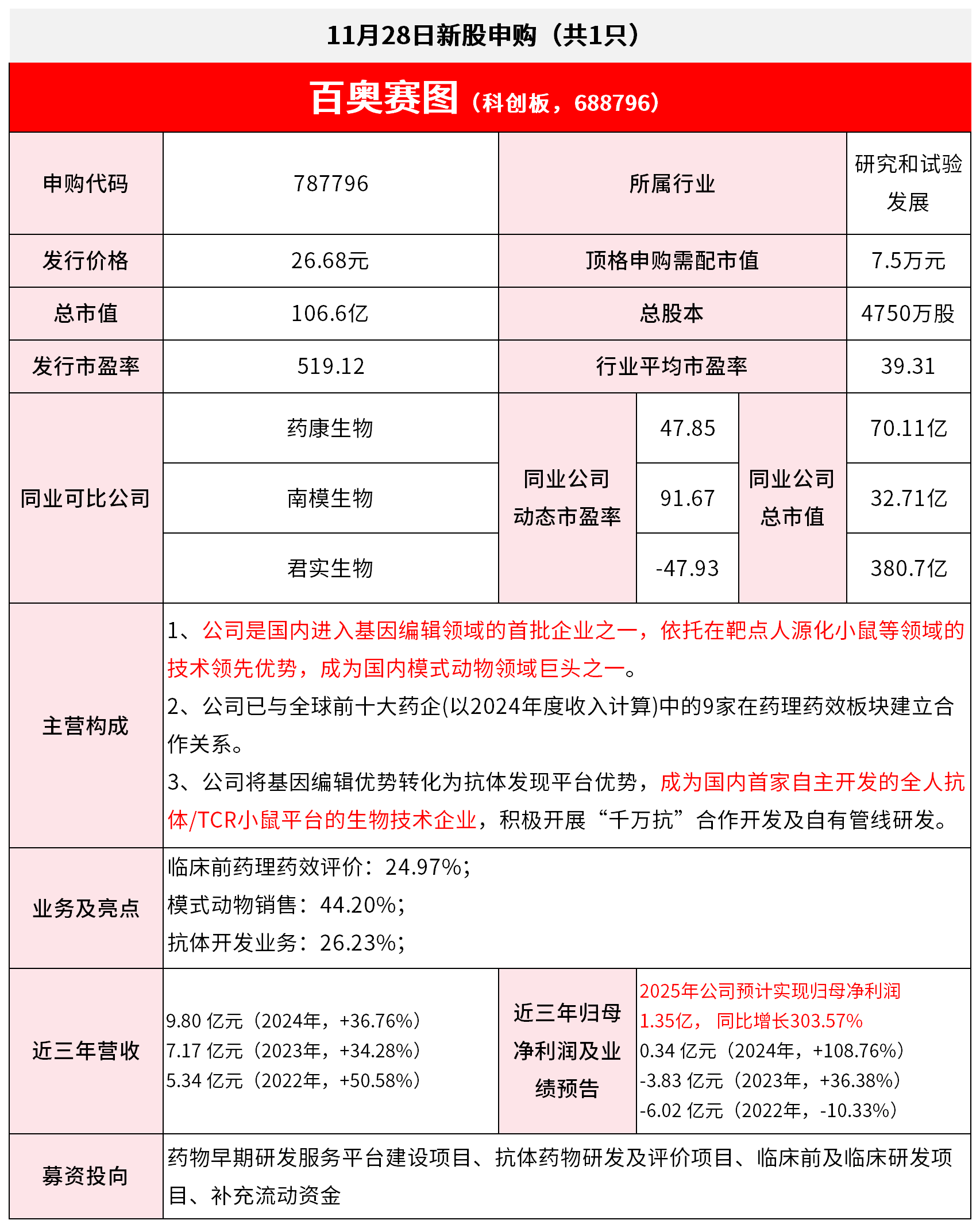
【11月28日IPO雷达】百奥赛图申购
Xuan Gu Bao· 2025-11-28 00:04
Core Viewpoint - The article discusses the upcoming IPO of Bai'ao Saitou on the Sci-Tech Innovation Board, highlighting its market position, financial performance, and future growth prospects [2][3]. Company Overview - Bai'ao Saitou is one of the first companies in China to enter the gene editing field, establishing itself as a leader in the model organism sector [2]. - The company has partnerships with the top ten global pharmaceutical companies based on projected 2024 revenues [2]. Financial Performance - The total market value of Bai'ao Saitou is 10.66 billion yuan, with an issuance price of 26.68 yuan per share and a high price-to-earnings ratio of 519.12 [2]. - The company reported revenue of 980 million yuan in 2024, reflecting a year-on-year growth of 36.76%, with previous years showing revenues of 717 million yuan in 2023 (+34.28%) and 534 million yuan in 2022 (+50.58%) [3]. Business Segmentation - The company's revenue composition includes: - Antibody development business: 26.23% - Model organism sales: 44.20% - Preclinical pharmacology and efficacy evaluation: 24.97% [2][3]. Fundraising Purpose - The funds raised from the IPO will be directed towards the construction of an early drug research and development service platform, antibody drug development, and to supplement working capital [3].