
广达

Search documents
世界正在重新认识中国
Xin Lang Cai Jing· 2025-12-20 08:26
Group 1 - Nvidia CEO Jensen Huang stated that in the next 5 to 10 years, "China will win" the generative AI competition due to its vast workforce dedicated to AI development compared to the U.S. [2][4] - Huang criticized U.S. export controls on China, calling them one of the "stupidest things" the U.S. has done, suggesting that such actions only empower China's efforts in AI [2][4] - The article highlights a significant gap in perception between China's rapid development and the Western world's understanding, which has historically been shaped by outdated views [5][6] Group 2 - The article discusses how recent events, such as the backlash against TikTok and increased tourism to China, have led to a shift in perception among Western youth and experts regarding China's advancements [6][8] - Influential figures like Thomas Friedman and Elon Musk have acknowledged China's progress, with Friedman stating, "I see the future, and it is not in America," indicating a growing recognition of China's potential [8][9] - The article emphasizes the advantages of China's economic model, which combines private enterprise efficiency with state-owned enterprise social equity, allowing for long-term strategic development [8][9]



特朗普最强AI军团…携手英伟达、Google等科技巨头 带旺台链
Jing Ji Ri Bao· 2025-12-16 23:30
Group 1 - The Trump administration announced the formation of the "US Tech Force," a research team of 1,000 engineers and experts, inviting major tech companies like Apple, NVIDIA, Oracle, Google, Dell, Microsoft, and OpenAI to participate in advancing AI infrastructure and digital transformation in the US [1][2] - The initiative is seen as a strong endorsement of AI development in the US, aiming to mitigate concerns about an "AI bubble" and ensuring robust growth in the sector under US dominance [1] - Taiwanese server manufacturers, including Hon Hai, Quanta, and Wistron, are expected to benefit significantly from the upcoming large orders related to AI infrastructure, as they hold over 90% of the global market share in AI server manufacturing [1] Group 2 - Hon Hai's global market share in AI servers exceeds 40%, positioning it as a key partner for the US in AI development, with expectations of increased market share driven by upcoming product launches from NVIDIA [1] - Quanta is optimistic about the AI server business, with visibility of orders extending at least until the end of 2026, and plans to expand AI server production capacity to meet strong customer demand [2] - The "US Tech Force" aims to recruit 1,000 engineers and experts with annual salaries ranging from $150,000 to $200,000, reflecting a significant effort to modernize the US workforce in response to the rapid expansion of AI ecosystems, particularly in competition with China [2]
2025年出货量下调至2.73万台
傅里叶的猫· 2025-12-14 12:37
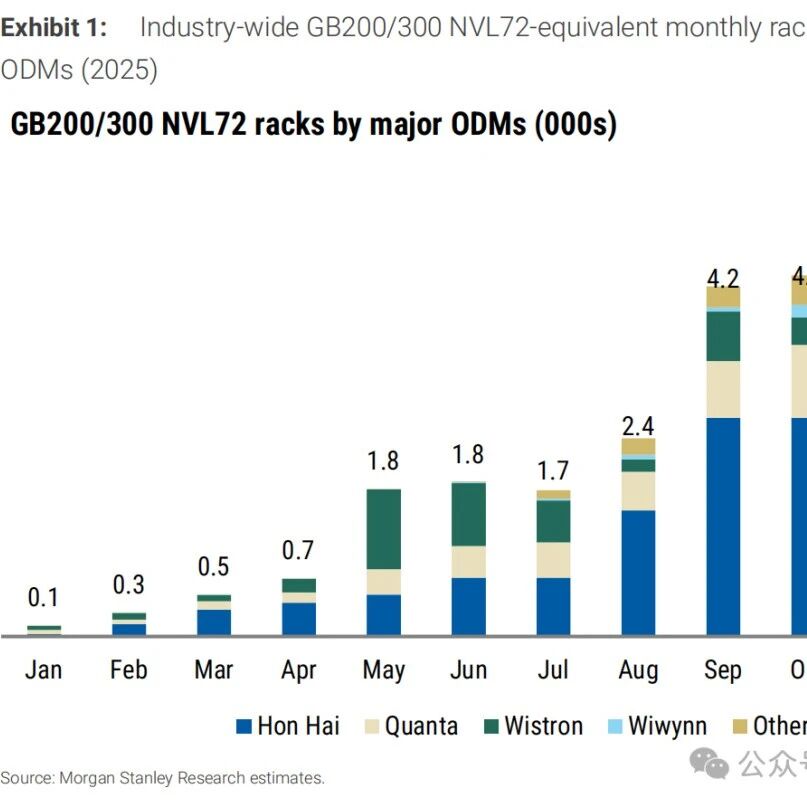
Core Viewpoint - The article discusses the AI industry chain, focusing on infrastructure, algorithms, and applications, while providing insights from recent reports by Morgan Stanley and JP Morgan regarding ODM manufacturers' performance and shipment forecasts. ODM Manufacturers' Performance and Shipment Analysis - Morgan Stanley ranks ODM manufacturers for GPU AI servers as Wistron > Hon Hai > Quanta [2][18] - Morgan Stanley's latest forecast for GB200/300 rack shipments is adjusted to 27,300 units, down from 28,000 units, primarily due to updates following Quanta's Q3 earnings call [2] - Quanta's management indicates a conservative outlook for AI revenue growth in Q1 2026, leading to a downward adjustment of their Q4 2025 rack shipment forecast from approximately 3,500 to 2,500 units [7] - Despite Quanta's adjustment, Wistron shows strong growth, leading to a slight increase in overall rack shipment forecasts for Q4 2025, from 8,000-8,500 to 13,500-14,000 units [7] Company-Specific Revenue Insights - Quanta reported November revenue of approximately NT$193 billion, with a month-on-month increase of 11% and a year-on-year increase of 36%, driven by GB200/300 rack shipments expected to reach 1,000-1,100 units [13] - Wistron achieved a record revenue of NT$281 billion in November, with a month-on-month increase of 52% and a year-on-year increase of 195%, attributed to significant increases in L10 computing tray shipments [14] - Hon Hai's November GB200 rack shipments remained stable at approximately 2,600 units, with expectations of a decline in December due to year-end holidays, maintaining a forecast of 7,200 units for Q4 2025 [15] 2026 Preliminary Outlook - The forecast for rack shipments in 2026 is challenging, but Morgan Stanley has adjusted its estimate to 70,000-80,000 units, up from 60,000-70,000 units, based on anticipated inventory carryover of approximately 2 million Blackwell chips [17] - Morgan Stanley maintains the ranking of ODM manufacturers as Wistron > Hon Hai > Quanta, noting that actual deliveries may be lower than predicted due to assembly and testing times for L11 racks not being included in the estimates [18]
2026年,AI服务器贵贵贵
3 6 Ke· 2025-12-11 11:51
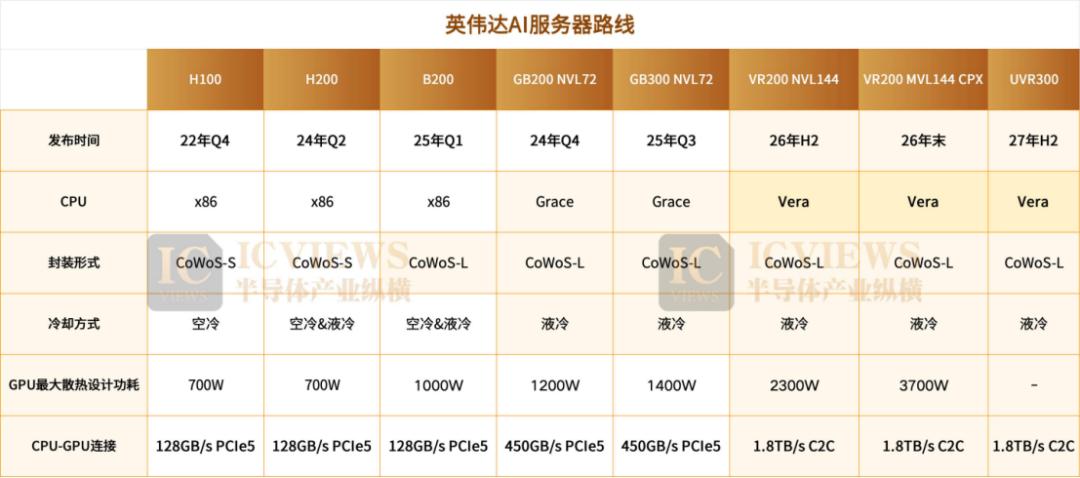
Core Insights - The AI server hardware is undergoing a significant design upgrade driven by GPUs and ASICs, with new platforms from NVIDIA and AMD expected to enhance computing power and cabinet density by 2026 [1][4] - The demand for AI servers is surging, with NVIDIA's platform projected to see cabinet demand more than double from approximately 28,000 units in 2025 to at least 60,000 units in 2026 [2] - The transition to advanced cooling and power solutions is essential as GPU power consumption increases, leading to a complex engineering system for future AI data centers [4][5] AI Server Demand - The demand for AI servers continues to rise, with NVIDIA's platform expected to see cabinet demand increase significantly [2] - AMD's Helios server rack project is also making progress, further intensifying the market demand for advanced AI hardware [2] NVIDIA AI Server Roadmap - NVIDIA's upcoming AI server platforms include the GB300 and Vera Rubin series, with increasing power consumption from 700W for H100 to 3700W for the upcoming VR200 platform [4][22] - The GB200 platform is currently the core driver of the AI server market [3] Supply Chain and Production - Major ODM manufacturers like Hon Hai, Quanta, Wistron, and Wiwynn are key suppliers for NVIDIA's AI server cabinets, with Hon Hai leading in production [10] - Hon Hai's AI server cabinet shipments increased by 300% quarter-over-quarter, with expectations to exceed NT$1 trillion in revenue by 2025 [10] Revenue and Market Share - In November, Quanta, Wistron, and Wiwynn reported record monthly revenues, with significant year-over-year growth [12] - By 2025, Hon Hai is expected to capture over 40% of the AI server market share, with GB200 and GB300 platforms dominating shipments [12] Industry Upgrades - The shift to NVIDIA's GB300 and Vera Rubin platforms represents a new cycle in AI hardware, prompting a reevaluation of supply chain components [13] - The power supply and cooling systems are undergoing significant changes to accommodate the increasing power demands of AI workloads [14][16] Power Supply Innovations - NVIDIA's Kyber power supply strategy aims to redefine data center power architecture, with projected values for Rubin Ultra cabinets expected to exceed ten times that of current GB200 cabinets by 2027 [16] - The transition to 800V DC power solutions is critical for meeting the demands of modern AI data centers [14][16] Cooling Solutions - NVIDIA's cooling technology is evolving from air cooling to liquid cooling solutions to manage the rising thermal demands of high-performance GPUs [17][22] - The value of cooling components for AI servers is expected to increase significantly, with projections indicating a 17% rise for the next generation of cooling modules [22] PCB Demand Surge - The upgrade of AI servers is driving a surge in demand for high-end PCBs, with manufacturers increasing production capacity for advanced multi-layer boards [23][24] - The market for high-end PCBs is expected to grow significantly, with prices for advanced boards potentially doubling due to increased complexity [23] CSP Capital Expenditure - Major cloud service providers (CSPs) are ramping up capital expenditures to support the growing demand for AI infrastructure, with projected increases in spending for 2025 and 2026 [26][29] - The total capital expenditure for the eight major CSPs is expected to exceed $600 billion in 2026, reflecting strong long-term growth potential in AI infrastructure [26][29]
2026年,AI服务器贵、贵、贵
Tai Mei Ti A P P· 2025-12-11 11:01
Core Insights - 2026 is identified as a critical window for AI server system upgrades, driven by significant design changes in GPU and ASIC technologies [1][4] - The demand for AI servers is expected to surge, with NVIDIA's platform projected to see cabinet demand more than double from approximately 28,000 units in 2025 to at least 60,000 units in 2026 [2][26] - The overall cost of AI servers is anticipated to rise significantly due to advancements in power supply, cooling solutions, and PCB requirements [5][26] Group 1: AI Server Hardware Upgrades - NVIDIA is set to launch the GB300, Vera Rubin platform, and Kyber architecture in 2026, enhancing computational power and cabinet density [1][4] - The GPU power design is evolving, with TDP increasing from 700W for H100 to 3700W for VR200 NVL44 CPX by late 2026, necessitating a shift to liquid cooling solutions [4][23] - The transition to more efficient power systems is underway, moving from 12V VRM to 48V DC bus systems to reduce conversion losses [4][14] Group 2: Market Demand and Supply Chain Dynamics - ODM manufacturers like Hon Hai, Quanta, Wistron, and Wiwynn are ramping up production, with Hon Hai's AI server cabinet shipments increasing by 300% quarter-over-quarter [10][12] - In November, Quanta and Wistron reported record monthly revenues, with Wistron showing a remarkable 194.6% year-over-year growth [12] - The market share for AI server cabinets in 2025 is projected to see Hon Hai holding over 52%, with Quanta and Wistron at approximately 19% and 21%, respectively [13] Group 3: Power and Cooling Solutions - NVIDIA's Kyber project aims to redefine power supply architecture for AI data centers, with a target to produce new power solutions by the end of 2026 [15][17] - The cooling technology is evolving from air cooling to liquid cooling, with the GB300 adopting a full cold plate liquid cooling solution to handle up to 1400W [18][23] - The cost of cooling components is expected to rise, with the total value of cooling components for the next-generation Vera Rubin platform projected to increase by 17% [23] Group 4: PCB and Component Upgrades - The demand for high-end PCBs is surging, with the number of layers and material quality increasing significantly due to the enhanced functionality of AI servers [24][25] - The global PCB market is expected to grow, with high-end HDI boards and multi-layer boards seeing demand increases of 14.2% and 18.5%, respectively [25] - The price of PCBs is anticipated to double with each upgrade cycle, reflecting the growing complexity and performance requirements of AI hardware [25] Group 5: Capital Expenditure Trends - Major cloud service providers (CSPs) are increasing their capital expenditures, with a projected total of over $600 billion in 2026, reflecting a 40% year-over-year growth [26][29] - CSPs like Google, Meta, and Amazon are significantly raising their capital expenditure forecasts for 2025, indicating strong demand for AI infrastructure [29] - The ongoing investment from CSPs provides a solid foundation for the rising costs associated with AI server upgrades [26][29]
科技2026展望:算力高景气延续,关注端侧AI创新机遇
Zhao Yin Guo Ji· 2025-12-11 05:30
Investment Rating - The report suggests a positive outlook for the technology sector, particularly focusing on AI computing infrastructure and end-side AI innovations [1][24]. Core Insights - The global technology industry is expected to experience a dual trend of differentiated terminal demand and accelerated AI innovation by 2026, driven by rapid iterations of AI large models [1][24]. - The report highlights two main investment themes: 1) AI computing infrastructure, where VR/ASIC architecture upgrades will drive growth in ODM and component suppliers; 2) End-side AI innovations, particularly in AI smartphones, PCs, and glasses, with companies like Luxshare Precision, Hontai Precision, BYD Electronics, Sunny Optical, AAC Technologies, and Xiaomi Group being key players [1][24]. Summary by Sections Server Market - The global server market is projected to be dominated by AI infrastructure investments, with AI server shipments expected to grow by 50% year-on-year to 2.32 million units in 2026 [2][25]. - The market will see a "GPU/ASIC dual-drive" pattern, with VR/ASIC architecture reshaping value and driving demand for connectors, cables, and power supply components [2][25]. Smartphone Market - Global smartphone shipments are anticipated to decline by 5% year-on-year to 1.18 billion units in 2026, primarily affecting low-end models due to macro uncertainties and rising storage costs [2][25]. - However, the high-end market remains resilient, with Apple expected to launch innovative products, including the first foldable iPhone and AI-driven devices [2][25]. AR/VR Market - The report forecasts that global AI glasses shipments will exceed 10 million units by 2026, marking a significant growth in the wearable technology sector [2][25]. - Major tech companies are accelerating their investments in AR/VR, with advancements in optical technologies expected to unlock further potential in the coming years [2][25]. PC and Automotive Electronics - The global PC market is expected to face challenges, with a projected 2% decline in shipments to 275 million units in 2026, influenced by the end of the Windows 11 upgrade cycle and rising storage costs [2][25]. - AI PCs are expected to penetrate the market significantly, with projections indicating that they will account for over 50% of shipments by 2026 [2][25]. Memory Price Impact - The report discusses the impact of rising memory prices on the technology supply chain, predicting that short-term pressures will affect mid-to-low-end consumer markets while high-end products may buffer the cost increases [27][30].





算力需求毫无停滞迹象!AI服务器“代工三巨头”11月业绩齐创历史新高
美股IPO· 2025-12-10 03:38
纬创领跑增长,11月营收同比大幅增长194.6%,AI服务器出货创新高;广达11月营收同比增36.5%,主要受惠AI服务器出货动能增加。纬颖11月营收同 比增158.6%,云服务供应商大客户需求持续放量。 AI服务器代工三大厂商广达、纬创及纬颖11月营收齐创单月历史新高,反映全球云端服务供应商持续加码AI基础设施建设,算力需求强劲增长态势未现 停滞迹象。 最新数据显示,纬创表现最为突出,11月合并营收冲上2806.24亿元新台币,环比增51.6%,同比增幅更高达194.6%。广达、纬颖营收分别达1929.47 亿元及968.85亿元新台币,环比增幅分别为11.4%和6.2%。 分析预期,随着英伟达新款GB300架构AI服务器进入出货旺季,三家厂商本季业绩有望齐创新高,推动全年营收交出至少年增五成以上的优异成绩。 这一业绩表现凸显全球AI算力需求的持续扩张,为投资者提供了AI产业链景气度延续的重要信号。 纬创领跑增长,AI服务器出货创新高 纬创11月业绩表现最为亮眼,合并营收2806.24亿元新台币,不仅月增51.6%,更较去年同期大幅增长194.6%。 公司透露,11月笔电出货量220万台,月增10万台,桌上 ...

AI进入“液冷时代”,市场低估了“转变力度”,国产供应链正加速入局
Hua Er Jie Jian Wen· 2025-12-08 03:07
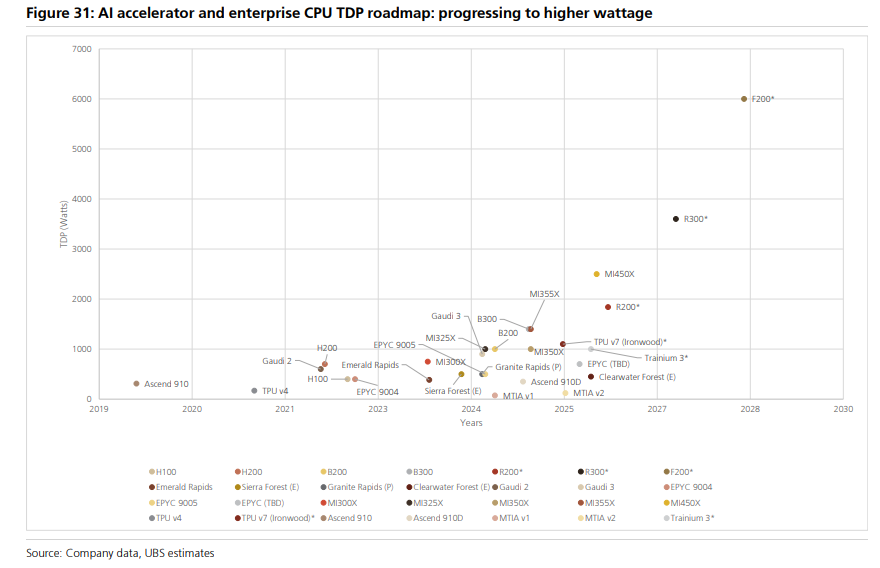
Core Insights - The transition to liquid cooling in data centers is becoming essential due to the rising power consumption of AI chips, marking a significant structural shift in the industry [1][2][4] - The global market for direct liquid cooling (DLC) is projected to grow from $1.138 billion in 2024 to $31.191 billion by 2030, with a compound annual growth rate (CAGR) of 51% [14][16] - The shift towards liquid cooling is driven by the need to meet stringent energy efficiency standards and the increasing power density of server cabinets [7][10] Market Dynamics - AI accelerator thermal design power (TDP) is rapidly increasing, with NVIDIA's GPUs expected to reach power levels between 1,800W to 7,000W in the coming years [2][4] - Traditional air cooling methods are becoming inadequate as cabinet power density exceeds 30-40kW, necessitating a shift to liquid cooling solutions [5][10] - Liquid cooling technology can reduce Power Usage Effectiveness (PUE) to below 1.2, making it a favorable option for meeting regulatory requirements [7] Technology Trends - The liquid cooling market is bifurcating into two main technology segments: Cold Plate technology for applications below 3,500W and Micro-Channel Lid (MCL) technology for higher power applications [10][12] - Cold Plate technology is expected to remain dominant for lower power applications, while MCL technology is anticipated to become mainstream for high-performance chips by 2026 [11][12] - The value of liquid cooling per rack is expected to quadruple by 2030, indicating a significant increase in market value [15] Supply Chain Evolution - NVIDIA is shifting its supply chain strategy from a "closed delivery" model to an "open ecosystem," allowing more suppliers to enter its supply chain [17][19] - This change provides opportunities for domestic suppliers to become either secondary suppliers through ODMs or primary suppliers as their technologies mature [17][19] - The estimated market for liquid cooling systems required for ASIC chips is projected to reach 35.3 billion RMB by 2026, with NVIDIA's platform requiring even more [19]
英伟达GTC盛会明年3月16日举行 黄仁勋将释出Vera Rubin最新进展
Jing Ji Ri Bao· 2025-12-07 23:12
Group 1 - Nvidia will hold its annual AI conference "GTC 2026" in San Jose, California, from March 16 to 19, 2026, with CEO Jensen Huang expected to deliver a keynote speech [1] - The next-generation AI platform, Vera Rubin, is anticipated to be a focal point, with strong order flow from Nvidia boosting its major server manufacturing partner, Hon Hai [1][2] - Huang is also expected to provide insights on the next-generation Feynman platform during the keynote, alongside showcasing new supply chain partners and clients [1] Group 2 - The industry expects Huang's keynote to focus on AI infrastructure, particularly the Vera Rubin platform, as well as advancements in CUDA technology and robotics [2] - The Vera Rubin NVL144 platform is projected to achieve 3.6 Exaflops of FP4 inference and 1.2 Exaflops of FP8 training performance, representing a 3.3 times improvement over the GB300 NVL72 [2] - Hon Hai is already developing servers for the Vera Rubin platform, planning to start mass production in the second half of next year, which is expected to drive significant growth from 2026 to 2027 [2]
外贸企业从被动候检到主动控链 松江从“世界工厂流水线”放眼“全球资源
Jie Fang Ri Bao· 2025-12-02 01:55
Core Insights - The article discusses the significant transformation in cross-border logistics in Shanghai, particularly through the establishment of the Songjiang Air Pre-Station, which enhances efficiency and redefines air transport processes [1][4][6]. Group 1: Infrastructure and Policy Changes - The Songjiang Air Pre-Station, launched in July and officially opened in November, represents a pioneering model in cross-border logistics, integrating "district-port linkage" to optimize air transport processes [1][4]. - The transition from a traditional export processing zone to a comprehensive bonded zone has positioned Songjiang as an "innovation engine" for foreign trade, leveraging policy advantages and manufacturing strengths [2][3]. Group 2: Efficiency Improvements - The Air Pre-Station allows for efficient sorting, booking, and customs pre-declaration, significantly reducing the time and costs associated with traditional airport logistics, with customs efficiency improved by 30% and logistics costs decreased by 15% [4][6]. - The new logistics model enables enterprises to proactively manage their supply chains, transforming the logistics process from a passive waiting game to a streamlined operation [5][6]. Group 3: Economic Impact and Market Dynamics - The article highlights the diversification of Songjiang's foreign trade, with private enterprises showing a 40.3% year-on-year increase in import and export volume, now accounting for 40.2% of total trade [8]. - The shift from a reliance on a few dominant players to a more varied market landscape is evident, with new technology products driving growth and non-U.S. markets seeing significant increases, particularly in Belt and Road countries [8][9]. Group 4: Strategic Initiatives and Future Outlook - Songjiang is exploring the expansion of the Air Pre-Station's capabilities and considering future railway hub developments to enhance its integration into global supply chains [6][8]. - The region's approach combines institutional innovation and ecosystem development, aiming to transition from a manufacturing hub to a global resource allocation center [7][9].