
拓荆科技

Search documents
存储设备专题报告:AI驱动存储扩容,设备环节确定性凸显
Dongguan Securities· 2025-12-30 09:18
Group 1 - The semiconductor industry is entering a new upcycle driven by AI, with global semiconductor revenue expected to reach approximately $975.46 billion in 2026, a 26.3% increase from 2025 [12][16] - Memory chips, particularly DRAM and NAND, are projected to be the core drivers of this cycle, with memory chip sales expected to grow by 27.8% in 2025 and 39.4% in 2026 [14][18] - The demand structure for memory chips is shifting from consumer electronics to dual drivers of "smart cars and data centers," with the automotive storage market expected to grow at a compound annual growth rate (CAGR) of about 21% from 2024 to 2030 [21][24] Group 2 - China's semiconductor equipment spending is expected to lead globally, with a projected $94 billion in spending from 2026 to 2028, accounting for 25% of global spending [50][54] - The demand for etching and thin film deposition equipment is expected to rise significantly as the industry transitions to 3D NAND technology, which reduces reliance on photolithography [61][66] - Lam Research indicates that the serviceable market for equipment per wafer for 3D DRAM and NAND will increase to 1.7 times and 1.8 times, respectively, compared to previous technologies [66]




华安基金科创板ETF周报:科创板第五套上市标准扩围至商业火箭
Xin Lang Cai Jing· 2025-12-30 06:32
Group 1: Policy and Industry Dynamics - The Shanghai Stock Exchange released guidelines to expand the fifth listing standard for commercial rocket companies on the Sci-Tech Innovation Board, aiming to support the innovation and development of the commercial aerospace sector [1][17] - The guidelines consist of 14 articles detailing requirements related to business scope, "hard technology" attributes, and standards for commercial rocket enterprises, providing targeted support for high-quality companies without significant revenue [1][17] - Several rocket companies have recently submitted IPO counseling records, indicating a growing interest in capital market participation [1][17] Group 2: Market Overview and Trends - The commercial rocket industry is at a critical stage of large-scale commercialization, necessitating further support from the capital market [2][18] - The Sci-Tech Innovation Board focuses on hard technology, including sectors like electronic chips, emerging software, and new information technology services, reflecting the rise of advanced manufacturing in China [2][18] - Recent trends show a rebound in the Sci-Tech Innovation Board, particularly in sectors such as chips, information technology, and new materials [3][19] Group 3: Sector Performance - The top five industries on the Sci-Tech Innovation Board are electronics, biomedicine, power equipment, computers, and machinery, collectively accounting for 88.2% of the board's market capitalization [4][20] - The semiconductor sector has seen significant interest, with a notable rebound in chip stocks driven by demand for AI computing infrastructure [21] - The high-end equipment manufacturing sector is experiencing growth, with a 15.4% year-on-year increase in engineering machinery import and export trade, reflecting a recovery in overseas demand [22] Group 4: Investment Opportunities - The AI computing demand is expected to surge, with continued capital investment from cloud vendors driving high demand for advanced chips [21] - The domestic engineering machinery update cycle is starting, supported by favorable policies in real estate and infrastructure [22] - The pharmaceutical sector remains active, with multiple innovative drugs and medical devices receiving approvals, indicating a robust pipeline for growth [23]





芯原股份公告单季签单近25亿,科创芯片ETF涨1.24%!
Jin Rong Jie· 2025-12-30 03:56
Group 1 - The core viewpoint of the news highlights the significant growth in the semiconductor sector, particularly driven by AI chip design and domestic replacement trends, as evidenced by the performance of companies like Chipone Technology and the related ETF [1] - As of December 30, the Shanghai Composite Index rose by 0.01%, while the Sci-Tech Chip Index increased by 1.26%. Notable individual stock performances included Chipone Technology rising over 4% and other companies like Haiguang Information and Cambricon Technologies rising over 2% [1] - The Sci-Tech Chip ETF (588200) saw a 1.24% increase with a trading volume of 1.574 billion yuan and a turnover rate of 3.97%. Over the past six months, the fund has increased by 53.75%, and year-to-date, it has risen by 59.66% [1] Group 2 - Chipone Technology announced on December 27 that it signed new orders worth 2.494 billion yuan from October 1 to December 25, 2025, marking a substantial increase of 129.94% compared to the same period last year and a further increase of 56.54% from the previous quarter, setting a new historical high for a single quarter [1] - The demand for design services, IP cores, and one-stop solutions from domestic chip companies is expanding, driven by the acceleration of AI computing power construction and the trend of domestic substitution [1] - The top ten weighted stocks in the Sci-Tech Chip ETF include SMIC, Haiguang Information, Cambricon, and others, collectively accounting for over 57.72% of the ETF's weight [1]

AI需求重塑芯片产业,存储、晶圆厂涨价超预期,半导体设备ETF(561980)持续吸金!
Sou Hu Cai Jing· 2025-12-30 02:46
Core Viewpoint - The semiconductor industry is experiencing a price surge driven by increased demand from AI applications and supply constraints, particularly in the storage and wafer sectors [3][6]. Group 1: Semiconductor Price Trends - The NAND flash wafer prices increased by over 10% in December, while SSD prices rose by 15%-20% [3]. - Major international storage suppliers have raised HBM3E prices by nearly 20% for 2026 [3]. - The current price uptrend is attributed to high demand for high-bandwidth memory (HBM) and large-capacity storage, coupled with a structural shift in production towards high-end products [3][6]. Group 2: Semiconductor Equipment Market - The global semiconductor equipment market is projected to reach $133 billion by 2025, with a year-on-year growth of 13.7%, and is expected to continue growing to $145 billion in 2026 and $156 billion in 2027 [6][11]. - The semiconductor equipment ETF (561980) has seen significant inflows, indicating strong investor interest in the sector [1][12]. - The ETF focuses on companies with high exposure to semiconductor equipment, materials, and integrated circuit design, with nearly 60% of its index comprising equipment [12]. Group 3: Domestic Semiconductor Development - The domestic semiconductor equipment sector is expected to accelerate growth in orders by 2026, driven by the expansion of storage and advanced processes [8]. - The domestic semiconductor equipment industry has achieved significant progress in replacing mature processes with local alternatives since 2019 [11]. - The focus on domestic substitution is not only in equipment but also in chip design and manufacturing processes [8][11].
供需缺口叠加AI需求高增,存储、晶圆厂等半导体多产业链进入涨价周期
Sou Hu Cai Jing· 2025-12-30 01:29
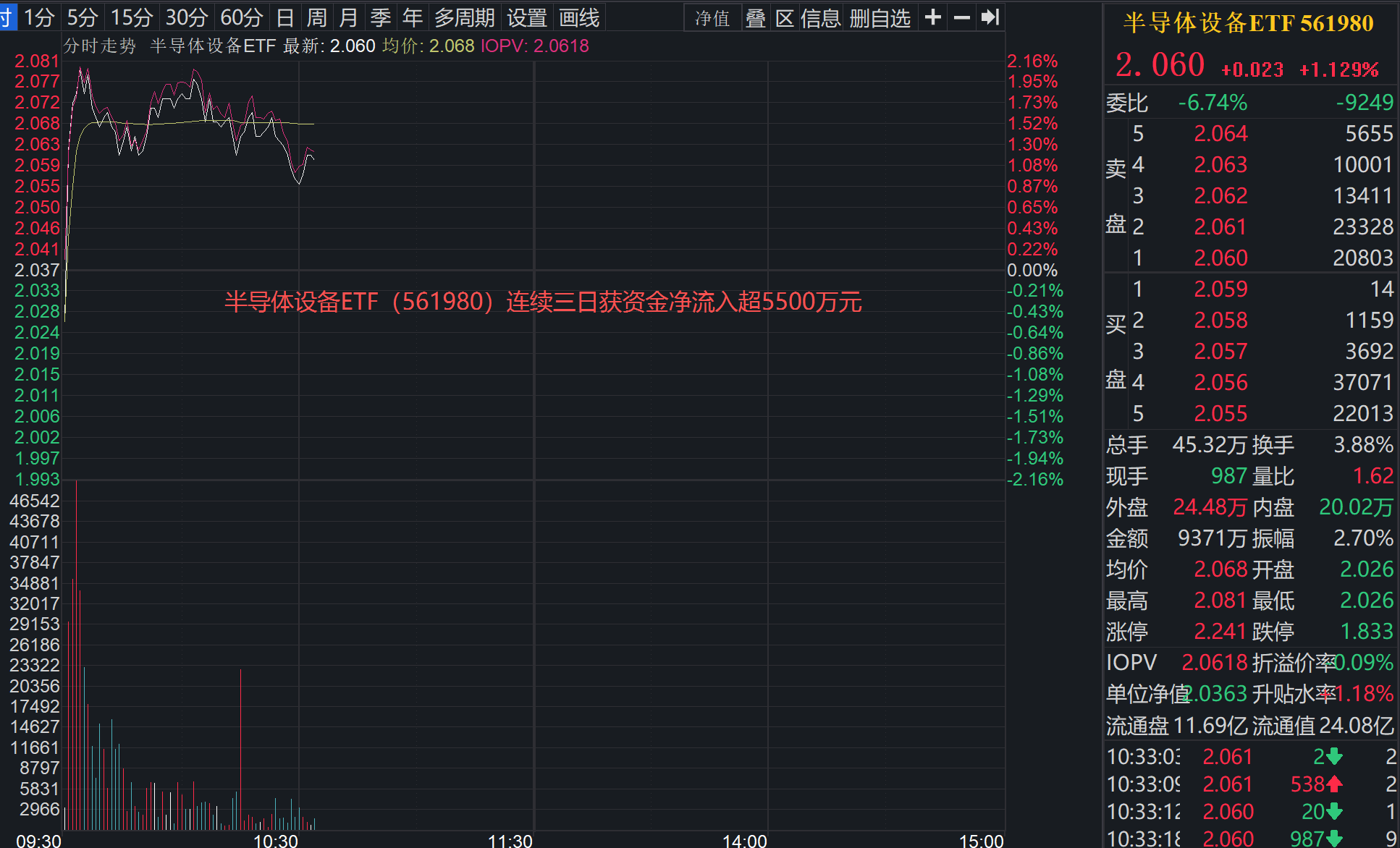
Core Viewpoint - The semiconductor industry is experiencing a price increase cycle across various segments, driven by AI demand and domestic substitution trends, indicating a structural market shift [2][20][23]. Group 1: Market Performance - The three major indices experienced fluctuations, with the Shanghai Composite Index achieving a nine-day winning streak, facing resistance around the 4000-point mark [1]. - The semiconductor equipment ETF (561980) saw a slight decline of 0.29%, but has attracted over 55 million yuan in capital inflows over the past three trading days [1]. Group 2: Price Increases in Semiconductor Sector - In December, NAND flash wafer prices rose by over 10% month-on-month, while solid-state drive (SSD) prices increased by 15%-20% [2][5]. - Major international storage suppliers have raised HBM3E prices by nearly 20% for 2026 [2]. - Semiconductor manufacturers, including SMIC, have issued price increase notices to downstream clients, particularly for the 8-inch BCD process platform, with increases around 10% [6]. Group 3: Industry Trends and Projections - According to SEMI, global semiconductor manufacturing equipment sales are projected to reach $133 billion in 2025, marking a 13.7% year-on-year increase, with continued growth expected into 2026 and 2027 [11]. - The semiconductor industry is benefiting from a recovery trend, with the China Securities Index reporting a 32.12% year-on-year revenue growth for the semiconductor sector in Q3 [13]. Group 4: Investment Focus - Current semiconductor investments are concentrated on high-end logic chips and memory (HBM) that directly benefit from the surge in computing power demand, as well as opportunities in domestic equipment manufacturing [23]. - The domestic semiconductor equipment industry is expected to see significant growth driven by both technology and inventory cycles, alongside increasing domestic substitution demand [2][20]. Group 5: ETF and Index Performance - The semiconductor equipment ETF (561980) tracks the China Securities Semiconductor Index, which has a nearly 60% focus on equipment, with over 90% of its composition in the semiconductor supply chain's upstream sectors [3]. - The index has shown a remarkable performance, with a year-to-date increase of over 62% as of December 29, outperforming other major semiconductor indices [3].

中芯国际并购方案出炉,配套设备厂商有望直接受益产能扩张
Xuan Gu Bao· 2025-12-30 00:55
Group 1 - SMIC announced a merger plan to issue 547 million shares to acquire 49% equity in SMIC North for a transaction price of 40.6 billion yuan [1] - The issuance targets include major investors such as the National Integrated Circuit Industry Investment Fund, Beijing Integrated Circuit Manufacturing and Equipment Investment Center, and others [1] - SMIC North was established in July 2013 as a joint venture between SMIC and the Beijing government, focusing on 40/28nm Polysion and 28nm HKMG processes with a design capacity of approximately 70,000 12-inch wafers per month [1] Group 2 - According to research from firms like China Merchants Securities, global wafer fab capital expenditure is expected to continue growing through 2026, with domestic advanced and mature process expansions anticipated [2] - The merger and AI demand growth are expected to drive global storage and advanced process capacity expansion, with a potential acceleration in domestic storage and advanced process expansions in 2026-2027 [2] - Domestic equipment manufacturers are likely to benefit from a favorable order outlook, with companies like North Huachuang, Zhongwei Company, and others positioned well in the market [2]
拓荆科技46亿元定增募资方案获问询函回复 前募项目非资本性支出占比显著下降
Xin Lang Cai Jing· 2025-12-29 14:01
Core Viewpoint - The company has optimized its non-capital expenditures significantly in its fundraising projects, aligning with regulatory requirements and focusing on high-end semiconductor equipment and technology development [1][2][3]. Group 1: Fundraising and Expenditure - The company plans to raise up to 4.6 billion yuan, with allocations of 1.5 billion yuan for high-end semiconductor equipment industrialization, 2 billion yuan for advanced technology research center, and 1.1 billion yuan for working capital [3]. - The non-capital expenditures in the current fundraising plan account for 38.94% of the total, with 1.7 billion yuan specifically allocated for the advanced technology research center [3]. - The previous non-capital expenditure ratio was reduced from 77.22% to 29.78% after adjustments in project funding allocations [2]. Group 2: Research and Development Capitalization - The company’s R&D capitalization rate is projected at 51.33%, which is in line with industry standards and similar to peers like Zhongwei Company [4]. - The company capitalizes R&D expenditures at specific project milestones, ensuring compliance with accounting standards [4]. Group 3: Financial Health and Performance - The company has a projected total funding gap of approximately 7.454 billion yuan from 2025 to 2027, with a current asset-liability ratio of 67.72% [5]. - Revenue is expected to grow from 1.706 billion yuan in 2022 to 4.103 billion yuan in 2024, reflecting a compound annual growth rate of 55.08% [6]. - As of September 2025, the company reported a significant improvement in cash flow, with net cash flow from operating activities reaching 2.832 billion yuan [7].
壹快评丨“募资即理财”现象蔓延,科技企业为何偏离研发初心
第一财经· 2025-12-29 12:49
2025.12. 29 本文字数:1670,阅读时长大约3分钟 作者 | 第一财经 魏中原 这些现象引发了市场对科技企业"重融资、轻研发"的担忧。需要厘清的是,问题不在于资本市场制度 本身,而在于执行与监督环节的缺失。以科创板为例,该板块的创新性制度设计的初衷是通过市场化 机制引导资金流向真正需要的硬科技研发,推动科技企业做大做强。 创新政策带来了溢价,使得市场给予的部分科技企业高估值与超募资金,本质上是社会对科技企业突 破技术"卡脖子"的深切期待,是国家为支持创新提供的特殊政策支持。这份政策支持的初心,始终指 向"研发突破"而非"理财躺赚"。 笔者认为,当前科技型上市公司募资理财现象背后有三方面深层原因。 企业层面,部分企业对研发周期和资金消耗速度缺乏准确评估,担心资金投入过快导致"烧钱"压力过 大,选择"慢撒网、稳推进"策略。 政策支持科技企业上市的初心,始终是为中国科技突破"卡脖子"技术提供资本支撑,为国家科技自立 自强注入源头活水。科创板等上市板块的设立,是国家推动科技创新、实现产业自主可控的战略性制 度安排。这一制度设计本身具有前瞻性与积极意义,其目标在于引导资本"脱虚向实",推动科技企业 真正在研 ...

“募资即理财”现象蔓延,科技企业为何偏离研发初心
Di Yi Cai Jing· 2025-12-29 11:56
Core Viewpoint - The initial intention of supporting technology companies to go public is to provide capital support for China's technological breakthroughs in critical areas, injecting vital resources for national technological self-reliance [1][2] Group 1: Current Issues - The phenomenon of "IPO for financial management" has evolved from isolated cases to a systemic behavior among technology companies, raising concerns about their commitment to research and development [1][2] - Companies like Moer Thread and Huahong Semiconductor have been reported to allocate substantial IPO funds (e.g., 7.5 billion yuan and over 20 billion yuan respectively) into low-risk financial products instead of investing in production and R&D [1] - This trend of diverting funds from essential projects to financial products distorts market resource allocation efficiency and undermines the integrity of the capital market [1] Group 2: Underlying Reasons - At the enterprise level, some companies lack accurate assessments of R&D cycles and funding consumption rates, leading them to adopt a cautious approach to funding allocation [3] - The market environment has seen inflated valuations in the primary market, prompting companies to rationalize their financial management strategies to maintain high valuations [4] - The responsibility of intermediary institutions has been lacking, as they fail to effectively supervise the use of raised funds, which should be directed towards actual projects rather than financial management [4] Group 3: Successful Examples - The design of the Sci-Tech Innovation Board has successfully supported the growth of several companies in sectors like semiconductors and biomedicine, with examples including SMIC and Zhongwei Technology, which have achieved technological breakthroughs and market value growth through effective fundraising [4] Group 4: Recommendations for Improvement - Strengthening the responsibility of intermediary institutions by incorporating continuous supervision into core assessment metrics and implementing thorough oversight of financial management behaviors [5] - Optimizing information disclosure requirements for companies to provide detailed funding usage plans and R&D progress, establishing a correlation assessment system between funding use and technological breakthroughs [5] - Creating positive incentives for companies with high R&D investment ratios and significant technological breakthroughs by offering green channels for refinancing, fostering a virtuous cycle between R&D investment, technological breakthroughs, and market value [5] Group 5: Conclusion - The development of the capital market requires professionalism and accountability from "gatekeepers," as well as a commitment from technology companies to their original intentions, ensuring that the Sci-Tech Innovation Board remains focused on strengthening China's technological capabilities rather than merely generating profits [6]
壹快评丨“募资即理财”现象蔓延,科技企业为何偏离研发初心
Di Yi Cai Jing Zi Xun· 2025-12-29 11:48
Group 1 - The core intention of policies supporting technology companies' IPOs is to provide capital support for breakthroughs in critical technologies and to inject fresh resources for national technological self-reliance [1][2] - The establishment of the Sci-Tech Innovation Board and other listing platforms is a strategic arrangement aimed at promoting technological innovation and achieving industrial autonomy [1][2] - There is a growing concern in the market regarding technology companies focusing more on financing rather than research and development, as evidenced by the trend of companies using IPO funds for financial management instead of investing in production and R&D [2][3] Group 2 - The phenomenon of using IPO funds for financial management has evolved from isolated cases to a systemic behavior among technology companies, particularly in the semiconductor sector [1][2] - The lack of accurate assessment of R&D cycles and funding consumption speed at the enterprise level has led some companies to adopt a cautious approach, opting for a "slow and steady" strategy [3][4] - The high valuations in the primary market have inflated financing expectations, prompting some companies to rationalize their use of funds to maintain these valuations [4] Group 3 - The responsibility of intermediary institutions has been lacking, as they fail to effectively supervise the use of raised funds, which should be directed towards actual projects rather than financial products [4] - The successful design of the Sci-Tech Innovation Board has led to the growth of several companies in sectors such as semiconductors and biomedicine, demonstrating the potential for technology breakthroughs and market value growth through proper funding [4][5] Group 4 - Recommendations for improving the mechanism include strengthening the responsibilities of intermediary institutions, optimizing information disclosure, and establishing positive incentives for companies with significant R&D investments [5][6] - A clear connection between funding usage and technological breakthroughs should be established to enhance transparency for investors [5] - The development of the capital market requires both professional oversight from "gatekeepers" and a commitment from technology companies to their original mission of driving technological advancement [6]