
荣盛石化

Search documents
石油化工行业周报:全球石油库存将持续增长至2026年,EIA预计今年全球原油将有184万桶、天的供应过剩-20251116
Shenwan Hongyuan Securities· 2025-11-16 12:15
Investment Rating - The report maintains a positive outlook on the petrochemical industry [3] Core Views - Global oil inventories are expected to continue increasing until 2026, with the EIA forecasting a supply surplus of 1.84 million barrels per day for this year [5][11] - The EIA has raised its price forecasts for crude oil and natural gas for 2025 and 2026, expecting an average crude oil price of $69 per barrel in 2025 and $55 per barrel in 2026 [6][8] - Demand growth for global oil is projected at 790,000 barrels per day in 2025 and 770,000 barrels per day in 2026, with significant contributions from the US, China, and Nigeria [8][45] Summary by Sections Supply and Demand Analysis - The EIA and IEA have both adjusted their global oil supply forecasts upwards by 100,000 to 150,000 barrels per day due to OPEC's announced production increases [10][11] - The EIA expects global oil production to rise by 2.81 million barrels per day in 2025 and 1.39 million barrels per day in 2026 [10][11] - The IEA anticipates a demand increase of 310,000 barrels per day in 2025 and 250,000 barrels per day in 2026, with a total average supply reaching 108.7 million barrels per day [46][47] Upstream Sector - Brent crude oil futures closed at $64.39 per barrel, reflecting a week-on-week increase of 1.19%, while WTI futures rose to $60.09 per barrel, up 0.57% [20] - The number of active oil rigs in the US increased to 549, with a slight week-on-week rise [35] Refining Sector - The report indicates an improvement in refining profitability due to rising product price spreads, despite current levels being relatively low [5][13] - The Singapore refining margin increased to $24.26 per barrel, while the US gasoline-WTI spread decreased to $20.84 per barrel [5] Polyester Sector - The profitability of PTA and polyester filament yarn has improved, with PTA prices rising to 4,585.4 CNY per ton [5][13] - The report suggests a recovery in the polyester sector, with expectations for improved profitability as supply and demand dynamics shift [13] Investment Recommendations - The report recommends focusing on leading companies in the polyester sector such as Tongkun Co. and Wankai New Materials, as well as top refining companies like Hengli Petrochemical and Sinopec [5][13] - It also highlights the resilience of oil companies like PetroChina and CNOOC in the face of potential price declines, recommending those with high dividend yields [13]


化工景气回升,关注三条投资主线
Guotou Securities· 2025-11-16 07:33
Investment Rating - The report maintains an investment rating of "Outperform the Market - A" for the chemical industry [4]. Core Views - The chemical industry is experiencing a recovery, with three main investment themes identified: demand exceeding expectations, "anti-involution" trends, and opportunities in leading companies at low valuations [19][21][22]. Summary by Sections 1. Key Insights of the Week - The report highlights a positive shift in consumer price index (CPI) and producer price index (PPI) data, indicating potential for recovery in the chemical sector [18]. - The overall PB ratio for the chemical industry is at 2.4, suggesting significant upside potential [18]. 2. Overall Performance of the Chemical Sector - The chemical sector index increased by 2.6% over the week, outperforming both the Shanghai Composite Index and the ChiNext Index [23]. - Year-to-date, the chemical sector index has risen by 34%, indicating strong performance relative to broader market indices [23]. 3. Individual Stock Performance in the Chemical Sector - Among 424 stocks in the chemical sector, 305 stocks rose while 115 fell, with notable gainers including Yongtai Technology (+33.9%) and Aoke Shares (+25.4%) [27]. 4. Investment Themes Theme 1: Focus on Demand Exceeding Expectations - The report emphasizes investment opportunities in upstream chemical products driven by the booming electric vehicle market, with a 34.6% year-on-year increase in sales [19]. - Key materials such as lithium iron phosphate and caprolactam are highlighted for their price elasticity due to supply-demand dynamics [19]. Theme 2: Attention to "Anti-Involution" Trends - The report discusses the progress in "anti-involution" efforts within the chemical industry, particularly in PTA and caprolactam, where production cuts are being implemented to optimize supply [21]. Theme 3: Opportunities in Low-Valuation Leading Companies - The report suggests focusing on leading companies with low valuations, as the supply-demand balance in the chemical sector continues to improve [22]. - Companies such as Wanhua Chemical and Baofeng Energy are recommended for investment consideration [22].
大炼化周报:秋冬订单放量中,涤纶长丝盈利持续修复-20251116
Xinda Securities· 2025-11-16 05:06
Investment Rating - The report does not explicitly state an investment rating for the petrochemical industry Core Insights - The report highlights that the domestic and international refining project price differentials have shown an upward trend, with domestic key refining project price differential at 2336.60 CNY/ton, up by 25.35 CNY/ton (+1.10%) week-on-week, while the international price differential reached 1436.69 CNY/ton, increasing by 67.88 CNY/ton (+4.96%) [2][3] - Brent crude oil's weekly average price was reported at 63.92 USD/barrel, reflecting a slight decrease of 0.49% [2][3] - The report notes that the polyester and nylon sectors are experiencing a recovery in profitability, particularly in the polyester filament segment, driven by increased demand and a rise in raw material prices [2][3] Summary by Sections Refining Sector - Saudi Arabia has lowered the December crude oil selling price to Asia in response to ample supply, leading to concerns over oversupply and a subsequent decline in international oil prices [2][3] - In the latter part of the week, China's crude oil imports increased, and a decline in the US dollar boosted market sentiment, contributing to a slight recovery in international oil prices [2][3] - The report indicates that domestic diesel and gasoline prices have seen slight increases, with average prices at 6788.57 CNY/ton (+105.86), 7626.57 CNY/ton (+12.29), respectively [2][3] Chemical Sector - The chemical products market remains weak, with supply-side disturbances affecting prices. Polyolefin prices are stable but slightly declining, while EVA prices have also seen a minor decrease [2][3] - The report mentions that pure benzene prices have continued to decline due to increased supply at the East China terminal, leading to a slight narrowing of price differentials [2][3] - The profitability of nylon fibers remains weak, while polyester filament production is increasing, supported by seasonal demand for winter fabrics [2][3] Market Performance - The stock performance of six major private refining companies shows varied results, with Oriental Energy seeing a significant increase of 10.13% in stock price over the week [2][3] - Over the past month, Hengli Petrochemical has experienced a stock price increase of 14.38%, indicating positive market sentiment towards certain companies in the sector [2][3]


荣盛石化(002493):民营炼化龙头,打造海内外双循环
Huaxin Securities· 2025-11-15 13:37
Investment Rating - The investment rating for the company is "Buy" and it is maintained [2][5][80] Core Views - The company, Rongsheng Petrochemical, has evolved from a textile company to a leading integrated petrochemical enterprise, completing significant milestones over 30 years [3][11] - The company has established a strategic partnership with Saudi Aramco, transferring a 10% stake at a high premium and forming a strategic cooperation agreement for raw material supply and chemical sales [3][16] - The Zhejiang Petrochemical project, owned by the company, is the largest single refining and chemical integration project globally, providing a strong competitive advantage [4][60] - The future growth of the company is expected to come from international expansion and collaboration with Saudi Aramco, particularly through the SASREF refinery project [4][20] Financial Performance and Forecast - The company is projected to recover from current pressures due to unfavorable petrochemical product prices, with net profits expected to rise significantly from 2025 to 2027 [5][80] - Forecasted net profits for 2025, 2026, and 2027 are 2.609 billion, 4.082 billion, and 5.440 billion yuan respectively, with corresponding PE ratios of 41.4, 26.4, and 19.8 [5][80] - Revenue growth rates are expected to be modest in the coming years, with a projected increase of 1.8% in 2025 and 7.1% in 2026 [6][80] Strategic Developments - The company is focusing on building a dual-circulation model through international partnerships, particularly with Saudi Arabia, to enhance its operational efficiency and market reach [4][20] - The SASREF project aims to integrate operations between the two countries, maximizing resource utilization and reducing costs through material recycling [20][71] Market Position - Rongsheng Petrochemical is recognized as one of China's leading private refining and chemical companies, with a solid integrated advantage and a focus on expanding its scale and market presence [5][80] - The company has maintained a competitive gross margin, ranking among the top in the industry, despite recent challenges [62]
我国进口原油市场结构及前瞻分析
Qi Huo Ri Bao· 2025-11-15 11:11
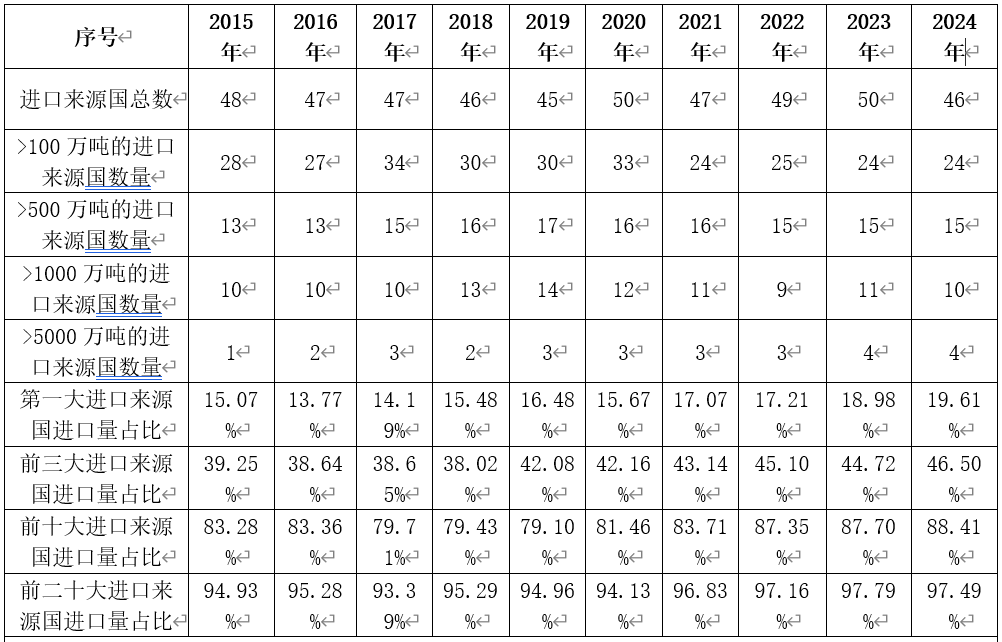
Core Viewpoint - The article discusses the significant role of crude oil in China's economy, highlighting the country's high dependence on oil imports and analyzing the trends and sources of crude oil imports over the past decade [1][2]. Group 1: Crude Oil Import Trends - From 2015 to 2024, China's annual crude oil import volume is projected to increase from approximately 336 million tons in 2015 to 553 million tons in 2024, representing a 1.65 times increase [2]. - The import volume is expected to exceed the historical peak of 564 million tons in 2023, with a year-on-year increase of about 3% in the first nine months of 2025 [2]. - The acceleration in import volume growth is attributed to rapid industrialization and urbanization, alongside the reform of the crude oil import quota system post-2015 [2]. Group 2: Characteristics of Import Sources - The number of countries supplying crude oil to China has remained above 45, indicating a diversification in import sources [3]. - The median share of oil supplied by individual countries ranges from 0.15% to 0.50% of total imports, enhancing energy supply security [3]. - The concentration of imports has increased, with the top ten source countries' share rising from 83.28% in 2015 to 88.41% in 2024 [9]. Group 3: Major Import Sources - The top ten crude oil suppliers to China include Saudi Arabia, Russia, Angola, Iraq, Oman, Kuwait, and Brazil, with Malaysia emerging as a significant supplier by 2024 [6][11]. - The import volume from Malaysia surged from 270,000 tons in 2015 to over 70 million tons in 2024, marking a 260-fold increase [11]. - Russia has become the largest supplier, with imports increasing by 24% in 2023, reaching 107 million tons, and is expected to maintain a significant share in the coming years [10][11]. Group 4: Future Outlook - The future import landscape is expected to be stable yet dynamic, with countries like Saudi Arabia and Oman maintaining steady export levels due to their stable geopolitical situations [16]. - The geopolitical tensions affecting countries like Russia, Iran, and Venezuela may lead to fluctuations in their export volumes to China, while countries like Brazil and Canada are likely to see increased exports due to rising production [17][18]. - China's energy strategy emphasizes the need for continued diversification of import sources to mitigate risks associated with geopolitical events [20].

中金 | 深度布局“十五五”:油气化工篇
中金点睛· 2025-11-15 00:07
Core Viewpoint - The oil and gas chemical industry is expected to prioritize high-quality development during the "14th Five-Year Plan" period, focusing on improving efficiency and safety while addressing competitive pressures and environmental goals [2][7][14]. Group 1: Achievements During the "14th Five-Year Plan" - The Chinese chemical industry has achieved significant growth, with projected revenues reaching 14.5 trillion yuan in 2024, a 45% increase from 2020 [2]. - China has established the world's largest and most comprehensive production system for chemical products, with over 50% of global production capacity in key chemicals like PTA, PA6, and methanol [2][6]. - By 2024, 11 Chinese companies are expected to be among the top 50 global chemical firms, accounting for 28% of the total revenue of these companies [2][6]. Group 2: Development Focus for the "15th Five-Year Plan" - The focus will shift towards quality-first strategies, emphasizing technological advancement, efficiency, and profitability to close the gap with developed countries [7][9]. - Key development directions include enhancing traditional chemical industries, advancing new materials technology, and promoting green and low-carbon development [15][19]. Group 3: Traditional Chemical Industry Enhancement - The "15th Five-Year Plan" suggests optimizing traditional industries to improve competitiveness and quality, particularly in sectors like mining, metallurgy, and chemicals [9][14]. - The industry has seen rapid capital expenditure growth since 2022, but faces challenges from increased competition and declining profit margins [14][19]. - The government is expected to implement measures to combat "involution" in the chemical sector, promoting high-quality development [14][15]. Group 4: New Materials Technology Advancement - The plan emphasizes the development of strategic emerging industries, including new materials and advanced manufacturing technologies [15][16]. - There is significant potential for domestic substitution in semiconductor materials and advanced packaging materials, with many categories still relying heavily on imports [15][17]. - The government aims to enhance self-sufficiency in key materials through targeted R&D initiatives [16]. Group 5: Green and Low-Carbon Development - The "15th Five-Year Plan" outlines goals for carbon peak and reduction, including implementing dual control over total carbon emissions and intensity [19]. - The plan includes measures for energy efficiency, promoting distributed energy systems, and expanding the carbon trading market [19][18]. - The chemical industry is expected to face stricter entry barriers based on carbon emissions, driving a transition towards high-quality, low-carbon production [19].

江苏索普拟定增募资15亿元投建醋酸乙烯及EVA项目 内部收益率12.64%
Xin Lang Cai Jing· 2025-11-14 11:39
Core Viewpoint - Jiangsu Sop Chemical Co., Ltd. plans to raise up to 1.5 billion yuan for the "Vinyl Acetate and EVA Integration Project (Phase I)" with a post-tax internal rate of return of 12.64% and a payback period of 8.57 years [1] Investment Project Overview and Return Analysis - The total investment for the project is 3.226 billion yuan, with construction investment at 2.636 billion yuan and additional costs totaling 480 million yuan [2] - The project aims to achieve an annual production capacity of 330,000 tons of vinyl acetate, generating an expected annual revenue of 3.142 billion yuan, with vinyl acetate product revenue accounting for 83.66% [2] - The internal rate of return of 12.64% is higher than Rongsheng Petrochemical's similar project (11.77%) but lower than Lianhong Xinke's (16.03%), indicating a reasonable industry level [2] - The unit investment per ton for this project is 97.7552 million yuan, lower than Shuangxin Environmental Protection (134.1157 million yuan) but slightly higher than Lianhong Xinke (65.0458 million yuan) [2] Project Necessity and Capacity Consumption - The project benefits from synergies with existing products, and construction is expected to be completed by 2026, with production starting in 2027 [3] - The estimated selling price of the product is set conservatively at 9,000 yuan/ton, which is 4.87% lower than the historical average [3] - The projected sales rate is expected to reach 100% due to increasing demand in downstream industries like photovoltaic EVA [3] Financial Condition and Operating Data Analysis - The company's gross profit margin has fluctuated from 15.58% in 2022 to 8.40% in the first half of 2025, primarily due to a decrease in sales price [4] - The net profit for 2024 is projected to be 213 million yuan, a significant increase of 1,088.11% driven by a 36.82% increase in vinyl acetate sales [4] Asset Quality Indicators - As of June 2025, accounts receivable and financing balances reached 689 million yuan, a 54.92% increase from the end of 2024 [5] - Inventory balance is 454 million yuan, with a lower-than-average impairment provision of 0.84% due to high inventory turnover [5] Monetary Funds and Financing Needs - The company currently has 906 million yuan in cash, with 831 million yuan available for use [6] - A funding gap of 1.865 billion yuan is anticipated from Q3 2025 to 2026, and the 1.5 billion yuan raised will help alleviate financial pressure [6] Accountant's Review Opinion - The accountant believes the investment structure of the project is reasonable and consistent with comparable industry projects, with key metrics reflecting industry cyclicality [7] - The company has adequately accounted for receivables and inventory impairment provisions, and there are no signs of asset impairment [8]

炼化及贸易板块11月14日跌0.66%,润贝航科领跌,主力资金净流出1.33亿元
Zheng Xing Xing Ye Ri Bao· 2025-11-14 08:58
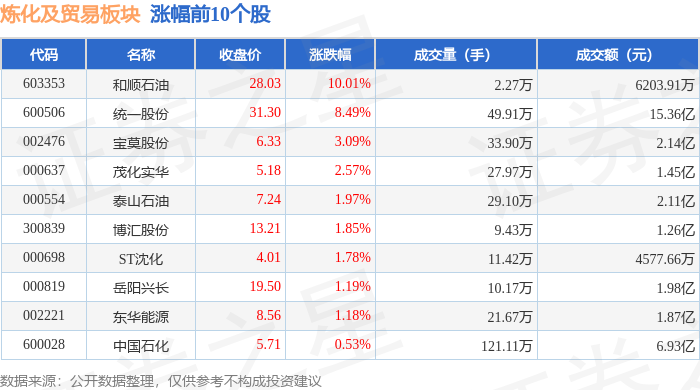
Market Overview - The refining and trading sector experienced a decline of 0.66% on November 14, with Runbei Hangke leading the losses [1] - The Shanghai Composite Index closed at 3990.49, down 0.97%, while the Shenzhen Component Index closed at 13216.03, down 1.93% [1] Stock Performance - Notable gainers in the refining and trading sector included: - Heshun Petroleum (603353) with a closing price of 28.03, up 10.01% [1] - Unified Shares (600506) at 31.30, up 8.49% with a trading volume of 499,100 shares and a transaction value of 1.536 billion [1] - Baomo Shares (002476) at 6.33, up 3.09% with a transaction value of 214 million [1] - Conversely, Runbei Hangke (001316) led the declines with a closing price of 35.90, down 3.49% [2] - Other notable decliners included: - Wanbangda (300055) at 8.40, down 3.34% [2] - Daqing Huake (000985) at 20.03, down 2.53% [2] Capital Flow - The refining and trading sector saw a net outflow of 133 million from institutional investors and 197 million from speculative funds, while retail investors contributed a net inflow of 330 million [2] - Detailed capital flow for selected stocks showed: - Unified Shares (600506) had a net inflow of 167 million from institutional investors, but a net outflow of 12 million from speculative funds [3] - China Petroleum (601857) experienced a net outflow of 10.24 billion in total trading volume [2][3]


PPI企稳复苏背景下石化产品价格趋势及投资机会 | 投研报告
Zhong Guo Neng Yuan Wang· 2025-11-14 07:45
Core Viewpoint - The report indicates that the price recovery of petrochemical products is expected to stabilize and uplift the Producer Price Index (PPI), driven by strong policy support focusing on supply-side optimization and demand-side expansion [1][2]. Group 1: Petrochemical Products and PPI - Petrochemical products have a high weight and strong volatility in the PPI composition, showing a strong correlation with PPI trends [1][2]. - Recent policies are aimed at optimizing supply and expanding demand, which may lead to a recovery in petrochemical prices and subsequently stabilize the PPI [1][2]. Group 2: Supply and Demand Dynamics - The optimization of the petrochemical downstream capacity structure is expected to initiate a new price cycle, with 2025 being a critical year for the refining industry [2]. - By 2025, domestic crude oil processing capacity is expected to be controlled within 1 billion tons, with an anticipated increase of 5.8 million tons in refining capacity from 2025 to 2030 [2]. - The government continues to push for the elimination of inefficient refining capacities, which may accelerate the exit of outdated refining capabilities [2]. Group 3: Demand Recovery and Structural Highlights - The overall demand for petrochemical products is slowly recovering, with structural differences in recovery dynamics among various chemical products [3]. - While demand for polyolefins is weak, aromatic products are benefiting from downstream capacity expansions, maintaining a high growth rate [3]. - High-end petrochemical materials are developing rapidly, aligning with national innovation and emerging industry needs, with products like high-end polyolefins and engineering plastics expected to see sustained demand growth [3]. Group 4: Investment Opportunities - Despite the current PPI not yet turning positive, petrochemical downstream stock prices have shown signs of stabilization and recovery, indicating a favorable investment opportunity [4]. - The report recommends key state-owned enterprises such as Sinopec and PetroChina, as well as private refining companies like Hengli Petrochemical and Rongsheng Petrochemical, due to their scale advantages and diverse product offerings [4].


信达证券:PPI企稳复苏背景下石化产品价格趋势及投资机会
智通财经网· 2025-11-14 07:29
Core Viewpoint - The report from Cinda Securities indicates that the price changes of petrochemical products are strongly correlated with the Producer Price Index (PPI), and recent policy efforts aimed at optimizing supply and expanding demand are expected to support a recovery in petrochemical prices, thereby stabilizing and potentially increasing the PPI [1] Group 1: Supply-Side Analysis - The optimization of the petrochemical downstream capacity structure is expected to initiate a new price cycle, with 2025 being a critical year for the refining industry, as the National Development and Reform Commission (NDRC) has set a cap on domestic crude oil processing capacity at 1 billion tons [1] - In 2024, domestic refining capacity is projected to be 923 million tons, with an expected addition of 58 million tons from 2025 to 2030, indicating that refining capacity expansion is nearing its limits [1] - The NDRC has emphasized the need to accelerate the elimination of inefficient and outdated refining capacities, which, combined with recent central government signals to reduce "involution," may lead to a quicker exit of outdated refining capacities [1] Group 2: Demand-Side Analysis - The overall demand for petrochemical products is gradually recovering, with structural highlights indicating that while the demand for major chemical products like polyolefins is weak, the demand for aromatics is expected to maintain high growth due to downstream capacity expansions [2] - High-end petrochemical materials are developing rapidly, aligning with national requirements for fine chemical innovation and the needs of emerging industries, with products like high-end polyolefins, engineering plastics, and lithium battery separators expected to see sustained high demand growth [2] Group 3: Market Performance and Investment Opportunities - Although the PPI has not yet turned positive, petrochemical downstream stock prices have shown signs of stabilization and recovery, indicating a favorable investment opportunity [3] - The government’s push for "de-involution" in key industries, including petrochemicals, and the recent "Stability Growth Work Plan for the Petrochemical Industry (2025-2026)" suggest a focus on eliminating outdated capacities and optimizing supply structures [3] - The expected gradual recovery in petrochemical product demand, coupled with improved profitability in the sector, supports the performance of petrochemical stocks, with companies like Rongsheng Petrochemical and Hengli Petrochemical showing significant quarter-on-quarter profit improvements [3] Group 4: Investment Recommendations - The report recommends focusing on state-owned chemical leaders such as Sinopec (600028.SH) and PetroChina (601857.SH), as well as private large refining enterprises like Hengli Petrochemical (600346.SH) and Rongsheng Petrochemical (002493.SZ) that have scale advantages and rich product layouts [4] - Additionally, companies like Tongkun Co., Ltd. (601233.SH) and Xin Fengming (603225.SH), which are enhancing their industrial chain synergy, are also highlighted as key investment opportunities [4] - The report suggests paying attention to Dongfang Shenghong (000301.SZ) as a potential investment target [4]
