
天山股份

Search documents
建材建筑周观点:继续看好“一带一路”出海+关注地产托底内需地产链受益
SINOLINK SECURITIES· 2025-04-20 12:23
Investment Rating - The report indicates a positive outlook for the real estate sector, emphasizing its role in boosting domestic demand and stabilizing the market [1][12]. Core Insights - The real estate market is transitioning back to its residential function, with significant declines in new home sales and construction activities projected for 2022-2024 [1][12]. - The implementation of new policies on May 17, 2024, aims to support the real estate market, including adjustments to loan rates and down payment requirements [1][12]. - Infrastructure projects are also highlighted as key drivers of domestic demand, particularly in regions like Xinjiang and Guangxi, with significant investments underway [2][13]. - The "Belt and Road" initiative remains a focal point for international expansion, with ongoing collaborations between China and Vietnam to enhance infrastructure connectivity [2][13]. Summary by Sections Weekly Discussion - The report discusses the importance of real estate in stimulating domestic demand, noting a shift towards residential needs and a significant drop in key market indicators [1][12]. - It highlights the recent government meetings aimed at stabilizing the real estate market and the potential impact of new policies on housing loans [1][12]. Cyclical Linkage - Cement prices have shown a year-on-year increase, with the national average price at 395 RMB/t, while glass prices have also seen slight increases [3][14]. - The report notes a stable demand for aluminum and steel, with expectations for continued high supply levels [3][14]. National Subsidy Tracking - Various regions have successfully implemented consumer subsidies, such as Shanghai's 1.8 billion RMB for home appliance upgrades, significantly boosting sales [4][15]. - The report suggests focusing on companies related to subsidized products in the construction materials sector [4][15]. Important Developments - The report mentions the strengthening of the strategic partnership between China and Vietnam, along with significant stock purchases by major shareholders in various companies [5][16]. - It emphasizes the government's commitment to stabilizing the stock market and supporting the real estate sector [5][16]. Market Performance (April 14-18) - The construction materials index experienced a slight decline, with specific segments like refractory materials and pipes performing better than others [17]. Construction Material Price Changes - Cement prices have slightly decreased in certain regions, while glass prices have shown minor increases, indicating a mixed market response [29][39]. - The report provides detailed statistics on the pricing trends and inventory levels for various construction materials [29][39].



碳市场扩围! 三大产业向“绿”而行
Shang Hai Zheng Quan Bao· 2025-04-15 18:11
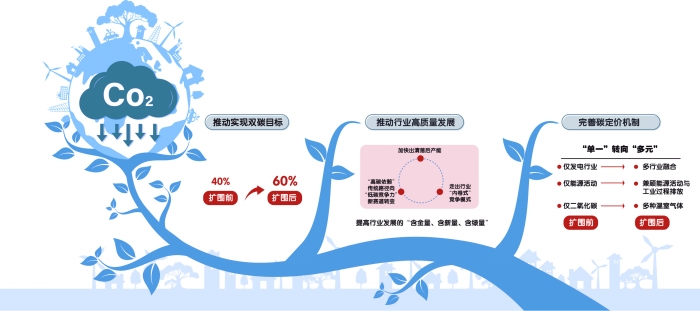
Group 1: Carbon Market Expansion - The Ministry of Ecology and Environment has issued a notice to strengthen management of carbon emissions trading, marking the first expansion of the national carbon market to include the steel, cement, and aluminum industries [2][4] - The transition period from 2024 to 2026 allows companies to prepare for stricter carbon constraints while focusing on upgrading technology and increasing the use of clean energy [4][5] - The carbon market expansion is expected to create a "butterfly effect," prompting the steel industry to adopt green technologies and phase out inefficient production [2][5] Group 2: Steel Industry Implications - The steel industry is expected to face new challenges and opportunities due to the carbon market expansion, with a focus on reducing carbon emissions and improving energy efficiency [5][6] - Companies like Baosteel anticipate a carbon emissions gap of approximately 100,000 tons annually, translating to a compliance cost of around 10 million yuan, which is manageable for overall operations [4][5] - The new policies will encourage steel companies to innovate and adopt advanced energy-saving technologies, ultimately leading to a more competitive and sustainable industry [5][7] Group 3: Cement Industry Readiness - Major cement companies such as Conch Cement and Tianshan Cement are well-prepared for the carbon market integration, viewing it as an opportunity to accelerate the exit of inefficient capacity and promote high-quality development [11][12] - The short-term impact on the cement industry is expected to be minimal, but long-term effects will include significant changes in production operations, data management, and investment in energy-saving technologies [13][14] - The introduction of carbon trading mechanisms is anticipated to reshape the competitive landscape of the cement industry, favoring companies with energy efficiency and carbon management capabilities [11][12] Group 4: Aluminum Industry Developments - The aluminum industry is also facing new pressures and opportunities as it enters the carbon market, with a focus on reducing emissions and enhancing energy efficiency [16][18] - The shift towards low-carbon aluminum production is expected to accelerate, with recycled aluminum becoming increasingly attractive due to its significantly lower carbon emissions compared to traditional methods [20][21] - Companies like Zhong Aluminum International are exploring new business opportunities in energy-saving technologies and the development of recycled aluminum, positioning themselves for future growth in a low-carbon economy [19][20]

建材、建筑及基建公募REITs周报:周观点:“关税”交易的三个阶段-20250414
EBSCN· 2025-04-14 11:46
Investment Rating - Non-metallic building materials: Buy (Maintain) [4] - Construction and Engineering: Overweight (Maintain) [4] Core Viewpoints - The report discusses three phases of the "tariff" trade, highlighting the impact of high tariffs between China and the US on domestic substitution and the potential benefits for companies with local production facilities [1][2] - The first phase focuses on domestic substitution due to high tariffs, suggesting attention to companies like Quartz Co., Kaisheng Technology, and Feiliwa, which are positioned to benefit from this trend [1] - The second phase indicates a global economic downturn due to a 10% tariff imposed by the US, leading to increased pressure on manufacturing and capital expenditure, with a recommendation to focus on state-owned enterprises and index-weighted stocks [1][2] - The third phase anticipates domestic policy adjustments aimed at boosting consumption and infrastructure investment, with specific recommendations for companies in the construction materials sector [2] Summary by Sections Phase 1: Domestic Substitution - Companies benefiting from domestic substitution include Quartz Co. (domestic sand for semiconductors), Kaisheng Technology (synthetic quartz sand), and Feiliwa (leading semiconductor quartz products) [1] - US-based companies like Puyang Nayi and China Jushi are expected to benefit from high tariff barriers [1] Phase 2: Global Economic Impact - The imposition of a 10% tariff by the US is expected to lower global economic forecasts, increasing demand risks and putting pressure on manufacturing [1][2] - Recommendations include focusing on state-owned enterprises such as China State Construction, China Railway Construction, and China Chemical [1][2] Phase 3: Domestic Policy Adjustments - Anticipated policy measures include boosting consumption, expanding into non-US markets, and structural investment opportunities in infrastructure [2] - Key companies to watch include cement and glass leaders like Anhui Conch Cement and Qibin Group, as well as consumer building materials leaders like Skshu Paint and Beixin Building Materials [2] Market Data Tracking - The report notes a decline in the CITIC Building Materials Index by 2.56% and the CITIC Construction Index by 3.29% during the reporting period [3] - Specific price data includes an average price of 398.33 CNY/ton for PO42.5 cement and 1269 CNY/ton for glass, with respective changes noted [3]
3月华东、华北、中南水泥提价,量、价提升有望受益基建加码
Guotou Securities· 2025-04-09 04:04
Investment Rating - The industry investment rating is "Leading the Market-A" [5] Core Viewpoints - Recent price increases in cement across various regions are expected to benefit from increased infrastructure investment [1][10] - The demand for cement is recovering, supported by effective peak-shifting production strategies and low inventory levels, leading to rising prices [3][10] - The cement industry is experiencing a gradual recovery in profitability due to strategic changes among leading companies and improved market conditions [8][10] Summary by Sections Price Increases - Multiple regions have announced price hikes for cement, with increases ranging from 10 to 100 CNY per ton in various areas [1] - As of April 4, 2025, the average prices for PO42.5 bulk cement (including tax) in different regions were reported, showing increases compared to previous lows [2] Demand and Supply Dynamics - National cement production in January-February 2025 was 171 million tons, a year-on-year decrease of 5.7%, but the decline is less severe compared to 2024 [3] - The operating rate of cement kilns in March was reported at 40.1%, a month-on-month increase of 12.5 percentage points, indicating improved production efficiency [3] Cost Factors - The average price of thermal coal has been declining, which supports improved profitability for cement companies as cement prices rise [3] Future Outlook - The cement demand is expected to continue recovering due to increased infrastructure investment and supportive government policies [9][10] - The industry is likely to see ongoing supply-side optimization policies that will help alleviate supply-demand imbalances and support price increases [9][10]


天山股份(000877):24Q4单季度扭亏,期待2025年盈利中枢上行
Changjiang Securities· 2025-04-07 08:20
Investment Rating - The investment rating for the company is "Buy" and is maintained [6][7]. Core Views - The company reported a total revenue of 86.995 billion yuan for 2024, a year-on-year decrease of 18.98%, with a net profit attributable to shareholders of -0.598 billion yuan, down 130.45% year-on-year. In Q4 2024, the revenue was 25.536 billion yuan, a decrease of 5.4% year-on-year, while the net profit attributable to shareholders was 3.149 billion yuan, an increase of 64.52% year-on-year [2][4][10]. Summary by Sections Financial Performance - In 2024, the company sold 19.823 million tons of cement, a decrease of 15.84% year-on-year. The sales of clinker and ready-mixed concrete also saw declines of 3.88% and 1.24%, respectively. Aggregate sales dropped by 8.22% [10]. - The revenue breakdown for 2024 shows that cement sales contributed 55.591 billion yuan (63.9% of total revenue), ready-mixed concrete sales contributed 23.478 billion yuan (26.99%), and aggregate sales contributed 4.756 billion yuan (5.47%) [10]. - The estimated revenue per ton for cement and clinker in 2024 was 247 yuan, down 23 yuan year-on-year, while the cost per ton was 209 yuan, also down 23 yuan year-on-year, resulting in a gross profit of 38 yuan per ton, unchanged year-on-year [10]. Future Outlook - The company anticipates earnings of 1.1 billion yuan and 1.6 billion yuan for 2025 and 2026, respectively, corresponding to price-earnings ratios of 37 and 26 times [6]. - Despite the pressure on demand, there is an expectation for some price elasticity due to supply constraints and the willingness of leading companies to maintain pricing power [10].
有色金属与新材料行业行深业度周报告:美国关税政策超预期,衰退预期主导金属大跌-2025-04-06
Ping An Securities· 2025-04-06 12:12
Investment Rating - The industry investment rating is "Outperform the Market" [62] Core Views - The report highlights that the U.S. tariff policy has exceeded expectations, leading to a significant drop in metal prices. The market is currently dominated by recession expectations, particularly affecting industrial metals [3][4] - For precious metals, gold prices have seen a correction due to the unexpected tariff policies, with COMEX gold futures dropping by 1.99% to $3056.1 per ounce as of April 3. The SPDR Gold ETF saw a slight increase of 0.1% to 932.8 tons [3][4] - Industrial metals are experiencing a downturn driven by recession fears, but there are long-term opportunities in the non-ferrous sector as market sentiment evolves [4] Summary by Sections Precious Metals - Gold: As of April 3, COMEX gold futures fell by 1.99% to $3056.1 per ounce. The U.S. core PCE for February was 2.79%, with a month-on-month increase of 0.13 percentage points. The manufacturing PMI for March was 49, down 1.3 percentage points [3][4] Industrial Metals - Copper: As of April 4, LME copper futures dropped by 10.4% to $8780 per ton. Domestic copper social inventory reached 313,600 tons, with a decrease of 20,900 tons. The LME copper inventory was 210,800 tons. The report notes that macro sentiment will continue to dominate copper prices in the short term, but there are long-term opportunities as supply constraints tighten [5][6] - Aluminum: As of April 3, LME aluminum futures fell by 6.6% to $2378.50 per ton. Domestic aluminum social inventory was 765,000 tons, with downstream operations gradually recovering. The report anticipates an upward shift in aluminum prices in the second quarter due to increasing demand from traditional consumption peaks and new energy sectors [5][6] - Tin: As of April 4, LME tin futures decreased by 2.22% to $35378 per ton. Domestic tin social inventory increased by 522 tons to 12,004 tons. The report indicates a tightening supply of tin and a potential increase in demand from the semiconductor sector [6] Investment Recommendations - The report recommends focusing on the copper, aluminum, and tin sectors. For copper, it suggests关注紫金矿业 (Zijin Mining). For aluminum,关注天山股份 (Tianshan Shares) is recommended. For tin,关注锡业股份 (Yunnan Tin Company) is advised due to the ongoing supply constraints and potential demand growth from AI applications [7][60]
美国“对等关税”及全球应对措施,中国经济“对等关税”
SINOLINK SECURITIES· 2025-04-05 12:59
Investment Rating - The report maintains a positive outlook on investment opportunities related to the "Belt and Road Initiative," "Western Development," and the "New Western Land-Sea Corridor" [6][14]. Core Insights - The report emphasizes the importance of the "Belt and Road Initiative" and its potential to strengthen investment rhythms, particularly in infrastructure, resource development, and energy sectors [8][12]. - The construction of the Pinglu Canal in Guangxi is highlighted as a key project that will enhance trade routes and support the dual circulation strategy [11]. - The report identifies significant investment opportunities in the western regions of China, particularly in Xinjiang, Tibet, Sichuan, and Guangxi, focusing on coal chemical projects and hydropower infrastructure [12][14]. - The report notes that domestic infrastructure demand is expected to support cement prices, with recent price increases indicating a potential upward trend in profitability [5][13]. Summary by Sections Belt and Road Initiative - Since the proposal of the "Belt and Road Initiative" in 2013, nearly 160 countries have signed agreements, with significant investment flows observed in Africa [2][9]. - Investment focus areas include infrastructure, resource development, and digital economy, with companies like Huaxin Cement and Keda Manufacturing expanding their overseas operations [10][12]. Pinglu Canal and Western Land-Sea Corridor - The Pinglu Canal is projected to be completed by 2026 and is expected to facilitate trade and logistics, enhancing the economic landscape of the Guangxi region [11]. - The North Bay Port is anticipated to benefit from increased capacity and trade routes once the canal is operational [11]. Western Development - Xinjiang's coal chemical industry is projected to attract investments of up to 631.8 billion yuan, with several companies positioned to capitalize on this growth [12][14]. - Infrastructure projects in Tibet and Sichuan are also highlighted, with ongoing investments in hydropower and transportation expected to drive regional development [12][14]. Cement Demand and Pricing - Recent cement price increases in various regions indicate a potential recovery in the market, supported by domestic infrastructure projects [5][13]. - The report suggests that the cement industry may see improved profitability due to effective supply management and increased demand from infrastructure investments [5][13].
中信证券:今年下半年后建材行业或将迎来趋势性投资机会
智通财经网· 2025-04-02 00:31
智通财经APP获悉,中信证券发布研报称,建材行业作为与房地产高度关联的领域,自2021年起面临收 入、利润的下行压力,行业也迎来了出清和竞争格局的优化。当前,中信证券预计需求下行幅度收窄, 二阶导转正,配合"反内卷"政策导向,部分细分行业迎来涨价及经营利润的提升,超出市场预期,行业 配置价值已经显现。 配置节奏上,中信证券认为需求压力越小、既有竞争格局越好的板块,越先迎来配置机会。推荐次序为 玻纤、水泥、消费建材。市值弹性上,中信证券认为出清产能越多,后续弹性越高。消费建材行业虽然 尚未迎来利润拐点,但是底部确立,考虑到龙头企业的长期成长性和行业出清情况,中信证券认为今年 下半年后或将迎来趋势性投资机会和相较玻纤、水泥更好的市值弹性。 中信证券主要观点如下: 2025年建材需求的判断:需求下滑,但二阶导转正。 基建端,随着化债工作的深入推进,地方政府债务压力得到有效缓解。一方面,有息负债增速明显放 缓,2024年全国城投有息负债41.2亿元,同比增速由双位数大幅下降至2.8%。另一方面,城投平台融资 成本显著下行,2025年1-2月新发城投债平均票面利率2.5%,同比下降0.6pct。待城投平台通过化债资金 ...

建材|如何看待反内卷形势下建材行业的投资机会和配置节奏
中信证券研究· 2025-04-02 00:02
Core Viewpoint - The building materials industry, closely linked to real estate, has faced revenue and profit pressures since 2021, but is now showing signs of demand stabilization and potential profit recovery due to policy shifts and market dynamics [1][5]. Group 1: Demand Outlook - The demand for building materials is expected to decline in 2025, but the rate of decline is narrowing, with a positive second derivative indicating potential recovery [2][4]. - Infrastructure investment is anticipated to improve due to reduced local government debt pressures and a more favorable financing environment, with a notable decrease in the growth rate of municipal financing debt [2]. - The real estate sector is experiencing significant declines in new construction and completion areas, but overall sales are expected to turn positive, indicating a potential shift in demand for building materials [3]. Group 2: Industry Dynamics - The "anti-involution" policy introduced by the government aims to curb excessive competition in the building materials sector, which has seen profit margins reach historical lows [6]. - The competitive landscape is crucial for recovery; larger firms with better market positions can influence pricing more effectively, while smaller firms may struggle [6][9]. - Companies like Beixin Building Materials, with over 60% market share, have demonstrated resilience during demand downturns, maintaining profitability in their gypsum board business [7]. Group 3: Price Recovery and Elasticity - The price recovery in the fiberglass sector is leading the way, with price increases initiated in early 2025 due to better demand and competitive conditions [8]. - The cement industry, while facing weaker demand than fiberglass, has a favorable competitive structure, with significant price increases observed in early 2025 [9]. - The consumer building materials sector, although lagging behind in demand recovery, shows potential for higher market value elasticity as the industry undergoes consolidation [9]. Group 4: Investment Strategy - The building materials industry presents structural investment opportunities under the "anti-involution" policy, with profits at a bottom and companies collaborating on price increases [12].

有色金属与新材料行业行深业度周报告:需求旺季启动,关注供需齐驱下的金属上涨行情-2025-03-30
Ping An Securities· 2025-03-30 12:11
Investment Rating - The industry investment rating is "Outperform the Market" (maintained) [1][72]. Core Views - Precious Metals - Gold: Gold prices continue to reach new highs, with the COMEX gold futures contract rising by 2.97% to $3118 per ounce as of March 28. The SPDR Gold ETF increased by 0.2% to 931.94 tons. Concerns about re-inflation in the U.S. are growing, with the core PCE in February at 2.79% year-on-year. The manufacturing PMI for February is at 50.3, indicating continued economic activity. The expectation is for gold prices to remain strong in the medium to long term due to persistent re-inflation expectations and weakening dollar credit [4]. - Industrial Metals: The demand season is starting, and there is a focus on the rising prices of metals driven by supply and demand dynamics [5]. Summary by Sections Precious Metals - Gold prices have reached new highs, with significant increases noted in both futures and ETF holdings. The market is experiencing inflation concerns, which are expected to support gold prices in the long term [4][13]. Industrial Metals - **Copper**: As of March 28, SHFE copper futures fell by 0.2% to 80,450 CNY/ton. Domestic copper social inventory decreased by 11,900 tons to 334,500 tons. The demand is expected to recover as downstream operations resume. Supply disruptions are anticipated due to the suspension of operations at Glencore's Altonorte copper smelter, which has an annual capacity of 350,000 tons. The expectation is for copper prices to gradually rise due to tightening supply and increasing demand [6][8]. - **Aluminum**: SHFE aluminum futures fell by 0.6% to 20,580 CNY/ton. Domestic aluminum social inventory is at 802,000 tons, with demand recovering as downstream operations resume. The upcoming bidding for power grid projects is expected to increase orders, particularly for aluminum cables. The expectation is for aluminum prices to rise in the second quarter due to strong demand [6][8]. - **Tin**: SHFE tin futures rose by 2.22% to 282,290 CNY/ton. Domestic tin social inventory increased by 934 tons to 11,482 tons. The supply of tin is expected to tighten due to production issues at the Bisie mine. The demand is anticipated to recover as the semiconductor sector improves, leading to a potential increase in tin prices [7][8]. Investment Recommendations - The report suggests focusing on the copper, aluminum, and tin sectors. For copper, the recommendation is to pay attention to Zijin Mining due to recovering domestic demand and tightening supply. For aluminum, Tianshan Co. is recommended as prices are expected to rise. For tin, attention is drawn to Xiyang Co. due to ongoing supply constraints and increasing demand from AI applications [8][70].