阿里

Search documents
【招银研究|区域深度】新型城镇化系列研究之城乡融合篇——城乡融合的现状、关键举措与未来机遇
招商银行研究· 2025-03-27 09:19
Core Viewpoint - Urban-rural integration is a crucial approach to address the urban-rural gap and achieve common prosperity in China, with a focus on policy evolution and development status [1] Policy Context - The evolution of urban-rural development policies in China has transitioned from "coordinated urban-rural development" to "urban-rural integration," reflecting a strategic adjustment to address deep-rooted issues and institutional barriers [6][7] Development Status - The income disparity between urban and rural residents has been narrowing, with the ratio of per capita disposable income decreasing from 3.1 times in 2007 to 2.3 times in 2024 [11] - Rural residents' Engel coefficient has decreased from 40.5 in 2007 to 32.4 in 2023, indicating improved living standards [14] - Rural infrastructure and social security systems have seen significant improvements, with over 86% of rural areas having access to tap water and 73% to sanitary toilets by 2023 [16] Key Measures - Three key measures to promote urban-rural integration include: 1. Establishing a policy framework for equal exchange and bidirectional flow of urban-rural factors, including reforms in household registration and social security systems [3] 2. Using counties as pilot areas for institutional reforms to protect farmers' property rights [3] 3. Promoting deep integration of industries, enhancing the digitalization and branding of modern agriculture, and activating rural tourism and wellness services [3] Opportunities for Commercial Banks - Urban-rural integration presents new development opportunities for commercial banks, encouraging them to innovate products and services while participating in the entire process of urban-rural integration [3]

好工作和好男人一样,不在市面上流通
后浪研究所· 2025-03-27 08:14
Core Viewpoint - The article discusses the current job market challenges and opportunities, highlighting the contrasting experiences of individuals in declining industries versus those in emerging sectors like AI. It emphasizes the importance of adaptability and leveraging new tools for job searching in a rapidly changing environment [21][22][25][39]. Group 1: Job Market Challenges - The job market is experiencing a downturn, particularly in industries like e-commerce and enterprise services, where profit margins are shrinking and job opportunities are limited [22]. - Individuals like Mi Lan and Wendy face difficulties in finding suitable positions, with many applications yielding little to no response, reflecting a saturated job market [8][12][22]. - The pressure of age and career gaps is influencing hiring decisions, with companies favoring younger candidates [14]. Group 2: Emerging Opportunities - Despite the challenges, sectors such as AI are witnessing a hiring boom, with high salaries being offered for positions like deep learning researchers, where annual salaries can reach 1.26 million [25]. - The government is focusing on nurturing emerging industries, including low-altitude economy, biomanufacturing, and AI, which are expected to replace traditional sectors and create new job opportunities [27]. - The article suggests that individuals should explore opportunities in less saturated markets, such as cross-border e-commerce, to find growth potential [23]. Group 3: Job Search Tools - The introduction of "Job Elevator AI" aims to assist job seekers in navigating the job market by providing access to a curated list of high-potential companies and roles [31][39]. - The platform includes a comprehensive database of over 10,000 companies, including unicorns and emerging startups, to help users find suitable job matches [35][41]. - Features like resume evaluation and personalized job recommendations are designed to enhance the job search experience, making it easier for candidates to identify their strengths and areas for improvement [46][52].

BBA集体遭遇“中年危机”,宝马每卖出4辆车有1辆电动车
21世纪经济报道· 2025-03-26 14:12
Core Viewpoint - The article discusses the challenges faced by BMW, Mercedes-Benz, and Audi in the Chinese market, highlighting their struggle with declining sales and profits amid a shift towards electric vehicles and intense price competition, leading to a "mid-life crisis" for these established brands [1]. Financial Performance - In 2024, BMW Group reported revenue of €14,238.8 million (approximately ¥1.12 trillion), a year-on-year decline of 8.4% [2]. - The EBIT was €1,097.1 million (approximately ¥862.9 billion), down 35.8%, with a profit margin dropping from 11% to 7.7% [2]. - Net profit fell to €767.8 million (approximately ¥603.9 billion), a decrease of 36.9%, yet still averaging a profit of €1.65 million per day [2]. Sales Performance - BMW Group's global sales in 2024 totaled 2.45 million vehicles, a 4% decline year-on-year [3]. - Sales in China were particularly affected, with a 13.4% drop to 715,200 units [4][16]. - The decline in sales was attributed to a lack of consumer confidence and aggressive price competition in the second half of the year [5]. Electric Vehicle Strategy - BMW is focusing on electric vehicle (EV) sales, with 15% of its sales in China being pure electric models, translating to over 107,000 units sold in 2024 [5][14]. - The company aims to launch over 40 new models globally by 2027, with a significant portion being electric [7]. - In 2024, BMW's electric vehicle sales reached 427,000 units, a 13.5% increase, making up 17.4% of total sales [9]. R&D Investments - BMW's R&D expenditure reached a record high of €910 million in 2024, accounting for 6.4% of total revenue, focusing on electric and digital technologies [28]. - The company is investing heavily in the development of cylindrical batteries and aims to localize production in China [30]. - BMW plans to reduce R&D spending as a percentage of revenue in 2025, targeting a range of 4%-5% while maintaining focus on electric and digital innovations [36]. Market Challenges - The price war in the Chinese market has pressured BMW's traditional pricing structure, leading to a significant profit loss of €440 million, with over half attributed to pricing strategies [20][22]. - Despite the growth in electric vehicle sales, it has not compensated for the decline in traditional vehicle sales, resulting in a nearly 40% drop in EBIT for the automotive division [21][15]. Future Outlook - BMW aims to achieve significant milestones in electric vehicle sales by 2025, targeting a cumulative total of 3 million new energy vehicles sold globally and 1.5 million pure electric vehicles delivered [23]. - The company is transitioning towards becoming a technology leader, with a focus on integrating AI and digital innovations into its product offerings [37].

国家体育总局官宣!周继红、张晓蓬,退休
证券时报· 2025-03-26 12:12
Group 1 - The article reports on the personnel changes in the National Sports Administration, specifically the removal of Zhou Jihong from her position as the Director of the Swimming Management Center and the leader of the National Diving Team, as well as Zhang Xiaopeng from his role as the Deputy Director and Discipline Inspection Secretary of the Table Tennis and Badminton Management Center [1] - Zhou Jihong is noted for her significant achievements, including winning the first Olympic gold medal for China in diving at the 1984 Los Angeles Olympics and her various roles within international swimming organizations, including being the first female Vice President of FINA [1]

腾讯控股(00700):常青游戏贡献总收入20%,MOBA/射击优势显著,海外增长领先行业
BOCOM International· 2025-03-26 10:54
Investment Rating - The report assigns a "Buy" rating for Tencent Holdings (700 HK) with a target price of HKD 583.00, indicating a potential upside of 16.1% from the current price of HKD 502.00 [4][31]. Core Insights - Tencent's evergreen games contribute approximately 20% to the total revenue, with a significant focus on MOBA and shooting genres, showing strong overseas growth that outpaces the industry [2][8]. - The company is expected to maintain its leading position in the gaming industry, with a projected 9% revenue growth in 2025, contributing 30% to total revenue [17][22]. - Tencent's market share in the domestic market remains stable at around 55%, while overseas gaming revenue is expected to grow at a compound annual growth rate of 11% from 2022 to 2024, surpassing the overall market growth of 7% [22][24]. Financial Overview - Revenue projections for Tencent are as follows: - 2023: RMB 609,015 million - 2024: RMB 660,257 million (up 8.4% YoY) - 2025E: RMB 713,818 million (up 8.1% YoY) - 2026E: RMB 767,880 million (up 7.6% YoY) - 2027E: RMB 818,920 million (up 6.6% YoY) [3][32]. - Net profit estimates are: - 2023: RMB 157,688 million - 2024: RMB 222,703 million (up 44.1% YoY) - 2025E: RMB 244,774 million (up 12.0% YoY) - 2026E: RMB 268,648 million (up 11.3% YoY) - 2027E: RMB 289,453 million (up 8.9% YoY) [3][32]. Game Performance and Strategy - Tencent's evergreen games are projected to generate a total revenue of approximately RMB 1,300-1,420 million in 2024, with a significant contribution from new titles like "Dungeon & Fighter: Origin" and "Delta Force" [7][11]. - The company has a robust pipeline of over 25 upcoming games, primarily based on popular IPs, which are expected to enhance its evergreen game portfolio [11][27]. - The report highlights the differentiation in game genres among competitors, with Tencent focusing on MOBA and shooting games, while other companies like NetEase and miHoYo target MMORPG and RPG genres respectively [14][15].

不止是数字游戏:快手财报中8个值得关注的AI关键点
华尔街见闻· 2025-03-26 09:52
Core Viewpoint - Kuaishou's 2024 financial report highlights a total revenue of 126.9 billion RMB, a year-on-year increase of 11.8%, and an adjusted net profit of 17.7 billion RMB, up 72.5%. The company is leveraging AI not just as a concept but as a revenue-generating engine, distinguishing itself in the competitive landscape of Chinese tech stocks [1][3][24]. Group 1: AI Strategy and Breakthroughs - Kuaishou's AI strategy has achieved eight core breakthroughs that are reshaping the short video industry and defining the future of the digital content sector [3]. - The first breakthrough is the recognition of Kuaishou's Keling AI as a global leader in technology, with its video generation capabilities ranked second only to Google's Veo 2 [4][5]. - The second breakthrough involves a comprehensive AI matrix with three technical pillars: visual model (Keling), language model (Kuaiyi), and recommendation model (ACT), creating a systemic technological barrier [6][7]. - The third breakthrough is the rapid commercialization of Keling AI, which has generated over 100 million RMB in revenue within months of its launch [8]. - The fourth breakthrough is the enhancement of Kuaishou's commercial ecosystem, with online marketing service revenue reaching 20.6 billion RMB, surpassing Baidu's 17.9 billion RMB [9]. Group 2: Content Production and Cost Efficiency - The fifth breakthrough is the democratization of creative production, allowing ordinary users to become content creators, thus enhancing user engagement and commercial conversion efficiency [13][14]. - The sixth breakthrough involves a revolutionary restructuring of content production costs, exemplified by the success of the AIGC micro-drama "Shan Hai Qi Jing," which significantly reduced production team size and costs [16][18]. Group 3: New Business Models and Ecosystem - The seventh breakthrough is the "Future Partner Program," which connects brands with creators, fostering a new ecosystem that enhances brand marketing efficiency [19]. - The eighth breakthrough is the revaluation of Kuaishou's technology company status, as investors reassess its long-term value in light of Keling AI's success and global impact [20][21]. Group 4: Market Context and Future Outlook - The current wave of revaluation for Chinese tech stocks, particularly Kuaishou, is seen as just the beginning, with the potential for significant valuation recovery as AI's value becomes more apparent [22][23].


李在明二审被判无罪!
证券时报· 2025-03-26 08:56
Group 1 - The Seoul High Court overturned the first-instance ruling and found Lee Jae-myung, the leader of South Korea's largest opposition party, not guilty of violating the Public Official Election Act [1][2] - In November of the previous year, the Seoul Central District Court sentenced Lee to one year in prison, suspended for two years, for lying during his presidential campaign [2] - The prosecution accused Lee of making false statements regarding his knowledge of Kim Moon-ki, the head of the first development division of the Seongnam Urban Development Corporation, during a media interview in December 2021 [2]

港股收盘 | 恒指收涨0.6% 绩优股走势强劲 恒大汽车午后一度暴涨230%
Zhi Tong Cai Jing· 2025-03-26 08:49
Market Overview - The Hong Kong stock market rebounded, with the Hang Seng Index rising by 0.6% to close at 23,483.32 points, with a total trading volume of 199.765 billion HKD [1] - The Hang Seng Tech Index increased by 1.01%, while the Hang Seng China Enterprises Index rose by 0.44% [1] - Market sentiment has been optimistic, but there are concerns about overseas risks as the U.S. tariff investigation results are expected soon [1] Blue-Chip Performance - Shenzhou International (02313) saw a strong performance post-earnings, rising by 12.66% to 62.3 HKD, contributing 9.75 points to the Hang Seng Index [2] - The company reported a revenue of 28.663 billion RMB for 2024, a year-on-year increase of 14.8%, and a net profit of 6.2406 billion RMB, up 36.9% [2] - Other notable blue-chip stocks include China Resources Mixc Lifestyle (01209) up 10.75%, Haidilao (06862) up 6.14%, and China Merchants Bank (03968) down 5.48% [2] Sector Highlights - The technology sector showed positive movement, with major stocks like Alibaba, Baidu, and Xiaomi rising over 1% [3] - Real estate and property management stocks experienced a broad increase, with China Resources Mixc Lifestyle rising over 10% [3] - The restaurant sector also saw gains, with Haidilao increasing by over 6% [3] Automotive Sector - The automotive sector showed signs of recovery, with companies like Leap Motor rising by 4.85% and Evergrande Auto experiencing a significant surge of 74.79% [3][8] - The Ministry of Commerce is promoting automotive consumption reforms, which may further stimulate the market [6] - The overall sentiment in the automotive market is expected to improve, with significant month-on-month growth anticipated in March [6] Earnings Reports - Haidilao reported a revenue of 42.755 billion RMB for 2024, a year-on-year increase of 3.14%, with a core operating profit of 6.23 billion RMB, up 18.74% [5] - The company served 415 million customers in 2024, a 4.5% increase from the previous year [5] - China Merchants Bank reported a slight decline in revenue for 2024, with total revenue of 337.488 billion RMB, down 0.48% year-on-year [7] Notable Stock Movements - Youjia Innovation (02431) surged by 31.79% after securing contracts with a well-known global car manufacturer [9] - Pop Mart (09992) reached a new high, with a revenue of 13.038 billion RMB for 2024, a 106.92% increase year-on-year [10] - COFCO Joycome (01610) rose by 8.51% after reporting a turnaround to profitability with a net profit of 538 million RMB [11]
AI板块的机遇与未来增长动能
Jie Mian Xin Wen· 2025-03-26 07:01
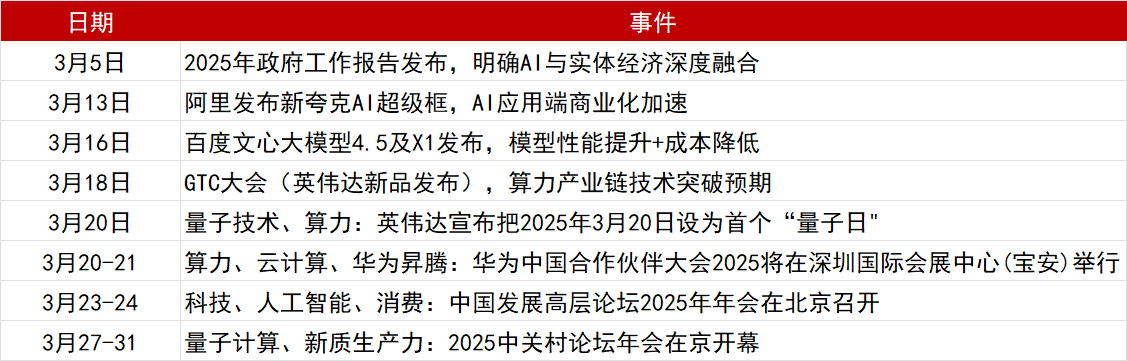
Core Viewpoint - The AI sector is experiencing a phase of adjustment since March 2025, with the Sci-Tech AI Index retreating approximately 7% from its peak, but recent trends indicate a recovery with a rise of over 1% on March 26, 2025, and significant trading activity in the leading ETF, Sci-Tech AI ETF (588790) [1][2]. Group 1: Recent Catalysts for AI Market - Market sentiment has been affected by delayed interest rate cuts from the Federal Reserve, leading to pressure on global tech stock valuations, alongside intensified competition in AI technology [2]. - The AI sector has seen a technical correction after a sustained rise since 2024, which is viewed as a normal market adjustment rather than a shift in the main growth trajectory [2]. - Key events in March 2025 have acted as catalysts for the AI market, including government reports emphasizing AI integration, major product launches from companies like Alibaba and Baidu, and significant conferences highlighting advancements in computing power [2]. Group 2: Core Catalysts - The 2025 government work report has prioritized "full-chain empowerment of artificial intelligence," focusing on three main areas: 1. Upstream computing power infrastructure with plans to add over 50 intelligent computing centers and a 40% year-on-year increase in computing power capacity [3]. 2. Midstream model breakthroughs supporting domestic models in various applications [4]. 3. Downstream application integration with smart terminals [4]. - Accelerated technological iterations are evident, with reduced training costs for large models, enabling a surge in AI applications [4]. - Capital expenditures are expected to exceed 120 billion yuan for Alibaba in 2025, marking a 197% increase year-on-year, primarily directed towards AI and cloud computing [6]. Group 3: Investment Value of Sci-Tech AI ETF - The Sci-Tech AI ETF (588790) closely tracks the Sci-Tech AI Index, focusing on top AI companies in the Sci-Tech sector, covering the entire industry chain from chips to applications [6]. - The index has significantly outperformed the Zhongzheng AI Index, with a return of 77.07% since its inception compared to 43.35% for the Zhongzheng AI Index [7]. - The top ten weighted stocks in the index are concentrated in semiconductor, general equipment, cloud services, and computer equipment sectors [9]. Group 4: Future Outlook for AI Market - Short-term performance will be influenced by earnings reports and event-driven catalysts, with expectations for some key stocks to exceed performance forecasts [10]. - The GTC conference is anticipated to catalyze the computing power supply chain with the release of new GPUs, benefiting domestic alternatives [11]. - Mid-term growth is expected from the proliferation of AI agents and increased user engagement, driving revenue growth in advertising and subscriptions [12]. - Long-term prospects include the rise of domestic models in international rankings and the potential for significant market penetration in computing power [14][15].
Z Potentials|沈振宇,一个潮玩公司如何做出世界第一的AIGC模型平台
Z Potentials· 2025-03-26 03:49
Core Viewpoint - The future of AI will lead every company to become an AI company, blurring the lines between AI and non-AI companies, as AI will transform all aspects of product development and problem-solving [2][10]. Group 1: Company Background and Development - Shen Zhenyu, the founder of Tensor.Art, has a background in AI and has witnessed the evolution of AI algorithms from classic machine learning to modern deep learning techniques [3]. - The company, originally known as QianDao, has transitioned into the AI space with Tensor.Art, which serves as a community and infrastructure for AI model sharing and training [11]. Group 2: Tensor.Art's Positioning and Strategy - Tensor.Art is positioned as a leading platform for AIGC model hosting and sharing, with over 2 million users and more than 500,000 models, generating over 2 million images daily [9]. - The platform aims to create a dual moat through model scale and creator scale, emphasizing that a larger number of models and creators will enhance commercial efficiency [19][20]. Group 3: AI Technology and Market Trends - AI technology is expected to become as fundamental as electricity, necessitating a shift towards numerous fine-tuned models to address specific scenarios rather than relying solely on large models [2][12]. - The company believes that open-source models will dominate the future, as they allow for greater participation from global talent and provide more flexibility for businesses compared to closed-source models [12][16]. Group 4: Competitive Advantages - Tensor.Art's competitive edge lies in its strong hosting capabilities, offering superior inference performance and cost-effectiveness compared to competitors like Civitai [17]. - The platform is designed to support creators in monetizing their models, with revenue-sharing mechanisms similar to those used by popular content platforms [18]. Group 5: Future Directions and Innovations - The company is exploring the integration of video and 3D models into its offerings, recognizing the growing demand for video content generation and the potential for significant market expansion [22][23]. - Tensor.Art is committed to remaining a facilitator of open-source models rather than developing proprietary models, focusing on supporting the broader open-source ecosystem [16].