
小米

Search documents
天龙集团(300063.SZ):与巨量引擎、腾讯等媒体平台保持战略合作关系
Ge Long Hui· 2025-12-17 00:56
Group 1 - The core viewpoint of the article highlights that Tianlong Group (300063.SZ) has established a comprehensive media resource matrix in its internet marketing segment, covering mainstream information flow media, search engine media, and smart terminal manufacturer media [1] - The company maintains strategic partnerships with major media platforms such as Douyin, Tencent, Baidu, Huawei, Xiaomi, Vivo, and 360 [1]

上证早知道|“国产GPU第二股”来了;存储短缺警报再起
Shang Hai Zheng Quan Bao· 2025-12-16 23:02
Group 1: Market Developments - Muxi Co., Ltd. was listed on the Shanghai Stock Exchange's Sci-Tech Innovation Board on December 17 [1] - The 2025 Xiaomi Human-Vehicle-Family Ecosystem Partner Conference was held on December 17 [1] - The 2025 China Artificial Intelligence Industry Innovation Development Conference opened on December 17 [1] Group 2: Regulatory and Standardization Updates - The State Administration for Market Regulation released the "Unified Social Credit Code Management Measures" on December 16, aiming for precise identification and dynamic tracking of organizations [3] - China is leading the formulation of 275 international standards and proposing 459 new international standard proposals in 2025, with a focus on 5G, semiconductors, and AI [3] Group 3: Digital Consumption Trends - The "Digital Consumption Development Report (2025)" indicates that by mid-2025, the number of digital consumption users in China will exceed 958 million, accounting for 85.3% of internet users [4] - The report highlights that 39.1% of internet users purchased smart products in the first half of 2025, while 8.2% engaged in online shopping for niche products [4] Group 4: Automotive Industry Insights - In November 2025, commercial vehicle production and sales reached 388,000 and 392,000 units respectively, with year-on-year increases of 18.6% and 24.4% [4] Group 5: Technology and Innovation - SK Hynix warned of a persistent shortage in DRAM supply until 2028, driven by AI demand and industry capacity adjustments [7] - Domestic semiconductor equipment and materials companies are expected to benefit from this super cycle, with companies like Dongxin Co. achieving breakthroughs in flash memory technology [8] Group 6: Green Energy Initiatives - The world's largest integrated green hydrogen and ammonia project was launched in Jilin Province, with a capacity for 4.5 million tons of green hydrogen and 200,000 tons of green ammonia annually [10] - The project is expected to significantly reduce oil consumption and carbon emissions, with green ammonia projected to become a major fuel source by 2050 [10] Group 7: Business Developments - Huachangda signed a strategic cooperation agreement with Shanghai Jiao Tong University to collaborate on industrial robotics and digital simulation technologies [13] - Qiaoyin Co. is expected to win a bid for a waste management project in Zunyi City, with a contract value of 1.225 billion over 25 years [13]


一扫年初阴霾!无人驾驶迈出关键一步 特斯拉(TSLA.US)股价触及历史新高
Zhi Tong Cai Jing· 2025-12-16 22:44
Core Viewpoint - Tesla is experiencing a strong rebound in its stock price after a significant decline earlier this year, driven by advancements in autonomous driving technology and positive market sentiment [1][2]. Group 1: Stock Performance - Tesla's stock price has recovered from a 36% drop in the first quarter, closing at a record high of $489.88, with a year-to-date increase of 21% [1]. - The company's market capitalization has reached approximately $1.63 trillion, making it the seventh largest publicly traded company globally [2]. Group 2: Autonomous Driving Developments - Tesla's CEO Elon Musk announced that the company is testing fully autonomous vehicles in Austin, Texas, without any occupants, which is seen as a significant step towards realizing the "robotaxi" vision [1]. - Despite the advancements, there are ongoing discussions regarding safety and regulatory compliance for the autonomous driving system, which has not yet been made widely available to the public [2]. Group 3: Financial Performance - Tesla's first-quarter vehicle deliveries fell by 13% year-over-year, with automotive revenue declining by 20%, while the second quarter saw a 16% drop in automotive revenue [3]. - In the third quarter, Tesla reported a 12% year-over-year revenue increase, driven by consumer purchases ahead of the expiration of federal electric vehicle tax credits [3]. Group 4: Market Challenges - The company faces challenges from the cancellation of tax incentives, negative public sentiment towards Musk, and intense competition from companies like BYD, Xiaomi, and Volkswagen [3]. - Tesla has introduced cheaper versions of the Model Y and Model 3, but these models have not significantly boosted sales in the U.S. and Europe, with November sales in the U.S. hitting a four-year low [3]. Group 5: Analyst Outlook - Despite the challenges, some Wall Street analysts remain optimistic about Tesla's future, with Mizuho Securities raising its target price from $475 to $530, citing improvements in Tesla's Full Self-Driving (FSD) technology [4]. - The potential for expanding the robotaxi fleet in cities like Austin and San Francisco is seen as a key factor for future growth, although the transition to fully autonomous operation remains a critical focus for the market [4].

十年磨一剑 百度的未来:昆仑芯
BambooWorks· 2025-12-16 09:10
Core Viewpoint - Baidu is considering the spin-off and IPO of Kunlun Chip, which has generated renewed investor interest in the company after a period of underperformance compared to its peers [2][4]. Group 1: Kunlun Chip Overview - Kunlun Chip was originally part of Baidu's smart chip and architecture division, starting its self-developed chip project in 2011 and becoming an independent entity in 2021 with an initial valuation of 13 billion yuan [4]. - The chip has undergone rapid iterations, with the first generation launched in 2021 and the second generation in 2023, alongside the introduction of the K100 accelerator card and RH800 server [4]. Group 2: Financial Performance - Kunlun Chip's revenue is projected to reach 5 billion yuan in 2025, with expectations of surpassing 10 billion yuan in the following year [6]. - In 2022, Kunlun Chip generated 2 billion yuan in revenue with a net loss of 200 million yuan, but is expected to achieve 3.5 billion yuan in revenue this year and break even [5][6]. Group 3: Market Position and Trends - Kunlun Chip ranked second in the Chinese data center AI accelerator card market with nearly 70,000 GPUs, significantly behind Nvidia's 1.9 million GPUs [5]. - The Chinese government is heavily supporting domestic chip development in response to U.S. technology restrictions, which is a strong catalyst for the chip business [7]. Group 4: Baidu's Broader Business Context - Baidu's overall financial performance has been disappointing, with a 7% year-on-year revenue decline to 31.17 billion yuan in Q3, and a significant drop in online marketing revenue [6]. - Despite the challenges, the potential success of Kunlun Chip and other initiatives like the autonomous driving service "Luobo Kuaipao" could revitalize Baidu's market valuation [9][11].



港股速报|港股继续下跌 原因找到了!后市如何操作?
Mei Ri Jing Ji Xin Wen· 2025-12-16 09:09
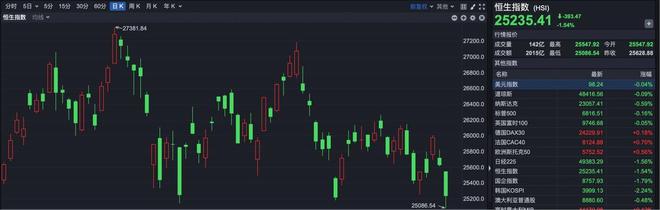
Market Performance - The Hong Kong stock market experienced a significant decline, with the Hang Seng Index closing at 25,235.41 points, down 393.47 points, representing a drop of 1.54% [1] - The Hang Seng Technology Index also fell, closing at 5,402.51 points, down 95.91 points, a decrease of 1.74% [2] Market Influences - The decline in the Hong Kong market was attributed to overall low market sentiment and a collective drop in the Asia-Pacific markets, notably the Nikkei 225 index down 1.56% and the KOSPI index down 2.24%, which negatively impacted both A-shares and H-shares [4] - Anticipation of the Bank of Japan's monetary policy meeting on December 18-19, where a potential interest rate hike from 0.5% to 0.75% is expected, may lead to foreign capital returning to Japan, increasing risk aversion and affecting the Hong Kong market [7] Sector Performance - The market saw widespread declines across various sectors, with notable drops in technology stocks such as Alibaba down nearly 3%, and other major players like Xiaomi, JD.com, and Bilibili down over 2% [7] - Gold stocks also faced declines, with Zijin Mining down over 4%, and other gold companies like Shandong Gold and Lingbao Gold down over 3% [7] Capital Flow - There was a net inflow of southbound funds into Hong Kong stocks, amounting to over 80 million HKD by the end of the trading day [8] Future Outlook - Analysts suggest that the Hong Kong market is at a potential rebound phase, with attractive long-term positioning despite existing risks. The focus remains on the economic fundamentals of China and the inflow of southbound capital [10] - The market is expected to remain volatile until the end of the year, with a consensus on a strong policy opening in the first quarter of the next year, particularly favoring sectors like technology and metals [10]






港股,突发!
券商中国· 2025-12-16 08:00
Core Viewpoint - The Hong Kong stock market, particularly the Hang Seng Technology Index, experienced significant declines due to rumors regarding tax recognition for high-tech companies, leading to a market reaction despite the lack of official confirmation [1][4]. Group 1: Market Reaction - On December 16, the Hang Seng Technology Index fell over 2.5%, with major stocks like Alibaba, Tencent, JD.com, and Meituan seeing increased losses [3][4]. - Individual stocks such as SenseTime dropped over 6%, and XPeng fell over 4%, while Alibaba and others experienced declines exceeding 3% [3][4]. - Alibaba's warrants saw a drastic drop, with some experiencing declines of over 85% [3]. Group 2: External Factors - External liquidity conditions have changed significantly, influenced by the Federal Reserve's hawkish stance on interest rates and the Bank of Japan's rate hikes, which have collectively impacted the Hong Kong market [4][6]. - The overall liquidity pressure in the banking system remains a concern, as indicated by comments from Federal Reserve officials [4]. Group 3: Tax Recognition Rumors - There are indications from brokerage analysts that the tightening of tax recognition for high-tech companies is not a blanket approach but rather a more stringent assessment [6]. - The market's pricing of these rumors reflects a one-time adjustment, with potential for a rebound if the situation reverses [1]. Group 4: Broader Economic Context - The current market conditions differ from the asset sell-off experienced in August last year, as the market has already priced in expectations for interest rate hikes from the Bank of Japan [7]. - Analysts suggest that while there are risks ahead, the immediate impact of the Bank of Japan's rate hike may be limited compared to previous instances [6][7].


国产射频芯片龙头昂瑞微登陆科创板 股价首日高开188.95%
Zhong Zheng Wang· 2025-12-16 07:00
Core Viewpoint - Beijing Angrui Microelectronics Technology Co., Ltd. has successfully listed on the Shanghai Stock Exchange's Sci-Tech Innovation Board, marking a significant advancement in the domestic RF chip sector [1][2] Company Overview - Founded in 2012, Angrui Micro is a national-level "little giant" enterprise focused on the design of RF and analog integrated circuits, specializing in RF front-end chips, RF SoC chips, and other analog chip development, design, and sales [1] - The company has developed high-integration 5G L-PAMiD products that meet international advanced and domestic leading standards, breaking the long-standing monopoly of international manufacturers [1] Market Position and Growth - Angrui Micro's RF front-end chips are now part of the supply chains for major terminal brands such as Honor, Samsung, Vivo, Xiaomi, and OPPO, while its RF SoC chips have entered the supply chains of Alibaba, Pinduoduo, BYD, and others [2] - The company anticipates a revenue of approximately 2.1 billion yuan in 2024, with a compound annual growth rate of over 50% in revenue over the past three years [2] IPO and Fund Utilization - The IPO is expected to raise a total of 2.067 billion yuan, which will primarily be used for the R&D and industrialization of 5G RF front-end chips and modules, RF SoC chips, and the construction of headquarters and R&D centers [2] - Notable investors participating in the strategic placement include Lenovo, BAIC, and several well-known financial institutions [2]
重估东南亚市场:品牌出海的“第一关”,没有简单模式
创业邦· 2025-12-16 03:43
Core Viewpoint - Southeast Asia is viewed as a primary market for Chinese brands seeking international expansion, but the reality is more complex than it appears, with significant challenges that require a deep understanding of local markets and consumer behavior [5][8][9]. Market Characteristics - The Southeast Asian market is characterized by its diversity in religion, ethnicity, and language, leading to fragmented channels and varying consumer purchasing power [8][9]. - There is no unified market or "one-size-fits-all" approach; brands must adapt to local conditions and consumer preferences [8][9]. Consumer Behavior - Traditional shopping habits remain strong, with physical retail still holding significant sway over online shopping, particularly in Malaysia and Singapore [11]. - The convenience of shopping malls, which are prevalent in urban areas, often rivals online shopping experiences due to underdeveloped electronic payment systems [11]. Brand Presence - Successful Chinese brands in Southeast Asia are predominantly found in the food and beverage sector, with notable examples including Haidilao and various tea brands [12][15]. - Non-food brands are also expanding, with significant activity in the toy, apparel, and electronics sectors, showcasing a growing presence in physical retail spaces [15][17]. Challenges Faced by Brands - Despite a strong presence, many Chinese brands struggle with visibility and profitability, often using stores more as brand showcases than for actual sales [19][20]. - The majority of Chinese brands occupy less favorable retail locations, often in higher floors of shopping malls, limiting their exposure to potential customers [20][21]. Market Dynamics - The rapid turnover of brands in Southeast Asia resembles a "fast-growing rainforest," where many brands can quickly rise to prominence but also face swift declines [23][24]. - The high turnover rate is exacerbated by a lack of long-term strategic planning among many brands, leading to unsustainable growth patterns [24][26]. Competitive Landscape - Korean and Japanese brands dominate the market, often employing a more cohesive and strategic approach to brand building compared to their Chinese counterparts [27][28]. - Chinese brands frequently rely on low pricing strategies, which can lead to intense competition and diminished profitability [28]. Brand Recognition - Many Chinese brands struggle with brand identity and recognition in Southeast Asia, often failing to leverage their Chinese heritage effectively [30][31]. - Successful brands, like Skintific, have managed to establish themselves without overtly emphasizing their Chinese origins, focusing instead on local market integration [30][31]. Marketing Strategies - Innovative marketing strategies, such as "store broadcasting" and enhanced offline distribution channels, are emerging as key tactics for brands looking to establish a foothold in the market [33][36]. - The integration of online and offline sales strategies is crucial for maximizing brand exposure and consumer engagement [35][36]. Distribution Challenges - Entering retail channels in Southeast Asia can be challenging due to the closed nature of many distribution networks, particularly in larger retail chains [37][38]. - However, the relatively low complexity of establishing physical retail locations in Southeast Asia presents opportunities for brands willing to invest in local market strategies [38].

射频芯片“攀登者”昂瑞微,开启科创板上市新篇章
Zheng Quan Shi Bao Wang· 2025-12-16 02:15
Core Viewpoint - Angrui Microelectronics officially listed on the Sci-Tech Innovation Board, marking a significant step for domestic high-end RF chips in the capital market and enhancing the self-sufficiency of China's semiconductor industry [1] Group 1: Market Position and Technology - RF chips are essential for wireless communication in various fields, including 5G, smartphones, IoT, and smart vehicles, yet the market has been dominated by international giants like Broadcom and Qualcomm, with domestic market share remaining low [1][2] - Angrui Micro has achieved significant milestones in the high-end RF front-end module market, specifically with its 5G L-PAMiD module, which has been successfully mass-produced and shipped in flagship models of major smartphone brands, breaking international monopolies [2][3] - The company has established a comprehensive layout in satellite communication, launching products for handheld terminals and positioning itself favorably in the upcoming satellite communication market, which is expected to grow significantly [3][4] Group 2: Financial Performance and Growth - Angrui Micro's revenue from RF front-end products grew by 9.26% year-on-year, while its RF SoC business saw a 22.38% increase, indicating strong performance despite challenges from client procurement strategies [7] - The company has diversified its customer base, significantly increasing direct supply revenue from brand clients, which has reached levels comparable to the previous year's total, showcasing resilience and adaptability [7] Group 3: Strategic Initiatives and Future Outlook - The timing of Angrui Micro's IPO aligns with a critical window for domestic RF chip replacement, as global geopolitical changes drive local brands to adopt domestic suppliers, particularly in high-end modules [8] - The company plans to raise 2.067 billion yuan through its IPO to invest in R&D and industrial upgrades for 5G RF front-end chips and modules, as well as RF SoC projects [8] - To capitalize on the domestic replacement trend, Angrui Micro must enhance its supply chain autonomy, expand into high-value markets like automotive electronics and industrial IoT, and develop comprehensive system-level capabilities [9]
每日投资策略-20251216
Zhao Yin Guo Ji· 2025-12-16 01:42
Macro Economic Outlook - The economic momentum in China is weakening, with November economic indicators falling below market expectations, indicating a further decline in economic activity [2] - Retail sales growth dropped to a post-pandemic low, significantly affected by high base effects and demand exhaustion from old-for-new subsidies, particularly in durable goods like home appliances, furniture, and automobiles [2] - Fixed asset investment growth has sharply declined, with real estate investment hitting a historical low, and both manufacturing and infrastructure investment growth continuing to slow [2] - A comprehensive decline in the real estate market, durable goods consumption, and new household loans suggests weakening terminal demand, forecasting a sluggish economic growth momentum into Q1 2026 [2] - GDP growth is expected to fall from 5% in 2025 to 4.8% in 2026, potentially triggering a new round of policy easing, including a 50 basis point RRR cut and a 10 basis point LPR cut in Q1 2026 [2] Global Market Performance - Major global stock indices showed mixed performance, with the Hang Seng Index closing at 25,629, down 1.34% for the day but up 27.76% year-to-date [2] - The S&P 500 and NASDAQ also experienced slight declines of 0.16% and 0.59% respectively, while the DAX and CAC indices saw minor gains [2] - The performance of the Chinese stock market was characterized by declines in healthcare, consumer discretionary, and information technology sectors, while consumer staples, utilities, and financials outperformed [4] Industry Outlook - The semiconductor industry is projected to maintain four core investment themes for 2026: AI-driven structural growth, China's semiconductor self-sufficiency trend, high-yield defensive allocations, and industry consolidation and mergers [5] - The global semiconductor market is expected to grow by 26% year-on-year to reach $975 billion in 2026, with AI-related segments leading the growth, particularly logic chips and memory chips [5] - Notable stock performances include Zhongji Xuchuang with a year-to-date increase of 407%, Shengyi Technology at 172%, and Northern Huachuang at 64.9% [5]