牧原股份

Search documents
生猪期货上市五周年 从“稳起步”到“深扎根”
Xin Lang Cai Jing· 2026-01-07 08:21
Core Viewpoint - The live pig futures market in China has developed significantly over the past five years, becoming an essential tool for stabilizing operations in the pig farming industry and enhancing its resilience against cyclical fluctuations [3][9]. Market Capacity - The liquidity of live pig futures has steadily improved, with the total trading volume reaching 17.993 million contracts and an average daily trading volume of 74,000 contracts by 2025, compared to 25,000 contracts and 60,000 contracts in 2021 [3][9]. - The average open interest has increased to 213,000 contracts, with levels maintained above 300,000 contracts since November 2025 [3][9]. Industry Participation - Over 3,000 industry enterprises are involved in live pig futures trading, with 24 out of 32 major pig companies participating in trading or delivery [3][9]. - Notable companies such as Muyuan Foods, Shennong Group, and others have issued announcements related to hedging with live pig futures [3][9]. Delivery Layout - The delivery network for live pig futures has expanded to cover 22 provinces, with 58 delivery warehouses established, up from 14 at the time of launch [4][10]. - The Dalian Commodity Exchange has optimized contract specifications and introduced new delivery methods to enhance efficiency and service to industry participants [4][10]. Risk Management and Support for Rural Revitalization - The Dalian Commodity Exchange has supported 774 "insurance + futures" projects, covering over 15.4 million pigs and providing compensation of 748 million yuan to farmers [4][10]. - These initiatives have benefited approximately 28,700 farming households across major pig-producing provinces [4][10]. Price Discovery - Live pig futures serve as a reference for macroeconomic policy formulation and production planning for farming enterprises, reflecting policy impacts quickly in market prices [5][10]. - The futures market has become a critical tool for large-scale enterprises to manage price volatility and stabilize supply-demand dynamics in the industry [5][11]. Industry Insights - Companies like Sichuan Dekang Agricultural Group have actively engaged in hedging since the launch of live pig futures, using it as a standard operational method to secure profits [11][12]. - Shaanxi Shiyang Agricultural Technology Co., Ltd. emphasizes the importance of futures in improving cash flow and stabilizing operations amid industry cycles [12][13]. Market Evolution - The rapid development of live pig futures has led to increased transparency in market information, allowing enterprises and farmers to make informed decisions [13]. - The market's growth reflects a deepening integration between futures and the real economy, with expectations for a more resilient and efficient live pig futures market in the future [13].


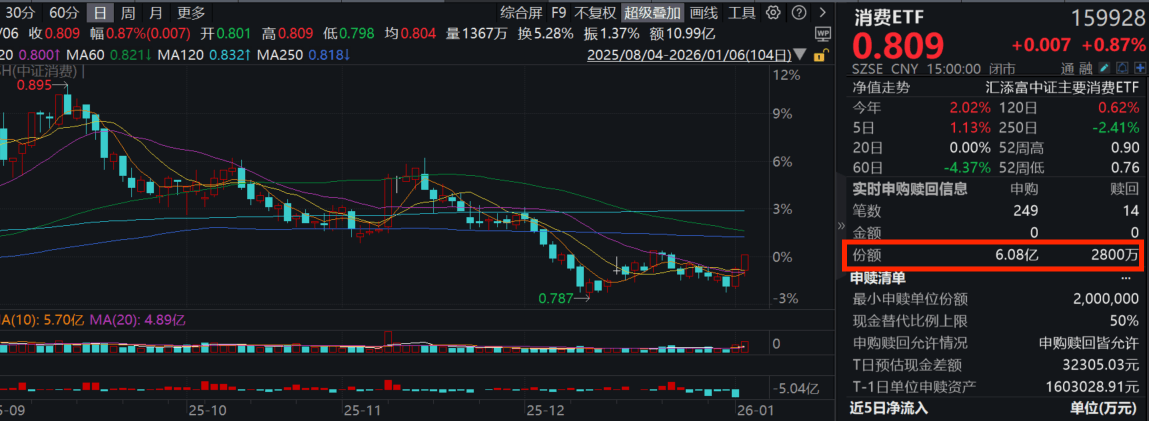
元旦消费开门红,茅台市场化转型打响第一枪!消费ETF(159928)两连阳后震荡回调,资金逢跌布局,获3亿元净申购!
Sou Hu Cai Jing· 2026-01-07 07:03
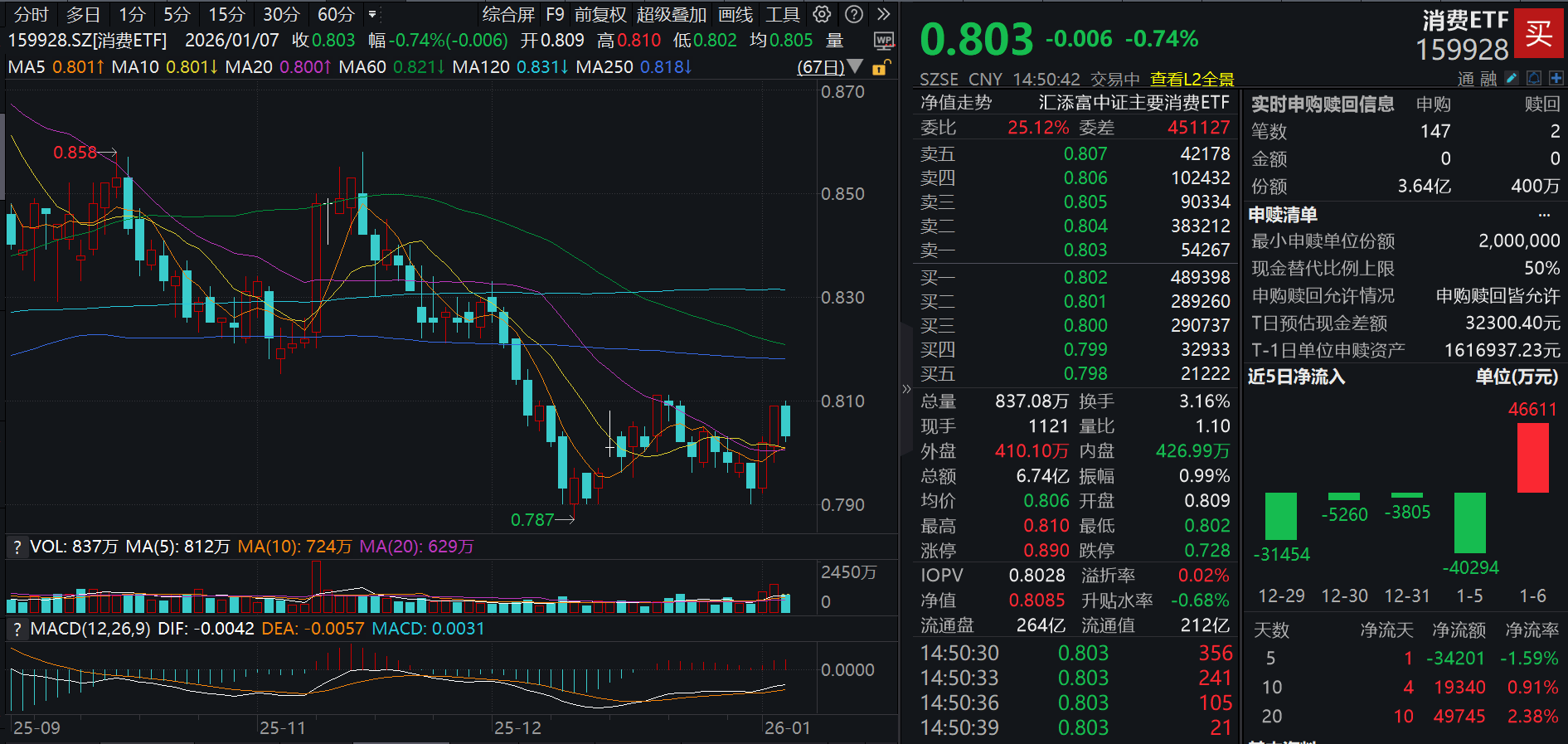
Group 1: Market Performance - The Shanghai Composite Index has risen again, with the Consumer ETF (159928) experiencing a 0.74% pullback after two consecutive days of gains, with a trading volume of 700 million yuan [1] - The Consumer ETF (159928) has seen a net subscription of over 360 million units, following a previous inflow of over 460 million yuan [1] - As of January 6, the latest scale of the Consumer ETF (159928) exceeds 21.3 billion yuan, leading its peers in the same category [1] Group 2: Consumer Market Trends - The inbound tourism market has shown a strong start to the New Year, with 292,000 foreign visitors benefiting from visa-free policies, marking a 35.8% year-on-year increase [3] - The emotional consumption market in China is rapidly growing, projected to rise from 16.3 trillion yuan in 2022 to 23.1 trillion yuan in 2024, reaching 27.2 trillion yuan by 2025, and surpassing 45 trillion yuan by 2029 [3] - Over 90% of young people recognize "emotional value," with nearly 60% willing to pay for it [3] Group 3: Valuation and Investment Opportunities - The valuation of the Consumer ETF (159928) is attractive, with a TTM price-to-earnings ratio of 19.5, placing it in the 4.08% percentile over the past decade, indicating it is cheaper than 96% of historical periods [3] - The Consumer ETF (159928) is characterized by its resilience through economic cycles, with over 68.55% of its top ten constituent stocks being essential consumer goods [10] Group 4: Sector-Specific Insights - The food and beverage industry is entering a mature phase, with growth opportunities arising from new consumer trends and channel transformations [8] - The white liquor sector is expected to perform well during periods of rising CPI, with a clear trend of increasing volume and price [9] - Moutai's market-oriented transformation is underway, focusing on consumer-centric strategies and dynamic product distribution [9][10]

猪-牛-禽-养殖周期-破晓见曦
2026-01-07 03:05
Summary of Key Points from the Conference Call Industry Overview - The conference call discusses the livestock industry, specifically focusing on the pig, chicken, and beef markets in China for the years 2025 and 2026 [1][3][14]. Core Insights and Arguments Pig Farming Sector - The pig farming sector is expected to experience significant impacts from the 2025 production capacity policies, leading to a slowdown in profit growth for leading companies and a downward adjustment of 2026 output targets [1][2]. - In 2025, the average price of pigs peaked at 16 RMB/kg but fell to 11 RMB/kg by the fourth quarter, indicating a trend of increasing supply due to rising breeding sow inventory [2]. - For 2026, it is anticipated that pig prices will continue to decline in the first half, with a focus on cost control and cash flow management being critical for companies [3]. Chicken Industry - The white chicken sector has faced two years of downturn, but the exit of small and medium enterprises is expected to stabilize the industry, leading to improved profitability and dividends ahead of the pig market [1][6]. - Leading companies in the white chicken sector, such as Shengnong, Hefeng, and Yisheng, have maintained profitability during price declines, with improved gross margins expected to yield significant profit elasticity when prices recover [10]. - The yellow chicken market, despite expansion by companies like Lihua and Wens, is projected to perform better in 2026, with price recovery anticipated in the second half of 2025 [12]. Beef Market - The beef market is showing signs of recovery since late 2025, with expectations of increased prices in 2026 due to reduced supply from exiting smallholders [3][13]. - The lack of publicly listed companies focused on beef cattle farming in China presents investment opportunities primarily in Hong Kong-listed dairy companies [3][13]. Investment Strategies - Investors are advised to focus on two types of companies in 2026: those with significant cost improvements, such as Muyuan Foods, and growth-oriented companies like Tiankang Biological, which are pursuing growth through acquisitions [1][5]. - Attention should also be given to fluctuations in agricultural product prices and production metrics such as survival rates and PSY (Production per Sow per Year) [5]. Additional Important Insights - The white chicken industry is currently facing challenges, with prices at historical lows, but the ongoing exit of smaller players is expected to lay the groundwork for future recovery [7][9]. - The overall outlook for the livestock sector in 2026 is more optimistic than in 2025, with potential for price recovery in white chicken and market expansion in yellow chicken [14][15]. This summary encapsulates the key points discussed in the conference call, providing a comprehensive overview of the livestock industry's current state and future outlook.
2026商品年度报告:周期底部、等待拐点再现
Ning Zheng Qi Huo· 2026-01-07 02:44
1. Report Industry Investment Rating - Not mentioned in the provided content 2. Core Viewpoints of the Report - In 2026, the supply - side pressure of the pig market will gradually ease as the reduction effect of the breeding sow inventory becomes apparent, and the demand side is expected to improve slightly. The pig price is predicted to show a trend of "low at the beginning and high at the end", and the annual average price will significantly increase compared to 2025 [4][5]. - The pig market will enter an upward cycle in 2026, with the inflection point likely to appear in the second and third quarters, and the market will achieve a substantial re - balance of supply and demand [41]. 3. Summary by Relevant Catalogs Chapter 1: Review of the Pig Market Trend in 2025 - The pig market in 2025 featured "high - pressure supply, oscillating price decline, deep industry losses, and accelerated capacity reduction". The price showed a three - stage trend: a mild decline from January to June, an accelerated decline from July to September, and a bottom - seeking at a low level from October to December. The annual average price dropped by 25.74% compared to 2024 [11][13]. - There was significant regional differentiation in the pig market in 2025, with the southern sales areas showing weak demand and the northern production areas being relatively resistant to price drops. The core reasons included the economic downturn in the south, increased scale of northern production areas, and sporadic epidemics [15]. Chapter 2: Analysis of the Pig Supply - Demand Situation in 2025/26 Supply Side - In 2025, the pig supply remained high, with the annual output in the first three quarters reaching 530 million heads, a year - on - year increase of 1.85%. The inventory of breeding sows was above the reasonable level until October, when the capacity reduction accelerated. The main reasons for the high inventory of breeding sows were the high pig price in 2024, the scale - expansion inertia of leading enterprises, and the lack of motivation for small and medium - sized enterprises to reduce capacity [18][19]. - There was significant cost differentiation in the industry in 2025. Leading enterprises had a cost advantage, with some having a breeding cost as low as 11.3 yuan/kg in October, while small and medium - sized enterprises and scattered farmers faced large losses due to high costs [23]. - The industry's concentration increased in 2025, with leading enterprises expanding their output and small and medium - sized enterprises accelerating their exit. It is expected that the proportion of the top 20 enterprises' output will exceed 35% in 2026 [25][26]. Demand Side - The demand for pigs in 2025 was weak, with the traditional peak season having little effect. The main reasons were the decline in residents' consumption ability due to the economic downturn, the low price of substitutes, and the change in consumption habits. The national pork consumption was expected to decrease by 2% year - on - year [28][30]. Policy Side - In 2025, the "anti - involution" policy was implemented to guide rational production, stabilize the inventory of breeding sows at 39 million heads, and optimize the capacity structure. The policy was implemented in four stages, effectively guiding market expectations, accelerating capacity reduction, and promoting industry structure optimization [32][35]. Other Influencing Factors - In 2025, pig diseases were sporadically distributed, which had a certain impact on local supply and prices [38]. Pig Cycle Inflection Point - The pig market will enter an upward cycle in 2026, with the core logic being the gradual manifestation of supply - side contraction and the marginal improvement of demand. The inventory of breeding sows will stabilize in a reasonable range, promoting the transition from "capacity reduction" to "capacity stabilization" [41]. Chapter 3: Outlook for the Pig Market in 2026 - In the first quarter of 2026, the pig price will be in a low - level oscillation. The supply pressure will still exist, but there will be seasonal demand support. It is expected that the average ex - factory price of national outer three - yuan pigs will rise to 12 - 12.5 yuan/kg before the Spring Festival and fall back to 11.5 - 12 yuan/kg after the Spring Festival [44]. - In the second and third quarters of 2026, the inflection point will appear, and the price will rise. The supply will contract, the demand will improve, and the pig price is expected to break through the cost line in the second - quarter end and reach 14 - 15 yuan/kg in the third - quarter end [46]. - In the fourth quarter of 2026, the price will rise steadily and oscillate at a high level. The supply will continue to contract, and the demand will be strong during the peak season. It is expected that the pig price will reach 15 - 16 yuan/kg, and the self - breeding and self - raising profit per head will reach 200 - 300 yuan [47][48].
相关部门释放绿色消费强信号,自由现金流ETF(159233)备受关注
Sou Hu Cai Jing· 2026-01-07 02:01
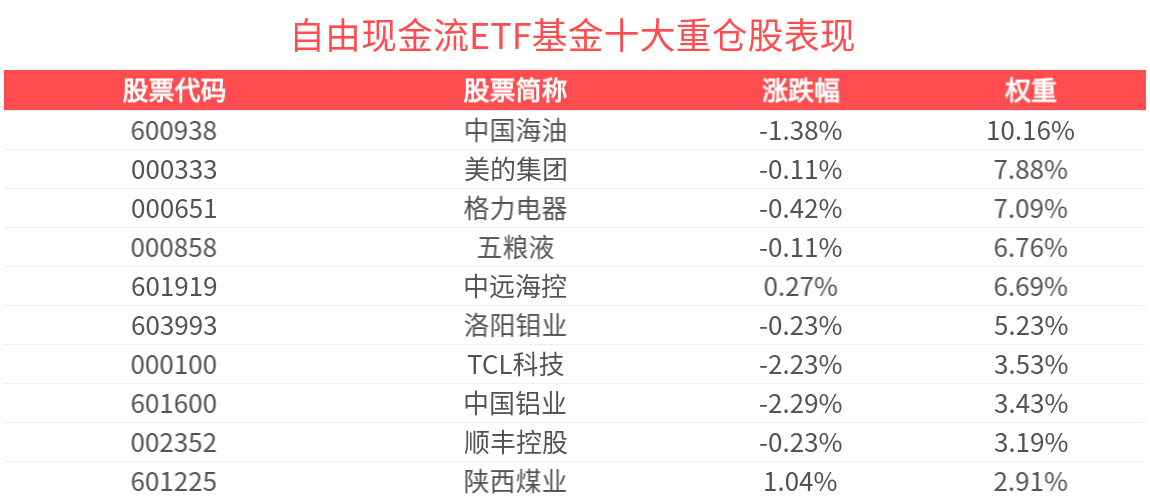
Group 1 - The core viewpoint of the news is the introduction of a policy by nine departments to promote green consumption, which is expected to inject strong momentum into sectors like non-ferrous metals, home appliances, and automobiles due to their cash flow strength [1] - The policy focuses on enhancing the green consumption incentive mechanism, emphasizing seven dimensions including the supply of green products and the recycling of waste items [1] - The Free Cash Flow ETF (159233) targets high free cash flow companies in the non-ferrous and home appliance sectors, which are better positioned to benefit from policy incentives and advance their green transformation and capacity expansion [1] Group 2 - The non-ferrous metals sector is generally viewed positively by authoritative institutions, with expectations of a bull market driven by monetary, demand, and supply factors by 2026, particularly for copper, aluminum, and tin [1] - Copper is highlighted as the "oil of the electrification era," with demand significantly benefiting from multiple factors such as new energy, AI computing power, and grid upgrades [1] - The home appliance sector is expected to see sustained demand improvement due to policies promoting green upgrades and trade-in programs, with a projected subsidy scale of 250 billion yuan by 2026 [2] Group 3 - The CSI Free Cash Flow Index (932365) includes top-weighted stocks such as China National Offshore Oil Corporation, SAIC Motor, Gree Electric Appliances, and others, with the top ten stocks accounting for 53.78% of the index [3] - The index reflects the overall performance of companies with strong cash flow creation capabilities, selecting 100 high free cash flow rate listed companies as sample securities [2][3]
生猪:仍存累库行为
Guo Tai Jun An Qi Huo· 2026-01-07 01:54
2026 年 1 月 7 日 生猪:仍存累库行为 | 周小球 | 投资咨询从业资格号:Z0001891 | zhouxiaoqiu@gtht.com | | --- | --- | --- | | 吴昊 | 投资咨询从业资格号:Z0018592 | wuhao8@gtht.com | | 【基本面跟踪】 | | | 生猪基本面数据 | | | 单 位 | 价 | 格 | 同 比 | | | --- | --- | --- | --- | --- | --- | --- | | 价 格 | 河南现货 | 元/吨 | | 12980 | 100 | | | | 四川现货 | 元/吨 | | 12850 | 0 | | | | 广东现货 | 元/吨 | | 12760 | -100 | | | 期 货 | | 单 位 | 价 | 格 | 同 比 | | | | 生猪2603 | 元/吨 | | 11810 | 150 | | | | 生猪2605 | 元/吨 | 12255 | | 145 | | | | 生猪2607 | 元/吨 | | 12940 | 140 | | | | | 单 位 | 成交量 | 较前日 ...
棕榈油:基本面驱动不强,关注宏观情绪影响豆油:单边区间为主,关注月差机会
Guo Tai Jun An Qi Huo· 2026-01-07 01:25
2026年01月07日 国泰君安期货商品研究晨报-农产品 观点与策略 | 棕榈油:基本面驱动不强,关注宏观情绪影响 | 2 | | --- | --- | | 豆油:单边区间为主,关注月差机会 | 2 | | 豆粕:隔夜美豆收跌,连粕或震荡 | 4 | | 豆一:震荡 | 4 | | 玉米:关注现货 | 6 | | 白糖:低位整理 | 7 | | 棉花:维持强势20260107 | 8 | | 鸡蛋:远月情绪转弱 | 10 | | 生猪:仍存累库行为 | 11 | | 花生:震荡运行 | 12 | 国 泰 君 安 期 货 研 究 所 请务必阅读正文之后的免责条款部分 1 期货研究 商 品 研 究 2026 年 01 月 07 日 品 研 究 棕榈油:基本面驱动不强,关注宏观情绪影响 豆油:单边区间为主,关注月差机会 | | | 【基本面跟踪】 油脂基本面数据 | | 棕榈油主力 | 单 位 元/吨 | 收盘价 (日盘) | 涨跌幅 0.14% | 收盘价 (夜盘) | 涨跌幅 0.47% | | --- | --- | --- | --- | --- | --- | --- | | | 豆油主力 | 元/吨 ...
大红包!2025年深市公司分红超5000亿元,创业板公司展现出更强增长活力
Jin Rong Jie· 2026-01-06 11:33
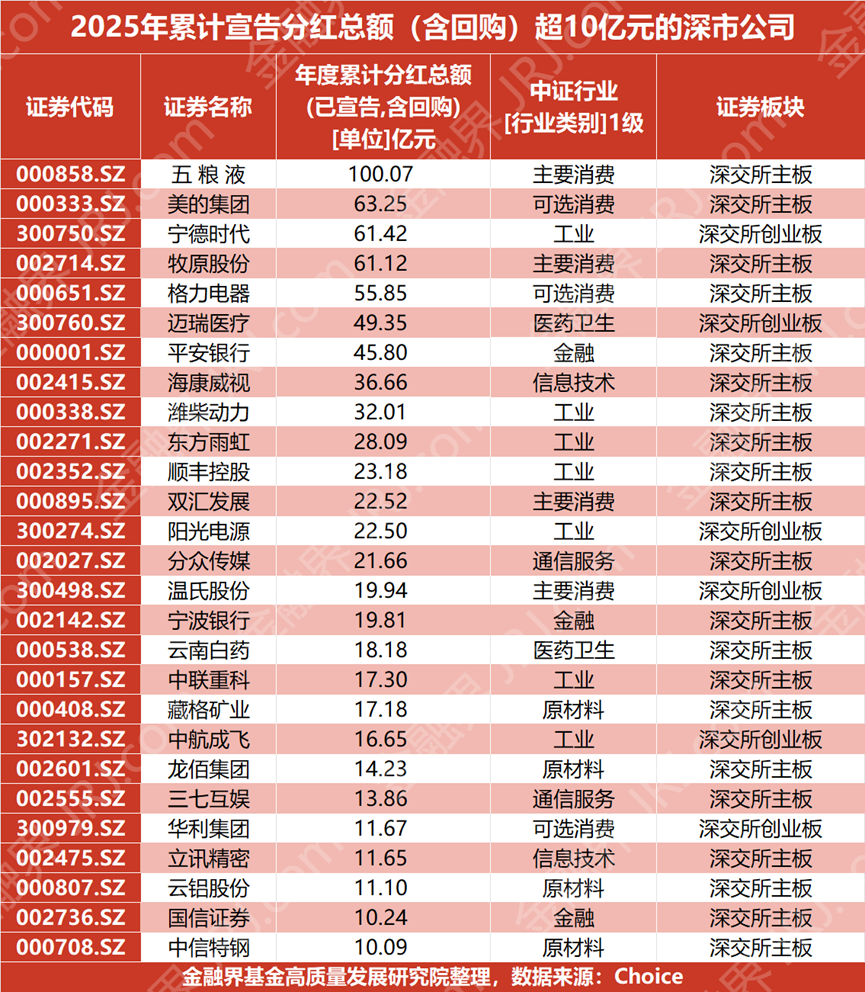
Core Insights - The total cash dividends of companies listed on the Shenzhen Stock Exchange (SZSE) are projected to exceed 500 billion yuan in 2025, reaching 547.56 billion yuan, indicating a stable high level of cash returns to investors [1] - Since the start of the 14th Five-Year Plan, cumulative dividends from SZSE companies have surpassed 2 trillion yuan, reflecting a solid market ecosystem that favors regular and substantial dividends [1] Summary by Category Dividend Scale and Growth - The dividend scale remains robust, consistently maintaining above the 500 billion yuan threshold [1] - In 2025, 533 companies on the SZSE implemented interim dividends totaling approximately 132.93 billion yuan, representing a growth of over 25% compared to the previous year [1] Attracting Long-term Investment - Stable high returns have attracted long-term capital investments, with 166 companies in the SZSE offering dividend yields exceeding 1%, and 108 companies yielding over 1.34%, particularly appealing to insurance and pension funds [1] Performance of Different Boards - While mainboard companies continue to dominate total dividend amounts, companies on the ChiNext board have shown stronger growth, with 945 companies increasing their total dividends by 8.41% year-on-year to 137.45 billion yuan [1] Industry Highlights - Leading companies in the consumer and financial sectors have set examples with significant dividend distributions, such as Wuliangye's interim dividend of 10.01 billion yuan and Gree Electric's distribution of 5.585 billion yuan [1] - In key future-oriented sectors, notable dividend cases have emerged from advanced manufacturing (CITIC Special Steel, Weichai Power), digital economy (Yilian Network, GoerTek), and green low-carbon sectors (CATL, Longyuan Power) [2] High Dividend Companies - In 2025, 28 companies on the SZSE announced total dividends exceeding 1 billion yuan, with Wuliangye leading at over 10 billion yuan, followed by Midea Group, CATL, and Muyuan Foods, each exceeding 6 billion yuan [3] - The distribution of these high-dividend companies is primarily in the consumer, industrial, and discretionary sectors, with notable representation from the pharmaceutical and information technology sectors [4]





慢牛格局下“现金为王”逻辑被再度验证!300现金流ETF(562080)收涨1.96%创新高
Xin Lang Cai Jing· 2026-01-06 10:59
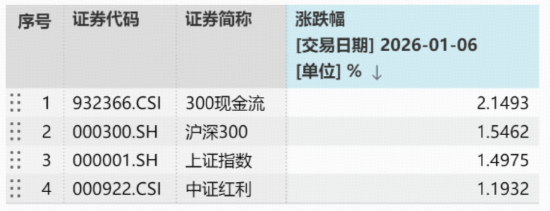
Core Viewpoint - The A-share market continues to perform strongly, with the 300 Cash Flow Index rising by 2.15%, outperforming major indices, reaffirming the "cash is king" logic in a slow bull market [1][14]. Index Performance - The 300 Cash Flow Index closed at a gain of 2.15% on January 6, 2026, outperforming the CSI 300, Shanghai Composite Index, and the CSI Dividend Index [1][14]. - The 300 Cash Flow ETF (562080) rose by 1.96%, reaching a historical high of 0.625 yuan, with its net asset value hitting new highs 29 times in the past year [1][14]. Fund Inflows - The 300 Cash Flow ETF has recorded a "ten consecutive days of gains" since its inception, attracting long-term capital with a net inflow of 57.82 million yuan over the last five trading days [2][14]. Component Stocks - Among the 50 large-cap "cash cow" stocks in the 300 Cash Flow Index, 46 stocks closed in the green, with Zijin Mining and Luoyang Molybdenum rising by 6.21% and 6.07%, respectively [4][14]. - Major oil companies, China Petroleum and China National Offshore Oil Corporation, saw increases of 1.99% and 2.58% [4][14]. Industry Allocation - The 300 Cash Flow Index is diversified and balanced, avoiding financial and real estate sectors to mitigate risks from industry downturns [8][19]. - The index is overweight in sectors like oil and petrochemicals, home appliances, and non-ferrous metals, achieving a balance between defensive and offensive strategies [10][21]. Cash Flow Focus - The index emphasizes "free cash flow," a key quality metric that reflects a company's ability to generate cash after necessary capital expenditures, thus serving as a critical indicator of financial health [6][17]. Historical Performance - Since its inception in 2014, the 300 Cash Flow Total Return Index has achieved a return of over 428%, with an annualized return exceeding 15% [10][21].
沪指劲升1.5%创逾10年新高!消费ETF(159928)涨近1%两连阳,近5亿元资金狂涌!i茅台普茅购买政策调整,限购量减半!
Xin Lang Cai Jing· 2026-01-06 09:59
Group 1 - The Shanghai Composite Index rose by 1.5%, reaching a new high not seen in over 10 years, with significant inflows into the consumer sector, particularly the Consumption ETF (159928), which saw a net inflow of over 460 million yuan [1][3] - The Consumption ETF (159928) has a current scale exceeding 20.7 billion yuan, leading its peers in the same category [1][3] - Kweichow Moutai's digital marketing platform "i Moutai" launched a new product, which sold out quickly, indicating strong consumer demand [3][6] Group 2 - Goldman Sachs predicts that China's GDP growth rate in 2026 will exceed market consensus, recommending an overweight position in A-shares and Hong Kong stocks, with expected annual increases of 15% to 20% for the stock market in 2026 and 2027 [3] - The valuation of the Consumption ETF (159928) is attractive, with a TTM price-to-earnings ratio of 19.38, placing it in the 3.36% percentile over the past decade, indicating it is cheaper than 96% of the historical time [3][13] - The Hong Kong Stock Connect Consumption 50 ETF (159268) also saw a rise of 0.97%, with significant trading volume, highlighting investor interest in consumer stocks [5] Group 3 - Recent meetings among liquor distributors indicate a stable supply strategy for 2026, with a focus on adjusting product offerings to meet market demand [6][10] - The white liquor sector is experiencing a V-shaped recovery, with expectations for improved supply-demand dynamics compared to 2025 [6][10] - The dairy sector is anticipated to see a recovery in milk prices, with leading companies expected to benefit from improved performance and dividend support [6][10]