
永兴材料

Search documents
浙商早知道-20250623
ZHESHANG SECURITIES· 2025-06-22 23:30
Group 1: Key Insights from Social Services Sector - The offline sector is expected to enter a new development cycle after adjustments, while online platforms continue to face competition [4] - Consumer willingness is gradually recovering, and industry penetration rates are on the rise [4] - Structural opportunities exist between offline and online sectors, with a gradual easing of competition in the e-commerce landscape [4] Group 2: Key Insights from Fixed Income Market - Investors are advised to focus on long-term and ultra-long-term non-active bonds, as well as 20-year local government bonds for yield spread opportunities [5] - The market sentiment has shifted towards bullishness on long-term bonds, with expectations of accelerated market activity if key benchmarks drop [5] - The bond market is experiencing a "running ahead" trend, indicating a proactive investment approach [5] Group 3: Key Insights from A-Share Strategy - The market is expected to continue in a volatile pattern, with the current weight index in a "bullish divergence" state [6][7] - The strategy emphasizes maintaining a portfolio structure centered around large financial institutions, particularly banks, as a stabilizing force [6][7] - The geopolitical situation and new consumer trends are influencing market adjustments [6][7] Group 4: Key Insights from Energy Metals Sector - The lithium industry is showing signs of bottoming out, with companies' price-to-book ratios reaching low levels [8] - Supply-demand balance in the lithium sector is expected to improve significantly by 2026, making it a favorable time to invest in companies with low costs and high growth potential [8] - The cobalt sector presents investment opportunities driven by policy catalysts, with specific companies recommended for attention [8] Group 5: Key Insights from Aviation and Airport Sector - The aviation supply-demand relationship is on the verge of reversal, with expectations for a strong summer travel season [9][10] - Despite short-term pressures from rising oil prices, the long-term outlook for the aviation industry remains positive, with demand expected to grow steadily [9][10] - The industry is projected to experience a significant improvement in supply-demand dynamics by 2025, leading to enhanced profitability [9][10] Group 6: Key Insights from Taotao Automotive - Taotao Automotive has entered a strategic partnership with K-Scale, focusing on humanoid robotics [11] - The collaboration aims to leverage K-Scale's AI capabilities and Taotao's local manufacturing strengths in North America [11] - Potential investment opportunities arise from exceeding order expectations and optimizing competitive dynamics in the robotics sector [11]

周报:刚果(金)钴出口禁令延期,或提振钴价上行-20250622
Huafu Securities· 2025-06-22 13:07
Investment Rating - The industry maintains a "stronger than the market" rating [7] Core Views - Precious Metals: The repeated changes in US tariff policies do not alter the long-term allocation value of gold. Recent economic data from the US shows a weakening trend, increasing market concerns about the economic outlook. This weak economic data will provide a basis for the Federal Reserve's future interest rate cuts. According to a survey by the World Gold Council, 76% of 73 global central banks expect to continue increasing their gold holdings over the next five years to diversify away from dollar assets, highlighting the central banks' willingness to purchase gold amid geopolitical factors and declining dollar credit. In the short term, potential risks and uncertainties from "reciprocal tariffs" support market risk aversion, leading to a price increase for gold, which is expected to show an overall pattern of easy rise and difficult fall. In the medium to long term, the core of gold trading remains risk aversion and stagflation trading under the uncertainty of global tariff policies and geopolitical factors, maintaining its long-term allocation value [3][12][13] - Industrial Metals: The supply-demand tightness remains unchanged, making it generally easy to rise and difficult to fall. For copper, the short-term expectation of Federal Reserve interest rate cuts continues, and the tight supply-demand pattern supports copper prices. In the medium to long term, as the Federal Reserve deepens interest rate cuts, it will boost investment and consumption, while opening up domestic monetary policy space. Additionally, the potential inflation rebound from the subsequent wide fiscal policies of the Trump administration will support the upward movement of copper price levels. Strong demand from the new energy sector will further widen the supply-demand gap, continuing to favor copper prices [4][14][15] - New Energy Metals: The extension of the cobalt export ban in the Democratic Republic of Congo may boost cobalt prices. The lithium market faces a dual weakness in supply and demand, with limited support from lithium salt plant repairs and production cuts. In the medium to long term, lithium mines are considered the most quality and elastic targets in the electric vehicle supply chain, suggesting strategic stock layout opportunities. Recommended stocks include Salt Lake Co., Cangge Mining, Yongxing Materials, and Zhongkuang Resources, with elastic attention to Jiangte Electric, Tianqi Lithium, and Ganfeng Lithium [4][19] - Other Minor Metals: The prices of rare earths remain stable. The tightening of spot supply and the slight reduction in the operating rate of separation plants due to cost and raw material supply issues have led to a relatively firm pricing environment. Demand is steadily increasing, with major magnetic material manufacturers continuing to procure, indicating that the demand remains, although the cautious purchasing attitude affects the overall order stability [5][20][23] Summary by Sections Precious Metals - The long-term allocation value of gold remains unchanged despite US tariff policy fluctuations [3][12][13] - Recommended stocks include Zhongjin Gold, Shandong Gold, and Chifeng Gold, with attention to Hunan Gold and Zhaojin Mining [3][12][13] Industrial Metals - The supply-demand tightness continues, supporting copper prices in the short term and medium to long term [4][14][15] - Recommended stocks include Luoyang Molybdenum, Tongling Nonferrous Metals, and West Mining [4][14][15] New Energy Metals - The cobalt export ban extension may lead to price increases [4][19] - Recommended stocks include Salt Lake Co., Cangge Mining, and Yongxing Materials [4][19] Other Minor Metals - Rare earth prices are stable, with demand increasing [5][20][23] - Recommended stocks include Hunan Gold, Huaxi Youshi, and Zhongjin Gold [5][20][23]
趋势研判!2025年中国云母电容器(CY)行业发展历程、产业链、市场规模、代表企业及发展趋势分析:信息化产业快速发展,推动云母电容器规模扩张[图]
Chan Ye Xin Xi Wang· 2025-06-22 01:54
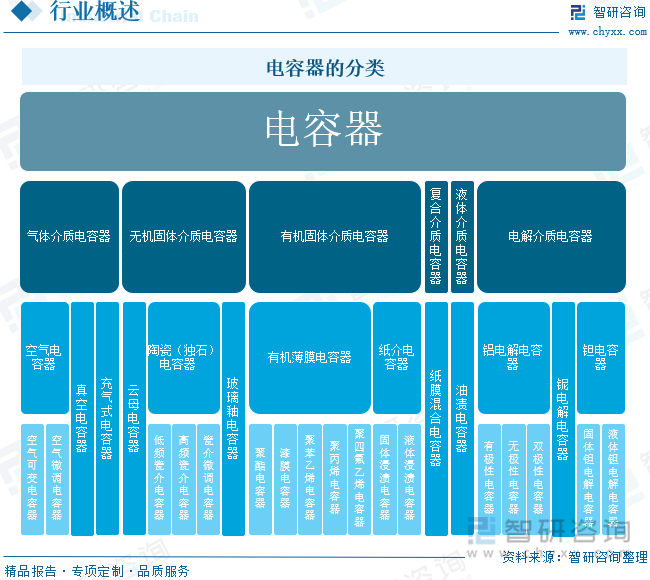
Core Viewpoint - The rapid development of the information technology industry in China has significantly boosted the growth of the mica capacitor (CY) industry, with the market size projected to increase from 0.992 billion yuan in 2017 to 2.258 billion yuan in 2024, reflecting a compound annual growth rate (CAGR) of 12.47% [1][16]. Industry Overview - Capacitors are essential components for storing electric charge and energy, with various types including gas, solid, and liquid dielectric capacitors, among which mica capacitors are a key category [3][5]. - Mica capacitors utilize natural mica as the dielectric medium, known for their high dielectric strength, low loss, and excellent thermal stability, making them irreplaceable by other capacitor types [5][11]. Market Growth - The mica capacitor industry in China is expected to grow significantly, driven by the increasing demand for high-performance and miniaturized electronic components [1][16]. - The market size of the mica capacitor industry is projected to reach 2.258 billion yuan by 2024, with a CAGR of 12.47% from 2017 [1][16]. Industry Development History - The mica capacitor industry has evolved through several stages, initially used as insulation materials in electrical equipment, and later expanding into various applications in electronics, power, and communication sectors [9][10]. - Technological innovations have become a key driver for the industry's growth, with new materials and processes enhancing the performance of mica capacitors [9][10]. Competitive Landscape - The mica capacitor market is characterized by intense competition among domestic and international companies, with domestic firms holding a significant market share due to cost advantages and localized services [17]. - Key players in the industry include Shaanxi Huamao Electronic Technology Co., Ltd., Green Energy (Shanghai) Energy Technology Co., Ltd., Chengdu Hongming Electronics Co., Ltd., and others [17][19]. Application Areas - Mica capacitors are widely used in high-frequency RF applications and satellite communication systems, benefiting from the rapid development of China's communication equipment manufacturing industry [14][16]. - The communication equipment manufacturing market in China is projected to grow from 2,106.598 billion yuan in 2018 to 2,755.288 billion yuan in 2024, with a CAGR of 4.58% [14]. Industry Chain - The upstream of the mica capacitor industry includes raw materials such as mica, metal foils, and various types of shells, while the downstream applications span electronics, power, and communication devices [11][12]. Future Trends - The industry is moving towards high-performance dielectric materials and automated, intelligent manufacturing processes, enhancing production efficiency and product quality [23][24]. - Mica capacitors are evolving from single energy storage components to multifunctional modules, integrating advanced features for applications in high-tech fields such as aerospace and renewable energy [25].

南华期货碳酸锂企业风险管理日报-20250618
Nan Hua Qi Huo· 2025-06-18 13:32
Report Summary 1. Report Industry Investment Rating No relevant content provided. 2. Core Viewpoints - The oversupply pattern in the lithium carbonate market in the second quarter is expected to continue, with no significant growth in demand - side production during the off - season. The supply - side production shows no obvious improvement, and both lithium ore and lithium salt inventories face great pressure, with a slow de - stocking process. The main market contradiction is that the pressure of lithium salt production capacity clearance is gradually spreading to the upstream ore end, and the loosening of ore prices will further drive down lithium salt prices. There is a risk of a spiral decline in ore and lithium salt prices. Also, be cautious of the contradiction between the high open interest of the 2507 contract and the approaching delivery month for new energy varieties [3]. - There are both positive and negative factors in the market. Positive factors include positive macro - policies that may stimulate power demand growth and an increasing probability of supply - side disturbances as lithium ore and lithium salt prices decline. Negative factors are the large future production capacity expectations of lithium ore, high inventories suppressing ore prices, high inventories of both lithium ore and lithium salt in a continuous accumulation trend, and the delay of production capacity clearance due to cost reduction of some high - cost technology routes [4]. 3. Summary by Relevant Catalogs 3.1 Futures Price and Strategy - **Futures Price Prediction**: The price of the lithium carbonate main contract is expected to fluctuate between 59,000 - 62,000 yuan/ton, with a current 20 - day rolling volatility of 20.1% and a 3 - year historical percentile of 20.8% [2]. - **Enterprise Risk Management Strategy**: - **Inventory Management**: For enterprises with high product inventories and at risk of inventory impairment, it is recommended to short 70% of the lithium carbonate futures (LC2509) to lock in profits, sell 30% of call options (either over - the - counter or on - exchange options), and buy out - of - the - money put options (either on - exchange or over - the - counter options) [2]. - **Procurement Management**: For enterprises with future procurement plans and worried about raw material price increases, it is recommended to buy far - month lithium carbonate contracts according to the procurement plan to lock in procurement costs, sell put options (either on - exchange or over - the - counter options), and buy out - of - the money call options (either on - exchange or over - the - counter options) [2]. 3.2 Futures Market Data - **Futures Contract Changes**: The closing price of the lithium carbonate main contract was 59,880 yuan/ton, up 20 yuan or 0.03% from the previous day; the trading volume was 181,046 lots, down 560 lots or 0.31%; the open interest was 306,885 lots, down 450 lots or 0.15%. The closing price of the LC2511 contract was 59,840 yuan/ton, up 80 yuan or 0.13%; the trading volume was 17,850 lots, down 3,940 lots or 18.08%; the open interest was 67,483 lots, up 4,127 lots or 6.51% [8]. - **Lithium Carbonate Month - spread Changes**: The LC07 - 08 month - spread was 340 yuan/ton (previous value: 160 yuan/ton, last week: 440 yuan/ton); LC08 - 11 was 300 yuan/ton (previous value: 300 yuan/ton, last week: 360 yuan/ton); LC09 - 11 was 40 yuan/ton (previous value: 100 yuan/ton, last week: - 100 yuan/ton); LC11 - 12 was - 380 yuan/ton (previous value: - 300 yuan/ton, last week: - 240 yuan/ton) [15]. 3.3 Lithium Ore and Lithium Salt Spot Prices - **Lithium Ore Prices**: The average daily prices of various lithium ores remained unchanged on the day. For example, the average price of lithium mica with Li2O: 2 - 2.5% was 1,225 yuan/ton, and the average price of lithium辉石 with Li2O: 6% (Brazil CIF) was 615 US dollars/ton [19]. - **Lithium Carbonate and Lithium Hydroxide Prices**: The average price of industrial - grade lithium carbonate was 58,850 yuan/ton, unchanged; the average price of battery - grade lithium carbonate was 60,450 yuan/ton, unchanged; the average price of industrial - grade lithium hydroxide was 53,420 yuan/ton, down 250 yuan or 0.47%; the average price of battery - grade lithium hydroxide (micropowder) was 64,570 yuan/ton, down 250 yuan or 0.39% [22]. - **Lithium Industry Chain Spot Spreads**: The battery - grade lithium carbonate - industrial - grade lithium carbonate spread was 1,600 yuan/ton, unchanged; the battery - grade lithium hydroxide - battery - grade lithium carbonate spread was 4,120 yuan/ton, down 250 yuan or 5.72%; the spread between battery - grade lithium hydroxide CIF in Japan and South Korea and domestic prices was - 934.79 yuan/ton, up 262.22 yuan or - 21.91% [26]. 3.4 Downstream Product Prices - **Downstream Product Quotes**: The prices of some downstream products remained stable, while others declined slightly. For example, the price of power - type lithium iron phosphate was 30,370 yuan/ton, unchanged; the price of 523 (consumer - type) ternary material was 105,220 yuan/ton, down 110 yuan; the price of 622 (consumer - type) ternary material was 111,120 yuan/ton, down 90 yuan or 0.08%; the price of 811 (power - type) ternary material was 143,120 yuan/ton, down 180 yuan or 0.13% [36][37]. 3.5 Lithium Carbonate Warehouse Receipts - **Warehouse Receipt Quantity Changes**: The total number of lithium carbonate warehouse receipts decreased from 31,713 to 29,967, a decrease of 1,746. Some warehouses such as Xiangyu Speed - Transfer Shanghai and Cosco Shipping Nanchang saw significant decreases in warehouse receipts [39].
7大碳酸锂头部企业对比(赣锋︱天齐︱盐湖︱永兴︱中矿︱雅化︱盛新)
鑫椤锂电· 2025-06-17 06:08
Group 1: Ganfeng Lithium - Ganfeng Lithium has established a closed-loop lithium ecosystem with an integrated layout across upstream lithium resource development, midstream lithium salt processing, and downstream lithium battery manufacturing and recycling [1][2] - The company has a lithium salt production capacity of over 150,000 tons LCE domestically and an additional 40,000 tons LCE from the Cauchari lithium salt lake in Argentina, totaling nearly 200,000 tons LCE [1][2] - Ganfeng Lithium is expanding its lithium salt processing capacity to meet growing demand while maintaining risk control and effective inventory management [1][2] Group 2: Tianqi Lithium - Tianqi Lithium focuses on strategic resource layout in China, Australia, and Chile, aiming to build leading-scale lithium compound production bases [6][7] - The company has a lithium concentrate production capacity of 162,000 tons per year at the Greenbushes lithium mine, with plans for further expansions [7] - Tianqi Lithium holds a 22.16% stake in SQM, the largest lithium salt lake producer globally, which enhances its investment returns [9] Group 3: Salt Lake Potash - Salt Lake Potash has a chlorate potassium production capacity of 5 million tons per year, playing a crucial role in stabilizing the potassium fertilizer market [11] - The company has a current lithium carbonate production capacity of 30,000 tons per year, with plans for a new integrated lithium salt project with a capacity of 40,000 tons per year [12] Group 4: Yongxing Materials - Yongxing Materials has established a dual business model of "new materials + new energy," optimizing its entire industry chain to reduce costs and enhance competitiveness [14][15] - The company has achieved a carbon lithium production cost of 50,000 yuan per ton, with expectations for further cost optimization [14] Group 5: Zhongjin Lingnan - Zhongjin Lingnan has diversified its operations into lithium and other mineral resources, with a focus on reducing costs in its lithium mining operations [16][17] - The company has significant lithium resources in Canada and Zimbabwe, with plans for further capacity expansions [18] Group 6: Self-owned Lithium Mines - The company has three production bases with a total lithium salt processing capacity of approximately 73,000 tons, with plans for further expansions [21] - The company has secured priority supply rights for the Li family lithium mine, which has a lithium oxide resource of approximately 50,220 tons [21][22] Group 7: Shengxin Lithium Energy - Shengxin Lithium Energy has established four major lithium resource layouts and five lithium product production bases, positioning itself as a leading player in the domestic lithium market [23][24] - The company has a lithium carbonate production capacity of 42,000 tons per year, with ongoing projects to increase capacity [25][26]




东兴证券晨报-20250616
Dongxing Securities· 2025-06-16 11:03
Group 1: Banking Industry Insights - The overall growth of social financing (社融) in May 2025 was supported by proactive fiscal policies, with a year-on-year increase of 8.7% [2][3] - The increase in social financing was primarily driven by government bond issuance, which net financed 1.46 trillion yuan, reflecting a positive fiscal stance [3] - Credit demand remains weak, with a year-on-year decrease in new RMB loans by 3.3 billion yuan in May, indicating a need for further stimulation of credit demand [4][6] Group 2: Loan Structure and Trends - In May, short-term loans for enterprises increased by 2.3 billion yuan year-on-year, while medium and long-term loans decreased by 1.7 billion yuan, influenced by debt replacement policies [4] - The residential loan sector showed a slight increase, with new loans of 540 million yuan, but short-term loans decreased, indicating weak consumer credit demand [4][6] - The weighted average interest rate for new loans remained stable at approximately 3.2% for enterprises and 3.1% for personal housing loans [6] Group 3: Market Outlook and Investment Strategy - The banking sector is expected to maintain stable growth due to the issuance of special government bonds and a shift in local government focus towards economic recovery [7][8] - The net interest margin is anticipated to narrow gradually, but the impact on profitability is expected to be manageable due to declining deposit rates [7] - The report suggests a focus on high-dividend stocks within the banking sector, particularly state-owned banks and regional banks with growth potential [8] Group 4: A-Share Market and Economic Recovery - The A-share market is positioned for a long-term slow bull phase, driven by structural economic changes and improved asset quality [9][10] - The report highlights the importance of manufacturing and the potential for growth in sectors such as semiconductors and high-end manufacturing [10][11] - The anticipated gradual economic recovery is expected to reflect positively on the stock market, with a focus on mid-cap and growth stocks [12][13] Group 5: Electronic Industry Trends - The electronic industry is entering a new development phase driven by AI advancements, with significant growth expected in wafer foundry, SoC, and thermal management materials [20][21] - The global semiconductor sales are projected to exceed 1 trillion USD by 2030, with a strong demand for chips driven by AI applications [20] - The SoC market is expected to grow at a CAGR of 8.3% from 2024 to 2029, fueled by the increasing demand for AI-optimized solutions [21] Group 6: Photovoltaic Industry Developments - The photovoltaic industry is focusing on supply-side optimization through self-regulation and technological innovation, with a recovery in Q1 2025 performance [23][24] - The report emphasizes the importance of silicon materials and battery cells in optimizing the supply structure, with a focus on reducing costs through new technologies [25][26] - The demand for energy storage solutions is expected to rise, particularly in the context of distributed energy projects [26] Group 7: Lithium Battery Industry Insights - The lithium battery sector is experiencing a recovery in demand, with solid-state and sodium batteries poised for significant growth [27][28] - The report highlights the potential for profitability improvements in the battery segment, driven by new applications and technological advancements [27] - Solid-state battery technology is expected to accelerate commercialization, benefiting companies with early-stage advantages [29]
有色:能源金属行业周报:本周沪锡价格环比上涨,海外供给偏紧预期对锡价或有支撑-20250615
HUAXI Securities· 2025-06-15 09:02
Investment Rating - The industry rating is "Recommended" [3] Core Views - The report indicates that the price of tin in Shanghai has increased week-on-week, supported by expectations of tight overseas supply [10][16] - Nickel prices have decreased due to an oversupply of pure nickel, with domestic production expected to decline but still not improving the oversupply situation [21][23] - Cobalt prices are under pressure with low operating rates at smelters and weak demand from downstream manufacturers [24][29] - Antimony prices have decreased domestically while maintaining historical highs in Europe, with significant price differences between domestic and overseas markets [30][34] - Lithium carbonate prices have increased slightly, but the market is expected to remain weak due to high inventory levels and cautious demand from downstream manufacturers [7][8] Summary by Sections Tin Industry Update - The price of tin in Shanghai has risen to 264,400 CNY/ton, with a decrease in inventory levels [10][11] - Supply constraints are expected due to transportation bans and production issues in Myanmar [10][16] Nickel Industry Update - The LME nickel price is reported at 14,970 USD/ton, with a decrease in inventory levels [21] - The Philippines is considering a ban on nickel ore exports, which could tighten supply for Chinese smelters [21][23] Cobalt Industry Update - Electrolytic cobalt prices are at 234,500 CNY/ton, with weak demand and low smelter operating rates [24][29] - The market is cautious due to uncertainties in Congo's export policies [29] Antimony Industry Update - Domestic antimony ingot prices are at 207,500 CNY/ton, with a significant price gap compared to European prices [30][34] - Export controls from China are expected to impact global supply and pricing dynamics [30][34] Lithium Industry Update - Battery-grade lithium carbonate prices have increased to 60,700 CNY/ton, but the market outlook remains weak due to high inventory levels [7][8] - Supply from lithium mines is stable, but demand from downstream manufacturers is cautious [7][8]

东兴证券晨报-20250612
Dongxing Securities· 2025-06-12 10:50
Core Insights - The report highlights that the AI wave is driving the electronic industry into a new development phase, with three core areas showing significant growth momentum: wafer foundry, SoC, and thermal management materials [2][3][6]. Wafer Foundry - The wafer foundry segment is expected to benefit from AI development, particularly in servers, data centers, and storage, which are the fastest-growing sub-markets. Global semiconductor sales are projected to exceed $1 trillion by 2030, with wafer demand expected to reach 11.2 million pieces per month in 2025 and grow to 15.1 million by 2030. The growth rates for 2024 and 2025 are forecasted at 6% and 7%, respectively [2][3]. SoC (System on Chip) - AI technology is becoming a crucial component of SoC architecture, enhancing smart processing capabilities for edge devices. The global SoC market is predicted to grow from $138.46 billion in 2024 to $205.97 billion by 2029, with a compound annual growth rate (CAGR) of 8.3% from 2024 to 2029. The demand for SoC in the automotive sector is also rising significantly [3][6]. Thermal Management Materials - The demand for thermal management materials is expected to grow rapidly due to the increased heat generation from AI-enabled devices. The global thermal management market is projected to expand from approximately $15.98 billion in 2023 to $26.43 billion by 2028, with an average annual growth rate of 10.5% [6][7]. Photovoltaic Industry - The photovoltaic industry is currently in a phase of supply-side optimization driven by self-discipline and technological innovation. The first quarter of 2025 saw a performance recovery due to installation rushes, but the industry remains in a loss phase. Key areas for supply-side optimization include silicon materials and battery cells, with a focus on reducing silver usage in production [6][7][8]. Lithium Battery Industry - The lithium battery sector is experiencing a recovery in market conditions, with solid-state batteries and sodium batteries expected to reach a scale application phase. The report suggests that the overall profitability of the lithium battery sector is improving, driven by new technologies and increasing demand from emerging applications [14][15][16]. Metal Industry - The report indicates that the supply-demand structure in the metal industry is improving, particularly for magnesium and lithium. The magnesium industry is expected to enter a state of sustained tight balance, while the lithium supply surplus is gradually improving. The global magnesium demand is projected to grow significantly due to its applications in lightweight and green technologies [18][19][23][24].
东兴证券晨报-20250611
Dongxing Securities· 2025-06-11 11:00
Core Insights - The report indicates that the global metal industry is still in a weak supply cycle, with exploration investments declining for the second consecutive year, down 3% to $12.5 billion in 2024 [3] - The magnesium industry is expected to enter a state of sustained tight balance, while the lithium industry is gradually improving its oversupply situation [2][11] Supply and Demand Analysis - Global mining supply growth is significantly constrained, with actual supply growth dropping from 6.35% to 2.22% in 2024, which is only 49.8% of the average growth rate over the past 30 years [4] - China's actual supply growth for ten non-ferrous metals is projected to remain within the fluctuation range observed since 2012, averaging 6.79% from 2023 to 2024 [4] Industry Trends - The report emphasizes the cyclical, growth, and hedging value of the metal industry, highlighting three main lines of focus: industrial metals with resilient supply-demand states, small metals with enhanced growth attributes, and precious metals with tight supply-demand fundamentals [7] - The proportion of holdings in the non-ferrous metal sector has significantly increased, reaching a historical high of 5.43% in Q1 2024, although it is expected to decline to 2.85% by Q4 2024 due to economic weakness and declining downstream demand [8] Magnesium Industry Insights - The magnesium industry is forming a new modern industrial cluster in China, which is expected to enhance scale efficiency and profitability, aligning with the development of the new energy industry [9] - Global magnesium production is projected to increase from 1.12 million tons in 2024 to 2 million tons by 2027, with a compound annual growth rate (CAGR) of 21% [9] Lithium Industry Insights - The lithium industry is expected to see a gradual improvement in supply-demand dynamics, with global lithium supply projected to grow from 1.231 million tons LCE in 2024 to 1.86 million tons LCE by 2027, reflecting a CAGR of 15% [11] - The demand for lithium is driven by the growth of the electric vehicle market and energy storage systems, with total lithium battery shipments expected to rise from 1,545 GWh in 2024 to 2,778 GWh by 2027 [11] Investment Opportunities - The report identifies key companies in the magnesium sector, such as Baowu Magnesium and Xingyuan Zhuomai, and in the lithium sector, including Tianqi Lithium, Ganfeng Lithium, Yongxing Materials, and Jinyinhai [10][12]
供应过剩格局短期难以扭转 锂价或持续走低
Zhong Guo Chan Ye Jing Ji Xin Xi Wang· 2025-06-10 22:20
Group 1 - The energy transition has significantly impacted the commodity market, with traditional energy consumption being replaced by new energy sources, leading to a surge in demand for battery metals like lithium and cobalt [1] - In 2022, lithium carbonate prices soared to 600,000 yuan per ton, while cobalt prices exceeded 570,000 yuan per ton [1] - The production cost of lithium carbonate has decreased due to capacity expansion and technological advancements, resulting in an oversupply and high inventory levels, causing a substantial price drop [1][2] Group 2 - The industry is currently in a phase of production reduction and capacity clearance, with a potential for price stabilization in the future as inventory decreases [2] - Only a few small enterprises are reducing production, while larger companies maintain profitability due to lower production costs [3] - The cash cost of producing lithium carbonate varies, with companies like Yongxing Materials achieving a production cost as low as 51,000 yuan per ton [3] Group 3 - Companies with lithium and salt lake resources maintain high operating rates, while those with lower self-sufficiency and higher costs face reduced utilization [4] - The competitive edge of salt lake lithium extraction is highlighted, suggesting that capacity clearance may be limited to hard rock lithium extraction [4] - The production structure is shifting, with salt lake lithium production expected to account for 31.6% of total lithium carbonate output in 2024, up from just 10% in 2021 [4] Group 4 - Despite falling lithium prices, lithium spodumene projects continue to be developed in Australia and Africa, with expectations of significant production increases by 2025 [5] - The peak demand for lithium has passed, particularly in the electric vehicle sector, where growth rates have slowed compared to previous years [6][7] - The domestic market for lithium is shifting towards energy storage, with projections indicating rapid growth in new energy storage installations in China from 2024 to 2030 [8] Group 5 - The current oversupply of lithium carbonate is expected to persist, with prices continuing to decline as the industry undergoes a "shuffle" phase [8]