
中国铝业

Search documents
2025年1-11月中国铝材产量为6151.1万吨 累计下降0.1%
Chan Ye Xin Xi Wang· 2026-01-02 06:47
Core Viewpoint - The aluminum industry in China is experiencing a slight decline in production, with a reported decrease in output for November 2025 and a marginal cumulative decline for the year [1]. Group 1: Industry Overview - In November 2025, China's aluminum production was 5.93 million tons, reflecting a year-on-year decrease of 0.4% [1]. - From January to November 2025, the cumulative aluminum production in China reached 61.51 million tons, showing a slight decline of 0.1% compared to the previous year [1]. Group 2: Companies Involved - Listed companies in the aluminum sector include China Aluminum (601600), Yun Aluminum (000807), Shenhuo Co. (000933), Jiaozuo Wanfang (000612), and Nanshan Aluminum (600219) [1]. Group 3: Market Research - Zhiyan Consulting has released a report titled "2026-2032 China Aluminum Material Industry Market Development Potential and Investment Risk Forecast Report," indicating ongoing research and analysis in the sector [1].



欧盟“碳关税”落地 钢铝产业影响几何?
2 1 Shi Ji Jing Ji Bao Dao· 2025-12-31 23:12
Core Viewpoint - The EU's Carbon Border Adjustment Mechanism (CBAM) will officially enter its "charging period" on January 1, 2026, initially covering six product categories: steel, cement, aluminum, fertilizers, electricity, and hydrogen. By 2028, the scope is expected to expand to approximately 180 downstream products, including washing machines and automotive parts, creating a comprehensive "green bill" that impacts both raw materials and finished products [1][2][4]. Group 1: CBAM Implementation and Scope - The CBAM's product coverage and execution timeline have become clearer, with a transitional phase from 2023 to 2025 focusing on carbon data research, leading to formal implementation in 2026 [2][3]. - The CBAM will charge for direct and indirect emissions from cement and fertilizers, while steel, aluminum, and hydrogen will not incur charges for indirect emissions [3][4]. - The EU plans to expand the CBAM to include downstream products related to steel and aluminum, with a total of 180 new products expected to be added by 2028 [3][4]. Group 2: Impact on Chinese Enterprises - Chinese enterprises exporting to the EU will need to establish differentiated carbon emission data management systems to comply with CBAM, particularly focusing on direct and indirect emissions [7][10]. - The introduction of a 50-ton annual import exemption threshold will significantly reduce the compliance burden for small and medium-sized enterprises, with approximately 90% of importers expected to be exempt from CBAM obligations [4][5]. - Major Chinese suppliers of steel and aluminum, such as China Aluminum and Nanshan Aluminum, may not be significantly impacted by CBAM due to their limited export volumes and ability to track production data [6][10]. Group 3: Carbon Footprint Regulations - The EU has introduced new battery regulations that require carbon footprint labeling, which will become another compliance requirement for exporting companies [8][9]. - The carbon footprint label will consist of four components, including a declaration of the battery's lifecycle carbon footprint, although the specific accounting methodology is still not defined [9][10]. Group 4: Strategic Responses and Advantages - Chinese companies are encouraged to adapt to EU standards and establish low-carbon supply chains to mitigate compliance risks while actively participating in international carbon rule-making [10][11]. - China's proactive approach to low-carbon transformation, including significant progress in energy structure and early adoption of low-carbon practices in industries like steel, positions it favorably against stricter EU regulations [10][11].
盐和铝-电解铝行业2026年度投资策略
2025-12-31 16:02
Summary of Key Points from the Conference Call Industry Overview - The conference call focuses on the aluminum industry, particularly the electrolytic aluminum sector, and its investment strategy for 2026, highlighting the impact of various macroeconomic and geopolitical factors on aluminum supply and demand [1][2]. Core Insights and Arguments - **Supply Constraints**: China's electrolytic aluminum production capacity is limited by dual carbon policies, power shortages, and technological constraints, leading to a long-term tight supply situation that supports high aluminum prices [1][2]. - **Global Manufacturing Recovery**: The global manufacturing PMI has remained above 50 for four consecutive months, indicating a recovery in manufacturing activity, particularly in Europe and emerging industrialized countries, which is expected to drive aluminum demand [4]. - **Geopolitical Risks**: Increased geopolitical risks and environmental uncertainties are raising the demand for strategic resource reserves, leading to more conservative mineral investments and stricter export controls, which further exacerbate supply uncertainties [1][5]. - **Interest Rate Impact**: A declining interest rate cycle typically boosts industrial metal prices. With low global inventory levels, a sustained decline in interest rates is expected to stimulate restocking, positively impacting aluminum prices [6]. - **North American Supply Issues**: Energy supply constraints in North America, exacerbated by AI development, may lead to further production cuts in the U.S. and Canada, affecting global supply-demand balance [12]. - **Recycling Challenges**: Progress in aluminum recycling is slow, with reduced subsidies for scrap aluminum and a lack of significant increases in scrap supply, maintaining a tight balance in domestic and international supply [15]. Additional Important Insights - **Historical Price Comparisons**: The aluminum market shows similarities to historical salt price trends, where both commodities have abundant reserves but face price pressures due to technological and regulatory constraints [3]. - **Future Demand Trends**: The demand for industrial metals, including aluminum, is expected to steadily increase in the coming years, driven by developments in AI, renewable energy, and infrastructure upgrades [4][8]. - **Valuation and Investment Outlook**: The aluminum sector has undergone debt repair, with an average dividend yield of 5%, making it attractive for long-term investments. The sector's valuation is currently around 8-9 times earnings, with potential to rise to 13-15 times [16][18]. - **Company Recommendations**: For companies with strong resilience, recommendations include Tianshan, Hongchuang, and Nanshan Aluminum, which are noted for their cost advantages and integrated operations [20]. For companies with flexibility, Yun Aluminum and Zhongfu are highlighted due to their benefits from marginal changes [19]. Conclusion - The aluminum industry is poised for growth due to a combination of supply constraints, recovering demand, and favorable macroeconomic conditions. Investment opportunities exist in companies with strong fundamentals and strategic positioning within the sector [21][22].
贵金属与工业金属-板块汇报和标的更新
2025-12-31 16:02
Summary of Key Points from Conference Call Records Industry Overview - **Precious Metals and Industrial Metals**: The report covers the silver and gold markets, along with copper and aluminum sectors, providing insights into price forecasts and investment opportunities. Silver Market Insights - **Short-term Risks**: The silver market faces short-term correction risks due to margin hikes, which may lead to price declines. However, the long-term outlook remains positive with a projected average price of 16,000 RMB/kg for next year [1][2]. - **Historical Context**: The volatility in silver prices is linked to past events, such as the 2011 margin hikes that led to significant price drops. Current conditions suggest a potential 20% correction from peak prices [2][4]. - **Valuation**: Companies like Shengda Resources and Yuguang Gold Lead are considered undervalued, with P/E ratios around 10 or lower, presenting good investment opportunities post-correction [4]. Gold Market Dynamics - **Market Drivers**: The gold market is influenced by central bank purchases and ETF investments, with stablecoin issuers like Tether significantly increasing their gold reserves to 104 tons, which is expected to support ongoing demand [5][6]. - **Stock Performance**: Gold stocks have underperformed relative to commodity prices due to interest rate expectations. Current valuations are considered low, with an average P/E of 12 times at gold prices around 1,000 USD/oz, indicating a buying opportunity [7]. Copper Price Forecast - **Price Expectations**: Copper prices are expected to rise, with an average forecast of 11,500 to 12,000 USD per ton, potentially reaching highs of 13,000 to 15,000 USD due to factors like interest rate cuts and supply constraints [8][9]. - **Beneficiary Companies**: Companies such as Minmetals Resources, Zijin Mining, and Luoyang Molybdenum are expected to benefit from rising copper prices due to significant production increases and strong silver by-product yields [9][10]. Aluminum Market Outlook - **Short-term Volatility**: The aluminum market may experience short-term fluctuations, but the long-term outlook is positive, with prices expected to stabilize above 21,500 RMB/ton, potentially reaching 24,000-25,000 RMB/ton [11][13]. - **Investment Opportunities**: Companies like Shenhuo Co., Yunnan Aluminum, and Zhongfu Industrial are highlighted as key players that will benefit from rising aluminum prices and improving EPS [19][20]. Cost Factors and Profitability - **Cost Analysis**: The cost of alumina is expected to decrease, which will enhance profitability across the industry. The projected drop in alumina prices to 2,600-2,700 RMB/ton could increase profits by approximately 1,000 RMB per ton [18]. - **Long-term Investment Strategy**: The aluminum sector is viewed as a strong investment opportunity due to low valuations and expected improvements in profitability, with a focus on companies that can provide dividends and have strong growth potential [17]. Additional Recommendations - **Stock Picks**: Specific companies recommended for investment include Yunnan Aluminum, Zhongfu Industrial, Shenhuo Co., and Tianshan Aluminum, with a focus on their growth potential and market positioning [20][21]. This summary encapsulates the key insights and projections from the conference call, providing a comprehensive overview of the precious metals and industrial metals sectors.

欧盟碳关税来了,钢铝产业影响几何
2 1 Shi Ji Jing Ji Bao Dao· 2025-12-31 06:44
Core Viewpoint - The EU's Carbon Border Adjustment Mechanism (CBAM) will officially enter its charging phase on January 1, 2026, initially covering six product categories: steel, cement, aluminum, fertilizers, electricity, and hydrogen. By 2028, the scope is expected to expand to approximately 180 downstream products, including washing machines and automotive parts [1][3]. Group 1: Implementation and Coverage - The CBAM's product coverage has been clarified, with a temporary agreement reached on December 12, 2022, confirming the initial six product categories [3]. - The implementation of CBAM will follow a phased approach, with a transition period from 2023 to 2025 focusing on carbon data research, leading to formal legislation in 2026 [14]. - The actual payment obligations will primarily affect companies collaborating with large EU importers due to exemption thresholds, which will significantly reduce compliance burdens for small and medium-sized enterprises [17]. Group 2: Product Specifics and Emission Accounting - Different products under CBAM will have varying emission coverage; for instance, indirect emissions from steel and aluminum will not incur charges, while cement and fertilizers will be charged for both direct and indirect emissions [14]. - The CBAM will expand its coverage to include downstream products by 2028, with the cost burden depending on the proportion of steel and aluminum in those products [15]. Group 3: Impact on Chinese Enterprises - Chinese enterprises exporting to the EU, particularly in the steel and aluminum sectors, will need to establish differentiated carbon emission data management systems to comply with CBAM [20]. - The majority of Chinese exporters affected by CBAM will be larger companies, as many small exporters will fall below the 50-ton exemption threshold [17]. - The actual impact on major Chinese aluminum exporters is expected to be limited due to their ability to track production data and lower actual emissions compared to default values set by CBAM [19]. Group 4: Broader Implications and Strategic Responses - The introduction of CBAM and other EU regulations signals a growing trend of green trade barriers, pushing for low-carbon transitions globally [24]. - Chinese companies are encouraged to adapt to EU standards and develop low-carbon supply chains to mitigate compliance risks while participating in international carbon rule-making [24][25]. - China's proactive approach to low-carbon transformation and its relatively better energy structure compared to other developing countries may provide a competitive advantage in the face of stringent EU regulations [25].

欧盟碳关税来了,钢铝产业影响几何
21世纪经济报道· 2025-12-31 06:33
Core Viewpoint - The European Union's Carbon Border Adjustment Mechanism (CBAM) will officially enter its charging phase on January 1, 2026, initially covering six product categories: steel, cement, aluminum, fertilizers, electricity, and hydrogen. By 2028, the scope is expected to expand to approximately 180 downstream products, including washing machines and automotive parts, creating a comprehensive "green bill" for trade [1][3][14]. Group 1: CBAM Implementation and Product Scope - The CBAM's product coverage has been clarified, with a focus on six primary products, each defined by specific EU customs tariff codes [3][12]. - The implementation of CBAM will occur in phases, with a transitional period from 2023 to 2025 for carbon data research, followed by formal legislation in 2026 [13][12]. - The product scope will expand to include downstream products by 2028, with the cost burden depending on the embedded emissions from steel and aluminum used in these products [14][15]. Group 2: Compliance and Impact on Chinese Enterprises - A significant exemption threshold of 50 tons for imports will reduce compliance burdens for small and medium-sized enterprises, with approximately 90% of importers expected to be exempt while still covering about 99% of related carbon emissions [15]. - Major Chinese steel and aluminum suppliers exporting to the EU will be primarily affected, while many smaller exporters may not face direct CBAM payment obligations due to the exemption threshold [15][17]. - Chinese enterprises are advised to establish differentiated carbon emission data management systems to comply with CBAM, focusing on direct and indirect emissions based on product categories [18][21]. Group 3: Broader Implications and Strategic Responses - The emergence of green trade barriers, exemplified by CBAM and the EU's battery regulations, indicates a trend towards stricter carbon management in global trade [21][20]. - Chinese companies are encouraged to adapt to EU standards and develop low-carbon supply chains to mitigate compliance risks while participating in international carbon rule-making [21][22]. - China's proactive low-carbon transition and early industry adjustments position it favorably against stricter EU regulations, potentially allowing it to maintain a competitive edge in the global market [22].
江西铜业触及涨停,有色金属ETF(512400)红盘上扬,铜冶炼环节关键指标释放紧张信号,支撑铜价维持强势运行
Xin Lang Cai Jing· 2025-12-31 06:17
Group 1: Copper Industry Insights - The copper ETF (512400) has increased by 0.89%, with a trading volume of 937 million yuan and a turnover rate of 4.51% [1] - Key copper smelting indicators are signaling tightness, with the 2026 copper concentrate long-term processing fee benchmark set at $0/ton and $0/pound, a significant decrease of $21.25/ton and 2.125 cents/pound year-on-year [1] - The decline in processing fees indicates fierce competition among smelting companies for raw materials, suggesting that profits in the industry chain are shifting towards upstream mining [1] Group 2: Titanium Alloy Demand - Titanium alloys are on the verge of a demand explosion, with a projected growth rate exceeding 10% over the next three years due to their high strength, low density, and corrosion resistance [2] - The maturity of 3D printing technology is breaking the application bottleneck of titanium alloy powders, which now account for approximately 20% of mainstream 3D printing materials [2] - The downstream titanium materials and powder segments are expected to become the fastest-growing areas within the industry chain as they transition from "0-1" validation to "1-10" scale expansion [2] Group 3: ETF Overview - The copper ETF (512400) closely tracks the CSI Shenwan Nonferrous Metals Index, which includes 50 listed companies from the nonferrous metals and non-metallic materials sectors [2] - The top ten weighted stocks in the index include Zijin Mining, Luoyang Molybdenum, Northern Rare Earth, Huayou Cobalt, China Aluminum, Ganfeng Lithium, Shandong Gold, Zhongjin Gold, Tianqi Lithium, and Chifeng Jilong Gold [2]
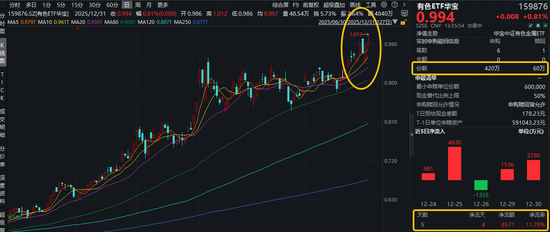
紫金矿业发布业绩预增公告!有色ETF华宝(159876)拉升2.5%创历史新高!获净申购360万份,资金积极抢筹!
Xin Lang Cai Jing· 2025-12-31 06:07
今日(12月31日)揽尽有色金属行业龙头的有色ETF华宝(159876)场内价格盘中涨超2.5%,现涨 0.81%,继续刷新上市以来的高点! 成份股方面,江西铜业领涨超9%,宝钛股份涨逾7%,云南锗业、国城矿业涨超5%。权重股方面,紫 金矿业涨超3%,洛阳钼业涨逾2%,中国铝业涨钞1%。 | 序号 | 名称 | 涨跌幅 ▼ | 两日图 | 申万一级行业 | 申万二级行业 | 申万三级行业 | 总市值 | 成交额 | | --- | --- | --- | --- | --- | --- | --- | --- | --- | | 1 | 江西铜业 | 9.43% | | 有色金属 | 工业金属 | 铜 | 1679亿 | 61.78亿 | | 2 | 宝林服务 | 7.57% | ------ | 有色全顾 | 小含厨 | 其他小全属 | 191亿 | 11.95亿 | | 3 | 云南接业 | | 5.42% mmm | 有色金属 | 小会属 | 其他小金属 | 207亿 | 12.86亿 | | ব | 国城市,亚 | 5.40% | Caroline of Children College of the ...
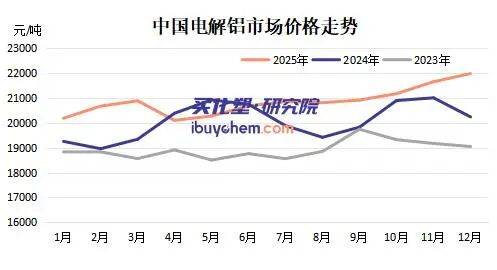
价格突破2.2万元/吨!电解铝价格创3年新高
Sou Hu Cai Jing· 2025-12-31 05:49
Core Viewpoint - The electrolytic aluminum market has entered a strong upward trend since 2025, driven by tight supply-demand dynamics, with domestic and international prices reaching new highs [1][3]. Supply Side Summary - The domestic electrolytic aluminum industry has entered a "stock replacement" era, with a production capacity ceiling set at approximately 45 million tons due to dual constraints from industry consensus on "anti-involution" and "carbon peak" policies [3]. - It is estimated that net new production capacity in China will only increase by 200,000 tons by 2025, with a total foreseeable increase of only 560,000 tons, making it difficult to effectively supplement market supply [3]. - Although countries like India and Indonesia are advancing new capacity construction, factors such as unstable power supply will hinder full production capacity by 2026, exacerbating the tight supply situation in the domestic market [3]. Demand Side Summary - Structural upgrades in demand are providing sustained upward momentum for electrolytic aluminum prices, with traditional construction sector demand stabilizing while the new energy sector becomes the core growth engine [5]. - The demand from the new energy vehicle industry continues to grow, with increased aluminum usage per vehicle due to lightweight trends; the acceleration of ultra-high voltage construction is significantly boosting demand for aluminum cables [5]. - The "aluminum replacing copper" trend in the power and electronics sectors is further expanding the application space for electrolytic aluminum, with projected demand growth rates of 2.1% in 2025 and 2026, outpacing supply growth of 1.6% [5]. Cost Side Summary - The release of cost dividends is a significant driver of profit expansion in the electrolytic aluminum industry, with key raw material prices, such as alumina, experiencing a decline due to ample supply [6]. - For instance, the domestic alumina futures price fell below 2,500 yuan/ton, nearly halving from its peak a year ago, contributing to an expanding profit margin for the industry [6]. - Major companies are showing stable profitability and improved cash flow, with China Aluminum leading the industry with a net profit of 10.872 billion yuan, a historical high for the same period, reflecting a year-on-year growth of 20.65% [6]. Industry Outlook - The tight supply-demand balance in the electrolytic aluminum industry is expected to persist, with demand growth in the new energy sector being a core driver for long-term industry development [6]. - Leading companies are likely to benefit from their production capacity advantages, industry chain layout, and cost control capabilities during this high-profit cycle [6]. - The acceleration of the "aluminum replacing copper" process and gradual recovery in overseas markets will further open up growth space for the electrolytic aluminum industry, with increasing industry concentration expected during the stock replacement phase [6].


有色板块早盘拉升,有色金属ETF(512400)跟踪指数第一大权重股紫金矿业涨近3%,2025年度净利润预增59%-62%
Xin Lang Cai Jing· 2025-12-31 05:16
Group 1 - The core viewpoint of the news is the performance of the non-ferrous metal ETF and the expected profit growth of Zijin Mining in 2025, indicating a positive outlook for the sector [1][2] - As of December 31, 2025, the non-ferrous metal ETF (512400) rose by 0.31% with a turnover of 3.77%, totaling 784 million yuan [1] - The index tracking the non-ferrous metal sector, the Zhongzheng Shenwan Non-Ferrous Metal Index, includes key stocks such as Zijin Mining, Jiangxi Copper, and Yunnan Copper, which have shown significant price increases [1][2] Group 2 - Zijin Mining announced an expected net profit of approximately 51 to 52 billion yuan for 2025, representing an increase of about 59% to 62% compared to the previous year [1] - The expected net profit excluding non-recurring gains is projected to be around 47.5 to 48.5 billion yuan, reflecting a year-on-year increase of approximately 50% to 53% [1] - The sales prices of gold, copper, and silver are expected to rise year-on-year during the reporting period, contributing to the profit growth [1]