信用债

Search documents
渤海证券研究所晨会纪要(2026.02.25)-20260225
BOHAI SECURITIES· 2026-02-25 00:24
证券分析师 022-28451618 SAC NO:S1150511010016 cuijian@bhzq.com 晨会纪要(2026/02/25) 崔健 渤海证券研究所晨会纪要(2026.02.25) 固定收益研究 成交规模微增,信用利差多数收窄——信用债周报 行业研究 美国关税政策再生变,对华关税迎边际下降——轻工制造&纺织服饰行业周 报 证 券 研 究 报 告 晨 会 纪 要 请务必阅读正文之后的声明 渤海证券股份有限公司具备证券投资咨询业务资格 1 of 5 晨会纪要(2026/02/25) 固定收益研究 成交规模微增,信用利差多数收窄——信用债周报 李济安(证券分析师,SAC NO:S1150522060001) 王哲语(证券分析师,SAC NO:S1150524070001) 1、核心观点 本期(2 月 9 日至 2 月 15 日)交易商协会公布的发行指导利率多数下行,整体变化幅度为-4 BP 至 0 BP。 本期信用债发行规模环比下降,企业债保持零发行,其余品种发行金额减少;信用债净融资额环比减少, 企业债净融资额增加,其余品种净融资额减少,企业债、短期融资券净融资额为负,其余品种净融资额为 正 ...
债市看多的逻辑
2026-02-11 15:40
Summary of Conference Call Notes Industry Overview - The focus of the conference call is on the bond market in China, with a long-term bullish outlook on the bond market despite short-term fluctuations [1][15]. Key Points and Arguments 1. **Long-term Bullish Outlook**: The company maintains a long-term bullish view on the bond market, with expectations of upward trends despite potential short-term volatility, particularly after the Spring Festival [1][10]. 2. **High Real Interest Rates**: China's real interest rates, measured by the 10-year government bond yield relative to CPI, remain high at approximately 1.1168, which is conducive to economic growth and necessitates a low-interest environment [2][4]. 3. **International Comparisons**: Historical data from developed economies shows that exiting low-interest environments takes considerable time, suggesting that China may also require a prolonged period to stabilize its interest rates [3][4]. 4. **Government Debt Levels**: The increasing scale of government debt, projected to rise to over 70 trillion for central government bonds and 80 trillion for local government bonds by 2026, indicates significant fiscal pressure that necessitates a low-interest environment [4][5]. 5. **Banking Sector Stability**: The banking sector's net interest margin has been declining, from approximately 2.1% in 2020 to 1.42% in 2025, which impacts profitability and necessitates a stable interest rate environment to maintain financial stability [6][7]. 6. **Insurance Sector Growth**: The insurance sector has seen rapid growth, with new premium income reaching 212.6 billion in January 2026, a 27.6% increase year-on-year, indicating strong demand for bonds from non-bank financial institutions [8][9]. 7. **Bond Market Demand**: There is a significant demand for bonds from various sectors, including insurance, as large amounts of fixed deposits are maturing and being converted into insurance products and other financial instruments [9][10]. 8. **Interest Rate Projections**: The 10-year government bond yield is expected to remain within the range of 1.7% to 1.9%, with a potential decline to 1.6% if interest rates are cut further [10][11]. 9. **Investment Strategies**: The company recommends focusing on high liquidity government bonds and credit bonds, with an emphasis on safety and yield, particularly in the context of expected low interest rates and potential market volatility [22][23]. Additional Important Content - **Fiscal and Monetary Policy Coordination**: The need for coordinated fiscal and monetary policies to support domestic demand is emphasized, with a focus on maintaining liquidity and reducing financing costs [15][16]. - **Asset Management Products**: The total assets of asset management products have reached 120 trillion, reflecting a growing trend in the financial market that requires careful monitoring [17][18]. - **Regional Investment Insights**: Specific regions such as Beijing and Guangxi are highlighted for their stable investment opportunities, with a focus on local government bonds and enterprises that are financially sound [26][29]. This summary encapsulates the key insights and strategic outlook presented during the conference call, focusing on the bond market dynamics, fiscal pressures, and investment strategies in the context of China's economic landscape.
——信用周报20260207:如何看待近期二永与普信债走势分化?
Huachuang Securities· 2026-02-08 00:20
Group 1: Market Overview - Credit bond yields generally declined this week, with credit spreads widening passively[1] - The overall equity market was weak, while the central bank supported the liquidity ahead of the Spring Festival, leading to a stronger bond market[1] - The 5-year credit spreads for Puxin bonds widened significantly after a previous compression, while 1-2 year AA real estate bonds performed well with a substantial narrowing of spreads[1] Group 2: Divergence in Bond Performance - The overall demand structure for bank perpetual bonds may be weaker compared to Puxin bonds due to regulatory impacts and changing investment preferences[2] - After a compression of excess spreads, the coupon value of perpetual bonds has decreased, influenced by weak market trading sentiment[2] - Concerns over redemption pressures in secondary bond funds have increased due to volatility in the equity market, leading to heightened selling pressure on perpetual bonds[2] Group 3: Investment Strategy - Current market conditions lack a clear trading theme, with short-term pricing factors expected to be neutral[3] - Focus on high convexity products is recommended, particularly in the 3-year and under category, where fund and wealth management demand is high[3] - For 4-5 year products, Puxin bonds near 4 years are highlighted for their high convexity, with yields around 2.5%[3]
大类资产早报-20260206
Yong An Qi Huo· 2026-02-06 01:41
Group 1: Global Asset Market Performance - The latest yields of 10 - year government bonds in major economies are as follows: US 4.181%, UK 4.558%, France 3.445%, Germany 2.842%, Italy 3.468%, Spain 3.221%, Switzerland 0.244%, Greece 3.450%, Japan 2.231%, Brazil 6.180%, China 1.810%, Australia 4.857%, New Zealand 4.535% [3] - The latest yields of 2 - year government bonds in major economies are: US 3.452%, UK 3.653%, Germany 2.090%, Japan 1.280%, Italy 2.243%, China (1Y yield) 1.318%, Australia 4.286% [3] - The latest exchange rates of the US dollar against major emerging - economy currencies are: Brazil 5.272, South Africa zar 16.309, Korean won 1463.600, Thai baht 31.802, Malaysian ringgit 3.948 [3] - The latest exchange rates of the RMB are: on - shore RMB 6.938, off - shore RMB 6.941, RMB central parity rate 6.957, RMB 12 - month NDF 6.806 [3] - The latest values of major economies' stock indices are: S&P 500 6798.400, Dow Jones Industrial Average 48908.720, Nasdaq 22540.590, Mexican stock index 68858.280, UK stock index 10309.220, France CAC 8238.170, Germany DAX 24491.060, Spanish stock index 17746.300, Russian stock index (not available), Nikkei 53818.040, Hang Seng Index 26885.240, Shanghai Composite Index 4075.917, Taiwan stock index 31801.270, South Korean stock index 5163.570, Indian stock index 8103.879, Thai stock index 1346.230, Malaysian stock index 1731.020, Australian stock index 9154.855, emerging - economy stock index 1507.530 [3] - The latest values of credit - bond indices are: US investment - grade credit - bond index 3561.790, euro - zone investment - grade credit - bond index 267.919, emerging - economy investment - grade credit - bond index 291.120, US high - yield credit - bond index 2927.790, euro - zone high - yield credit - bond index 413.450, emerging - economy high - yield credit - bond index 1846.721 [3] Group 2: Stock Index Futures Trading Data - The closing prices of A - shares, CSI 300, SSE 50, ChiNext, and CSI 500 are 4075.92, 4670.42, 3059.01, 3260.28, and 8146.11 respectively, with percentage changes of - 0.64%, - 0.60%, - 0.33%, - 1.55%, and - 1.84% [4] - The PE (TTM) values of CSI 300, SSE 50, CSI 500, S&P 500, and Germany DAX are 14.08, 11.64, 36.92, 27.25, and 19.00 respectively, with环比 changes of - 0.05, - 0.02, - 0.68, - 0.24, and - 0.09 [4] - The risk premium (1/PE - 10 - year interest rate) of S&P 500 is - 0.51 with a环比 change of 0.13, and that of Germany DAX is 2.42 with a环比 change of 0.04 [4] - The latest fund - flow values for A - shares, the main board, the SME board, ChiNext, and CSI 300 are - 909.73, - 607.84, (not available), - 237.79, and - 34.01 respectively, and the 5 - day average values are - 447.20, - 349.02, (not available), - 69.06, and - 76.03 [4] Group 3: Other Trading Data - The latest trading volumes of the Shanghai and Shenzhen stock markets, CSI 300, SSE 50, the SME board, and ChiNext are 21762.20, 5504.33, 1479.97, 4377.19, and 5522.89 respectively, with环比 changes of - 3047.51, - 855.86, - 218.85, - 414.09, and - 1233.00 [5] - The basis and basis percentage of IF, IH, and IC are - 5.22 (- 0.11%), 2.39 (0.08%), and - 25.91 (- 0.32%) respectively [5] - The closing prices of T2303, TF2303, T2306, and TF2306 in treasury - bond futures are 108.32, 105.91, 108.33, and 105.94 respectively, with percentage changes of 0.07%, 0.06%, 0.08%, and 0.04% [5] - The current R001, R007, and SHIBOR - 3M in the money market are 1.3926%, 1.5522%, and 1.5805% respectively, with daily changes of - 17.00 BP, - 1.00 BP, and 0.00 BP [5]
债市日报:2月5日
Xin Hua Cai Jing· 2026-02-05 08:05
新华财经北京2月5日电债市周四(2月5日)小幅回暖,国债期货主力全线收涨,银行间现券收益率多数 回落,曲线中段下行1BP左右;公开市场单日净投放645亿元,短期资金利率有所回升。 机构认为,上日晚间公布的央行1月国债净买入量虽然增加,但绝对规模并不算大,对债券的支撑意义 相对有限。目前交投依然缺少明确的方向,重新回到观望状态,春节假期将至,节前料将维持震荡格 局。 中证转债指数收盘下跌0.84%,报516.89,成交金额701.18亿元。双良转债、欧通转债、华辰转债、金 05转债、海优转债跌幅居前,分别跌16.86%、7.61%、6.70%、6.48%、6.40%。尚太转债、泰坦转债、 东时转债涨幅居前,分别涨57.30%、11.60%、6.80%。 【行情跟踪】 【海外债市】 北美市场方面,当地时间2月4日,美债收益率涨跌不一,2年期美债收益率跌0.61BP报3.555%,3年期 美债收益率跌0.56BP报3.632%,5年期美债收益率跌0.17BP报3.830%,10年期美债收益率涨0.8BP报 4.274%,30年期美债收益率涨2.38BPs报4.918%。 亚洲市场方面,日债收益率"短升长降",5年期 ...
2025公募纯固收榜单!9只产品逆势涨超5%,20只收益告负
2 1 Shi Ji Jing Ji Bao Dao· 2026-01-16 09:21
Market Performance - The bond market in 2025 exhibited a volatile adjustment, with interest rate bonds experiencing a downward trend in yields in the first half due to factors like reserve requirement ratio cuts and interest rate reductions, followed by an upward trend in the second half as equity markets strengthened, leading to a year-end yield for 10-year government bonds in the range of 1.85% to 1.87%, a significant recovery from the low of 1.59% at the beginning of the year [2] - Credit bond yields mirrored government bond yields, initially rising, then falling, and finally fluctuating upwards, with credit spreads first narrowing and then experiencing volatility [2] Performance of Pure Fixed Income Public Products - As of December 31, 2025, there were 6,915 public RMB pure fixed income products in existence, with an average net value growth rate of 2.05% for the year [3] - 96.9% of these products had annual net value growth rates between 1% and 5%, with 9 products exceeding 5% growth, while 20 products reported negative annual returns [3] - Institutions such as Hangyin Wealth Management, Nanyin Wealth Management, and Beiyin Wealth Management performed well, with average net value growth rates exceeding 2.5% [3] - The top ten performing products came from five different wealth management companies, with Xinyin Wealth Management having four products listed and Minsheng Wealth Management having three [3] Product Analysis - The top product, Minsheng Wealth Management's "Fuzhu Pure Bond 91-Day Holding Period No. 27", aimed to control short-term volatility and drawdown risk while maintaining asset liquidity, primarily investing in mid-to-high-grade credit bonds, with a bond holding ratio of 73.32% and a leverage level of 128.17% as of Q3 2025 [5] - The third-place product, Schroder Jiao Yin Wealth Management's "Derun Fixed Income Enhanced 30-Day Holding Period Product C", primarily invested in mid-to-high-grade credit bonds and money market instruments, with investments in bonds, cash, and bank deposits accounting for 38.59% and 33.18% respectively [5] - Looking ahead, "Derun Fixed Income Enhanced 30-Day Holding Period Product C" will focus on investor risk appetite, inflation, and the impact of new "fund redemption fee" regulations, maintaining a primary focus on high-grade bond allocations while increasing portfolio diversification to avoid credit downgrades [5]
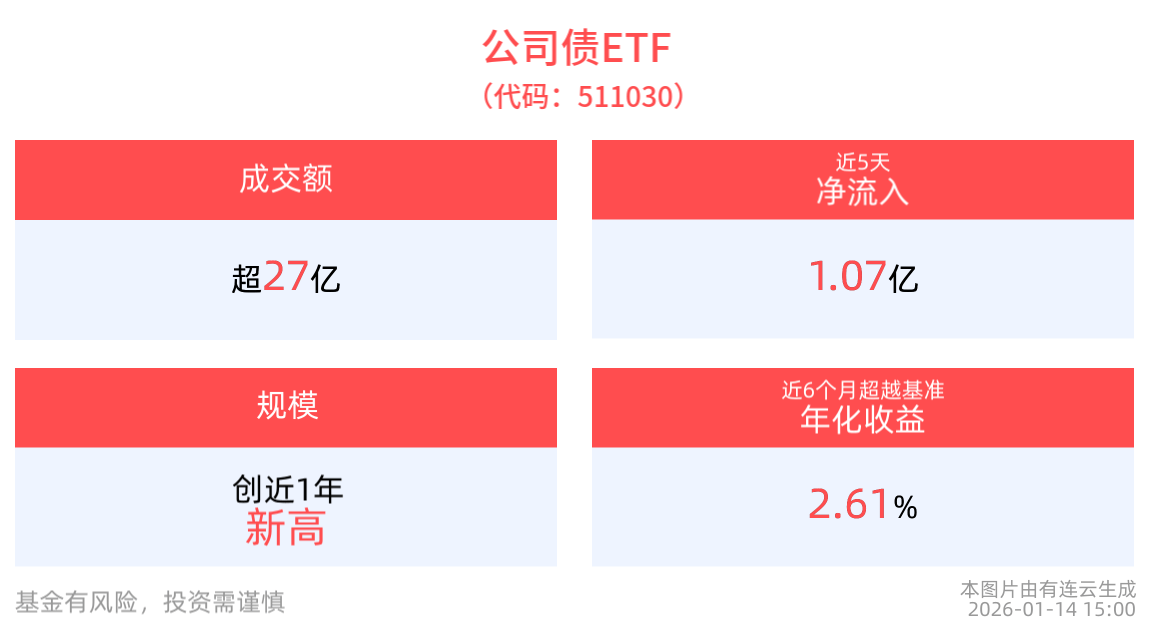
成交额超27亿元,公司债ETF(511030)近5个交易日净流入1.07亿元
Sou Hu Cai Jing· 2026-01-15 01:46
Group 1: Credit Bond Market Performance - Credit bond yields showed mixed results, with 10Y major bank secondary bonds down by 2.05 basis points, while 7Y bonds increased by 0.5 basis points [1] - In the industrial bond sector, yields varied, with notable decreases in 25 Hebei Zhongfeng MTN001A by 4.22 basis points and 25 BWS SCP006 by 3.35 basis points, while 25 Anhui Investment MTN002 increased by 10.13 basis points [1] - City investment bonds also exhibited mixed performance, with 25 Linggui City Investment SCP002 down by 12.83 basis points and 21 Gantou 01 up by 47.59 basis points [1] Group 2: Institutional Investment Trends - Institutions recommend continuing to favor equities over bonds, with net selling of long-term bonds decreasing significantly [2] - On January 14, net buying of 10Y government bonds by securities firms reached 17 billion, while insurance funds increased their holdings by 65 billion [2] - The trading volume in the stock market reached 4 trillion, contributing to the recent rise in DR001 rates [2] Group 3: Company Bond ETF Insights - As of January 14, 2026, the company bond ETF (511030) was priced at 106.76, with a 1.48% increase over the past year [5] - The latest scale of the company bond ETF reached 34.115 billion, marking a one-year high, with a recent inflow of 1.07 million over the last five trading days [6] - The company bond ETF has maintained a tracking error of 0.003% this year, closely following the China Bond - Medium to High Grade Corporate Bond Spread Factor Index [7]

1月14日信用债异常成交跟踪
SINOLINK SECURITIES· 2026-01-14 15:33
Report Industry Investment Rating - Not provided in the given content Core Viewpoints - Among the bonds with discounted transactions, "24 Chanrong 08" had a relatively large deviation in bond valuation price. Among the bonds with rising net prices, "24 Hongjian 01" had a relatively high deviation in valuation price. Among the Tier 2 and perpetual bonds with rising net prices, "24 CCB Tier 2 Capital Bond 02B" had a relatively large deviation in valuation price; among the commercial financial bonds with rising net prices, "25 CEB Bond 02" had a relatively high deviation in valuation price. Among the bonds with a transaction yield higher than 5%, transportation bonds ranked high [2]. - The changes in credit bond valuation yields were mainly distributed in the [-5,0) interval. The transaction terms of non - financial credit bonds were mainly distributed between 2 and 3 years, with the highest proportion of discounted transactions for varieties within 0.5 years; the transaction terms of Tier 2 and perpetual bonds were mainly distributed between 4 and 5 years, with the highest proportion of discounted transactions for varieties within 1 year. By industry, the bonds in the household appliances industry had the largest average deviation in valuation price [2]. Summaries by Related Catalogs Discounted Transaction Tracking - Bonds such as "24 Chanrong 08", "24 Chanrong 06", etc. in the non - bank financial industry had relatively large deviations in valuation price and high valuation yield deviations. "24 Zhonghua 08" in the comprehensive industry and "26 Lanhua MTN001" in the coal industry also had certain deviations in valuation price [3]. Tracking of Bonds with Rising Net Prices - "24 Hongjian 01" in the urban investment industry had a relatively high deviation in valuation price. Many bank - related Tier 2 and perpetual bonds also had positive deviations in valuation price, such as "24 CCB Tier 2 Capital Bond 02B", "24 BOC Tier 2 Capital Bond 02B", etc. [5]. Tracking of Tier 2 and Perpetual Bond Transactions - Bonds of state - owned banks such as "24 CCB Tier 2 Capital Bond 02B", "24 BOC Tier 2 Capital Bond 02B" had relatively large deviations in valuation price. Some bonds of joint - stock banks and city commercial banks also showed certain deviations [7]. Tracking of Commercial Financial Bond Transactions - Bonds like "25 CEB Bond 02", "25 Huishang Bank 01" had small positive deviations in valuation price and relatively stable valuation yields [8]. Tracking of Bonds with Transaction Yield Higher than 5% - Bonds such as "24 Ruimao 02" in the transportation industry and "23 Chanrong 05" in the non - bank financial industry had high transaction yields [9]. Distribution of Credit Bond Transaction Valuation Deviations on the Day - The changes in credit bond valuation yields were mainly distributed in the [-5,0) interval [2]. Distribution of Non - financial Credit Bond Transaction Terms on the Day - The transaction terms of non - financial credit bonds were mainly distributed between 2 and 3 years, and the proportion of discounted transactions for varieties within 0.5 years was the highest [2]. Distribution of Tier 2 and Perpetual Bond Transaction Terms on the Day - The transaction terms of Tier 2 and perpetual bonds were mainly distributed between 4 and 5 years, and the proportion of discounted transactions for varieties within 1 year was the highest [2]. Discounted Transaction Proportion and Transaction Scale of Non - financial Credit Bonds in Each Industry - The bonds in the household appliances industry had the largest average deviation in valuation price [2].
大类资产早报-20260113
Yong An Qi Huo· 2026-01-13 01:19
Report Summary 1. Report Industry Investment Rating No relevant content provided. 2. Core Viewpoints No explicit core viewpoints are presented in the given content. It mainly offers data on global asset market performance, stock index futures trading, and bond futures trading. 3. Directory - Based Summaries Global Asset Market Performance - **10 - Year Treasury Bonds**: Yields of 10 - year treasury bonds in major economies are as follows: US 4.177, UK 4.372, France 3.505, Germany 2.840, etc. [2] - **2 - Year Treasury Bonds**: Yields of 2 - year treasury bonds in major economies are as follows: US 3.535, UK 3.650, Germany 2.093, etc. [2] - **Exchange Rates**: Dollar exchange rates against major emerging - economy currencies are provided, such as 5.375 against the Brazilian currency, 16.390 against the South African rand, etc. [2] - **Stock Indices**: Latest values of major economy stock indices are given, including S&P 500 at 6977.270, Dow Jones Industrial Index at 49590.200, etc. [2] - **Credit Bond Indices**: Values of credit bond indices in different regions are presented, like US investment - grade credit bond index at 3546.240, Euro - zone investment - grade credit bond index at 266.750, etc. [2] Stock Index Futures Trading Data - **Index Performance**: A - share closed at 4165.29 with a 1.09% increase,沪深300 at 4789.92 with a 0.65% increase, etc. [3] - **Valuation**: PE (TTM) values are reported, such as 14.48 for 沪深300, 12.04 for 上证50, etc., along with their环比变化. [3] - **Risk Premium**: Risk premium data and their环比变化 are provided for some indices, e.g., - 0.59 for S&P 500 with a - 0.02环比变化. [3] - **Fund Flows**: Latest values and 5 - day average values of fund flows for different sectors are given, like 285.89 for A - shares, - 117.28 for the main board, etc. [3] Bond Futures Trading Data - **Stock Index Futures**:成交金额 and环比变化 are reported for 沪深两市, 沪深300, etc.主力升贴水 data for IF, IH, IC are also provided. [4] - **Treasury Bond Futures**: Closing prices and percentage changes for T2303, TF2303, etc. are presented. [4] - **Funding Rates**: R001 is at 1.3895% with a - 13.00 BP日度变化, R007 at 1.5249% with no change, etc. [4]
【固收】信用债发行量季节性上升,各行业信用利差涨跌互现——信用债周度观察(20260104-20260109)(张旭/秦方好)
光大证券研究· 2026-01-11 23:03
Group 1 - The core viewpoint of the article highlights a significant increase in credit bond issuance in the primary market, with a total of 332 bonds issued, amounting to 312.27 billion yuan, representing a 306.00% increase compared to the previous period [4][5] - In terms of issuance scale, industrial bonds accounted for 135.37 billion yuan, a 295.92% increase, while urban investment bonds reached 138.91 billion yuan, a 409.86% increase, together making up 43.35% and 44.48% of the total issuance respectively [4][5] - The average issuance term for credit bonds was 2.73 years, with industrial bonds averaging 1.88 years and urban investment bonds averaging 3.24 years [4] Group 2 - The average coupon rate for credit bonds was 2.22%, with industrial bonds at 2.06%, urban investment bonds at 2.32%, and financial bonds at 1.71% [5] - In the secondary market, credit spreads varied by industry, with the largest increase in AAA-rated food and beverage sector by 2.1 basis points, while the largest decrease was in the communication sector by 8.3 basis points [6] - The total trading volume of credit bonds reached 1,403.85 billion yuan, a 121.26% increase, with commercial bank bonds, corporate bonds, and medium-term notes being the top three in trading volume [7]