
反内卷措施

Search documents
上月CPI同比上涨0.8% 回升至2023年3月以来最高
Sou Hu Cai Jing· 2026-01-11 12:33
Group 1: CPI Analysis - In December 2025, the Consumer Price Index (CPI) increased by 0.2% month-on-month and 0.8% year-on-year, marking the highest level since March 2023 with a 0.1 percentage point increase from November [1] - The core CPI rose by 1.2% year-on-year, maintaining a growth rate above 1% for four consecutive months [5] - The increase in CPI was primarily driven by rising prices of industrial consumer goods, excluding energy, and a significant rise in food prices, particularly fresh fruits and seafood [4][6] Group 2: PPI Analysis - The Producer Price Index (PPI) fell by 1.9% year-on-year in December 2025, but the decline was less severe than in November, with a 0.3 percentage point narrowing of the drop [3][7] - Month-on-month, the PPI increased for three consecutive months, indicating a strengthening trend [3] - Factors contributing to the PPI increase include seasonal demand improvements and rising prices in the non-ferrous metals sector, which have been supported by anti-involution measures [7][8] Group 3: Sector-Specific Insights - The prices in the non-ferrous metal mining sector have been rising for 22 consecutive months, driven by both international demand for key metals and domestic growth in high-end manufacturing sectors such as lithium batteries and photovoltaic equipment [9] - The government's policy to stabilize growth in the non-ferrous metal industry aims for an average annual increase of 5% in value-added output from 2025 to 2026 [9]

东亚银行:恒指明年目标30800点,关注人工智能、新兴工业、服务消费板块
Sou Hu Cai Jing· 2025-12-16 08:53
Core Viewpoint - East Asia Bank projects a target of 30,800 points for the Hang Seng Index by 2026, corresponding to a price-to-earnings ratio of 12.8 times, with a focus on artificial intelligence, emerging industries, and consumer services sectors [1] Group 1 - The bank's investment strategist, Wu Yongqiang, indicates that measures to counteract "involution" in mainland China and optimized supply policies can reduce irrational competition and enhance industrial capacity utilization, which will help improve the profit margins of Chinese enterprises [1] - The bank anticipates that the Federal Reserve may have the opportunity to cut interest rates 3 to 4 times by 2026, totaling 75 to 100 basis points [1] - Currently, the best lending rate for the Hong Kong dollar has dropped to a low level and is not expected to decrease further in line with the Federal Reserve's rate cuts, while the Hong Kong dollar interbank offered rate still has room to decline [1]

光伏太阳能股普跌 阳光能源(00757)跌4.71% 花旗料大多数组件的月度需求预计在12月将下降
Xin Lang Cai Jing· 2025-12-11 04:00
Group 1 - The solar energy stocks have generally declined, with notable drops including Sunshine Energy (down 4.71%), GCL-Poly Energy (down 4.42%), and GCL-New Energy (down 2.70%) [1][2] - Citigroup's report indicates that solar product prices remain relatively stable, with cost levels providing potential support, despite a 2-3% decrease in solar glass prices due to inventory pressure and weak demand [1][2] - As of December 4, the average inventory period for solar companies has increased to 31.1 days, more than double the 15 days reported at the end of September, indicating a slowdown in demand for solar installations in China [1][2] Group 2 - Monthly demand for most components is expected to decline in December due to planned production cuts, alongside a recovery in polysilicon capacity [1][2] - Citigroup forecasts limited downside for polysilicon prices, primarily supported by cost levels [1][2] - The report expresses a more favorable outlook for inverter manufacturers, such as Sungrow Power Supply and DAYU, which are expected to benefit from high demand growth in energy storage systems [1][2] - Additionally, polysilicon manufacturers are anticipated to benefit from anti-competitive measures expected to be implemented in 2026, aimed at alleviating overcapacity [1][2]



ANHUI CONCH CEMENT(600585):CEMENT SALES VOLUME RESILIENT;UPBEAT ON IMPROVING INDUSTRY LANDSCAPE DRIVEN BY ANTI-INVOLUTION MEASURES
Ge Long Hui· 2025-11-01 11:51
Core Viewpoint - Anhui Conch Cement's 1-3Q25 results showed a revenue decline of 10% YoY, while net profit attributable to shareholders increased by 21% YoY, indicating a mixed performance amid challenging market conditions [1] Group 1: Financial Performance - Revenue for 3Q25 fell 11% YoY to Rmb20.01 billion, while net profit attributable to shareholders grew 3.4% YoY to Rmb1.94 billion, slightly missing expectations due to disappointing price hikes during the peak season in eastern China [1] - Cumulative net operating cash flow rose 7% YoY to Rmb11.1 billion, with cumulative capex reaching Rmb6.5 billion and free cash flow remaining abundant at Rmb4.6 billion [4] Group 2: Market Conditions - Cement sales volume demonstrated resilience despite a broader industry decline, with China's cement output falling 5.2% YoY over 9M25 and 7% YoY in 3Q25; Anhui Conch Cement's decline in sales volume was milder than the industry average [2] - Weak cement prices were observed, with average selling prices (ASP) in eastern and southern China dropping 10% and 13% QoQ in 3Q25, putting pressure on the firm's ASP [3] Group 3: Cost Management - The firm's expenses per tonne may have declined, with total expenses falling 13% YoY to Rmb2.12 billion and the expense ratio dropping 0.1ppt YoY to 10.6% [3] - Gross margin rose 1.7ppt YoY but declined 4.5ppt QoQ to 21.5%, indicating a mixed impact from cost management and pricing pressures [3] Group 4: Future Outlook - The company is expected to benefit from potential price hikes and improved competitive landscape due to anti-involution measures, with a projected 2% YoY rise in ASP in October compared to 3Q25 [4] - The financial forecasts for 2025 and 2026 net profits have been cut by 10% and 5% to Rmb8.7 billion and Rmb10 billion, respectively, reflecting ongoing pressure on cement demand [4]
中泰国际每日晨讯-20251020
ZHONGTAI INTERNATIONAL SECURITIES· 2025-10-20 08:51
Market Overview - The Hang Seng Index and the National Enterprises Index fell by 4.0% and 3.7% respectively last week, primarily due to tariff issues and concerns surrounding U.S. regional banks Zions and Western Alliance involved in credit fraud cases [1] - On Friday, the Hang Seng Index and the National Enterprises Index dropped by 2.5% and 2.7% respectively, with major sectors like technology, healthcare, brokerage, and automotive seeing significant declines, while gold-related stocks like Lao Pu Gold and Chow Tai Fook rose due to increasing gold prices [1] Company Performance - Chow Tai Fook reported a recovery in same-store sales growth in mainland China, Hong Kong, and Macau for Q2 (July-September), with retail value increasing by 4.1% year-on-year [1] - Insurance companies, including China Pacific Insurance and China Life, released positive profit forecasts, expecting net profit growth of 40%-60% and 50%-70% respectively for the first three quarters [2] Macroeconomic Dynamics - The Eurozone's harmonized consumer price index (CPI) for September showed a year-on-year increase of 2.2%, up 0.2 percentage points from August, aligning with Bloomberg's forecast [3] - Core consumer prices, excluding food and energy, rose by 2.4% year-on-year, exceeding both August's figures and Bloomberg's predictions by 0.1 percentage points [3] Industry Dynamics - In the gaming sector, Macau's gaming revenue for Q3 reached 62.57 billion MOP, reflecting a year-on-year increase of 12.5% and a quarter-on-quarter increase of 2.4% [4] - Despite a general decline in Hong Kong stocks due to fluctuations in U.S.-China trade relations, new consumer stocks like Lao Pu Gold performed well, rising by 18.0% last week [4] - In the automotive sector, NIO responded to GIC's allegations, stating that the related unfounded claims were investigated three years ago, with its stock rebounding by 2.1% on Friday after a 12.9% decline over the week [4] Pharmaceutical Sector - The pharmaceutical industry saw a general decline last week, influenced by U.S. Senate discussions on banning certain Chinese biotech companies from receiving federal funding and President Trump's remarks on lowering prices for popular diabetes and weight loss drugs [5] - Despite these challenges, Chinese pharmaceutical companies have made significant progress in overseas licensing, with Hansoh Pharmaceutical granting Roche rights to develop and commercialize a colorectal cancer drug outside of mainland China and Hong Kong, receiving an upfront payment of $80 million and potential milestone payments of up to $1.45 billion [5] New Energy and Utilities - The new energy and utilities sector in Hong Kong experienced a general decline, although defensive stocks like Huaneng International, China Everbright Environment, and Power Assets Holdings saw gains of 3.9%, 6.6%, and 2.1% respectively [6] - The photovoltaic sector faced notable declines, with companies like Xinyi Solar, Flat Glass Group, and GCL-Poly Energy dropping by 4.5%, 3.9%, and 0.8% respectively [6]
ETF基金周报:资金分歧显现红利低波类ETF净流入34亿-20251020
Dongguan Securities· 2025-10-20 08:50
Group 1 - The report highlights a significant inflow of 34 billion yuan into dividend low-volatility ETFs, indicating a divergence in fund allocation as investors seek both offensive and defensive positions in the market [2][10][16] - Gold and silver have shown strong performance, with silver futures rising by 7.15% and gold futures achieving a record nine consecutive weekly gains, reflecting a shift towards safe-haven assets [4][9] - The average weekly return for commodity ETFs was notably high at 9.05%, while stock and cross-border ETFs experienced an average decline of over 3% [4][10] Group 2 - In the stock ETF segment, traditional energy and banking sectors have shown resilience, with the banking sector experiencing its first significant weekly gain since early July [13][16] - The report suggests that investors should consider reallocating to new economy sectors such as artificial intelligence and robotics during market adjustments, while also recognizing seasonal opportunities in high-dividend coal stocks [13][16] - The bond ETF segment saw a net outflow of 138.97 billion yuan, with convertible bond ETFs underperforming due to pressure from equity funds, while long-term interest rate bonds showed stronger performance [17][19] Group 3 - The analysis of financing and margin trading indicates a split in high-risk leveraged funds, with some betting on safe-haven assets like gold and others on technology sectors supported by loose monetary policy [20][21] - The report emphasizes that the divergence in fund flows between recession and growth bets is expected to converge, depending on economic recovery or recession risks [20]
近19月来首次,核心CPI同比涨1%
Mei Ri Jing Ji Xin Wen· 2025-10-15 14:06
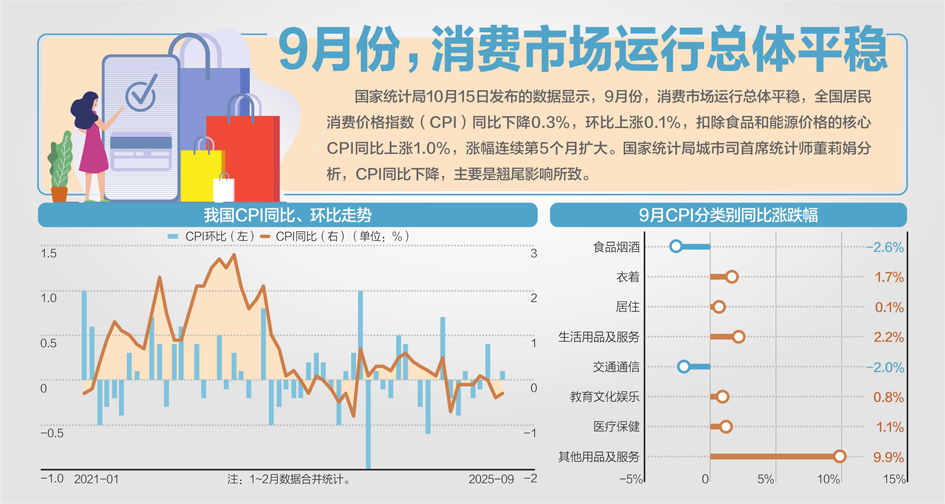
Group 1: CPI Analysis - In September, the Consumer Price Index (CPI) increased by 0.1% month-on-month and decreased by 0.3% year-on-year, with the core CPI (excluding food and energy) rising by 1% year-on-year, marking the first return to this level in 19 months [1][4] - The year-on-year decline in CPI was primarily due to a "tail effect," with food prices dropping by 4.4%, significantly impacting the overall CPI [4][5] - The increase in core CPI is attributed to the effects of consumption promotion policies and rising prices in appliances and mobile phones, which offset the decline in food prices [4][5] Group 2: PPI Analysis - The Producer Price Index (PPI) remained flat month-on-month in September, with a year-on-year decline of 2.3%, a reduction in the decline by 0.6 percentage points compared to the previous month [6][7] - The flat PPI reflects weak domestic demand despite stable international oil prices and rising copper prices, with certain export-heavy industries facing price pressures [6][7] - Future PPI trends are expected to remain flat in October, with a year-on-year decline projected to be around 2.2%, indicating challenges in turning positive by year-end [6][7]
宏观周报(9月22日-9月28日):美联储分歧加剧,国内静待政策加力-20250928
Yin He Zheng Quan· 2025-09-28 07:02
Group 1: Federal Reserve and Economic Outlook - The Federal Reserve officials show significant divergence regarding future interest rate cuts, adding uncertainty to the outlook[2] - Powell indicates that any rate cuts will likely be slow and moderate unless there is a clear economic downturn[2] - U.S. economic data remains resilient, with PPI's year-on-year decline narrowing and industrial profits turning positive, suggesting the effectiveness of anti-involution measures[2] Group 2: Domestic Economic Indicators - As of September 26, 2023, passenger car sales reached 1.191 million units, a year-on-year increase of 0.3% and a month-on-month increase of 5.9%[2] - The Baltic Dry Index (BDI) averaged 2118.6, up 5.9% month-on-month and 7.7% year-on-year, indicating strong export resilience[2] - Industrial production shows a month-on-month increase, with average blast furnace operating rates rising by 0.47 percentage points to 84.47%[2] Group 3: Price Trends and Inflation - As of September 26, 2023, pork prices fell by 0.94% week-on-week, while the average wholesale price of 28 monitored vegetables rose by 1.16%[2] - The Consumer Price Index (CPI) shows a slight increase in food prices, with energy prices rising by 0.8% and food prices by 0.5%[4] - Core PCE price index increased by 0.2% month-on-month and 2.9% year-on-year, indicating stable inflation levels[4] Group 4: Fiscal and Monetary Policy - This week, ordinary government bonds issued totaled 247.5 billion, with an issuance progress of 79%[3] - The central bank's net MLF injection was 300 billion, signaling a monetary easing policy[3] - The yield curve for government bonds steepened, with the 30-year yield at 2.217% and the 10-year yield at 1.8768%[3]
中石化午后跌近4% 上半年利润同比下跌近四成 瑞银看好三季度盈利略微改善
Zhi Tong Cai Jing· 2025-08-22 06:42
Core Viewpoint - Sinopec's stock has declined nearly 4% following the release of its mid-year financial results, reflecting significant drops in revenue and net profit compared to the previous year [1] Financial Performance - Sinopec reported a revenue of 1.41 trillion yuan for the first half of the year, a decrease of 10.6% year-on-year [1] - The net profit attributable to shareholders was 21.483 billion yuan, down 39.8% year-on-year [1] - Main business revenue for the first half was 1.3804 trillion yuan, a decline of 10.7% year-on-year, primarily due to falling prices of oil and petrochemical products as well as decreased sales volumes [1] Quarterly Insights - UBS reported that Sinopec's net profit for the second quarter was 8.2 billion yuan, representing a year-on-year decline of 53% and a quarter-on-quarter decline of 38% [1] - The firm anticipates a slight improvement in Sinopec's profitability for the third quarter, citing stable oil prices compared to the previous quarter and minimal negative impact from crude oil inventory [1] - The third quarter is traditionally a peak season for chemical products, which may lead to increased profits in that segment [1] Long-term Outlook - UBS believes that China's anti-involution measures, combined with the exit of foreign production capacity, will enhance the fundamentals of refining in the long term [1] - Sinopec has lowered its full-year capital expenditure guidance by 5% [1]

港股异动 | 中石化(00386)午后跌近4% 上半年利润同比下跌近四成 瑞银看好三季度盈利略微改善
智通财经网· 2025-08-22 06:37
Core Viewpoint - Sinopec's stock has declined nearly 4% following the release of its mid-year financial results, reflecting a significant drop in revenue and profit compared to the previous year [1] Financial Performance - Sinopec reported a revenue of 1.41 trillion yuan for the first half of the year, a year-on-year decrease of 10.6% [1] - The net profit attributable to shareholders was 21.483 billion yuan, down 39.8% year-on-year [1] - Main business revenue for the first half was 1.3804 trillion yuan, a decline of 10.7% year-on-year, primarily due to falling prices of oil and petrochemical products as well as decreased sales volumes [1] Quarterly Insights - UBS reported that Sinopec's net profit for the second quarter was 8.2 billion yuan, representing a year-on-year decline of 53% and a quarter-on-quarter decline of 38% [1] - The firm anticipates a slight improvement in Sinopec's profitability for the third quarter, citing stable oil prices compared to the previous quarter and minimal negative impact from crude oil inventory [1] - The third quarter is traditionally a peak season for chemical products, which may lead to increased profits in that segment [1] Long-term Outlook - UBS believes that China's anti-involution measures, combined with the exit of foreign production capacity, will enhance the fundamentals of refining in the long term [1] - Sinopec has lowered its full-year capital expenditure guidance by 5% [1]