
宽松交易

Search documents
站在2026年的起点:从“宽松交易”走向“复苏验证”,全球资产配置逻辑如何重构?
Di Yi Cai Jing Zi Xun· 2026-02-05 00:44
回顾2025年,全球大类资产的表现高度依赖于货币政策预期的变化。无论是美股的结构性上涨,还是黄 金、有色金属等资产的阶段性走强,其背后都绕不开"美联储何时、以多快的节奏降息"这一核心变量。 在经历了2025年全球市场的剧烈波动后,2026年的资产配置正站在一个关键分水岭。一方面,美联储降 息预期反复修正,全球流动性环境仍处在"拐点区间";另一方面,亚洲与新兴市场的相对吸引力持续抬 升,中国资产在全球配置中的角色也正在发生微妙变化。 近日,施罗德2026投策会举行,围绕"全球视野下的资产配置新思路"展开深入讨论。与会嘉宾普遍认 为,全球流动性环境正从"宽松预期"走向"节奏博弈",结构性机会将主导新一轮资产表现,投资逻辑也 需要随之调整。 宏观环境切换:全球流动性从"宽松预期"走向"节奏博弈" 站在2026年的起点,这一逻辑正在发生变化。 施罗德基金管理(中国)有限公司副总经理兼首席投资官安昀指出,市场正在从"押注宽松"的单一交 易,逐步转向对经济基本面与盈利修复的重新定价。"2025年更多是一种宽松交易和估值修复,而2026 年开始,投资者需要回答的是:宽松能否真正转化为经济复苏与盈利改善。" 从美联储角度看, ...


美国就业数据能带来宽松交易机会吗?
Sou Hu Cai Jing· 2026-02-03 03:10
美国就业市场正经历从疫后"供不应求"向当前"供需基本平衡"的关键转折。此前,劳动力供给的刚性缺口为就业市场提供了韧性缓冲,使得即便需求降温, 失业率上升也较为平缓。然而,2025年下半年以来,劳动参与率回升、新增就业放缓,推动失业率由4.1%升至4.4%,主因并非大规模裁员,而是供给端修 复——尤其是青少年临时回流与移民劳动力重新进入市场。其中,移民因素更具持续性:2025年特朗普政府强化边境管控大幅减少非法流入,但境内移民出 清阶段性结束,外国出生劳动力回流却难以迅速匹配岗位,推高失业率。 展望2026年,供给侧对失业率的下拉作用有望减弱。移民执法重心在于控制新增流入,而非大规模驱逐存量,预计移民净流入降幅已近极限,劳动力供给扰 动趋于平稳。与此同时,需求侧仍承压:企业受关税成本挤压盈利,压缩人力开支意愿增强,表现为招聘趋谨慎、偏好低薪岗位、加速AI替代;政府因财 政资金紧张(联邦依赖临时拨款、州政府普遍缩编),招聘扩张受限;而求职者信心下滑、跳槽难度加大,也印证招聘需求疲软。整体看,就业市场虽未加 速恶化,但弱势延续概率较高。 在此背景下,若就业数据进一步走弱且通胀保持可控,美联储或在政策权衡中更侧重防范 ...

美联储降息预期强化,有色行情还能走多远?
摩尔投研精选· 2026-01-29 11:00
01丨 美联储换帅前瞻 2024年9月美联储启动降息周期以来,全球权益市场同步走强,贵金属及工业金属价格同步上涨,商品市场与权益市场呈现强关联性, 宽松交易的定价是核心。 当前美联储四位候选人的背后,特朗普政府的核心诉求皆涉及干预美联储经济决策。 国泰海通证券认为: 0 2丨 有色价格走强+美联储降息预期强化 近年大宗商品价格结构性走强,但受全球宏观经济及利率压制,矿企资本开支仍处震荡期,202 5年上半年全球龙头矿企资本开支同比 下滑5. 48%,距离2012年上轮周期高点仍有约30%的向上修复空间。 1) 里德与沃什处于靠前位置 ,无论哪位候选人上任,短期美联储货币政策或将延续宽松,弱美元概率较大, 但需注意潜在的缩表政 策力度与传导; | 候选人 | 政策主张 | 资产影响推断 | | | | | | | | | | | --- | --- | --- | --- | --- | --- | --- | --- | --- | --- | --- | --- | | | | 美元指数 | | | | 黄金属 | | | | 全球权益市场 | | | | | 中性 利空 不确定 利好 | 利好 | | | ...

国泰海通 · 晨报260129|美联储换帅前瞻:历史复盘与影响展望
国泰海通证券研究· 2026-01-28 14:08
短期来看,宽松交易仍在延续,权益与金属市场受益。 我们认为: 1 )无论哪位候选人上任,短期美联储货币政策或将延续宽松,弱美元概率较大,但需注 意潜在的缩表政策力度与传导。 2 )贵金属方面,弱美元与实际利率下降将支撑黄金的货币与金融属性需求,而若哈塞特当选可能引发政策稳定性担忧,第 三重利好因素或推动黄金等贵金属避险资产进一步上行。 3 )宽松交易环境下,整体利好全球权益市场。对中国权益市场而言,随着经济转型加快、无风险 收益下沉与资本市场改革,"转型牛"的升势远未结束。 【策略】 美联储换帅前瞻:历史复盘与影响展望 全 球资本市场相关性显著提升。 2024 年 9 月美联储启动降息周期以来,中、欧等主要经济体同步推进,全球流动性宽松格局形成。我们认为这一现象本质 是全球化债,核心逻辑正是通过债务置换逐步降低资金成本,缓解政府债务的利息偿付压力。对于全球市场而言: 1 )权益市场同步走强,纳斯达克 100 、 日经 225 等发达市场指数涨幅居前,上证指数、胡志明指数等新兴市场指数亦表现亮眼,且上行斜率的拐点几乎同步出现; 2 )贵金属及工业金属价格同步 上涨,金融属性领先实物需求属性扩张。商品市场与权益市 ...


【环球财经】美联储1月议息会议前瞻: 宽松交易能否延续?
Zhong Guo Jin Rong Xin Xi Wang· 2026-01-28 11:22
转自:新华财经 新华财经上海1月28日电(葛佳明) 作为备受市场关注的事件,美联储将在北京时间1月29日(周四) 凌晨公布1月议息会议决定。目前市场普遍预期,美联储1月料"按兵不动",将基准利率维持在 3.50%-3.75%的区间水平,此次会议不会发布新的经济和政策预期,市场将重点关注美联储主席鲍威尔 对后续利率路径的表述,在美联储深陷政治漩涡之际,美联储独立性、新主席人选以及鲍威尔去留或成 为市场真正的焦点。 降息料按下暂停键 在进入美国联邦公开市场委员会(FOMC)会议静默期前,多数美联储官员表示,当前的政策立场"处 于良好位置""既不急于进一步宽松,也不需要立即转向",释放观望信号。 12月议息会议以来的经济数据显示,美国劳动力市场和通胀趋势无明显变化,两者均趋于稳定,就业增 长表现疲软,但在经济增长和消费支出向好的背景下,12月失业率回落至4.4%。美联储锚定2%通胀目 标所参考的个人消费支出价格指数PCE去年11月录得 2.8%,略高于市场预期。 华泰证券表示,近期数据显示经济增长韧性较强,美国就业市场下行风险可控,2025年12月以来首次申 请失业金人数大多好于预期,2025年三季度GDP等数据明 ...
国泰海通:宽松交易仍在延续 新任美联储主席变动有望重塑全球货币政策路径与市场空间
智通财经网· 2026-01-27 22:45
智通财经APP获悉,国泰海通发布研报称,本轮全球宽松周期下,各类资产关联度上升,新任美联储主 席的变动有望重塑全球货币政策路径与市场空间。短期来看,宽松交易仍在延续,权益与金属市场受 益。该行认为:1)无论哪位候选人上任,短期美联储货币政策或将延续宽松,弱美元概率较大,但需 注意潜在的缩表政策力度与传导。2)贵金属方面,弱美元与实际利率下降将支撑黄金的货币与金融属 性需求,而若哈塞特当选可能引发政策稳定性担忧,第三重利好因素或推动黄金等贵金属避险资产进一 步上行。3)宽松交易环境下,整体利好全球权益市场。对中国权益市场而言,随着经济转型加快、无 风险收益下沉与资本市场改革,"转型牛"的升势远未结束。 全球资本市场相关性显著提升。2024年9月美联储启动降息周期以来,中、欧等主要经济体同步推进, 全球流动性宽松格局形成。该行认为这一现象本质是全球化债,核心逻辑正是通过债务置换逐步降低资 金成本,缓解政府债务的利息偿付压力。对于全球市场而言:1)权益市场同步走强,纳斯达克100、日 经225等发达市场指数涨幅居前,上证指数、胡志明指数等新兴市场指数亦表现亮眼,且上行斜率的拐 点几乎同步出现;2)贵金属及工业金属价 ...

美国就业数据能带来宽松交易机会吗?-兴业证券
Sou Hu Cai Jing· 2026-01-27 16:38
Group 1 - The core viewpoint of the report is that the U.S. labor market has transitioned from a post-pandemic state of supply-demand imbalance to a more balanced state, with current employment performance showing signs of weakness [1][15][18] - The unemployment rate increased from 4.1% in mid-2025 to 4.4% by the end of 2025, primarily due to an increase in labor supply rather than layoffs [1][18] - Labor force participation rates have rebounded, particularly among youth and immigrants, but the sustainability of this influx is questionable [1][22][27] Group 2 - On the supply side, the increase in unemployment is attributed to a rise in labor supply, with the labor force participation rate stabilizing in the first half of 2025 and then increasing in the second half [18][22] - The demand side faces cooling pressures, with companies absorbing tariff costs and compressing labor costs, leading to a preference for lower-paid workers and increased part-time positions [2][43] - Government funding constraints are limiting personnel expansion, and job mobility among job seekers has decreased, indicating a decline in confidence [2][43][44] Group 3 - The report suggests that if employment continues to weaken and inflation remains manageable, the Federal Reserve may increase the weight of employment risk in its monetary policy decisions, potentially reopening avenues for easing [2][43] - The current market anticipates that the Federal Reserve will implement less than two rate cuts in 2026 [2][43][31] - The labor market's response to economic conditions is critical, with the potential for a loosening of monetary policy if employment data shows further deterioration [2][43][31]


【招银研究】海外宽松交易延续,国内春季行情打开——宏观与策略周度前瞻(2025.12.29-12.31)
招商银行研究· 2025-12-29 11:01
Group 1: US Economic Overview - The actual GDP growth rate for Q3 was 4.3%, with consumption growth at 3.5%, investment at -0.3%, and exports at 8.8% [2] - The K-shaped recovery continues, with services and non-durable goods consumption accelerating, while durable goods consumption remains sluggish [2] - The investment in equipment and intellectual property benefited from optimistic AI expectations, while construction and real estate investments were hindered by high interest rates [2] Group 2: Q4 Economic Predictions - The GDPNow model predicts a Q4 GDP growth rate of 3.0%, with consumption growth at 2.7%, investment at 7.0%, and exports at 6.6% [3] - Caution is advised regarding the sustainability of consumption growth due to declining savings rates and a weak job market [3] - Investment growth is primarily driven by inventory replenishment post-tariff impacts and a weak recovery in real estate investment [3] Group 3: Stock Market Insights - The S&P 500 and Nasdaq indices saw slight increases of 1.4% and 1.3% respectively, with December typically being a strong month for US stocks [4] - Concerns about high valuations and AI bubble risks persist, with future market dynamics expected to oscillate between high valuations, interest rate cuts, and AI monetization [4] - Recommendations include maintaining a diversified portfolio, focusing on materials and industrial sectors alongside technology [4] Group 4: Bond Market and Currency Trends - In a rate-cutting cycle, US bond yields are expected to trend downward, with short-term bonds benefiting directly from Fed actions [4] - The dollar is anticipated to remain in a downtrend due to high Fed rate cut expectations, although a long-term recovery is expected by 2026 [4] - The RMB is experiencing strong appreciation driven by year-end settlement demand, with further appreciation likely as the interest rate differential narrows [5] Group 5: Chinese Economic Conditions - The real estate market continues to weaken, with new home and second-hand home transactions dropping by 27.4% and 25.8% respectively in December [6] - Industrial profits fell by 13.1% year-on-year in November, indicating increasing economic pressure and weak recovery momentum [7] - Export dynamics show a short-term contraction in volume but a price recovery, with container shipping rates rebounding [8] Group 6: Fiscal and Monetary Policy - The 2026 fiscal policy will focus on expanding expenditure, optimizing government bond tools, and enhancing local financial autonomy [9] - The monetary policy is shifting towards a more flexible approach, emphasizing support for domestic demand and innovation [10] - The bond market is expected to remain slightly weak in the short term, with a focus on mid-term bond investments [11] Group 7: Market Outlook - Short-term risks include the potential decline in year-end capital inflows and increased earnings volatility in January [12] - The technology sector remains a key focus, with recommendations to balance investments across technology, dividends, and consumer sectors [13] - The Hong Kong market is expected to benefit from continued inflows and a favorable interest rate environment, despite current pressures [13]

开局之年——2026年宏观经济与资本市场展望①
Xin Lang Cai Jing· 2025-12-26 02:34
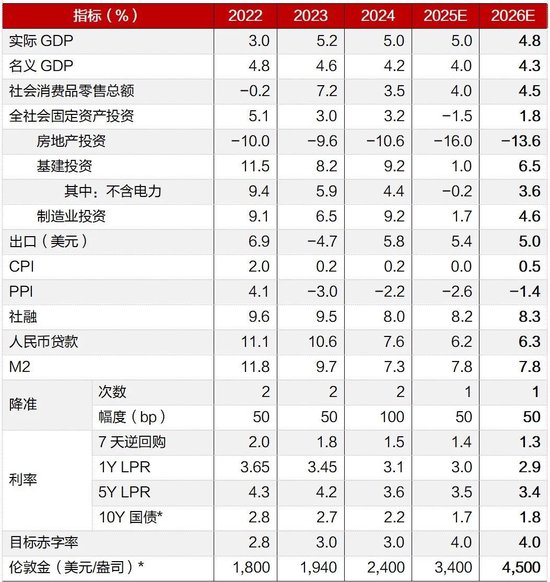
Group 1: Macroeconomic Outlook - The US economy is expected to maintain steady growth in 2026, supported by fiscal policies during the midterm election year, with a projected GDP growth of 2.4% and CPI inflation around 2.5% [1][7][55] - The K-shaped economic recovery in the US is likely to continue, with a concentration of growth in the "AI + finance" sectors, while the consumer sector shows signs of low-quality growth [1][10][55] - The Federal Reserve is anticipated to adopt a dovish stance, potentially lowering interest rates to around 3% [1][51][55] Group 2: Chinese Economic Forecast - China's GDP growth is projected to reach 4.8% in 2026, characterized by stable external demand, improved internal demand, and price recovery [2][4][82] - The fiscal policy will be more proactive, with a target deficit rate of 4.0%, corresponding to a deficit scale of 5.85 trillion yuan, and a total fiscal arrangement of 43 trillion yuan [2][86][87] - Monetary policy is expected to be moderately accommodative, with a potential reduction in the OMO rate to 1.3% and a reserve requirement ratio cut of 50 basis points [3][92][93] Group 3: Investment and Consumption Trends - Fixed asset investment growth in China is expected to recover to 1.8%, driven by increased fiscal spending and the commencement of major projects [2][5][86] - Retail sales growth is projected to rise to 4.5%, supported by strong consumer policies [2][5][86] - The capital market outlook suggests a bullish trend for the stock market, with A-shares expected to continue upward momentum, while the bond market may experience fluctuations [3][6]
锡价周评:再立新红突破34万 龙头业绩爆发,产业链迎来价值重估
Xin Lang Cai Jing· 2025-12-19 08:09
Price Trends - This week, tin prices on the Changjiang Nonferrous Metals Network exhibited a "V-shaped reversal," with a significant rebound after a mid-week low of 318,750 yuan/ton, ultimately closing at 337,500 yuan/ton on Friday [3] - The average price for the week was reported at 327,800 yuan/ton, reflecting an increase of 1,200 yuan/ton compared to the previous week [3] Macro Influences - Early in the week (December 15-16), macroeconomic expectations were mixed, leading to downward pressure on prices, with tin prices declining due to a lack of upward drivers in the industrial metals market [4] - A pivotal event occurred on December 18 when the U.S. November CPI and core CPI data significantly underperformed expectations, leading to a shift in market sentiment towards aggressive rate cuts by the Federal Reserve [5][7] Market Sentiment - Following the CPI data release, the market quickly transitioned to a "rate cut trade," resulting in a weaker dollar and a sharp decline in U.S. Treasury yields, which boosted liquidity expectations globally [7] - By the end of the week (December 18-19), a consensus on monetary easing emerged, further supporting tin prices, which rose to 337,500 yuan/ton, reflecting a strong correlation with the performance of U.S. tech stocks [8] Geopolitical Factors - During the week, geopolitical tensions in the Democratic Republic of Congo and Cambodia impacted regional logistics and supply chains, creating short-term risks to the stability of global metal supplies [10] - The ongoing conflict in the DRC is expected to have a more direct and significant impact on tin prices, potentially leading to further price increases if the situation escalates [10] Industry Performance - Leading companies in the tin industry, such as Yunxi (Yunxi Co., Ltd.), reported substantial profit growth in the first three quarters, exceeding production targets amid high tin prices [11] - The industry is focusing on resource control through domestic and international acquisitions and technological upgrades, indicating a shift towards high-quality development models that emphasize efficiency and value addition [11] Short-term Price Outlook - Short-term tin price trends are expected to remain resilient at high levels, influenced by supply-side disruptions, macroeconomic sentiment, and demand structure changes [12] - The core judgment is that tin prices are likely to oscillate within a high range, with significant upward movements requiring new supply crises or unexpected macroeconomic easing signals [12]
