
M1增速

Search documents
2月金融数据点评:社融增速平稳运行,M1增速显著回升
Orient Securities· 2026-03-15 12:04
Investment Rating - The report maintains a "Buy" rating for the banking sector, indicating a positive outlook for the industry in 2026 [4][23]. Core Insights - The banking sector is expected to return to a fundamental narrative in 2026, supported by policy financial tools and resilient asset expansion. The sector is currently in a deposit repricing cycle, which is likely to stabilize net interest margins. Structural risks are anticipated to receive policy support [4][23]. - The report highlights two main investment themes: 1. High-quality small and medium-sized banks with solid fundamentals, including Nanjing Bank (601009, Buy), Ningbo Bank (002142, Buy), and Chongqing Rural Commercial Bank (601077, Buy) 2. Large state-owned banks with stable fundamentals and good defensive value, including Bank of Communications (601328, Not Rated) and Industrial and Commercial Bank of China (601398, Not Rated) [4][23]. Summary by Sections Social Financing and Credit Growth - In February 2026, social financing grew by 8.2% year-on-year, with a net increase of 2.38 trillion yuan, exceeding market expectations. The increase in social financing was driven by a significant rise in corporate loans and government bonds [10][11]. - The total new RMB loans in February were 900 billion yuan, with a year-on-year decrease of 1.1 trillion yuan. Corporate loans increased significantly, while retail loans saw a notable decline due to regulatory tightening and weak housing demand [14][15]. M1 and M2 Growth - M1 increased by 5.9% year-on-year, while M2 grew by 9.0%. The growth in M1 was attributed to increased fiscal spending and a shift of corporate deposits to household savings [20][21]. - In February, new RMB deposits totaled 1.17 trillion yuan, with a significant increase in household deposits, while corporate deposits decreased substantially [20][22]. Investment Recommendations - The report emphasizes the potential for absolute returns in the banking sector in 2026, driven by favorable policies and a stable economic environment. It suggests focusing on quality small and medium-sized banks and large state-owned banks for investment opportunities [4][23].





2026年2月社融数据点评:企业信贷同比多增,M1增速回升
Southwest Securities· 2026-03-15 07:30
Financing Trends - In February 2026, the total social financing (社融) stock grew by 8.2% year-on-year, maintaining the same growth rate as January[1] - The incremental social financing in February 2026 was 23,792 billion RMB, an increase of 1,461 billion RMB year-on-year, marking the second consecutive month of year-on-year growth[1] - The issuance of RMB loans to the real economy increased by 8,484 billion RMB in February 2026, up 1,956 billion RMB year-on-year, indicating a return to year-on-year growth[1] Corporate and Government Financing - Corporate loans increased by 14,900 billion RMB in February 2026, up 4,500 billion RMB year-on-year, reflecting enhanced corporate credit willingness[2] - Government bond financing in February 2026 was 14,036 billion RMB, a decrease of 2,903 billion RMB year-on-year, primarily due to base effects from the previous year[1] - Direct financing saw a new addition of 16,000 billion RMB, down 2,706 billion RMB year-on-year, largely impacted by government bond financing[1] Household Financing and Deposits - Household loans decreased by 6,507 billion RMB in February 2026, down 2,616 billion RMB year-on-year, influenced by the timing of the Spring Festival[2] - RMB deposits increased by 11,700 billion RMB in February 2026, but this represented a decrease of 32,500 billion RMB year-on-year[4] - M1 growth rate rose to 5.9%, an increase of 1 percentage point, attributed to strong foreign exchange settlements by export enterprises[4] Economic Outlook - The government set a GDP growth target of 4.5%-5% for 2026, aiming for better outcomes in practice[1] - The monetary policy remains "moderately loose," consistent with the previous year's economic work conference, with an increased focus on "reasonable price recovery"[1]
固定收益点评:财政节奏加快或带动企业融资改善
GOLDEN SUN SECURITIES· 2026-03-15 05:20
Group 1: Report's Investment Rating - Not provided in the content Group 2: Core Viewpoints of the Report - In February, the overall credit and social financing were stable. The increase in corporate loans might be related to the accelerated fiscal expenditure. The follow - up fiscal expenditure acceleration needs further observation. The widening gap between deposit and loan growth rates supports banks to increase bond allocation and inter - bank lending, creating a loose liquidity environment and stabilizing the interest rate ceiling. It is expected that by mid - year, the 10 - year Treasury bond yield may drop to 1.6% - 1.7% [1][4] Group 3: Summary by Related Catalogs Credit and Social Financing Situation - In February, credit was slightly less than the same period last year, and social financing was slightly more, both in line with expectations. The corporate medium - and long - term loans increased by 350 billion yuan year - on - year to 890 billion yuan. The increase in corporate loans might be related to the accelerated fiscal expenditure [1][7] - In February, the new credit was 900 billion yuan, a year - on - year decrease of 110 billion yuan. Corporate credit increased by 1490 billion yuan, a year - on - year increase of 450 billion yuan, mainly due to the 350 - billion - yuan year - on - year increase in corporate medium - and long - term loans. The new social financing was 2.38 trillion yuan, a year - on - year increase of 146.1 billion yuan, and the stock of social financing increased by 8.2% year - on - year, with the growth rate remaining the same as the previous month. The new government bonds in February were 1.4 trillion yuan, with a slightly slower year - on - year growth, but the overall rhythm was similar to last year. In the first half of 2026, the social financing growth rate may show a gentle downward trend [2][10] M1 and M2 Growth Rates - In February 2026, the year - on - year growth rate of M1 rose by 1 percentage point to 5.9%, which might be related to the increase in corporate credit and corporate foreign exchange settlement and sales. The growth rate of M2 was the same as the previous value, with a year - on - year growth of 9.0%. The stable M2 growth rate was mainly due to the continuous growth of household deposits [3][16] Deposit and Loan Growth Rate Gap - In February, the new deposits were 1.17 trillion yuan, a year - on - year decrease of 3.25 trillion yuan, including a 1.6 - trillion - yuan year - on - year decrease in fiscal deposits. Combining January and February, deposits still increased by 520 billion yuan year - on - year. The year - on - year growth rate of deposits at the end of February was 8.7%, the same as at the end of December last year. After excluding fiscal deposits, the growth rate of other deposits increased. The combined loans from January to February were 530 billion yuan less than the same period last year, and the year - on - year growth rate slowed down from 6.4% in December last year to 6.0% in February. The widening gap between deposit and loan growth rates led to an increase in the bank's asset gap, and banks needed to allocate bonds and conduct fund lending to make up for the gap [3][19]
居民存款搬家,降息降准可期
泽平宏观· 2026-03-13 16:06
Core Viewpoint - The financial data for February 2026 shows a stable growth in social financing and a recovery in corporate financing demand, supported by proactive government policies and a loose liquidity environment [4][6]. Group 1: Financial Data Overview - Social financing growth remains high at 8.2%, with new social financing of 2.38 trillion yuan, an increase of 146.9 billion yuan year-on-year [4][6]. - M2 growth is steady at 9.0%, while M1 growth has increased to 5.9%, indicating a narrowing gap between the two [5][15]. - The total amount of new loans in February is 900 billion yuan, a decrease of 110 billion yuan year-on-year [10]. Group 2: Policy and Market Dynamics - Government bond issuance has been front-loaded, with net financing reaching 2.38 trillion yuan in the first two months, supporting social financing growth [4][9]. - The central bank is expected to continue implementing a moderately loose monetary policy, including potential interest rate cuts [6][9]. - Direct financing has shown a mixed performance, with corporate bond financing decreasing while stock financing has improved [9]. Group 3: Credit Trends - Credit growth is slowing, primarily due to a decline in household loans, with a year-on-year decrease of 2.6 trillion yuan in February [10][11]. - Corporate short-term and medium-to-long-term loans have increased, with new corporate loans totaling 1.49 trillion yuan, up by 450 billion yuan year-on-year [10][11]. - The real estate market shows structural differentiation, with new home prices rising by 2.37% year-on-year while second-hand home prices fell by 8.78% [13]. Group 4: Deposits and Savings Behavior - Resident deposits increased by 3.11 trillion yuan, up by 2.5 trillion yuan year-on-year, indicating a continued trend of "deposit migration" [6][16]. - Non-bank deposits increased by 1.39 trillion yuan, reflecting a shift in savings behavior due to lower interest rates on traditional savings products [16]. - The M2-M1 gap has narrowed to 3.1 percentage points, suggesting improved liquidity conditions, although the extent of this improvement remains to be observed [15][16].

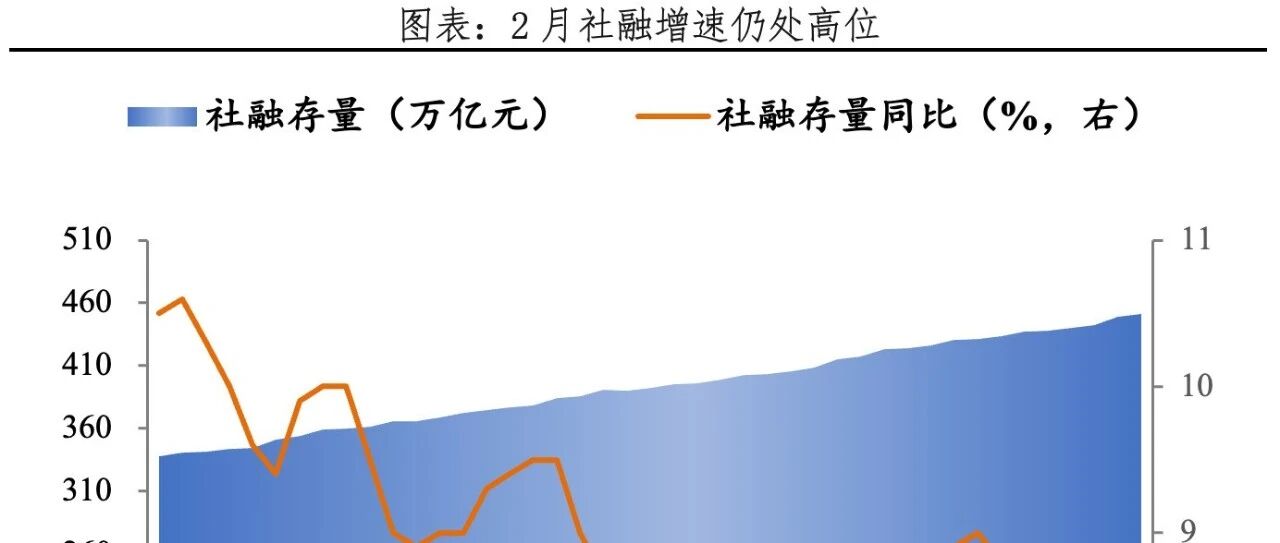
2026年2月金融数据预测:社融增速或延续小幅下行
Hua Yuan Zheng Quan· 2026-02-28 07:48
1. Report Industry Investment Rating - No information provided in the given content 2. Core Views of the Report - Forecasts for February 2026: 750 billion yuan in new loans, 1.99 trillion yuan in social financing increment, M2 reaching 349.2 trillion yuan with a YoY increase of 8.9%, new - caliber M1 YoY increase of 5.0%, and social financing growth rate of 8.1% [2] - New loans in February may be less than the same period last year due to weak real - economy financing demand, mortgage prepayment pressure, and weak consumer credit demand. It is expected that short - term personal loans will be - 30 billion yuan, medium - and long - term personal loans will be - 15 billion yuan, short - term corporate loans will be + 30 billion yuan, medium - and long - term corporate loans will be + 45 billion yuan, and bill financing will be + 30 billion yuan [3] - M2 growth rate in February may be stable. The new - caliber M1 growth rate is expected to be 5.0% at the end of February 2026, with little change from the previous month. M2 growth rate is expected to be 8.9% [3] - Social financing increment in February may be less than the same period last year, and the growth rate will decline slightly. The social financing growth rate may continue to decline in the next few months and reach about 7.5% by the end of 2026. The social financing increment in 2026 is predicted to be about 35 trillion yuan [3] - The adjustment of long - term bonds may be an opportunity. After the adjustment at the end of February, the yield of long - term bonds is expected to fall again after the sentiment stabilizes. The target points for the 10Y Treasury bond are 1.75% in Q1 and 1.70% in Q2. It is expected that the 10Y Treasury bond yield will fluctuate between 1.6% - 1.9% in 2026 [3] 3. Summary by Relevant Catalogs Forecast of New Loans - In February 2026, new loans are expected to be 750 billion yuan, less than the same period last year. Due to factors such as weak real - economy financing demand, mortgage prepayment pressure, and weak consumer credit demand, the new loans in 2026 may still be less than the same period last year [2][3][7] Forecast of M2 and M1 - The new - caliber M1 growth rate at the end of February 2026 is expected to be 5.0%, with little change from the previous month. The M2 growth rate at the end of February is expected to be 8.9%, relatively stable [3] Forecast of Social Financing - The social financing increment in February 2026 is predicted to be 1.99 trillion yuan, less than the 2.23 trillion yuan in February 2025. The social financing growth rate at the end of February is expected to drop to 8.1%. The social financing growth rate may continue to decline in the next few months and reach about 7.5% by the end of 2026. The social financing increment in 2026 is predicted to be about 35 trillion yuan [2][3][10] Analysis of Long - Term Bonds - The adjustment of long - term bonds at the end of February may be an opportunity. After the sentiment stabilizes, the yield of long - term bonds is expected to fall again. The target points for the 10Y Treasury bond are 1.75% in Q1 and 1.70% in Q2. It is expected that the 10Y Treasury bond yield will fluctuate between 1.6% - 1.9% in 2026. The allocation of ultra - long bonds by insurance funds may increase in March, and the yield of the 30Y Treasury bond active bond is expected to reach 2.2% [3]
2026物价展望:CPI有望温和回升 PPI或将转正
Zhong Guo Jing Ji Wang· 2026-02-18 08:56
Group 1 - In 2025, consumer prices (CPI) remained stable year-on-year, while industrial producer prices (PPI) decreased by 2.6% [1][2] - Food prices fell by 1.5% in 2025, with pork prices shifting from a 7.7% increase to a 6.1% decrease, impacting CPI by approximately 0.08 percentage points [2] - Energy prices saw a significant decline of 3.3%, influenced by international oil price fluctuations, with gasoline and diesel prices dropping by 7.2% and 7.8% respectively [2] Group 2 - The PPI showed a narrowing decline in the second half of 2025, with a decrease of only 1.9% by December, the smallest drop since September 2024 [3] - Factors contributing to the PPI's performance included improved domestic market competition and varying impacts from external factors, such as rising prices in the non-ferrous metals sector and declining oil prices [3] - The low price environment remains a concern for the Chinese economy, affecting corporate revenues, profits, and government finances [3] Group 3 - For 2026, macroeconomic indicators suggest a potential recovery in both CPI and PPI, supported by policies aimed at expanding domestic demand and addressing supply-side issues [4][5] - The financial outlook for 2026 anticipates CPI to rise by approximately 0.8%, with PPI expected to turn positive around the second quarter [6][5] - Structural characteristics of the PPI recovery will depend on demand strength and the effectiveness of policies aimed at stimulating consumption and investment [6][7]
2026年1月金融数据点评:存款搬家加速,M1、M2增速大幅回升
GF SECURITIES· 2026-02-14 05:23
Investment Rating - The industry rating is "Buy" [6] Core Insights - The overall social financing growth slightly declined to 8.2% in January, while M1 and M2 growth rates significantly rebounded, with M1 growing by 4.9% and M2 by 9.0% [6][16] - Government net financing increased significantly by 2,831 billion yuan year-on-year, contributing to the overall social financing growth [6][17] - The report indicates a shift in deposit structure due to accelerated deposit migration, impacting M1 negatively while having limited effect on M2 [6][16] Summary by Sections Overall Situation - Social financing growth decreased slightly to 8.2%, while M1 and M2 growth rates increased significantly [15][16] - M1 and M2 growth rates rose by 1.1 percentage points and 0.5 percentage points respectively compared to the previous month [6][16] Government Sector - Fiscal strength showed a year-on-year decline, impacting overall financing dynamics [39] Household Sector - Demand remained stable year-on-year, with short-term loan demand increasing [39] Corporate Sector - Short-term loan demand increased year-on-year, while bill financing saw a significant reduction [39] Non-Bank Sector - The acceleration of deposit migration was noted, with non-bank deposits increasing by 1.45 trillion yuan year-on-year [6][39]



货币宽松,居民存款搬家
泽平宏观· 2026-02-13 16:33
Group 1: Core Insights - The social financing growth rate in January is 8.2%, slightly down from 8.3% in the previous month, indicating overall stability in financing conditions [3][6] - New social financing reached 7.22 trillion yuan, a year-on-year increase of 165.4 billion yuan, marking a historical high for the same period [6][9] - The monetary policy remains accommodative, with expectations for potential reserve requirement ratio (RRR) cuts and interest rate reductions in the first half of the year [4][5] Group 2: Financial Data Characteristics - The credit growth rate has slowed, with the year-on-year growth of credit balance at 6.1%, down 0.3 percentage points from the previous month [3][12] - M2 and M1 growth rates have both increased, with M2 at 9.0% and M1 at 4.9%, indicating a narrowing gap between the two [4][15] - Government bond net financing increased by 976.4 billion yuan, supporting social financing growth [9] Group 3: Credit and Financing Structure - The structure of financing shows a shift, with government bonds and bills providing support while on-balance sheet credit and direct financing are still adjusting [3][8] - New loans in January amounted to 4.9 trillion yuan, a decrease of approximately 320 billion yuan year-on-year, reflecting weaker credit expansion [12] - Short-term loans for residents increased significantly, while medium- and long-term loans faced pressure, indicating a cautious approach to long-term borrowing [13]
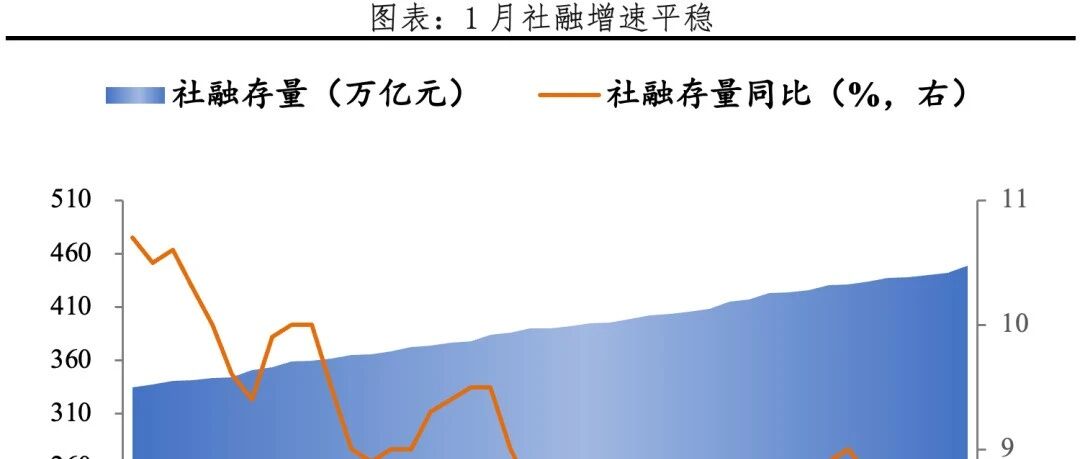
2026年1月金融数据预测:社融增量或同比接近
Hua Yuan Zheng Quan· 2026-02-03 02:17
1. Report Industry Investment Rating - Not mentioned in the provided content 2. Core Viewpoints of the Report - Forecasts for January 2026: 4.9 trillion yuan in new loans, 7.07 trillion yuan in social financing increment; at the end of January, M2 reaches 345.1 trillion yuan with a YoY increase of 8.3%, new - caliber M1 YoY increase of 3.7%, and social financing growth rate of 8.1% [2] - New loans in January may be close to the same period last year, but the new loans in 2026 may still increase less year - on - year due to weak credit demand and non - negligible credit risks [3] - M1 growth rate may decline in January, and M2 growth rate may also decline slightly [3] - Social financing increment in January may be close to the same period last year, and the growth rate may decline slightly. The social financing growth rate may continue to decline in the next few months, and is expected to drop to around 7.5% by the end of 2026. The predicted social financing increment for 2026 is about 35 trillion yuan [3] - Long - term bonds may continue a small - scale rebound in February, and the yield of the active 30Y Treasury bond may return to around 2.2%. The yield of the 10Y Treasury bond is expected to fluctuate between 1.6% - 1.9% in 2026 [3] 3. Summary by Related Catalogs New Loans - It is expected that new loans in January will be 4.9 trillion yuan, with individual loans increasing by 450 billion yuan, corporate loans increasing by 4.5 trillion yuan, and non - bank inter - bank loans decreasing by 50 billion yuan [3] - Among individual loans, short - term loans are expected to increase by 50 billion yuan, and medium - and long - term loans are expected to increase by 400 billion yuan. Among corporate loans, short - term loans are expected to increase by 1.6 trillion yuan, medium - and long - term loans are expected to increase by 3.3 trillion yuan, and bill financing is expected to decrease by 400 billion yuan [3] M1 and M2 - The new - caliber M1 growth rate at the end of January is expected to be 3.7%, with a slight month - on - month decrease. The M2 growth rate at the end of January is expected to be 8.3%, with a slight month - on - month decline [3] Social Financing - The social financing increment in January is predicted to be 7.07 trillion yuan, close to the 7.05 trillion yuan in January 2025. The increment of RMB loans to the real economy is expected to be 4.95 trillion yuan, undiscounted bank acceptance bills to increase by 30 billion yuan, net corporate bond financing to be 50 billion yuan, and net government bond financing to be 110 billion yuan [3] - The social financing growth rate is expected to drop to 8.1% at the end of January, and may continue to decline in the next few months, reaching around 7.5% by the end of 2026. The predicted social financing increment for 2026 is about 35 trillion yuan [3] Bond Market - From November 20, 2025, to the end of January 2026, securities firms' proprietary trading, funds, and annuities significantly reduced their holdings of ultra - long - term interest - rate bonds, with a net sale of 349.8 billion yuan in total. Long - term bonds may continue to rebound in February, and the yield of the active 30Y Treasury bond may return to around 2.2%. The yield of the 10Y Treasury bond is expected to fluctuate between 1.6% - 1.9% in 2026 [3]
债市周周谈-12月金融数据解读及未来展望
2026-01-19 02:29
Summary of Key Points from the Conference Call Industry Overview - The conference call discusses the financial market trends in China, particularly focusing on the credit demand, social financing, and government bond market for the year 2026. [1][2][3] Key Insights and Arguments - **Weak Credit Demand**: Overall credit demand in China is weak, influenced by manufacturing overcapacity and the impact of local government debt on financing needs. [3][6] - **Loan Structure**: In December 2025, new loans amounted to 910 billion yuan, with a significant portion being short-term corporate loans and bill discounts, indicating banks' aggressive lending strategies at the end of the quarter. [2][4] - **Personal Loans Decline**: Personal loans have been in continuous negative growth since August 2025, reflecting low consumer credit demand despite a strong stock market performance. This trend is expected to persist into 2026. [2][3] - **Social Financing Trends**: Social financing growth is projected to decrease, with an expected total of approximately 3.5 trillion yuan for 2026, slightly lower than the previous year. [6][9] - **Government Bond Issuance**: The issuance of government bonds is expected to increase, with a stable credit growth forecast for 2026, as the issuance schedule is front-loaded. [9][19] Important but Overlooked Content - **M1 Growth Rate**: The M1 growth rate fell to 3.8% by the end of 2025, with expectations of maintaining around 3% in the second half of 2026. [5] - **Insurance Sector Impact**: The nearing conclusion of a 6 trillion yuan special bond debt plan may improve the supply of long-term bonds, which is crucial for the investment strategies of the insurance sector. [7][8] - **Bank Wealth Management Trends**: Bank wealth management products are expected to see significant growth in the second and third quarters of 2026, while the first quarter typically shows a decline due to banks focusing on loan growth. [11][12] - **Long-term Bond Demand**: There is a notable increase in demand for long-term government bonds from rural commercial banks due to a decrease in their funding costs, with expectations of a significant rise in their holdings of 15 to 30-year bonds. [17] - **Stock Market Regulation**: The regulatory body is actively preventing excessive volatility in the stock market, with recent actions indicating a desire to control overheating in the market. [18] Investment Recommendations - It is suggested to consider investing in secondary capital bonds or perpetual bonds for yield, while also exploring opportunities in 30-year government bonds for potential price movements. [20]