PPI
Search documents
2026年1月PMI点评:开年的微妙信号
Guolian Minsheng Securities· 2026-01-31 08:37
[Table_Author] 分析师:陶川 分析师:钟渝梅 执业证书:S0590525110006 执业证书:S0590525110008 邮箱:taochuan@glms.com.cn 邮箱:zhongyumei@glms.com.cn 更值得关注的是,在已召开两会的地方中,多数下调或维持了 2026 年增长目标, 我们认为或说明"十五五"开局之年,各地正从以往追求"增速"向注重"提质" 转变。这一结构性调整的方向,也从 1 月处于荣枯线(以上)的 EPMI、高技术制 造业 PMI 中得以印证。 相关研究 本公司具备证券投资咨询业务资格,请务必阅读最后一页免责声明 证券研究报告 1 1 月 PMI:开年的微妙信号 glmszqdatemark 2026 年 01 月 31 日 2026 年 1 月 PMI 点评 事件:1 月 31 日,国家统计局公布 2026 年 1 月中国采购经理指数运行情况。1 月份,制造业采购经理指数(PMI)为 49.3%,比上月下降 0.8 个百分点,制造 业景气水平有所回落。 1 月 PMI 回落可能不完全归因于统计局所说的"传统淡季",其背后有多重节奏 性因素交织。比如由于今 ...
Volatility in Gold, Silver; Why Trump Picked Warsh
Youtube· 2026-01-30 14:46
Kevin Hanks is with me live at the CBOE for our pre-bell playbook. And look, it's Kevin Walsh. We've been waiting for it.It's very interesting that he chose right now to tell us this news um at the Melania premiere. Maybe he was trying to promote the premiere, too. Who knows.But that's it. It's Kevin Worsh. What do you think.>> Good morning, Nicole. Yeah, you know, someone asked me last night at dinner, who would I pick if I was the president. And I said of the four people, either one of the Kevin was fine, ...
吴说每日精选加密新闻 - 美国公布 2025 年 12 月最终需求 PPI 环比上涨 0.5%
Xin Lang Cai Jing· 2026-01-30 14:29
(来源:吴说) 沃什曾于 2006–2011 年担任美联储理事,并曾代表美联储参与 G20 事务;此前还在白宫国家经济委员 会任职,并在摩根士丹利从事投行业务。目前,沃什为胡佛研究所访问学者、斯坦福大学商学院讲师, 并任职于杜肯家族办公室。Kevin Warsh 曾是加密项目 Basis 的早期投资人之一,并任加密风投机构 Electric Capital 的顾问。 3.香港加快完善虚拟资产与稳定币监管框架 香港财库局局长许正宇表示,香港持续推进虚拟资产监管。《稳定币条例》已生效,金管局正处理法币 稳定币发行人牌照申请;虚拟资产交易、托管、顾问及管理服务的监管制度将于今年内提交立法会。政 府亦计划落实 OECD 加密资产申报框架,预计 2028 年起开展跨境税务信息自动交换。 1.美国公布 2025 年 12 月最终需求 PPI 环比上涨 0.5% 美国公布 2025 年 12 月最终需求 PPI 环比上涨 0.5%,高于 11 月的 0.2% 和 10 月的 0.1%。其中,最终 需求服务价格环比上涨 0.7%,为主要推动因素,最终需求商品价格环比持平。剔除食品、能源和贸易 服务后的核心 PPI 环比上涨 ...
服务成本大幅上涨 美国12月PPI增速超预期
智通财经网· 2026-01-30 14:05
智通财经APP获悉,美国12月PPI年率 3%,预期2.7%,前值3.00%。美国12月核心PPI年率 3.3%,预期2.90%,前值3.00%。数据公布 后,美元指数DXY短线小幅走高近10点,美债收益率小幅走高。 | Metric | Actual | Estimate | | --- | --- | --- | | PPI final demand (MoM) | +0.5% | +0.2% | | PPI ex. food, energy (MoM) | +0.7% | +0.2% | | PPI final demand (YoY) | +3.0% | +2.8% | | PPI ex. food, energy (YoY) | +3.3% | +2.9% | 其中,服务成本大幅上涨,贸易利润率指标创下2024年年中以来的最大增幅。该类别价格上涨主要归因于机械设备批发利润率的提 高。然而,商品价格在上月上涨后保持不变。 PPI数据与本月早些时候公布的数据基本相符,1月中旬公布的美国12月CPI同比涨幅为2.7%,与市场预期及前值一致;环比涨幅为 0.3%,同样与市场预期及前值一致。最新的PPI表明, ...
化工ETF受追捧 多只产品份额年内增长较快
Zheng Quan Ri Bao· 2026-01-29 17:17
化工ETF份额增长最多 Wind资讯数据显示,截至1月29日记者发稿,在中证细分产业主题指数中,细分有色指数年内涨幅最大,为34.04%;细分 化工指数次之,涨幅为12.47%;细分地产、细分机械、细分食品、细分医药、细分金融涨幅分别为3.88%、3.34%、2.62%、 1.46%和-5.56%;由此可见,周期板块整体表现突出。 跟踪细分化工指数的ETF业绩随之"水涨船高",鹏华基金、华宝基金、富国基金、天弘基金等多家公募机构旗下的化工 ETF年内净值增长率均在13%以上。基金净值的增长也吸引了资金的踊跃申购,多只化工ETF份额增长较快。 本报记者 方凌晨 今年以来,A股市场周期行情持续演绎,化工板块与有色金属板块同频走高,成为周期主线中的两大核心方向。化工板块 的市场关注度提升,带动多只化工ETF(交易型开放式指数基金)份额大涨。 另据记者了解,多位主动权益类基金的基金经理此前已在组合中配置了化工板块。有业内人士表示,在"反内卷"背景下, 化工行业盈利能力逐渐修复,配置价值凸显。 行业盈利逐渐修复 今年以来,A股市场震荡走强,周期行情持续演绎,未来市场走向和投资机会成为投资者关注的焦点。多位基金经理表 示 ...
推动物价合理回升,多部门明确政策思路
Di Yi Cai Jing Zi Xun· 2026-01-25 13:13
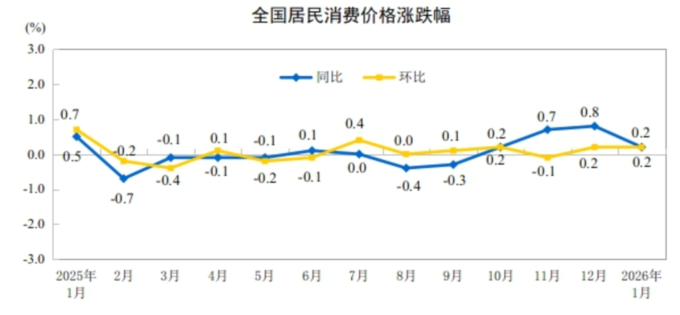
价格是经济冷暖的信号,也是提振微观主体信心的关键。 第一财经记者注意到,国家发改委、国家统计局、中国人民银行等多部门近期均对当前物价问题作出表 态,并明确了今年推动价格合理回升的政策举措。 国家统计局局长康义表示,推动物价合理回升,既有利于促进企业和居民增收,也有利于稳定市场预 期,要继续发挥宏观政策集成效应,扩大居民消费,规范市场竞争行为,积极破解供需矛盾,促进物价 合理回升。 具体到政策层面,国家发改委表示,将从总量政策、结构政策、改革政策三方面发力,实施一系列调 控、改革、监管举措,打好"组合拳",着力推动物价温和回升。央行也提出,把促进经济稳定增长、物 价合理回升作为货币政策的重要考量,继续实施好适度宽松的货币政策,为推动物价合理回升营造适宜 的货币金融环境。 从能源价格来看,受国际油价波动下行影响,国内能源价格下调,也是CPI走低的重要因素。2025年, 能源价格下降3.3%,影响CPI下降约0.25个百分点。 2025年,扣除食品和能源后的核心CPI比上年上涨0.7%,涨幅比上年扩大0.2个百分点。其中12月份上涨 1.2%,连续4个月保持在1%以上。随着消费品以旧换新政策拉动,部分行业产能治理成 ...
经济修复平稳 政策加力支持中小企业发展
Jing Ji Guan Cha Wang· 2026-01-23 14:43
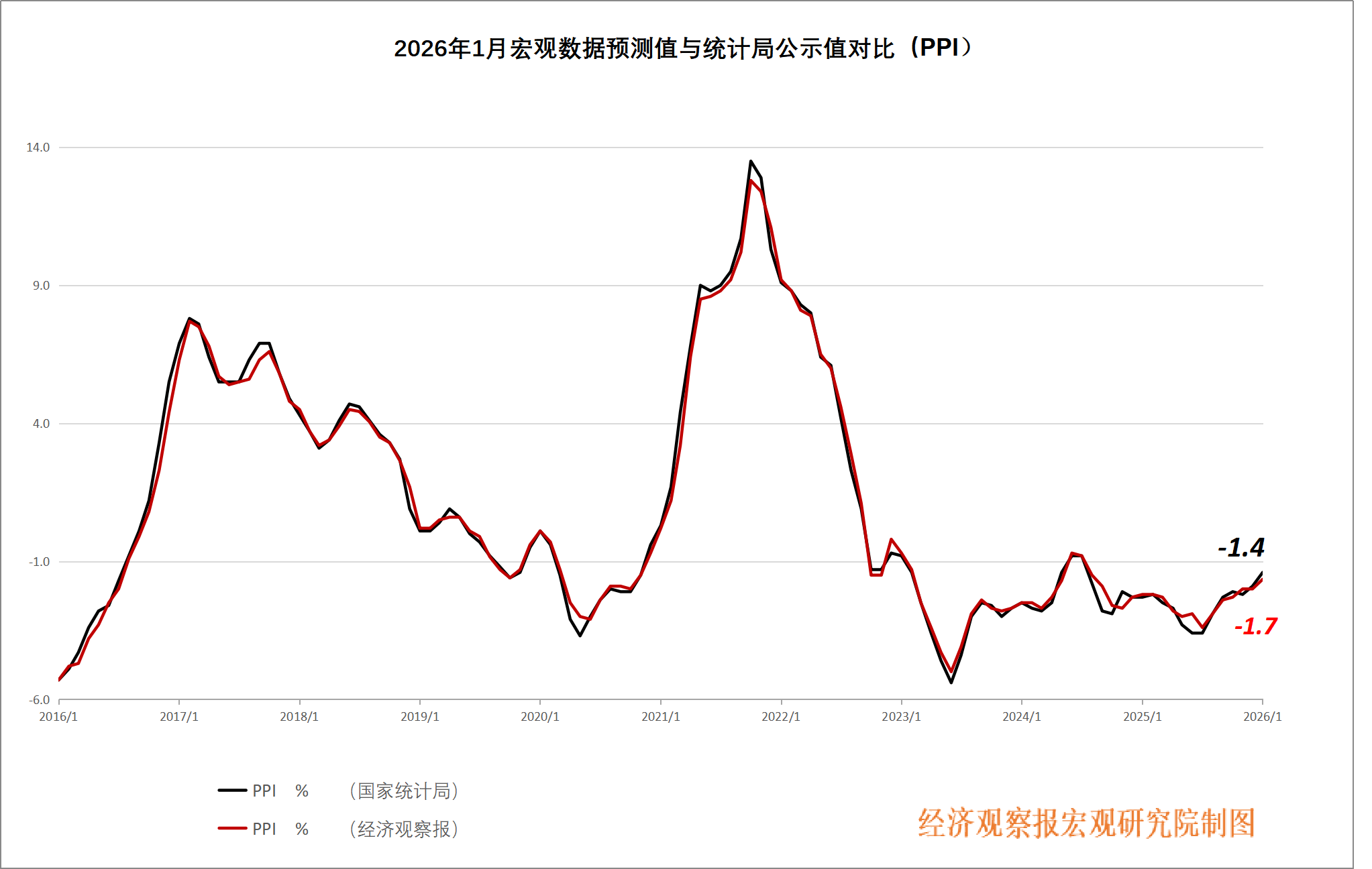
2025年12月经济数据显示:CPI同比增速由0.7%上升至0.8%;PPI从-2.2%上升至-1.9%;制造业PMI由49.2%上升至50.1%;新增人民币贷款9100亿元;M2同 比增速上升为8.5%。 由《经济观察报》发起的"经济观察报月度观察",每月发布一次。本次共有11家机构参与月度宏观数据预测。 CPI:通胀水平有望持续回升 李晓丹 实习生 王欣 彭萧州/文 有色金属价格逆势大涨、制造业PMI重返扩张区间、企业中长期贷款增长,2025年的宏观数据显出经济保持平稳修复。值得 关注的是,中小企业景气仍在收缩区间,需要为中小企业发展进一步营造有利环境。同时,房地产市场的低迷对价格和投资仍有较大拖累。 CPI公布值(同比):0.8% 前值:0.7% CPI预测值(同比):0.8% 西部证券(002673)首席宏观分析师边泉水点评:12月食品CPI环比增长0.3%,连续五个月正增长;同比增长1.1%,涨幅扩大。其中,猪肉价格仍在下跌, 12月环比下跌1.7%,同比下降14.6%;鲜菜价格环比增长0.8%,同比涨幅扩大至18.2%。 从核心CPI来看,12月核心CPI环比增长0.2%,持平于去年同期;同比增长 ...
李迅雷专栏 | PPI“失去十五年”之谜
中泰证券资管· 2026-01-21 11:32
Core Viewpoint - The Producer Price Index (PPI) in China has shown a zero increase over the past 15 years, despite a significant GDP growth of 250% during the same period, indicating a persistent weakness in producer prices and underlying demand issues [3][4][41]. Group 1: PPI Trends and Historical Context - The PPI has been in a negative growth phase since October 2021, marking 39 consecutive months of year-on-year decline by December 2025 [1]. - From 2012 to 2025, there were 111 months of negative PPI, indicating that two-thirds of this period experienced deflation in producer prices [1][4]. - The PPI index, set at 100 in December 2010, remained unchanged at 100 by December 2025, reflecting no price increase over 15 years [1][4]. Group 2: Economic Growth vs. PPI - China's GDP grew from less than 40 trillion yuan in 2010 to over 140 trillion yuan by 2025, a 2.5 times increase, while the broad money supply (M2) increased 3.68 times during the same period [4]. - Despite significant economic growth, the PPI's lack of increase raises questions about the underlying demand and pricing power within the economy [4][41]. Group 3: Factors Influencing PPI - The PPI's long-term decline is attributed to weak demand, particularly after the peak of the real estate market in 2021, which has affected both upstream and downstream price transmission [39][41]. - The relationship between real estate investment and PPI indicates that a downturn in real estate correlates with a decline in producer prices, as seen in historical data [34][41]. - The inability of upstream price changes to effectively transmit to downstream prices is exacerbated by high competition in the downstream sectors and insufficient demand [20][39]. Group 4: External Influences and Export Dynamics - Export dynamics play a crucial role in influencing midstream product prices, with a significant portion of manufacturing exports being affected by global demand fluctuations [24][26]. - The export price index has seen a notable decline, indicating that reliance on price competition to maintain export volumes may not be sustainable [26][28]. - The overall weak demand in the domestic market, particularly in the context of real estate and consumer confidence, has further constrained PPI recovery [28][39]. Group 5: Recommendations for Economic Policy - To address the persistent weakness in PPI, it is essential to adjust the supply-demand relationship by expanding effective demand, particularly through increasing the income of middle and low-income groups [41][49]. - Stabilizing the real estate market is suggested as a means to support consumer spending and alleviate overcapacity issues in various industries [41][49]. - The focus should shift towards enhancing consumer income through government policies, which may involve restructuring fiscal spending to prioritize direct transfers to households [41][49].
专访中国政策科学研究会经济政策委员会副主任徐洪才:PPI回升现积极信号,如何巩固物价修复态势?
Xin Lang Cai Jing· 2026-01-20 12:45
Core Viewpoint - The recent data on prices indicates positive signals for the economy, with the Producer Price Index (PPI) showing a narrowing year-on-year decline and the Consumer Price Index (CPI) reaching a three-year high, suggesting a potential recovery in industrial production and consumer demand [1][3]. Economic Indicators - In December 2025, the PPI year-on-year decline narrowed to 1.9%, with a month-on-month increase for three consecutive months, indicating the effectiveness of proactive fiscal and moderately loose monetary policies [3]. - The CPI in December 2025 rose to 0.8% year-on-year, marking the highest level in nearly three years [1]. Consumer Behavior - Final consumption expenditure contributed over 50% to economic growth in 2025, with "self-indulgent consumption" rising, as service retail sales grew by 5.5%, outpacing goods retail sales by 1.7 percentage points [1][9]. - The growth in per capita consumption expenditure was still slower than the growth in per capita disposable income, indicating a need for improved conversion of income into consumption [10]. Industrial Production - The recent month-on-month increase in PPI suggests a recovery in industrial production demand, although the sustainability of this trend remains to be observed [3]. - The high-tech manufacturing sector accounted for 17.1% of the value added in large-scale industries, indicating a long-term trend towards high-tech manufacturing leading industrial development [6]. Policy Recommendations - To maintain the recovery of PPI, it is crucial to expand consumer demand and increase residents' income, especially during the upcoming traditional sales season [4]. - Policies should focus on enhancing consumer rights protection, creating consumption hotspots, and providing direct cash subsidies to low-income groups to stimulate spending [10][11]. Future Outlook - The rise of "self-indulgent consumption" presents a significant growth opportunity, particularly in sectors like health and wellness, which could drive future economic expansion [9]. - The effectiveness of monetary policy is currently limited, as a significant amount of money is not effectively translating into actual demand, highlighting the need for stabilizing expectations in economic work [8].
12月宏观数据分析:2025年预期目标圆满实现,但复苏动能仍不强
Xi Nan Qi Huo· 2026-01-20 02:02
1. Report Industry Investment Rating No relevant content provided. 2. Core Viewpoints of the Report - The GDP growth target of 5% in 2025 was successfully achieved, but the growth rate declined quarter - by - quarter. The macro - economic data in December continued to fall, and the recovery momentum remained weak. Consumption, fixed - asset investment, and the real estate market were sluggish, while exports showed resilience and inflation data improved [3]. - A rational and objective view of the current macro - economy is needed. The transformation, adjustment, and bottoming - out of the real estate market require time, and the domestic economic recovery cannot be achieved overnight. More active macro - policies should be implemented to expand domestic demand and optimize supply [4]. - In the future, "expanding domestic demand and combating cut - throat competition" will remain important long - term policy measures. The financial market is in a state of "weak reality, strong expectation", and the market sentiment is continuously improving. In 2026, the macro - economy and asset prices are expected to continue the upward repair trend, but patience is required [4]. 3. Summary by Directory 3.1 Manufacturing PMI: A Slight Rebound but Still Weak - In December, the manufacturing PMI was 50.1%, up 0.9 percentage points from the previous month, entering the expansion range. Large - scale enterprises' PMI was 50.8%, up 1.5 percentage points; medium - sized enterprises' PMI was 49.8%, up 0.9 percentage points; small - sized enterprises' PMI was 48.6%, down 0.5 percentage points [6]. - Among the five sub - indices of the manufacturing PMI, the production index, new order index, and supplier delivery time index were above the critical point, while the raw material inventory index and employment index were below it. The production and new order indices increased, indicating accelerated production and improved market demand, but the employment index declined slightly [6]. - Overall, although the manufacturing PMI rebounded in December, the manufacturing sector was still weak, and the economic recovery momentum was insufficient [9]. 3.2 CPI and PPI: Inflation Continued to Improve - In December 2025, the national CPI rose 0.8% year - on - year and 0.2% month - on - month. Food and non - food prices both increased, and among the eight major categories of prices, five increased and two decreased year - on - year [10]. - The PPI decreased 1.9% year - on - year in December, with the decline narrowing by 0.3 percentage points, and increased 0.2% month - on - month, with the growth rate expanding by 0.1 percentage points. The anti - cut - throat competition policy has achieved continuous results, and the PPI year - on - year growth rate is expected to turn positive in 2026 [12][15]. 3.3 Import and Export: Maintaining Resilience - In December, China's imports denominated in US dollars increased 5.7% year - on - year, and exports increased 6.6% year - on - year, both exceeding expectations. The trade surplus was 1,141.4 billion US dollars [16]. - Since the second quarter, exports have been stronger than expected, showing strong resilience. The real risk for China's foreign trade lies in the potential economic recession in the US and the slowdown of global economic growth [18]. - In December, China's exports to regions other than the US maintained steady growth, and exports to ASEAN countries continued to replace those to the US [19]. 3.4 Credit: Weak Resident Credit Demand and Declining M1 Growth - At the end of 2025, the stock of social financing scale was 442.12 trillion yuan, a year - on - year increase of 8.3%. The annual increment of social financing scale was 35.6 trillion yuan, 3.34 trillion yuan more than the previous year [20][21]. - In December, resident short - term and long - term loans both decreased significantly, indicating weak resident consumption and housing credit demand. Government bond issuance slowed down, M1 growth declined, but enterprise credit improved and M2 growth rebounded [24][25]. - Overall, the credit demand of the real economy was still weak, and the upward trend of M1 and M2 growth faced resistance [26]. 3.5 Industrial Production, Consumption, and Investment: Industrial Production Rebounded, while Consumption and Investment Growth Continued to Decline - In December 2025, the added value of large - scale industrial enterprises increased 5.2% year - on - year and 0.49% month - on - month. For the whole year of 2025, it increased 5.9% compared with the previous year [27]. - In December, the total retail sales of consumer goods increased 0.9% year - on - year. After excluding the impact of national subsidies, consumption in 2025 was weak, indicating insufficient domestic demand. Further consumption - promotion policies may be introduced in 2026 [27][28]. - In 2025, the national fixed - asset investment (excluding rural households) decreased 3.8% year - on - year. The growth rates of manufacturing investment, infrastructure investment, and real estate development investment all continued to decline [32]. 3.6 Real Estate Market: Continued Downtrend - In 2025, the sales area and sales volume of newly built commercial housing decreased by 8.7% and 12.6% respectively year - on - year. The real estate development investment decreased 17.2% year - on - year [31][32]. - The new construction, construction, and completion of real estate all declined further. The real estate development climate index continued to fall in December [35][36]. - The real estate market is currently at the bottom stage. With the decline of the base, the year - on - year decline of sales area and sales volume is gradually narrowing. The first half of 2026 is expected to be a critical period for the real estate market to stop falling and stabilize [38]. 3.7 Summary and Outlook - In December, the macro - economy was weak, with consumption, fixed - asset investment, and the real estate market remaining sluggish, while exports were resilient and inflation data improved [40]. - The main constraints on macro - economic recovery and asset price repair are insufficient domestic effective demand represented by real estate and consumption, and over - capacity in multiple industries. More policy support is needed [40]. - The financial market is in a state of "weak reality, strong expectation". In 2026, the macro - economy and asset prices are expected to continue the upward repair trend, but one should track policy implementation details and wait for positive macro - economic signals [40].