
流动性

Search documents
股指周报:外部扰动加剧,股指保持韧性-20260202
Guo Mao Qi Huo· 2026-02-02 08:28
1. Report Industry Investment Rating - Not provided in the content 2. Core Views of the Report - Despite intensified external disturbances, A-shares maintain strong resilience due to sufficient domestic liquidity and positive market sentiment. Short - term index fluctuations are expected to be limited, and long - term investors can gradually build long positions [3]. 3. Summary by Relevant Catalogs 3.1 Main Views and Strategy Overview - **Influence Factors and Driving Forces** - Economic and corporate profit factors are neutral to bearish. In January, the manufacturing PMI dropped to 49.3% from 50.1% due to statistical factors and early Spring Festival returns. The non - manufacturing PMI also declined to 49.4% from 50.2%. The production and new order indices decreased by 1.1 and 1.6 percentage points respectively [3]. - Policy factors are neutral. The selling pace of broad - based ETFs has slowed recently. From January 15th, institutions concentrated on reducing broad - based index ETFs, with a cumulative scale of over 700 billion yuan by January 27th. However, the reduction speed decreased significantly on January 28th and 29th [3]. - Overseas factors are bearish. Trump's nomination of Warsh, a well - known hawk, as the new Fed Chairman has raised concerns about tighter overseas liquidity. On Friday, the US dollar rebounded sharply, and gold and silver prices tumbled [3]. - Liquidity factors are neutral to bullish. As of January 29th, the margin trading balance in A - shares was 2730.42 billion yuan, an increase of 15.94 billion yuan from the previous week. The average daily trading volume last week increased by 264.3 billion yuan compared to the previous week [3]. - **Investment View and Trading Strategy** - The investment view is to go long opportunistically. Although external disturbances have intensified, the index is likely to remain resilient in the short - term. Long - term investors can gradually build long positions [3]. - The trading strategy is to go long opportunistically, with attention to overseas geopolitical risks [3]. 3.2 Stock Index Market Review - **Index and Futures Weekly Returns** - Last week, the CSI 300 rose 0.08% to 4706.3, the SSE 50 rose 1.13% to 3066.5, the CSI 500 fell 2.56% to 8370.5, and the CSI 1000 fell 2.55% to 8254.9 [5]. - For futures contracts, the IF main contract was flat, the IH main contract rose 3.60%, the IC main contract rose 8.49%, and the IM main contract rose 7.66% [6]. - **Industry Index Market Review** - Among the Shenwan primary industry indices, the top - performing sectors last week were communication (5.8%), non - ferrous metals (3.4%), agriculture, forestry, animal husbandry and fishery (1.8%), food and beverage (1.6%), and non - bank finance (1%). The underperforming sectors were national defense and military industry (-7.7%), power equipment (-5.1%), automobile (-5.1%), computer (-4.8%), and comprehensive (-4.7%) [10]. - **Stock Index Futures Volume and Open Interest Tracking** - For the CSI 300 futures, the trading volume was 814,420 lots, a 30.21% increase, and the open interest was 332,644 lots, a 10.98% increase [12]. - For the SSE 50 futures, the trading volume was 378,798 lots, a 43.27% increase, and the open interest was 122,366 lots, a 12.50% increase [12]. - For the CSI 500 futures, the trading volume was 1,061,171 lots, a 22.45% increase, and the open interest was 349,459 lots, a 2.41% increase [12]. - For the CSI 1000 futures, the trading volume was 1,257,463 lots, a 18.37% increase, and the open interest was 408,840 lots, a 3.24% increase [12]. - **Contract Premium and Discount** - As of January 30th, the current - month contract IF2602 had an annualized premium of 1.35%; IH2602 had an annualized premium of 0.97%; IC2602 had an annualized premium of 1.39%; IM2602 had an annualized premium of 5.8% [17]. - The next - month contract IF2603 had an annualized premium of 0.74%; IH2603 had an annualized premium of 1.82%; IC2603 had an annualized discount of 0.72%; IM2603 had an annualized premium of 0.52% [17]. - The current - quarter contract IF2606 had an annualized discount of 0.36%; IH2606 had an annualized premium of 1.15%; IC2606 had an annualized discount of 2.2%; IM2606 had an annualized discount of 3.51% [17]. - The next - quarter contract IF2609 had an annualized discount of 1.72%; IH2609 had an annualized discount of 0.69%; IC2609 had an annualized discount of 3.03%; IM2609 had an annualized discount of 4.94% [17]. - **Cross - Variety Spread Performance** - The spread of CSI 300 - SSE 50 was 1639.8, at the 95.3% historical quantile level; the spread of CSI 1000 - CSI 500 was - 115.7, at the 16.5% historical quantile level [21]. - The ratio of CSI 300/CSI 1000 was 0.6, at the 22.5% historical quantile level; the ratio of SSE 50/CSI 1000 was 0.6, at the 20% historical quantile level [21]. 3.3 Stock Index Influence Factors - Liquidity - **Funding and Macro - Liquidity** - This week, the central bank conducted 1761.5 billion yuan in reverse repurchase operations in the open market, with 1181 billion yuan in reverse repurchases maturing, resulting in a net injection of 580.5 billion yuan. There was also 200 billion yuan in MLF maturing, and 150 billion yuan in treasury cash fixed - deposit operations were carried out [27]. - Next week, 1761.5 billion yuan in reverse repurchases will mature, and 70 billion yuan in 91 - day repurchase - style reverse repurchases will mature on Wednesday [27]. - **Market Volume and Margin Trading Balance** - As of January 29th, the margin trading balance in A - shares was 2730.42 billion yuan, an increase of 15.94 billion yuan from the previous week [33]. - As of January 29th, the proportion of margin trading purchases in the total market turnover was 9.6%, at the 77% quantile level in the past decade [33]. - The daily trading volumes of A - shares last week were 3280.6 billion yuan, 2921.5 billion yuan, 2992.3 billion yuan, 3259.4 billion yuan, and 2862.4 billion yuan respectively, with the average daily trading volume increasing by 264.3 billion yuan compared to the previous week [33]. - As of January 30th, the risk premium rate of the CSI 300 was 5.24, at the 49.1% quantile level in the past decade [33]. 3.4 Stock Index Influence Factors - Economic Fundamentals and Corporate Earnings - **China's Macro - Indicators** - In December 2025, GDP at constant prices was 4.5%, industrial added value increased by 5.2% year - on - year, fixed - asset investment decreased by 3.8% year - on - year, and real estate investment decreased by 17.2% year - on - year [36]. - The manufacturing PMI in January 2026 was 49.3%, a decrease of 0.8 percentage points from December 2025. The non - manufacturing PMI was 49.4%, a decrease of 0.8 percentage points [45]. - **Corporate Earnings** - For major broad - based indices, the year - on - year growth rates of net profit attributable to shareholders of the parent company and the return on net assets (TTM) showed different trends in different periods. For example, the CSI 300 had a year - on - year growth rate of net profit attributable to shareholders of the parent company of 5.22% in Q3 2025, and a return on net assets (TTM) of 9.93% [50]. - For Shenwan primary industry indices, the profitability and return on net assets (TTM) also varied. For instance, the non - bank finance industry had a year - on - year growth rate of net profit attributable to shareholders of the parent company of 38.65% in Q3 2025, and a return on net assets (TTM) of 12.94% [51]. 3.5 Stock Index Influence Factors - Policy Drivers - **Recent Macro - Policy Trends** - The government has proposed to implement more proactive fiscal policies and moderately loose monetary policies in 2026, focusing on expanding domestic demand, promoting innovation, and stabilizing the real estate market [55]. - Policies such as optimizing housing purchase restrictions, increasing consumer subsidies, and supporting equipment updates have been introduced to boost the economy [55][57]. 3.6 Stock Index Influence Factors - Overseas Factors - **US Economic Indicators** - In December 2025, the US manufacturing PMI was 47.9%, a decrease of 0.3 percentage points from the previous value, and the non - manufacturing PMI was 54.4%, an increase of 1.8 percentage points [68]. - The University of Michigan Consumer Confidence Index in January 2026 was 56.4, an increase of 3.5 from the previous value [68]. - The seasonally - adjusted unemployment rate in December 2025 was 4.4%, and the number of new non - farm payrolls (seasonally - adjusted) was 50,000 [68]. - **Trump Team's Actions** - Trump has proposed a series of tariff policies, including increasing tariffs on imports from China, Canada, and Mexico, which have led to trade frictions and counter - measures [74][76]. 3.7 Stock Index Influence Factors - Valuation - **Index Valuation Levels** - As of January 23, 2026, the rolling price - to - earnings ratios of the CSI 300, SSE 50, CSI 500, and CSI 1000 were 14.1 times, 11.5 times, 38.9 times, and 51.5 times respectively, at the 79%, 78.4%, 79.8%, and 76.1% quantile levels since October 2014 [83]. - **Sector Profitability and Valuation Levels** - Different sectors have different price - to - earnings ratios, price - to - book ratios, and their historical quantile levels. For example, the bank sector had a price - to - earnings ratio of 6.3, at the 44% historical quantile level in the past decade, and a price - to - book ratio of 0.5, at the 26% historical quantile level [88].
【国债周报(TL&T&TF&TS)】:债期各期限分化-20260202
Guo Mao Qi Huo· 2026-02-02 08:08
1. Report Industry Investment Rating - No information provided in the content 2. Core Viewpoints of the Report - In the short - term, the Treasury bond futures market is expected to continue the volatile pattern and it is difficult to form a unilateral trend. The current market has both long and short factors. On one hand, institutional allocation demand and the risk - hedging property of RMB assets support the market, especially for ultra - long - term varieties. On the other hand, stock market performance, policy expectations, and changes in supply - demand relations will jointly affect market fluctuations. In the medium - to - long - term, the bond market trend depends on the sustainability of economic recovery, the actual strength of fiscal policy, and the subsequent direction of monetary policy. If economic data such as inflation continues to pick up and more regions are able to expand their balance sheets after debt resolution, the possibility of interest rates rising after reaching the bottom will increase [4][6] 3. Summary by Relevant Catalogs 3.1 Main Viewpoints - Last week, the Treasury bond futures market showed differentiation between long and short ends. The ultra - long - end center slowly declined with the TL main contract down 0.34% for the week, the 10 - year main contract steadily rose slightly with a weekly gain of about 0.11%, and the medium - and short - term maturities changed little. Market fluctuations were mainly in equities and commodities. The turning point of risk assets on Friday was due to factors like the Iranian situation, new Fed candidates, US policy shutdown risk, and risks in the US stock market during the earnings season. Domestic bonds were less affected by other major asset classes. The central bank continuously released liquidity through reverse repurchase, with a total of 176.15 billion yuan in reverse repurchase operations for the week, achieving a net injection after offsetting maturities. The 7 - day reverse repurchase rate remained stable at 1.40%, and the weighted average DR007 rate fluctuated around the policy rate, keeping the funds reasonably abundant. The marginal weakness of the ultra - long end might be due to some long - position funds taking profits at the beginning of the week, causing the TL2603 contract to correct. However, the long - term allocation demand from the "good start" dividend - insurance sales of insurance institutions and the inflow of foreign risk - hedging funds supported the price to stabilize around 112 yuan [4] 3.2 Liquidity Tracking - The content mainly presents various charts related to liquidity, including open - market operations (volume and price), medium - term lending facilities (volume and price), deposit - based pledged repurchase, SHIBOR, Shanghai Stock Exchange pledged repurchase rate, bond - pledged repurchase rate, R007&DR007 spread and trading volume, inter - bank certificate of deposit issuance rate, excess reserve ratio, LPR, deposit reserve ratio, Treasury bond yields, Treasury bond term spreads, US Treasury bond yields, and US Treasury bond term spreads. But there is no specific text summary of these data [8][9][11] 3.3 Treasury Bond Futures Arbitrage Indicator Tracking - The content shows various indicators of Treasury bond futures arbitrage, including basis, net basis, implied repo rate (IRR), and implied interest rate for 2 - year, 5 - year, 10 - year, and 30 - year Treasury bond futures contracts in the current quarter. But there is no specific text analysis of these indicators [38][41][48]
X @Yuyue
Yuyue· 2026-02-02 07:01
为什么机会还是会出现在链上?因为流动性太差了。只要上限不断降低,链上就总还有人玩,这也是为什么现在只有 meme 能玩了的原因。除了玩 meme 之外,就是理财目前除了 OKX 的 USDG 比较香之外,就是前两天的 WLFI 活动了。今天 WLFI 的 USD1 奖励发了,看了下各路博主测算下来的年化在 10-15% 左右,溢价买的 USD1 也不亏财富效应和理财的上限都在逐渐降低,蛰伏并等待一个好的时机再出手吧Yuyue (@yuyue_chris):整体上我认为目前链上的流动性并不好,但是大机会还是会出现在链上。跟 @lanaaielsa 交流了一下,他有个观点我很认同,那就是目前 base 的热钱明显比其他地方多这一点我觉得除了这两天 AI 龙虾火热之外,可能还和 base https://t.co/OzOCslMfjK ...
港股异动 | 石油及油服股早盘走低 伊朗局势持续扰动油价 机构提示警惕地缘事件反转
智通财经网· 2026-02-02 02:03
华泰期货发布研报称,此轮油价上涨属于地缘、宏观以及流动性三重叠加,由于周五贵金属的暴跌以及 沃什就任美联储主席,美元有望企稳反弹,同时美元信用崩塌的宏观叙事也有望得到缓解,宏观情绪以 及美元走弱对油价的推升作用缓和,与之关联的流动性因素也可能退潮,地缘方面,伊朗局势仍高度紧 张,霍尔木兹海峡是全球石油重要出口咽喉,仍需密切关注局势发展,对短期油价的支撑作用依然较 强,但需要警惕类似2025年6月事件出现快速反转后的大幅回落。 消息面上,周一,WTI原油跌4%,布伦特原油跌超5%。伊朗外长阿拉格齐日前接受采访时表示,伊朗 外长称有可能与美达成公平协议此外,一名伊朗官员表示,伊朗伊斯兰革命卫队没有在霍尔木兹海峡进 行演习的计划,伊朗官方也没有发布过任何这类声明,先前关于伊朗将在此进行实弹演习的消息是"错 误的"。 智通财经APP获悉,石油及油服股早盘走低,截至发稿,山东墨龙(00568)跌8.6%,报3.93港元;中石化 油服(01033)跌7.22%,报0.9港元;中海油服(02883)跌1.98%,报8.4港元;中海油(00883)跌2.87%,报 23.68港元;中石油(00857)跌2.16%,报9.08 ...



流动性转为下行趋势
Guolian Minsheng Securities· 2026-02-01 13:34
Quantitative Models and Factor Analysis Quantitative Models and Construction Methods Model 1: ETF Hot Trend Strategy - **Model Name**: ETF Hot Trend Strategy - **Model Construction Idea**: The strategy is based on selecting ETFs with the highest and lowest prices in an upward trend and further filtering them based on the steepness of the regression coefficients of the highest and lowest prices over the past 20 days[31] - **Model Construction Process**: 1. Select ETFs where both the highest and lowest prices are in an upward trend 2. Construct support and resistance factors based on the steepness of the regression coefficients of the highest and lowest prices over the past 20 days 3. Choose the top 10 ETFs with the highest turnover rate in the past 5 days relative to the past 20 days to construct a risk parity portfolio[31] - **Model Evaluation**: The strategy achieved a return of 61.41% since 2025, with an excess return of 38.22% compared to the CSI 300 Index[31] Model 2: ETF Three-Strategy Fusion - **Model Name**: ETF Three-Strategy Fusion - **Model Construction Idea**: The strategy combines three industry rotation strategies driven by quantitative fundamentals, quality low volatility, and distressed reversal to achieve factor and style complementarity and reduce the risk of a single strategy[34] - **Model Construction Process**: 1. Construct industry rotation strategies based on quantitative fundamentals, quality low volatility, and distressed reversal 2. Combine the three strategies in equal weights to select industries from different dimensions[34] - **Model Evaluation**: The strategy achieved a cumulative return of 12.24% from April 10, 2017, to January 30, 2026, with a Sharpe ratio of 0.74[39] Model 3: All-Weather Strategy - **Model Name**: All-Weather Strategy - **Model Construction Idea**: The strategy aims to achieve stable returns by avoiding the "prediction" dilemma through diversified risk. It follows three basic principles: asset selection, risk adjustment, and structural hedging[53] - **Model Construction Process**: 1. Select assets 2. Adjust risks 3. Perform structural hedging to achieve balanced allocation and smooth out volatility[53] - **Model Evaluation**: The high-volatility version achieved an annualized return of 11.8% with an average maximum drawdown of 3.6% and a Sharpe ratio of 2.3. The low-volatility version achieved an annualized return of 8.8% with an average maximum drawdown of 2.0% and a Sharpe ratio of 3.4[61] Model Backtesting Results ETF Hot Trend Strategy - **Return**: 61.41% since 2025[31] - **Excess Return**: 38.22% compared to CSI 300 Index[31] ETF Three-Strategy Fusion - **Cumulative Return**: 12.24% from April 10, 2017, to January 30, 2026[39] - **Sharpe Ratio**: 0.74[39] All-Weather Strategy - **High-Volatility Version**: - **Annualized Return**: 11.8%[61] - **Average Maximum Drawdown**: 3.6%[61] - **Sharpe Ratio**: 2.3[61] - **Low-Volatility Version**: - **Annualized Return**: 8.8%[61] - **Average Maximum Drawdown**: 2.0%[61] - **Sharpe Ratio**: 3.4[61] Quantitative Factors and Construction Methods Factor 1: Profitability Yield Factor - **Factor Name**: Profitability Yield Factor - **Factor Construction Idea**: Measures the profitability of stocks to identify high-profitability stocks[63] - **Factor Construction Process**: Calculate the profitability yield of stocks and select those with the highest profitability yield[63] - **Factor Evaluation**: Achieved a positive return of 3.24% this week, indicating that high-profitability stocks regained market favor[63] Factor 2: Value Factor - **Factor Name**: Value Factor - **Factor Construction Idea**: Measures the value of stocks to identify high-value stocks[63] - **Factor Construction Process**: Calculate the value of stocks and select those with the highest value[63] - **Factor Evaluation**: Achieved a positive return of 2.67% this week, reflecting that high-value stocks gained market attention[63] Factor 3: Leverage Factor - **Factor Name**: Leverage Factor - **Factor Construction Idea**: Measures the leverage of stocks to identify high-leverage stocks[63] - **Factor Construction Process**: Calculate the leverage of stocks and select those with the highest leverage[63] - **Factor Evaluation**: Achieved a positive return of 1.32% this week, indicating that high-leverage stocks gained market attention[63] Factor Backtesting Results Profitability Yield Factor - **Weekly Return**: 3.24%[63] Value Factor - **Weekly Return**: 2.67%[63] Leverage Factor - **Weekly Return**: 1.32%[63]
特朗普提名美联储新主席!美元强,金价跌,人民币走势不改
Bei Jing Shang Bao· 2026-02-01 12:21
Core Viewpoint - Kevin Walsh has been nominated by President Trump to succeed Jerome Powell as the next Chairman of the Federal Reserve, with a policy inclination towards "parallel rate cuts and balance sheet reduction" [1][3]. Group 1: Kevin Walsh's Background and Policy Stance - Walsh has a background in mergers and acquisitions at Morgan Stanley and served as a Federal Reserve Governor from 2006 to 2011, making him the youngest member at that time [3]. - Initially viewed as a supporter of free trade and a hawkish figure in monetary policy, Walsh has shifted to support Trump's tariff policies and calls for accelerated rate cuts [3]. - He advocates for lower interest rates while simultaneously calling for a significant reduction in the Fed's balance sheet and easing bank regulations, which contrasts with typical rate cut cycles [4]. Group 2: Market Reactions and Implications - Following Walsh's nomination, the U.S. dollar strengthened, gold prices fell sharply, and Bitcoin experienced significant declines, indicating market concerns about potential political pressures on the Fed [6][7]. - The dollar index rose from a low of 95.55 to around 96.99 after the announcement, while gold prices saw volatility, dropping from a historical high of over $5,500 per ounce [6]. - Bitcoin fell below $80,000, reflecting its sensitivity to changes in interest rate expectations and the dollar's strength [7]. Group 3: Future Policy Challenges - Walsh's proposed policies face challenges, including the need for majority support from the Federal Open Market Committee and the effectiveness of his policy mix depending on regulatory reforms [5]. - Analysts suggest that if Walsh leads the Fed, there may be 1-3 rate cuts within a year, but the long-term policy path remains uncertain due to the potential conflicting effects of balance sheet reduction and rate cuts [5]. - The dynamic between tightening and loosening monetary policy will depend heavily on economic performance and inflation data, as well as Walsh's ability to balance Fed independence with political pressures [5]. Group 4: Impact on Domestic Markets - The Fed's policy changes are expected to have spillover effects on domestic financial markets, particularly through exchange rates and capital flows [9]. - If Walsh's policies lead to a stronger dollar, it may exert short-term pressure on the Chinese yuan, although potential rate cuts could help narrow the interest rate differential between the U.S. and China [9][10]. - Despite external influences, China's economic fundamentals are expected to provide support for the yuan's stability, with a focus on maintaining a balanced and resilient foreign exchange market [10][11].


春节前,政府债发行提速
HUAXI Securities· 2026-01-31 14:37
[Table_Title2] 流动性跟踪 [Table_Summary] ►概况: 1 月资金面,两轮波动,中枢平稳 回顾开年以来资金利率走势,月内资金经历两轮波动。第一轮波动于 14 日前 后。随着央行回笼跨年资金,加之 13日买断式逆回购续作时点错位,资金缺口压力 达到阶段性峰值。叠加银行融出下降、北交所密集新股发行等多因素影响,资金利 率于 14 日快速升至 1.49%,R007 亦突破 1.6%。月内第二轮资金波动源于税期与 跨月需求的紧密衔接,二者叠加推升资金价格季节性走升,R001、R007 分别收于 1.51%、1.64%,整体跨月压力不算大。 [Table_Title] 春节前,政府债发行提速 全月来看,资金中枢仍维持平稳,R007 月均值较前月下行 2.2bp 至 1.55%、 DR007 小幅上行 1.8bp 至 1.51%附近。隔夜资金中枢整体较去年 12 月有所上行, R001、DR001 月均值分别环比上行 4.7、5.5bp 至 1.41%、1.34%。 1 月资金面"变中趋稳"的背后,主要得益于供给端的支撑。一方面是央行投放 相对"慷慨",为资金面宽松奠定基础。1 月国债买卖数据 ...
重大信号出现!这个板块暴跌之后,我准备卖房抄底!
Sou Hu Cai Jing· 2026-01-31 03:48
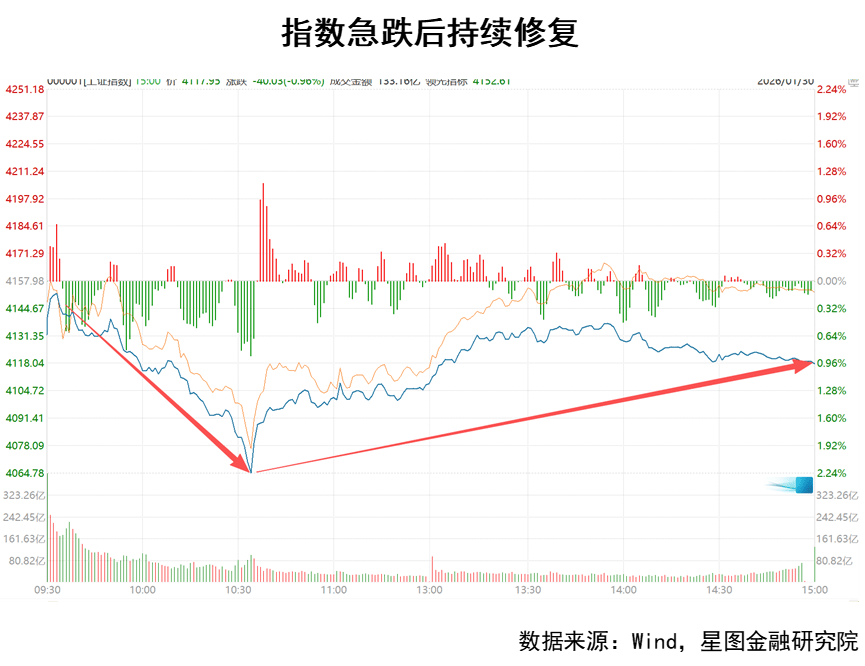
Market Overview - The A-share market showed mixed performance with the Shanghai Composite Index down by 0.96%, Shenzhen Component down by 0.66%, and the ChiNext Index up by 1.27% [1] - The total trading volume in the Shanghai, Shenzhen, and Beijing markets was 28,624 billion yuan, a decrease of 3,970 billion yuan from the previous day [1] Sector Performance - AI hardware sectors saw a broad increase, with significant gains in optical modules, optical circuit switching, optical communication, optical chips, and advanced packaging [1] - The non-ferrous metals sector experienced a collective sharp decline, with industrial metals, rare earths, gold and jewelry, and other related sectors showing significant losses [1] - Traditional sectors like liquor and real estate, referred to as "old stocks," performed poorly after a recent surge [1] Investment Sentiment - The market is experiencing a significant risk rotation, with funds flowing into underperforming technology and agriculture sectors as a form of risk aversion [1] - Despite the sharp decline in the non-ferrous metals sector, it is believed to have medium to long-term investment value, with the performance of this sector closely tied to commodity prices, particularly gold [9] - The liquidity in the market remains robust, as indicated by the reduced trading volume being attributed to investors locking in positions rather than panic selling [5] Specific Stock Insights - The liquor index showed a significant decrease in trading volume, suggesting that large funds are not exiting but rather locking in positions, indicating potential for future gains [10][11] - The "old stocks" like liquor and real estate may present opportunities for short-term trading, with potential returns of 10%-20% based on technical signals [10]
帮主郑重:黄金40年一遇的暴跌,是在给谁上课?
Sou Hu Cai Jing· 2026-01-31 00:56
各位朋友早上好,我是帮主。今天一早,全球市场就被一道"金色闪电"劈中了——不是暴涨,而是暴 跌。黄金价格单日暴跌超过12%,创下40年来最大跌幅;白银更夸张,盘中一度狂泻36%,创下历史记 录。昨天还在热议的"创新高"狂欢,一夜之间就变成了踩踏式抛售的恐慌。这场面,是不是让你瞬间清 醒了?它用一种近乎残酷的方式,给我们所有投资者,上了一堂关于市场本质的实践课。 第二,理解"流动性"的双刃剑效应。黄金白银市场深度好、流动性强,这能让资金快速进入推高价格, 也同样能让资金疯狂出逃砸穿地板。不要因为资产"硬"就忽视其交易层面的脆弱性。 第三,将这次暴跌作为一次珍贵的"压力测试"。它测试的不是黄金的价值,而是你自身的投资心性和风 险控制体系。你的心脏是否承受得住?你的持仓比例是否让你夜不能寐?这次实盘演练,比读一百本投 资书都管用。 总结来说,黄金的40年一跌,是一声响亮的警钟。它不是在告诉我们黄金失去了价值,而是在提醒我 们:在任何市场中,对群体情绪的警惕,都应该和对资产价值的信仰一样重要。 当潮水以惊人的速度 退去时,我们才能看清谁在裸泳,而谁的泳裤始终穿得结实。 市场接下来会进入一段复杂的震荡期,去消化这种极端 ...

不惧扰动 跨节资金面压力或总体可控
Shang Hai Zheng Quan Bao· 2026-01-30 20:04
Group 1 - The central bank's continuous liquidity injection through medium-term tools and stable short-term interest rates are leading to a focus on the funding dynamics around the Spring Festival [1] - Despite increased funding disturbances due to factors like credit "New Year opening" and seasonal cash withdrawal demands, the overall pressure on the funding environment remains controllable under the central bank's support [1][4] - Historical trends indicate that funding prices typically enter a seasonal tightening window in the two weeks before the Spring Festival, followed by marginal easing afterward [2] Group 2 - The seasonal factors affecting the funding environment include the "New Year opening" of bank liabilities and the impact of the "big tax period" in January, which may create liquidity shocks [3] - The central bank has significantly increased the net injection of medium-term liquidity, with a total of 1 trillion yuan injected through reverse repos and MLF in January, reflecting a continuation of a moderately loose monetary policy [4] - It is expected that the central bank will maintain a reasonable liquidity level, with anticipated liquidity injections before the Spring Festival ranging from 3 trillion to 3.5 trillion yuan to ensure stable funding across the holiday period [4]

