
资金面

Search documents
每日债市速递 | 第一批936亿元超长期特别国债资金下达
Wind万得· 2026-01-23 00:13
Open Market Operations - The central bank announced a 7-day reverse repurchase operation of 210.2 billion yuan at a fixed rate of 1.40% on January 22, with a net injection of 30.9 billion yuan after accounting for 179.3 billion yuan in reverse repos maturing on the same day [1]. Funding Conditions - The interbank market saw a slight tightening in funding as the D R001 weighted average interest rate rose over 9 basis points to around 1.41%. Overnight rates in the anonymous click (X-repo) system also increased to 1.52%, with limited supply [3]. - Non-bank institutions borrowing against pledged credit bonds saw overnight rates around 1.60%, higher than the previous day. January is a significant tax payment month, leading to reduced liquidity supply, although overall funding sentiment remains stable [3]. Interbank Certificates of Deposit - The latest transaction for one-year interbank certificates of deposit among major banks was at 1.61%, showing a slight increase from the previous day [7]. Government Bonds and Futures - The closing prices for government bond futures showed declines: the 30-year main contract fell by 0.07%, the 10-year by 0.05%, the 5-year by 0.04%, and the 2-year by 0.02% [12]. Key News - The National Development and Reform Commission announced the allocation of 93.6 billion yuan in special long-term government bonds to support approximately 4,500 projects across various sectors, driving total investment over 460 billion yuan [13]. - The implementation period for personal consumption loan interest subsidies has been extended to December 31, 2026, with significant adjustments in support scope and limits, potentially lowering effective interest rates to around 2% for consumers [13]. - The second-hand housing market in major cities has shown signs of recovery, with a decrease in listing volumes in Shanghai for nine consecutive months, indicating a more balanced supply-demand relationship [13]. Global Macro - Japan's government maintained a cautiously optimistic economic outlook while warning of risks from U.S. trade policies. The report noted a fifth consecutive month of recovery in private consumption, which constitutes over half of the economy [15]. - The Bank of Japan is expected to maintain its policy rate at 0.75% during its upcoming meeting, although analysts caution that a hawkish stance may be adopted due to a weak yen and persistent domestic inflation [15]. - South Korea's GDP growth for Q4 2025 was reported at 1.5% year-on-year, below the expected 1.9%, with a quarter-on-quarter decline of 0.3% [15].


债市日报:1月22日
Xin Hua Cai Jing· 2026-01-22 08:04
Core Viewpoint - The bond market showed slight weakness with all government bond futures closing down, while the interbank bond yield exhibited mixed trends, indicating a cautious outlook ahead of the Spring Festival and the Two Sessions [1][2]. Market Performance - Government bond futures closed lower across the board, with the 30-year main contract down 0.07% at 112.17, the 10-year main contract down 0.05% at 108.15, the 5-year main contract down 0.04% at 105.835, and the 2-year main contract down 0.02% at 102.408 [2]. - The interbank bond yield showed slight divergence, with the 30-year government bond yield down 0.45 basis points (bps) to 2.2565%, while the 10-year government bond yield increased by 0.05 bps to 1.834% [2]. Overseas Market Trends - In North America, U.S. Treasury yields collectively fell, with the 10-year yield down 5.16 bps to 4.241% [3]. - In Asia, Japanese government bond yields continued to decline, with the 10-year yield down 2.3 bps to 2.266% [3]. - In the Eurozone, yields on 10-year bonds increased, with French bonds up 1.7 bps to 3.541% [3]. Primary Market - The Export-Import Bank's financial bonds had a bid yield of 1.4226% for the 1.2521-year and 1.7028% for the 5.5041-year, with bid-to-cover ratios of 2.63 and 6.74 respectively [4]. - The China Development Bank's financial bonds had a bid yield of 1.6683% for the 3-year and 1.8772% for the 7-year, with bid-to-cover ratios of 2.85 and 3.83 respectively [4]. Liquidity Conditions - The central bank conducted a 7-day reverse repurchase operation with a total amount of 2102 billion yuan at an interest rate of 1.40%, resulting in a net injection of 309 billion yuan for the day [5]. - The Shibor rates showed mixed performance, with the overnight rate rising by 9.1 bps to 1.413% [5]. Institutional Insights - Huatai Securities suggests maintaining a configuration of medium to short-term credit bonds, with a focus on leveraging opportunities in the ultra-long end and government bonds [6]. - CITIC Securities notes that the central bank's balance sheet has expanded steadily, indicating a potential for government bond trading to influence yields [7]. - Guosheng Fixed Income emphasizes that current inflation is not indicative of a broad price increase, suggesting that monetary policy may remain stable or undergo minor adjustments [7].


广发期货日评-20260122
Guang Fa Qi Huo· 2026-01-22 02:25
Group 1: Report Investment Ratings - No investment ratings for the industry are provided in the report [2] Group 2: Core Views - The A-share market is expected to enter a volatile trend after a continuous upward movement followed by a decline, with trading volume shrinking and market sentiment cooling. For the bond market, the short - term capital is relatively loose, and the long - end of the bond futures is strengthening, but there are still some resistance levels. The precious metals market is supported by macro - geopolitical events and shows a relatively strong trend. The steel market is in a situation of weak supply and demand, and the prices are oscillating. Other commodity markets also have different trends based on their own supply - demand fundamentals and market factors [2] Group 3: Summaries by Categories Financial Products - **Stock Index Futures**: A - shares have different trends such as a decline after a rally and a weak rebound. It is recommended to control portfolio risks, take profits on some profitable contracts, reduce long positions, and wait for re - entry opportunities [2] - **Bond Futures**: The capital is stable and loose, and the long - end of bond futures is strengthening. It is advisable to temporarily watch on the unilateral strategy and not chase the high. For the spot - futures strategy, pay attention to the positive spreads of TS, T, and TF contracts and the strategy of widening the basis [2] - **Precious Metals**: Gold can be bought at dips above the 20 - day moving average and sell out - of - the - money call options to lock in risks. Silver is in a high - level oscillation, and it is advisable to participate cautiously. Platinum can be bought at dips when it touches the 20 - day moving average, and an option straddle strategy can be used within a certain price range [2] Industrial Products - **Steel and Iron**: Steel has weak supply and demand, with steel prices oscillating. Iron ore supply is in the off - season and ports are accumulating inventory. For coking coal and coke, the market has over - anticipated, and they are expected to be in a downward - biased oscillation. For silicon - related products, the supply - demand situation is improving, and they are in a wide - range oscillation [2] - **Non - ferrous Metals**: Copper prices are oscillating and inventories are accumulating. Aluminum products are affected by macro factors, and there are different trading strategies for different varieties. Zinc prices are oscillating and falling back, and tin is in a wide - range oscillation. Nickel is in an oscillating adjustment, and stainless steel is in a relatively strong oscillation [2] - **New Energy**: Industrial silicon futures are oscillating, polycrystalline silicon is in a weak - biased oscillation, and lithium carbonate is in a strong - biased operation [2] Energy and Chemical Products - Most products have different trends based on their supply - demand fundamentals. For example, PX is in a short - term high - level oscillation, PTA is oscillating and following raw materials, and some products such as short - fiber and bottle - chip are also affected by supply - demand and raw material factors. Some products like ethylene glycol and pure benzene have specific trading strategies based on their inventory and supply - demand situations [2] Agricultural Products - Different agricultural products have different trends. For example, soybean meal has strong bottom support, palm oil may try to break through the annual resistance level, and products like sugar are in a weak - biased oscillation, while cotton needs to pay attention to the support level [2]
牛市中后期,有哪些信号要注意?|第425期精品课程
银行螺丝钉· 2026-01-21 07:07
Core Viewpoint - The current state of A-shares and Hong Kong stocks is still considered a bull market, despite fluctuations and signs indicating it may be in the later stages of the bull cycle [4][10][53]. Market Performance - Over the past year, A-shares and Hong Kong stocks have seen significant increases, with the Hang Seng Index rising by 56.51% and the CSI All Share Index increasing by 68.54% from September 2024 to January 2026 [5]. - The CSI All Share Index experienced a rise of 61.93% from its lowest point in September 2024 to its peak in October 2025, confirming a technical bull market [9]. Market Signals - Signs indicating the potential late stage of the bull market include: 1. A surge in stock fund subscriptions exceeding 100 billion on January 12, 2026, alongside the suspension of certain fund subscriptions [13]. 2. An increase in the margin requirement from 80% to 100% announced by major exchanges on January 14, 2026, aimed at curbing leveraged investments [14]. 3. Significant net outflows from major ETFs, suggesting institutional investors are taking profits [14][15]. Market Characteristics - The current bull market has been characterized by significant gains in small-cap and growth stocks, with some reaching overvaluation [17]. - Conversely, dividend stocks have shown modest gains and remain relatively undervalued, indicating potential for future growth [21]. Valuation Insights - As of January 20, 2026, the market is rated around 3.8 stars, indicating that most stocks have returned to normal valuations, with fewer stocks considered undervalued [36]. - The overall valuation landscape has shifted from a high percentage of undervalued stocks in September 2024 to a more normalized state by early 2026 [37]. Key Indicators to Monitor - Important indicators to watch in the later stages of a bull market include: 1. Market valuation trends [28]. 2. The liquidity environment, which has been influenced by the U.S. Federal Reserve's interest rate policies [40]. 3. The fundamental performance of listed companies, which has shown positive growth but may not be sustainable [44]. Summary - The market is experiencing typical bull market fluctuations, with the current phase indicating a potential late-stage environment. Investors are advised to remain vigilant for key signals related to market valuation, liquidity, and company fundamentals while maintaining a strategy of buying on dips and selling on rallies [53].

【笔记20260120— 今日大寒,债市乍暖】
债券笔记· 2026-01-20 10:33
Core Viewpoint - The market is perceived as the true intelligence, and it is essential to follow its direction rather than attempt to predict outcomes independently [1]. Group 1: Market Conditions - The bond market shows signs of warming, with long-term bonds being particularly attractive. The concentration of borrowing for 30-year bonds reached 30%, and the yield spread between 30-year and 10-year bonds is at 50 basis points, a level not seen since the introduction of 30-year bond futures [6]. - The interbank funding market is balanced and slightly loose, with a significant drop in long bond yields. The central bank conducted a 3.24 billion yuan reverse repurchase operation, with 3.586 billion yuan maturing, resulting in a net withdrawal of 346 million yuan [3]. - The stock market is experiencing fluctuations, with no unexpected information from the National Development and Reform Commission and the Ministry of Finance. The 10-year government bond yield opened at 1.8325% and fluctuated, reaching a low of 1.815% before recovering to 1.825% [5]. Group 2: Interest Rates and Trading Data - The weighted average rates for various interbank funding instruments are as follows: RO1 at 1.42%, R007 at 1.54%, R014 at 1.63%, and R1M at 1.63%. The trading volume for RO1 was approximately 78.17 billion yuan, while R007 had a volume of about 7.44 billion yuan [4]. - The financing balance in the stock market has decreased, indicating a cooling effect on the market. The dynamics between large-cap and small-cap stocks are shifting, with large-cap stocks struggling to outperform small-cap stocks [9].
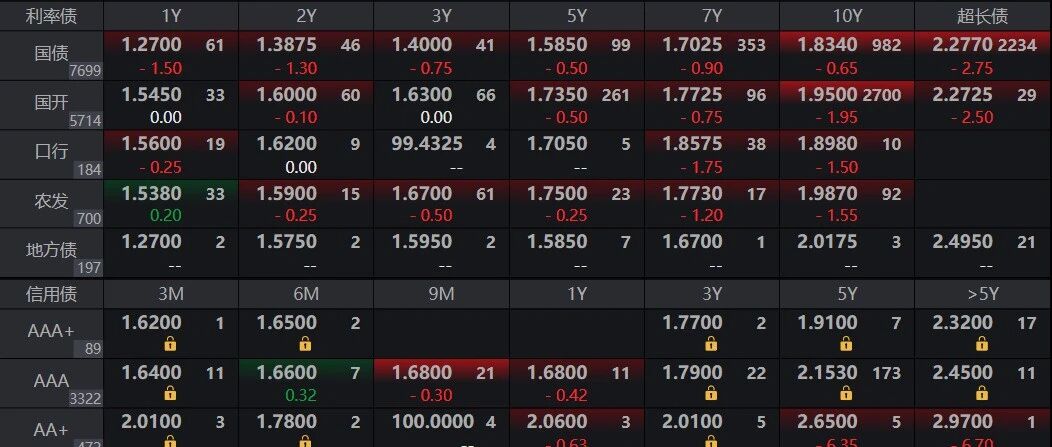
国债期货:经济数据公布 债市震荡企稳
Jin Tou Wang· 2026-01-20 02:14
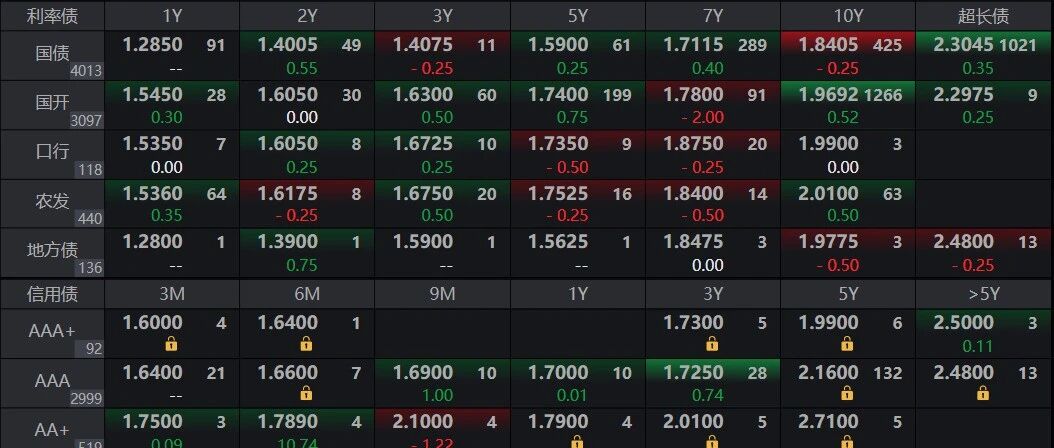
Market Performance - The majority of government bond futures closed lower, with the 30-year main contract down by 0.22%, the 10-year main contract down by 0.02%, the 5-year main contract down by 0.02%, and the 2-year main contract unchanged [1] - The yields on major interbank bonds mostly rose, with the 10-year China Development Bank bond yield increasing by 0.35 basis points to 1.9675%, while the 10-year government bond yield decreased by 0.1 basis points to 1.8420%, and the 30-year government bond yield rose by 0.3 basis points to 2.3040% [1] Funding Conditions - The central bank announced a 7-day reverse repurchase operation of 158.3 billion yuan at a fixed rate of 1.40%, with the same amount being the bid and awarded [2] - On that day, 86.1 billion yuan of reverse repos matured, resulting in a net injection of 72.2 billion yuan [2] - The interbank market showed stable funding supply and prices, with the overnight repo weighted average rate (DR001) fluctuating slightly above 1.3% [2] Economic Fundamentals - The National Bureau of Statistics reported that China's GDP for 2025 is projected to be 14,018.79 billion yuan, with a year-on-year growth of 5% [3] - In Q4 2025, GDP is expected to grow by 4.5%, matching the forecast, while Q3 growth was 4.8% [3] - Retail sales in December 2025 increased by 0.9% year-on-year, below the expected 1.5% [3] - Fixed asset investment decreased by 3.8% year-on-year, worse than the expected decline of 2.4% [3] - Real estate development investment in 2025 was 82,788 million yuan, down 17.2% from the previous year, with new housing sales area and sales value declining by 8.7% and 12.6%, respectively [3] Operational Recommendations - The funding conditions have marginally eased, but a contraction is expected due to the tax period [4] - The recently released December economic data indicates a divergence between strong production and weak demand [4] - The 10-year government bond yield is currently around 1.85%, which is considered a reasonable pricing [4] - Future bond market trends will likely depend on policy strength and supply-demand conditions in Q1, with the 10-year bond yield expected to fluctuate between 1.83% and 1.88% [4]
【笔记20260119— 今天有两个数,一个是-17%,另一个也是-17%】
债券笔记· 2026-01-19 10:14
Group 1 - The investment environment is characterized by trial and error, with few guaranteed opportunities for significant profits, which reflects the market's normal state [1] - The financial market shows a balanced and slightly loose liquidity, with the central bank conducting a 7-day reverse repurchase operation of 158.3 billion yuan, resulting in a net injection of 72.2 billion yuan [3] - Economic data for December indicates strong production but weak demand, with a slight increase in the stock market and a subdued bond market [5] Group 2 - The bond market is experiencing low trading volumes, with the most active 10-year government bonds trading less than 600 times, indicating a lack of investor engagement [5] - Recent economic indicators show a 17% decline in real estate investment and a 17% drop in the birth rate, highlighting significant demographic and economic challenges [5] - The current interest rates for various financial instruments are as follows: R001 at 1.38%, R007 at 1.53%, and R014 at 1.62%, with varying changes in transaction volumes [4]
税期来临,关注央行投放情况
Western Securities· 2026-01-18 07:22
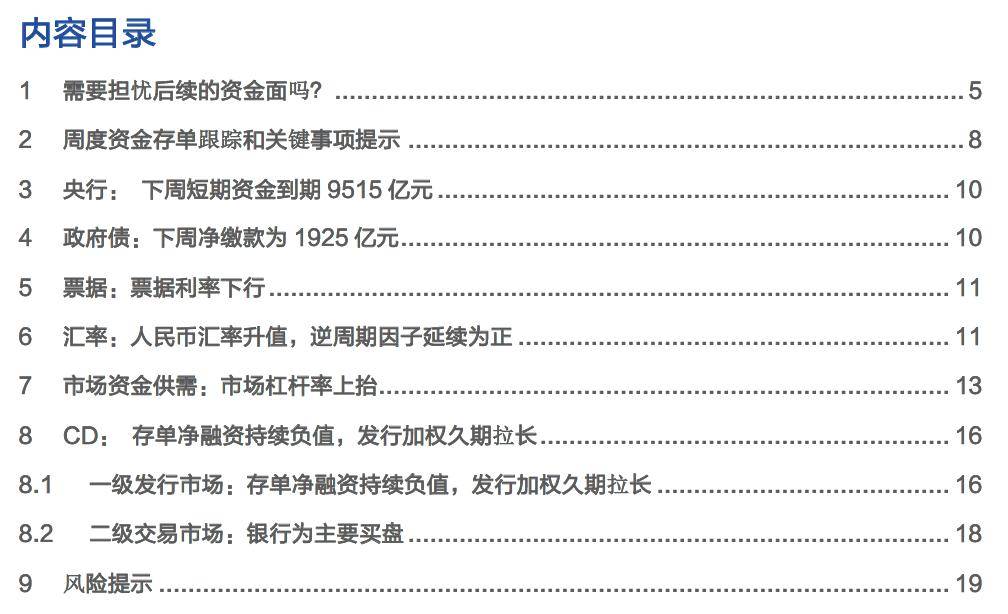
1. Report Industry Investment Rating No relevant content provided. 2. Core Views of the Report - Short - term bond market may face downward pressure. Small - position active participation in band trading after adjustments, emphasizing reverse operations. Consider the market's concerns about factors such as the supply pressure of ultra - long - term government bonds in Q1, the impulse of credit issuance at the beginning of the year, and the continuous rise of equity and commodity prices. Long - term bonds may continue to be under pressure. The strategy is mainly based on short - duration carry strategies, and small - position participation in band trading after adjustments [3][15]. - Next week, the capital market will face phased pressure, but the pressure during the tax period is expected to be controllable. It is necessary to pay attention to the central bank's capital injection during the tax period [2]. 3. Summary According to the Directory 3.1 Review and Outlook of the Bond Market - This week, under the combined effects of equity market adjustment, policy game, and capital market fluctuations, the bond market oscillated and recovered with increased volatility. The yields of 10Y and 30Y government bonds changed by - 4bp and + 0.1bp respectively. The capital price first rose and then fell due to the reserve payment day and the delayed release of outright repos [10][11]. - Next week, the capital market will face phased pressure. The net withdrawal of the open - market will increase to 1.1015 trillion yuan, and the government bond issuance scale will increase to 706.6 billion yuan. However, due to the relatively late Spring Festival this year and the structural interest rate cut, the capital pressure is expected to be controllable [2][14]. 3.2 Bond Market Review 3.2.1 Funding: Central Bank Net Injection, Funding Rates First Up Then Down - This week, the central bank's open - market net injection was 81.28 billion yuan. From January 12th to January 16th, the central bank injected 951.5 billion yuan and had 138.7 billion yuan of reverse repos mature. The capital price first rose and then fell. R001 and DR001 rose by 3bp and 5bp respectively compared with January 9th [19][20]. 3.2.2 Secondary Trend: Oscillating Downward, Increased Volatility - This week, yields oscillated downward with increased volatility. Except for 3M and 30Y, the yields of other key - term government bonds declined. Except for 5Y - 3Y and 50Y - 30Y, the term spreads of other key - term government bonds widened. As of January 16th, the yields of 10Y and 30Y government bonds changed by - 4bp and + 0.1bp respectively compared with January 9th [27]. 3.2.3 Bond Market Sentiment: Widening of 30Y - 10Y Government Bond Spread, Recovery of Bond Fund Duration - From January 12th to January 16th, the weekly turnover rate of 30Y government bonds dropped to 37%. As of January 16th, the 50Y - 30Y government bond spread narrowed by 1.9bp compared with January 9th, and the 30Y - 10Y government bond spread widened by 3.7bp. The inter - bank leverage ratio slightly decreased to 108.1%, and the exchange leverage ratio decreased to 123.2%. The median duration of medium - and long - term pure - bond funds recovered, and the divergence decreased [33]. 3.2.4 Bond Supply: Increase in Government Bond Issuance Scale Next Week - This week, the net financing of interest - rate bonds decreased and turned negative, with a net financing of - 174.4 billion yuan. The net financing of government bonds and local government bonds decreased, while that of policy - bank bonds increased. Next week, the planned issuance of government bonds is 475 billion yuan, and the planned issuance of local government bonds is 231.6 billion yuan [49][52][53]. 3.3 Economic Data: Improvement in Real Estate Transactions, Weak Performance in Automobile Consumption - In December, imports and exports ended at a high level. The growth rate of social financing slightly declined, and household credit remained weak. Since January, real estate transactions have improved, and automobile consumption has been weak. High - frequency data shows that new - home transactions have turned positive month - on - month, and the year - on - year decline has narrowed. Thirteen - city second - hand housing transactions have increased month - on - month, and the year - on - year decline has narrowed. Automobile consumption has turned negative both month - on - month and year - on - year [58][59]. 3.4 Overseas Bond Market: Cooling of Core Inflation in the US in December - In December, the core inflation in the US cooled down. The Fed's interest - rate cut expectation was further dampened. Overseas bond markets showed that US bonds declined, and emerging markets mostly declined. This week, the 2Y US bond yield rose 5bp to 3.59%, and the 10Y US bond yield rose 6bp to 4.24%. The 10Y - 2Y US bond spread widened from 64bp on January 9th to 65bp [68][69]. 3.5 Major Asset Classes: Strength in Shanghai Gold and Crude Oil, Adjustment in Shanghai Copper - The CSI 300 index slightly adjusted this week. As of January 16th, 2026, it closed at 4731.9 points, down 0.57% from January 9th. This week, Shanghai gold, the Nanhua Pig Index, and the Nanhua Crude Oil Index rose, while Shanghai copper weakened. The performance of major asset classes was: Shanghai gold > Pig > CSI 1000 > Crude oil > Rebar > US dollar > Chinese bonds > Chinese - funded US dollar bonds > Convertible bonds > CSI 300 > Shanghai copper [75]. 3.6 Next Week's Bond Market Calendar - The calendar includes information on liquidity injection and maturity, government bond supply, fundamental data, and important domestic and international events from January 19th to January 25th, 2026 [80].
财通证券:预计DR001中枢仍将低于政策利率的水平,资金面系统性收敛的概率不大
Sou Hu Cai Jing· 2026-01-18 05:38
Group 1 - The core viewpoint suggests that from December 2025 to January 2026, there may be a liquidity easing due to factors such as government bonds and accelerated credit, leading to a potential increase in bank deposits [1][3][18] - The central bank emphasizes maintaining liquidity and guiding overnight rates to operate near policy rates, indicating a flexible approach to monetary policy [3][12][18] - The market is experiencing increased volatility in funding prices due to the gradual consumption of bank reserves and the lagging effect of six-month reverse repos [3][13][18] Group 2 - The outlook for certificates of deposit (CDs) remains unchanged, with future adjustments dependent on funding conditions and expectations of easing [2][4] - Recent data shows that net financing for CDs continues to be negative, particularly for state-owned banks, while secondary market demand is primarily driven by banks [20][68] - Upcoming weeks will see significant maturities of CDs, with a total of 7,061.70 billion yuan maturing in the next week, indicating potential funding disturbances [5][56][70] Group 3 - The central bank's operations indicate a net injection of 8,128 billion yuan, with a focus on short-term liquidity management [26][28] - Government bonds are expected to have a net repayment of 1,925 billion yuan next week, which may influence market liquidity [31] - The overall market leverage ratio is increasing, with banks showing a decrease in lending while non-bank financial institutions are adjusting their borrowing strategies [41][49]

1月大税期,三种情景
HUAXI Securities· 2026-01-17 15:05
Group 1: Liquidity Overview - From January 12 to 16, the liquidity showed unexpected fluctuations, with R001 rising from 1.35% to 1.49% and R007 exceeding 1.60% due to a lack of buyout reverse repos[1] - As of January 16, the bank's lending scale returned to over 5 trillion yuan, providing some support to the liquidity[3] - The expected liquidity gap for the upcoming tax period is approximately 2 trillion yuan, compounded by 1.1 trillion yuan of public market expirations and 0.25 trillion yuan of government debt payments, totaling over 3.3 trillion yuan[2] Group 2: Market Trends and Projections - The liquidity rates are expected to remain loose, similar to January 2024, due to structural interest rate cuts and a relatively late Spring Festival this year[2] - Historical trends show three liquidity patterns in January: tight (2021, 2025), slight convergence (2023), and relatively loose (2022, 2024)[2] - The central bank is likely to increase liquidity injections during the tax period to maintain market stability, with a reference to a net liquidity injection of about 1.5 trillion yuan in January 2024[3] Group 3: Public Market and Government Debt - From January 19 to 23, a total of 11.015 trillion yuan will expire in the public market, including 9.515 trillion yuan in reverse repos[4] - The estimated net payment for government bonds from January 19 to 23 is 2.465 trillion yuan, significantly higher than the previous week's -0.485 trillion yuan[8] - The government bond issuance is accelerating, with a planned issuance of 7.066 trillion yuan for the week, compared to 2.818 trillion yuan the previous week[41] Group 4: Interbank Certificates of Deposit - The pressure from maturing interbank certificates of deposit is decreasing, with 6,799 billion yuan maturing from January 19 to 23, down from 8,339 billion yuan the previous week[50] - The weighted issuance rate for interbank certificates of deposit increased to 1.65%, with significant contributions from state-owned and joint-stock banks[48]