AI革命

Search documents
郭永航与中国工程院院士潘垣座谈交流
Guang Zhou Ri Bao· 2025-12-19 01:56
Core Insights - Guangzhou is focusing on advancing the new energy and energy storage industries by leveraging its strengths in technology innovation and industrial integration [2][3] - The collaboration between local government and academic institutions aims to enhance research and development in nuclear fusion and power technologies, aligning with national strategic needs [2][3] Group 1: Government Initiatives - The Guangzhou government is implementing the spirit of the 20th Central Committee and the Central Economic Work Conference to promote high-level technological self-reliance and innovation [2] - The city aims to build a modern industrial system referred to as "12218" to support its economic growth [2] Group 2: Research and Development - Academician Pan Yuan's team is focused on nuclear fusion, pulsed strong magnetic fields, and power technology, which aligns with Guangzhou's goals in new energy and energy storage [2][3] - The team highlighted the explosive growth in electricity demand driven by the AI revolution and the rapid development of smart networks, new energy vehicles, and the digital economy [3] Group 3: Collaboration and Future Prospects - There is a strong emphasis on deepening collaboration between industry, academia, and research to achieve breakthroughs in new energy technologies and their application [3] - The partnership aims to enhance international cooperation and seize opportunities in energy technology and industry [3]
直击2025证券时报分析师年会: 洞见价值荣耀加冕 投研天团苏州论剑
Zheng Quan Shi Bao· 2025-12-18 22:06
Group 1 - The 2025 Securities Times Analyst Annual Conference and Best Analyst Award Ceremony was held in Suzhou, gathering nearly 2000 guests from over 60 securities firms and nearly 100 listed companies [2][3] - The conference theme was "Going Far by Starting Small, Continuing to Enhance," focusing on enhancing financial service quality and supporting the development of the real economy [2][3] - The event featured keynote speeches from prominent figures, including the Chief Economist of Changjiang Securities and the Chairman of Jiemai Technology, emphasizing the importance of research in identifying market trends [2][3] Group 2 - The 2025 Best Analyst Award winners were announced, with notable firms like Changjiang Securities, GF Securities, and Huachuang Securities recognized for their research excellence [3][4] - The award for the best research team, SSR, was highly anticipated, with top firms showcasing their influence in the industry [3] - In the macroeconomic research category, GF Securities' research team won first place, followed by teams from Huachuang Securities and Zheshang Securities [3] Group 3 - The conference also awarded the "Visionary Investment Institution" prize based on the accuracy of institutions' voting results across 30 research areas, with several prominent funds recognized [4] - Nearly 50 securities firms participated in the awards, with over 1300 institutions applying for voting qualifications, managing assets exceeding 100 trillion yuan [4] Group 4 - From December 18 to 19, top analysts discussed investment strategies for 2026, focusing on macroeconomic trends and market directions [5][6] - Key insights included the characteristics of global narratives and the differentiation of domestic economic drivers, with expectations for a narrowing temperature difference in the economy [6] - Analysts highlighted that stock market valuations remain neutral, with corporate earnings providing some support, while bond markets face limited downward interest rate space [6]






2026年上半年国际油价或震荡筑底
Sou Hu Cai Jing· 2025-12-17 23:57
Core Viewpoint - International oil prices have been on a downward trend since late June 2025, with Brent crude oil prices dropping from around $79 per barrel to approximately $59 per barrel, marking a cumulative decline of 26% due to increased supply and weak demand. The prices are expected to stabilize in 2026 [1]. Group 1: Oil Price Trends - Brent crude oil prices started to rise in mid-December 2024, reaching around $82 per barrel in January 2025, but subsequently fell due to weak U.S. manufacturing PMI and a loose supply environment [2]. - OPEC+ announced a production increase plan of 411,000 barrels per day for three consecutive months starting in April 2025, indicating a strategy to regain market share [2]. - By November 2025, OPEC's crude oil production rose to 28.48 million barrels per day, an increase of 1.71 million barrels per day from March [2]. Group 2: Supply and Demand Factors - Increased supply from OPEC+ and Russia has contributed to the weak oil price environment, with OPEC+ gradually exiting voluntary production cuts [3]. - Despite expectations of U.S. sanctions on Russian oil potentially affecting around 2 million barrels per day, the actual impact has been minimal, with Russian Urals crude trading at a discount of about $25 per barrel compared to Brent [3]. - Weak demand in the Northern Hemisphere, with U.S. petroleum product apparent demand declining by 0.3% year-on-year in November, further suppresses oil prices [3]. Group 3: Future Considerations - A reduction in upstream capital expenditures may provide some support for oil prices, as Brent crude prices falling below $60 per barrel approach the cost line for some shale oil companies [4]. - Ongoing supply risks from Venezuela, Russia, and Iran remain significant, with potential U.S. sanctions on Venezuela possibly raising oil prices by $3 to $5 per barrel if tensions escalate [5]. - The Federal Reserve's interest rate cuts may boost U.S. demand and inflation, potentially supporting oil prices, with expectations of further rate cuts as inflation remains below 4% [6]. Group 4: Market Outlook - The oil market is expected to be oversupplied in the first half of 2026, with Brent crude prices likely to stabilize around $64 per barrel in the second half during the demand peak [6].
美联储政策转向真相,Paulson将就业风险放首位,内部分歧藏不住
Sou Hu Cai Jing· 2025-12-16 16:13
Group 1 - The core message from the Philadelphia Fed President Anna Paulson emphasizes that the risks in the labor market are now more critical than inflation concerns [2][19] - The current job market shows a troubling trend, with hiring concentrated in healthcare and social services, while other sectors have largely stalled [4][15] - The unemployment rate stands at 3.7% as of November, but the labor force participation rate has not returned to pre-pandemic levels, indicating underlying weaknesses [4][15] Group 2 - Paulson expresses optimism about inflation, suggesting that tariff impacts on prices will likely diminish by mid-next year [6][19] - The Federal Reserve's recent interest rate cuts, totaling 75 basis points, are seen as a precautionary measure to support the labor market [7][19] - Internal disagreements within the Federal Reserve are evident, with three members voting against the recent rate cut, highlighting differing views on the balance between supporting employment and controlling inflation [9][19] Group 3 - The current economic environment is more complex than in previous years, with factors like AI and global trade disruptions complicating the Fed's ability to manage economic stability [9][19] - The Fed's shift from prioritizing anti-inflation measures to focusing on risk prevention signals a significant change in policy direction [19][21] - The upcoming January meeting will be crucial, as various economic indicators could influence the Fed's policy decisions [19][21]

观察| 你曾引以为傲的工作,正在成为历史
未可知人工智能研究院· 2025-12-15 10:02
Core Viewpoint - The article discusses a significant shift in the job market and societal structure due to the rise of AI, leading to a reversal of economic hierarchies where manual labor becomes more valuable than knowledge work [14][25][49]. Group 1: Job Market Changes - Millions of white-collar workers are entering the job market as AI tools replace many knowledge-based jobs, while manual labor jobs are becoming scarce and highly valued [14][25]. - The demand for skilled tradespeople, such as electricians and welders, is at an all-time high, with companies offering salaries of 20,000 to 30,000 yuan per month, which exceeds the pay of many mid-level positions in tech companies [25]. - The employment rate for vocational school graduates (96.5%) has surpassed that of bachelor's degree holders (88.1%) for two consecutive years, indicating a shift in job market dynamics [25]. Group 2: Societal Implications - The traditional perception of "white-collar" jobs as superior is being challenged, as blue-collar jobs may offer more economic security and stability in the future [27][28]. - The societal structure built around the idea that intellectual work is more valuable than manual work is being disrupted, leading to potential identity crises for those who have defined themselves by their professional titles [29][30]. - The article draws parallels to historical events, such as the Black Death, which drastically changed labor dynamics and power structures, suggesting that a similar transformation is occurring today due to AI [20][24]. Group 3: Psychological Impact - The rapid changes in job value and societal status may lead to significant psychological adjustments for individuals who have long identified with their professional roles [29][32]. - There is a potential for a new social order where success is redefined, and traditional markers of achievement, such as job titles, may lose their significance [40][43]. - The article emphasizes the need for flexibility and the ability to redefine success in the face of these changes, as the old systems of value may no longer apply [48].

东吴证券:除了商业航天 还有哪些产业趋势值得关注?
Xin Lang Cai Jing· 2025-12-14 06:47
Group 1 - The core viewpoint emphasizes the need for a self-reliant approach in technology and security, focusing on deepening reforms to enhance internal growth resilience [1][3] - The industry configuration for 2026 will revolve around two main lines: technology and security, and reform and growth [1][4] Group 2 - In the technology and security sector, there is a focus on AI capabilities, resource and energy security, and the development of cutting-edge industries [1][4] - The AI industry is expected to benefit from domestic computing power and chip manufacturing, with attention on AI power infrastructure, new AI glasses, humanoid robots, and B2B AI applications [1][4] - Resource and energy security will involve the reassessment of strategic resources and the establishment of a new energy system, with a focus on metals like copper, aluminum, and tin, as well as new energy developments such as solid-state batteries and nuclear energy [1][4] Group 3 - The reform and growth aspect will address supply-side anti-involution and demand-side consumption promotion, with a shift from trading policy expectations to pricing recovery points [1][4] - Key areas of interest include the electrolyte, positive and negative electrodes, membranes, and the photovoltaic industry chain, as well as improvements in the chemical, steel, and thermal coal sectors due to capacity reduction [1][4] - There will be an increased emphasis on service and non-durable goods consumption, particularly in travel, aviation, hotels, duty-free shopping, and essential consumer goods like frozen foods and health products [1][4]

每周主题、产业趋势交易复盘和展望:除了商业航天,还有哪些产业趋势值得关注?-20251214
Soochow Securities· 2025-12-14 05:13
Market Overview - The average daily trading volume of the entire A-share market reached 1.82 trillion CNY, an increase of approximately 256.9 billion CNY compared to the previous week[8] - The North Securities Index and the Innovation Index had the highest weekly gains, with the North Securities Index rising by 2.79% and the Innovation Index by 2.74%[12] Market Style Performance - Small-cap stocks showed relative strength, with their performance oscillating above the zero axis in the rolling 30-day relative return analysis[15] - Growth stocks outperformed value stocks, with the relative return difference showing an upward trend in the positive range[18] Participant Performance - QFII and fund heavyweights demonstrated strong excess returns, with the QFII heavy index increasing by 1.40% and the fund heavy index by 0.70%[21] Market Sentiment - The margin trading balance increased to 2.5 trillion CNY before retreating, indicating fluctuating market sentiment[25] Sector Performance - The report highlights strong sector performances, with specific industries showing significant weekly gains, although detailed percentage changes are not provided in the summary[31] Industry Trend Outlook - The report emphasizes the importance of technology and security, advocating for self-reliance in technology to enhance national security and economic resilience[47] - Key focus areas include AI capabilities, resource security, and energy safety, with attention on domestic consumption and supply-side reforms[47] Risk Factors - Potential risks include slower-than-expected economic recovery, geopolitical uncertainties, and industry-specific volatility that could impact company performance[50]
ETF盘中资讯|背后三大推手显现!紫金矿业涨超2%,有色龙头ETF(159876)拉升1.5%,获净申购1200万份!超级周期能有多长?
Sou Hu Cai Jing· 2025-12-12 02:26
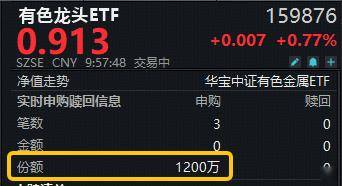
Core Viewpoint - The non-ferrous metal sector is experiencing significant growth, with the Non-Ferrous Metal Leader ETF (159876) seeing a price increase of over 1.5% during trading, reflecting strong investor confidence in the sector's future performance [1] Group 1: ETF Performance - The Non-Ferrous Metal Leader ETF (159876) has gained 0.77% as of the latest update, with a net subscription of 12 million units, indicating a total capital inflow of 140 million yuan over the past four days [1] - Key constituent stocks such as Western Mining, Tin Industry Co., and Chihong Zinc & Germanium have all risen by over 3%, while other stocks like Yunnan Aluminum and Zijin Mining have increased by more than 2% [1] Group 2: Key Stocks and Market Trends - The top-performing stocks in the ETF include Western Mining (3.96%), Tin Industry Co. (3.81%), and Chihong Zinc & Germanium (3.56%), with significant trading volumes reported [2] - The outlook for industrial metals such as copper, aluminum, cobalt, and lithium is positive for 2025, driven by three main factors: energy transition, AI revolution, and strategic reserves amid global competition [2] Group 3: Market Cycle and Investment Strategy - The duration of the super cycle for non-ferrous metals is likely to extend until 2026, influenced by the recovery of the US dollar, strategic reserve progress, and the effectiveness of "anti-involution" policies [3] - A diversified investment approach through the Non-Ferrous Metal Leader ETF and its associated funds is recommended to mitigate risks and capture the overall sector's performance [4]

不那么鹰派的降息,扩表重启初始规模超预期
Bank of China Securities· 2025-12-11 09:07
1. Report Industry Investment Rating - Not mentioned in the provided content 2. Core Viewpoints of the Report - The Fed cut interest rates by 25 basis points as expected, but the overall tone was less hawkish than market expectations. This meeting is conducive to pushing down short - term interest rates and the US dollar index, and driving up risk assets and commodities. The long - term trend of the interest rate curve may face upward pressure due to the impact of technological revolution on the neutral interest rate [2][7] - The report expects two interest rate cuts next year, mainly because the dovish tone of this meeting shows the weakening of the hawkish camp, and the new candidates after the personnel change of the Fed next year tend to be dovish [7] 3. Summary by Relevant Catalogs 3.1 Fed Meeting Results - **Interest Rate Decision**: The Fed cut the federal funds rate target range by 25 basis points to 3 - 3/4 percent. Three people voted against the decision, with Miran asking for a 50 - basis - point rate cut and Goolsbee and Schmid believing there should be no rate cut [2][5][12] - **Policy Outlook**: The meeting statement re - introduced the expression "in considering the extent and timing of...", indicating that future decisions will remain flexible, and consecutive rate cuts are no longer the baseline scenario [3] - **Economic Situation Assessment**: The statement removed the expression "the unemployment rate remained low", indicating that the Fed is worried about the current unemployment rate [3] - **Balance Sheet Policy**: In December, the technical expansion of the balance sheet (RMP) was launched, with an initial monthly purchase of $40 billion in T - Bills (including coupon - bearing Treasury bonds within 3 years if necessary), and the high - level purchase will be maintained until the tax season in April. The Fed also removed the upper limit on the use of the Standing Repurchase Facility (SRF) [3] - **Dot Plot**: It shows that the interest rate path is the same as in September. The GDP forecast for 2026 was significantly raised, but it did not drive down the unemployment rate forecast. The dot plot still maintains the interest rate cut path, with one rate cut each in 2026 and 2027 [3][6] 3.2 Press Conference Highlights - **Interest Rate Stance**: Powell said that interest rate hikes are not under consideration [4] - **Employment Situation**: Powell said that the risk in the employment market has increased. From June to September, the unemployment rate rose by 0.3%. After considering the QCEW correction, the actual monthly new employment was - 20,000 people [4] - **Inflation Viewpoint**: Powell continues to hold the view that inflation is temporary. Current service inflation is falling, but it is offset by the rising commodity inflation driven by tariffs. He expects that if there are no new tariffs, commodity inflation should peak in the first quarter of next year and start to decline in the second half of next year [11] 3.3 Market Impact - After the meeting, the 2 - year, 5 - year, and 10 - year Treasury bond yields fell by 8, 6, and 4 basis points respectively. The Bloomberg US dollar index fell 0.44%. The S&P 500 and Nasdaq indexes rose 0.67% and 0.33% respectively, and gold rebounded [7] 3.4 Economic Forecast Changes | Indicator | 12 - Month Forecast | 9 - Month Forecast | Change | | --- | --- | --- | --- | | Real GDP | 2025: 1.7%; 2026: 2.3%; 2027: 2.0%; 2028: 1.9%; Long - term: 1.8% | 2025: 1.6%; 2026: 1.8%; 2027: 1.9%; 2028: 1.8%; Long - term: 1.8% | 2025: +0.1; 2026: +0.5; 2027: +0.1; 2028: +0.1 | | Unemployment Rate | 2025: 4.5%; 2026: 4.4%; 2027: 4.2%; 2028: 4.2%; Long - term: 4.2% | 2025: 4.5%; 2026: 4.4%; 2027: 4.3%; 2028: 4.2%; Long - term: 4.2% | 2027: (0.1) | | PCE Inflation | 2025: 2.9%; 2026: 2.4%; 2027: 2.1%; 2028: 2.0%; Long - term: 2.0% | 2025: 3.0%; 2026: 2.6%; 2027: 2.1%; 2028: 2.0%; Long - term: 2.0% | 2025: (0.1); 2026: (0.2) | | Core PCE Inflation | 2025: 3.0%; 2026: 2.5%; 2027: 2.1%; 2028: 2.0% | 2025: 3.1%; 2026: 2.6%; 2027: 2.1%; 2028: 2.0% | 2025: (0.1); 2026: (0.1) | | Interest Rate Cut Range | 2025: Cut by 75 basis points; 2026: Cut by 25 basis points; 2027: Cut by 25 basis points | 2025: Cut by 75 basis points; 2026: Cut by 25 basis points; 2027: Cut by 25 basis points | 2025: The annual interest rate cut range remains unchanged; 2026: The annual interest rate cut range remains unchanged; 2027: The annual interest rate cut range remains unchanged | [9]
法兴银行:短期看跌 但美元将在2026年底“王者归来”
智通财经网· 2025-12-11 08:09
该行强调了一个关键矛盾:紧缩的财政配合宽松的货币政策无疑会削弱美元,但宽松的货币和财政政策 在长期是不可持续的。随着市场注意力从短期利率波动重新转向中长期增长基本面,美元指数预计将在 2026年下半年回升,年底目标看至100.2。 非美货币的结构性困境难以突破 智通财经APP获悉,法国兴业银行表示,尽管美元将在短期内承压,但中长期将凭借美国经济基本面的 相对优势重拾升势,实现美元的"王者归来"。 法兴银行指出,美国经济数据的疲软,特别是劳动力市场数据的走弱,是影响外汇市场关注点的核心因 素。这种疲软正在抵消市场对 AI 革命所带来的乐观情绪,促使市场将焦点转移到下一任美联储主席可 能实施的大幅降息政策上。 该行预计,由于第四季度美国经济增长放缓,美元将在未来几周和 2026 年初面临下行压力。尽管如 此,中期来看,该行认为美国经济增长前景不会大幅恶化,恶化程度不会超过市场已经消化的部分。除 非美国财政政策出现重大紧缩,否则美元的下行空间将是有限的。 日元的情况则更为严峻。作为过去五年表现最差的主要货币,日元实际有效汇率已下跌近30%。长期的 低利率环境、温和的通胀水平以及对公共债务可持续性的担忧,共同压制了日 ...