
地缘政治

Search documents
财经随笔记:黄金新高后回落,关注震荡破位情况(2026.1.14)
Sou Hu Cai Jing· 2026-01-14 00:49
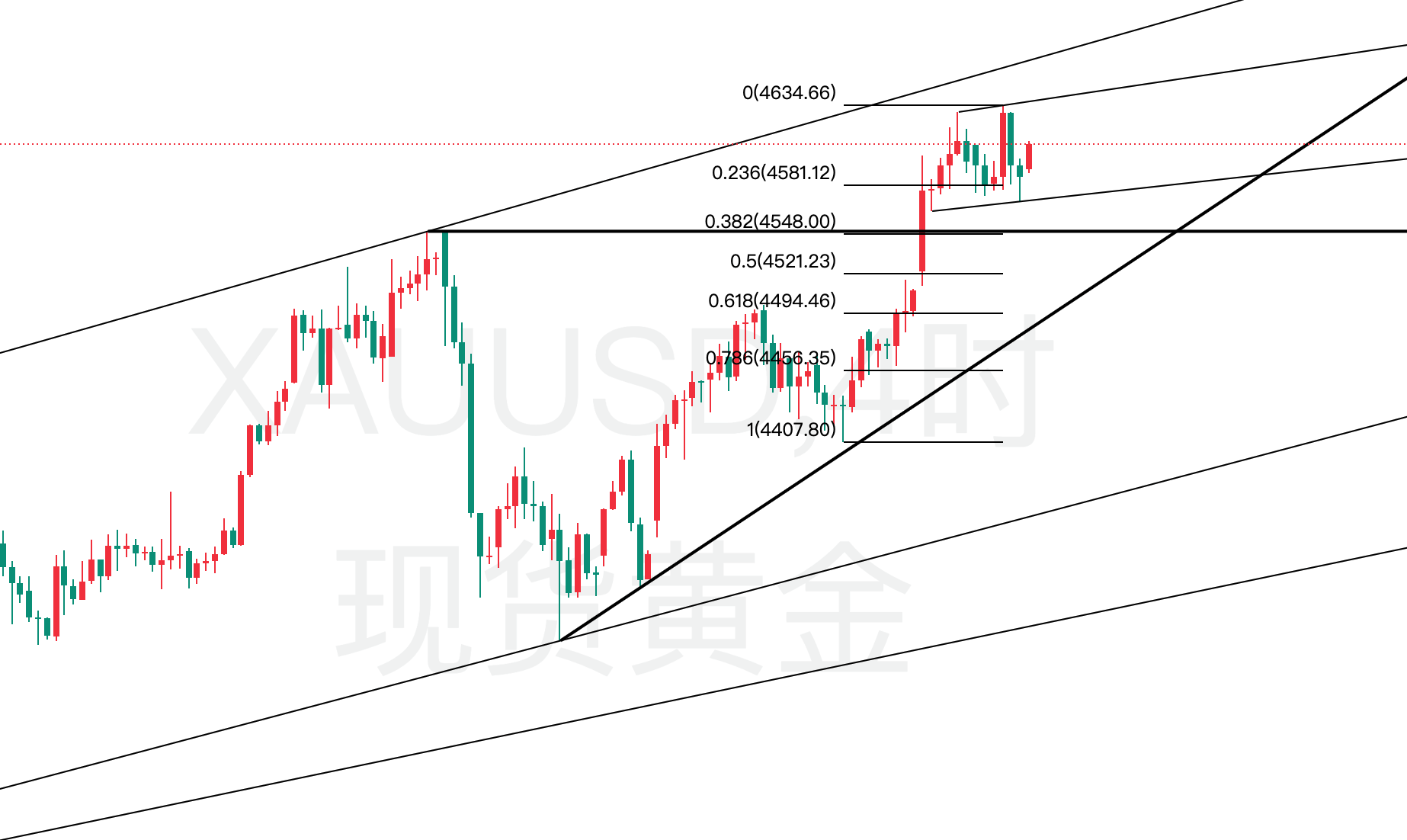
Core Viewpoint - The gold market experienced fluctuations with a slight opening increase, reaching a high of 4634/4635 before retreating, indicating a potential short-term correction while maintaining a long-term optimistic outlook due to factors like interest rate cuts and geopolitical tensions [1][2][3]. Fundamental Analysis - Inflation and Interest Rate Expectations: The US December CPI and core CPI data were lower than expected, reinforcing market bets on two interest rate cuts by the Federal Reserve in 2026. However, the lower inflation also suggests economic cooling, which diminishes gold's appeal as an inflation hedge, leading to profit-taking [2]. - Geopolitical Support: Tensions from the Trump administration's investigation into the Federal Reserve's independence and threats of tariffs on Iran's trade partners have heightened demand for safe-haven assets, providing underlying support for gold prices despite the strength of the dollar [2]. Key Focus for Today - The US Supreme Court will rule on the legality of Trump's tariffs, and several economic indicators, including retail sales and PPI data, will be released. These factors are expected to influence the dollar's movement and gold price volatility [3]. - Overall, while gold faces short-term correction pressure, long-term factors such as the interest rate cycle and geopolitical dynamics support its status as a safe-haven asset, with a positive outlook for 2026 [3]. Technical Analysis - Daily Level: Gold's price action on Tuesday ended with a bearish candle after a series of gains, indicating a potential pause in the upward trend. The 5-day moving average at 4550 is crucial for support; a drop below this level could signal further correction risks [4]. - Four-Hour Level: The price structure remains focused on the upward channel formed since 4274, with key support at 4570 and resistance between 4636-4640. A breakout above these levels could lead to further upward movement, while a drop below 4550 would necessitate caution regarding support levels [6]. Summary of Resistance and Support Levels - Resistance levels to watch: 4635/4640, 4662, and 4689/4690 [6]. - Support levels to monitor: 4570, 4550, 4521, and 4500/4494 [6].

【沥青日报】华东重交沥青高低端价维稳,短期跟随成本端地缘演绎
Xin Lang Cai Jing· 2026-01-13 23:20
Market Performance - The main contract BU 2603 opened high and maintained fluctuations, closing at 3140, down 0.66% from the previous settlement price, with a 7-day cumulative increase of 3.9% [31][32] - The next month contract 2606 decreased by 0.25% compared to the previous settlement price, with the near-month contract showing a larger decline than the far-month contract [31] Spot Market - The market price for Shandong heavy asphalt is 3080 CNY/ton, unchanged from the previous week, with a 7-day cumulative increase of 4.4%. The Shandong basis is -60 CNY/ton, with a 7-day cumulative increase of 12 CNY/ton [31][32] - The market price for East China heavy asphalt is 3200 CNY/ton, also unchanged. The East China basis is +60 CNY/ton, with a 7-day cumulative decrease of 8 CNY/ton [31] Crack Spread Changes - The BU-Brent spread recorded -144 CNY/ton, with a 7-day cumulative decrease of 15 CNY/ton. The main BU contract closed down 0.5%, while Brent decreased by 0.1% [31][32] - The geopolitical tensions between the US and Iran have led to stronger oil price increases compared to asphalt, indicating a risk point for the multi-crack spread [31] Fundamental Changes - According to Longzhong's spot price statistics, the reference price for Shandong independent refineries is between 3010-3140 CNY/ton, with the main reference price at 3220-3240 CNY/ton, and the market benchmark price at 3080 CNY/ton [32] - The tightening of available spot resources is noted, with East China heavy asphalt prices remaining stable [32] - Refineries are expected to gradually increase asphalt production due to acceptable profit margins, which may squeeze profit margins and require more raw materials [32][33] Short-term Outlook - The near-month contract is expected to focus on geopolitical premiums [33] Strategy - The strategy is to maintain a fluctuating approach, focusing on near-month contracts while buying low on far-month contracts, with a temporary observation on the crack spread [34]

2026年中国保险投资官调查显示:投资前景预期偏乐观 权益资产继续受青睐
Zheng Quan Shi Bao· 2026-01-13 19:17
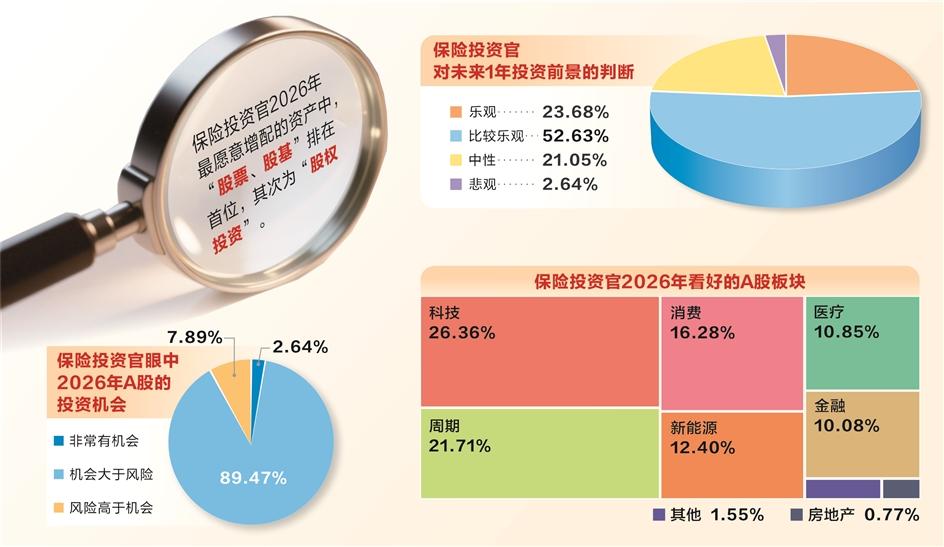
Core Viewpoint - The insurance investment officers are optimistic about the investment outlook for 2026, with over 70% expressing a "optimistic" or "relatively optimistic" sentiment, indicating a significant improvement compared to early 2025 [5][7]. Investment Preferences - The most favored asset class for increased allocation in 2026 is "stocks and equity funds," followed by "equity investments" [6][19]. - A significant majority of insurance investment officers (over 70%) plan to increase their allocation to equity assets, with 68.42% expecting a "slight increase" and 2.63% anticipating a "significant increase" [22][23]. Sector Outlook - The sectors viewed as having the most potential in A-shares for 2026 include technology (26.36%), cyclical (21.71%), and consumer sectors (16.28%) [26]. - Nearly 70% of insurance investment officers still see value in dividend-paying assets, driven by a low-interest-rate environment [26]. Market Sentiment - 89.47% of investment officers believe that the opportunities in the A-share market outweigh the risks, citing factors such as corporate profit improvement and structural opportunities [10]. - The overall sentiment towards the investment environment for 2026 is mixed, with 36.84% of officers believing it will weaken compared to 2025, while 23.68% expect it to improve [9]. Geopolitical Concerns - Geopolitical issues are identified as the primary uncertainty for 2026, with around 40% of investment officers highlighting this as a major concern [15]. - Concerns about the international market environment and domestic economic conditions also rank high among investment officers [15][16]. Risk Factors - The primary risk identified by investment officers is stock market volatility, with over 50% expressing concern about this issue [17]. - Credit risk remains a significant concern, particularly in light of potential defaults and liquidity issues [17]. Investment Strategy - Investment officers are increasingly diversifying their asset allocation, with a notable interest in alternative investments such as real estate investment trusts (REITs) [21]. - The focus on maintaining a balanced approach to equity investments is emphasized, with a need to optimize the investment structure while keeping the overall proportion stable [23][24].
伊朗遭遇1979年来最严峻挑战 但它不是委内瑞拉美国纠结了?
Di Yi Cai Jing· 2026-01-13 15:30
Group 1 - Iran is facing its largest challenge since the establishment of the Islamic Republic in 1979, with widespread protests against rising prices and currency devaluation leading to casualties among security personnel and civilians [1][2] - The Iranian government, led by President Pezeshkian, is committed to addressing the economic difficulties faced by the people and is open to listening to their demands [1] - The U.S. government, under President Trump, is considering further measures against Iran, including potential military action and economic sanctions targeting Iran's commercial partners [1][3] Group 2 - The Iranian Foreign Minister, Zarif, stated that security forces have regained control of the situation, but protests continue in some areas, indicating the severity of the unrest [2] - The U.S. has issued a security warning for its citizens to leave Iran immediately, reflecting concerns over the rising death toll and escalating tensions [2][7] - Iran's internet access has been restricted since January 8, with the government stating that the situation must stabilize before lifting the ban, while also enhancing domestic internet infrastructure [2] Group 3 - The U.S. has intensified its economic threats, with Trump announcing a 25% tariff on any country engaging in trade with Iran, which is seen as a way to exert pressure indirectly [3][4] - Iran's main trading partners include China, the UAE, and Turkey, with significant trade volumes reported, such as $13.37 billion in 2024 between China and Iran [3] - The Iranian government is seeking diplomatic channels for communication with the U.S., expressing a willingness to engage in dialogue without accepting lectures [5][6] Group 4 - The U.S. is exploring a range of military options in response to the situation in Iran, including airstrikes and cyber warfare, while also considering the implications of potential military action [6][7] - Iran's Defense Minister warned that any attack on its national interests would lead to retaliation against enemy facilities, signaling a readiness to respond to external threats [7] - Israel has maintained a low profile regarding the protests in Iran, emphasizing that the situation is an internal matter while remaining vigilant [8]
伊朗遭遇1979年来最严峻挑战,但它不是委内瑞拉美国纠结了?
Di Yi Cai Jing· 2026-01-13 13:25
Core Viewpoint - The article discusses the significant challenges faced by Iran, including widespread protests against rising prices and currency devaluation, and the U.S. government's mixed signals regarding military intervention and economic sanctions against Iran [2][4][10]. Group 1: Iran's Domestic Situation - Iran is experiencing its largest challenge since the establishment of the Islamic Republic in 1979, with protests leading to casualties among both security personnel and civilians [2]. - Iranian President Pezeshkian emphasized the government's commitment to addressing the economic difficulties faced by the people [2]. - The Iranian government has reported that 111 security personnel have died during the recent unrest, indicating the severity of the protests [4]. Group 2: U.S. Response and Military Threats - President Trump has threatened military action against Iran, reflecting a hesitance in the U.S. administration regarding direct military intervention [2][10]. - The U.S. State Department issued a security warning for American citizens to leave Iran immediately, highlighting the escalating tensions [10]. - Trump announced a 25% tariff on any country doing business with Iran, which is seen as an extension of economic pressure rather than a direct attack on Iran itself [5]. Group 3: Diplomatic Channels and International Reactions - Iran has expressed a willingness to engage in dialogue with the U.S. but rejects any form of lecturing [7][9]. - The Iranian Foreign Minister has reached out to a U.S. envoy to discuss the possibility of a meeting, indicating a potential for diplomatic engagement [9]. - European perspectives, such as that of German Chancellor Merz, suggest a belief that the Iranian government may not last long, reflecting a broader skepticism among EU nations regarding Iran's stability [12]. Group 4: Economic Implications - Iran's main trading partners include China, the UAE, and Turkey, with significant trade volumes reported, such as $13.37 billion in 2024 between China and Iran [5]. - The ongoing unrest and U.S. sanctions are likely to impact Iran's economic relationships and trade dynamics in the region [5]. Group 5: Market Reactions - The geopolitical uncertainty surrounding Iran has led to a surge in demand for safe-haven assets, with gold and silver prices reaching historical highs [12].
每日投行/机构观点梳理(2026-01-13)
Xin Lang Cai Jing· 2026-01-13 11:44
Group 1: Concerns about Federal Reserve Independence - UBS suggests that concerns over the independence of the Federal Reserve may lead to a more hawkish stance in monetary policy [1] - Goldman Sachs expects the Federal Reserve to continue making data-driven decisions despite the pressure from the criminal investigation against Chairman Powell [1][2] - Rabobank indicates that increasing political pressure on the Federal Reserve could result in higher volatility for the dollar in 2026 [1] Group 2: Market Reactions and Implications - Rabobank warns that the investigation into Powell could reignite "sell-America" trades, posing significant downside risks for the dollar [2] - ABN Amro suggests that the investigation may delay any potential interest rate cuts by the Federal Reserve as officials may adopt a more hawkish stance to defend the institution [2] - The Swiss franc has become a favored safe-haven currency amid concerns regarding the Federal Reserve's independence [4] Group 3: Economic Forecasts and Trends - State Street Global Advisors reports a greater than 30% probability that spot gold will exceed $5,000 per ounce this year, driven by geopolitical dynamics and Federal Reserve policies [2] - Fitch Ratings anticipates a moderate recovery of the Japanese yen from historical lows by 2026, despite ongoing challenges in the labor market [4] - Zhongjin Securities predicts that the Federal Reserve may cut interest rates by approximately 50 basis points in 2026 due to weak employment data [8]
沥青日报:低开后震荡运行-20260113
Guan Tong Qi Huo· 2026-01-13 11:36
【冠通期货研究报告】 沥青日报:低开后震荡运行 发布日期:2026年1月13日 【行情分析】 供应端,上周沥青开工率环比回落2.0个百分点至25.4%,较去年同期高了1.3个百分点,处于近 年同期偏低水平。据隆众资讯数据,2026年1月份国内沥青预计排产200万吨,环比减少15.8万吨,减 幅为7.3%,同比减少27.6万吨,减幅为12.1%。上周,沥青下游各行业开工率多数下跌,其中道路沥 青开工环比下跌3个百分点至17%,受到资金和天气制约。上周,华东地区主力炼厂间歇停产,其出 货量减少较多,全国出货量环比减少20.05%至21.03万吨,处于中性偏低水平。沥青炼厂库存率环比 上升,仍处于近年来同期的最低位附近。美国突袭委内瑞拉并逮捕马杜罗引发地缘政治局势动荡, 与影响国内原油不同,委内瑞拉重油是国内地炼重要的低价原料,而此次美国军事袭击之下,委内 瑞拉稀释沥青贴水幅度预计缩小,委内瑞拉重质原油流向国内地炼严重受限,特朗普称委内瑞拉将 向美国移交3000万至5000万桶石油,美国能源部长赖特宣称,美国将"无限期"地控制委内瑞拉石 油销售,这将影响国内沥青的生产和成本,目前美国政府倾向与维多和托克等全球大宗商 ...
宏观金融日报-20260113
Yi De Qi Huo· 2026-01-13 11:16
1. Report Industry Investment Rating No relevant content provided. 2. Core Views of the Report - The stock index futures market adjusted on Tuesday after the regulatory authorities cooled down the market on Monday night. The short - term index may continue to oscillate and adjust. Investors are advised to focus on the structure rather than the index, wait for the volatility to decrease, and be aware of the possible disturbances from the annual report performance forecasts of listed companies near the end of January [5]. - Due to the further escalation of geopolitical situations, the safe - haven sentiment has risen. The macro funds may increase their allocation of long - term bonds for risk hedging. At present, when the valuation of long - term bonds is at a low level, it is not advisable to short. It is recommended to lightly try to go long on TL2603 in treasury bond futures [9]. - The precious metals sector showed obvious differentiation in the Asian market today. Silver continued to be strong, mainly driven by macro - level changes such as international geopolitical tensions and the challenge to the Fed's independence. In the short - term, it is difficult for the Powell case to have a major negative impact on gold and silver. Micro - level factors such as tight silver inventory also support the silver price [11][12]. - The shipping companies have lowered the spot freight rates, and the bullish sentiment in the container shipping index market has ebbed. The spot freight rate may reach an inflection point at the end of January if the cargo volume growth before the Spring Festival falls short of expectations. Spot enterprises are recommended to continue with hedging, and positive arbitrage opportunities between EC2604 and EC2608 contracts can be focused on [14]. 3. Summary According to Relevant Catalogs 3.1当日要闻 - Since January 14, 2026, anti - dumping duties will continue to be imposed on imported solar - grade polysilicon originating from the United States and South Korea for a period of 5 years [2]. - On January 12, CME announced a change in the margin setting method for gold, silver, platinum, and palladium contracts, from a fixed - amount margin to a percentage of the contract's notional value, effective after the close on January 13 [2]. - US President Trump announced that any country conducting business with Iran will face a 25% tariff on all its business with the US, and the US State Department asked US citizens to leave Iran immediately [3]. - The US Department of Justice launched a criminal investigation into Fed Chairman Powell regarding a $2.5 - billion over - budget renovation project of the Fed's headquarters [3]. - Two Chinese - flagged super - large oil tankers that were originally heading to Venezuela to load crude oil for debt repayment have turned back [4]. - Japanese Prime Minister Hayasaka Sanae expressed her intention to dissolve the House of Representatives at the beginning of the parliamentary session on January 23 [4]. 3.2品种观点 3.2.1股指期货 - On Tuesday, the market declined. The Shanghai Composite Index fell 0.64%, and the trading volume of the Shanghai and Shenzhen stock markets was 3.651 trillion yuan, an increase from the previous trading day. Among the underlying indexes of stock index futures, the CSI 300 fell 0.60%, the SSE 50 fell 0.34%, the CSI 500 fell 1.28%, and the CSI 1000 fell 1.84%. Among the current - month contracts of stock index futures, IF2601 fell 0.56% (basis 5.17 points), IH2601 fell 0.21% (basis 3.67 points), IC2601 fell 1.26% (basis 29.52 points), and IM2601 fell 1.92% (basis 30.67 points) [5]. - The petroleum and petrochemical, pharmaceutical and biological, and non - ferrous metal sectors led the gains, while the military industry, electronics, and communication sectors led the losses [5]. - Since December 16, the Shanghai Composite Index has continued to rise. The trading volume of the Shanghai and Shenzhen stock markets hit a record high for two consecutive days on January 12 and 13, the margin trading balance increased by 45.5 billion yuan on January 12, and the premium and discount of stock index futures narrowed significantly, indicating high market sentiment [5]. - From the perspective of the Spring Festival market evolution, the time is not yet up, but more than half of the upward space has been achieved. If the trading volume of the two markets can remain above 3 trillion yuan or even increase, the market risk is low; otherwise, attention should be paid [5]. 3.2.2国债期货 - On Tuesday, the central bank conducted 358.6 billion yuan of 7 - day reverse repurchase operations, with 16.2 billion yuan of reverse repurchases maturing, resulting in a net investment of 342.4 billion yuan. The money market was loose, and the overnight repurchase rate was 1.39% [9]. - Affected by the escalation of geopolitical situations, the safe - haven sentiment rose. Treasury bond futures opened slightly higher in the morning, and futures performed better than spot bonds. TL2603 returned above the 10 - day moving average. In the past four trading days, the trend of treasury bonds has gradually become less correlated with the stock market [9]. - Since December, treasury bond futures have been under pressure due to increased expectations of stable growth and supply concerns. Although the PMI data in December returned above the boom - bust line and relevant policies were implemented at the beginning of the year, the sustainability of the data structure is questionable, and the fundamentals are hard to reverse. Currently, the above negative factors have been partially released [9]. 3.2.3贵金属 - In the Asian market today, the precious metals sector was significantly differentiated. Shanghai silver stood above the 20,000 - yuan integer mark for two consecutive days. Domestic gold and silver rose 1.01% and 5.90% respectively, while platinum and palladium fell 3.32% and 5.22% respectively, with the former two hitting new historical highs during the session [11]. - Speculative funds mainly increased their positions. Gold had a large - scale increase in positions for five consecutive days. According to the initial position data released by CME on the 12th, the total position of New York gold futures was 530,500 lots (+30,990 lots); the total position of New York silver futures was 152,800 lots (+2,306 lots); the total position of New York platinum futures was 77,757 lots (-1,361 lots); the total position of New York palladium futures was 19,519 lots (+113 lots) [11]. 3.2.4集运指数 - Shipping companies have lowered the spot freight rates, and the bullish sentiment in the container shipping index market has ebbed. The 04 - contract of the container shipping index significantly corrected on Tuesday. For example, Hapag - Lloyd lowered the booking freight rates for late January by $50 and $100 to $1,635/TEU and $2,635/FEU respectively; CMA CGM's latest quotes for some February voyages followed the January - end prices [14]. - The current transportation demand is stable, and the supply - demand relationship is relatively balanced. If the cargo volume growth before the Spring Festival falls short of expectations, the spot freight rate may reach an inflection point at the end of January. According to the China Shipping Prosperity Survey data, the prosperity range in the first quarter of this year has dropped to a slight prosperity level compared with the fourth quarter of last year, the confidence of container shipping enterprises has declined, and the corporate profit situation may narrow [14]. 3.3未来24小时重点数据 - Tonight (January 13): At 21:30, the US December CPI annual rate unadjusted (%) is expected to be 2.7 (previous value 2.7); the US December core CPI annual rate unadjusted (%) is expected to be 2.7 (previous value 2.6); at 23:00, the US October seasonally - adjusted annualized total of new home sales (in ten thousand units) is expected to be 70.5 (previous value 70.5) [18]. - Tomorrow (January 14): At 10:00, the State Council Information Office will hold a press conference on China's import and export situation in 2025; at 10:30, China's December trade balance in US dollars (in billions of US dollars) is expected to be 113.3 (previous value 111.68), the December export annual rate in US dollars (%) is expected to be 2.9 (previous value 5.9), and the December import annual rate in US dollars (%) is expected to be 0.8 (previous value 1.9); at 21:30, the US November retail sales monthly rate (%) is expected to be 0.4 (previous value 0), and the US November PPI annual rate (%) is expected to be 2.7 (previous value 2.7); at 23:00, the US December annualized total of existing home sales (in ten thousand units) is expected to be 421 (previous value 413) [18].
特朗普看上的格陵兰岛,最终会走向何方?
首席商业评论· 2026-01-13 11:14
Core Viewpoint - The article discusses the geopolitical significance of Greenland, highlighting its strategic location and resource potential, while also addressing the complexities surrounding its political status and the challenges faced by the U.S. in its ambitions to control the island [6][7][13]. Geopolitical Significance - Greenland is the world's largest island, with two-thirds of its territory located within the Arctic Circle, making it a key strategic asset for military and shipping routes [7][9]. - The melting Arctic ice due to global warming is expected to open up regular shipping routes by around 2030, significantly shortening travel times between Europe and Asia by 30% compared to the Suez Canal [11]. - Control over Greenland is viewed as essential for the U.S. to maintain dominance in the Arctic and counter Russian military movements [11][18]. Resource Potential - Greenland is rich in natural resources, including 31 out of 34 critical minerals identified by the EU, with an estimated 1.5 million tons of rare earth elements, crucial for technology and defense industries [13]. - The surrounding waters are believed to contain trillions of dollars worth of oil and gas resources, although extraction is currently hindered by challenging conditions and lack of infrastructure [13][15]. Political Landscape - The 2009 Greenland Self-Government Act stipulates that any change in territorial status requires a public referendum in Greenland and approval from the Danish Parliament [15]. - Current public sentiment shows a strong desire for independence from Denmark, but a significant majority (92%) opposes joining the U.S., indicating a complex political landscape [15][27]. U.S. Strategic Interests - The U.S. has long been interested in Greenland, viewing it as a potential military stronghold to enhance its Arctic defense capabilities and counteract Russian influence [17][18]. - Trump's administration aims to leverage Greenland's resources and strategic location to bolster U.S. economic and military interests, despite the challenges of local opposition and international law [18][20]. Future Scenarios - The most likely outcome is that the U.S. will focus on establishing de facto control over Greenland through military presence and economic partnerships, rather than formal annexation [28]. - Maintaining the status quo is also a possibility, especially if domestic issues in the U.S. divert attention from Greenland [31]. - A scenario where Greenland freely joins the U.S. is considered highly unlikely due to the need for multiple favorable conditions [34]. - The least probable outcome involves a military invasion, which would have severe geopolitical repercussions [35]. Conclusion - The ongoing competition for Greenland reflects broader tensions between U.S. hegemonic ambitions and the principles of modern international order, emphasizing the importance of respecting sovereignty and cooperative governance [36][39].

【UNforex财经事件】关键通胀数据前夕 黄金进入高位盘整阶段
Sou Hu Cai Jing· 2026-01-13 09:56
当前市场的观望情绪,主要集中在即将公布的12月美国消费者价格指数。市场普遍预计,12月CPI环比 增幅为0.3%,同比增速维持在2.7%;剔除食品和能源因素后的核心CPI同比或小幅回升至2.7%。交易层 面普遍认为,通胀数据与预期之间的差异,将直接影响市场对1月28日美联储会议政策立场的判断,并 放大美元及贵金属的短线波动。在数据公布前,黄金多头普遍选择放缓节奏,避免进行激进押注。 整体来看,在美元短线企稳以及CPI关键风险事件临近的背景下,黄金运行节奏转入高位整理阶段。但 从政策不确定性、地缘局势以及利率预期等基本面因素出发,支撑金价的中期逻辑并未发生实质性变 化,价格回调过程中仍具备吸引配置型资金介入的条件。 地缘政治因素同样对黄金回调空间形成约束。伊朗国内局势持续动荡,美国方面近期释放出更为强硬的 政策信号,包括潜在军事行动选项以及新的贸易与关税威胁。特朗普周一晚间表示,任何与伊朗保持贸 易往来的国家,其输美商品都可能面临额外关税安排。这一表态进一步加剧了市场对地区稳定性的担 忧。在地缘不确定性维持高位的背景下,避险资金对黄金的配置需求依然稳固,成为金价维持高位运行 的重要支撑来源。 UNforex 1 ...