地缘政治

Search documents
百利好晚盘分析:黄金向上破位 短期维持强势
Sou Hu Cai Jing· 2026-01-13 09:09
Gold - Geopolitical tensions remain high as Iran's foreign minister claims that Iranian security forces have controlled the national situation, with the US and Israel bearing "direct responsibility" for events in Iran. President Trump has stated that any country doing business with Iran will face a 25% tariff, and airstrikes against Iran are a potential option [2] - Analyst Chen Yu from Bailihau believes that the Trump administration's threats against the current Federal Reserve Chairman Powell will likely undermine the Fed's independence, increasing market distrust in the US dollar and leading to a strong performance in gold in the short term [2] - On the technical front, the previous trading day saw a bullish trend with a closing positive candle, indicating a strong short-term market. The price has broken through previous highs, suggesting potential for further upward movement. Support is noted in the $4550-$4560 range [2] Crude Oil - The US State Department has issued an emergency security warning for American citizens to leave Iran immediately, indicating a potential for airstrikes against Iran, which could escalate tensions in the Middle East and support oil prices due to supply disruption risks [3] - Despite geopolitical tensions potentially driving oil prices higher, the fundamental outlook remains concerning due to oversupply risks, with OPEC+ and US production levels remaining high. Recent economic data indicates a slowdown in US economic growth, which may hinder improvements in oil demand [3] - Technically, the oil price has recently broken above the 20-day moving average, indicating strength. The price has surpassed the previous resistance level of $58.80, suggesting potential for further upward movement. Support is noted at the $58.50 level [3] US Dollar Index - Recent US economic data has been disappointing, with May non-farm payrolls adding only 50,000 jobs, falling short of market expectations. The annual increase for 2025 is projected to be less than 600,000, marking the worst performance since the pandemic. Although the unemployment rate has decreased from 4.5% to 4.4%, the decline in labor force participation indicates that improvements in the job market are not stable [4] - The manufacturing PMI for December fell to 47.9, remaining below the neutral line for ten consecutive months, indicating ongoing contraction in the US manufacturing sector [4] - According to CME's FedWatch tool, the probability of a 25 basis point rate cut in January is 5.0%, while the probability of maintaining the current rate is 95.0%. By March, the cumulative probability of a 25 basis point cut rises to 26.0% [4] - On the technical side, the previous trading day saw a decline from highs, indicating potential for further downward risk. However, the overall trend remains upward, with the price still above the 20-day and 62-day moving averages, suggesting short-term bullish sentiment. Support is noted at the 98.69 level [4] Nikkei 225 - The recent trend in the Nikkei 225 has been strong, with the price breaking out of previous consolidation patterns, indicating a bullish outlook and potential for further upward movement [5] - On the 4-hour chart, the price is moving along the 62-day moving average, with short-term attention on a potential pullback to test support at the 52626 level [5] Copper - The recent trend in copper has been characterized by a primary upward movement, with expectations for continuation. Indicators show that both the 20-day and 62-day moving averages are trending upward, indicating a strong bullish trend [6] - On the 4-hour chart, the price has been moving along the 62-day moving average, with attention on a potential pullback to test support at the $5.83 level [6]


不给石油就挨打?!
Xin Lang Cai Jing· 2026-01-13 08:23
Core Viewpoint - The article discusses recent U.S. military actions in Venezuela and international waters, highlighting the geopolitical and energy implications of these actions, particularly regarding oil resources [2]. Group 1: U.S. Military Actions - The U.S. military conducted operations in Venezuela under the pretext of "anti-drug" and "regional security," forcibly controlling and relocating President Maduro and his wife [2]. - Following the actions in Venezuela, the U.S. military seized a large oil tanker flying the Russian flag in the North Atlantic international waters [2]. Group 2: Geopolitical Implications - The article suggests that the U.S. is attempting to legitimize its aggressive actions through a narrative of law enforcement, masking deeper geopolitical and energy calculations [2]. - Historical context is provided, indicating that the "law of the jungle" is not a sustainable path for civilization, implying that current aggressors will face consequences as global rules deteriorate [2].
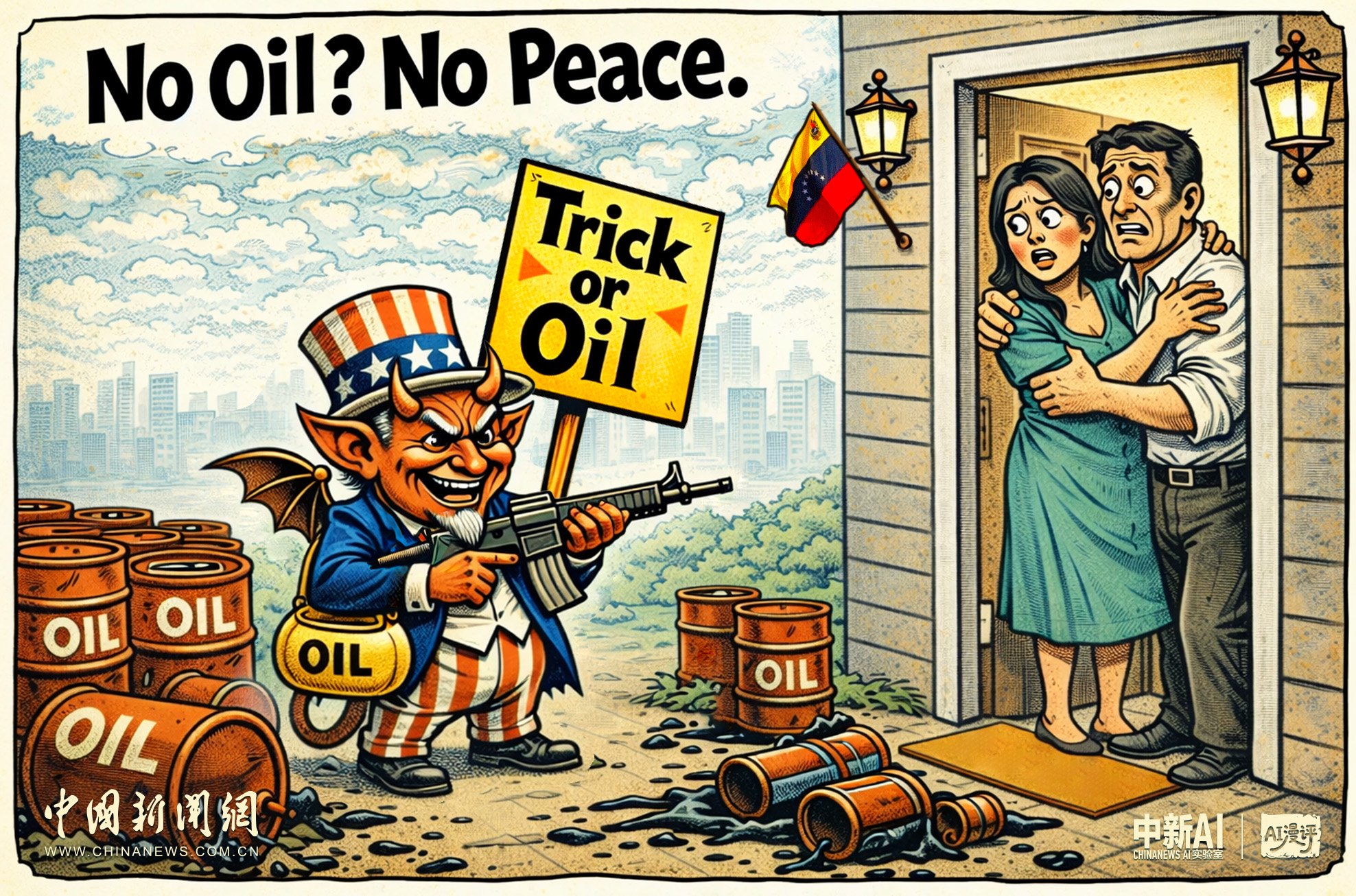
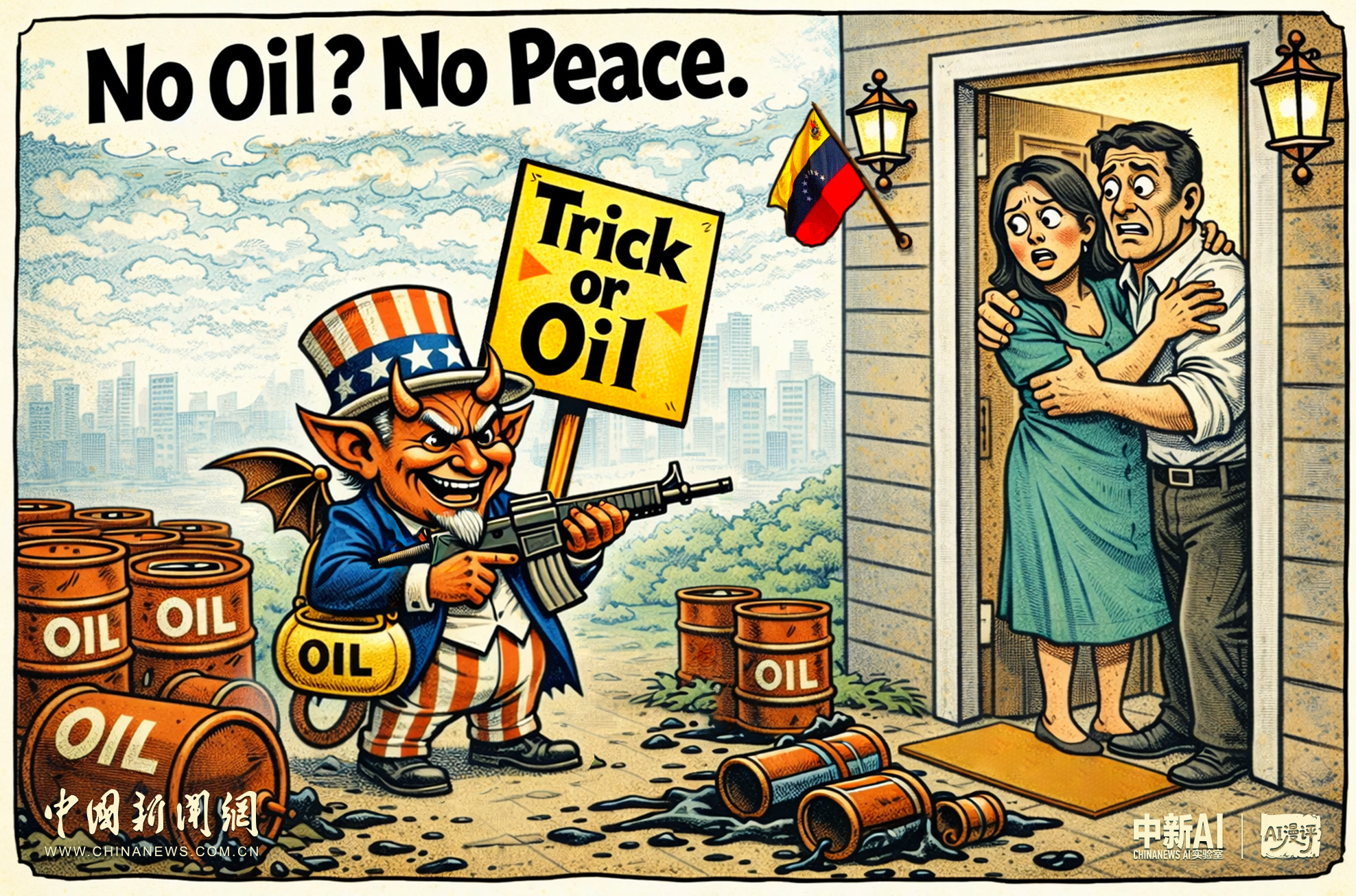
AI漫评|不给石油就挨打?!
Zhong Guo Xin Wen Wang· 2026-01-13 08:23
Core Viewpoint - The article discusses recent U.S. military actions in Venezuela and international waters, highlighting the geopolitical and energy implications of these actions, which are framed as law enforcement but are seen as displays of U.S. hegemony [2]. Group 1: U.S. Military Actions - The U.S. military conducted a raid in Venezuela under the pretext of "anti-drug" operations and "regional security," forcibly controlling and relocating President Maduro and his wife [2]. - Following the Venezuela operation, the U.S. military seized a large oil tanker flying the Russian flag in the North Atlantic international waters [2]. Group 2: Geopolitical Implications - The actions taken by the U.S. are viewed as an attempt to exert control over strategic resources, particularly oil, revealing underlying geopolitical and energy calculations [2]. - The narrative of law enforcement used by the U.S. is criticized as a facade that fails to conceal the deeper motives of power and resource control [2]. Group 3: Historical Context - The article references historical precedents, suggesting that the "law of the jungle" is not a sustainable path for civilization, implying that current aggressors will eventually face consequences for their actions [2].
高层会商、撤离警告、关税大棒……美对伊朗持续施压
Xin Hua She· 2026-01-13 08:21
新华社北京1月13日电 美国媒体报道,美国总统特朗普定于13日与政府高级官员讨论美国针对伊朗的下一步措施。这将是近期特朗普与美高级官 员首次正式会商针对伊朗的相关方案。美国国务院12日发布"安全警告",要求美国公民立即离开伊朗。 特朗普12日还在社交媒体发文称,任何与伊朗有商业往来的国家在与美国进行任何商业往来时将被加征25%的关税。 另据美国《华尔街日报》援引匿名美国官员的话报道称,特朗普计划13日与政府高级官员讨论美国针对伊朗的下一步措施,其中可能包括增加反 伊朗政府网络消息源、针对伊朗军事和民用目标部署秘密网络武器、对伊朗政权实施更多制裁以及进行军事打击等,但预计特朗普不会在会议上 作出最终决定。 美国务院发"安全警告" 关税"配合"军事威胁 特朗普12日下午在社交媒体发文称,任何与伊朗有商业往来的国家在与美国进行任何商业往来时将被加征25%的关税。特朗普称,这是"最终"决 定并"立即生效"。 特朗普没有在社交媒体上就此作具体说明。 由于美国对伊朗长期实施严厉制裁,双方没有商业往来和正式外交关系,美国无法通过关税手段直接对伊朗进行有效施压。 白宫新闻秘书莱维特当天早些时候说,面对当前伊朗局势,特朗普认为 ...
能源化策略:地缘?撑油价,化??估值追?需谨慎
Zhong Xin Qi Huo· 2026-01-13 08:01
1. Report Industry Investment Rating No relevant content found. 2. Core View of the Report - The geopolitical risks continue to support crude oil prices, and the chemical industry is over - valued, so it should be treated with a volatile mindset. The industry may continue to fluctuate strongly, but it is not recommended to chase more [2][3][4]. 3. Summary by Related Catalogs 3.1 Crude Oil - **View**: Geopolitical factors continue to disrupt, and attention should be paid to risks in Iran. The supply pressure persists, but the geopolitical premium fluctuates. The price of oil will continue to fluctuate under the balance of oversupply and frequent geopolitical disruptions. Short - term focus is on the risk of price surges related to Iranian geopolitics [4][7]. - **Logic**: Expectations of increased sanctions by the US on Russia or Iran fuel supply concerns, and the situation in Iran is highly uncertain. The US - Venezuela crude oil trade may increase, and there may be a potential impact of Venezuelan sanctioned oil on the compliant oil market. Geopolitical prospects in Russia - Ukraine, Iran, and Venezuela are the core factors affecting crude oil supply expectations [7]. - **Outlook**: Volatile. Supply pressure continues, but the geopolitical premium is unstable, so it should be viewed as volatile in the short term [4][7][8]. 3.2 Asphalt - **View**: The asphalt futures price is oscillating in an over - valued range [4]. - **Logic**: OPEC+ will suspend production increases in Q1. The US is cooperating with Venezuela to receive its oil, and partial sanctions on Venezuela are lifted. This supports asphalt costs but may lead to sufficient supply in the long - term. Hainan's asphalt production has increased significantly, and the supply - demand situation is weak with inventory accumulation and reduced demand [9]. - **Outlook**: Oscillating downward. The absolute price of asphalt is over - valued, and its medium - to long - term valuation is expected to decline [9]. 3.3 High - Sulfur Fuel Oil - **View**: The price of high - sulfur fuel oil futures has declined due to the pressure from Venezuelan heavy oil [4]. - **Logic**: OPEC+ suspends production increases in Q1. Venezuela will transfer 30 - 50 million barrels of oil to the US, increasing heavy - oil supply. The demand for high - sulfur fuel oil is suppressed by high - level floating storage in the Asia - Pacific region, and its substitution by natural gas and photovoltaic energy [9]. - **Outlook**: Volatile. The expected increase in Venezuelan oil production will put long - term pressure on high - sulfur fuel oil, but short - term support comes from the US - Iran conflict [11]. 3.4 Low - Sulfur Fuel Oil - **View**: The price of low - sulfur fuel oil futures is oscillating upward [4]. - **Logic**: It follows the upward trend of crude oil. There are some supporting factors, but it also faces challenges such as reduced shipping demand, substitution by green energy, and high - sulfur fuel substitution. Its valuation is low and it is expected to follow crude oil price movements [12]. - **Outlook**: Volatile. It is affected by green fuel substitution and limited high - sulfur substitution demand, but its current low valuation means it will fluctuate with crude oil [12]. 3.5 Methanol - **View**: Methanol is expected to be stable with a weakening trend, as inventory pressure is significant and MTO demand is weak [4]. - **Logic**: The domestic supply is relatively abundant, while downstream demand is weak. Port inventory is high, and there are plans for some MTO plants to shut down, which may further weaken demand [28]. - **Outlook**: Weakening in the short term [28]. 3.6 Urea - **View**: The actual trading volume has slowed down, and urea is oscillating and consolidating [4]. - **Logic**: The supply remains at a high level of around 200,000 tons per day, while the procurement from traders and compound fertilizer factories has slowed down, resulting in a lack of trading enthusiasm [29]. - **Outlook**: Oscillating. Without a significant change in fundamentals, the market is closely related to order transactions. It may be stable with a weakening trend in the short term [29]. 3.7 Ethylene Glycol - **View**: The arrival of foreign vessels is concentrated, and inventory tank capacity is tight [4]. - **Logic**: The recent arrival of a large number of vessels has led to a significant increase in inventory, causing the spot basis to weaken and reducing traders' willingness to hold goods [20][22]. - **Outlook**: The price will be range - bound in the short term, and the long - term inventory pressure is still large, so the rebound height is limited [22]. 3.8 PX - **View**: The loosening of polyester demand exerts pressure on upstream raw materials [4]. - **Logic**: International oil prices are rising, and naphtha prices are increasing due to cost factors. Although PTA demand provides some support, the supply from domestic and foreign PX plants is increasing. The short - term PX profit is adjusting downward from a high level [13]. - **Outlook**: The PX price is expected to be range - bound in the short term, and attention should be paid to the support around 7000 - 7100 yuan/ton. The profit decline is limited [13]. 3.9 PTA - **View**: There are concentrated reports of polyester production cuts, putting pressure on the basis and processing fees [4]. - **Logic**: The upstream cost still provides some support, and the PTA supply - demand situation is currently stable. However, the concentrated production cuts in the downstream polyester industry may lead to a weaker basis and limited processing fee space [14]. - **Outlook**: The price will fluctuate with costs. In the medium term, consider going long on the TA05 contract on dips, and short - term shorting in the 5200 - 5300 yuan/ton range. Look for positive spreads on TA05 - 09 on dips [15]. 3.10 Short - Fiber - **View**: The price fluctuation has narrowed, and the sales are stable [4]. - **Logic**: The cost of upstream polyester raw materials has slightly declined, and the short - fiber price is range - bound. The downstream sales have improved slightly, and the market demand is stable [23][24]. - **Outlook**: The short - fiber price will follow the movement of upstream raw materials, and the processing fee is under some pressure [24]. 3.11 Bottle Chip - **View**: More plants are under maintenance in January, and profit support is strengthening [4]. - **Logic**: The price of upstream raw materials has slightly declined, and the bottle - chip market price has followed the cost movement. The market trading atmosphere is average, and the profit is expected to recover. The inventory is expected to decline smoothly before the festival, and the processing fee has stronger support [25]. - **Outlook**: The absolute price will fluctuate with raw materials, and the processing fee has stronger support at the bottom [25]. 3.12 Styrene - **View**: Driven by exports and a positive market atmosphere, styrene has been oscillating strongly recently [4]. - **Logic**: Exports are good, with confirmed exports of 48,000 tons in January and 12,000 tons in February. Port inventory has decreased, and market sentiment is positive. Macro and crude oil factors are also positive. The supply - demand situation is favorable in January, but there may be a risk of price correction if there is an unexpected increase in supply [18]. - **Outlook**: If there is no significant increase in supply or major negative news from crude oil, it will remain oscillating strongly in the short term, driven by repeated export news [18]. 3.13 PVC - **View**: There is a short - term "rush to export", which supports PVC [4]. - **Logic**: The export tax rebate for PVC will be cancelled on April 1st, leading to a short - term "rush to export". However, the long - term inventory pressure is large. Domestically, supply elasticity has increased, while overseas, the US Olin VCM plant has restarted. Downstream demand is seasonally weak, and the sustainability of "rush to export" orders is uncertain [37]. - **Outlook**: The short - term "rush to export" supports the price, but the long - term price may face pressure due to the possible poor sustainability of exports and high inventory [38]. 3.14 Caustic Soda - **View**: It has a low valuation and weak expectations, and is operating weakly [4]. - **Logic**: The production remains high, and inventory pressure is large. Demand from the alumina industry is weak, and non - aluminum downstream demand is also poor. Although the price of liquid chlorine limits the decline of caustic soda, the overall supply - demand situation is under pressure [39]. - **Outlook**: The supply - demand situation remains under pressure, and the price is expected to be weakly oscillating, with the decline limited by liquid chlorine [39]. 3.15 LLDPE - **View**: Driven by a positive macro sentiment, LLDPE is oscillating upward [33]. - **Logic**: Oil prices are oscillating, and geopolitical factors continue to affect supply expectations. The futures price has rebounded slightly due to macro expectations and positive market sentiment, but the profit of various production methods has slightly recovered, and the downstream demand is in the off - season [33]. - **Outlook**: Volatile in the short term [33]. 3.16 PP - **View**: Boosted by the macro environment but with reduced downstream trading volume, PP is oscillating upward [34]. - **Logic**: Oil prices are oscillating, and geopolitical factors affect supply expectations. The macro environment is positive for PP, but the downstream is in the off - season, and the trading volume has decreased after the price rebound. The short - term maintenance rate has slightly decreased [34]. - **Outlook**: Volatile in the short term [34]. 3.17 PL - **View**: Some downstream plants have restarted, and PL is oscillating upward [35]. - **Logic**: PDH maintenance expectations provide support. Propylene enterprise inventory is controllable, and downstream demand has increased slightly. However, the demand is still limited in the off - season [35]. - **Outlook**: Volatile in the short term [35]. 3.18 Indexes - **Comprehensive Index**: The commodity index, the commodity 20 index, the industrial products index, and the PPI commodity index all showed an upward trend on January 12, 2026, with increases of 1.57%, 1.85%, 1.27%, and 1.31% respectively [287]. - **Energy Index**: On January 12, 2026, the energy index was 1102.68, with a daily increase of 0.36%, a 5 - day increase of 1.45%, a 1 - month increase of 0.52%, and a year - to - date increase of 1.48% [288].
美国对伊朗所有贸易伙伴加税25%,对中俄的精准打击!欲锁死伊朗
Sou Hu Cai Jing· 2026-01-13 07:46
Core Viewpoint - The announcement of a 25% tariff on all countries trading with Iran by the U.S. is aimed at economically isolating Iran, particularly targeting its key trade partners, China and Russia, to achieve a strategic goal of cutting off Iran's external trade [1][3][21]. Group 1: Economic Impact - The tariff represents an escalation of unilateral sanctions to a "global collective punishment," forcing countries to choose between the Iranian and U.S. markets [3][21]. - The sudden announcement bypassed traditional legislative processes, establishing a new trade rule that imposes a 25% fee on any goods entering the U.S. market that are linked to Iran [9][11]. - The complexity of international trade means that many companies may unknowingly have ties to Iran, creating a climate of fear and uncertainty rather than just compliance costs [13][30]. Group 2: Geopolitical Implications - The tariff is not merely a trade issue but a geopolitical maneuver aimed at disrupting the economic arteries of Eurasia, particularly affecting China's westward expansion and Russia's southern access [7][21]. - The relationship between Iran, China, and Russia is evolving, with trade increasingly conducted in local currencies and bypassing the U.S. dollar, indicating a shift away from the traditional dollar-dominated system [23][37]. - The U.S. strategy may backfire, as countries like China and Russia have developed resilience against U.S. sanctions, potentially leading to a parallel trade system that undermines U.S. economic influence [30][38]. Group 3: Market Reactions - The announcement has already caused immediate reactions in global shipping insurance rates, highlighting the swift impact of U.S. policy changes on international markets [5]. - The emergence of a "ghost fleet" of ships operating outside Western insurance systems is a direct response to U.S. sanctions, indicating a shift in how global trade is conducted [25][30]. - The potential for rising oil prices due to supply chain disruptions could lead to renewed inflationary pressures in the U.S., reminiscent of past oil crises [28][30].
1.13黄金暴涨120美金 重回4600争夺
Sou Hu Cai Jing· 2026-01-13 07:31
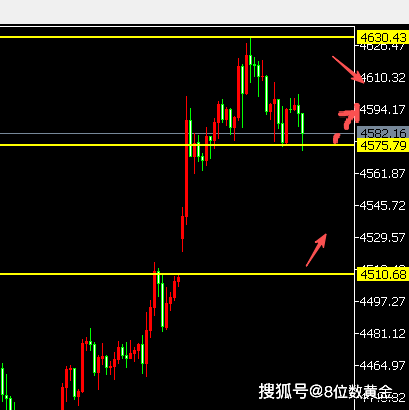
黄金上周回升,重回4500的关口后。昨天再暴力狂飙,高开高走,一度大涨120美金,刷历史新高后, 再次回落重回4600关口调整。 下方跌破了此位置,继续看向4510的支撑。 黄金12月结束,以冲高回落收官后。到本月,又迎来回升,收复了所有的跌幅后。多头暴力冲顶,再刷 历史新高。多头归来,再破高,新高看向4700,不猜顶。当然了,下方再次大的调整,可看向4500的区 域。 昨天刷新高,刚碰到4630。 再遇阻回落,重回4600下方。 今天进入调整,触及4575的位置。 今天的走势 再次弹起,围绕4600调整。 当然了,上方再战4630的位置。 再次上破,看历史新高,不猜顶。 当然了,不破高,再次调整,或再探4575的位置。 对于现货黄金的投资,方向和趋势的判断尤其重要。更重要的是入场点和出场点的把握能力,说白了就 是准确率,这个是能够实现稳健获利的必要的前提条件。这个不是一两本书,或者一两年功夫实操就可 以锻炼出来的。而是需要长时间实操和结果和经验。 同时对于仓位风险的把控能力,做到足够的低的风险,实现最大化的盈利的机会,这个是每个投资者必 要的基础。最快的实现盈利的方式,就是跟随真正的高手,他怎么做,你怎么做 ...
矿业ETF(561330)连续10日资金净流入近6亿元,有色板块企稳后供需逻辑支撑价格
Mei Ri Jing Ji Xin Wen· 2026-01-13 04:01
Group 1 - The non-ferrous metals industry is facing strategic value enhancement opportunities due to various macroeconomic factors [1] - Precious metals, particularly gold, are expected to rise in price due to factors such as monetary easing, expanding dollar credit cracks, and high debt levels [1] - Demand growth driven by artificial intelligence and high-end equipment manufacturing, along with geopolitical security premiums, is likely to lead to a revaluation of commodity prices [1] Group 2 - The mining ETF (561330) tracks the non-ferrous mining index (931892), which includes listed companies involved in the mining and processing of precious, industrial, and rare metals [1] - This index is characterized by strong cyclicality and is significantly influenced by global economic conditions and fluctuations in commodity prices [1]
情况有变,美国最新投票结果公布,特朗普公开承认,自己或将下台
Sou Hu Cai Jing· 2026-01-13 03:51
就在过去几天,美国政坛发生了令人震惊的动态,特朗普的支持率首次跌破党内的红线。面对接连不断的挑战和压力,他终于罕见地松口承认:如果中期选 举失利,他可能会被赶下台。与此同时,外部战火不断升级,美军在多个国家展开了军事行动,而特朗普的外交政策则正面临着四面楚歌的局面。 在这种 内外交困的时刻,美国最高法院即将就特朗普政府的关税政策作出裁决,一场可能引爆千亿美元退款潮的风暴一触即发。那么,特朗普的政治局势究竟发生 了什么变化?为何他会突然承认自己的可能下台? **军事行动频繁,特朗普加剧全球紧张局势** 仅仅过了一周,1月11日,美国再次对叙利亚发动了空袭,打击了多个被称为IS残余势力的目标。同一天,特朗普还对古巴发出了强硬警告,要求其立刻达 成谈判协议,否则将面临零石油、零资金的封锁。特朗普的这些军事行动,背后藏着强烈的地缘政治算计。与此同时,特朗普还启动了末日飞机E-4B,这 一举动引发了国际社会的高度关注。美国民众也开始担心,是否会爆发战争。尤其是特朗普指责伊朗已触及红线,并表示正在考虑多种军事选项,这一系列 操作,让整个中东局势骤然紧张。 更令人震惊的是,特朗普提出了夺岛计划,明确点名格陵兰岛,企图引发与 ...
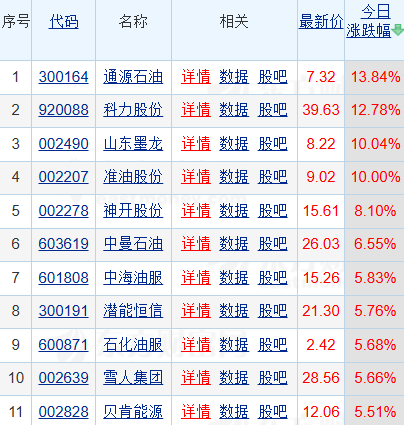
油气设服板块爆发!2股涨停通源石油涨超13%,地缘政治与政策多重利好共振
Jin Rong Jie· 2026-01-13 03:19
Group 1: Market Performance - The oil and gas service sector showed strong performance, with two stocks hitting the daily limit up, including Tongyuan Petroleum rising over 13% and Keli Co. rising over 12% [1][2] - Other notable stocks included Shandong Molong and Zhun Oil, both hitting the limit up, while ShenKong Co. rose over 8% and Zhongman Petroleum over 6% [1][2] Group 2: Geopolitical Influences - Recent geopolitical changes, particularly the U.S. military actions in Venezuela and plans to restore the country's oil infrastructure, have catalyzed market sentiment, with expectations that the U.S. will lift sanctions on Venezuela, which holds the world's largest oil reserves of approximately 302.8 billion barrels [1][3] - The severe damage to Venezuela's oil facilities necessitates large-scale orders for repairs, directly benefiting oil service equipment companies [1][3] Group 3: Oil Price Outlook - Geopolitical risks are expected to support oil prices in the short term, with predictions of prices remaining in the range of $60 to $70 per barrel, despite a current oversupply in the global oil market [3] - A short-term supply gap of around 1 million barrels per day from Venezuela is anticipated to push oil prices upward [3] Group 4: Policy Support - Domestic policies, particularly the revised "Petroleum and Natural Gas Infrastructure Planning, Construction, and Operation Management Measures," effective from January 1, 2026, provide a clear development path for the oil and gas service industry [3][4] - The policy encourages social capital participation in projects like gas storage and LNG receiving stations, enhancing the operational framework for national pipeline networks [3][4] Group 5: Industry Opportunities - The demand for oil and gas exploration, pipeline laying, and equipment maintenance is expected to rise due to policy-driven infrastructure improvements [4] - The oil and gas exploration service sector is likely to benefit from increased investment in exploration, with companies possessing advanced seismic and drilling technologies expected to see sustained growth in orders and revenue [5][6] - The deep-sea oil and gas development is driving demand for high-end equipment, with manufacturers possessing core technologies poised for a surge in orders and market share [6]