资产配置

Search documents
银行积存金门槛飙至千元,中长线该怎么投?
Sou Hu Cai Jing· 2025-11-17 20:51
Core Insights - Recent surge in gold prices has led banks to increase investment thresholds for gold accumulation products, indicating a shift in market dynamics [3] - Banks are raising thresholds to manage operational risks and filter genuine long-term investors, rather than allowing speculative trading [3][4] - Gold is viewed as a stable asset for long-term investment, emphasizing the importance of asset allocation over short-term trading [3][4] Summary by Sections - **Investment Thresholds** Major banks like China Construction Bank and China CITIC Bank have raised the minimum investment amounts for gold accumulation from around 800-1000 to 1200-1500 [3] - **Market Behavior** The increase in thresholds is a response to the high demand for gold as prices rise, aiming to control the influx of speculative investors [3][4] - **Investment Strategy** Long-term investors are advised to approach gold as a stabilizing asset rather than a quick profit tool, with a focus on gradual accumulation rather than reacting to market fluctuations [4]


权益潮涌下的基金投资者
Shang Hai Zheng Quan Bao· 2025-11-17 19:14
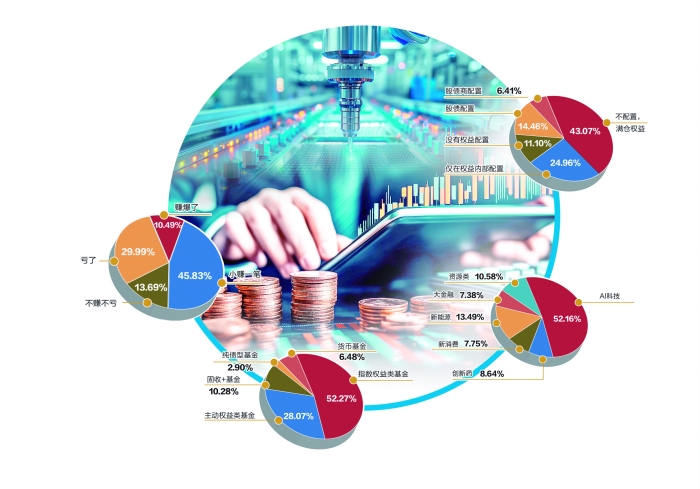
Core Insights - The capital market has shown steady growth this year, with equity funds experiencing significant gains driven by sectors like technology, innovative pharmaceuticals, and new energy [2][3] - Ordinary stock funds and equity fund indices have increased by approximately 30% year-to-date, outperforming the Shanghai Composite Index and CSI 300 Index [3] - The total scale of equity funds has surpassed 10 trillion yuan, an increase of over 2 trillion yuan since the end of last year [3] Investor Experience - Nearly 60% of surveyed investors reported profits this year, with 10% claiming substantial gains and 45.83% indicating modest profits [3][4] - Some investors have struggled with past losses affecting their current performance, with nearly 30% still facing losses this year [4][5] - A significant portion of investors (40%) are favoring full investment in equity funds without a structured allocation strategy [6][9] Fund Preferences - Index funds are the most favored type of investment, receiving 52.27% of votes, followed by active equity funds at nearly 30% [6] - The popularity of index funds is attributed to their clear logic, transparency, and low costs, which have gained investor confidence [7] - The total scale of domestic stock ETFs is projected to reach 2 trillion yuan by the end of 2024 and nearly 4 trillion yuan by November 2025 [6] Investment Strategies - Investors are increasingly adopting a diversified approach, with nearly 25% indicating they have made internal allocations within equity assets this year [10] - Recommendations suggest using bond funds as a base and selectively increasing equity fund allocations, particularly in domestic technology growth sectors [11] - The industry is moving towards a more rational allocation strategy to break the cycle of "funds making money while investors do not" [11]
全市场17只商品ETF总规模年内增长超200%
Zheng Quan Ri Bao· 2025-11-17 16:15
Core Insights - The commodity ETF market has experienced explosive growth in 2023, with total net inflows reaching 102.02 billion yuan and total assets growing by 203.92% to 229.99 billion yuan as of November 14 [1] - The primary driver of this growth is the performance of gold ETFs, with leading products like Huaan Gold ETF reaching a scale of 87.38 billion yuan, a 70-fold increase since its inception in 2013 [1] - Factors contributing to the growth include rising commodity prices, the attractiveness of commodity ETFs as low-threshold investment tools, and the expansion of product lines [1][3] Commodity Price Performance - Gold prices have surged this year, with COMEX gold up 48%, SEG gold 54.17%, and Shanghai gold 54.33% as of November 14 [2] - The strong performance of gold directly impacts the net asset value of related commodity ETFs, with the highest net value growth rate reaching 53.94% for 14 products [2] Market Dynamics - The demand for gold ETFs has been bolstered by increased risk aversion, asset allocation optimization, and favorable index investment policies [3] - While gold ETFs have thrived, other commodity ETFs have shown mixed performance, with some experiencing losses, indicating structural differentiation within the market [4][5] Future Outlook - Industry experts anticipate a continued positive trend for commodity ETFs, although structural differentiation is expected to persist [6] - Factors such as potential interest rate cuts by the Federal Reserve may support commodity prices and the overall performance of commodity ETFs, while agricultural and energy chemical ETFs may remain under pressure [6]
国泰海通|非银:资产配置“股升债降”,主动管理将更为重要——2025年三季度保险公司资金运用点评
国泰海通证券研究· 2025-11-17 14:27
Core Viewpoint - The insurance industry's fund utilization balance has steadily increased, with a further rise in equity asset allocation and a decrease in bond asset allocation, indicating the growing importance of active management capabilities in investment [1][4]. Group 1: Fund Utilization Overview - As of Q3 2025, the insurance industry's fund utilization balance reached 37.5 trillion yuan, a year-to-date increase of 12.6%, driven by stable growth in new and renewal premiums, with a year-on-year premium growth of 8.8% [2]. - The life insurance sector accounted for 33.7 trillion yuan, also up 12.6% year-to-date, while the property insurance sector reached 2.4 trillion yuan, increasing by 7.5% [2]. Group 2: Asset Allocation Changes - By the end of Q3 2025, the insurance industry allocated 3.62 trillion yuan to equity assets, an increase of 1.19 trillion yuan year-to-date, with an allocation percentage of 10.0%, up 2.5 percentage points from the beginning of the year [3]. - The allocation to equity funds rose to 5.5%, up 0.2 percentage points year-to-date, while bond asset allocation was 50.3%, up 0.8 percentage points year-to-date but down 0.8 percentage points from Q2 [3]. - Bank deposits accounted for 7.9% of the allocation, down 1.1 percentage points year-to-date, and other assets (primarily non-standard) accounted for 18.4%, down 2.7 percentage points year-to-date [3]. Group 3: Investment Management Strategy - The net investment yield is trending downward due to a low interest rate environment and narrowing credit spreads, indicating a need for insurance companies to shift from passive to active management strategies [4]. - The focus should be on flexibly seizing market opportunities and continuously optimizing asset allocation structures to achieve stable investment returns [4]. Group 4: Investment Recommendations - The expectation is that insurance companies will continue to optimize their asset allocation strategies, leading to improved profitability, maintaining an "overweight" rating for the industry [5].

迈科期货:帮助客户系好风险控制这根“安全绳”
Qi Huo Ri Bao Wang· 2025-11-17 01:09
Core Insights - The 19th National Futures (Options) Live Trading Competition has concluded, with Maike Futures serving as the designated trading firm for the third consecutive year, enhancing its brand influence and customer interaction [1][4] - The competition saw a significant increase in customer participation, with 875 participants, a 33% year-on-year growth, attributed to internal promotions and incentives [1] - The company emphasizes the importance of risk management and education in futures trading, aiming to prevent clients from overtrading and to promote disciplined trading practices [3][4] Company Strategy - Maike Futures aims to respond to the complex market environment and industry changes by adhering to compliance and driving innovation, focusing on providing safe, convenient, and high-quality services [2] - The company plans to enhance its wealth management capabilities and improve its research and service levels through continuous interaction with traders [1][5] - Future strategies include personalized services and customized products based on client needs, as well as embracing AI advancements to improve trading technology and service convenience [5] Industry Trends - The competition highlighted a shift in options trading from a niche activity to a mainstream risk management and strategy expression tool, indicating a growing maturity in the market [4] - The company recognizes the need for deeper understanding of macroeconomic factors and policies, as well as the proficient use of various trading tools in a competitive environment [2][4] - The ongoing transformation in China's futures market is expected to enhance participant maturity and stability, with the competition serving as a catalyst for industry development [4]
共话2026年期货市场投资机遇
Qi Huo Ri Bao Wang· 2025-11-17 00:51
Core Insights - The 2025 Global Futures Traders Conference highlighted key investment strategies focusing on concentration, patience, and risk management among successful traders [1][2][3] - Participants expressed optimism for the stock index futures market, predicting a slow bull market driven by technology and emerging industries, despite potential macroeconomic challenges [3][4] Group 1: Winning Strategies - Lin Wei Jin, champion of the global lightweight group, emphasized the importance of "focus, patience, and risk control" in trading, particularly in the sugar futures market [1] - Li Cheng Jie, ranked 9th in the high-net-worth group, shared his transition from stock speculation to asset allocation, highlighting the significance of making correct decisions based on macro research [1][2] - Yuan Zuo Yue, 6th in the quantitative group, attributed his success to a combination of quantitative models and subjective filtering, maintaining discipline over a decade [2] Group 2: Market Outlook for 2026 - Participants discussed the long-term potential of stock index futures, with Yu Hui expressing confidence in their intrinsic value and future profitability despite recent price increases [2][3] - Li Cheng Jie noted that stock index futures have entered a slow bull phase, driven by technology sectors, while cautioning against macroeconomic disruptions [3] - The commodity market is expected to experience differentiation, with Lin Wei Jin predicting a bearish trend in the sugar market and caution from Kuang Bai Lin regarding the construction and black sectors [3][4] Group 3: Investment Strategies - Li Cheng Jie proposed focusing on lithium carbonate and other renewable energy commodities, while also considering shorting opportunities in overseas oil markets [3] - Yuan Zuo Yue suggested that the end of homogenized commodity market trends post-2017 necessitates enhanced analysis of sectors and products through a combination of quantitative and subjective approaches [4] - Xue Chang Hao advocated for a non-directional approach, utilizing a dual selling strategy to adapt to market trends and seek consistent returns [4]
创新产品涌现债券ETF强势吸金
Shang Hai Zheng Quan Bao· 2025-11-16 14:02
Core Insights - The bond ETF market has experienced rapid growth, with the total scale increasing from 1799.87 billion yuan at the end of last year to 7054.23 billion yuan as of November 12, marking a growth of over 5200 billion yuan this year [1][2][3] - There are currently 53 bond ETFs, with 30 of them exceeding 100 billion yuan in scale, a significant increase from only 5 such ETFs at the end of 2024 [2][4] - The emergence of innovative bond ETFs has provided investors with a diverse range of asset allocation tools, and further innovative products are anticipated [5] Market Growth - The bond ETF market has seen the addition of 32 new ETFs this year, contributing to a total of 53 [2] - The rapid growth in scale is attributed to multiple factors, including the low interest rate environment, which has increased the demand for trading over traditional buy-and-hold strategies [2][3] - The liquidity support from market makers has significantly improved, enhancing the overall liquidity of bond ETFs and creating a positive feedback loop [3] Innovative Products - Numerous innovative bond ETFs have been launched this year, including the first batch of 8 benchmark market-making credit bond ETFs in January and 24 sci-tech bond ETFs that have collectively reached a scale of 2520.21 billion yuan [4][5] - The first batch of 8 benchmark market-making credit bond ETFs has seen its scale grow from 217.1 billion yuan to 1209.89 billion yuan, with 7 products now exceeding 100 billion yuan [4] - The development of sci-tech bond ETFs has shown significant variation, with 15 out of 24 exceeding 100 billion yuan in scale, while 3 have scales below 36 billion yuan [4] Future Outlook - The China Securities Regulatory Commission has proposed to steadily expand the bond ETF market, aiming to enhance the supply of low-risk investment options for investors [5] - Long-term projections indicate that bond ETFs will continue to attract capital inflows, with potential for more ETFs tracking various industry and concept indices [5]
有绝对收益思维的投资人,长期收益都不会差!
雪球· 2025-11-16 13:01
Group 1 - The article emphasizes the difference between absolute and relative returns in investment strategies, highlighting that absolute returns focus on the actual profit made regardless of market conditions, while relative returns compare performance against a benchmark or market index [4][5][6][7]. - The author argues that pursuing relative returns is significantly more challenging than achieving absolute returns, as many investors fail to capture even the market's gains during bullish phases [11][12][16]. - The article discusses the psychological impact of holding a single asset during market downturns, noting that investors may struggle with feelings of inadequacy when other asset classes perform well while their chosen asset declines [18][20]. Group 2 - The author presents a strategy for achieving absolute returns through diversified asset allocation, which allows for capturing gains across different market phases, thereby reducing risk [10][24]. - The article provides a specific asset allocation example, suggesting a ratio of 5:1:3:1 for A-shares, U.S. stocks, bonds, and gold, respectively, and mentions that since the implementation of this strategy, the weighted return has exceeded 21% [24][25]. - The author concludes that for non-professional investors, focusing on absolute returns offers a more favorable risk-reward ratio compared to the complexities of consistently achieving relative returns [27].

周期洗牌,存款缩水股市被套!中国经济回暖背后,普通人如何避坑
Sou Hu Cai Jing· 2025-11-16 12:38
Group 1 - The article emphasizes that many individuals are struggling with their investments in 2025 due to a lack of understanding of market cycles, leading to poor financial decisions [1] - It highlights the contrasting economic conditions between China and the United States, with China experiencing economic stimulus and lower loan rates, while the U.S. faces stagnant orders and rising prices [3][5] - The article suggests that understanding economic cycles is crucial for making informed investment choices, as government policies shift between stimulating consumption and tightening fiscal measures [5][7] Group 2 - It advises that during economic recovery, investors should focus on sectors supported by government policies, such as green energy and infrastructure technology [7] - In times of market overheating, caution is advised against blindly chasing high prices, as this can lead to significant losses [7][8] - The article recommends a balanced investment strategy for ordinary families, combining low-risk assets like savings or bonds with a smaller portion allocated to high-growth sectors [10] Group 3 - The underlying principle for successful investing is to adapt to changing market conditions and avoid the temptation of quick profits [12] - Maintaining cash flow and understanding asset allocation are essential for long-term wealth growth, allowing investors to weather market fluctuations [12]
各国通胀有差异,为何我国经常发生通胀,而日本几乎不会?结果令人意外
Sou Hu Cai Jing· 2025-11-15 18:11
Core Insights - The inflation differences between China and Japan reflect the distinct stages of economic development and national conditions, making it difficult to determine absolute superiority [1] - Japan's long-term price stability is influenced by factors such as aging population and sluggish economic growth, while China's moderate inflation indicates economic vitality and potential [1] Inflation Rates - Over the past decade, China's average inflation rate was approximately 2.3%, while Japan's was only 0.8%, leading to a 25% increase in Chinese prices compared to an 8% increase in Japan [2] - Over a 30-year period, Japan's price levels have remained nearly unchanged since the early 1990s, with instances of deflation [2] Demographic Factors - Japan has the highest aging population globally, with over 29% aged 65 and above, resulting in low consumption demand and high savings rates [2] - In contrast, China's labor force aged 16-59 constitutes 61.2% of the total population, driving strong consumption demand [2] Economic Growth - Rapid economic growth typically correlates with higher inflation due to increased investment, employment, and consumer demand [3] - Japan has experienced low growth rates averaging around 0.7% from 2014 to 2024, leading to weak overall demand and limited inflationary pressure [3] - China has maintained high growth rates, with a projected GDP growth of approximately 5% in 2024, contributing to inflationary pressures [3] Monetary Policy - Japan's central bank has implemented ultra-loose monetary policies, including zero and negative interest rates, but these have not effectively stimulated inflation due to demographic and growth factors [4] - Japan's M2 money supply grew by only about 35% from 2014 to 2024, indicating low monetary expansion [4] - Conversely, China's M2 money supply increased by approximately 115% during the same period, suggesting greater inflationary pressure [5] Industrial Structure - Japan's highly industrialized and efficient economy allows for productivity gains that can offset cost increases, with manufacturing productivity rising by about 2.1% annually from 2020 to 2025 [5] - China's industrialization is still in progress, leading to more noticeable price increases [5] Housing Market - China's housing market has seen significant price increases over the past two decades, affecting overall consumer prices through direct and indirect channels [6] - Japan's real estate market has remained subdued since the bubble burst, contributing to stable price levels [6] Consumer Behavior - Japanese consumers are highly price-sensitive, which limits companies' ability to raise prices easily [8] - In contrast, Chinese consumers have developed higher inflation expectations, leading to anticipatory consumption that can drive prices up [10] Globalization and Government Regulation - Japan benefits from a global economic structure that allows for low-cost imports and high-value exports, influencing its inflation dynamics [10] - China faces greater pressure from international market fluctuations, impacting its inflation levels [10] - Both countries have different approaches to price monitoring and regulation, with Japan having a more established system [10] Social Welfare Systems - Japan's comprehensive social welfare system helps stabilize prices, while China's system is still developing, leading to higher price pressures in healthcare and education [11]