
反内卷政策

Search documents
化工ETF(159870)收涨超2.6%,连续4天获资金净流入
Xin Lang Cai Jing· 2026-02-06 09:04
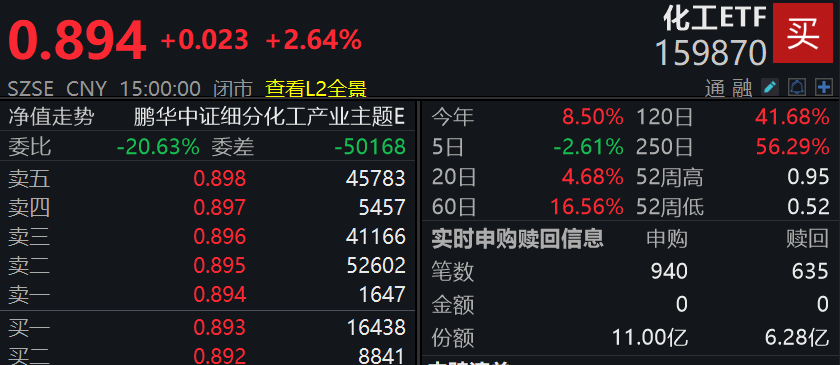
Group 1 - Chemical stocks collectively rose today, with the Chemical ETF (159870) seeing a net subscription of 472 million shares, marking four consecutive days of net inflow [1] - The recovery of the industry is driven by anti-involution policies, with the civil explosives sector benefiting from both western development and overseas expansion [1] - The demand for humanoid robots has surged, driving the rise of the specialty plastics industry, with PEEK materials becoming a core beneficiary [1] Group 2 - Tesla's Optimus-Gen2 utilizes PEEK materials to achieve weight reduction and speed enhancement, confirming its irreplaceability in key components such as joints and transmission systems [1] - PEEK materials exhibit excellent properties such as high-temperature resistance, high strength, and self-lubrication, with high production process barriers due to complex polymer reactions and precision processing controls [1] - The estimated value of PEEK materials for a single humanoid robot ranges from 1,367 to 4,102 CNY, indicating a broad market potential as the industry scales [1] Group 3 - As of February 6, 2026, at 15:00, the CSI Sub-Industry Chemical Theme Index (000813) rose by 2.48%, with component stocks such as Enjie Co., Ltd. up by 10.00%, Hongda Co., Ltd. up by 6.86%, and Zhejiang Longsheng up by 6.18% [1] - The Chemical ETF (159870) increased by 2.64%, with the latest price reported at 0.89 CNY [1] - The CSI Sub-Industry Chemical Theme Index consists of seven sub-indices, reflecting the overall performance of listed companies in related sub-industries [2]

长城基金陈良栋:看好2026年A股市场 重点关注两大方向
Xin Lang Cai Jing· 2026-02-06 09:03
2026年开年以来,科技成长板块再度成为上攻行情中的重要引擎。但近期市场震荡整固,科技成长板块 也呈现显著分化,立足当下展望后市,A股市场将如何表现?哪些投资方向值得重点关注?针对这些投 资者关心的问题,我们一起来看长城基金基金经理陈良栋的解读。 专题:2026年度投资策略|顶级基金公司、基金经理展望马年投资机会 专题:2026年度投资策略|顶级基金公司、基金经理展望马年投资机会 2026年开年以来,科技成长板块再度成为上攻行情中的重要引擎。但近期市场震荡整固,科技成长板块 也呈现显著分化,立足当下展望后市,A股市场将如何表现?哪些投资方向值得重点关注?针对这些投 资者关心的问题,我们一起来看长城基金基金经理陈良栋的解读。 陈良栋表示,总体看好2026年A股市场投资机会,原因包括:1)全球处于秩序变化和重建过程,中国 有能力维持一个可持续的预期稳定的经营环境,随着房地产去杠杆到了中后期,对宏观经济的影响将会 降低,加上刺激消费和"反内卷"政策的推出,市场对国家稳住宏观经济信心增强;2)在美国持续进入 降息周期,以及人民币汇率走强预期下,A股市场估值具备吸引力;3)人工智能带动全球新一轮的技 术升级和效率提升, ...
中国化工行业展望:供需拐点将至,行业分化开启
Zhong Cheng Xin Guo Ji· 2026-02-06 08:41
Investment Rating - The report provides a stable investment outlook for the chemical industry, with specific segments showing varying degrees of stability and weakening [3]. Core Insights - The report anticipates a turning point in the chemical industry in 2026, driven by the gradual implementation of "anti-involution" policies, although the extent of demand recovery in certain downstream sectors remains uncertain [2][4]. - The chemical industry is expected to shift its growth drivers towards technological innovation and industrial upgrades, while still needing to monitor the recovery of traditional downstream sectors like real estate [4]. - The report highlights that the peak investment period for the chemical industry has passed since 2025, with ongoing pressure from excess capacity in general materials and structural differences in demand [4][5]. - Financial performance among chemical companies has shown significant divergence since 2025, indicating potential risks for companies with weaker credit profiles [4][5]. Summary by Sections Analysis Approach - The analysis focuses on the credit fundamentals of the chemical industry, assessing factors affecting supply-demand dynamics and raw material price fluctuations to infer impacts on corporate performance and financial health [5]. Industry Fundamentals - Since 2025, the domestic economy has maintained a stable growth trajectory, but external demand from developed countries has weakened, posing challenges for the chemical sector [6]. - The report notes that the recovery of traditional downstream demand, particularly in real estate, is crucial for the industry's growth, while new market opportunities will arise from technological advancements [6][9]. Industry Financial Performance - The report analyzes 556 listed companies in the chemical sector, revealing that financial performance varies significantly across different sub-sectors, with some facing greater challenges than others [37].
短期波动不改长期逻辑,化工新叙事正徐徐展开
Xin Lang Cai Jing· 2026-02-06 08:40
Core Viewpoint - The chemical industry is experiencing a pivotal moment driven by supply-side reforms, which may lead to improved profitability and valuation recovery for leading companies in the sector [4][28][38]. Group 1: Industry Overview - The chemical industry has faced significant challenges over the past four years, including excess production capacity and declining profits due to weak domestic demand and increased exports [4][5][24]. - The industry is closely linked to global economic conditions, with periods of opportunity often followed by prolonged downturns [4][24]. Group 2: Supply-Side Reforms - Recent government policies aim to eliminate low-price competition and encourage quality improvements, leading to the exit of outdated production capacities [6][7][24]. - The tightening of new capacity approvals is expected to fundamentally change the industry's landscape, reducing excess supply both domestically and globally [7][27]. Group 3: Profitability and Valuation Recovery - The chemical sector may witness a "Davis Double Play" scenario, where both profitability and valuations improve simultaneously [28]. - Current valuations for leading chemical companies remain low, not reflecting their asset scale or market position, indicating potential for significant upward revaluation [29][30]. Group 4: Market Consensus - There is a growing consensus among institutional investors regarding the chemical sector, driven by confidence in policy execution, recognition of bottoming profitability, and acknowledgment of low valuations [31]. Group 5: Short-Term Adjustments and Long-Term Trends - Recent fluctuations in the chemical sector are viewed as short-term disturbances, with the long-term positive trend and core logic remaining intact [32]. - The industry is expected to benefit from a tightening supply environment and ongoing policy support, which may lead to a positive shift in price expectations for chemical products [32][34]. Group 6: Investment Strategies - Investment opportunities in the chemical sector can be captured through a professional framework that focuses on identifying businesses with clear pricing power and potential for profit recovery [35][36]. - Key strategies include investing in sectors with stable pricing capabilities, capturing price rebounds during market pessimism, and identifying advanced production capacities that can yield significant profits [36][37].
山西证券:反内卷政策托底煤价 煤炭供应或受约束
智通财经网· 2026-02-06 06:12
Core Viewpoint - The coal market in China is experiencing a significant adjustment in December 2025, with a notable decline in prices due to strong supply and weak demand factors, despite expectations for improved performance in coal companies in Q4 2025 and potential recovery in 2026 [1][6][7] Supply - In December 2025, China's raw coal production reached 437 million tons, a year-on-year decrease of 1% but a month-on-month increase of 2.40% [2] - The total raw coal output for 2025 is projected to be 4.832 billion tons, reflecting a year-on-year increase of 1.2%, although the growth rate has marginally declined compared to the previous month [2] Demand - The terminal demand for coal is expected to decline in 2025, with fixed asset investment decreasing by 3.8%, including a 17.2% drop in real estate investment [3] - In December 2025, the growth rates for various sectors were negative, including thermal power at -3.2%, pig iron at -9.9%, and cement at -6.6% [3] Imports - Coal imports in December 2025 saw a significant month-on-month increase of 33.02%, totaling 58.6 million tons, which is a year-on-year increase of 11.95% [4] - However, the total coal import volume for 2025 is expected to be 490 million tons, a year-on-year decrease of 9.6% [4] Prices - December 2025 witnessed a decline in coal prices across various types, with the average prices for Shanxi premium mixed 5500 thermal coal, Beijing-Tangshan main coking coal, and Tianjin secondary metallurgical coke all adjusting downwards [5][6] Market Dynamics - The adjustment in coal prices is attributed to strong supply and weak demand, with factors such as weather, renewable energy, and real estate failing to support coal demand adequately [6] - Despite concerns over the rapid price decline in December, the trend of "anti-involution" remains unchanged, with expectations for policy support to stabilize prices in January 2026 [7] Investment Focus - Companies to watch in the thermal coal sector include Yanzhou Coal Mining (600188.SH), Shaanxi Coal and Chemical Industry (601225.SH), China Shenhua Energy (601088.SH), and others [8] - In the coking coal sector, focus on Shanxi Coking Coal (000983.SZ), Huaibei Mining (600985.SH), and Lu'an Environmental Energy (601699.SH) [8]

【恒力石化(600346.SH)】实控人首次增持公司股份,彰显未来发展信心——公告点评(赵乃迪/蔡嘉豪)
光大证券研究· 2026-02-05 23:08
查看完整报告 特别申明: 本订阅号中所涉及的证券研究信息由光大证券研究所编写,仅面向光大证券专业投资者客户,用作新媒体形势下研究 信息和研究观点的沟通交流。非光大证券专业投资者客户,请勿订阅、接收或使用本订阅号中的任何信息。本订阅号 难以设置访问权限,若给您造成不便,敬请谅解。光大证券研究所不会因关注、收到或阅读本订阅号推送内容而视相 关人员为光大证券的客户。 报告摘要 点击注册小程序 点评: 实控人首次增持公司股份,彰显未来发展信心 公司2025年4月9日发布《关于实际控制人增持公司股份计划的公告》,实际控制人之一陈建华先生计划自 2025年4月9日起12个月内,以自有资金或自筹资金通过上海证券交易所交易系统以集中竞价交易方式增持 本公司股份,增持金额不低于人民币5亿元,不超过人民币10亿元。2026年2月3日,公司实际控制人首次 增持公司股份。公司作为国内领先的民营炼化一体化企业,其实际控制人之一陈建华先生此次增持未导致 公司控制权结构发生变化,公司治理结构保持稳定。自2025年7月中下旬以来,随着大炼化行业景气度逐 步修复,公司股价涨幅显著,当前时点公司实控人增持公司股份,展现出对公司未来发展的信心。 ...


1月份中国大宗商品价格指数创2022年7月份以来新高
Zheng Quan Ri Bao· 2026-02-05 16:55
Core Insights - In January 2026, China's Commodity Price Index (CBPI) reached 125.3 points, marking a month-on-month increase of 6.3% and a year-on-year increase of 12.7%, the highest since July 2022 [1] - The increase in the index is attributed to optimistic business expectations and ongoing production expansion, supported by new policies, while also facing challenges from international geopolitical changes and commodity price volatility [1] Industry Analysis - The non-ferrous price index surged to 159.6 points, with a month-on-month increase of 9.9% and a year-on-year increase of 26.6% [2] - The chemical price index rose to 99.3 points, showing a month-on-month increase of 3.8% but a year-on-year decrease of 9.8% [2] - The black metal price index increased to 79.2 points, with a month-on-month rise of 2.2% and a year-on-year decline of 1.6% [2] - The agricultural product price index slightly increased to 98.3 points, with a month-on-month rise of 0.2% and a year-on-year increase of 5.7% [2] - The mineral price index fell to 71.3 points, with a month-on-month decrease of 0.3% and a year-on-year decrease of 10.3% [2] - The energy price index declined to 94.6 points, with a month-on-month drop of 3.2% and a year-on-year decrease of 11.6% [2] Commodity Performance - Among 50 monitored commodities, 33 (66%) saw price increases, while 17 (34%) experienced price declines in January compared to December 2025 [2] - The top three commodities with the highest price increases were lithium carbonate (up 48.4%), refined tin (up 20.2%), and refined nickel (up 19.5%) [2] - The commodities with the largest price declines were corrugated paper (down 13.1%), caustic soda (down 7%), and coke (down 6.9%) [2] Geopolitical and Market Trends - Tensions in North America and the Middle East, along with a weakening US dollar, have contributed to rising international oil prices and record highs in copper prices [3] - Gold and silver prices reached historical highs in January, but significant declines were observed towards the end of the month due to margin adjustments and Federal Reserve announcements [3] - Future projections suggest that gold prices may experience both upward trends and volatility, with ongoing geopolitical risks providing long-term support despite short-term fluctuations [3]
1月中国大宗商品价格指数创近三年半来新高
Zhong Guo Xin Wen Wang· 2026-02-05 08:21
Core Viewpoint - In January, China's Commodity Price Index (CBPI) reached 125.3 points, marking a month-on-month increase of 6.3% and a year-on-year increase of 12.7%, the highest since July 2022 [1] Group 1: Market Trends - The increase in the CBPI indicates a continued recovery and positive market sentiment, supported by national strategic policies and optimistic business expectations [1][2] - The rise in prices is influenced by international geopolitical changes, expectations of loose monetary policy, and significant fluctuations in commodity futures prices, leading to rapid increases in prices of non-ferrous metals and chemicals [1] Group 2: Sector Analysis - The non-ferrous price index saw a substantial increase, while the chemical price index also rose quickly; the black series price index continued to recover, and agricultural product prices increased slightly [1] - Among the 50 monitored commodities, 33 (66%) experienced price increases, while 17 (34%) saw price declines in January [1] - The top three commodities with the highest price increases were lithium carbonate, refined tin, and refined nickel; the top three with the largest declines were corrugated paper, caustic soda, and coke [1]
创金合信基金魏凤春:应对波动市场的确定性布局
Xin Lang Cai Jing· 2026-02-05 07:15
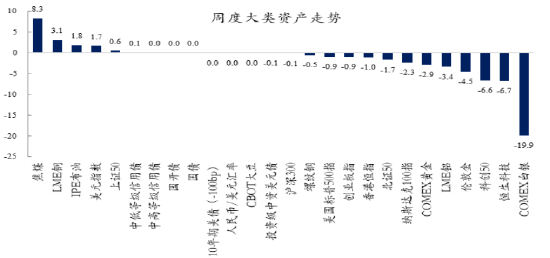
本文作者为创金合信基金首席经济学家魏凤春 上期首席视点从政府纠正市场失灵的角度提出了需要从基本面出发进行布局,其背景是预计2026年波动 加剧是市场基本的特征,本周金银铜罕见的波动验证了这一特征。过渡期的市场,周期的错位与驱动力 的转换是市场波动的主要来源,如何通过相对确定性的策略来应对市场的波动是本首席视点着重讨论的 内容。2026年市场的本质是五大周期共振下的结构重塑,波动源于周期错位,机会藏于周期协同。面对 相对高波动环境,关键在于把握政策托底、产业分化、物价回升等较为确定性的逻辑,以周期为纲、以 盈利为锚,应对波动、把握主线。 一、波澜壮阔的一周 在西方经济学和金融学占主导的金融市场,源远流长的中华文化对现代市场的前瞻性判断越来越受到投 资者的关注。2026年岁在丙午,干支为赤马红羊,过去的一周,市场波动剧烈。虽然说波动是市场的常 态,但凡事都有个度,超过了这个度,量变引起质变,节奏和趋势的边界就模糊了。在之前的首席视点 中,我们已经指出:从周期视角与市场运行规律看,波动加大将成为贯穿全年的核心特征。这并非单纯 是周期玄学在起作用,而是国内市场驱动力切换、全球秩序重构与货币政策不确定性共同作用的必然结 ...
供需双弱格局延续,铜价暂陷震荡格局
Hua Tai Qi Huo· 2026-02-05 03:39
1. Report Industry Investment Rating - Copper: Cautiously bullish [8] - Options: Sell put options [8] 2. Core View of the Report - After a significant decline, copper prices are showing signs of stabilizing and rebounding as gold prices gradually stabilize. The persistently low TC price pattern remains unchanged, so the probability of continuous decline is not high. However, due to the approaching Spring Festival holiday, demand continues to weaken. For enterprises with buy - hedging needs, they can carry out appropriate small - scale hedging (about two weeks' worth), but the position should not be too heavy. It is expected that the copper price will operate in the range of 98,000 yuan/ton to 110,000 yuan/ton before the Spring Festival [8] 3. Summary by Relevant Catalogs 3.1 Market News and Important Data 3.1.1 Futures Quotes - On February 4, 2026, the main contract of Shanghai copper opened at 104,950 yuan/ton and closed at 105,160 yuan/ton, a 0.63% increase from the previous trading day's close. The night - session main contract of Shanghai copper opened at 104,000 yuan/ton and closed at 102,590 yuan/ton, a 2.22% decrease from the afternoon closing price of the same day [1] 3.1.2 Spot Situation - According to SMM, the average spot price of SMM 1 electrolytic copper was at a discount of 100 yuan/ton, a 20 - yuan increase from the previous day. The copper price ranged from 103,800 to 105,010 yuan/ton, and the closing price was 103,830 yuan/ton. The market supply of goods was tight, and holders were reluctant to sell at low prices, causing the spot discount to gradually narrow. Downstream procurement slowed down, and the pattern of weak supply and demand continued. It is expected that the discount will continue to narrow slightly today [2] 3.2 Important Information Summary 3.2.1 Macro and Geopolitical Aspects - Iranian Foreign Minister Araqchi clarified Iran's official stance on the talks with the US in Oman, stating that the talks will be held in Muscat, the capital of Oman, at around 10 a.m. on February 6. The US previously rejected Iran's proposal to change the original meeting location from Istanbul, Turkey, to Oman, which raised concerns in the Middle East about the possibility of Trump taking military action [3] 3.2.2 Economic Data - The US added 22,000 new ADP jobs in January, far lower than the market expectation of 48,000. The previous value was revised down from 41,000 to 37,000. The US Bureau of Labor Statistics (BLS) announced that it will release the January non - farm payroll report on February 11, the job vacancy data on February 5, and reschedule the release of the January CPI on February 13 [3] 3.2.3 Mining End - Swedish copper and zinc mining company Boliden said on February 3 that heavy rainfall in Portugal in January caused water management problems at its Somincor mine. Although the company maintained its performance guidance for the mine in 2026, it said that the overall impact of the rain on the first - quarter performance would depend on future weather conditions. Boliden's CEO Mikael Staffas said that considering the company's leverage ratio, including net reclamation debt, which is much higher than the 20% target in the dividend policy, the company will not consider additional cash distribution this year [4] 3.2.4 Smelting and Import - On February 4, the China Nonferrous Metals Industry Association announced that it has stopped more than 2 million tons of new or planned copper smelting projects, indicating a key substantial progress in the industry's self - initiated capacity management and "anti - involution" policy. The association will continue to cooperate with national departments to strictly control new copper smelting projects, aiming to reverse the passive situation of the increasing proportion of imported copper concentrates. The association is also promoting the improvement of the copper resource reserve system, including expanding the national strategic reserve scale and exploring the establishment of a commercial reserve mechanism [5] 3.2.5 Consumption - In January 2026, the terminal consumption of copper products showed the characteristic of pre - holiday rush, but there were differences among specific sectors. In the power sector, State Grid orders were the core support, but project - end orders were weak. The home appliance industry was strong due to the year - end peak season. The automotive sector had stable orders. Traditional sectors such as construction and hardware were dragged down by the real - estate slump. High copper prices significantly suppressed terminal demand, and downstream procurement showed a "buy - on - dips" characteristic. It is expected that terminal consumption will enter a seasonal trough in February [6] 3.2.6 Inventory and Warehouse Receipts - LME warehouse receipts changed by 1,450 tons to 178,650 tons compared with the previous trading day. SHFE warehouse receipts changed by 751 tons to 159,772 tons. On February 4, the domestic electrolytic copper spot inventory was 330,400 tons, a change of 7,600 tons from the previous week [7]