市场风格切换

Search documents
突发!多只高位股跳水,3倍大牛股下杀12%!银行股却逆市拉升,市场风格要切换了吗?
雪球· 2025-08-21 08:10
Market Overview - The market experienced fluctuations with mixed results across the three major indices, with the Shanghai Composite Index rising by 0.13%, while the Shenzhen Component and ChiNext fell by 0.06% and 0.47% respectively [2] - The total trading volume in the Shanghai and Shenzhen markets reached 2.42 trillion yuan, an increase of 158 billion yuan compared to the previous trading day, marking the seventh consecutive day of trading volume exceeding 2 trillion yuan [3] Stock Performance - A significant number of stocks declined, with over 3,000 stocks falling in total. Sectors such as oil and gas, digital currency, beauty care, and banking saw gains, while rare earth permanent magnets, PEEK materials, liquid cooling servers, and CPO sectors faced declines [3] - Several high-profile stocks experienced sharp declines, including Dongxin Co., which dropped over 12% after a substantial increase of over 270% in the past two months [4] - Notably, bank stocks showed resilience, with Agricultural Bank of China and Postal Savings Bank of China both reaching historical highs [9] Company Highlights - Muyuan Foods reported a nearly 9% increase in stock price, driven by a significant rise in its half-year earnings. The company achieved a revenue of 76.46 billion yuan, a year-on-year increase of 34.46%, and a net profit of 10.53 billion yuan, up 1169.77% [13][15] - The company plans to reduce its breeding sow inventory to 3.3 million by the end of the year as part of a national initiative to stabilize pig prices [18] Digital Currency Sector - The digital currency sector has seen a resurgence, with related stocks experiencing significant gains. The sector index rose over 2%, reaching a historical high [19] - Recent positive developments in the digital currency space include suggestions from U.S. Federal Reserve officials to allow staff to hold small amounts of crypto assets, and partnerships in Singapore to facilitate digital currency payments [22][23]



总量“创”辩第109期:突破3674,后市怎么看
Huachuang Securities· 2025-08-19 09:13
Group 1: Macroeconomic Insights - Weakening credit and investment indicate a potential balance in supply and demand, suggesting a positive outlook for the market[2] - The current market intervention policies have reduced stock volatility, enhancing risk-adjusted returns for equities[2] - The overall financing scale for enterprises is still growing, with improvements in equity and bond financing compared to the same period last year[12] Group 2: Fund Performance and Asset Allocation - The average return of newly established public funds in the current bull market has reached breakeven, with a total of 3 trillion yuan in new funds issued from 2019 to 2021[18] - Fund redemption pressures are expected to increase post-breakeven, particularly in sectors like new energy, pharmaceuticals, and food and beverage[22] - The total position of stock funds is at 99.11%, reflecting a 61 basis point increase from the previous week, indicating strong market sentiment[40] Group 3: Bond Market Outlook - The bond market is expected to enter a "hard mode," with the 10-year government bond yield projected to rise slightly to a core volatility range of 1.65%-1.75%[31] - The second phase of the bond market strategy emphasizes timely adjustments and profit-taking, particularly around the 1.65% yield level[31] - The liquidity gap in August is estimated to be around 1.8 trillion yuan, indicating a seasonal increase in funding pressure[29] Group 4: European Market Risks - Eurozone assets face systemic risks, including low risk premiums and potential overvaluation compared to U.S. assets[32] - The Eurozone's economic recovery remains fragile, with weak credit demand and declining growth rates in M3 money supply[33] - The strong euro has negatively impacted exports, with a decline in export growth from 3% to 0.9% year-on-year[34]
策略|牛市的再思考?
2025-08-18 15:10
Summary of Conference Call Notes Industry Overview - The notes discuss the financial market dynamics, particularly focusing on the non-bank deposit ratio as an indicator of private sector financial asset allocation, which tends to rise during bullish equity markets and decline when the real economy and real estate are weak [1][3][5]. Key Points and Arguments - **Non-Bank Deposit Ratio Trends**: The non-bank deposit ratio has shown significant increases during periods of strong equity market performance, specifically noted in July 2020, December 2021, and projected from December 2023 to December 2024. Currently, the ratio stands at approximately 13%, with historical highs reaching 14% [1][4]. - **Impact of Economic Indicators**: The Producer Price Index (PPI) and housing price diffusion index are critical in assessing the influence of the real economy and real estate returns on financial asset allocation. Weakness in these indicators leads to a preference for financial assets, as seen in historical cycles from 2011-2015 and 2014-2015 [1][5]. - **Policy Environment**: The political bureau meeting on July 30 emphasized risk prevention in key areas and support for capital market development, indicating a favorable policy outlook for the capital markets while being less optimistic about real estate [6]. - **Historical Market Dynamics**: The analysis of the 2014 market shows that an increase in incremental capital significantly supported the stock market, with a notable rise in new account openings and silver-to-stock transfers in the latter half of the year [7][8]. - **Market Style Shifts**: Historical data from 2014 and 2015 indicates that market styles shifted based on the influx of capital. High-performing stocks, large-cap stocks, and low P/E stocks outperformed during periods of significant capital inflow, suggesting a potential for similar trends if new capital enters the market [9]. Additional Important Insights - **Current Market Sentiment**: There is a growing trend of style switching in the market, with a need to monitor retail investors and private sector tendencies towards equity asset allocation. An increase in this inclination could lead to a higher likelihood of style shifts [2][10]. - **Future Projections**: If the slope of capital inflow continues to steepen, it may lead to a reversal of past effective factors, with a potential preference for high-performing and large-cap stocks in a low real economy return environment [9][10]. This comprehensive analysis highlights the interconnectedness of economic indicators, policy decisions, and market dynamics, providing a framework for understanding potential investment opportunities and risks in the current financial landscape.
债市情绪面周报(8月第2周):股市十年新高之际,债市情绪如何?-20250818
Huaan Securities· 2025-08-18 12:36
Report Summary 1. Report Industry Investment Rating The provided report does not mention the industry investment rating. 2. Core Viewpoints - **Hua'an Securities' View**: Amid the market style shift, there are still short - term long - trading opportunities in the bond market. Although the bond market has faced a style shift due to the strong performance of the stock and commodity markets, investors can still find long - trading opportunities such as taking advantage of the steeper curve and wider spreads, paying attention to the increased willingness of allocation investors to buy bonds when funds are loose, considering the possible short - covering of certain 30 - year Treasury bonds, and seizing the entry opportunity after the bond market correction. [2] - **Seller's View**: Only 30% of fixed - income sellers are bullish on the bond market, over 60% hold a neutral attitude, and the sentiment remains the same as last week. [3] - **Buyer's View**: The overall view of fixed - income buyers is neutral, and the sentiment index has declined. Over 80% of buyers hold a neutral view. [3] 3. Summary by Directory 3.1 Seller and Buyer Market - **Seller Market Sentiment Index and Interest - rate Bonds**: The weighted sentiment index this week is 0.21, up from last week, and the unweighted index is 0.26, unchanged from last week. 32% of institutions are bullish, 61% are neutral, and 6% are bearish. [11] - **Buyer Market Sentiment Index and Interest - rate Bonds**: The weighted sentiment index this week is 0.05, down 0.07 from last week, and the unweighted index is 0.06, down 0.097 from last week. 13% of institutions are bullish, 81% are neutral, and 6% are bearish. [12] - **Credit Bonds**: The market focuses on the "stock - bond seesaw" and "stable wealth - management scale". Due to the continuous rise of the equity market suppressing the bond market, it is recommended to shorten the duration. The wealth - management scale is stable, and the short - term liability pressure is controllable. [16] - **Convertible Bonds**: Institutions generally hold a neutral - to - bullish view this week. 77% of institutions are bullish, and 23% are neutral. [19] 3.2 Treasury Bond Futures Tracking - **Futures Trading**: As of August 15, the prices of TS/TF/T/TL Treasury bond futures contracts decreased compared to last Friday, the trading volume increased, the open interest decreased, and the trading - to - open - interest ratio increased. [24][25] - **Cash Bond Trading**: On August 15, the turnover rates of 30Y Treasury bonds, interest - rate bonds, and 10Y China Development Bank bonds all increased compared to last week. [32] - **Basis Trading**: Except for the TS contract, the basis of other main contracts narrowed. The net basis of TS/T/TL main contracts widened, and the IRR of main contracts generally increased. [44][45][47] - **Inter - period and Inter - variety Spreads**: The inter - period spreads of main contracts generally widened, and the inter - variety spreads showed mixed trends. [58][59]
7月零售、投资环比意外转负
HUAXI Securities· 2025-08-15 11:33
Economic Performance - July industrial added value growth slowed to 5.7%, down 1.1 percentage points from the previous month, while retail sales growth fell to 3.7% from 4.8%[2][3] - The weighted year-on-year growth rate of investment, retail, and export delivery value dropped to -0.1%, a decrease of 3 percentage points compared to the previous year[1] Demand and Supply Dynamics - The gap between supply and demand indicators reached 5.8 percentage points, the highest in recent years, indicating a significant demand shortfall[1] - July's industrial production and sales rate was 97.1%, down 0.2 percentage points year-on-year, showing a slight improvement compared to the previous month's decline of 0.3 percentage points[1] Export and Retail Trends - Export delivery value growth decreased to 0.8% in July from 4.0% in June, contributing approximately 0.09 percentage points to industrial added value growth, a drop of 0.35 percentage points from June[2] - Automotive retail sales plummeted to -1.5% in July, significantly impacting overall retail performance, which saw a reduction of 0.4 percentage points in its contribution[3] Investment Insights - Fixed asset investment growth for January to July was 1.6%, with a notable decline of 1.2 percentage points from the previous month, while equipment investment grew by 15.2%, down 2.1 percentage points[4] - July's fixed asset investment year-on-year dropped to -5.3%, influenced by extreme weather conditions affecting outdoor construction activities[4] Real Estate Market - Real estate sales area and sales value in July fell by 7.8% and 14.1% year-on-year, respectively, indicating a continued weakness in the sector[5] - New residential prices in July saw a month-on-month decline of 0.3%, with second-hand housing prices dropping by 0.5%, reflecting ongoing market challenges[5] Overall Economic Outlook - The overall economic data for July indicates a slowdown, with production showing resilience while demand remains weak[6] - The potential for new economic policies may arise in September and October, particularly in the real estate sector, as authorities seek to stabilize the market[5][8]
20cm速递|科创创业ETF(588360)涨超2.1%,市场风格切换与创新药赛道逻辑解析
Mei Ri Jing Ji Xin Wen· 2025-08-14 06:32
Group 1 - The core viewpoint is that the current economic environment is characterized by stable recovery, with market risk appetite influencing market dynamics. The Politburo meeting in July emphasized the continuity and stability of policies, indicating that macro liquidity will remain loose [1] - Incremental funding is currently dominated by financing funds, private equity, and active funds such as industry/theme ETFs. It is expected that the technology sector, which has a relatively high but low-level prosperity, and small-cap styles will outperform [1] - In July, the market showed an upward trend, with technology and small-cap growth styles performing well. Leading technology stocks and the ChiNext Index led the gains, with industry performance focusing on anti-involution price increases and technology [1] Group 2 - The Science and Innovation Entrepreneurship ETF (588360) tracks the Science and Innovation Entrepreneurship 50 Index (931643), which can have a daily fluctuation of up to 20%. This index selects the 50 largest emerging industry listed companies from the Sci-Tech Board and ChiNext to reflect the overall performance of representative emerging industries [1] - The index emphasizes technology attributes and growth potential, focusing on sectors such as information technology, industrial, and healthcare [1] - Investors without stock accounts can consider various fund options, including the Guotai CSI Science and Innovation Entrepreneurship 50 ETF linked C (013307) and A (013306), as well as the Guotai ChiNext 50 ETF linked A (023371) and C (023372) [1]

帮主郑重:沪指站上3700点!但4200股下跌藏玄机,这波行情要换打法?
Sou Hu Cai Jing· 2025-08-14 04:35
Group 1 - The A-share market experienced a mixed performance, with the Shanghai Composite Index reaching a four-year high of 3700 points before declining slightly, closing up 0.2%, while over 4200 stocks in the market were down [1][3] - The rise in the index was primarily driven by large financial stocks, with China Pacific Insurance rising over 4% and Changcheng Securities hitting the daily limit, indicating strong support from major players [3] - The digital currency sector saw significant activity, with stocks like Guotou Intelligent and Hengbao shares hitting the daily limit, suggesting that the market is anticipating favorable policy developments [3] Group 2 - There was a notable increase in trading volume, reaching 1.4 trillion yuan, indicating a divergence in market sentiment, with some investors chasing hot stocks while others were quietly selling off [3] - Certain sectors, such as military equipment and CPO, experienced sharp declines, with stocks like Beifang Changlong and Changcheng Military Industry dropping nearly 7%, likely due to profit-taking and a shift in market focus [3] - Despite the Shanghai Composite Index hitting a new high, the Shenzhen Component and ChiNext Index both fell, highlighting that market enthusiasm was concentrated in a few sectors, which may indicate a lack of sustainability in the rally [3][4] Group 3 - For long-term investors, the rise of large financial stocks signals a recovery in market confidence, but the widespread decline in individual stocks serves as a caution against chasing trends [4] - The performance of the index does not guarantee that all stocks will rise, emphasizing the need for investors to identify opportunities in less active stocks while being cautious of overvalued sectors [4] - The ability of the index to maintain its position above 3700 points will be crucial, as continued volume growth could indicate further upward momentum, while a failure to hold could suggest a need for caution [4]
市场风格切换,大盘成长品种中证A500ETF指数基金(159215)红盘上扬
Sou Hu Cai Jing· 2025-07-17 02:33
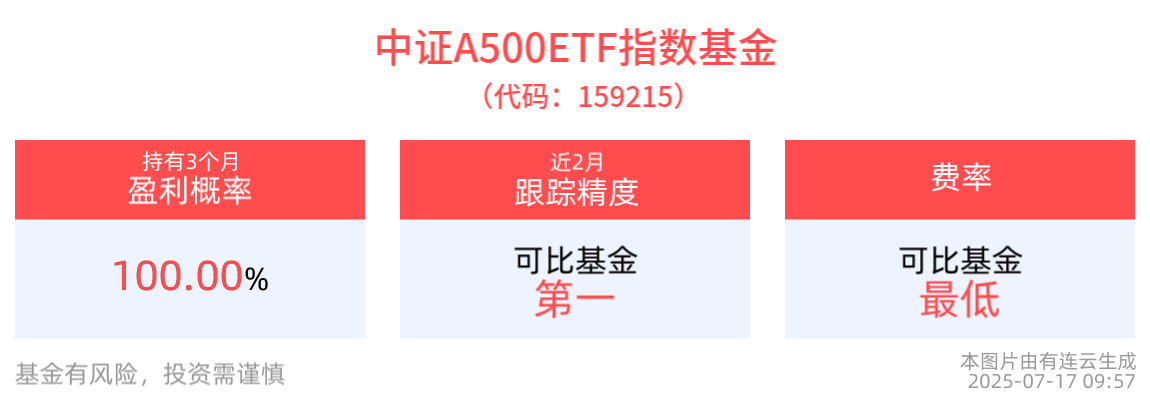
Core Insights - The China Securities A500 Index (000510) has shown a positive performance with a 0.24% increase as of July 17, 2025, with notable gains in constituent stocks such as Dongshan Precision (002384) up by 8.17% and TCL Zhonghuan (002129) up by 6.62% [2] Group 1: Market Performance - The China Securities A500 ETF Index Fund (159215) has increased by 0.38%, with a latest price of 1.04 yuan [2] - Over the past week, the A500 ETF Index Fund has accumulated a 0.78% increase [2] - The fund's trading volume showed a turnover of 0.09% with a transaction value of 1.4408 million yuan [2] - The fund's average daily transaction value over the past month was 78.9665 million yuan [2] - The latest fund size reached 1.642 billion yuan [2] Group 2: Fund Performance Metrics - Since its inception, the A500 ETF Index Fund has achieved a maximum monthly return of 3.52% and a longest consecutive monthly gain of 2 months with a total increase of 5.29% [3] - The fund has a monthly profit percentage of 66.67% and a monthly profit probability of 79.63% [3] - The maximum drawdown since inception was 8.01%, with a recovery period of 35 days [3] - The fund's management fee is 0.15% and the custody fee is 0.05%, which are among the lowest in comparable funds [3] - The tracking error over the past 2 months was 0.030%, indicating the highest tracking precision among comparable funds [3] Group 3: Top Holdings - As of June 30, 2025, the top ten weighted stocks in the A500 Index include Kweichow Moutai (600519), CATL (300750), and Ping An Insurance (601318), collectively accounting for 20.67% of the index [4] - The weightings of the top stocks are as follows: Kweichow Moutai at 0.38%, CATL at 0.29%, and Ping An at 0.22% [6]
A股唯一可媲美英伟达的板块,变天在即?
财富FORTUNE· 2025-07-16 13:01
Core Viewpoint - The banking sector has emerged as a standout performer in the A-share market this year, with a market capitalization increase of over 2 trillion yuan, drawing comparisons to the tech giant Nvidia [1] Group 1: Performance and Valuation - As of July 16, the bank ETF (512800) tracking the China Securities Bank Index has risen 36% over the past year, with a year-to-date increase of over 19%, significantly outperforming the CSI 300 and Shanghai Composite Index [2] - The core logic supporting the banking sector's performance includes policy-driven insurance fund allocation, institutional demand for high dividends, and expectations for valuation recovery [2] - Current bank sector valuations are low, with a price-to-book (PB) ratio around 0.7, which is at the 39th percentile over the past decade, and a dividend yield of approximately 4%, making it attractive compared to the 10-year government bond yield of about 1.6% [2] Group 2: Risks and Market Sentiment - Recent market movements indicate increasing divergence in sentiment, with the banking sector experiencing a pullback after three consecutive days of decline from July 14 to 16, leading to some investors being trapped in high positions [3] - A significant signal of caution emerged when China Life, a major shareholder, announced plans to fully divest its 0.70% stake in Hangzhou Bank within three months, interpreted as a warning against the current high valuations of bank stocks [3] - The logic for bearish sentiment is based on the risks of overheating and the potential for a breakdown in the supportive "club" of institutional investors, as some bank stocks have surged over 40% this year, creating substantial profit-taking opportunities [4] Group 3: Market Dynamics and Future Outlook - The average dividend yield of the four major banks has dropped to 3.85%, nearing a decade-low, raising concerns about the attractiveness of bank stocks [4] - The banking sector is facing unprecedented challenges, with net interest margins historically falling below non-performing loan rates, posing a serious threat to long-term profitability [4] - As bank stocks face pressure, leading tech stocks have surged, indicating a reallocation of funds from banks to growth sectors, suggesting a potential shift in market dynamics [4][5] - While the banking sector still has support from low valuations and potential incremental capital, the signs of overheating, reduced insurance fund holdings, and fundamental pressures indicate that its leading position may be under significant challenge [5]
指数基金全面跑赢的时代已结束,主动基金的夏天已来临
雪球· 2025-07-16 08:29
Core Viewpoint - The article discusses the cyclical nature of A-shares and the rotation between active and index funds, highlighting that the current trend may favor active funds after a prolonged period of underperformance [3][6]. Group 1: Index Funds Outperforming Active Funds - Historical instances show that index funds have outperformed active funds during five notable periods, including bull markets and specific market conditions from 2022 to 2024 [8]. - The first three instances of index funds outperforming occurred during bull markets, characterized by rapid and significant gains, typically lasting less than a year [10]. - The fourth instance, covering 2016-2018, was less intense, with index funds, particularly the CSI 300, outperforming due to a focus on large-cap value stocks [11][16]. Group 2: Reasons for Performance Rotation - Market dynamics dictate that when stocks rise significantly, they may face corrections, leading to periods where index funds appear to perform better [22]. - The influx of capital into index funds, especially ETFs, has been a significant factor in their recent outperformance, with the domestic ETF market reaching 4.32 trillion yuan as of July 4 [24]. - Economic conditions also play a role; in times of economic downturn, active stock selection may yield negative excess returns, particularly during the Federal Reserve's interest rate hikes from 2022 to 2024 [26]. Group 3: Future Outlook for Active Funds - The adjustment period for active funds has been sufficient, indicating a potential trend reversal where active funds may start to outperform again [30][32]. - Despite ongoing growth in index fund capital, there are signs of policy support for active funds, which may lead to a resurgence in their performance [34]. - Structural investment opportunities in sectors like AI and innovative pharmaceuticals may favor active fund strategies moving forward [35].