
弱美元

Search documents
西部证券晨会纪要-20250806
Western Securities· 2025-08-06 01:56
Group 1: Market Strategy - The short-term narrative of a strong US dollar has come to an end, with a focus on previously suppressed Hong Kong stocks and precious metals, while maintaining a balanced allocation in US stocks and emphasizing technology growth [1][9]. - The market is expected to shift back to a "weak dollar" narrative, benefiting precious metals like gold and silver, which have been under pressure from a strong dollar [8][9]. Group 2: Company Analysis - Cangge Mining - Cangge Mining's performance in H1 2025 was primarily driven by Jilong Copper, with a revenue of 1.678 billion yuan, a year-on-year decrease of 4.74%, and a net profit of 1.8 billion yuan, a year-on-year increase of 38.80% [2][11]. - The company has a cash dividend payout ratio of 87.14%, reflecting a strong commitment to shareholder returns, with a cash dividend of 10 yuan per 10 shares [12][13]. - Earnings per share (EPS) forecasts for 2025-2027 are 2.03, 2.55, and 3.23 yuan, with price-to-earnings (PE) ratios of 24, 19, and 15 respectively, maintaining a "buy" rating [12][13]. Group 3: Industry Insights - Nonferrous Metals - The price of potassium chloride has risen significantly due to large contracts and production cuts by major overseas manufacturers, with an average selling price of 2,845 yuan per ton, a year-on-year increase of 25.57% [12][13]. - The lithium carbonate market is currently in a bottoming phase, with prices fluctuating between 60,000 to 80,000 yuan per ton, leading to a revenue decline of 57.90% for the company's lithium carbonate business [12][13]. Group 4: Market Trends - North Exchange - The North Exchange market is experiencing a narrow fluctuation trend, with a focus on themes such as military industry, robotics, and new materials for potential rotation opportunities [3][15]. - The North Exchange A-share trading volume reached 199.7 billion yuan, with the North Exchange 50 index closing at 1,436.78, up 0.25% [15][30]. Group 5: Macro Economic Policy - The "anti-involution" policy initiated by the Central Economic Committee aims to address chaotic competition in various industries, which is expected to have a significant impact on the current low PPI prices and influence both equity and bond markets [4][19]. - The PPI is anticipated to stabilize and recover in the second half of the year, supported by the implementation of more proactive fiscal policies and moderate monetary policies [20][21].
建信期货铜期货日报-20250805
Jian Xin Qi Huo· 2025-08-05 02:01
Report Summary 1. Report Industry Investment Rating There is no information about the industry investment rating in the report. 2. Core View of the Report The current copper market shows inventory accumulation both at home and abroad, and it is the off - season for domestic demand. The short - term spot market has weak support for copper prices, and copper prices are mainly macro - driven. The weak US dollar and the loose monetary policies of China and the US are conducive to risk assets, so the short - term downside space for copper is limited, and attention should be paid to the support level of 77,000 [10]. 3. Summary by Directory 3.1. Market Review and Operation Suggestions - The Shanghai copper market showed a slight increase of 0.08%, with the main contract closing at 78,330 and the spot price rising by 90 to 78,420. The spot premium of Shanghai copper was stable, rising by 5 to 180. The premium of US - dollar copper declined, and the market supply and demand were weak. The LME0 - 3 contango structure remained around 50, and the expectation of inventory accumulation for LME copper was strong [10]. - The domestic and foreign markets are both experiencing inventory accumulation, and it is the off - season for domestic demand. The short - term spot market has weak support for copper prices. Copper prices are mainly influenced by the macro - environment. The weak US dollar and the loose monetary policies of China and the US are favorable for risk assets, and the short - term downside space for copper is limited. Attention should be paid to the support level of 77,000 [10]. 3.2. Industry News - Mitsubishi Materials Corporation is considering reducing the copper concentrate processing volume of its Onahama Smelting Co., Ltd. It plans to reduce the copper concentrate processing volume by shutting down some facilities after the scheduled equipment maintenance from October to November this year, while maintaining the processing volume of electronic waste to improve the utilization ratio of recycled materials and profitability [11]. - Non - formal miners in Peru have suspended negotiations with the government and may resume protests due to differences in the negotiations. Miners who cannot meet the deadline will be excluded from the government's work regularization plan [11]. - Vedant's performance report for the first quarter of fiscal year 2026 shows that the company's quarterly profit did not meet expectations. Although local demand was strong, it could not offset the negative impacts of falling aluminum and copper prices and increased tax expenditures. The company's total revenue increased by 6.2% year - on - year to 374.34 billion rupees (about 4.3 billion US dollars), but the net profit decreased by 11.7% year - on - year to 31.85 billion rupees [12].
如何应对弱美元:是抛售美元资产,还是对冲美元汇率?
Hua Er Jie Jian Wen· 2025-08-02 06:39
Core Insights - The article discusses the ongoing depreciation of the US dollar, which has fallen 8% since early 2025, and predicts that this trend will continue, suggesting that hedging against dollar exchange rate risks is more effective than simply selling dollar-denominated assets [1][4]. Group 1: Dollar Depreciation Trends - Since early 2025, the dollar has depreciated by 10% against developed market currencies and 8% on a trade-weighted basis [1]. - Historical data shows that during periods of dollar weakness, asset performance can vary significantly, with US equities often rising but underperforming compared to overseas markets [2]. Group 2: Macro Drivers of Dollar Movement - Goldman Sachs identifies three main factors influencing dollar trends: "US growth," "US monetary policy," and "non-US/risk premium" [3]. - Concerns about US growth typically lead to simultaneous declines in the dollar and US equities, while dovish Fed policy expectations weaken the dollar and lower US yields [3]. Group 3: Investment Strategies - The report suggests that reducing exposure to US assets may be reasonable if the dollar continues to weaken, with emerging market assets likely to benefit [4]. - The analysis indicates that hedging against currency risks in US equities may be more compelling than reducing allocations to US stocks, as returns after hedging during dollar weakness periods have been comparable to global markets [4].



特朗普更喜欢“弱美元”?经济学家警告:这将伤害美国家庭
Feng Huang Wang· 2025-08-01 03:57
Group 1 - President Trump's preference for a weaker dollar is aimed at benefiting U.S. businesses, despite opposition from several economists who argue it could harm American households [1][2] - Trump claims that a weaker dollar can enhance the competitiveness of U.S. manufacturers and boost tourism, citing the recent stock price increase of Caterpillar as an example [1] - Economists warn that a weaker dollar makes imported goods more expensive, potentially driving inflation and increasing costs for everyday items, which could negatively impact families [2][3] Group 2 - The U.S. economy is characterized as consumption-driven and reliant on imports, meaning a weaker dollar could lead to higher prices for imported goods and contribute to inflation [2] - Critics highlight that the rising deficit and debt are undermining global confidence in the dollar, despite Trump's assertions that his policies will strengthen the economy [3] - The dollar index experienced a significant decline of 10.8% in the first half of the year, marking the worst performance since 1973 [3]
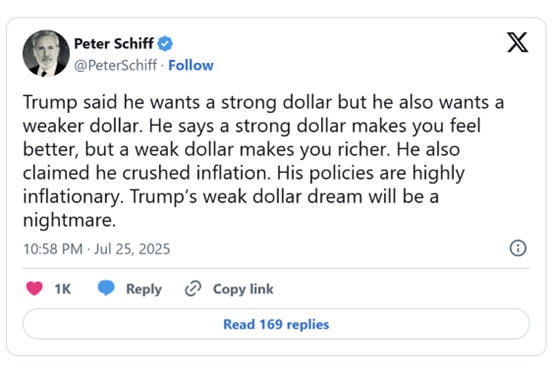
弱美元提振全球经济,IMF上调全球经济增长预期至3.1%
Hua Er Jie Jian Wen· 2025-07-30 03:04
尽管贸易紧张局势和地缘政治风险挥之不去,但弱势美元和"打了折扣"的关税为全球经济提供了意想不到的缓冲。IMF将2026年全球经济增长预 期从3.0%上调至3.1%,2025年预期从2.8%上调至3.0%。美国和中国的经济增长预期也获得上调。 7月29日(周二),国际货币基金组织(IMF)最新《世界经济展望》报告,为笼罩在贸易战阴影下的全球经济带来了些许曙光。 国际货币基金组织(IMF)上调了其对全球经济增长的预测,指出弱势美元和低于预期的美国关税,共同为世界经济提供了缓冲,使其得以展现 出一种"薄弱的韧性"。 IMF预计,2026年全球经济增长率将达到3.1%,高于4月份预测的3.0%;2025年的增长预期也从2.8%上调至3.0%。作为世界最大的两个经济体, 美国和中国的增长前景同样获得了上调。 IMF首席经济学家Pierre-Olivier Gourinchas表示,美元走弱缓解了全球金融环境,因为这降低了许多新兴市场和外国公司以美元计价的债务的偿债 成本。同时,他指出,目前美国对进口商品征收的有效关税率约为17%,低于4月份预测时所依据的24%,"关税压力有所缓解"。 然而,IMF警告称,这种复苏的根基 ...
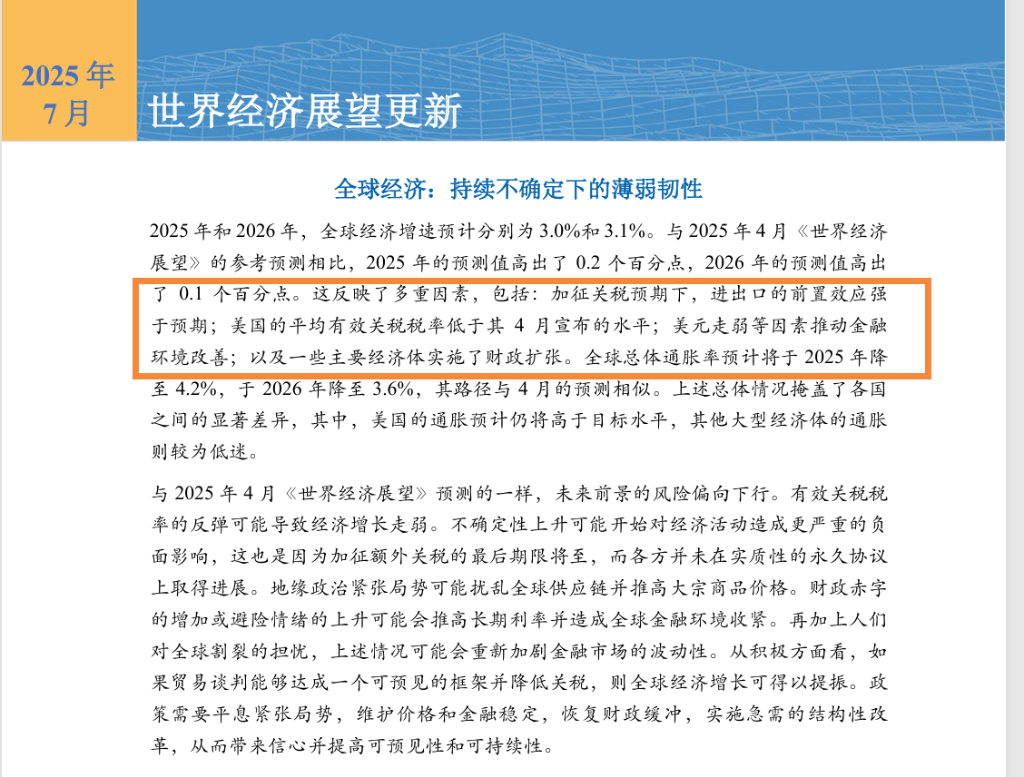
弱美元提振全球经济!IMF上调全球经济增长预期至3.1%
Hua Er Jie Jian Wen· 2025-07-30 02:52
IMF预计,2026年全球经济增长率将达到3.1%,高于4月份预测的3.0%;2025年的增长预期也从2.8%上调至3.0%。作为世界最大的两个经济体, 美国和中国的增长前景同样获得了上调。 IMF首席经济学家Pierre-Olivier Gourinchas表示,美元走弱缓解了全球金融环境,因为这降低了许多新兴市场和外国公司以美元计价的债务的偿债 成本。同时,他指出,目前美国对进口商品征收的有效关税率约为17%,低于4月份预测时所依据的24%,"关税压力有所缓解"。 然而,IMF警告称,这种复苏的根基尚不稳固。报告强调,全球经济增长仍低于3.7%的疫情前平均水平,且前景风险偏向下行。贸易政策的不确 定性、可能反弹的关税税率以及地缘政治紧张局势,都可能对经济活动造成严重负面影响。 弱美元与"打折扣"的关税成关键 7月29日(周二),国际货币基金组织(IMF)最新《世界经济展望》报告,为笼罩在贸易战阴影下的全球经济带来了些许曙光。 国际货币基金组织(IMF)上调了其对全球经济增长的预测,指出弱势美元和低于预期的美国关税,共同为世界经济提供了缓冲,使其得以展现 出一种"薄弱的韧性"。 此次IMF上调预期的核心逻辑 ...
黄金牛市未完?富达看高至4000美元 押注鸽派美联储+弱美元
智通财经网· 2025-07-29 03:28
Group 1 - Fidelity International predicts gold prices may reach $4,000 per ounce by the end of next year due to the Federal Reserve's interest rate cuts, a weaker dollar, and central banks increasing gold reserves [1][2] - Ian Samson, a multi-asset fund manager, notes that the company remains bullish on gold, with some funds increasing their gold allocation from 5% to nearly 10% over the past year [1][2] - Gold prices have risen over 25% this year, driven by uncertainties from U.S. trade policies and conflicts in the Middle East and Ukraine, alongside continued central bank purchases [1][2] Group 2 - Goldman Sachs shares a similar optimistic outlook on gold prices, forecasting a potential rise to $4,000 per ounce, while Citigroup expresses a more cautious stance predicting a decline [2] - The upcoming Federal Reserve meeting is expected to maintain current interest rates, but there may be dissent among officials advocating for support of the slowing labor market [2] - Samson highlights that gold typically benefits from a weaker dollar and lower interest rates, with ongoing central bank purchases and expanding fiscal deficits enhancing gold's appeal as a hard asset [3]
“弱美元”:来到十字路口
2025-07-29 02:10
Summary of Key Points from the Conference Call Industry Overview - The discussion primarily revolves around the **U.S. economy**, **monetary policy**, and the **impact of tariffs** on the dollar's performance in the global market. Core Insights and Arguments 1. **Weak Dollar Performance**: The dollar has weakened significantly in the first half of the year, with the dollar index around 98, influenced by a larger downward revision of U.S. economic growth compared to global growth, Trump's tariff policies, and expectations of Federal Reserve rate cuts [2][4][6]. 2. **Economic Growth Projections**: The IMF revised U.S. economic growth forecasts from 2.7% to 1.8%, while global growth was adjusted from 3.3% to 2.8%. This indicates a more significant impact on the U.S. economy compared to the global economy [2][4]. 3. **Tariff Policy Impact**: Trump's tariffs have had a strong and uncertain impact, particularly following the announcement of reciprocal tariffs in April. However, the negative impact on the U.S. economy is expected to diminish in the second half of the year due to new trade agreements [4][5]. 4. **Federal Reserve's Dilemma**: The Fed faces a dual risk of needing to cut rates due to political pressure while inflation levels do not support rapid cuts. The market anticipates two rate cuts in the second half, but the timing remains uncertain [6][7][17]. 5. **Fiscal Pressure and Dollar Weakness**: High deficit rates typically correlate with a weak dollar. The CBO predicts that interest payments as a percentage of GDP will rise, indicating potential future dollar weakness [7][9]. 6. **Tariff Revenue Projections**: U.S. tariff revenue is expected to reach $250 billion in 2025, with a potential increase of $2.5 trillion over the next decade, which may alleviate some fiscal pressures despite the "Big and Beautiful" plan increasing the deficit [9][17]. 7. **Global Fund Allocation Trends**: There has been a shift in global fund allocation, with a reduction in stock holdings and an expansion in bond holdings. The "American exceptionalism" narrative is reversing, but the dollar's status as a reserve currency remains strong [3][11][14]. 8. **Stablecoin Development**: The development of stablecoins is crucial for maintaining the dollar's reserve status in the cryptocurrency space, with the U.S. government taking steps to ensure its dominance [15]. Other Important but Potentially Overlooked Content 1. **Inflation Monitoring**: Attention is needed on structural pressures within the CPI, as rising inflation could complicate the Fed's decision-making regarding rate cuts [6][7]. 2. **Market Sentiment and Future Trends**: The market sentiment may experience a reversal in the second half of the year, with potential fluctuations in the dollar's value as it navigates between 95 and 100 [18]. 3. **Long-term Fiscal Outlook**: While there are concerns about long-term debt and fiscal health, short-term impacts on the dollar are expected to be manageable due to measures taken by the current administration [17].
美元进入贬值通道,15万亿资金回流中国,人民币升值压力增大
Sou Hu Cai Jing· 2025-07-27 08:23
Group 1 - The core issue revolves around President Trump's pressure on the Federal Reserve to lower interest rates, which he argues is necessary to stimulate the economy amid rising fiscal deficits and debt levels [1][5][9] - Trump's actions are seen as a challenge to the independence of the Federal Reserve, which is crucial for maintaining the US dollar's status as the world's reserve currency [7] - The US federal debt is projected to exceed $36 trillion by 2025, with a debt-to-GDP ratio surpassing 120%, leading to increased costs of issuing government bonds in a high-interest-rate environment [9][11] Group 2 - There is a significant capital inflow into China, with $1.2 trillion entering the market in the first half of 2025, driven by a strong economic performance and the attractiveness of RMB assets [13][15] - The RMB has appreciated by 1.9% against the USD in the first half of 2025, reflecting its growing appeal among international investors [17][19] - The trend of de-dollarization is accelerating globally, with the RMB accounting for 53% of cross-border transactions in the first half of 2025, surpassing the USD for the first time [20][21] Group 3 - The People's Bank of China is implementing measures to balance internal and external economic pressures, including adjusting reserve requirements and promoting RMB internationalization [22] - China's foreign exchange reserves increased by $115.1 billion in the first half of 2025, providing a buffer against external shocks [22]
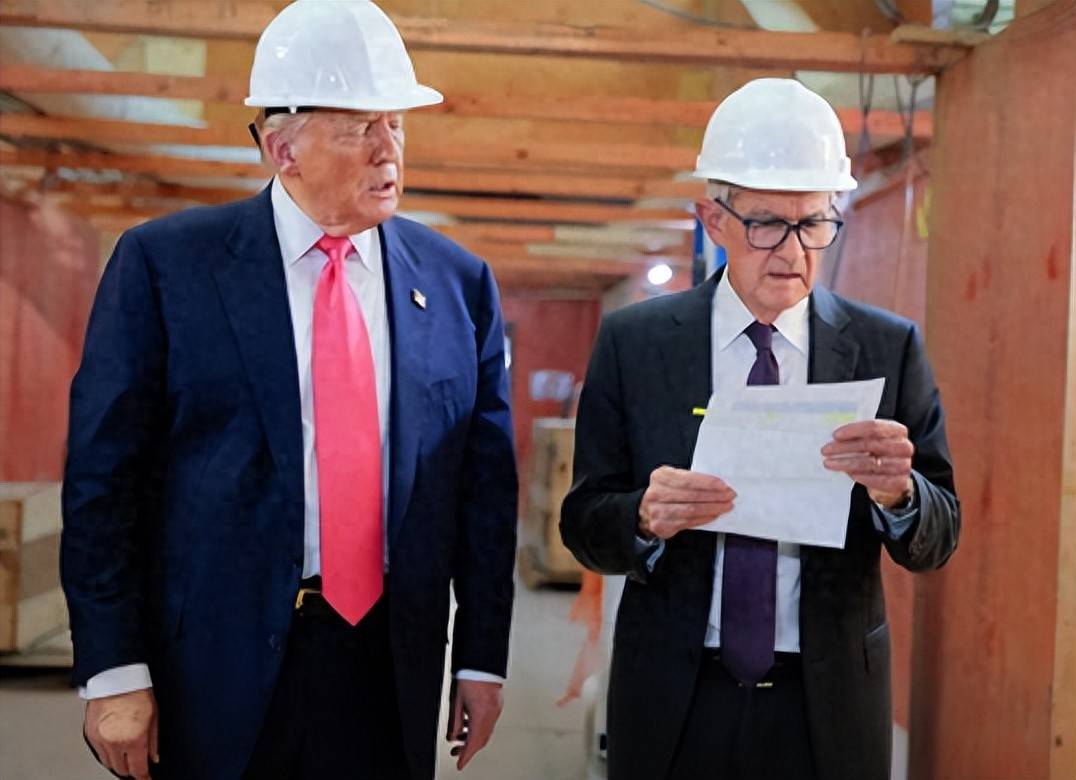
美国总统特朗普:永远不会说想要弱美元。
news flash· 2025-07-25 13:05
Core Viewpoint - President Trump stated that he will "never say" he wants a weak dollar, emphasizing the importance of a strong currency for the U.S. economy [1] Group 1 - The statement reflects the administration's stance on currency strength and its implications for trade and economic policy [1] - A strong dollar is often associated with lower inflation and increased purchasing power for consumers, which can positively impact economic growth [1] - The comments may influence market perceptions and investor sentiment regarding U.S. monetary policy and international trade dynamics [1]