
铜价走势

Search documents
大量精铜供应几乎被锁定 内外盘铜价均创历史新高
Jin Tou Wang· 2025-12-05 02:07
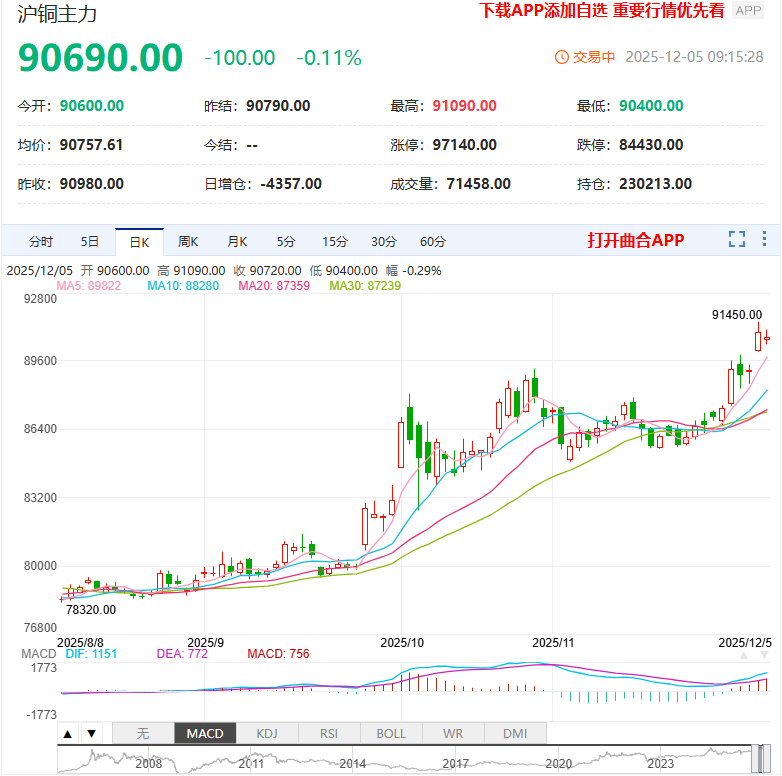
今日开盘,沪铜期货从高位回落,截止发稿,主力合约报90690.00元/吨,跌幅0.11%。 国内来看,12月4日国内市场电解铜现货库存16.45万吨,较27日降0.71万吨,较1日增0.60万吨;上海库存11.16 万吨,较27日降0.22万吨,较1日增0.28万吨;广东库存1.34万吨,较27日降0.02万吨,较1日降0.01万吨;江苏 库存3.54万吨,较27日降0.53万吨,较1日增0.26万吨。 山金期货表示,从目前的时间点看比较困难,因为首先供应端矿山26年的增长不会很高,在当前大量精铜供应 几乎被锁定的情况下实际的供需很难出现大幅过剩。另一方面年底阶段是传统旺季叠加国内新一年度稳增长政 策窗口期,企业预算的调整同样可能在短期释放需求空间,因此我们预计需求对铜价的影响仍需要一定的时间 才能显现,短期继续看好铜价向上运行。 12月4日内外盘铜价大幅走高,均创历史新高,其中国际铜2601合约日内涨超3%,沪铜2601合约日内涨超2%。 12月4日,LME单日注销仓单达5.69万吨,环比增加803%,为2013年以来的单日最大增幅。注销仓单占当日 LME铜库存比例达35%,主要集中在亚洲仓库(5.54万吨 ...

供应紧绷与需求分化,铜价高位震荡中酝酿新平衡
Sou Hu Cai Jing· 2025-12-04 14:30
(来源:中商信息CCM) 产业链经营压力凸显 高铜价对下游加工企业造成显著压力。精铜杆企业面临"两头挤压"困境:原料成本高企而加工费难以提 升。为应对成本压力,下游企业普遍缩短备货周期,部分企业库存不足一个月,甚至选择停产观望。 来源:中商信息CCM 短期展望 结论:2025年11月以来,国内铜价呈现高位震荡格局,价格重心较10月有所上移。沪铜主力合约主要在 85,000-88,000元/吨区间波动,LME铜价在10,500-11,000美元/吨范围内徘徊。11月上旬因美联储释放鹰 派信号,铜价承压回落;下旬随着降息预期回升及供应紧张态势加剧,价格重拾升势。 预计12月铜价将维持震荡偏强走势。美联储12月降息预期(目前概率回升至80%以上)将成为关键影响 因素。基本面方面,供应紧张格局难以快速缓解,而需求端将延续分化态势。需密切关注宏观政策变化 及下游对高铜价的承受能力,短期价格可能存在阶段性回调风险,但中长期供需缺口支撑下,铜价中枢 有望继续上移。 供需结构分化加剧 供应端持续紧绷是市场的核心特征。全球铜矿供应增速仅1.6%,远低于冶炼产能扩张速度。铜精矿加 工费已跌至历史低点-40美元/吨至-44.5美元 ...
如何理解本次铜价上涨以及注销仓单变动?
对冲研投· 2025-12-04 12:00
Core Insights - The article highlights a significant increase in the cancellation of warehouse receipts for copper at the London Metal Exchange (LME), reaching 50,725 tons, the highest level since 2013, indicating a sharp change in spot demand in Asia, particularly in Taiwan and South Korea [4][12]. Group 1: Cancellation of Warehouse Receipts - The cancellation of warehouse receipts is primarily driven by two factors: increased actual demand from downstream manufacturing and traders' expectations of rising copper prices, leading them to withdraw from the exchange inventory system [4][6]. - The cancellation ratio for copper has surged to over 35%, significantly higher than the historical average of 12-15%, reflecting a structural shift in global copper trade [14][12]. Group 2: Market Dynamics and Price Influences - The article identifies five typical market scenarios that influence copper prices, emphasizing the critical role of cancellation ratios in price movements [7][8][9][10][11]. - Current macroeconomic factors, including Federal Reserve policy expectations and geopolitical risks, have increased their explanatory power for price fluctuations to 65%, compared to a historical average of 40% [12]. Group 3: Supply Constraints and Future Outlook - Future copper supply is expected to face three main constraints: declining resource quality, lagging capital expenditures, and increased geopolitical risk premiums [30]. - The article suggests establishing a multi-dimensional monitoring system focusing on the marginal changes in LME cancellation ratios, inventory turnover rates, and macroeconomic sentiment indicators to better navigate the volatile copper market [31].

11000新高后,高盛对铜价发出警告:年内供应过剩50万吨,明年或区间震荡
美股IPO· 2025-12-04 08:19
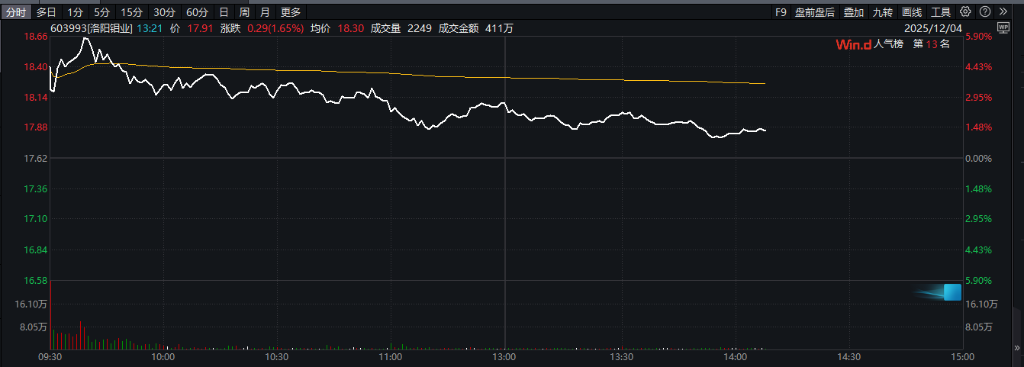
高盛认为,近期铜价上涨主要基于对未来市场紧缺的预期,而非当前基本面支撑,预计2026年铜价将在1万至1.1万美元区间震荡。该行预测今年铜供应 将比需求多出约50万吨,2026年逐步趋于平衡,真正的短缺要到2029年才会出现。 在最新发布的研报中,高盛的Aurelia Waltham分析师团队写道, 近期铜价上涨主要基于对未来市场紧缺的预期,而非当前基本面支撑。该行预计今年 铜供应将比需求多出约50万吨,铜短缺要到2029年才会出现。 高盛将2026年上半年伦敦金属交易所(LME)铜均价预测上调至10,710美元,反映美国潜在关税政策推动铜流入的影响,但下半年或有小幅回调。此 外,美国以外地区的"极低"库存问题可通过更高的地区升水和更紧的伦敦金属交易所(LME)价差得到缓解。 LME铜价周三在创下每吨1.154万美元的历史新高,主要由于市场担心美国征收关税前金属大量涌入造成全球供应紧张。周四亚太地区矿业股跟随走 高,洛阳钼业A股一度上涨6%,Capstone Copper澳洲股票一度涨8.2%。 铜仍被高盛视为工业金属中的"首选",受全球电网与能源基础设施投资拉动,长期供需结构趋紧,但短期内市场仍处于小幅过剩状 ...

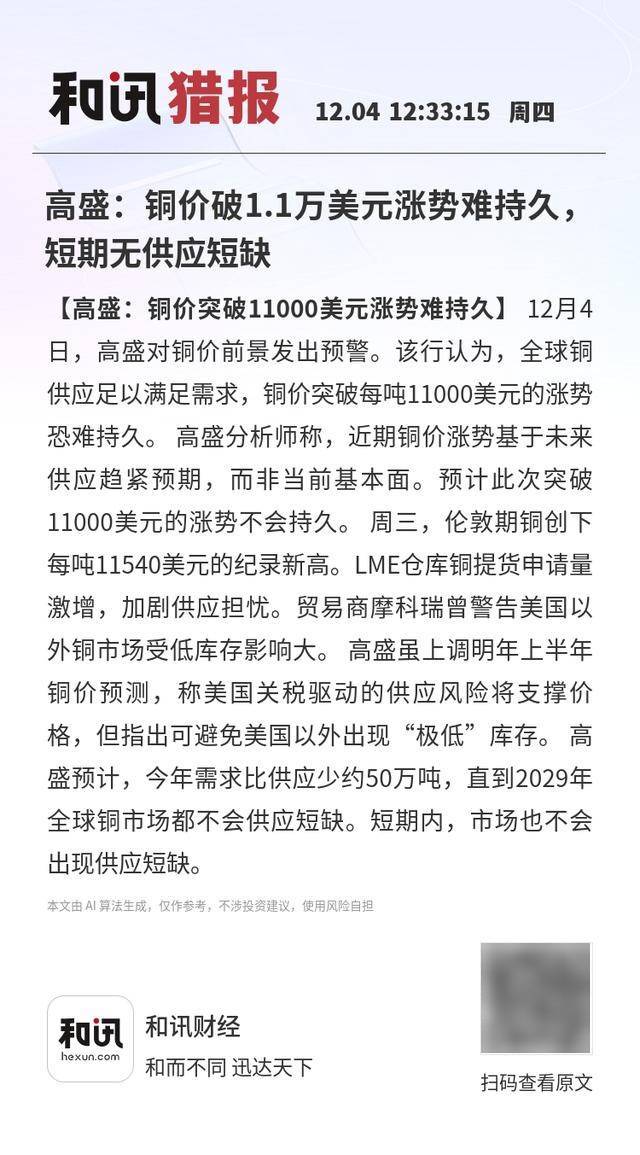
高盛:铜价破1.1万美元涨势难持久,短期无供应短缺
Sou Hu Cai Jing· 2025-12-04 06:37
和讯财经 xun.co 和而不同 迅达天下 出现供应短缺。 本文由 Al 算法生成,仅作参考,不涉投资建议,使用风险自担 【高盛:铜价突破11000美元涨势难持久】12月4日,高盛对铜价前景发出预警。该行认为,全球铜供应 足以满足需求,铜价突破每吨11000美元的涨势恐难持久。 高盛分析师称,近期铜价涨势基于未来供应 趋紧预期,而非当前基本面。预计此次突破11000美元的涨势不会持久。 周三,伦敦期铜创下每吨 11540美元的纪录新高。LME仓库铜提货申请量激增,加剧供应担忧。贸易商摩科瑞曾警告美国以外铜 市场受低库存影响大。 高盛虽上调明年上半年铜价预测,称美国关税驱动的供应风险将支撑价格,但 指出可避免美国以外出现"极低"库存。 高盛预计,今年需求比供应少约50万吨,直到2029年全球铜市 场都不会供应短缺。短期内,市场也不会出现供应短缺。 本文由 AI 算法生成,仅作参考,不涉投资建议,使用风险自担 扫码查看原文 ...

11000新高后,高盛对铜价发出警告:年内供应过剩50万吨,明年或区间震荡
Hua Er Jie Jian Wen· 2025-12-04 06:30
Core Viewpoint - Goldman Sachs warns that the recent surge in copper prices above $11,000 per ton is unsustainable due to sufficient global copper supply, predicting prices will fluctuate between $10,000 and $11,000 per ton by 2026 [1][5]. Supply and Demand Dynamics - Goldman Sachs projects a surplus of approximately 500,000 tons in the copper market for 2025, primarily due to weak demand in some Asian countries in Q4, with the surplus narrowing to 160,000 tons in 2026, indicating a gradual market balance [5]. - The recent rise in copper prices is driven by market expectations of future supply tightness rather than current demand or inventory changes, with speculative positions nearing historical highs [4][6]. - Despite concerns over low inventory levels outside the U.S., Goldman Sachs believes the severity of this issue is overstated, suggesting that regional inventory tightness can be alleviated through market mechanisms [6]. Price Forecasts - Goldman Sachs has raised its forecast for the average LME copper price in the first half of 2026 to $10,710 per ton, influenced by potential U.S. tariffs on refined copper imports, which are expected to support prices [5][7]. - The firm anticipates a slight price correction in the second half of 2026 following the implementation of tariffs, despite short-term price increases driven by tariff expectations and inventory movements [5][7]. - Long-term projections indicate that copper prices could reach $15,000 per ton by 2035, reflecting structural demand growth and resource constraints [7]. Investment Outlook - Copper is still viewed as the "preferred" industrial metal by Goldman Sachs, driven by investments in global energy infrastructure and strategic sectors like AI and defense [3][7]. - Investors are encouraged to take long positions in December 2027 LME copper contracts, with a solid price floor at $10,000 per ton expected [7].
高盛:铜价突破每吨1.1万美元“不可持续”,短缺时代尚未到来
Jin Shi Shu Ju· 2025-12-04 04:25
Group 1 - Goldman Sachs expresses caution regarding the recent surge in copper prices, stating that the breakout above $11,000 per ton will likely be temporary due to ample metal supply to meet global demand [1] - The recent rise in copper prices is primarily driven by expectations of future market tightness rather than current fundamentals, with Goldman Sachs predicting that the current price level will not be sustained [1] - Concerns over copper being rushed to the U.S. before global tariffs have led to a tightening of global supply, pushing prices to a record high of $11,540 per ton on the London Metal Exchange [1] Group 2 - Goldman Sachs forecasts a demand shortfall of approximately 500,000 tons compared to supply this year, with a significant copper shortage not expected until 2029 [2] - The anticipated supply surplus in 2026 is projected to be much smaller at only 160,000 tons, indicating that the market is moving closer to balance and suggesting that a copper shortage is not imminent [2]
铜日报:贵金属市场情绪暂时退潮,电解铜期价短期回落-20251203
Tong Hui Qi Huo· 2025-12-03 06:20
Report Industry Investment Rating - Not provided in the given content Core View of the Report - The copper price is expected to fluctuate at a high level in the next one to two weeks due to the continuous risk of structural shortage on the supply - side, support from the new energy sector but weakness in traditional sectors on the demand - side, and cautious macro sentiment [3][47] Summary According to Relevant Catalogs Copper Futures Market Data Change Analysis - **Main Contract and Basis**: On December 02, the SHFE main contract price dropped to 88,710 yuan/ton, a 0.57% decline from the previous day; the LME price fell to 11,145 dollars/ton, a 0.78% decrease. The premium of flat - water copper strengthened to 45 yuan/ton, and the LME(0 - 3) premium remained at 69.18 dollars/ton [1] - **Position and Trading Volume**: The LME position increased slightly to 334,442 lots on December 01, while the trading volume of the BC copper contract significantly shrank to 7,607 lots [1] Analysis of Industrial Chain Supply - Demand and Inventory Changes - **Supply Side**: The copper market faces a risk of structural shortage due to declining ore grades and extended project cycles. The Kamoa - Kakula smelter was put into operation on November 21, which will gradually reduce inventory. Saudi Arabia launched a mineral exploration tender, but the short - term supply increase is limited. Overall, the supply side is restricted by rising costs [2] - **Demand Side**: The demand in the power sector is stable. On December 02, Kingboard announced a 5 - 10% price increase to cope with the cost pressure of copper foil. The support from the new energy sector is evident as Nord Co., Ltd. signed a copper foil supply agreement from 2026 - 2028. However, traditional demand is weak, with the home appliance production schedule in December showing a 14.1% year - on - year decline, sluggish trading in the recycled copper rod market, and shrinking orders from brass rod enterprises [2] - **Inventory Side**: The LME inventory decreased to 30,568 tons on December 02, while the SHFE inventory rose to 161,800 tons. The SMM national inventory decreased by 14,500 tons to 159,000 tons on December 01 due to reduced imports, but a slight inventory build - up is expected [2] Industrial Chain Price Monitoring - **Spot (Premium/Discount)**: The price of SMM:1 copper premium copper decreased by 440 yuan/ton to 88,820 yuan/ton, a 0.49% decline; the flat - water copper premium increased by 20 yuan/ton to 45 yuan/ton, an 80% increase; the wet - process copper discount increased by 5 yuan/ton to - 35 yuan/ton, a 16.67% decrease; the LME(0 - 3) premium increased slightly [5] - **Price**: The SHFE price decreased by 510 yuan/ton to 88,710 yuan/ton, a 0.57% decline; the LME price decreased by 88 dollars/ton to 11,145 dollars/ton, a 0.78% decrease [5] - **Inventory**: The LME inventory decreased by 927 tons to 30,568 tons, a 2.94% decrease; the SHFE inventory increased by 2,375 tons to 161,800 tons, a 1.49% increase; the COMEX inventory increased by 2,592 short tons to 431,938 short tons, a 0.60% increase [5] Industry Dynamics and Interpretation - On December 02, the recycled copper rod market had weak follow - up price increase power of recycled copper raw materials, resulting in a widening refined - scrap price difference. However, the market trading was still sluggish [6] - On December 02, Kingboard raised the price of its copper - clad laminate products by 5 - 10% due to increased raw material costs [6] - On December 02, Nord Co., Ltd.'s subsidiary signed a 373,000 - ton copper foil supply agreement with CATL from 2026 - 2028 [6] - On December 01, the SMM national copper inventory decreased by 14,500 tons to 159,000 tons. A slight inventory build - up is expected in the future [7] - On December 01, SolGold rejected Jiangxi Copper's acquisition offer [7] Price Trend Judgment - The copper price is expected to fluctuate at a high level in the next one to two weeks, driven by the continuous risk of structural shortage on the supply - side, support from the new energy sector but weakness in traditional sectors on the demand - side, and cautious macro sentiment [3]
冶炼端消息拉涨行情
Guan Tong Qi Huo· 2025-12-02 12:24
今日沪铜高开高走,日内偏强,美国 ISM 制造业 PMI 数据持续疲软,最新数值为 48.2,不仅低于前值 48.7,弱于市场预期的 48.6。全球第二大铜矿印尼铜矿发生泥石流 事故停产后,计划自 2026 年第二季度(7 月)起,分阶段重启大规模生产,后续铜矿偏 紧预期将有缓解,稳定铜价。由于冶炼厂集中在 10 月、11 月检修,预计随着工厂的复 产,12 月铜国内产量将增加。铜冶炼厂加工费持续在 42 美元/干吨附近窄幅波动,冶炼 厂依靠副产品及长协订单维持经营成本。需求方面,截至 2025 年 9 月,铜表观消费量为 132.18 万吨,金九银十旺季结束后,铜价依然保持增长趋势,下游高价抵触情绪下,买 兴下降,铜表观需求环比减少,但下游电网及储能依然刚需托底,需求量难有大幅度的 减少。综合来看,降息预期基本在盘面充分反映兑现,后续支撑乏力,中国铜冶炼厂采 购联合体(CSPT)表示,其成员已达成减产共识,计划在 2026 年减产 10% 以上,刺激铜 价上涨,消息面支撑有限,铜价上方空间不足。 【冠通期货研究报告】 冶炼端消息拉涨行情 发布日期:2025 年 12 月 2 日 【行情分析】 资料来源:同花 ...
美联储12月降息预期升温支撑铜价:沪铜日评20251202-20251202
Hong Yuan Qi Huo· 2025-12-02 03:40
Group 1: Report Information - Report Title: "Shanghai Copper Daily Report 20251202: Rising Expectations of Fed Rate Cut in December Support Copper Prices" [1] Group 2: Copper Market Data Shanghai Copper Futures - On December 1, 2025, the closing price of the active contract was 89,280, up 1,850 from the previous period; trading volume was 189,675 lots, up 95,167; open interest was 232,702 lots, up 14,445; inventory was 31,495 tons, down 3,749 [2] - The Shanghai copper basis was -51, up 25; SMM 1 electrolytic copper - semi - average price was 89,275, up 1,875; SMM semi - water copper opening discount - half average price was 25, down 30; SMM premium copper opening discount - half average price was 190, up 10 [2] London Copper - On December 1, 2025, the LME 3 - month copper futures closing price (electronic trading) was 11,232.5, up 57; LME copper futures 0 - 3 - month contract spread was 69.1, up 24.41; LME copper futures 3 - 15 - month contract spread was 218.26, up 23.26; the Shanghai - London copper price ratio was 7.9484, up 0.13 [2] COMEX Copper - On December 1, 2025, the closing price of the active copper futures contract was 5.269, up 0.07; total inventory was 429,346, up 11,680 [2] Group 3: Core Views Supply - Demand Logic - Supply side: There are disturbances in the production of multiple copper mines at home and abroad, the China copper concentrate import index remains negative, leading to a tight domestic copper concentrate supply - demand expectation. Scrap copper supply has increased, and domestic processing fees for blister copper or anode plates have risen. The overhaul capacity of copper smelters in November decreased month - on - month [2] - Demand side: The capacity utilization rates of copper wire and cable, copper enameled wire, copper strip, copper tube, and brass rod increased compared to last week. The capacity utilization rate of refined copper rods decreased, and that of recycled copper rods remained flat. Higher copper prices suppress downstream purchasing willingness [2] - Inventory side: China's electrolytic copper social inventory decreased compared to last week, while LME electrolytic copper inventory and COMEX copper inventory increased [2] Market Outlook - Weak US employment performance has increased the probability of a Fed rate cut in December. Production disturbances in multiple overseas copper mines may make the Shanghai copper price cautiously bullish [2] Group 4: Trading Strategies - Hold previous long positions cautiously. Pay attention to the support level around 83,000 - 85,000 and the resistance levels around 90,000 - 97,000/107,000 for Shanghai copper; the support level around 10,100 - 10,500 and the resistance level around 12,300 - 13,500 for London copper; the support level around 4.8 - 5.0 and the resistance level around 5.5 - 6.0 for US copper [2]