
哑铃策略

Search documents
港股科技ETF天弘(159128)、港股通央企红利ETF天弘(159281)资金连续净流入天数均居同标的第一,机构:港股配置上重回哑铃策略
2 1 Shi Ji Jing Ji Bao Dao· 2025-11-18 02:05
Group 1 - The Hong Kong stock market indices opened lower, with both technology and dividend sectors declining [1] - The Hong Kong Stock Connect Technology Index fell over 1%, while stocks like Kingsoft Cloud rose over 6% [1] - The Tianhong Hong Kong Stock Connect Technology ETF (159128) saw a net inflow of 39.8 million yuan over two days, reaching historical highs in both shares and scale [1] Group 2 - The Hong Kong Stock Connect Central State-Owned Enterprises Dividend Index dropped over 0.7%, with companies like Sinopec and China National Offshore Oil Corporation showing gains [1] - The Tianhong Hong Kong Stock Connect Central State-Owned Enterprises Dividend ETF (159281) recorded a net inflow of 40.5 million yuan over five days, also achieving historical highs in net inflow days [1] - Tianhong Fund highlighted that the Central State-Owned Enterprises Dividend Index includes high dividend yield companies, benefiting from policy advantages and market characteristics [2] Group 3 - Recent fluctuations in the Hong Kong stock market are attributed to external volatility and investor profit-taking behavior [2] - Despite the market's current state, there are expectations for upward adjustments in external liquidity, suggesting potential investment opportunities [2] - A "barbell strategy" is recommended for asset allocation, focusing on technology and non-ferrous metals for growth, while emphasizing dividends and turnaround stocks for defense [2]


港股科技再调整?高股息资产逆市坚挺!港股上车还得回归“哑铃策略”?
Xin Lang Ji Jin· 2025-11-17 06:04
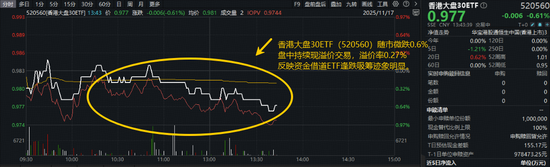
Core Viewpoint - The Hong Kong stock market continues to experience adjustments, with major indices declining, particularly in the technology and biotechnology sectors, while high-dividend stocks show resilience [1][3]. Market Performance - On November 17, the Hong Kong stock market saw a general decline, with the Hong Kong Large Cap 30 ETF (520560) dropping by 0.6% and maintaining a premium trading rate of 0.28%, indicating a buying interest in ETFs during market dips [1][3]. - Key stocks such as Alibaba, Tencent, and Xiaomi experienced varying degrees of decline, while high-dividend stocks like China National Offshore Oil Corporation and China Petroleum showed gains [3]. Economic Indicators - Hong Kong's overall export volume increased by 13.8% year-on-year in September, suggesting an improvement in the external trade environment [3]. - Analysts from Zhongtai Securities noted that the Hong Kong market is navigating between "China's fundamentals" and "overseas liquidity," with energy and financial sectors likely to act as stabilizers [3]. Investment Insights - Guotai Junan Securities highlighted that the current valuation of Hong Kong stocks may have upward potential compared to historical and overseas benchmarks, with foreign capital expected to return significantly next year, potentially exceeding 1.5 trillion yuan [3]. - The Hong Kong Large Cap 30 ETF (520560) was launched on November 12, offering a diversified investment in 30 large-cap Chinese stocks, combining a "technology + dividend" strategy for both offensive and defensive positioning [5]. ETF Composition - The top holdings in the Hong Kong Large Cap 30 Index include Alibaba (18.07%), Tencent (15.44%), and China Construction Bank (7.64%), with the top ten stocks accounting for 72.84% of the index [6].
科技板块获逆势加仓 “哑铃策略”重回视野
Zhong Guo Zheng Quan Bao· 2025-11-16 20:09
Core Viewpoint - The A-share and Hong Kong stock markets experienced high-level fluctuations last week, showcasing a structural market with a focus on both growth and value sectors, leading to a renewed interest in the "barbell strategy" among investors [1][5]. Group 1: Market Performance - The A-share and Hong Kong markets displayed notable structural characteristics, with the Hong Kong innovation drug and gold sectors leading the market [2]. - The Hang Seng Innovation Drug ETF (159316) and other ETFs tracking the Hong Kong pharmaceutical sector saw weekly gains of around 7% [2]. - A500 ETF and other major ETFs in the A-share market recorded significant trading volumes, with A500 ETF achieving over 130 billion yuan in total trading [2]. Group 2: Investment Trends - Despite a general pullback in technology-themed ETFs, funds flowed into the Sci-Tech 50 index, which saw a net inflow of 2.3 billion yuan, making it the top equity index for net inflows [3]. - The AI-themed ETFs also attracted over 1 billion yuan in net inflows, indicating strong investor interest in emerging technology sectors [3]. - The overall liquidity in A-share and Hong Kong markets is expected to remain reasonably ample, with emerging industries like AI and innovative pharmaceuticals poised for further development [3]. Group 3: Barbell Strategy - The high dividend sectors in the Hong Kong market attracted significant capital, with products like the Hang Seng Dividend Low Volatility ETF gaining attention [5]. - The "barbell strategy," which combines technology growth and high dividend stocks, is being emphasized by various institutions as a key investment approach in the current market environment [5][6]. - The current allocation of public funds in the TMT sector has reached historical highs, indicating a potential shift in market dynamics and a focus on structural opportunities [5][6].
债市专题研究:风偏回落,哑铃优先
ZHESHANG SECURITIES· 2025-11-16 11:25
Group 1: Report Industry Investment Rating - No relevant content found Group 2: Core Views of the Report - In the medium - term, the expectation of a slow - bull market in the equity market remains solid. With a temporary decline in market risk appetite, the dumbbell strategy is expected to achieve excess returns. The valuation factor and volatility factor are expected to strengthen marginally. In the short - term, attention should be paid to the risk of excess drawdown due to style mismatch in the convertible bond market. It is recommended to maintain a neutral position to enjoy the excess returns brought by the spill - over of the equity bull market, taking into account both growth and defense [1][22] Group 3: Summary by Relevant Catalog 1. Convertible Bond Weekly Thinking - From November 10 to November 14, 2025, the style of the convertible bond market changed significantly, with the tech - growth style retreating and the energy and consumption indices strengthening. The main line of the convertible bond market is not clear, and sector rotation has accelerated. The technology sectors represented by AI computing power and semiconductors have declined, while the power equipment and photovoltaic industries have performed well. The dividend style has strengthened due to risk - aversion and overseas tech valuation bubbles. As the year - end approaches, some investors may lock in profits, and the market is likely to be dominated by rotation, increasing the difficulty of convertible bond trading [11] - In the volatile market, the valuation of bond - like convertible bonds is firm, and the market tends to be defensive in the short - term. As of November 14, 2025, the median price of convertible bonds is close to 134 yuan, a recent high. The market style has shifted from offensive to defensive, with bond - biased convertible bonds performing better than equity - biased ones. The pure - bond premium rate of bond - like convertible bonds has been rising. In terms of valuation, the convertible bond valuation is oscillating at a high level, with the premium rate of bond - like convertible bonds at 84.51%, the balanced convertible bonds at about 22.66%, and the equity - like convertible bonds at 10.18%, down about 1.13 percentage points from the recent high [3][12] - In the volatile market, attention should be paid to the tail risk of the momentum factor to avoid the risk of excess return drawdown caused by trend reversal. The convertible bond momentum factor has performed well this year, mainly because it has captured the "trend effect" in the convertible bond market since Q2 2025. However, with the continuous small - scale outflow of passive funds represented by ETFs, there is a possibility of style switching in the convertible bond market. The momentum effect brought by liquidity premium may be the source of excess returns in the convertible bond market this year. In the short - term, attention should be paid to the risk of excess drawdown due to style mismatch. As the equity market enters the performance verification stage, the valuation factor and volatility factor are expected to strengthen, enabling investors to enjoy the excess returns from the value regression of undervalued convertible bonds and through high - selling and low - buying in the volatile market [4][14][19] - In November, investors are recommended to focus on convertible bonds such as Shangyin, Shouhua, Aola, Jingke, Baolong, Keshun, Yingbo, Wei, Jin 25, and Anji [23] 2. Convertible Bond Market Tracking 2.1 Convertible Bond Market Conditions - The report provides the performance data of various convertible bond indices in different time periods (recent week, recent two weeks, since September, recent month, recent two months, recent half - year, and recent one - year), including the Wande Convertible Bond Energy Index, Wande Convertible Bond Materials Index, etc. [24] 2.2 Convertible Bond Individual Securities - The report shows the top ten and bottom ten individual convertible bonds in terms of price increase and decrease in the recent week [26][27] 2.3 Convertible Bond Valuation - The report presents the valuation trends of bond - like, balanced, and equity - like convertible bonds, as well as the valuation trends of convertible bonds with different parities [28][36] 2.4 Convertible Bond Price - The report shows the proportion trend of high - price bonds and the median price trend of convertible bonds [38]

中国太平20251113
2025-11-14 03:48
Summary of China Taiping's Conference Call Company Overview - **Company**: China Taiping - **Industry**: Insurance Key Financial Performance - In the first half of 2025, China Taiping's net profit growth exceeded 60%, and net assets increased by 31% compared to the beginning of the year [2][3] - In Q3 2025, Taiping Life, a major subsidiary, reported a net profit increase of 370% for the quarter, with a year-to-date net profit growth also exceeding 60% [3] Strategic Focus and Transformation - The company successfully transitioned to a dividend insurance model, achieving a target where at least 50% of new single premiums come from this product by 2025 [2][7] - The focus for 2025 is on transformation rather than rapid growth, laying the groundwork for a strong start in 2026 [2][5] - The company is shifting towards a diversified product strategy, emphasizing traditional insurance 2.0 in the latter half of 2025 [2][5] Investment Strategy - In Q3 2025, China Taiping adjusted its investment strategy, increasing its allocation to A-shares, with 30% of new premium funds invested in this market [4][9] - The investment yield for the first half of 2025 was influenced by a conservative approach, but the company is now focusing on growth stocks in the A-share market [9][10] Tax and Regulatory Environment - The high effective tax rate in 2024 was due to losses under old accounting standards, leading to significant deferred tax assets [8] - The company expects a more accurate and lower effective tax rate after transitioning to new accounting standards in 2026 [8] Pension Ecosystem Development - China Taiping has made significant progress in building a pension ecosystem, with high occupancy rates in projects like Shanghai Wutong and Chengdu Furong [8] - The company has completed 5 to 6 major asset projects and is expanding through a light asset model to over seventy institutions [8] Competitive Positioning - The management team is highly market-oriented and committed to maintaining competitiveness through strategic execution and product diversification [6][7] - The company aims to balance between traditional and dividend insurance products while maintaining a competitive edge in the market [7] Future Outlook - China Taiping anticipates continued growth in net profit, value, and net assets, focusing on a stable investment strategy amid market uncertainties [10][11] - The company is optimistic about its stock price performance, believing it is undervalued compared to peers [17] Miscellaneous - The comprehensive cost ratio for Taiping Property & Casualty Insurance was 96.9% in the first half of 2025, marking a historical high [14] - The company is actively exploring new market opportunities while consolidating its existing positions in both domestic and international markets [14] This summary encapsulates the key points from the conference call, highlighting China Taiping's financial performance, strategic initiatives, investment strategies, and future outlook.
今日分红登记!港股红利低波ETF与中证红利质量ETF联袂月度分红进行时
Sou Hu Cai Jing· 2025-11-14 02:44
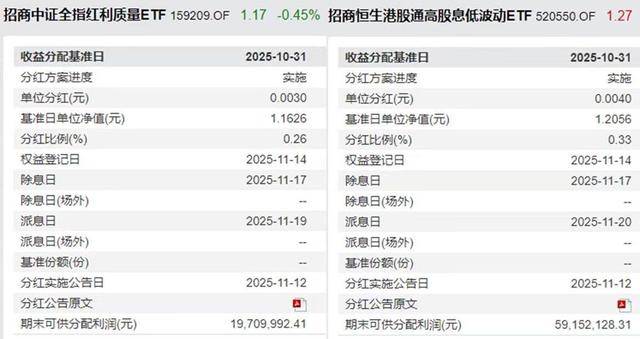
Core Viewpoint - The two ETFs under China Merchants Fund, namely the Hong Kong Dividend Low Volatility ETF (520550) and the CSI Dividend Quality ETF (159209), are demonstrating stable cash flow return capabilities with their recent dividend distributions, marking the seventh and fifth distributions of the year respectively [1] Group 1: Dividend Distribution Details - The dividend distribution record date for both ETFs is set for November 14, 2025 [1] - The unit dividend for the Hong Kong Dividend Low Volatility ETF is 0.0030 CNY, with a dividend ratio of 0.26% based on a net asset value of 1.1626 CNY [2] - The unit dividend for the CSI Dividend Quality ETF is 0.0040 CNY, with a dividend ratio of 0.33% based on a net asset value of 1.2056 CNY [2] - The payout dates are November 19, 2025, for the Hong Kong Dividend Low Volatility ETF and November 20, 2025, for the CSI Dividend Quality ETF [2] Group 2: Investment Strategy Insights - The Hong Kong Dividend Low Volatility ETF (520550) follows a "deep value" strategy, focusing on "high dividend + low volatility" factors, primarily investing in defensive sectors such as finance, energy, and utilities, with a dividend yield close to 6% [3] - The CSI Dividend Quality ETF (159209) adopts a "value growth" strategy, emphasizing "high dividend + high quality," selecting high-quality companies from growth sectors like consumer and pharmaceuticals, maintaining a dividend yield of 3%-5% while showing better price elasticity [3] - Investors are advised to adjust their allocations based on risk preferences, with conservative investors leaning towards the Hong Kong Dividend Low Volatility ETF for stable returns, while aggressive investors may focus on the CSI Dividend Quality ETF for growth opportunities [3]
新成立ETF不急于建仓 均衡配置成核心策略
Zhong Guo Zheng Quan Bao· 2025-11-13 20:04
Core Viewpoint - The recent cautious stance of ETF managers contrasts sharply with the heated market environment, indicating a shift towards a more prudent investment approach among institutional investors as they navigate market volatility and style rebalancing [1][5]. ETF Positioning - Several newly established ETFs are adopting a "low position" strategy, with some having equity positions as low as 10% or even close to zero, reflecting a wait-and-see approach before fully deploying capital [1][3]. - For instance, the Huaxia CSI Photovoltaic Industry ETF had an equity position of 33.19% as of November 11, which is below the required thresholds for investment in index components [2]. - Other ETFs, such as the Jiashi CSI Sub-Sector Chemical Industry Theme ETF and the Yifangda CSI Satellite Industry ETF, reported equity positions of 19.99% and 10.02%, respectively, as of early November [2]. Institutional Caution - The cautious behavior of ETFs is notable, as they typically aim to quickly align with their benchmark indices. However, recent listings show a significant delay in building positions, suggesting a more conservative approach from fund managers [4]. - Regulatory guidelines emphasize the need for fund managers to ensure compliance with investment ratios before listing, yet many funds are still in the process of building their portfolios, indicating a cautious market sentiment [4]. Market Dynamics - The Shanghai Composite Index has experienced volatility around the 4000-point mark, with a shift in market focus from technology stocks to sectors like new energy and cyclical stocks, which are showing improved performance [5]. - Institutional attitudes have shifted from aggressive to cautious, with passive funds slowing their pace of investment and actively managed funds also adopting a more conservative stance [5]. Investment Strategies - The concepts of "balanced allocation" and "barbell strategy" are regaining prominence among institutional investors, moving away from the previously favored growth-oriented strategies [6]. - Historical data suggests a tendency for a shift from growth to value styles in the fourth quarter, indicating a potential rebalancing rather than a complete style switch [6]. - Investment firms recommend a barbell strategy, combining high-dividend assets with a focus on quality growth assets, to navigate the current market conditions [6][7].
新成立ETF不急于建仓均衡配置成核心策略
Zhong Guo Zheng Quan Bao· 2025-11-13 20:02
Core Viewpoint - The recent cautious stance of newly established ETFs contrasts sharply with the heated market environment, indicating a more prudent attitude among institutional investors as they navigate market volatility and style rebalancing [1][5]. ETF Positioning - Several newly launched ETFs are adopting a "low position" strategy, with some having equity positions as low as 10% or even close to zero, reflecting a wait-and-see approach before fully deploying their capital [1][3]. - For instance, the Huaxia CSI Photovoltaic Industry ETF had an equity position of 33.19% as of November 11, which is below the required thresholds set by its fund contract [2]. - Other ETFs, such as the Jiashi CSI Sub-Sector Chemical Industry Theme ETF and the Yifangda CSI Satellite Industry ETF, reported equity positions of only 19.99% and 10.02%, respectively [2]. Market Dynamics - The cautious approach of ETFs comes amid a backdrop of the Shanghai Composite Index fluctuating around the 4000-point mark, with a notable shift in market styles as technology stocks face adjustments while new energy and cyclical sectors show improved performance [4][6]. - The market is currently experiencing a "rebalancing" rather than a complete "switch," with institutions returning to more balanced strategies after a period of aggressive growth-focused investments [6]. Investment Strategies - The "balanced allocation" and "barbell strategy" are re-emerging as core investment strategies among institutions, emphasizing a mix of dividend-paying assets and high-quality growth assets [5][6]. - Historical data suggests that after a strong performance in growth styles during the third quarter, a shift towards value styles in the fourth quarter is common, reinforcing the need for a balanced approach [6]. Recommendations - Fund managers are encouraged to consider increasing allocations to high-dividend stocks while maintaining a focus on quality growth assets, particularly in the context of the current market dynamics [7].
1.31万亿南向资金扫货港股
Di Yi Cai Jing Zi Xun· 2025-11-13 13:21
Core Insights - The Hong Kong stock market is experiencing a surge in investment, with significant inflows from southbound funds and public funds, indicating strong market interest despite recent volatility [2][4][6] Group 1: Market Performance - The Hang Seng Index has shown a slight increase of 0.81% as of November 13, with a maximum drawdown of -8.17% and a maximum increase of 8.89% in the fourth quarter [3] - The Hang Seng Technology Index has seen a decline of 7.49% with a maximum drawdown exceeding 15% [3] - Both indices have outperformed major global markets with annual gains exceeding 33% [3] Group 2: Fund Inflows - Southbound funds have recorded a net inflow of 1.31 trillion HKD year-to-date, marking a historical high and a 60% increase compared to last year's total inflow of 807.87 billion HKD [4] - Public funds have significantly increased their holdings in Hong Kong stocks, reaching a market value of 1.36 trillion HKD by the end of Q3, a more than 40% increase from the previous quarter and a doubling from the same period last year [4][5] - Over half of the active equity funds have increased their allocation to Hong Kong stocks, with some funds raising their positions by over 20% in a single quarter [4] Group 3: ETF Trends - The trend of investing in Hong Kong stocks through ETFs has intensified, with 79 Hong Kong Stock Connect-themed ETFs seeing a net inflow of nearly 300 million HKD in the fourth quarter, totaling 2.184 billion HKD for the year [5] - The total size of these ETFs has surged to 352.87 billion HKD, a 3.4-fold increase from the end of last year [5] Group 4: Investment Preferences - Dividend-paying assets are gaining popularity, with significant net subscriptions to various dividend-focused ETFs [5] - There is a noticeable shift in capital flows, with previous high-growth sectors like technology and innovative pharmaceuticals experiencing a slowdown in inflows [5][9] Group 5: Market Dynamics - The alternating activity between A-shares and Hong Kong stocks is attributed to industry cycle rotations rather than significant capital shifts between the two markets [6] - The Hong Kong market is seen as attractive due to its valuation advantages, structural benefits, and the ongoing appeal of Chinese assets [6][7] Group 6: Growth and Value Considerations - The Hong Kong market offers a dual appeal for defensive and growth-oriented investments, with blue-chip stocks providing stable dividends and innovative sectors presenting growth opportunities [7][8] - Concerns about potential bubbles in growth assets are countered by the argument that recent price increases are corrections of previous undervaluations rather than speculative bubbles [8]

恒指重上27000点,1.31万亿南向资金扫货港股
Di Yi Cai Jing· 2025-11-13 11:29
Core Insights - The Hong Kong stock market is experiencing a significant influx of capital, with southbound funds reaching a record net purchase of 1.31 trillion HKD this year, surpassing 5 trillion HKD in total net purchases historically [1][2] - Public fund holdings in Hong Kong stocks have also surged, reaching 1.36 trillion HKD by the end of Q3, marking a more than 40% increase from the previous quarter and doubling from the same period last year [2][3] - The market is witnessing a shift in investment preferences, with dividend-paying assets gaining popularity over technology stocks, indicating a potential change in investment themes [1][7] Fund Flows and Performance - The Hong Kong stock market has shown a "first decline, then rise" pattern in Q4, with the Hang Seng Index up 0.81% as of November 13, despite a maximum drawdown of 8.17% [2] - Southbound funds experienced a net outflow of 35.21 million HKD on November 13, ending a streak of 16 consecutive days of net buying, although the year-to-date net inflow remains at a historic high [2][3] - Public equity funds have increased their exposure to Hong Kong stocks, with over half of the 1980 products analyzed raising their allocations significantly [3][4] ETF Growth and Investment Trends - The total size of Hong Kong stock ETFs has exploded, increasing 3.4 times from 799.57 billion HKD at the end of last year to 3.53 trillion HKD, making them a key channel for capital allocation [4][5] - Dividend-themed ETFs are particularly popular, with significant net subscriptions recorded for various funds, indicating a strong preference for stable income-generating assets [5][6] Market Dynamics and Sector Rotation - The alternating activity between A-shares and Hong Kong stocks is attributed to industry cycle rotations rather than significant capital shifts between the two markets [6][7] - The current market environment allows for both defensive and growth-oriented investments, with blue-chip stocks offering high dividend yields and innovative sectors attracting substantial capital [7][8] - Concerns about potential bubbles in growth assets are countered by the argument that recent price increases are corrections from previously low valuations rather than speculative bubbles [7][8]