
财政支出

Search documents
7月税收收入同比增长5%,增速明显改善背后是这些原因
2 1 Shi Ji Jing Ji Bao Dao· 2025-08-19 10:16
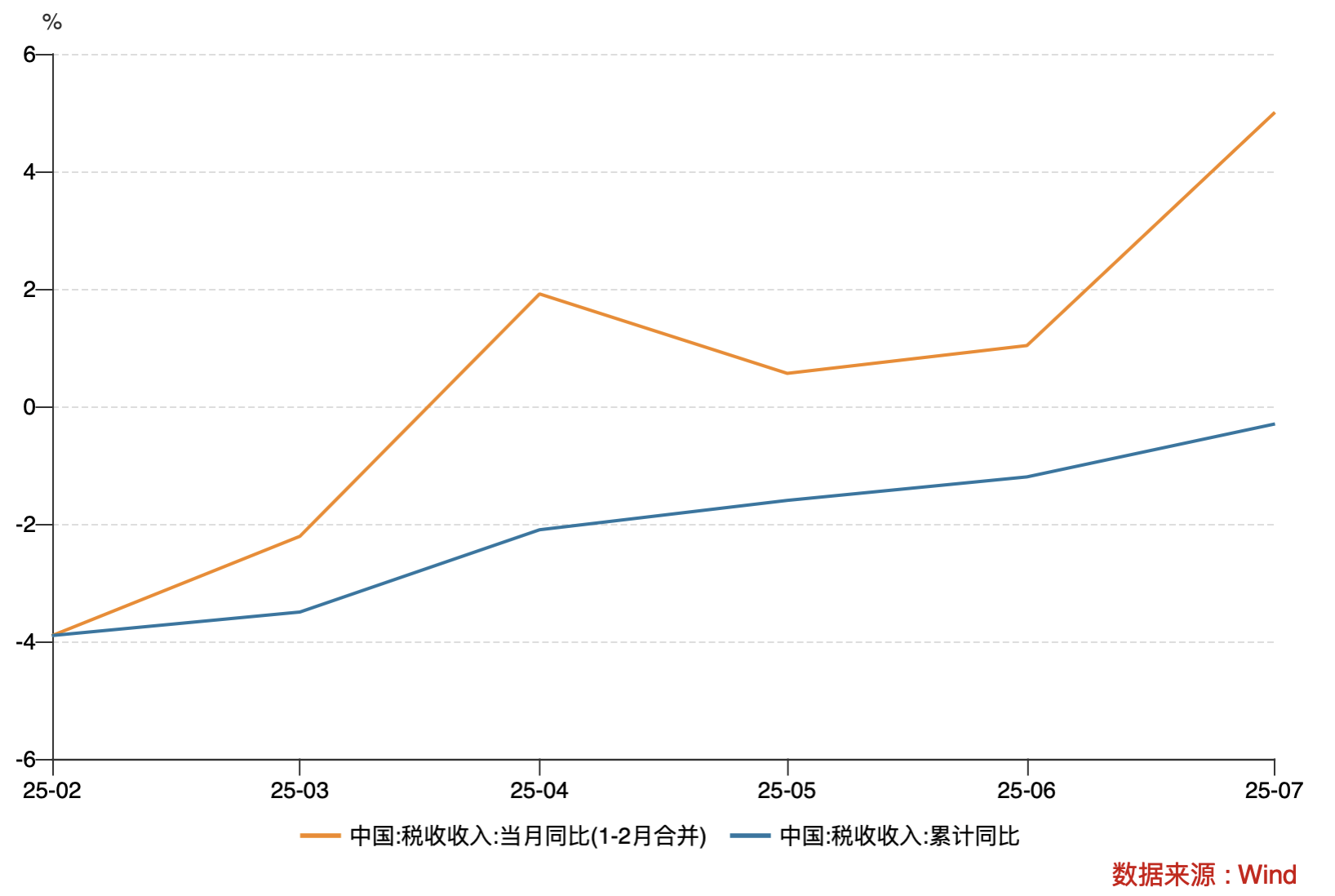
Core Insights - The Ministry of Finance reported that from January to July, the national general public budget revenue reached 13.58 trillion yuan, a year-on-year increase of 0.1%, marking the first positive growth in revenue for the year [1] - Tax revenue totaled 11.09 trillion yuan, a slight decline of 0.3% year-on-year, while non-tax revenue increased by 2% to 2.49 trillion yuan [1] - The recovery in fiscal revenue growth in July was attributed to improved corporate profit expectations and the wealth effect from the rising Shanghai Composite Index [1] Tax Revenue Breakdown - Domestic value-added tax revenue was approximately 4.26 trillion yuan, up 3% year-on-year, indicating stable growth in industrial and service sectors [2] - Corporate income tax revenue was about 3.06 trillion yuan, down 0.4%, reflecting pressure on corporate profits [2] - Import goods value-added tax and consumption tax totaled 1.03 trillion yuan, down 6.1%, consistent with weak import trends [2] - Personal income tax revenue reached 927.9 billion yuan, up 8.8%, supported by stable growth in resident income and improved tax administration [2] - Securities transaction stamp duty revenue was 936 billion yuan, up 62.5%, indicating active capital market trading [2] Monthly Trends - From April onwards, monthly tax revenue has shown continuous positive growth for four consecutive months, with July seeing a significant increase of 5% [2][4] - The cumulative decline in tax revenue narrowed significantly, with a reduction of 0.3% for the first seven months compared to a 1.2% decline in the first half of the year [4] Sector Performance - Key sectors such as equipment manufacturing and modern services showed strong tax revenue performance, with notable increases in specific industries like railway and aerospace equipment [5] - The overall tax revenue performance is expected to improve in the second half of the year, driven by stable economic conditions and active capital markets [6] Government Expenditure - From January to July, national general public budget expenditure reached 16.07 trillion yuan, a year-on-year increase of 3.4%, with significant growth in social security, education, and health expenditures [9] - The issuance of government bonds has accelerated, contributing to a stronger fiscal expenditure environment [9] - The broad fiscal expenditure, combining general public budget and government fund expenditures, grew by 8.9% year-on-year, marking a strong performance [10]

前7月全国一般公共预算收入135839亿元 同比增长0.1%
Zhong Guo Xin Wen Wang· 2025-08-19 08:51
National General Public Budget Revenue - National general public budget revenue for January to July reached 135839 billion, a year-on-year increase of 0.1% [1] - Tax revenue amounted to 110933 billion, showing a decline of 0.3% year-on-year, while non-tax revenue was 24906 billion, increasing by 2% [1] - Central government revenue was 58538 billion, down 2% year-on-year, while local government revenue was 77301 billion, up 1.8% [1] Major Tax Revenue Items - Domestic value-added tax collected was 42551 billion, reflecting a growth of 3% [2] - Domestic consumption tax totaled 10213 billion, with a year-on-year increase of 2.1% [3] - Corporate income tax revenue was 30566 billion, showing a slight decline of 0.4% [4] - Personal income tax reached 9279 billion, marking an increase of 8.8% [5] - Import VAT and consumption tax amounted to 10300 billion, down 6.1%, while customs duties were 1316 billion, decreasing by 6.5% [6] - Export tax rebates were 14065 billion, up 9.7% [7] - Urban maintenance and construction tax was 3105 billion, increasing by 2.7% [8] - Vehicle purchase tax was 1183 billion, down significantly by 18.4% [9] - Stamp duty revenue was 2559 billion, with a notable increase of 20.7%, including a 62.5% rise in securities transaction stamp duty [10] - Resource tax collected was 1747 billion, down 1.6% [11] - Decrease in deed tax revenue to 2694 billion, down 15% [12] - Property tax revenue was 3201 billion, increasing by 11.2% [13] - Urban land use tax reached 1653 billion, up 5.8% [14] - Land value increment tax was 2786 billion, down 17.8% [15] - Cultivated land occupation tax was 918 billion, increasing by 3.1% [16] - Environmental protection tax revenue was 190 billion, up 12.5% [17] - Other tax revenues totaled 737 billion, with a slight increase of 0.9% [18] National General Public Budget Expenditure - National general public budget expenditure for January to July was 160737 billion, a year-on-year increase of 3.4% [19] - Central government expenditure was 23327 billion, up 8.8%, while local government expenditure was 137410 billion, increasing by 2.5% [19] Major Expenditure Items - Education expenditure reached 24438 billion, increasing by 5.7% [20] - Science and technology expenditure was 5330 billion, up 3.2% [21] - Cultural, tourism, sports, and media expenditure totaled 2012 billion, increasing by 5.3% [22] - Social security and employment expenditure was 27621 billion, up 9.8% [22] - Health expenditure reached 12402 billion, increasing by 5.3% [22] - Energy conservation and environmental protection expenditure was 2949 billion, up 4.3% [22] - Urban and rural community expenditure was 11185 billion, down 3.5% [22] - Agriculture, forestry, and water expenditure was 12323 billion, down 7.7% [22] - Transportation expenditure was 6340 billion, down 3.3% [22] - Debt interest payment expenditure was 7573 billion, increasing by 6.4% [22] National Government Fund Budget Revenue - National government fund budget revenue for January to July was 23124 billion, a decrease of 0.7% [23] - Central government fund budget revenue was 2596 billion, up 8.8%, while local government fund budget revenue was 20528 billion, down 1.8% [23] - Revenue from state-owned land use rights transfer was 16950 billion, down 4.6% [23] National Government Fund Budget Expenditure - National government fund budget expenditure for January to July was 54287 billion, a significant increase of 31.7% [23] - Central government fund budget expenditure was 7109 billion, up 4.5 times, while local government fund budget expenditure was 47178 billion, increasing by 18.1% [23] - Expenditure related to state-owned land use rights transfer was 23572 billion, down 6.1% [23]
前7个月财政收入由负转正,卖地收入降幅收窄
Sou Hu Cai Jing· 2025-08-19 08:49
Group 1 - The core viewpoint of the article highlights the mixed performance of China's public budget revenue and expenditure in the first seven months of the year, with a slight increase in local revenue but a decline in central revenue [1][2] - National general public budget revenue reached 135839 billion yuan, a year-on-year increase of 0.1%, while the central budget revenue was 58538 billion yuan, down 2% [1] - Tax revenue for the same period was 110933 billion yuan, a decrease of 0.3%, while non-tax revenue was 24906 billion yuan, an increase of 2% [2] Group 2 - Total public budget expenditure was 160737 billion yuan, reflecting a year-on-year growth of 3.4%, with central expenditure at 23327 billion yuan, up 8.8% [2] - Specific areas of expenditure such as social security and employment, education, and health saw significant increases of 9.8%, 5.7%, and 5.3% respectively [3] - Government fund budget revenue was 23124 billion yuan, down 0.7%, with local government fund revenue declining by 1.8% [5] Group 3 - Analysts suggest that fiscal policy is expected to strengthen in the second half of the year, emphasizing the need for timely implementation of existing policies and the introduction of new measures [5] - Recommendations include accelerating local debt issuance, considering the issuance of special government bonds, and enhancing investment in human capital to boost consumption [5][6] - The focus areas for fiscal support include increasing transfer income for residents, promoting consumption through trade-in programs, and accelerating public spending in technology and infrastructure [6]
新增贷款转负,意料之外
HUAXI Securities· 2025-08-14 02:01
Loan and Financing Data - New social financing (社融) in July was 11,600 billion CNY, a year-on-year increase of 3,893 billion CNY, but below the market expectation of 14,100 billion CNY[1] - New RMB loans turned negative at -500 billion CNY, a decline of 3,100 billion CNY year-on-year, marking the first negative value since July 2005[1] - The scale of new government bonds reached 12,440 billion CNY in July, an increase of 5,559 billion CNY year-on-year, contributing significantly to new social financing[2] Economic Demand and Loan Trends - New loans to the real economy fell sharply to -4,263 billion CNY, setting a historical low since data collection began[2] - New household loans were -4,893 billion CNY, a decrease of 2,793 billion CNY year-on-year, indicating weak consumer demand[3] - New corporate loans were 600 billion CNY, with short-term loans at -5,500 billion CNY and medium to long-term loans at -2,600 billion CNY, the latter marking the first negative value since August 2016[4] Financial Market Insights - M1 money supply grew by 5.6% year-on-year, exceeding the expected 5.3%, but this growth is attributed to a low base effect rather than active deposit mobilization[5] - Non-bank financial institutions saw an increase in deposits by 2,100 billion CNY, while household deposits decreased by 1,100 billion CNY, suggesting a shift of funds from banks to non-bank entities[6] - The overall financial data for July indicates a slow recovery in demand, necessitating potential monetary easing measures to stimulate economic activity[6]
斯本年度前七个月财政赤字有所增长
Shang Wu Bu Wang Zhan· 2025-08-12 13:56
主要支出中,养老金支出占11亿欧元,同比增长8.4%;社会保障支出13亿欧元增长2.7%;投资支出6.12 亿欧元增长1.1%,涉及军队现代化与交通基础设施。补贴支出为3.32亿欧元,同比减少8400万欧元,反 映出对能源和洪灾援助的逐步退坡。 斯通社8月8日卢布尔雅那消息,斯洛文尼亚国家财政今年前七个月的支出较去年同期增长7.4%,达91 亿欧元,占全年预算的53.1%;同期收入为82亿欧元,同比增长2.9%,占全年预算的53.6%。财政赤字 为9.12亿欧元,比去年增加3.99亿欧元。财政部表示增长仍在预期以内。 在收入方面,税收是主要来源,总额达72亿欧元,同比增长4.3%。其中增值税为32亿欧元,所得税为 12亿欧元,企业所得税收入则同比减少14%,为10亿欧元。消费税收入略降至9.29亿欧元,主要因烟酒 税减少。整体来看,财政运行仍属可控,但企业税收下降趋势值得警惕。 ...
财政收入延续增长凸显我国经济韧性
Jin Rong Shi Bao· 2025-08-08 07:59
财政部近日发布的数据显示,今年前4个月,全国一般公共预算收入80616亿元,同比下降0.4%, 降幅较一季度收窄0.7个百分点;全国一般公共预算支出93581亿元,同比增长4.6%,完成预算的 31.5%,支出进度为2020年以来同期最快。 1至4月,全国非税收入15060亿元,同比增长7.7%,主要是多渠道盘活资产等带动。4月份,非税 收入增速进一步降至1.7%。对此,温彬表示,今年以来,非税收入增速持续放缓,主要是随着化债资 金落实到位,地方政府财政状况有所好转,对资产盘活的依赖度下降。 国盛证券首席经济学家熊园表示,4月份,一般财政收入增速进一步抬升,税收收入增速由负转 正,四大税种中个税收入改善是主要支撑,其余税种走弱,可能与入库节奏有关。另外,国有资产盘活 较难持续,非税收入增速为去年3月份以来最低水平。 具体到4月份,一般公共预算收入同比增长1.9%,增速较上月加快1.6个百分点。其中,税收收入增 速加快4.1个百分点至1.9%,非税收入增速放缓4.3个百分点至1.7%;一般公共预算支出同比增长5.8%, 增速较上月加快0.1百分点。 中央财经大学教授温来成在接受《金融时报》记者采访时表示,今年前 ...

拉加经委会预计2025年拉美和加勒比地区经济增长2.2%
Xin Hua She· 2025-08-06 10:24
Core Insights - The United Nations Economic Commission for Latin America and the Caribbean (ECLAC) forecasts economic growth for the region at 2.2% in 2025 and 2.3% in 2026, influenced by external factors such as geopolitical conflicts and tightening financial conditions, as well as internal factors like weak consumer demand [1] Economic Growth Projections - South America is expected to grow by 2.7% this year, driven by strong performances from Argentina, Ecuador, and Colombia, surpassing the regional average [1] - Central America and Mexico are projected to grow by only 1.0%, a significant decline due to reduced demand from the United States [1] - The Caribbean region (excluding Guyana) is anticipated to grow by 1.8%, showing a slowdown compared to the previous year [1] Employment and Inflation Outlook - Economic growth slowdown is expected to limit employment growth in the Latin American region [1] - Inflation rates in the region are projected to remain around 3% from 2025 to 2026, with upward pressure and risks due to potential increases in international food and energy prices [1] Recommendations for Development Financing - The report suggests enhancing development financing capabilities in Latin America through improved efficiency in fiscal spending, optimized tax management, reforms in the international financial system, better sovereign debt resolution mechanisms, and strengthening the role of development banks in resource mobilization [2]
宏观金融数据日报-20250801
Guo Mao Qi Huo· 2025-08-01 06:24
Report Summary 1. Industry Investment Rating - There is no information about the industry investment rating in the provided content. 2. Core View - After consecutive strong rallies, with the phased realization of macro - level positives, the upward speed of stock indices may slow down, and market volatility and adjustments should be watched out for [4]. 3. Summary by Related Catalogs Market and Operation - **Interest Rates**: DR001 closed at 1.40% with an 8.17bp increase, DR007 at 1.55% with a 3.67bp increase, GC001 at 1.03% with a 75.00bp decrease, GC007 at 1.43% with a 19.50bp decrease, SHBOR 3M at 1.57% with a 0.20bp increase, LPR 5 - year at 3.50% with no change, 1 - year treasury at 1.37% with a 1.25bp decrease, 5 - year treasury at 1.56% with a 1.25bp decrease, 10 - year treasury at 1.71% with a 1.50bp decrease, and 10 - year US treasury at 4.38% with a 4.00bp increase [3]. - **Central Bank Operations**: The central bank conducted 2832 billion yuan of 7 - day reverse repurchase operations yesterday, with 3310 billion yuan of reverse repurchases maturing, resulting in a net withdrawal of 478 billion yuan. This week, there are 16563 billion yuan of reverse repurchases maturing, but government bond issuances and certificate of deposit maturities are lower than last week, and month - end fiscal expenditures may speed up, which could bring incremental funds to the inter - bank market [3]. Stock Index Market - **Index Performance**: The CSI 300 closed at 4076 with a 1.82% decrease, the SSE 50 at 2776 with a 1.54% decrease, the CSI 500 at 6226 with a 1.40% decrease, and the CSI 1000 at 6661 with a 0.85% decrease. The trading volume of the two markets was 19360 billion yuan, an increase of 918 billion yuan from the previous day. Industry sectors generally declined, with energy metals, steel, coal, mining, photovoltaic equipment, real estate development, shipbuilding, precious metals, and chemical fiber industries leading the decline [3]. - **Futures Contracts**: IF's current - month contract closed at 4070 with a 1.8% decrease, IH's at 2777 with a 1.6% decrease, IC's at 6187 with a 1.3% decrease, and IM's at 6612 with a 0.9% decrease. IF's trading volume was 156196 with a 13.2% increase, IH's was 75925 with a 7.0% increase, IC's was 119559 with a 13.6% increase, and IM's was 267774 with a 15.8% increase. IF's open interest was 270987 with a 1.4% decrease, IH's decreased, IC's was 227163 with a 1.2% decrease, and IM's was 348264 with a 0.5% increase [3]. - **Premium and Discount**: IF's current - month contract had a premium of 3.10%, IH's had a discount of - 1.23%, IC's had a premium of 15.22%, and IM's had a premium of 17.89% [5].
加皇银行:粘性通胀、有弹性的经济及更强劲的财政支出将使加拿大央行再次按兵不动
news flash· 2025-07-28 04:00
Core Viewpoint - The Royal Bank of Canada anticipates that the Bank of Canada will maintain interest rates unchanged in the upcoming meeting due to sticky inflation, a resilient economy, and stronger fiscal spending [1] Economic Conditions - Trade tensions are escalating, and Canadian economic data remains weak [1] - The labor market showed signs of bottoming out in June, with a partial recovery in the confidence index that had plummeted in March [1] - The USMCA (United States-Mexico-Canada Agreement) allows most Canadian exports to enter the US duty-free, which is crucial for Canada [1] Inflation and Monetary Policy - Recent inflation reports have unexpectedly risen, primarily driven by pressures from the domestic service sector [1] - The combination of sticky inflation data, a weak yet relatively resilient economic backdrop, and the prospect of increased fiscal spending are reasons why the Bank of Canada is unlikely to cut rates again in this cycle [1]

2025年6月财政数据点评:如何看待上半年财政形势?
EBSCN· 2025-07-27 12:36
Revenue Analysis - The cumulative year-on-year growth rate of national general public budget revenue from January to June 2025 is -0.3%, unchanged from the previous value[1] - The cumulative year-on-year growth rate of general public budget expenditure is +3.4%, down from +4.2%[1] - Government fund budget revenue shows a cumulative year-on-year growth rate of -2.4%, improving from -6.9% previously[1] Tax Revenue Insights - In June, tax revenue shows a year-on-year growth of +1.04%, an improvement compared to May[3] - The domestic consumption tax in June increased by +1.96%, while the vehicle purchase tax rose by +5.99%, indicating a positive contribution from automotive consumption[4] - The corporate income tax grew by +2.73%, reflecting a low base effect, but remains lower than the growth rate of value-added tax[4] Government Fund Performance - Government fund budget revenue in June increased significantly by +20.8%, recovering from -8.1% the previous month, driven by land sales[25] - The expenditure of government funds in June surged by +79.2%, compared to +8.8% in the previous month, with land-related expenditures showing a year-on-year growth of +5.9%[25] Expenditure Trends - General public budget expenditure growth in June is +0.38%, a decrease of 2.25 percentage points from the previous month[15] - Infrastructure-related expenditure in June fell by -8.80%, while social security and health expenditures also saw declines[15] - The completion rate for general public budget revenue from January to June is 48.8%, lower than the average of the past five years[15]