全球央行购金

Search documents
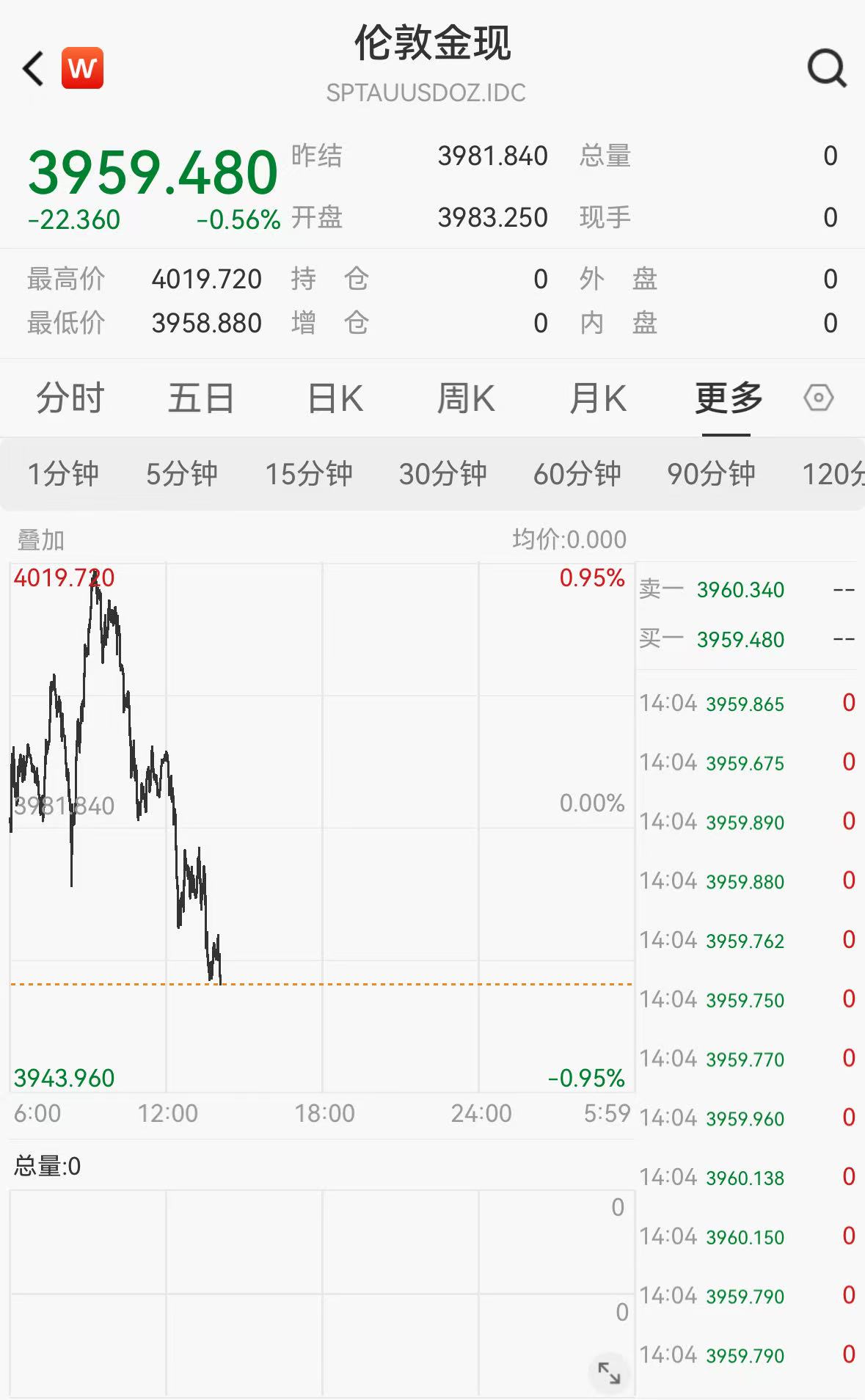
现货黄金跌破3960美元 机构:明年跌到3500美元
2 1 Shi Ji Jing Ji Bao Dao· 2025-10-28 06:20
Core Viewpoint - The recent decline in gold prices is attributed to a combination of easing geopolitical risks, profit-taking by bullish investors, and short-term liquidity tightening, leading to a significant drop in prices from recent highs [1][2] Factors Contributing to Gold Price Correction - **Macroeconomic Environment Changes**: The easing of the U.S. government shutdown crisis, reduced trade tensions, and lower expectations of geopolitical conflicts have diminished gold's appeal as a safe-haven asset [2] - **Technical Overbought Conditions**: The market experienced technical selling pressure due to overbought conditions, with implied volatility of gold options nearing levels seen in late April, indicating excessive market sentiment and crowded trading [2] - **Dollar and U.S. Treasury Yield Movements**: A slight increase in the U.S. 10-year Treasury yield, alongside a sell-off in U.S. debt, reflects an enhanced market risk appetite, which has not provided effective support for gold prices despite a minor decline in the dollar index [2] Future Market Outlook - **Short-term Predictions**: Some institutions have begun to lower their gold price forecasts, with expectations that prices may drop to $3,500 per ounce by the end of next year, while others predict a decline to $3,800 in the next three months [3] - **Long-term Support Factors**: The trends of "de-dollarization" and geopolitical uncertainties are expected to provide underlying support for precious metals. The interplay between Federal Reserve policy expectations and market sentiment will be crucial for price volatility [3] - **Historical Context**: Historical trends indicate that expectations of interest rate cuts, geopolitical risks leading to dollar weakness, and persistent government deficits are factors that could support a long-term increase in gold demand as an alternative asset [3] Investment Strategy - **Market Positioning**: Investors are advised to view the current price correction as a potential opportunity for positioning, with a focus on monitoring Federal Reserve signals, geopolitical developments, and alternative economic indicators [4] - **Cautious Approach**: A cautious bullish strategy is recommended, emphasizing strict position management to navigate volatility risks amid information scarcity [4]

大错特错!黄金行情远未结束当前转折概率仅25%,这3个信号才关键
Sou Hu Cai Jing· 2025-10-26 17:26
Core Viewpoint - The recent sharp decline in gold prices, marked by a 5.3% drop on October 21, is seen as a technical adjustment rather than a fundamental shift in the gold market's long-term bullish trend [1][3][13] Market Reaction - On October 21, gold prices fell nearly $300 from a peak of $4,381 per ounce, marking the largest single-day drop in five years [1] - The probability of a complete reversal in gold's upward trend is assessed at only 25% by professional institutions [3] - The market's volatility has raised caution among traders, indicating a shift in short-term sentiment [3] Key Factors Influencing Gold Prices - A sudden decrease in market risk aversion, driven by optimistic signals regarding U.S.-China trade agreements and potential ceasefire in the Russia-Ukraine conflict, has contributed to the sell-off [3] - The strengthening of the U.S. dollar, which rose 0.34% on October 21, has further pressured gold prices, making it more expensive for non-U.S. currency investors [3] Underlying Support for Gold - The long-term bullish logic for gold remains intact despite short-term challenges [5][10] - Key signals to monitor for the gold market include: - Real interest rates: A declining real interest rate environment typically supports gold prices [5] - U.S. dollar trends: Gold remains favorable as long as the dollar does not show a significant upward trend [6] - Gold volatility: Current volatility levels, while heightened, have not reached extreme historical levels, suggesting potential for recovery [8] Central Bank Activity - Global central banks have shown strong demand for gold, with net purchases reaching 1,136 tons in 2024, second only to historical peaks [10] - The People's Bank of China has consistently increased its gold reserves, surpassing 74 million ounces [10] Historical Context and Future Outlook - Historical trends indicate that gold prices often follow a ten-year cycle, with the current bull market lasting 34 months, slightly exceeding historical averages [12] - Structural changes in the global monetary system, including a weakening U.S. dollar credit system, support gold's transition from a traditional safe-haven asset to a "new monetary anchor" [12] - Upcoming economic indicators, such as the U.S. CPI data and Federal Reserve meetings, will be critical for assessing short-term gold price movements [12]

家里有“矿”,涨超有色|2025招商证券“招财杯”ETF实盘大赛
Sou Hu Cai Jing· 2025-10-24 07:44
Core Insights - The article discusses the ongoing trends in the ETF market, particularly focusing on the performance of various metals, including gold, rare earths, copper, aluminum, lithium, and cobalt, influenced by factors such as Federal Reserve interest rate policies and geopolitical tensions [1][3][4]. ETF Market and Investment Opportunities - The "Zhaocai Cup" ETF live competition aims to educate investors on asset allocation and risk management, promoting the healthy development of the ETF market [1]. - The China Securities Rare Earth Mining Index is highlighted as a potential investment target due to its focus on leading companies in the non-ferrous sector, benefiting from metal price performance [2]. Federal Reserve Policies and Market Impact - The Federal Reserve's expected interest rate cuts are seen as a significant driver for the non-ferrous mining sector, with a high likelihood of a 25 basis point cut in the upcoming meetings [3][4]. - The Fed's shift from a tightening to a loosening monetary policy is expected to support the performance of the non-ferrous mining industry [4]. Gold Market Dynamics - Gold prices have shown a significant upward trend, driven by expectations of Fed rate cuts and increased central bank purchases, with global central bank gold purchases exceeding 1,000 tons since 2022 [6][7]. - The geopolitical landscape, including conflicts and trade disputes, has heightened global demand for gold as a safe-haven asset [6][8]. Rare Earth Market Insights - Rare earth prices have surged due to supply constraints from China's export controls and high demand from the renewable energy sector [9][10]. - China dominates the global rare earth market, holding approximately 44 billion tons of the total 90 billion tons of rare earth oxides [9]. Copper and Aluminum Market Trends - Copper prices are expected to remain strong due to a supply gap exacerbated by production cuts from major mines and increasing demand from AI and renewable energy sectors [12][13]. - Aluminum prices are anticipated to show strong performance due to low valuations and potential demand increases, with current PE ratios for aluminum companies being lower than those for copper [14][15]. Lithium and Cobalt Market Outlook - The lithium market is currently influenced by supply-side reforms, with expectations of a significant supply increase post-2027 [16]. - Cobalt prices are expected to remain strong due to reduced export quotas from the Democratic Republic of Congo, which is a major supplier [16]. Overall Market Perspective - The non-ferrous metals sector, including industrial metals, gold, rare earths, and energy metals, is projected to experience tight supply conditions, supported by recovering domestic macroeconomic demand and ongoing trends in renewable energy [17]. - Investors are encouraged to focus on the China Securities Rare Earth Mining Index for potential opportunities, as it includes leading companies that are more likely to benefit from rising metal prices [17].

降了!降了!网友:“我刚买,你就跌!”
Sou Hu Cai Jing· 2025-10-23 04:38
Core Viewpoint - The international gold price experienced a significant drop of over 5% on October 21, marking the largest single-day decline in five years, primarily due to profit-taking by investors and easing concerns over international trade tensions [1]. Group 1: Price Movement - On October 21, the international spot gold price fell approximately 5.3% to $4,123.85 per ounce, with an intraday drop of 6.3%, the largest decline in over a decade [1]. - Since late August, gold prices surged from around $3,300 per ounce to over $4,000, driven by geopolitical changes, global economic uncertainty, and actions by central banks [1]. - Year-to-date, international gold prices have increased by about 60% [1]. Group 2: Market Influences - The recent decline in gold prices is attributed to several factors, including profit-taking by investors, a recovery in risk appetite, and reduced concerns over international trade tensions [1]. - Analysts believe that the long-term driving factors behind the recent surge in gold prices remain intact, suggesting a potential recovery in gold prices in the coming months [1].
贵金属数据日报-20251022
Guo Mao Qi Huo· 2025-10-22 04:51
Report Summary 1. Report Industry Investment Rating No relevant content provided. 2. Core Viewpoints of the Report - In the short - term, after the easing of the Sino - US trade situation, positive news such as Trump's planned visit to China in early 2026 and the European joint statement on Ukraine have boosted market risk appetite, putting pressure on precious metal prices. The transfer of inventory from New York to London has relieved the physical tightness of London silver. It is expected that precious metal prices may shift to a high - level wide - range oscillation. [6] - In the long - term, the Fed still has room to cut interest rates this year, global geopolitical uncertainties persist, the US debt is unsustainable, and major - power competition intensifies, increasing the long - term credit risk of the US dollar. The long - term center of gold prices is likely to continue to move up, and long - term investors are advised to go long on dips. [6] 3. Summary by Related Catalogs 3.1 Price Tracking of Domestic and Foreign Precious Metals - **Price and Price Changes**: On October 21, 2025, compared with October 20, London gold spot rose 2.5% to $4340.36 per ounce, London silver spot rose 0.4% to $51.72 per ounce. COMEX gold rose 2.5% to $4355.80 per ounce, and COMEX silver rose 0.6% to $50.70 per ounce. Domestic gold and silver futures also showed varying degrees of increase. [5] - **Spread and Spread Changes**: The spread of gold TD - SHFE active price increased by 48.5%, and the spread of silver TD - SHFE active price decreased by 31.8%. The spread of gold domestic - foreign (TD - London) decreased by 21.4%, and the spread of silver domestic - foreign (TD - London) decreased by 1.2%. The SHFE and COMEX gold - silver ratios both increased by 1.9%. [5] 3.2 Position and Inventory Data - **Position Data**: From October 17 to October 20, 2025, the gold ETF - SPDR position rose 1.09% to 1058.66 tons, and the silver ETF - SLV position rose 1.76% to 15769.7749 tons. The non - commercial long and short positions of COMEX gold and silver also showed different degrees of change. [5] - **Inventory Data**: On October 21, 2025, compared with October 20, SHFE gold inventory rose 2.32% to 86565.00 kilograms, SHFE silver inventory decreased 12.44% to 749362.00 kilograms. COMEX gold inventory decreased 0.19%, and COMEX silver inventory decreased 0.59%. [5] 3.3 Interest Rate, Exchange Rate and Stock Market Data - **Interest Rate and Exchange Rate**: From October 20 to October 21, 2025, the US dollar/Chinese yuan central parity rate decreased by 0.06% to 7.09, the US dollar index rose 0.07% to 98.62, the 2 - year US Treasury yield remained unchanged at 3.46%, and the 10 - year US Treasury yield decreased by 0.50% to 4.00%. [5] - **Stock Market and Commodity Market**: The VIX index decreased by 12.27%, the S&P 500 index rose 1.07% to 6735.13, and NYMEX crude oil decreased by 0.56% to $56.93. [5] 3.4 Market Review and Outlook - **Market Review**: On October 21, the main contract of Shanghai gold futures rose 2.02% to 994.06 yuan per gram, and the main contract of Shanghai silver futures rose 0.2% to 11805 yuan per kilogram. [5] - **Short - term Outlook**: Precious metal prices may still need some adjustment in the short - term, but due to factors such as the ongoing US government shutdown and the expected interest - rate cut in October, prices are unlikely to continue to decline significantly. Domestic silver prices may be relatively resistant to decline, and prices are expected to shift to a high - level wide - range oscillation. [6] - **Long - term Outlook**: In the long - term, the center of gold prices is likely to continue to move up, and long - term investors are advised to go long on dips. [6]
金价突然跳水
Xin Jing Bao· 2025-10-21 13:29
黄金价格在近期冲高后正处于高位震荡阶段。10月17日,黄金价格盘中一度突破4390美元/盎司的历史 峰值。就在市场正在等待黄金突破4400美元关口,10月21日黄金价格却出现下调。10月21日下午现货黄 金已失守4300美元关口,晚间黄金价格再度快速下探。 "金价涨得快,势必调整会更加剧烈。"汇管信息研究院副院长赵庆明在接受贝壳财经记者采访时表示, 从今年8月底至今的2个月时间内,黄金价格已经上涨了约1000美元。 在赵庆明看来,这轮金价上涨主要是全球看多情绪驱动。地缘政治、全球央行购金、全球流动性过剩是 推动黄金上涨的三大因素。但目前来看,这三大因素均未有明显变化,且近期地缘政治的紧张局势出现 缓解迹象。 新京报贝壳财经记者姜樊 10月21日晚间,现货黄金持续下跌,黄金跌破4200美元/盎司,跌幅高达到3.8%。 "投资者也要立足长期逻辑,当前支撑金价长期上行的核心因素(如全球不确定性、实际利率下行趋势 等)未发生根本改变,建议把握市场节奏,采取逢低布局策略,待金价回调至合理区间时择机逐步建 仓。"瞿瑞还建议,投资者也要明确投资目标,以资产保值、对冲风险为核心,而非单纯追逐短期价差 收益,规避盲目追高导致的 ...
金价冲高回落,波动加剧
Bao Cheng Qi Huo· 2025-10-21 01:52
贵金属 | 周报 · 2025 年 10 月 21 日 贵金属周报 专业研究·创造价值 投资咨询业务资格:证监许可【2011】1778 号 期货研究报告 姓名:龙奥明 宝城期货投资咨询部 从业资格证号:F3035632 投资咨询证号:Z0014648 电话:0571-87006873 邮箱:longaoming@bcqhgs.com 作者声明 贵金属 本人具有中国期货业协会授 予的期货从业资格证书,期货投 资咨询资格证书,本人承诺以勤 勉的职业态度,独立、客观地出 具本报告。本报告清晰准确地反 映了本人的研究观点。本人不会 因本报告中的具体推荐意见或观 点而直接或间接接收到任何形式 的报酬。 金价冲高回落,波动加剧 核心观点 上周金价冲高回落,纽约金一度逼近 4400 美元,沪金一度站上 1000 元关口。此次金价飙升是多重因素共振的结:1、美国银行业风 险成为直接导火索。美国区域性银行相继披露贷款问题,引发市场对 信贷体系稳定性的担忧。这一事件导致美国 74 家最大银行的市值单 日蒸发超过 1000 亿美元,恐慌情绪推动资金流向黄金等避险资产。 2、美联储降息预期进一步强化了金价上涨动力。市场对美联储降息 ...
宝城期货贵金属有色早报(2025年10月20日)-20251020
Bao Cheng Qi Huo· 2025-10-20 01:59
投资咨询业务资格:证监许可【2011】1778 号 宝城期货贵金属有色早报(2025 年 10 月 20 日) ◼ 品种观点参考 时间周期说明:短期为一周以内、中期为两周至一月 | 品种 | | 短期 | 中期 | 日内 | 观点参考 | 核心逻辑概要 | | --- | --- | --- | --- | --- | --- | --- | | 黄金 | 2512 | 上涨 | 上涨 | 震荡 偏强 | 长线看强 | 中长线上行趋势不变,中美摩擦 助推行情 | | 铜 | 2512 | 上涨 | 上涨 | 上涨 | 长线看强 | 矿端扰动再起,资金关注度快速 上升,中美贸易加剧波动 | 说明: 1.有夜盘的品种以夜盘收盘价为起始价格,无夜盘的品种以昨日收盘价为起始价格,当日日盘收盘价为终点价格, 计算涨跌幅度。 2.跌幅大于 1%为下跌,跌幅 0~1%为震荡偏弱,涨幅 0~1%为震荡偏强,涨幅大于 1%为上涨。 3.震荡偏强/偏弱只针对日内观点,短期和中期不做区分。 主要品种价格行情驱动逻辑—商品期货 品种:黄金(AU) 日内观点:震荡偏强 中期观点:上涨 参考观点:长线看强 核心逻辑:黄金市场在 10 月 ...
贵金属有色金属产业日报-20251017
Dong Ya Qi Huo· 2025-10-17 10:21
1. Report Industry Investment Rating There is no information about the industry investment rating in the report. 2. Core Views of the Report - **Precious Metals**: The international spot gold price has reached a record high of over $4380 per ounce, driven by increased trade tensions, the US government shutdown, and dovish statements from Fed officials. The value of gold as a hedge has been further enhanced by geopolitical risks and the trend of central bank gold purchases and de - dollarization. The large capital inflow into the Shanghai gold futures contract indicates strong market sentiment [3]. - **Copper**: Demand is suppressing copper price increases, but rising expectations of interest rate cuts may lead to a rebound. The 86,000 yuan per ton level is a key resistance point [15]. - **Aluminum**: In the short - term, macro factors are the core drivers of aluminum prices. With the expansion of China's core CPI in September and expectations of Fed rate cuts, and the reduction of inventory, the Shanghai aluminum futures may show a slightly upward trend. Alumina is in an oversupply situation, and its price is declining. Cast aluminum alloy has strong support due to raw material shortages and policy factors [37][38]. - **Zinc**: The fundamentals of domestic and overseas zinc markets are different, with the domestic market showing a pattern of strong supply and weak demand. Low inventory provides short - term price support, and attention should be paid to the opening of export windows and potential macro - driven factors [63]. - **Nickel and Stainless Steel**: In the nickel industry chain, the quota for nickel ore in 2026 is expected to decrease. The new energy sector is in a peak season, while nickel iron prices are weakening. Stainless steel sales are sluggish after the holiday, but export prospects are positive. Macro factors such as Sino - US tariffs and interest rate cut expectations should be monitored [77]. - **Tin**: The tin market has a pattern of tight supply and differentiated demand. Supply is constrained by the delayed resumption of Burmese mines and Indonesia's crackdown on illegal mining, while demand is divided between weak traditional electronics and strong high - end solder demand from AI servers and new energy vehicles. Low inventory supports prices, but high prices are suppressing trading [91]. - **Lithium Carbonate**: Market demand is good, and warehouse receipts are decreasing. The demand from downstream lithium - battery material enterprises is expected to increase, which may support the futures price [106]. - **Silicon Industry Chain**: For industrial silicon, as the dry season approaches, production cuts may increase, and prices may rise slightly, but inventory pressure limits the upside. The polysilicon market is affected by news and has weak fundamentals [117]. 3. Summary by Related Catalogs Precious Metals - **Price Movement**: The international spot gold price has broken through $4380 per ounce, and the Shanghai gold futures contract has the largest capital inflow in the domestic commodity futures market [3]. - **Influencing Factors**: Trade tensions, the US government shutdown, Fed officials' dovish statements, geopolitical risks, and central bank gold purchases are the main factors driving the rise in gold prices [3]. Copper - **Price Data**: The latest price of Shanghai copper futures main contract is 84,390 yuan per ton, with a daily decline of 0.78%. London copper has a daily increase of 0.45% [16]. - **Market Outlook**: Demand restricts price increases, but interest rate cut expectations may lead to a rebound. The 86,000 yuan per ton level is a key resistance point [15]. Aluminum - **Price Data**: The latest price of Shanghai aluminum futures main contract is 20,910 yuan per ton, with a daily decline of 0.31%. Alumina futures main contract price is 2,800 yuan per ton, with a daily increase of 0.36% [39]. - **Market Outlook**: Macro factors drive short - term price trends. Aluminum inventory is decreasing, while alumina is in an oversupply situation [37]. Zinc - **Price Data**: The latest price of Shanghai zinc futures main contract is 21,815 yuan per ton, with a daily decline of 0.57%. London zinc has a daily increase of 0.85% [64]. - **Market Outlook**: The domestic and overseas zinc markets have different fundamentals, and low inventory provides short - term price support [63]. Nickel and Stainless Steel - **Price Data**: The latest price of Shanghai nickel futures main contract is 121,160 yuan per ton, with a daily decline of 0%. The stainless steel futures main contract price is 12,630 yuan per ton, with a daily increase of 0% [78]. - **Market Outlook**: The nickel ore quota in 2026 is expected to decrease. The new energy sector is booming, while nickel iron prices are weakening. Stainless steel sales are slow, but export prospects are positive [77]. Tin - **Price Data**: The latest price of Shanghai tin futures main contract is 280,750 yuan per ton, with a daily decline of 0.21%. London tin has a daily increase of 1.01% [92]. - **Market Outlook**: The tin market has a pattern of tight supply and differentiated demand, and low inventory supports prices [91]. Lithium Carbonate - **Price Data**: The latest price of lithium carbonate futures main contract is 75,700 yuan per ton, with a daily increase of 760 yuan [107]. - **Market Outlook**: Market demand is good, and warehouse receipts are decreasing, which may support the futures price [106]. Silicon Industry Chain - **Price Data**: The latest price of industrial silicon futures main contract is 8,430 yuan per ton, with a daily decline of 2.03%. Polysilicon and other product prices are also provided in the report [117]. - **Market Outlook**: As the dry season approaches, industrial silicon production cuts may increase, and prices may rise slightly. The polysilicon market is affected by news and has weak fundamentals [117].
金价破4220美元,央妈和老百姓为何都抢购?专家揭秘背后三重推力
Sou Hu Cai Jing· 2025-10-17 08:48
Core Insights - The price of gold jewelry brands such as Chow Tai Fook and Chow Sang Sang has surged to 1235 RMB per gram, marking a historic breakthrough above 1230 RMB [1] - International gold prices have skyrocketed, with London spot gold exceeding 4225 USD, reflecting a weekly increase of approximately 200 USD [3] - The Federal Reserve's anticipated interest rate cuts have significantly boosted the gold market, with the dollar index dropping to a multi-month low of 98.65, making gold more attractive to investors [3] Group 1: Market Trends - Global central banks are purchasing gold at the fastest pace in decades, with the People's Bank of China increasing its gold reserves for 11 consecutive months [5] - In Q2 2025, global central bank net gold purchases reached 166 tons, with 95% of surveyed central banks expecting to continue increasing their gold holdings in the coming year [5] - High gold prices have led to a 26% year-on-year decline in gold jewelry consumption in China during the first half of 2025, while sales of gold bars and coins increased by 23.69% [7] Group 2: Consumer Behavior - Consumers are increasingly viewing gold as a savings method rather than just for decoration, leading to a 249% year-on-year revenue increase for Lao Pu Gold [8] - The average transaction value at Beijing SKP stores rose from 25,000 RMB in 2024 to over 40,000 RMB in July 2025 [8] - The Shenzhen Shui Bei gold market faced turmoil with several gold merchants experiencing operational issues, prompting warnings from the Shenzhen Jewelry Association regarding high-leverage virtual betting activities [8] Group 3: Investment Adjustments - Several banks, including ICBC and Bank of China, have raised the minimum purchase threshold for gold investment products, now generally ranging from 750 to 1000 RMB [10] - The gold recycling market has seen a surge in activity, with reports of a 50% increase in customers returning gold for cash [11] - Despite the overall increase in gold prices, the gold repurchase business in the Shui Bei market showed lackluster performance during the recent holiday period [11] Group 4: Price Dynamics - As of October 16, 2025, London gold was reported at 4227.91 USD per ounce, with a daily high of 4234.36 USD [11] - The Shanghai gold futures contract was priced at 968.1 RMB per gram, reaching a peak of 969.62 RMB on the same day [11] - Analysts suggest that while gold prices may experience short-term volatility, the long-term outlook remains positive due to global economic conditions characterized by high debt and low growth [11]