
全球资产配置

Search documents
盈米小帮投顾团队-第18次信号发车
Sou Hu Cai Jing· 2025-11-14 07:42
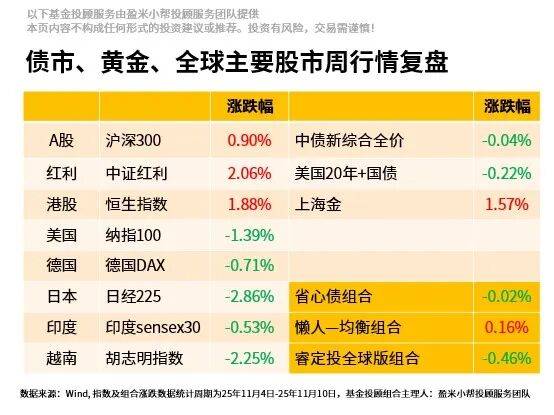
Market Overview - Global markets exhibited significant divergence last week, with A-shares continuing their rebound while US, Japanese, and Vietnamese markets experienced pullbacks [1] - The overall bond market remained stable, and gold emerged as one of the few rising safe-haven assets, increasing by approximately 1.6% [1] Performance Summary - A-shares (CSI 300) rose by 0.90%, while the Hang Seng Index increased by 1.88%. In contrast, the Nasdaq 100 fell by 1.39%, the Nikkei 225 dropped by 2.86%, and the Ho Chi Minh Index declined by 2.25% [1] - The bond market showed minimal fluctuations, with the China bond index nearly flat and US 20-year bonds down by 0.22% [1] Investment Strategy - The company's global allocation strategy demonstrated its ability to maintain long-term value despite short-term volatility, achieving a cumulative return of 19.43% this year, marking the third consecutive year of positive growth [5] - The "Lazy Balanced" strategy reported a return of 14.01% this year, indicating a smoother performance and stronger resistance to volatility compared to previous years [6] Asset Allocation Insights - The "Lazy Balanced" portfolio currently holds approximately 57% in equities, allowing for sufficient capital to capitalize on potential market corrections [12] - The portfolio's bond component, despite a brief decline, quickly recovered, providing a reliable foundation for the overall strategy [6] Market Sentiment - The A-share market is expected to continue experiencing oscillations as institutions enter the year-end clearing phase, leading to generally weak trading intentions [8] - The Hong Kong market is anticipated to remain in slight fluctuations, influenced by external market performances, while its valuation remains reasonable compared to the S&P 500 and CSI 300 [8]

专访瑞银全球投资银行胡凌寒:香港IPO热潮超预期 未来将现三大趋势
证券时报· 2025-11-13 02:23
Core Viewpoint - The Hong Kong IPO market is experiencing a strong recovery since 2025, with fundraising exceeding HKD 200 billion, regaining its position as the global leader in IPOs [2][3]. Market Performance - The performance of the Hong Kong IPO market this year has exceeded expectations, with significant contributions from high-quality companies and a continuous influx of foreign capital [3][5]. - Notable projects such as the IPO of Mixue Ice City and the placement of BYD have demonstrated the market's robust recovery, with the former achieving record frozen capital and attracting substantial foreign investment [5][6]. Impact of HKEX Reforms - Recent reforms by the Hong Kong Stock Exchange (HKEX) have positively influenced the market, particularly in optimizing IPO pricing and public market regulations, making it more attractive for large A-share companies to list [8][10]. - The new regulations have stabilized the allocation ratio between institutional and retail investors, enhancing the pricing power of institutions and improving post-IPO performance [10]. Foreign Capital Inflow - There is a clear trend of foreign capital returning to the Hong Kong IPO market, especially from European and Middle Eastern investors, driven by the need for diversified asset allocation [11][12]. - The shift in foreign investment strategies reflects a rebalancing of portfolios, with increased interest in Chinese assets [12]. Future Trends - The outlook for the Hong Kong IPO market remains positive, characterized by a virtuous cycle of good supply creating good demand, with many high-growth companies planning to list [13][14]. - Key trends for the future include diversification in company size and industry, a strong linkage between supply and demand, and the globalization of Chinese enterprises, with Hong Kong serving as a vital capital platform [14].


全球资产配置:周期洞察与战略布局
Guoxin Securities· 2025-11-12 14:53
Group 1: Global Asset Allocation - The report emphasizes the need for a new paradigm in asset allocation due to the changing macroeconomic environment, where traditional safe assets like bonds are losing their reliability as a safety net [3][4] - It suggests that embracing equity assets and industry trends is crucial for effective asset allocation, advocating for a multi-cycle framework that combines long-term and short-term strategies [4][5] - The report highlights the importance of diversifying asset allocation globally to overcome local market limitations, suggesting that investors should consider various international markets and asset classes [25][26] Group 2: Insights on Market Cycles - The report outlines the characteristics of the new global macroeconomic normal, including aging populations, rising geopolitical risks, and changing asset correlations, which impact long-term economic growth [6][8] - It discusses the failure of traditional asset allocation frameworks and the paradox of safe assets, indicating a significant decline in the supply of safe assets post-financial crises [9][19] - The report identifies the structural bull market logic for gold, driven by the shortage of safe assets and the growing demand for hedging against risks [19][20] Group 3: Investment Opportunities - The report recommends focusing on countries with favorable fundamentals for equity investments, particularly after technical corrections in markets like the US, Japan, and India [4][25] - It suggests that the bond market's core logic has shifted from seeking yield to pursuing diversification, with expectations of favorable conditions for government bonds due to anticipated monetary policy easing [4][25] - The report indicates that commodities, particularly gold, remain in a long-term bull market despite short-term corrections, while oil supply excess poses risks [4][25] Group 4: Historical Context and Future Trends - The report notes a historic turning point in Chinese residents' asset allocation, shifting from real estate-driven wealth storage to a more diversified approach involving financial assets [31][32] - It highlights the importance of understanding the lifecycle of asset allocation, where financial goals and personal milestones drive diversification strategies [21][31] - The report draws comparisons with global experiences in low-interest-rate environments, noting how different countries adapt their asset allocation strategies based on local economic conditions [90][95]
北京金融街热议全球资产配置,人民币资产成为长期资本配置新宠
Di Yi Cai Jing· 2025-11-12 12:58
Core Insights - China's economic resilience, high-quality development path, and the low volatility characteristics of RMB assets provide unique value for risk diversification and stable returns in global asset portfolios [1][7] Group 1: Global Investment Opportunities - The current global economic landscape faces increased uncertainty and rising protectionism, yet financial globalization remains a crucial driver for economic recovery [2] - Long-term capital and management institutions are increasingly focusing on strategic and diversified allocations across economic cycles, geographical regions, and asset classes [2] - China's strong economic resilience and clear growth targets present significant opportunities for global investors, with per capita GDP projected to rise from $10,632 in 2020 to $13,445 in 2024 [2] Group 2: Cross-Border Capital Flow - China's commitment to high-level opening up injects confidence into cross-border capital flows, with foreign financial assets and liabilities exceeding $11 trillion and $7.2 trillion respectively by mid-2025 [3] - Despite the large market, foreign investment in China's stock, bond, and banking sectors remains relatively low, indicating substantial future potential [3] Group 3: RMB Asset Allocation Value - In the context of increasing uncertainty in global financial markets, diversification in asset allocation has become essential, with RMB assets gaining attention for their low volatility and stable returns [4] - The rapid development of the offshore RMB bond market provides a rich array of investment options, with significant growth in issuance and diversification of issuers [5] Group 4: Stability of RMB - The stability of the RMB and its low volatility enhance its attributes as an international currency, making it an attractive option for long-term investors [6] - Recent observations indicate that RMB exchange rate fluctuations are significantly lower than those of other major currencies, suggesting a shift towards a more mature international currency [6] Group 5: Future Directions - The ongoing reforms in capital markets, including the registration system and deepening of bond connect mechanisms, are enhancing the predictability and convenience of foreign investment [7] - Areas such as ESG investment, technological innovation, and industrial upgrading are viewed as key focus areas for future medium to long-term capital cooperation [7]

相约深圳!2025湾区财富大会将于11月20日金博会期间启幕
2 1 Shi Ji Jing Ji Bao Dao· 2025-11-10 06:09
Group 1 - The "2025 Bay Area Wealth Conference" will take place on November 20, 2025, during the 19th Shenzhen International Financial Expo, focusing on "New Trends in Wealth Management: Investing Globally from the Bay Area" [1] - The event will gather top financial institutions and high-net-worth participants from the Greater Bay Area, discussing current wealth management and global allocation strategies [1][2] - The Greater Bay Area has an economic total of 14.79 trillion yuan, making it the largest bay area globally, with Hong Kong's asset and wealth management scale exceeding 35 trillion HKD and Shenzhen's wealth management total surpassing 31 trillion yuan [1] Group 2 - The morning forum will feature discussions on global wealth management, asset revaluation in China, alternative investments for high-net-worth individuals, and trends in the Hong Kong ETF market, with insights from major financial institutions [2] - The Guangdong-Hong Kong-Macao Greater Bay Area Research Institute will release the "2025 Cross-Border Wealth Management Report," revealing trends in cross-border wealth management over the past year [2] - The afternoon session will delve into global asset allocation, exploring new paradigms and practical topics such as Hong Kong stock investments and cross-border wealth management [2][3] Group 3 - The conference will analyze the changing investment behaviors of high-net-worth clients, focusing on the shift from preservation to "inheritance + impact investing" [3] - The collaboration between 21st Century Business Herald and Shenzhen International Financial Expo aims to create a platform for wealth management and asset management institutions to showcase their brands and foster cooperation [3] - Registration is open for representatives from financial institutions, high-net-worth individuals, and industry researchers interested in wealth management and asset allocation [3]
【申万宏源策略】美元流动性持续紧张,海外调整A股相对坚挺——全球资产配置每周聚焦 (20251031-20251107)
申万宏源证券上海北京西路营业部· 2025-11-10 02:07
Core Viewpoint - The article discusses the ongoing tightness in US dollar liquidity and its impact on global markets, particularly highlighting the relative resilience of A-shares amidst overseas adjustments [2] Group 1: Market Conditions - US dollar liquidity remains tight, influencing global asset allocation strategies [2] - A-shares have shown relative strength compared to other markets during recent adjustments [2] Group 2: Investment Implications - The current market environment suggests potential investment opportunities in A-shares due to their resilience [2] - Investors may need to reassess their strategies in light of the tightening liquidity and its effects on various asset classes [2]

【申万宏源策略】全球市场基金对中国股市配置回升至中性水平——全球资产配置资金流向月报(2025年10月)
申万宏源证券上海北京西路营业部· 2025-11-07 02:43
Core Viewpoint - Global market funds' allocation to the Chinese stock market has returned to a neutral level, indicating a potential stabilization in investor sentiment towards China [2] Group 1: Market Trends - The allocation of global market funds to China has increased, reflecting a recovery in confidence among international investors [2] - The current allocation level is considered neutral, suggesting that investors are reassessing their positions in the Chinese market [2] Group 2: Fund Flows - There has been a notable inflow of capital into Chinese equities, which may signal a shift in investment strategies among global funds [2] - The report highlights that this trend could lead to increased volatility in the Chinese stock market as funds adjust their positions [2]
永安期货:扬帆国际蓝海,打造跨境金融标杆
Qi Huo Ri Bao Wang· 2025-11-06 03:19
Core Viewpoint - Yong'an Futures is positioning itself as a leader in the internationalization of China's futures industry, establishing a robust global financial service network and achieving significant overseas revenue growth [1][3]. Group 1: International Expansion - Yong'an Futures began its international journey in 2006 by establishing a branch in Hong Kong, marking the start of its globalization strategy [3]. - The company expanded into Singapore in 2014, forming a dual-core structure with Hong Kong and Singapore as key operational hubs [3]. - By 2024, Yong'an Futures' overseas revenue is projected to exceed 430 million yuan, ranking among the top listed futures companies in China [1]. Group 2: Business Model and Services - The core competitive advantage of Yong'an Futures lies in its "risk management + wealth management" dual-driven service system, leveraging the geographical advantages of Hong Kong and Singapore [6]. - The company has successfully extended its services to various regions, achieving over 700 million USD in business scale over the past five years [6]. - Yong'an Futures offers tailored global asset allocation solutions for institutional clients, high-net-worth individuals, and industry clients, covering a wide range of financial instruments [6]. Group 3: Research and Asset Management - Yong'an Futures has built a strong asset management team focused on active management and absolute returns, enhancing its capabilities in equity and fixed income investments [8]. - The company employs a diversified asset allocation strategy, utilizing futures hedging and value investment logic to optimize global asset portfolios [8]. Group 4: Future Outlook - Looking ahead, Yong'an Futures aims to deepen strategic partnerships with international financial institutions and enhance its global asset allocation capabilities [10]. - The company is committed to providing high-quality, efficient, and comprehensive financial services to global investors, positioning itself as a benchmark for cross-border integrated financial services [10].


全球资产配置资金流向月报(2025年10月):全球市场基金对中国股市配置回升至中性水平-20251105
Shenwan Hongyuan Securities· 2025-11-05 02:44
Market Overview - In October, the investment agreements between Japan, South Korea, and the United States were finalized, leading to significant gains in the Japanese and South Korean stock markets, which rose by 19.1% and 12.2% respectively[3] - The Hang Seng Tech Index experienced a notable decline of 8.53% during the same period[3] Global Asset Flows - Global money market funds saw an inflow of approximately $1,290 billion in October, a decrease from $1,550 billion in September[19] - The U.S. equity market attracted $595.1 billion, while China and emerging markets received inflows of $180.6 billion and $241.6 billion respectively[19] China Market Dynamics - In October, China's equity market attracted $180.62 billion, accounting for 74.76% of the total inflow into emerging markets[19] - The inflow into China's fixed income market was $26.17 billion, representing 32.09% of the total emerging market inflow[19] Country Allocation Trends - Global funds' allocation to the Chinese stock market has rebounded to the historical 40th percentile, with a slight increase of 0.1 percentage points from September[19] - The allocation to the U.S. stock market was 61.6%, reflecting a marginal increase of 0.1 percentage points from the previous month[19] Risk Considerations - Short-term asset price fluctuations may not accurately represent long-term trends, and there are risks associated with potential economic downturns in Europe and the U.S.[3]
港股估值处于历史低位,外资持续加仓科技板块
Sou Hu Cai Jing· 2025-11-05 02:42
Core Insights - Despite a significant year-to-date increase in the MSCI Hong Kong Index, its valuation remains below the ten-year average, making it one of the cheapest stock markets in the Asia-Pacific region, excluding ASEAN [1] - As of the end of September, passive funds have seen a cumulative inflow of $18 billion into the Chinese stock market this year [1] - The technology sector in Hong Kong has become a focal point for foreign investment, with institutions viewing it as having both valuation safety margins and growth potential [1] - Analysts suggest that with local economic stabilization, a recovery in the IPO market, and improved global liquidity due to the Federal Reserve's interest rate cuts, the Hong Kong technology sector is likely to continue gaining revaluation momentum [1] - Morgan Stanley anticipates that this upward trend will extend until 2026, providing long-term investment opportunities for investors [1] Sector Analysis - The technology sector in Hong Kong is highlighted as a key area for foreign investment due to its attractive valuation and growth prospects [1] - Specific ETFs related to the Hong Kong technology sector include the Hong Kong Stock Connect Technology ETF (159101), which covers the entire technology supply chain, and the Hang Seng Internet ETF (513330), which focuses on leading internet companies [1]