
大类资产配置

Search documents
晨会纪要-20251204
Guoxin Securities· 2025-12-04 02:27
Macro and Strategy - The report discusses the ongoing expansion and diversification of public REITs in China, highlighting the inclusion of various asset types and industries, with a projected market size increase of 2.3 to 3.8 trillion yuan, indicating a potential 10-16 times expansion compared to the current scale [7][8][10] - The average dividend yield of public REITs from 2022 to 2025 is 5.73%, which is higher than the average yield of the CSI Dividend Index at 5.52%, showcasing their attractiveness as a stable income asset [8][9] - Public REITs are characterized by a dual return structure comprising dividend income and asset appreciation, with a significant portion of returns coming from dividends over longer investment horizons [9][10] Industry and Company - The Chinese duty-free industry is entering a new cycle, with Hainan's duty-free sales experiencing a compound annual growth rate (CAGR) of 39% from 2011 to 2019, but facing a decline of 37% from peak sales due to various market pressures [17][18] - Recent data indicates a recovery in Hainan's duty-free sales, with year-on-year growth of 3%, 13%, and 27% from September to November 2025, suggesting a positive trend in high-end consumption [18][19] - The report emphasizes the importance of policy support and market dynamics in shaping the future of the duty-free sector, with expectations for continued growth driven by improved consumer confidence and strategic policy enhancements [19][20][21] Automotive Industry - The report highlights the rapid advancements in smart driving technology, with companies like Tesla and Huawei leading the way in achieving Level 4 automation through innovative algorithms and architectures [24][25] - The penetration rate of smart driving technologies is expected to see significant growth, with projections indicating an increase from 11.3% to 26.3% for highway navigation assistance (NOA) by 2025 [25] - The global market for robotaxi services is projected to reach nearly 10 trillion yuan, with companies like Waymo and Apollo at the forefront of commercialization efforts [25][26] Non-Banking Sector - The report outlines the importance of the second pillar of the pension system in China, focusing on the development of enterprise and occupational pensions to address the challenges of an aging population [26][27] - The occupational pension system has achieved full coverage, while enterprise pensions are expanding from state-owned to private enterprises, indicating a shift towards a more diversified pension landscape [27][28] - The investment strategy for pension funds is evolving towards a "barbell" approach, balancing stable income-generating assets with growth-oriented investments in technology and manufacturing sectors [28]
大类资产月度策略(2025.12):股债岁末盘整,原油寒意未消-20251203
Guoxin Securities· 2025-12-03 10:59
Group 1 - The report indicates a combination of "loose monetary policy + credit easing," with a low risk of tightening in the funding environment, which continues to support macroeconomic and asset performance [1][13][19] - In November, the A-share market is expected to stabilize as liquidity disturbances and risk appetite weaken, with major indices experiencing a general pullback [2][31] - The report highlights that the bond market remains resilient despite weak fundamentals, with a slight increase in credit bond indices and a decline in government bond yields [3][38] Group 2 - The report emphasizes the importance of large-cap growth stocks in the current market environment, supported by China's manufacturing PMI and industrial output growth [19][20][21] - It suggests a quantitative asset allocation model for domestic assets, recommending 30% in stocks, 35% in bonds, 23.3% in crude oil, and 11.7% in gold under an aggressive allocation scenario [24][26] - The report notes a divergence in global central bank policies, with a trend towards easing but with varying degrees among different economies, impacting investment strategies [56][57]
2025年12月大类资产配置月报:回调或是风险资产的买入时机-20251203
ZHESHANG SECURITIES· 2025-12-03 10:45
- The **Macroeconomic Scoring Model** is used to assess asset allocation preferences based on macroeconomic factors. It evaluates domestic and global conditions, including monetary policy, inflation, and credit, to generate asset-specific timing views. For December, the model turned cautious on the CSI 800 and 10-year government bonds due to tightening domestic monetary conditions, while maintaining a positive outlook on the S&P 500, crude oil, and copper[18][19][20] - The **US Equity Timing Model** monitors economic indicators and market sentiment to identify optimal entry points for US equities. It highlights that, before the Federal Reserve's December meeting, uncertainty around rate cuts may suppress risk appetite. However, fiscal expansion post-government reopening could stabilize the economy, presenting potential buying opportunities if equity prices decline[21][22][24] - The **Gold Timing Model** tracks factors such as fiscal pressure, central bank policies, and global de-dollarization trends. The latest indicator value is -0.54, reflecting marginal weakening due to reduced fiscal expansion. However, the model suggests that gold's medium-term upward trend remains intact, supported by global de-dollarization and potential rate cut expectations[25][26][27] - The **Crude Oil Timing Model** evaluates demand, inventory levels, macro risks, and investor sentiment. The current oil sentiment index is -0.1, indicating a cautious outlook. While global demand shows marginal improvement, other factors, including inventory and macro risks, have weakened, suggesting a deteriorating fundamental outlook for crude oil[27][29][31] - The **Asset Allocation Strategy** uses quantitative signals and macro factor adjustments to allocate risk budgets across asset classes. For November, the strategy achieved a return of -0.2%, with a 12.2% return over the past year and a maximum drawdown of 2.9%. The December allocation reduced exposure to the CSI 800 and 10-year government bonds while increasing allocations to the S&P 500, gold, and copper[3][32][34] Model Backtesting Results - **Macroeconomic Scoring Model**: December views include cautious stances on the CSI 800 and 10-year government bonds, while maintaining positive views on the S&P 500, crude oil, and copper[18][19][20] - **US Equity Timing Model**: Indicates medium-term opportunities for US equities post-Federal Reserve meeting, contingent on fiscal expansion and economic stabilization[21][22][24] - **Gold Timing Model**: Latest indicator value is -0.54, with medium-term support from global de-dollarization and potential rate cut expectations[25][26][27] - **Crude Oil Timing Model**: Current sentiment index is -0.1, reflecting a cautious outlook due to weakening fundamentals[27][29][31] - **Asset Allocation Strategy**: November return of -0.2%, 12-month return of 12.2%, and maximum drawdown of 2.9%. December allocation adjustments include increased exposure to the S&P 500, gold, and copper, with reduced exposure to the CSI 800 and 10-year government bonds[3][32][34]

大类资产月度策略:股债岁末盘整,原油寒意未消-20251203
Guoxin Securities· 2025-12-03 09:30
Group 1 - The report indicates a continued trend of "loose monetary policy + credit easing," with a low risk of tightening in the funding environment, which supports macroeconomic and asset performance [1][13][19] - In October, China's new social financing was 816.1 billion yuan, lower than the expected 1,537.7 billion yuan, and new RMB loans were 220 billion yuan, also below the expected 451.2 billion yuan, indicating a slight pullback in credit pulses but an overall continuation of the upward trend for the year [1][13] - The report suggests that the A-share market is expected to stabilize towards the end of the year, with limited short-term upside or downside, and anticipates a potential upward momentum in the first quarter of the following year [2][3] Group 2 - The report highlights that the bond market remains resilient despite weak fundamentals, with the overall bond market showing stability amid a backdrop of declining interest rates [3][31] - In November, the 10-year government bond yield decreased by 6.9 basis points to 1.73%, indicating a stable bond market environment [31] - The report notes that the commodity price trends are diverging, with oil prices under pressure and gold prices experiencing fluctuations, influenced by global economic conditions and geopolitical factors [4][31] Group 3 - The report emphasizes a focus on large-cap growth stocks due to the recovery in the domestic economy, with China's manufacturing PMI at 49.2, indicating a better outlook compared to the US [19][20] - The report suggests that the overall economic recovery is favorable for growth sectors, with industrial value-added growth of 6.1% year-on-year from January to October [19][20] - The report recommends an asset allocation strategy favoring equities over commodities and bonds, with specific allocations for aggressive and conservative strategies [24][26]

【广发金工】PMI数据仍处于荣枯线以下,债券资产有望回暖:大类资产配置分析月报(2025年11月)
广发金融工程研究· 2025-12-03 03:23
Core Viewpoint - The overall macro analysis indicates a bearish outlook for equity assets, while technical analysis shows an upward trend with moderate valuation and capital outflow [1][2][8] - For bonds, the macro perspective is bullish, and the technical trend is also upward [1][2][8] - Industrial products are viewed negatively from a macro standpoint, with a downward price trend technically [1][2][8] - Gold assets are favored in the macro analysis, with an upward price trend technically [1][2][8] Macro Analysis - The macro analysis categorizes assets based on their performance under different macro indicators, indicating that equity assets are currently under pressure, while bonds and gold are favored [4][8] - The analysis employs T-tests to assess the impact of macro indicators on asset returns, revealing significant differences in average returns based on the trend of macro indicators [4][5] Technical Analysis - The technical analysis utilizes closing prices and various indicators to assess asset trends, with equity, bonds, and gold showing upward trends, while industrial products are on a downward trend [10][13] - The latest trend indicators for equity and bond assets are positive, while industrial products show a negative trend [14][13] Valuation Indicators - The equity risk premium (ERP) for the CSI 800 index is at 55.71%, indicating a moderate valuation level [17][18] - The analysis of capital flow indicates a net outflow of 102.9 billion yuan for equity assets, suggesting a negative sentiment in the market [21][22] Asset Allocation Performance Tracking - Historical performance data shows that a fixed ratio combined with macro and technical indicators yielded a return of 10.50% for 2025, with an annualized return of 12.00% since April 2006 [3][26] - Different asset allocation strategies, including volatility control and risk parity, have also been analyzed, showing varying returns and risk profiles [30][33] Summary of Views - The combined scores from macro and technical indicators suggest a bearish outlook for equity assets, a bullish stance for bonds and gold, and a negative view for industrial products [23][25]



南方基金:2025即将收官,2026年大类资产如何配置?
Sou Hu Cai Jing· 2025-12-03 02:28
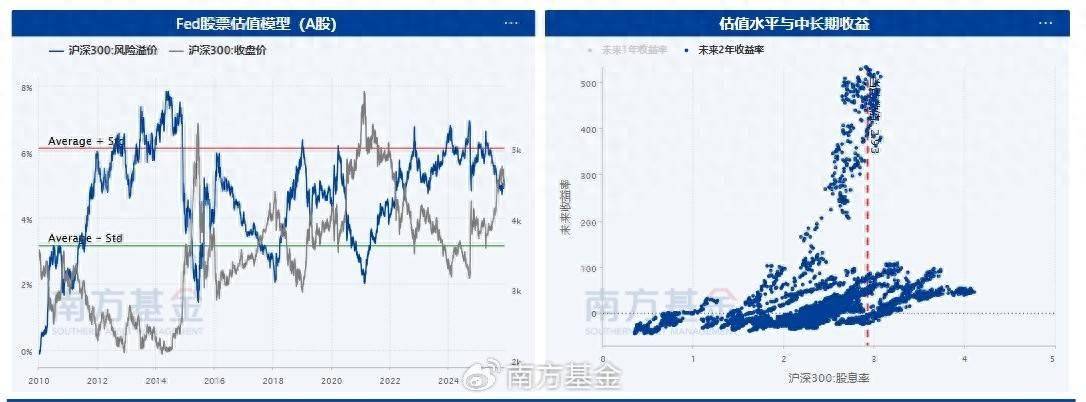
Group 1: Domestic Macro Economic Analysis - The domestic macroeconomic outlook for 2026 is expected to start smoothly, with significant achievements in high-quality development. The economic growth target is anticipated to remain around 5% [3] - The fiscal policy is likely to maintain a proactive tone, with a projected government budget deficit rate of 4% and new special bond issuance of 4.4-5 trillion yuan [4] - Monetary policy is expected to continue a supportive stance, with potential for 1-2 reserve requirement ratio cuts and 1-2 interest rate cuts of 10-20 basis points [4] Group 2: International Macro Economic Analysis - The U.S. economy is projected to stabilize in 2026, supported by a resumption of fiscal expansion, with the deficit rate expected to return to 6.5% [5] - The Federal Reserve is anticipated to lower interest rates 2-3 times in 2026, despite inflation remaining sticky [5] Group 3: Market Outlook - The A-share market is viewed positively, with macro factors such as market valuation, fundamental recovery, and supportive policies likely to strengthen A-shares [6] - The growth style is currently overvalued, but opportunities remain in the technology manufacturing sector driven by the AI wave [6] - Focus on high-prosperity sectors such as the technology industry and materials with improved supply-demand dynamics is recommended [6] Group 4: Bond Market and Commodity Outlook - The bond market is expected to have limited overall odds, with yields likely to remain in a low volatility range [8] - Commodities like copper and gold are anticipated to rise, supported by resilient U.S. demand and domestic policy measures [8]
中金:布局年末政策窗口期
中金点睛· 2025-12-02 23:49
文/中金大类资产:李昭,杨晓卿 点击小程序查看报告原文 美联储12月可能再次降息,明年初或放慢降息节奏。 12月9日-10日将召开美联储FOMC会议,由于近期美国通胀与增长数据都偏低,我们预测美联储再次降息25bp。目前市场计入美联储12月降息概率为88% [1],2026年降息两次(图表1)。 图表1:目前市场计入美联储12月降息概率为88% | | | | | | | CME FEDWATCH TOOL - CONDITIONAL MEETING PROBABILITIES | | | | | | | --- | --- | --- | --- | --- | --- | --- | --- | --- | --- | --- | --- | | | | | | | MEETING DATE 150-175 175-200 200-225 225-250 250-275 275-300 300-325 325-350 350-375 375-400 400-425 | | | | | | | | 2025/12/10 | | | | | 0.0% | 0.0% | 0.0% | 0.0% | 87.6% ...

国泰海通:12月适度偏向成长 重视主投科技领域基金
Zhi Tong Cai Jing· 2025-12-01 13:21
Core Viewpoint - The report from Guotai Junan Securities indicates that the external geopolitical situation has become complex, leading to a temporary pullback in the A-share market. It suggests that future fund allocations should maintain a balanced style while slightly favoring growth, with a focus on technology sector funds and consideration of cyclical and financial assets [1][2]. Equity Mixed Funds - In November, the manufacturing PMI rose to 49.2%, an increase of 0.2 percentage points from the previous month, supported by improved foreign trade conditions due to recent US-China economic negotiations [2]. - The Chinese stock market experienced a rapid decline in the penultimate week of November, followed by a recovery in the last week, indicating potential for stabilization and upward movement as a good opportunity for increasing holdings [2]. - The report emphasizes a focus on technology growth and low-position investment opportunities in large financial and consumer sectors, suggesting a structural investment opportunity in both value and growth styles for 2024 [2]. Bond Funds - Following a significant drop, the bond market may enter a phase of corrective rebound, although the extent of recovery may not exceed that of October. The macro environment provides support for bond pricing, allowing for participation in the rebound of certain underpriced bonds [3]. - The report recommends maintaining a "quick in and out" strategy to capitalize on structural opportunities, with a focus on flexible duration interest rate bonds and high liquidity credit bonds [3]. QDII and Commodity Funds - The report highlights that global sovereign credit differentiation and the weakening of the US dollar are prompting central banks to diversify reserves, enhancing the position of gold relative to the dollar and US Treasuries. It suggests a suitable allocation to gold ETFs for long-term and hedging investments [4]. - With the anticipated expansion of capital expenditure in the AI industry and technology companies, the report expects upward revisions in earnings forecasts for US stocks by 2026, recommending an overweight position while being cautious of short-term volatility risks [4]. Fund Recommendations - Recommended equity mixed funds include: Southern Quality Preferred, E Fund Environmental Protection Theme, Boda Huatai Preferred, GF Multi-Factor, Guotai Consumption Preferred, Huatai Baoxing Growth Preferred, and others [5]. - Recommended open-end bond funds include: Bank of China Pure Bond, Fortune Tianli Growth Bond, and China Europe Prosperity [6]. - Recommended QDII and commodity funds include: E Fund Gold ETF, Huaan Yifu Gold ETF, GF Nasdaq 100 ETF, and Invesco Great Wall Nasdaq Technology ETF [6].

在临界中博弈路径——2026年全球大类资产展望
Xin Hua Cai Jing· 2025-12-01 08:09
Core Viewpoint - The global market in 2026 is entering a critical chaotic phase, with increased correlation and sensitivity of asset prices, necessitating a shift from diversifying assets to diversifying paths in investment strategies [1][2][3] Economic Growth - The IMF projects global economic growth to slow to 3.1% in 2026, down 2 percentage points from 2024, while developed economies are expected to grow at 1.6% [2] - Emerging markets show significant divergence, with India and some Latin American countries maintaining stability, while most economies are more sensitive to external demand changes [2] Policy Environment - Global interest rates are expected to remain relatively high in 2025-2026, with the US policy rate projected to fall to 3.0-3.25% and the Eurozone around 2.15% [2] - The interaction between fiscal and monetary policies is becoming stronger due to high debt levels and interest rates, leading to quicker market reactions to policy signals [2] Market Structure - The applicability of traditional linear assumptions is declining, with inflation paths becoming less smooth and economic cycles no longer synchronized [2][3] - There is an increasing tendency for risk and non-risk assets to move in sync, indicating a rise in correlation among assets during this critical phase [2][3] Investment Strategy - The shift from asset diversification to path diversification is becoming essential, as traditional methods of risk mitigation through asset quantity are facing challenges [3][4] - Path diversification focuses on positioning across different risk factors, policy changes, and market narratives to maintain stability across various market scenarios [4] Asset Performance - The economic outlook for 2026 suggests a scenario of "low inflation, weak employment, and slowing but resilient growth," leading to clearer structural differentiation among asset classes [4][5] - US long-term yields are expected to fluctuate within the range of 3.9%-4.2%, while equity structures are showing increased differentiation, particularly in response to policy signals [4][5] Currency and Commodity Outlook - Gold is expected to remain strong due to policy uncertainty and central bank reserve demand, while the US dollar is likely to weaken, with the index projected to range between 95-100 [5] - Non-US currencies are anticipated to perform relatively better, with the euro benefiting from a weaker dollar and the Chinese yuan showing potential for moderate strengthening due to stable policies and domestic demand recovery [5]
大类资产与基金周报:权益与黄金回升,权益基金涨幅达3.01%-20251130
Tai Ping Yang Zheng Quan· 2025-11-30 13:44
[Table_Message]2025-11-30 金融工程周报 大类资产与基金周报(20251124-20251128)—— 权益与黄金回升,权益基金涨幅达 3.01% [Table_Author] 证券分析师:刘晓锋 电话:13401163428 E-MAIL:liuxf@tpyzq.com 执业资格证书编码:S1190522090001 证券分析师:孙弋轩 电话:18910596766 E-MAIL:sunyixuan@tpyzq.com 执业资格证书编码:S1190525080001 内容摘要 太 平 洋 证 券 股 份 有 限 公 司 证 券 研 究 报 告 请务必阅读正文之后的免责条款部分 守正 出奇 宁静 致远 [Table_Title] [Table_Summary] . 金 融 工 程 周 报 ◼ 大类资产市场概况:1)权益:本周 A 股市场中上证指数收盘 3888.60,涨跌幅 1.40%, 深证成指、中小板指数、创业板指、上证 50、沪深 300、中证 500、中证 1000、中证 2000、 北证 50 涨跌幅分别为 3.56%、3.74%、4.54%、0.47%、1.64%、3.14 ...