春季躁动

Search documents
李迅雷:股指连阳,“春季躁动”背后的逻辑
Xin Lang Cai Jing· 2026-01-12 11:23
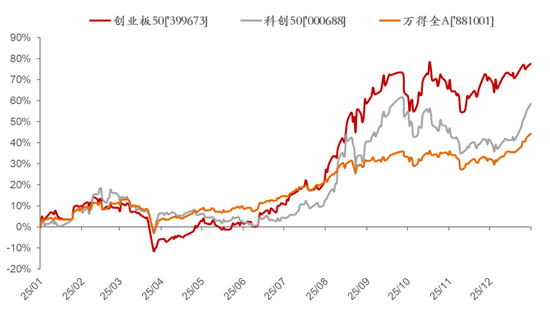
Group 1 - The core narrative of the A-share market has shifted from "growth" to "competitiveness" since 2021, influenced by external factors such as the Trump administration's impact on international order [44][45] - The market increasingly believes in China's long-term competitiveness in key sectors like AI, semiconductors, and high-end manufacturing, leading to rising expectations for perpetual growth rates [44][45] - The A-share market's pricing logic is now more focused on the long-term competitiveness of leading companies rather than immediate economic pressures, indicating a decoupling from traditional macroeconomic indicators [45][46] Group 2 - The current economic pressures include a slowdown in real estate, stagnant income growth, and weak consumer confidence, yet the competitiveness of Chinese companies in high-end manufacturing and AI is improving [45][46] - The market's valuation is driven by the long-term success of leading firms in global competition, rather than current economic challenges, suggesting a dual narrative where economic stress and corporate strength coexist [45][46] - The historical context shows that market performance can diverge from economic fundamentals, as seen in past examples like the U.S. stock market during World War II and China's market from 2000 to 2005 [37][40][41] Group 3 - The investment logic has shifted towards AI, electricity, and critical resources, with capital expenditures in these areas growing rapidly, although they have limited impact on household income [52][53] - The relationship between corporate competitiveness and household income growth is becoming more differentiated, reflecting a broader economic transformation [53][54] - The ongoing structural changes in the economy are leading to a "temperature difference" where corporate profits rise while household income growth remains subdued [54][56]

股指连阳,“春季躁动”背后的逻辑
李迅雷金融与投资· 2026-01-12 11:15
Group 1 - The core narrative of the market has shifted from "growth" to "competitiveness," driven by external factors such as the U.S.-China tech competition and the need for self-sufficiency in key industries [17][33] - The A-share market has shown resilience despite economic pressures, with the performance of leading companies in global competition being a key driver of market valuation rather than domestic consumption or income growth [18][27] - The current investment logic emphasizes sectors like AI, power, and critical resources, which are experiencing rapid capital expenditure growth, while traditional consumer sectors face challenges [26][28] Group 2 - The divergence between corporate competitiveness and household income growth reflects a broader transformation in the economic structure, where companies are optimizing costs to enhance global competitiveness [28][31] - Historical examples illustrate that market performance can diverge from economic fundamentals, as seen in the U.S. during WWII and China's market in the early 2000s, where investor sentiment and risk premiums played significant roles [9][14][16] - The current market environment suggests that the valuation of leading companies is increasingly decoupled from traditional economic indicators, focusing instead on their long-term competitive advantages [5][8][18] Group 3 - The rise in valuations for sectors like commercial aerospace, AI, and semiconductors reflects a belief in China's ability to compete and innovate in critical areas, despite short-term economic challenges [18][19] - The shift in demand dynamics, particularly in the context of AI and energy infrastructure, is driving a new cycle of investment that differs from traditional recovery patterns [19][24] - The market's focus on a few core assets, which contribute significantly to overall market capitalization, indicates a concentration of value creation in leading firms rather than a broad-based economic recovery [5][8][18] Group 4 - The ongoing adjustments in corporate cost structures and labor compensation models are indicative of a strategic response to global competition, which may lead to increased income volatility for workers [28][31] - The institutional differences between China's centralized policy approach and the more fragmented Western model highlight the advantages of sustained support for key industries in fostering long-term competitiveness [33][34] - The current macroeconomic landscape is characterized by a complex interplay of geopolitical uncertainty, technological competition, and evolving consumer behaviors, necessitating a nuanced investment strategy [35][36]

刷新历史纪录!A股全市成交额3.64万亿元,后市怎么看?
Sou Hu Cai Jing· 2026-01-12 08:01
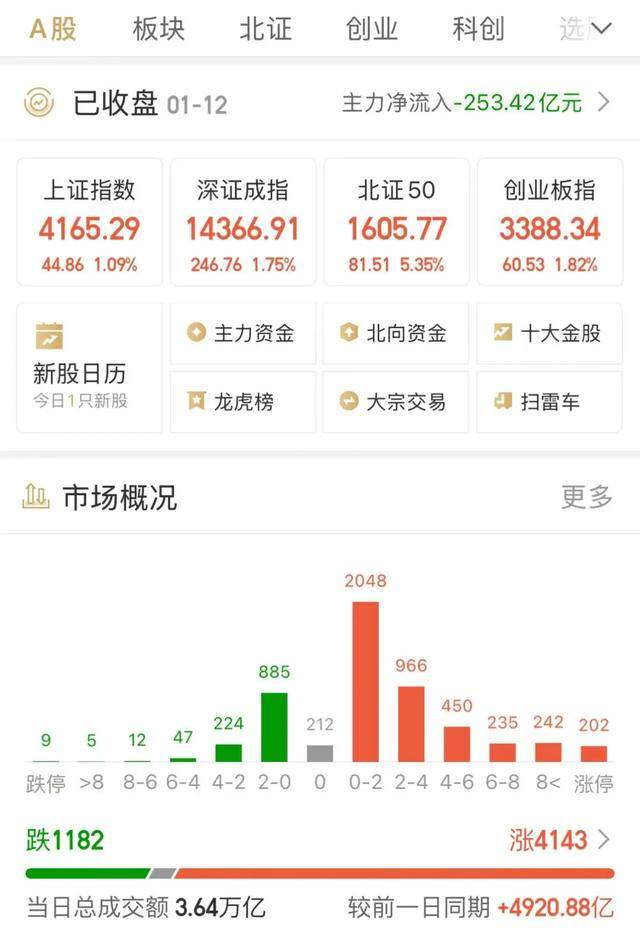
Market Performance - The Shanghai Composite Index rose over 1%, marking a "17 consecutive days of gains," while the Shenzhen Component Index increased by 1.75% and the ChiNext Index by 1.82% [1] - The total market turnover reached 3.64 trillion yuan, setting a new historical record, surpassing the previous high of 3.45 trillion yuan on October 8, 2024 [1][4] - More than 4,100 stocks experienced price increases during this trading session [1] Sector Performance - The commercial aerospace and AI application sectors led the market, with brain-computer interface concepts also seeing significant gains [1] - Sectors such as computing hardware, insurance, and oil and gas experienced the largest declines [1] Investor Sentiment - A veteran investor noted the unprecedented heat in the A-share market, highlighting that there has been no significant pullback [4] - In the first hour of trading on January 12, the total turnover approached 1.7 trillion yuan, with half-day turnover exceeding 2.31 trillion yuan, indicating strong capital inflow [4] Economic Outlook - The chief economist at AVIC Securities suggested that the spring market rally may have entered a major upward phase, supported by improvements in the fundamental and policy environment [7] - Recent domestic inflation data showed a year-on-year increase of 0.8% in CPI, the highest since March 2023, indicating a positive trend in economic conditions [7] - The "anti-involution" policy aligns with market concerns and is expected to have a more pronounced effect on industries under profit pressure [7] Investment Strategy - The economist recommended a balanced allocation in sectors with marginal catalysts and advised monitoring industries with improving fundamentals that have lagged in the current rally for potential investment opportunities [7]
春季行情启动如何配置,如何交易?
ZHONGTAI SECURITIES· 2026-01-12 07:53
Group 1 - The current market uptrend is supported by long-term capital inflows and strong performance from the insurance sector, with the A500 ETF seeing significant net inflows of nearly 100 billion RMB in December 2025, contributing to market buoyancy [4][8][12] - The "spring rally" is characterized by a seasonal pattern in the A-share market, typically occurring from late December to the first quarter, driven by macroeconomic policies, liquidity conditions, and the timing of financial reports [5][22][24] - Historical data from 2016 to 2025 indicates that the spring rally usually starts in late January and lasts about 30 trading days, with an average index increase of approximately 15% [24][25][31] Group 2 - The macroeconomic environment for 2026 is expected to remain in a weak recovery phase, with structural support for technology-related sectors likely to continue, as policies emphasize growth and technological advancement [33][37][38] - The transition from old to new economic drivers is showing initial results, with several high-tech companies moving from policy-driven growth to performance validation, which is crucial for sustained investment confidence [40][41][45] - The market is likely to experience active trading with structural opportunities rather than a broad-based rally, as long-term capital and policy support create a conducive environment for thematic investments [48][49][50] Group 3 - Investment recommendations suggest prioritizing small-cap growth and innovation-driven sectors, as these areas are expected to benefit from improved liquidity and risk appetite [57][58] - The strategy should focus on short-term trend tracking and rapid rotation among themes, as the market dynamics are driven more by policy and industry expectations than by fundamental improvements [60][61] - The securities and financial technology sectors are expected to benefit from increased trading volumes and active leverage, while the insurance sector is positioned for long-term growth due to favorable market conditions and improved investment returns [63][64]


1.12犀牛财经早报:内存条价格一年暴涨300%
Xi Niu Cai Jing· 2026-01-12 01:49
Group 1 - Public funds entering the market since 2026 are expected to exceed 45 billion yuan, driven by new stock ETFs and actively managed funds [1] - The A-share market has seen a "spring rally," with the Shanghai Composite Index surpassing 4100 points and significant trading volume, leading to notable gains for several funds [1] - Over half of the A-share companies have reported positive earnings forecasts for 2025, indicating a healthy growth trend [2] Group 2 - The price of 16GB memory modules has surged over 300% in the past year, driven by high demand from AI data centers and supply chain shortages [2] - SanDisk is implementing a 100% cash prepayment requirement for future storage chip allocations, indicating a shift in the semiconductor supply chain dynamics [2] - The establishment of China's first dedicated optical quantum computer manufacturing facility marks a significant step towards the industrialization of quantum technology [3][4] Group 3 - The approval of multiple innovative drugs in early 2026 highlights the growth of the domestic pharmaceutical industry, supported by favorable regulatory policies [4] - Companies like Kosin Technology and Hebang Bio are forecasting net losses for 2025 due to market demand fluctuations and asset impairment provisions [9][10] - The Shenzhen Stock Exchange has terminated the review of Zhuhai Saiwei's IPO application, reflecting regulatory scrutiny in the market [6] Group 4 - The auction of 416 million shares of Shanxi Bank has attracted significant attention, with the bank seeking to optimize its shareholder structure [7][8] - The resignation of Liu Peng from Zhongshun Jierou's executive positions indicates potential shifts in leadership strategy within the company [8] - The stock of Hongxun Technology has experienced significant volatility, with the company clarifying its business focus amid market speculation [10]
享受春季躁动主升浪
AVIC Securities· 2026-01-12 01:47
Market Overview - The market sentiment is significantly active, with the Wind All A Index rising by 5.11% in the first week of 2026, indicating a potential main upward wave of spring excitement[8] - The A-share market has surpassed the 30 trillion yuan mark in trading volume for the fifth time in history, after 73 trading days[8] Economic Indicators - In December, the Consumer Price Index (CPI) increased by 0.8% year-on-year, marking the highest level since March 2023, with a month-on-month increase of 0.1 percentage points[9] - The Producer Price Index (PPI) shows a significant upward trend since June 2025, indicating a recovery in the manufacturing sector[9] Sector Performance - Key sectors such as defense, electric power equipment, communication, and biomedicine have shown continuous improvement in revenue and net profit over the past two quarters, reflecting high-quality fundamental recovery[17] - The technology sector, particularly commercial aerospace, AI applications, and humanoid robotics, continues to lead market performance[8] Investment Strategy - The report suggests focusing on sectors with improving profitability, including beauty care, communication, basic chemicals, automotive, electric power equipment, biomedicine, electronics, and machinery[19] - The investment ratings for companies are categorized as "Buy" for expected growth of 5%-10%, "Hold" for -10% to +5%, and "Sell" for declines over 10%[25] Risk Factors - The report highlights potential risks associated with market volatility and regulatory changes impacting various sectors[24]
中金:港股和A股谁“错”了?
Xin Lang Cai Jing· 2026-01-12 01:18
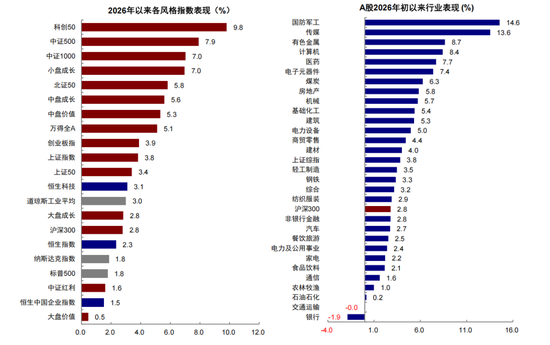
Group 1 - The core driver of the A-share market's strong performance at the beginning of 2026 is the "excess liquidity" chasing "scarce return assets," rather than significant changes in the macroeconomic fundamentals [2][11] - The A-share market has shown a clear structural preference for sectors like commercial aerospace, non-ferrous metals, and brain-computer interfaces, with small-cap stocks outperforming large-cap stocks [2][3] - The A-share market's gains have primarily been driven by valuation expansion, while traditional consumer stocks have lagged behind due to their closer correlation with domestic demand fundamentals [2][5] Group 2 - The Hong Kong stock market has underperformed due to a lack of attractive structural opportunities and a weaker funding environment, reflecting a deteriorating fundamental backdrop [10][13] - The absence of significant inflows from southbound capital has been noted, with December's average daily inflow dropping to 10.9 million HKD, significantly lower than the 60 million HKD average for the entire year [18][20] - The Hong Kong IPO market remains active, with a total of 2,858 million HKD raised in 2025, but the overall market performance has been muted compared to A-shares [20][21] Group 3 - Historical analysis indicates that the "spring market" effect is more pronounced in A-shares than in Hong Kong stocks, with A-share indices showing an average increase of 4.6% during the period from early December to early March, compared to only 0.5% for Hong Kong stocks [23][24] - The A-share market has consistently outperformed the Hong Kong market in terms of sector performance, particularly in technology, military, and home appliance sectors, which have shown average gains around 10% [23][24] Group 4 - The structural differences between A-shares and Hong Kong stocks lead to varying earnings growth rates, with A-shares expected to see a growth rate of 4%-5% in 2026 compared to 3% for Hong Kong stocks [30] - A-shares benefit from a more favorable micro liquidity environment, while Hong Kong stocks face multiple constraints, including potential declines in southbound capital inflows [33][34] - The unique structural opportunities in Hong Kong, such as high dividend yields and sectors like internet and innovative pharmaceuticals, provide a complementary investment avenue despite the overall market underperformance [35][36]
股指期货:情绪积极,动态跟踪相关变量
Guo Tai Jun An Qi Huo· 2026-01-12 01:04
1. Industry Investment Rating - No information provided in the report. 2. Core Views - Last week, the stock market continued its upward trend, with the Shanghai Composite Index breaking through 4000 and 4100 points, and the daily trading volume exceeding 3 trillion. The comprehensive, national defense and military industry, and media sectors led the gains, while the banking sector was the only one to decline, and the transportation and petroleum and petrochemical sectors had relatively small gains [1]. - The upward logic of the market since the beginning of the year is driven by the typical spring rally, which is mainly affected by policies, liquidity, and risk appetite in the environment of a vacuum in the first - quarter economic data and financial reports. Positive policy expectations, the expected return of funds to the stock market at the beginning of the new year, the absence of obvious overseas risks, and continuous positive news in industries and themes have created a positive feedback loop of capital inflow - price increase - further capital inflow [1]. - The sustainability of the spring rally depends on core drivers such as policies, liquidity, and risk appetite. Attention should be paid to factors like the determination of the new Fed chairman, the US interest - rate cut space this year, possible policy cooling measures in China after breaking through two integer thresholds, and the overall local policy direction after the local two sessions. In the short term, sentiment remains positive, and relevant variables should be dynamically tracked. In the longer term, the upward slope is expected to slow down as positive factors are gradually realized [2]. - Key factors to watch include December economic data, 2025 GDP data, local two sessions, the new Fed chairman, and this year's easing space [3]. 3. Strategy Recommendations Short - term Strategy - The intraday trading frequency can refer to the 1 - minute and 5 - minute K - line charts. The stop - loss and take - profit levels of IF, IH, IC, and IM can be set at 95 points/119 points, 78 points/47 points, 202 points/283 points, and 245 points/327 points respectively [4]. Trend Strategy - Adopt a bullish approach. The core operating ranges of the IF2601 main contract of IF are 4622 - 4860 points; the IH2601 main contract of IH, 3055 - 3196 points; the IC2601 main contract of IC, 7846 - 8371 points; and the IM2601 main contract of IM, 7875 - 8405 points [4]. Cross - variety Strategy - Hold the strategy of shorting IF (or IH) and going long on IC (or IM) [5]. 4. Summary by Directory 4.1 Spot Market Review - Last week, most global stock indices rose, with the Shanghai Composite Index up 3.82%. Since 2025, major domestic indices have also shown varying degrees of increase, such as the Shenzhen Component Index up 35.6%, and the ChiNext Index up 55.4% [10][12]. - Most industries in the CSI 300 and CSI 500 indices rose last week. In the CSI 300 index, the information and pharmaceutical industries had relatively large increases, while the telecommunications industry declined. In the CSI 500 index, the telecommunications and industrial industries had significant gains [14]. - The trading volume and turnover rate of the Wind All - A index are presented in the report, reflecting the market's trading activity [14]. 4.2 Stock Index Futures Market Review - Last week, the main contract IC of stock index futures had the largest increase and the largest amplitude [16]. - The trading volume and open interest of stock index futures rebounded [16]. - The report shows the basis (futures - spot) trend of stock index futures main contracts and the cross - variety ratio of main contracts [16]. 4.3 Index Valuation Tracking - As of December 31, the TTM price - to - earnings ratios of the Shanghai Composite Index, CSI 300 Index, SSE 50 Index, CSI 500 Index, and CSI 1000 Index were 16.54 times, 14.16 times, 11.78 times, 33.94 times, and 46.78 times respectively [17][20]. 4.4 Market Capital Flow Review - The report shows the trends of margin trading balance, new - established equity - biased funds, and the ratio of margin trading balance to A - share free - float market capitalization [23]. - Last week, the capital interest rate first rose and then fell, and the central bank conducted net repurchase after the new year [23].
4100点、16连阳,春季行情来了?
吴晓波频道· 2026-01-12 00:30
Core Viewpoint - The article discusses the recent bullish trend in the A-share market, highlighting a significant increase in trading activity and investor sentiment, particularly in the context of a "spring market rally" that has historical precedence [10][21]. Market Performance - As of January 7, the margin trading balance in the A-share market reached 26,047 billion yuan, marking a historic high [4]. - The Shanghai Composite Index achieved a rare "16 consecutive days of gains," setting a record for the longest winning streak in its history [6][21]. - From early December to January 9, the Shanghai Composite Index rose approximately 5.26%, while the Shenzhen Component Index and the ChiNext Index increased by about 7.41% and 7.58%, respectively [8]. Investor Behavior - There is a noticeable increase in discussions about stocks among the public, indicating heightened interest in the market [5]. - The influx of new investors is evident, with 2.5967 million new accounts opened in December 2025, a year-on-year increase of 30.55% [8]. Economic Indicators - The Producer Price Index (PPI) and Consumer Price Index (CPI) showed positive signs, with December 2025 recording the best performance of the year [11]. - The CPI increased by 0.8% year-on-year, indicating a return to positive growth [11]. Sector Performance - In 2025, the non-ferrous metals sector led the industry with a remarkable annual increase of 94.73%, while the food and beverage sector saw a decline of 9.69% [9]. - The aerospace equipment sector experienced a significant rise of approximately 146%, with many commercial space stocks seeing gains exceeding 100% [9]. Future Outlook - The article suggests that the current market rally may signal a new phase for the stock market, with expectations for continued strength in technology sectors and a gradual recovery in traditional industries [20][22]. - The anticipated "spring market" may extend into 2026, with a focus on technology innovation and consumption recovery as key investment themes [22][23]. - The article emphasizes the importance of patience and strategic investment in quality stocks, particularly as regulatory measures against financial misconduct are expected to tighten [27].

中金:港股和A股谁“错”了?
中金点睛· 2026-01-11 23:58
Core Viewpoint - The strong performance of A-shares at the beginning of 2026 is primarily driven by "excess liquidity" chasing "scarce return assets," rather than significant changes in the macroeconomic fundamentals [2][3][5]. Group 1: A-share Market Dynamics - The A-share market has seen a 16-day consecutive rise, with small-cap stocks outperforming large-cap stocks, continuing the trend from 2025 [3][5]. - The main contributors to the A-share gains are valuation expansions, with sectors like commercial aerospace and materials leading the charge [5][8]. - A-share trading volumes have reached historical highs, with a single-day turnover exceeding 30 trillion yuan, indicating strong market activity [5][8]. Group 2: Hong Kong Market Performance - The Hong Kong market has lagged behind, primarily due to a lack of attractive structural opportunities and weaker capital flows [9][11]. - Key sectors in Hong Kong, such as dividends, internet, and new consumption, are not currently in the market's focus, leading to underperformance [11][19]. - The Hong Kong IPO market remains active, with significant fundraising, but the overall market sentiment is subdued compared to A-shares [17][19]. Group 3: Capital Flow and Liquidity - Domestic capital flows have favored A-shares, with southbound capital flows slowing down significantly since late 2025 [15][19]. - The liquidity environment for A-shares is more favorable, benefiting from domestic microeconomic conditions, while Hong Kong faces constraints from external factors [28][30]. - The anticipated inflow of southbound capital in 2026 may not match the record levels seen in 2025, as A-shares attract more attention [30][32]. Group 4: Structural Differences and Future Outlook - A-shares are expected to have a higher overall profit growth rate of 4%-5% in 2026, compared to Hong Kong's 3%, driven by stronger sectors like technology and manufacturing [25][26]. - The structural advantages of Hong Kong, including its focus on dividends and innovative drugs, provide unique investment opportunities, even as A-shares outperform overall [30][32]. - The ongoing credit cycle and its impact on market dynamics will guide investment strategies, with a focus on sectors like AI, dividends, and cyclical stocks [33].