美联储降息

Search documents
地缘冲突缓和,黄金多空分歧加大,金价高位波动
Mei Ri Jing Ji Xin Wen· 2026-01-08 01:15
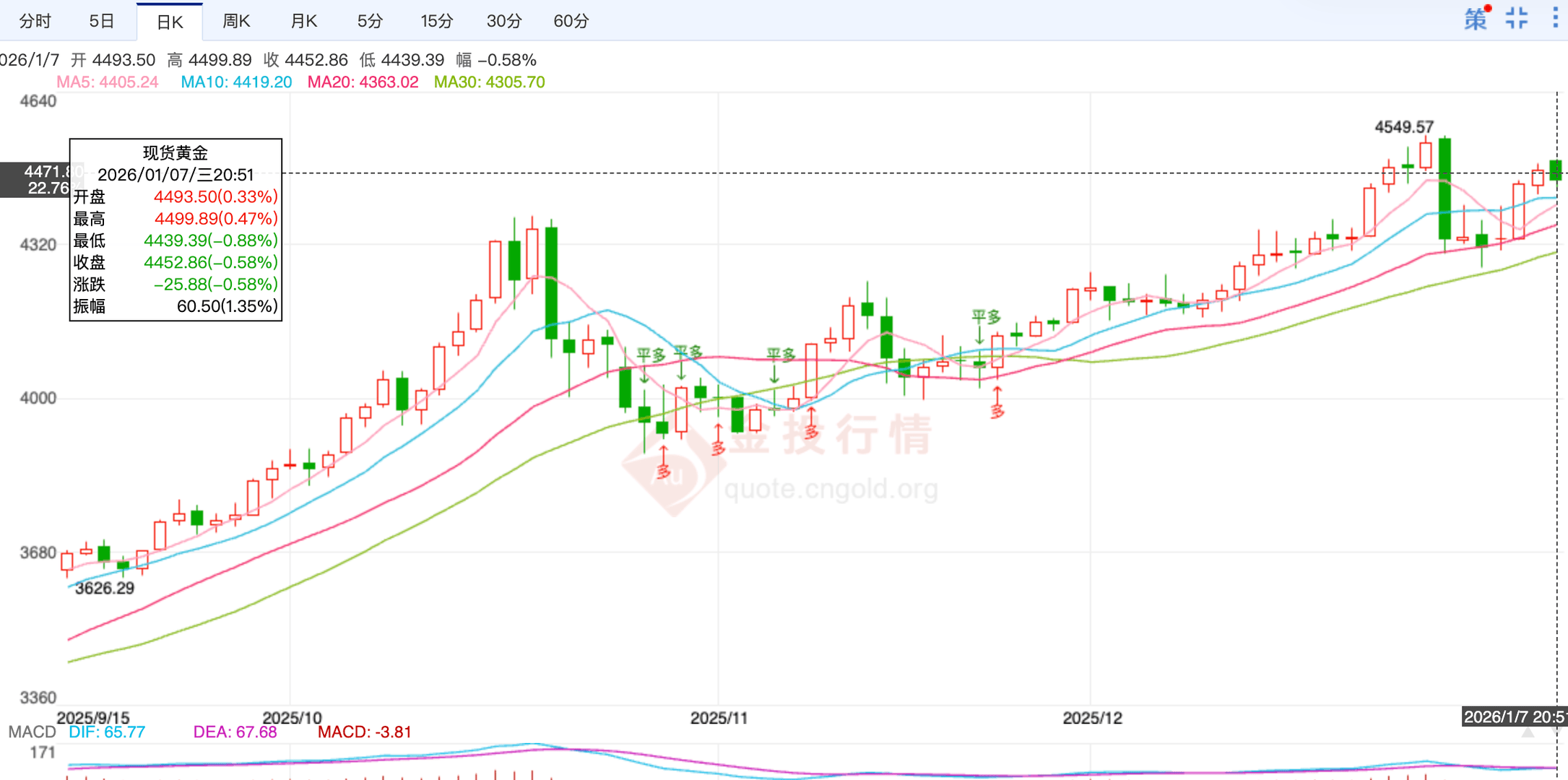
Core Viewpoint - The article discusses the recent fluctuations in gold prices, influenced by geopolitical developments and market dynamics, highlighting the need for cautious investment strategies in the precious metals sector [1]. Market Performance - On January 7, gold prices fell from a high of $4,512 to a low of $4,432, before slightly recovering at the end of the trading session [1]. - COMEX gold futures closed down 0.65% at $4,467.1 per ounce, while the China Gold ETF (518850) also fell by 0.65%, and the gold stock ETF (159562) decreased by 1.36%. In contrast, the non-ferrous metals ETF (516650) rose by 0.39% [1]. Geopolitical Influence - Ukrainian President Zelensky indicated during a visit to Cyprus that negotiations with U.S. and European partners have reached a new level, with the potential to end the conflict with Russia by mid-2026 [1]. Market Dynamics - The beginning of the year saw significant volatility in gold prices, following remarkable increases in 2025, where gold surged over 60% and silver over 140%, leading to substantial profit-taking [1]. - The current market behavior reflects a "surge and plunge" pattern, indicating investor uncertainty and differing opinions on future price movements [1]. Investment Strategy - Investors are advised to avoid a "blind chasing" mentality and focus on upcoming economic indicators, particularly the U.S. non-farm payroll report, which will directly impact the Federal Reserve's interest rate decisions and, consequently, the short-term trends in precious metals [1]. - If a prolonged rate-cutting cycle is confirmed, the bullish trend in precious metals is expected to continue in the long term [1].
连续14个月增加黄金储备:申万期货早间评论-20260108
申银万国期货研究· 2026-01-08 00:36
Core Viewpoint - China has increased its gold reserves for 14 consecutive months, with a total of 74.15 million ounces as of December 2025, reflecting a rise of 30,000 ounces from the previous month, while foreign exchange reserves reached a new high of $335.79 billion, up by $11.5 billion [1][9]. Group 1: Economic Indicators - The global manufacturing PMI for December 2025 was reported at 49.5%, a slight decrease of 0.1 percentage points from the previous month, remaining within the 49%-50% range for 10 consecutive months [1]. - The ISM services PMI in the U.S. rose by 1.8 points to 54.4, marking the highest level since October 2024 [1]. - The ADP reported an increase of 41,000 in private sector employment in December, reversing the previous month's decline but falling short of market expectations [1]. Group 2: Precious Metals - Precious metals are experiencing a period of consolidation, supported by a macroeconomic environment characterized by easing inflation pressures in the U.S. and a weak job market, which strengthens expectations for interest rate cuts by the Federal Reserve [2]. - The long-term upward trend for gold is expected to continue, bolstered by factors such as weakened dollar credibility and central bank purchases [2]. - Silver and platinum are also expected to see price increases due to supply constraints and steady industrial demand, particularly in solar energy applications for silver and catalytic converters for platinum [2]. Group 3: Stock Indices - The U.S. stock indices showed mixed performance, with the comprehensive sector leading gains while the oil and petrochemical sector lagged [3]. - The financing balance increased by 18.887 billion yuan to 25,623.09 billion yuan as of January 6 [3]. - The appreciation of the RMB against the USD is expected to attract overseas capital back to China, supporting asset revaluation and reinforcing a long-term bullish trend in the A-share market [3][11]. Group 4: Government Actions - The People's Bank of China announced a 1.1 trillion yuan reverse repurchase operation to maintain liquidity in the banking system, continuing a trend of monetary easing [8]. - The central bank's focus for 2026 includes enhancing counter-cyclical and cross-cyclical adjustments, indicating a strong expectation for easing policies at the beginning of the year [12].


百亿美元抛压将至!贵金属上演跳水 ,黄金“里程悲”银铂钯重挫
Di Yi Cai Jing· 2026-01-08 00:26
贵金属市场遭遇黑色星期三,国际金价在触及4500美元关口后遭遇抛售压力,促使投资者在高位进行获 利了结。与此同时,周四(8日)起,彭博大宗商品指数的年度权重调整将正式启动,预计将引发超过 100亿美元黄金和白银期货的多头平仓。受此影响,国际金价日内一度下探近70美元,白银、铂金和钯 金尾盘跌幅均超过4%。不过,受地缘政治、美联储降息等因素提振,机构依然看好今年的贵金属行 情。 【百亿美元抛压将至!#贵金属上演跳水# ,黄金"里程悲"银铂钯重挫】#国际金价日内一度下探近70美 元# ...
贵金属突然跳水
Di Yi Cai Jing Zi Xun· 2026-01-08 00:17
Group 1 - The core viewpoint of the article highlights a significant sell-off in the precious metals market, particularly gold, following a peak at $4500, driven by profit-taking and an upcoming rebalancing of the Bloomberg Commodity Index, which is expected to trigger over $10 billion in long liquidation in gold and silver futures [2][3]. - The Bloomberg Commodity Index, a widely used benchmark in the commodity investment field, is undergoing an annual weight adjustment from January 8 to 14, with substantial funds involved. The weight of silver futures in the index is being reduced from 9% to just below 4% by 2026, while gold's weight is also significantly decreased [3]. - Citigroup estimates that the sell-off in gold and silver will amount to around $7 billion each, with gold's assets under management (AUM) at $33.8 billion and a target of $27 billion, while silver's AUM is $12.9 billion with a target of $6 billion [3]. Group 2 - Morgan Stanley notes that January is a month of intense competition between bullish and bearish factors for gold investors, as historical data shows an 80% probability of price increases during the last ten trading days of the previous year and the first twenty trading days of the new year [4]. - Despite the traditional seasonal strength of gold, the large-scale technical sell-off due to index weight adjustments may counteract this upward momentum, with Morgan Stanley warning that the sell-off pressure this year is more significant than last year [4]. - Following a record annual increase in gold and silver prices, investors are taking profit, as evidenced by the reduction in net long positions in COMEX gold and silver futures [5]. Group 3 - The outlook for gold remains positive, as it has surpassed U.S. Treasury bonds to become the largest reserve asset globally, with central bank gold holdings nearing $4 trillion, exceeding the $3.9 trillion in U.S. Treasury bonds [6]. - The increase in gold's appeal as a safe-haven asset is driven by geopolitical tensions and concerns over fiscal sustainability, with a cumulative price increase of nearly 70% expected for the year [6]. - Market expectations for further easing of monetary policy by the Federal Reserve provide additional support for gold prices, as lower interest rates reduce the opportunity cost of holding non-yielding assets like gold and silver [6]. Group 4 - Recent geopolitical developments, including U.S. military actions in Venezuela and renewed interest in Greenland, have heightened geopolitical tensions, which are likely to influence market sentiment and gold demand [7]. - Economic indicators show a slowdown in U.S. economic momentum, with expectations of approximately two interest rate cuts by the Federal Reserve this year, further supporting the case for rising gold prices [7]. - Analysts predict that gold prices could reach $5000 per ounce by the end of the first quarter, driven by central bank gold purchases, expanding fiscal deficits, declining U.S. interest rates, and ongoing geopolitical risks [7].

贵金属突然跳水
第一财经· 2026-01-08 00:10
Core Viewpoint - The article discusses the recent volatility in the precious metals market, particularly gold and silver, due to significant sell-off pressures triggered by the annual rebalancing of the Bloomberg Commodity Index, which is expected to lead to over $10 billion in long position liquidations in gold and silver futures [3][4]. Group 1: Market Dynamics - The Bloomberg Commodity Index, a widely used benchmark in the commodity investment field, had nearly $109 billion in assets under management as of last October [4]. - The annual weight adjustment period for this index runs from January 8 to 14, with silver's weight being reduced from 9% to just below 4%, and gold's weight also significantly lowered [4]. - Citigroup estimates that the sell-off in gold and silver will amount to around $7 billion each, with Morgan Stanley highlighting that silver will face the most substantial selling pressure this year compared to last [5]. Group 2: Seasonal Trends and Investor Behavior - Historically, January is a month of intense market dynamics for gold, with an 80% probability of price increases during the last ten trading days of the previous year and the first twenty trading days of the new year [5]. - However, the large-scale technical sell-off due to index weight adjustments may counteract this seasonal trend, prompting investors to closely monitor this variable [5]. - Recent data from the CFTC indicates that speculators reduced their net long positions in gold and silver, with gold positions decreasing by 10,668 contracts and silver by 7,270 contracts as of December 30 [6]. Group 3: Future Outlook - Despite the short-term price corrections, the outlook for gold remains positive due to ongoing geopolitical tensions and expectations of further monetary easing by the Federal Reserve, which typically supports gold prices [8][10]. - The World Gold Council reports that central banks' gold holdings have reached nearly $4 trillion, surpassing U.S. Treasury holdings for the first time in 30 years, indicating a significant shift in reserve asset preferences [8]. - UBS forecasts that gold prices could reach $5,000 per ounce by the end of the first quarter, driven by central bank purchases, expanding fiscal deficits, and persistent geopolitical risks [10].

道指深夜下挫460点,存储概念回调,热门中概股多数下跌,白银重挫,油价飘绿
21世纪经济报道· 2026-01-07 23:30
Market Overview - The U.S. stock market showed mixed results, with the S&P 500 and Dow Jones indices reaching historical highs before retreating, where the Dow Jones fell by 466 points, a decline of nearly 1% [1] - The storage sector experienced a notable pullback, with major Chinese concept stocks mostly declining, and both gold and silver stocks suffered significant losses [1] Major Indices Performance - Dow Jones: 48,996.08, down 466.00 (-0.94%) - Nasdaq: 23,584.27, up 37.10 (+0.16%) - S&P 500: 6,920.93, down 23.89 (-0.34%) [2] Technology Stocks - Google (Alphabet) rose over 2%, surpassing Apple to become the second-largest U.S. stock by market capitalization; Microsoft and Nvidia increased by over 1%, while Facebook declined nearly 2% [2] - Intel saw a significant rise of over 6%, with an intraday increase exceeding 11% following the launch of its next-generation PC platform processor, Core Ultra3 [2] Storage Sector - The storage sector faced a sharp decline, with Western Digital dropping nearly 9%, Seagate Technology down nearly 7%, and Micron Technology falling over 1%. In contrast, SanDisk saw a rise of over 1% after a previous day increase of over 27% [3] Chinese Concept Stocks - The Nasdaq Golden Dragon China Index fell by 1.58%, with notable declines in stocks such as CloudMi Technology (down over 11%), and both Artis Solar and Tencent Music (down over 5%). Alibaba and Beike also dropped over 2% [4] - However, some stocks like Su Xuan Tang Pharmaceutical rose over 18%, and several others including Dingdong Maicai and iQIYI increased by over 5% [4] Precious Metals - Gold and silver stocks experienced significant declines, with Hecla Mining and First Majestic Silver dropping over 4%, and Barrick Gold falling nearly 1% [5] - Spot gold and silver saw substantial corrections, with gold down 0.87% and silver down 3.56% in the night session [6] Oil Market - International oil prices showed a downward trend, with NYMEX WTI crude oil falling over 1% to $56.4 per barrel, and ICE Brent crude dropping over 0.4% [7] Cryptocurrency Market - The cryptocurrency market saw most major coins decline, with Bitcoin dropping over 2% to $91,101 per coin, and over 96,000 individuals experiencing liquidation in the last 24 hours [8] Economic Indicators - Recent ADP employment data indicated an increase of 41,000 jobs in December 2025, suggesting a cooling trend in the labor market, which may reinforce expectations for continued interest rate cuts by the Federal Reserve in the first half of the year [9]

ADP止跌职位空缺却下滑,非农将如何影响美联储降息预期
Di Yi Cai Jing Zi Xun· 2026-01-07 23:12
Group 1 - The core economic data released this week indicates a partial recovery in the U.S. job market at the end of last year, but it has not fully overcome challenges. The Federal Reserve's interest rate futures pricing suggests the first rate cut could occur in the second quarter if the non-farm payroll data falls short of market expectations [1] - In December 2025, U.S. companies added 41,000 jobs, which is below the expected 48,000, indicating a weak labor market. Employee wage growth has also declined, with a year-on-year increase of 4.4%, matching the lowest level since the pandemic [2] - Job growth is concentrated in a few sectors, primarily healthcare, hospitality, and restaurants, highlighting the weakness of the labor market over the past year. The current labor market is characterized by low hiring and low layoffs, with no clear signs of a significant rebound in hiring [3] Group 2 - The U.S. Labor Department's JOLTS report shows a decline in job vacancies and hiring in November, with job openings dropping from nearly 7.5 million to about 7.1 million, and the hiring rate decreasing from 3.4% to 3.2% [4] - The upcoming non-farm payroll data, set to be released on January 9, is expected to be a key driver for market direction. In November, the U.S. non-farm payrolls increased by 64,000, but the unemployment rate rose to 4.6%, the highest in over four years [5] - The Federal Reserve's economic outlook for 2026 is generally optimistic, predicting accelerated economic growth and a stable unemployment rate, although concerns remain about the labor market's cooling [6] Group 3 - There are significant risks in the market, as inflation improvement has stalled and the labor market shows signs of weakness. The slowing job growth and declining wage pressure indicate a challenging economic environment [7] - The current labor market is not in an ideal state of equilibrium, and the "low hiring, low layoffs" model may not be sustainable. If consumer spending decreases, it could lead to a wave of layoffs [7] - The weakening labor market provides a rationale for the Federal Reserve to adjust its rate cut expectations, and if the non-farm report is too weak, it may signal more severe economic risks than currently anticipated [7]

美国就业降温强化宽松预期 获利回吐压制金价但下行空间受限
智通财经网· 2026-01-07 22:28
智通财经APP获悉,在近期大幅上涨后,国际金价周三出现明显回调,投资者选择获利了结。不过,弱 于预期的美国就业数据强化了市场对美联储年内降息的押注,限制了金价跌幅。 截至收盘,现货黄金下跌0.87%,报每盎司4,455.42美元,盘中一度最多下挫1.7%至4,422.89美元。2月 交割的美国黄金期货收跌 0.7%,报4,462.50美元。 High Ridge Futures金属交易主管David Meger表示,当日的下跌主要是此前一轮快速上涨后的正常获利 回吐。但他也指出,偏软的就业数据持续支撑美联储转向宽松的逻辑,而这正是近期金价走强的重要背 景。 数据显示,美国11月职位空缺降幅大于预期,而另一份由ADP发布的报告显示,12月私营部门就业增长 同样不及预期。根据LSEG汇编的数据,市场目前预计今年美联储累计降息约61个基点,投资者的注意 力已转向周五即将公布的非农就业报告。 与此同时,中国央行继续增持黄金。官方数据显示,中国央行在去年12月连续第14个月增持黄金储备。 Meger表示,这一数据反映出亚洲地区依然强劲的实物需求,也是近期金价不断上行的重要原因之一。 作为不生息的避险资产,黄金通常在低利 ...
【UNforex财经事件】达里奥警示黄金大涨信号 货币价值变化重塑资产定价
Sou Hu Cai Jing· 2026-01-07 18:46
Group 1 - The core message highlights that the recent rise in gold prices reflects deeper concerns about the weakening value of fiat currencies, rather than just short-term safe-haven demand [1][3] - Bridgewater's founder Ray Dalio emphasizes that the current environment of low interest rates and technology investment sentiment supports risk appetite, but discussions about the long-term impact of currency purchasing power on asset pricing are intensifying [1][2] - The comparison of asset performance using gold as a benchmark indicates that the actual returns of U.S. stocks in 2025 will be significantly weaker than what is presented in nominal terms, suggesting that evaluating asset performance solely based on nominal returns may obscure real risk exposure [1] Group 2 - The market is currently experiencing a structural differentiation in asset performance, influenced by policy expectations, economic data, and valuation factors, necessitating a greater focus on risk control and timing in investment allocation [2] - The upcoming U.S. non-farm payroll report is anticipated to be a crucial reference for assessing labor market resilience and the direction of interest rate policies, which could impact the performance of the dollar, precious metals, and overall risk asset pricing [2] - Both gold and stocks have benefited from the accommodative environment over the past year, but as price levels have significantly increased, their sensitivity to macro changes is also rising, indicating the need to pay attention to relative value relationships between assets [2][3]
金价银价再涨,有金店小克重生肖金条卖断货 专家:短期不宜追高,长期可考虑逢低布局
Sou Hu Cai Jing· 2026-01-07 15:57
Core Viewpoint - Gold and silver prices are expected to experience significant increases in 2026 after a correction at the end of 2025, driven by geopolitical tensions and economic factors such as interest rate cuts and a weakening dollar [1][10]. Group 1: Market Trends - Gold prices fell significantly at the end of 2025, dropping below $4,300 per ounce, but rebounded to nearly $4,500 in early January 2026, with a slight retreat to around $4,465 [2]. - Silver prices followed a similar trend, experiencing a drop before rising again, reaching $82.73 per ounce, close to last year's peak of $83.62, before settling around $79.6 [2]. - Domestic gold prices briefly fell below ¥1,000 per gram but quickly recovered, with prices reaching ¥1,402 per gram for certain gold jewelry [2]. Group 2: Consumer Behavior - High demand for small-weight zodiac gold bars was observed, leading to stock shortages in some stores, particularly at the Beijing Caibai store, where customers were actively purchasing gold bars [4][8]. - The issuance of gold consumption vouchers in Beijing contributed to increased foot traffic and sales in some stores, while other locations experienced lower customer turnout due to rising gold prices [8][10]. Group 3: Expert Insights - Experts attribute the short-term rise in gold prices to heightened risk aversion following U.S. actions in Venezuela, alongside expectations of continued interest rate cuts by the Federal Reserve and a weaker dollar [10][11]. - Long-term support for gold prices is expected to remain strong due to ongoing central bank purchases and the "de-dollarization" trend, which is seen as a slow but steady process that will bolster gold's value over time [10][11]. - Analysts recommend caution in the short term, advising against chasing prices, while suggesting that long-term investors consider buying on dips due to the underlying supportive factors for gold and silver [10][11].