经济转型

Search documents
杨德龙:本轮牛市启动的背后逻辑
Xin Lang Ji Jin· 2025-09-01 03:04
Market Overview - The recent market rally has seen the index break through key levels of 3600, 3700, and 3800 points, with trading volumes exceeding 3 trillion yuan [1] - After reaching 3800 points, the market has shown signs of adjustment, indicating a slow bull market rather than a rapid and short-lived rally [1] Driving Factors - The rally is driven by two main factors: favorable policies that boost investor confidence in economic recovery and significant capital inflows [1] - Five main sources of capital inflow have been identified: 1. Institutional investors, particularly insurance funds, increasing their positions in large-cap blue-chip stocks [1] 2. A shift of 1.1 trillion yuan in household deposits from savings to capital markets, with non-bank deposits increasing by 2.14 trillion yuan [1] 3. Funds flowing from the real estate market due to its current downturn, with investors seeking opportunities in the stock market [2] 4. Capital moving from the bond market to equities as bond prices decline [2] 5. Funds from traditional industries, especially those facing overcapacity, seeking opportunities in the capital market [2] Market Sentiment - Despite the influx of capital, investor sentiment remains divided, with both bullish and bearish perspectives present [3] - The current market is characterized as being in the early stages of a bull market, with the Shanghai-Shenzhen 300 index's price-to-earnings ratio around 14.5, below historical averages [3] Market Dynamics - The current market is expected to exhibit a slow upward trend, potentially lasting two to three years, contrasting with the rapid bull markets of the past [4] - The margin financing balance has surged to over 2.2 trillion yuan, nearing historical highs, which raises concerns about excessive leverage [4][5] Economic Context - The global economic landscape is influenced by trade tensions, particularly the U.S.-China trade war, which has led to adjustments in export structures and a decrease in reliance on U.S. exports [6] - Domestic economic recovery is indicated by a 30% increase in sales of products under the "trade-in" program, although overall consumer spending remains subdued [6] Sector Focus - The current market is seen as a "technology bull market," with significant growth in sectors such as robotics, semiconductors, and artificial intelligence, while traditional industries face challenges [8][9] - Investment strategies should focus on emerging sectors with growth potential, while avoiding traditional industries that are in decline [9]
长盛同盛LOF: 长盛同盛成长优选灵活配置混合型证券投资基金(LOF)2025年中期报告
Zheng Quan Zhi Xing· 2025-08-29 11:29
Fund Overview - The fund is named Changsheng Tongsheng Growth Preferred Flexible Allocation Mixed Securities Investment Fund (LOF) and was established on December 26, 2014 [3] - The fund is managed by Changsheng Fund Management Co., Ltd. and custodied by Bank of China [2][3] - The fund aims to achieve long-term asset appreciation by focusing on sectors related to economic transformation, industrial upgrading, model innovation, and policy hotspots [3] Investment Strategy - The fund employs a combination of top-down industry selection and bottom-up stock picking to identify companies with high growth potential and reasonable valuations [3] - The asset allocation strategy involves dynamic adjustments among stocks, stock index futures, bonds, and money market instruments to control market risk and enhance allocation efficiency [3][4] Performance Metrics - As of June 30, 2025, the fund's net asset value was approximately RMB 385.95 million, with a total of 266,920,910.72 fund shares [3][20] - The fund achieved a net asset value per share of RMB 1.446, with a net value growth rate of 7.51% during the reporting period [15][20] - The fund's total realized income for the period was RMB 20.45 million, with a total profit of RMB 26.42 million [5][21] Financial Indicators - The fund's total assets amounted to RMB 388.83 million, with liabilities totaling RMB 2.87 million [19][20] - The fund's profit distribution for the reporting period was not implemented, in accordance with legal regulations and fund contract agreements [17] - The fund's performance benchmark is set at 50% of the CSI 300 Index return plus 50% of the China Bond Composite Index return [4][7] Management and Governance - The fund management company, Changsheng Fund Management Co., Ltd., was established in March 1999 and is one of the first ten fund management companies in China [8] - The company has a registered capital of RMB 206 million and manages a total of 73 open-end funds as of June 30, 2025 [8][9] - The fund management adheres to principles of honesty, diligence, and responsibility, ensuring fair treatment of all investment portfolios [12][13]

并非迷信!一旦房地产救不起来,明年楼市或有“5个”大难题?
Sou Hu Cai Jing· 2025-08-28 13:35
Group 1 - The proportion of loans related to real estate accounts for nearly 40% of bank credit, and real estate-related income constitutes 50% of local comprehensive financial resources [2] - Real estate represents 60% of urban residents' assets, indicating its significant role in household wealth [2] - The real estate sector is interconnected with over 60 industries, affecting the employment of potentially over a billion people, which could lead to economic downturns if the housing market continues to decline [2] Group 2 - Many households rely on real estate for 80% of their wealth, often financing homes through debt that extends over 20 to 30 years, making them vulnerable to market fluctuations [5] - The reliance on land sales for local government revenue is substantial, with some regions deriving up to 65% of their financial resources from land transfer fees, which could disrupt public projects and social welfare if the housing market remains weak [7] Group 3 - The transition to a new development phase requires less dependence on real estate, yet maintaining stability in the housing market remains crucial for economic transformation [9] - Recent favorable policies have begun to reverse the downturn in the housing sector, potentially serving as a catalyst for economic transition towards innovation and consumption-driven growth [9] - Investment in sectors like renewable energy and biotechnology is encouraged to create new growth points, while improving housing security for low-income groups is essential for social equity [9] Group 4 - Increased uncertainty necessitates cautious investment strategies, emphasizing the importance of rational decision-making and diversification to mitigate risks associated with market instability [11] - Continuous learning and skill enhancement are vital for individuals to adapt to economic changes and maintain resilience in the face of transformation [13]

国内高频 | 暑期人流持续高位(申万宏观·赵伟团队)
赵伟宏观探索· 2025-08-28 00:15
Group 1: Industrial Production - Industrial production has shown signs of recovery, with the blast furnace operating rate increasing by 1.1 percentage points year-on-year to 5.9% [2][6] - Midstream production shows a mixed outlook, with PTA and automotive production performing poorly, down 6.6% and 5.9% year-on-year respectively, while soda ash and polyester filament production improved, up 0.1% to 5.8% and 0.9% to 3.1% respectively [2][16] - Cement production continues to improve, with the national grinding operating rate down 1.5 percentage points year-on-year to -5.6%, and cement shipment rates slightly up by 0.8% to -2.9% [28][32] Group 2: Demand Tracking - Daily average transaction area of new homes remains weak, up 2.9 percentage points year-on-year to -6.3%, with first-tier cities showing some recovery [52] - Port cargo throughput related to exports has significantly increased, with cargo throughput and container throughput up 7.1% to 9.7% and 6.1% to 14.8% year-on-year respectively [61][68] - The national migration scale index has decreased by 5.2 percentage points year-on-year to 16.6%, but domestic flight operations have increased by 1.0% to 2.7% [73] Group 3: Price Trends - Agricultural product prices are showing divergence, with pork and fruit prices down 0.1% and 0.8% respectively, while egg and vegetable prices increased by 1.7% and 2.5% [3][101] - The industrial product price index has generally declined, with the Nanhua industrial product price index down 1.4% [113] - The energy and chemical price index decreased by 0.9%, and the metal price index fell by 1.7% [113][120]
A股新“股王”诞生!超越茅台登顶!
Sou Hu Cai Jing· 2025-08-27 08:26
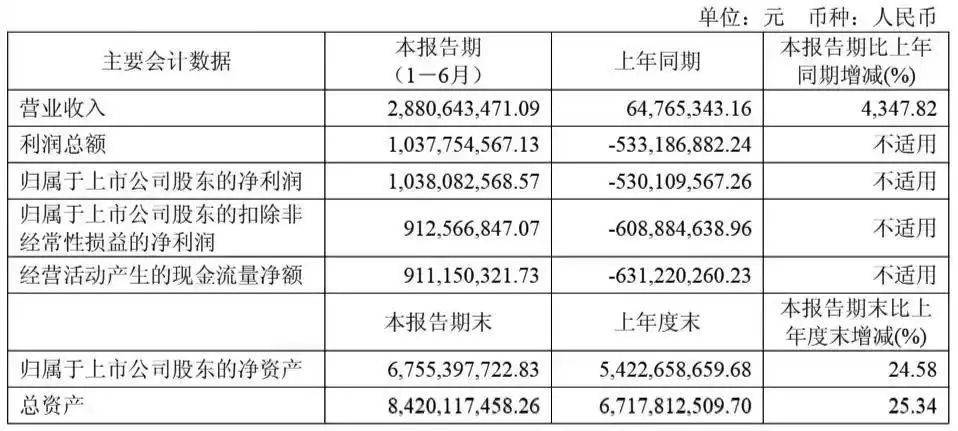
Core Viewpoint - The competition between chip company Cambricon and liquor giant Kweichow Moutai highlights a significant shift in the A-share market, with Cambricon briefly surpassing Moutai to become the new stock king, reflecting the rise of AI and technology-driven growth narratives in China [1][5]. Company Performance - Cambricon reported a staggering revenue increase of approximately 4,347.82% year-on-year, achieving about 2.881 billion yuan in revenue for the first half of 2025, compared to 64.765 million yuan in the same period last year [2][3]. - The company also turned a profit, with a net profit attributable to shareholders of approximately 1.038 billion yuan, and a net profit excluding non-recurring items of about 912.57 million yuan [2][3]. - The net cash flow from operating activities was approximately 911.15 million yuan, a significant recovery from a loss of 631.22 million yuan in the previous year [3]. Market Dynamics - The rise of Cambricon signifies a broader transition in China's economic structure, moving from traditional consumption to technology innovation, with sectors like semiconductors and AI becoming key growth drivers [6][7]. - The market capitalization of the electronics sector has surpassed that of the banking sector, indicating a shift from a finance-driven market to one focused on technology and electronics [6][7]. - The competition between Cambricon and Kweichow Moutai is not just a stock price battle but represents a fundamental change in development logic, emphasizing a focus on hard technology and innovation [7].
列国鉴丨记者观察:资源丰富 “微缩版非洲”喀麦隆在挑战中寻新机
Xin Hua Wang· 2025-08-27 07:13
Economic Overview - Cameroon, often referred to as "Africa in miniature," faces significant challenges in economic and social development due to international instability and terrorism threats [1] - The country has a diverse geography and rich natural resources, with a land area of over 470,000 square kilometers and a population exceeding 28 million [2] - Cameroon is known as the "granary of Central Africa," with fertile lands and a variety of agricultural products, including rubber, bananas, and palm oil [2] Resource Potential - The forest area in Cameroon covers 22.5 million hectares, accounting for approximately 46.3% of the country's land, with a timber reserve of 4 billion cubic meters [2] - The country has abundant water resources, with hydropower potential representing 3% of the world's total [3] - Major ports, such as Douala and Kribi, facilitate trade for neighboring landlocked countries [3] Historical Context - Cameroon has a complex colonial history that has led to divisions between English-speaking and French-speaking regions, resulting in ongoing social and political tensions [4] - The English-speaking regions, which make up about 20% of the population, have experienced significant unrest and conflict since 2017, leading to thousands of deaths and displacements [4] Economic Challenges - The rise of extremist groups like Boko Haram has severely impacted local communities and hindered development [5] - Fluctuations in international oil and gas prices have adversely affected Cameroon’s economy, with crude oil export revenues decreasing by 25.6% and liquefied natural gas revenues down by 33.3% year-on-year [5] Government Initiatives - The Cameroonian government is actively seeking economic transformation through a national development strategy for 2020-2030, focusing on manufacturing and agricultural modernization [6] - Key industrial projects are planned, including mining, aluminum production, and fertilizer manufacturing, to drive economic growth [6] - Infrastructure projects, such as the Kribi deep-water port expansion, aim to enhance the country's economic structure and facilitate the processing and export of raw materials [6] Political Landscape - The upcoming presidential election in October 2025 is anticipated to influence the political stability and economic trajectory of Cameroon, with the current president, Paul Biya, announcing his candidacy [7]
公募基金规模首次突破35万亿元大关;法拍竞价超500次,牛散入场接盘锦龙股份 | 券商基金早参
Mei Ri Jing Ji Xin Wen· 2025-08-27 01:44
Group 1 - The auction of 35 million shares of Jinlong Co. attracted six individual bidders, resulting in a total bid of 342 million yuan, indicating market interest despite differing views on the company's future [1] - The public fund market in China has reached a historic milestone, with total assets surpassing 35 trillion yuan, reflecting ongoing demand for wealth management among residents [2] - Billion-yuan private equity firms have concentrated their investments in five key sectors, including electronics and pharmaceuticals, signaling confidence in technological innovation and manufacturing upgrades [3] Group 2 - Changcheng Securities reported a significant increase in net profit for the first half of 2025, reaching 1.385 billion yuan, a year-on-year growth of 91.92%, which is expected to boost investor confidence in the company [4] - The overall revenue for Changcheng Securities also grew by 44.24%, with a notable improvement in cash flow, indicating strong operational performance [4] - The performance of Changcheng Securities is likely to support valuations in the brokerage sector, contributing positively to the financial market amid ongoing reforms [4]

杨德龙:市场赚钱效应明显增强 吸引场外资金逐渐入场
Xin Lang Ji Jin· 2025-08-27 01:21
Group 1: Economic Recovery and Policy Measures - The macroeconomic environment is showing signs of recovery, with GDP growth at 5.3% in the first half of the year, exceeding the initial target of around 5% [1] - CPI for the first half of the year was -0.1%, indicating a need for continued policy support to stabilize growth [1] - Trade tensions, particularly with the US, have had limited impact on China's economy, with exports to the US decreasing from a peak of 19% to around 24% [1] Group 2: Capital Market Dynamics - The capital market is seen as a key driver for consumer confidence and investment, with recent market performance showing significant upward movement, surpassing the 3800-point mark and approaching 3900 points [2] - Record trading volumes exceeding 3 trillion yuan indicate increasing investor confidence and market optimism [2] Group 3: Sources of Market Upward Movement - Five main sources of capital inflow are identified: institutional investors increasing equity positions, funds moving from the bond market to equities, household savings seeking better returns, capital exiting overcapacity industries, and accelerated foreign investment [3] - Foreign investment in Chinese assets reached 10.1 billion USD in the first half of the year, with expectations for further acceleration in the second half [3] Group 4: Market Characteristics and Trends - The current bull market is characterized as a slow and steady bull market lasting 2-3 years, rather than a rapid surge [4] - The technology innovation sector is leading the market, benefiting from economic transformation and advancements in areas such as AI and smart driving [4] - The market is displaying a "barbell" pattern, with both low-valuation high-dividend sectors and technology sectors experiencing significant gains [4] Group 5: Investor Sentiment and Fundraising - Investor confidence is increasing, as evidenced by the recovery in equity fund issuance, with many new funds exceeding 1.1 billion yuan in initial offerings [5] - The current market conditions are viewed as favorable for investing in quality stocks and funds, presenting opportunities for wealth growth [5]
沙特电竞世界杯:从中东热情到新经济布局
Yang Shi Xin Wen Ke Hu Duan· 2025-08-26 06:07
Core Points - The second Electronic Sports World Cup concluded in Riyadh, Saudi Arabia, featuring 25 tournaments across 24 popular esports titles, with a record prize pool exceeding $70 million [1][3] - The event attracted over 2,000 participants and was attended by notable figures, including Saudi Crown Prince Mohammed bin Salman, who awarded the championship trophy to the winning team, Team Falcons [1][3] Economic Impact - The event is part of Saudi Arabia's Vision 2030 strategy, aiming to diversify the economy beyond oil by investing in the gaming and esports industry [8][10] - Saudi Arabia has approximately 23.5 million gamers, representing 67% of the population, with 44% aged between 18 and 35, indicating a significant market potential [8][10] - The esports industry is expected to contribute around 50 billion Saudi Riyals (approximately 95.7 billion RMB) to the GDP and create over 39,000 new jobs by 2030 [10] Event Highlights - The event generated substantial economic benefits through ticket sales, sponsorships, and broadcasting rights, with ticket sales increasing by 53% compared to the previous edition [12] - The tournament attracted tens of thousands of international tourists, boosting local industries such as hospitality and transportation [12] - The event also provided a platform for the gaming development, esports equipment manufacturing, and content creation industries [12] Social Impact - The esports World Cup serves as a means for Saudi Arabia to reshape its social image and connect with global culture, moving beyond traditional associations with oil and desert [11][14] - The event showcased a significant female presence among both participants and attendees, reflecting social changes within Saudi Arabia [14] Cultural Exchange - The event featured collaborations with Chinese enterprises to enhance its visibility in China, resulting in more localized broadcasts and sponsorships [15][16] - The "China-Saudi Esports Cultural Carnival" was held alongside the World Cup, celebrating the 35th anniversary of diplomatic relations between China and Saudi Arabia [16]

差距拉大!2025年,中国GDP将突破20万亿美元,美国可超过30万亿
Sou Hu Cai Jing· 2025-08-24 04:28
Economic Growth Projections - China's GDP is projected to reach $20 trillion by 2025, supported by a stable economic growth rate of at least 5% [1][3] - In 2024, China's GDP is estimated at $18.94 trillion, with the first half contributing $8.68 trillion, accounting for 45.83% of the total [3] Trade and Surplus - China's trade surplus for the first seven months reached $683.514 billion, a year-on-year increase of 31.2%, marking the highest level for the same period [3] - The trade surplus is expected to exceed $1.2 trillion in 2025, providing strong support for economic growth [3] Domestic Demand and Investment - Social retail sales grew by 4.8% year-on-year in the first seven months, but fixed asset investment growth was only 1.6% due to weak real estate and private investment [4] - The uneven development across industries is a core reason for the moderate economic growth rate of around 5% [6] Structural Challenges - The transition from old to new economic drivers is incomplete, with traditional growth engines losing momentum [6] - There is a need for precise macroeconomic regulation and deeper reforms to stimulate private investment and stabilize the real estate market [6] Future Economic Landscape - By 2025, both China and the U.S. are expected to achieve significant GDP milestones, with the U.S. projected to reach $30.04 trillion [8][10] - The economic growth of both countries will have systemic impacts on global trade, investment, and market confidence [10] Quality of Growth - The focus is shifting towards achieving balanced, efficient, and sustainable development, emphasizing the quality of growth alongside quantity [10] - China's economic transformation is aimed at enhancing the quality of life for its citizens while navigating various challenges [10]