
地缘政治

Search documents
有色金属板块活跃,机构这样看后市
Di Yi Cai Jing· 2025-08-04 04:51
Core Viewpoint - The non-ferrous metal sector showed slight strength today, with companies like Chifeng Jilong Gold Mining, Jintian Copper, and Western Gold experiencing notable gains. The market sentiment is influenced by the Federal Reserve's stance on interest rates and the recent disappointing non-farm payroll data, which has increased expectations for rate cuts this year [1]. Group 1: Market Sentiment and Economic Indicators - The Federal Reserve did not cut interest rates, but dissenting voices against maintaining rates have emerged [1]. - Non-farm payroll data significantly underperformed expectations, leading to heightened expectations for interest rate cuts within the year [1]. - The geopolitical tensions and ongoing global trade disputes have enhanced the investment appeal of gold, suggesting a bullish outlook for gold prices in the medium to long term [1]. Group 2: Investment Recommendations - Analysts recommend focusing on companies with production growth and performance releases in the gold sector [1]. - The recent U.S.-EU tariff negotiations resulted in a 15% import tariff on EU products, lower than the previously threatened 30%, which may reduce global trade friction risks [1]. - The ongoing trend of central banks purchasing gold, combined with a weakening U.S. dollar, is expected to support a rise in gold prices [1].
原油月报:基本面将迎来强弱转换拐点-20250804
Hua Tai Qi Huo· 2025-08-04 03:26
Report Industry Investment Rating No investment rating information is provided in the report. Core Viewpoints - After the roller - coaster market in June due to Middle - East conflicts, oil prices were generally volatile in July. Brent crude oil traded in the range of $65 - 73 per barrel. In the last week of July, influenced by Trump's threat of secondary tariffs on countries purchasing Russian oil and the sharp downward revision of non - farm payroll data in the US, the oil price fluctuation increased significantly. Geopolitics and macro - sentiment dominated the oil price movement during the period with less prominent fundamental contradictions [3]. - As global refineries reach their annual peak operating rates, the demand for crude oil will experience a shift from strong to weak. China's high crude - oil inventory indicates a disconnection between imports and terminal consumption, which may not be sustainable. With the new supplies from Latin America, the North Sea, etc., entering the market, the oil market will decline in the second half of the year. Unless the US significantly increases sanctions on Russia leading to a notable supply decrease, the center of oil prices will move down [3]. - The short - term oil price will oscillate within a range. If the absolute price returns to a high level, consider short - selling in the medium - term. A Brent crude oil backwardation strategy is recommended [4]. Summary According to the Table of Contents Price Spread: Geopolitical Concerns and Macro - sentiment Once Again Dominate the Market - In terms of absolute prices, after the June fluctuations, oil prices were volatile in July. Brent traded between $65 - 73 per barrel. In late July, geopolitical and macro - factors increased price volatility. Geopolitics and macro - sentiment dominated the market when fundamentals were less contradictory [10]. - Regarding monthly spreads, the monthly spreads of the three major benchmark crudes remained strong in July, with the near - month premium still very firm. The shape of the forward curve showed a premium structure at the near end and was close to flat at the far end. The monthly spreads of WTI and Brent were weaker than that of Dubai. The short - end structures of CFD and DFL were also relatively firm, indicating good physical demand during the refinery peak season [10]. - For physical discounts, the discounts of North Sea oil varieties were differentiated. The discounts of OseBerg and Johan Sverdrup decreased significantly. The discount of Azerbaijani Azeri crude dropped sharply due to organic chlorine pollution. The discount of West African oil decreased slightly, while the physical discounts of Middle - East oil varieties were firm. The discount of Guyanese crude in Latin America declined from a high level. In North America, the triangular spread of WTI in Cushing, Midland, and Houston narrowed again, indicating that the tight inventory situation in Cushing had not been completely alleviated [10]. - In terms of regional spreads, the Brent - Dubai EFS recently dropped to around $1 per barrel, showing an obvious trend of the East being stronger than the West. The WTI - Brent spread was maintained at around $3.3 per barrel [11]. - Regarding refined - oil spreads, the diesel crack spread and monthly spread declined from high levels. In the short term, factors such as the continuous decline in diesel shipments from the Middle East to Europe, low diesel inventories in the West, and refinery operation issues drove the strong performance of European diesel in June. The east - west diesel spread continued to weaken, promoting more arbitrage shipments from the East to Europe and refineries to switch to diesel production for re - balancing. The diesel contradiction mainly came from the supply and trade sides rather than the demand side [11]. Petroleum Inventory: The Differentiation of Crude - oil Inventories between China and Overseas Continues - According to Kpler's high - frequency inventory data, as of the end of July, the global sea - land crude - oil inventory (excluding China and the US SPR inventory) was about 2.85 billion barrels, which was at a relatively low level in the same period of history. China's on - shore crude - oil inventory continued to increase, with a total of about 1.14 billion barrels (excluding underground SPR). China's high inventory was due to both the active replenishment of strategic reserves to hedge geopolitical risks and the passive inventory build - up caused by the decline in refinery processing volume [22]. - In terms of floating - storage crude - oil, as of the end of July, the global floating - storage crude - oil inventory rose to 89 million barrels, and the Iranian floating - storage crude - oil increased to 48 million barrels. Regarding refined - oil inventories, the global refined - oil inventory increased slightly last week, but the inventory level remained at a five - year low in the same period. Meanwhile, the European diesel inventory continued to decline, and the tight diesel spot situation had not been alleviated [22]. Crude - oil Shipments: Both Shipments and Arrivals Increase Simultaneously - In terms of global shipments, the global crude - oil shipments in July rose to the high level of the same period in the past five years. OPEC's shipments reached 20 million barrels per day but dropped below 17 million barrels per day in the last week of July (mainly due to Saudi Arabia's exports falling below 6 million barrels per day). It is expected that with OPEC's production increase and the decrease in direct - burning power - generation demand for crude oil in the Middle East in summer, OPEC's exports still have room to grow. Non - OPEC shipments reached a high of 21.5 million barrels per day this year. Latin American shipments increased to 5.3 million barrels per day, with the increased supply from Guyana and Brazil offsetting the decreased supply from Mexico and Ecuador. West African shipments were stable at 3.4 million barrels per day, and North African shipments (including transit shipments from Egypt) remained stable at 2.5 million barrels per day. In North America, Canada's crude - oil shipments remained at around 0.8 million barrels per day, and the US shipments remained at a low of 3.1 million barrels per day. The shipments from Russia in the former Soviet Union region dropped to 3.2 million barrels per day, while Kazakhstan's shipments remained at a high of 1.6 million barrels per day. Due to organic chlorine pollution, Azerbaijan's shipments dropped to 0.4 million barrels per day. In the North Sea, Norway's recent oil - field maintenance led to a drop in shipments to 1.5 million barrels per day [24]. - Regarding global arrivals, the recent arrivals rose to a high of 44.2 million barrels per day this year and in the same period of history. The arrivals in Northeast Asia remained at a high of 15.8 million barrels per day, South Asian arrivals increased slightly to 5 million barrels per day, Southeast Asian imports remained strong at 3.6 million barrels per day, the US arrivals dropped to 2.7 million barrels per day, and European arrivals increased significantly recently to 8.9 million barrels per day. As refineries reach their peak operating rates in mid - August and then decline, the arrivals will gradually decrease. Meanwhile, China's high crude - oil imports may reverse in the second half of the year, which will also drag down the arrivals [25][26]. Crude - oil Supply: OPEC Increases Production Cautiously, and Non - OPEC Non - US Production Increases Accelerate - OPEC+'s actual production increase still does not match the quota increase, indicating Saudi Arabia's cautious attitude towards production increase. OPEC's overall released supply is still very restricted. According to OPEC's plan to lift production limits, it will continuously increase production by 0.55 million barrels per day before September to completely cancel the 2.2 million barrels per day production limit. The negotiation between Iraq and Kurdistan on the resumption of oil exports has made some progress, but the Kurdish oil exports have not resumed, and the resumption requires the consent of Turkey [35]. - Recently, the supply situation in Latin America has improved significantly. Brazil's supply has grown strongly supported by the commissioning of four FPSO projects. Guyana is expected to install a new FPSO in the third quarter, one quarter earlier than the market expected. Recently, the two crude - oil pipelines in Ecuador have resumed operation, and Ecuador's crude - oil exports will resume. Argentina's crude - oil supply has continuously reached new highs [35]. - In the US, due to cautious capital expenditure and the slowdown of well - drilling and completion operations, it is expected that the US production will stabilize after reaching 13.5 million barrels per day, and the decline will not be significant. The commissioning of projects in the Gulf of Mexico will partially offset the decline in shale - oil production [35]. Refinery Maintenance and Profits: The Peak of Operating Rates is Approaching - The global refinery shutdown volume continued to decline seasonally. As of the week of July 25, the global shutdown capacity dropped to 5.2 million barrels per day. Refinery units in China, the former Soviet Union, Japan, and Latin America restarted. It is expected that the global refinery operating rate will reach its annual seasonal high in mid - August and then decline, entering the autumn maintenance period from September to October. Meanwhile, as the diesel crack spread declined from a high level, the global refinery profits decreased significantly, especially in the regions east of the Suez Canal [42]. Geopolitics: Trump Threatens Secondary Tariffs on Russian Oil, and India Will Not Abandon Russian - oil Purchases - Regarding the Russia - Ukraine situation, there has been no obvious progress in the cease - fire agreement. The 18th round of EU sanctions has increased the sanctions on Russian oil, including the implementation of a dynamically adjusted price cap on Russian oil and restrictions on third - country refineries from processing Russian oil and re - exporting it to Europe to plug the refining loophole. Trump plans to restore Chevron's operating license in Venezuela, which will help stabilize Venezuela's crude - oil supply. In terms of tariffs, Trump has successively announced trade agreements with various countries, reducing the tariff risk. Trump threatened to impose secondary tariffs on countries purchasing Russian oil, mainly targeting China, India, and Turkey, aiming to gain more benefits in tariff negotiations. China will ignore Trump's threat of Russian - oil tariffs, and India also said it will continue to purchase Russian crude oil. India currently purchases up to 2 million barrels per day of Russian crude oil and is the largest buyer of Russian Urals crude oil since the Russia - Ukraine conflict. There is no additional supply in the current market to fill the 2 million barrels per day supply gap of Russian oil [44][47]. Liquidity: Hedge Funds Are Bullish on Diesel, but Positions Are Overcrowded - Recently, in terms of fund positions, there has been a divergence between Brent and WTI. The net long positions of Brent funds have risen to a high level, while the net long positions of WTI funds have decreased significantly. In terms of refined - oil positions, the net long positions of European and US diesel funds are at a high level this year, indicating extremely crowded long positions and a relatively consistent bullish sentiment in the market [50]. Overall Forecast: The Fundamental Situation Will Enter a Turning Point from Strong to Weak in August - As global refineries reach their annual peak operating rates, the demand for crude oil will experience a shift from strong to weak. China's high crude - oil inventory indicates a disconnection between imports and terminal consumption, which may not be sustainable. With the new supplies from Latin America, the North Sea, etc., entering the market, the oil market will decline in the second half of the year. Unless the US significantly increases sanctions on Russia leading to a notable supply decrease, the center of oil prices will move down [54].
连涨5周后首度回调,国防军工ETF人气不降反升!资金押注阅兵行情
Xin Lang Ji Jin· 2025-08-03 12:32
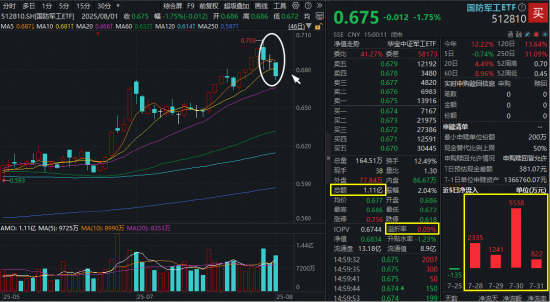
Core Viewpoint - The defense and military industry sector experienced an unexpected decline on August 1st, with the ETF (512810) dropping to a low of 2.2%, marking a three-day consecutive decline and falling below the 10-day moving average [1] Group 1: Market Performance - The defense and military sector ETF (512810) saw a cumulative decline of 0.74% over the week, ending a five-week streak of gains, despite a significant trading volume of 4.86 billion yuan, the highest in nearly 11 weeks [2][3] - The ETF recorded a trading volume of 1.11 billion yuan on August 1st, indicating high market activity and strong buying interest despite the price drop [1] Group 2: Sector Dynamics - The recent pullback in the sector is attributed to market sentiment, technical corrections after consecutive gains, and profit-taking ahead of the "August 1st" expectations, while the underlying investment logic remains robust [3] - Key factors supporting future growth include the upcoming military parade, ongoing geopolitical tensions sustaining military trade, and the critical delivery phase of the military's 14th Five-Year Plan, with expectations for accelerated order releases in the third quarter [3] Group 3: Stock Performance - Among the component stocks, 57 declined while 23 rose, with notable declines in ground equipment stocks, particularly North Navigation, which fell by 7% [4] - Major stocks like AVIC Shenyang Aircraft Corporation and China Shipbuilding Corporation also experienced declines of 3.89% and 1.31%, respectively, while Longcheng Military Industry saw a significant fluctuation of 14.85% [4] Group 4: ETF Characteristics - The ETF (512810) encompasses both traditional and emerging military capabilities, covering various hot topics such as commercial aerospace, low-altitude economy, large aircraft, deep-sea technology, military AI, and controllable nuclear fusion [5] - The ETF underwent a share split in June, reducing the investment threshold by half, allowing investors to access core military assets for under 70 yuan [5]

邻国油田西望欧陆,万里油龙缘何绕行?中亚能源棋局暗藏大国博弈
Sou Hu Cai Jing· 2025-08-03 01:27
而欧洲方向却占尽地利。苏联时期建造的里海管道联盟(CPC)系统直通俄罗斯黑海港口,哈萨克斯坦原油在此装船,三天就能抵达意大利码头。这条"黄 金水道"年输送量6700万吨,占哈国出口总量的81%。反观中哈原油管道,即便二期扩建后年运力也仅1200万吨,还不及欧洲管道的五分之一。 历史遗产与价格博弈 摊开亚欧大陆地图,哈萨克斯坦的西部油田与中国西北边境直线距离不过千余公里。可现实数据让人大跌眼镜——这个中亚最大产油国每年80%的原油漂洋 过海输往欧洲,留给隔壁中国的份额仅占6%-13%。当黑金洪流固执西行,地缘政治的暗流早已在管道里奔涌。 油田在西,市场在东 V B - ngesportion in t the dian f 1 the first 2015 t 2017 ellight n 24 哈萨克斯坦的"石油心脏"在里海之滨。田吉兹、卡沙甘等超级油田距离中国西部边境足足3000公里,中间横亘着天山山脉与浩瀚沙漠。输油车翻山越岭开到 中国,每桶成本高达30美元,比通过里海管道输往欧洲贵一倍有余。 美国资本的身影同样在油田深处浮现。哈国30.9%的原油由美国企业开采,雪佛龙公司掌控着田吉兹油田的开发权。当中国 ...

欧美贸易协议给欧洲留下巨大隐患
Jing Ji Ri Bao· 2025-08-01 21:59
Core Viewpoint - The trade agreement between the U.S. and the EU, reached on July 27, aims to address tariffs, energy procurement, and investment, temporarily avoiding a potential high-intensity tariff conflict, but raises concerns about its sustainability and impact on European competitiveness [1][2][3]. Tariff and Investment Summary - The U.S. will impose a 15% tariff on EU products, replacing a previously threatened 30% punitive tariff, while the EU commits to investing $600 billion in the U.S. and purchasing $750 billion worth of U.S. energy products over three years [2]. - The agreement includes zero tariffs on strategic materials like aircraft parts and key chemicals, but maintains existing tariffs on steel and aluminum, with unresolved issues regarding spirits [2]. European Internal Reactions - There is significant dissent within Europe regarding the agreement, with various leaders expressing concerns about its fairness and long-term implications for European economic strength [3]. - French Prime Minister Béru criticized the deal as a capitulation to the U.S., while German Chancellor Merz acknowledged the negative impact on Germany's economy [3]. Economic Implications - The 15% tariff is expected to weaken the competitiveness of EU exports in the U.S., particularly affecting key industries such as automotive and cosmetics, with potential long-term economic costs for Europe [4]. - A report from the Kiel Institute for the World Economy predicts a 0.13 percentage point loss in Germany's economic growth due to the agreement [4]. Uncertainties and Risks - The agreement contains ambiguities, particularly regarding the steel and aluminum tariffs, and lacks clarity on specific product exemptions, which could lead to future disputes [5]. - The investment commitments from the EU to the U.S. lack detailed terms, raising concerns about potential imbalances and the risk of the U.S. prioritizing its own interests [5]. Internal Discrepancies - The differing interests among EU member states and the lack of supportive policies for the agreement's implementation may create significant obstacles to its approval and execution within the EU [6]. Conclusion - The trade agreement reflects a compromise by Europe under pressure, aiming to stabilize market expectations in the short term, but it risks undermining European autonomy in trade, energy, and investment in the long run [7].
巴西懵了,刚准备反击美,结果特朗普开后门,近700种商品获豁免
Sou Hu Cai Jing· 2025-08-01 15:36
Group 1 - The U.S. announced a punitive tariff of up to 50% on Brazilian imports, targeting Brazil's growing influence in the BRICS nations and challenging the U.S. dollar system [1][3] - Brazil's government responded strongly, claiming the U.S. actions were an infringement on its sovereignty and vowed to retaliate based on the Economic Equivalence Act [3] - A surprising twist occurred when a long list of exemptions was included in the executive order, allowing nearly 700 products, which accounted for 44.6% of Brazil's exports to the U.S., to avoid the additional tariffs [3][6] Group 2 - The U.S. has maintained a trade surplus with Brazil, with total trade nearing $81 billion in 2024 and a cumulative surplus of approximately $410 billion over the past 15 years [6] - Brazil is not just a resource exporter but also a significant market for U.S. industrial goods and services, making the trade relationship highly interdependent [6][10] - The exempted products include critical items such as aircraft, orange juice, and iron ore, which are essential to U.S. industries and supply chains [6][8] Group 3 - The U.S. coffee market, heavily reliant on Brazilian imports, reacted sharply to the tariff threats, with coffee futures prices rising significantly [8] - Brazilian diplomats and business leaders focused their efforts on U.S. interest groups that would be adversely affected by a trade war, leading to a strong internal lobbying effort [10] - The final outcome was a compromise where the high tariffs served as a political statement while the exemptions addressed the economic realities faced by U.S. businesses [10]

能源化策略日报:地缘决定原油?势,国内化?受到焦煤下跌拖累-20250801
Zhong Xin Qi Huo· 2025-08-01 04:45
1. Report Industry Investment Rating - Not provided in the given content 2. Core Viewpoints of the Report - The global geopolitical tensions and US tariff proposals have led to a stagnant oil market, with traders on the sidelines. The decline in domestic manufacturing activity and weakening domestic and export demand have dragged down domestic commodities and the energy - chemical sector. The high volatility of crude oil continues, while the chemical industry is weaker due to the cooling of market sentiment [2][3] 3. Summary by Relevant Catalogs 3.1 Market Outlook - **Crude Oil**: Geopolitical factors continue to drive oil prices, with high refinery开工 rates in China and the US providing support. However, supply pressure from OPEC+ is also present. The strong current situation driven by high refinery开工 and the weak expectation driven by supply pressure lead to oil price oscillations. Attention should be paid to geopolitical risks [9] - **Asphalt**: With rising oil prices, short - selling opportunities for asphalt emerge. The current asphalt price is overvalued, and the monthly spread is expected to decline as warehouse receipts increase [10] - **High - Sulfur Fuel Oil**: It is regarded as weak. Supply is increasing while demand is decreasing, and geopolitical factors only cause short - term price fluctuations [10] - **Low - Sulfur Fuel Oil**: Its price follows the weakening of crude oil. It faces factors such as falling shipping demand, green energy substitution, and high - sulfur fuel substitution, and is expected to maintain low - valuation fluctuations [12] - **PX**: The commodity sentiment has cooled, but the cost still provides some support. The overall supply - demand pattern has limited changes, and the inventory remains at a low level [14] - **PTA**: Some plants have short - term shutdowns, and the cost still has some support. It is expected to oscillate in the short term, and attention should be paid to the implementation of major plant maintenance at the beginning of August [15] - **Pure Benzene**: There is no obvious driving force, and it oscillates in a narrow range. The fundamental situation has improved in the third quarter, but the rebound is restricted by inventory pressure [18] - **Styrene**: The commodity sentiment has cooled, and it oscillates in a narrow range. There is an expectation of weakening supply - demand, and port inventories are accumulating [19] - **Ethylene Glycol**: Typhoons have temporarily affected port inventory reduction. In the short term, the cost support has weakened, and supply pressure has increased. There is an expectation of inventory inflection [20] - **Short - Fiber**: The inventory has increased month - on - month. The price passively follows the raw materials, and downstream demand remains weak [22] - **Bottle - Chip**: It returns to the cost - pricing model. The price oscillates weakly following the decline of upstream raw materials [23] - **Methanol**: The port inventory is accumulating, and it oscillates in the short term. The production profit is still relatively high, and there is a negative feedback expectation in the downstream olefin sector [24] - **Urea**: The demand is generally weak, and the market is in a state of weak downward movement. The supply - demand pattern of strong supply and weak demand remains unchanged, and the market is expected to oscillate or decline [25] - **Plastic**: The maintenance rate has decreased, and it oscillates. Oil prices oscillate in the short term, and the supply pressure is still present. The demand is in the off - season, and overseas factors need to be monitored [27] - **PP**: Attention should be paid to the Sino - US game, and it oscillates. Oil prices oscillate, the supply side has an incremental trend, and the demand side is weak. Overseas factors and Sino - US tariff games need to be monitored [29] - **PL**: It mainly follows the fluctuations, and may oscillate in the short term. The short - term capital game is significant, and the spot impact is limited [29] - **PVC**: The policy expectation has cooled, and it mainly oscillates. The market sentiment has cooled, the fundamental situation is under pressure, and the cost is expected to rise [32] - **Caustic Soda**: The spot price has been unexpectedly reduced, and it is under cautious pressure. The downstream demand has marginal changes, and the production is at a high level. The downward space is limited due to low inventory and cost support [32] 3.2 Variety Data Monitoring 3.2.1 Energy - Chemical Daily Indicator Monitoring - **Inter - term Spreads**: Different varieties have different inter - term spread values and changes. For example, Brent's M1 - M2 spread is 0.8 with a change of 0.03, and PX's 1 - 5 month spread is 26 with a change of - 18 [33] - **Basis and Warehouse Receipts**: Each variety has corresponding basis and warehouse receipt data. For example, asphalt's basis is 126 with a change of - 9, and the number of warehouse receipts is 81140 [34] - **Cross - Variety Spreads**: There are also corresponding cross - variety spread values and changes. For example, the 1 - month PP - 3MA spread is - 335 with a change of 28 [35] 3.2.2 Chemical Basis and Spread Monitoring - Not provided with specific summarized content in the given text, only variety names are listed such as methanol, urea, etc. [36][47]
五矿期货能源化工日报-20250801
Wu Kuang Qi Huo· 2025-08-01 01:58
Report Industry Investment Rating No relevant content provided. Core Viewpoints of the Report - The current fundamental market for crude oil is healthy. With low inventories in Cushing, combined with hurricane expectations and Russia-related events, crude oil has upward momentum. However, the seasonal demand decline in mid-August will limit its upside potential. A short-term target price of $70.4 per barrel for WTI is given, suggesting short-term long positions with profit-taking on dips and left-side layout for September's Russia geopolitical expectations and hurricane supply disruption season [2]. - For methanol, the upstream production is expected to increase, and the demand side may turn weak, so methanol may face downward pressure. It is recommended to wait and see [4]. - For urea, the supply and demand are weak, and there is no significant unilateral trend. It is recommended to wait and see [6]. - For rubber, the price is consolidating after a decline. It is recommended to wait and see, and consider a long RU2601 and short RU2509 band operation [10]. - For PVC, the supply is strong and the demand is weak, with high valuation. It is necessary to observe whether exports can reverse the domestic inventory build-up pattern. There is a risk of a significant decline [11]. - For styrene, the BZN spread is expected to repair, and the price may follow the cost side to oscillate upward after the port inventory is reduced [14]. - For polyethylene, the price may be determined by the game between the cost side and the supply side in the short term. It is recommended to hold short positions [17]. - For polypropylene, the cost side may dominate the market, and the price is expected to follow crude oil to oscillate upward [18]. - For PX, the inventory is expected to continue to decline, and it is recommended to consider long positions on dips following crude oil [21]. - For PTA, the supply is expected to increase and the inventory to build up. It is recommended to consider long positions on dips following PX [22]. - For ethylene glycol, the fundamental situation is expected to turn weak, and there is pressure on the short-term valuation to decline [23]. Summary by Related Catalogs Crude Oil - **Market Quotes**: WTI main crude oil futures closed down $0.94, or 1.34%, at $69.36; Brent main crude oil futures closed down $0.92, or 1.25%, at $72.55; INE main crude oil futures closed up 1.70 yuan, or 0.32%, at 531.4 yuan [1]. - **Data**: Singapore ESG weekly oil product data showed that gasoline inventories decreased by 0.22 million barrels to 12.75 million barrels, a 1.72% decline; diesel inventories increased by 0.59 million barrels to 8.46 million barrels, a 7.47% increase; fuel oil inventories increased by 0.97 million barrels to 24.67 million barrels, a 4.09% increase; total refined oil inventories increased by 1.33 million barrels to 45.87 million barrels, a 3.00% increase [1]. Methanol - **Market Quotes**: On July 31, the 09 contract fell 14 yuan/ton to 2405 yuan/ton, and the spot price fell 12 yuan/ton, with a basis of -10 [4]. - **Fundamentals**: Upstream production has bottomed out and is expected to increase, while the demand side may turn weak, leading to a pattern of increasing supply and weakening demand. The inventory level has decreased [4]. Urea - **Market Quotes**: On July 31, the 09 contract fell 28 yuan/ton to 1714 yuan/ton, and the spot price remained unchanged, with a basis of +46 [6]. - **Fundamentals**: Domestic production has continued to decline, and the demand is weak. Exports are an important source of demand growth. The supply and demand are weak, and the inventory reduction is slow [6]. Rubber - **Market Quotes**: NR and RU are consolidating after a significant decline, following the trend of industrial products [9]. - **Fundamentals**: Tire factory operating rates have declined, and the demand is in a seasonal off-season. The supply reduction may be less than expected. The inventory has increased [10]. - **Operation Suggestions**: Wait and see for now, and consider a long RU2601 and short RU2509 band operation [10]. PVC - **Market Quotes**: The PVC09 contract fell 118 yuan to 5041 yuan, and the spot price of Changzhou SG-5 was 4950 (-110) yuan/ton, with a basis of -91 (+8) yuan/ton and a 9-1 spread of -135 (+2) yuan/ton [11]. - **Fundamentals**: The cost side is stable, the overall operating rate has decreased, the demand is weak, and the inventory has increased. The supply is strong and the demand is weak, with high valuation [11]. Styrene - **Market Quotes**: The spot price has increased, the futures price has decreased, and the basis has strengthened [12]. - **Fundamentals**: The cost side has support, the BZN spread has room to repair, the supply has increased, the port inventory has significantly increased, and the demand has increased slightly [14]. - **Outlook**: The BZN spread is expected to repair, and the price may follow the cost side to oscillate upward after the port inventory is reduced [14]. Polyethylene - **Market Quotes**: The futures price has decreased, and the spot price has remained unchanged, with a basis of 0 yuan/ton, strengthening 37 yuan/ton [17]. - **Fundamentals**: The upstream operating rate has decreased, the inventory has decreased, and the downstream demand is weak. The price may be determined by the game between the cost side and the supply side in the short term [17]. - **Operation Suggestions**: Hold short positions [17]. Polypropylene - **Market Quotes**: The futures price has decreased, and the spot price has remained unchanged, with a basis of 47 yuan/ton, strengthening 27 yuan/ton [18]. - **Fundamentals**: The upstream operating rate has decreased slightly, the inventory situation is mixed, and the downstream demand is weak. The cost side may dominate the market, and the price is expected to follow crude oil to oscillate upward [18]. PX - **Market Quotes**: The PX09 contract fell 56 yuan to 6928 yuan, and the PX CFR fell 8 dollars to 858 dollars, with a basis of 142 yuan (-5) and a 9-1 spread of 64 yuan (-42) [20]. - **Fundamentals**: The operating rate has decreased, the downstream PTA operating rate is high, the inventory is low, and the polyester and terminal operating rates have recovered. The inventory is expected to continue to decline [21]. - **Operation Suggestions**: Consider long positions on dips following crude oil [21]. PTA - **Market Quotes**: The PTA09 contract fell 48 yuan to 4808 yuan, and the East China spot price fell 35 yuan to 4825 yuan, with a basis of -15 yuan (-5) and a 9-1 spread of -32 yuan (-34) [22]. - **Fundamentals**: The supply is expected to increase, the demand side is about to end the off-season, and the inventory has increased. The processing fee has limited room for operation [22]. - **Operation Suggestions**: Consider long positions on dips following PX [22]. Ethylene Glycol - **Market Quotes**: The EG09 contract fell 36 yuan to 4414 yuan, and the East China spot price fell 24 yuan to 4503 yuan, with a basis of 68 yuan (+2) and a 9-1 spread of -27 yuan (+1) [23]. - **Fundamentals**: The supply side has decreased slightly, the downstream demand is weak, the port inventory has decreased, and the valuation is relatively high. The fundamental situation is expected to turn weak, and there is pressure on the short-term valuation to decline [23].
俄外长与叙政权外交负责人讨论地区局势
Xin Hua Wang· 2025-08-01 00:40
Core Viewpoint - The meeting between Russian Foreign Minister Lavrov and Syrian officials focused on regional stability and Syria's reconstruction, with Russia reaffirming its support for Syria's sovereignty and territorial integrity [1] Group 1: Russia's Position - Russia opposes the use of Syrian territory for geopolitical competition by other countries and calls for actions that avoid escalating tensions [1] - Lavrov emphasized the necessity to completely lift sanctions against Syria, stating that sanctions only harm the Syrian people [1] Group 2: Economic Cooperation - Discussions included how Russia can participate in Syria's economic recovery, with an agreement to reassess previously reached agreements and establish a joint committee to evaluate existing mechanisms [1] Group 3: Syrian Stance - Syrian officials expressed no intention to invade Israel, focusing instead on national reconstruction and expressing fatigue with war [1] - They highlighted that Israeli attacks on Syria violate international law and hinder reconstruction efforts and stability [1]
25%关税!特朗普对印度下手了 | 京酿馆
Sou Hu Cai Jing· 2025-07-31 11:03
Core Viewpoint - The article discusses President Trump's decision to impose a 25% tariff on goods from India, along with an undisclosed penalty, signaling a shift in U.S.-India trade relations and highlighting the complexities of their negotiations [4][9]. Trade Relations - Trump announced that starting August 1, the U.S. will impose a 25% tariff on Indian goods, which surpasses tariffs on other countries like Vietnam (20%) and Indonesia (19%) [4][6]. - The U.S. has a significant trade deficit with India, with a reported $457 billion, which Trump emphasized in his statements [4][6]. Negotiation Challenges - Key obstacles in U.S.-India trade negotiations include agricultural market access and India's digital tax on U.S. tech companies, which has led to tensions [7][10]. - India's previous proposals to increase bilateral trade to $500 billion by 2030 have not materialized, indicating a failure in negotiations [6][10]. Geopolitical Implications - The imposition of tariffs is seen as a tool for the U.S. to challenge India's trade and diplomatic autonomy, particularly due to India's reliance on Russian military equipment and energy [9][11]. - Trump's actions suggest a shift in U.S. foreign policy, prioritizing "America First" over traditional alliances, which may diminish India's strategic position [16]. Political Context - India's Prime Minister Modi faces political pressure domestically, making it difficult for him to concede to U.S. demands without risking his support base [15][16]. - The upcoming 2024 elections in India add to the complexity, as Modi's party has lost its parliamentary majority, limiting his negotiating power [15][16].
