
去产能

Search documents
申万宏源策略一周回顾展望(25/06/30-25/07/05):去产能是慢变量,去产量是快变量
Shenwan Hongyuan Securities· 2025-07-05 11:58
Core Insights - The report emphasizes the distinction between "capital expenditure reduction," "capacity reduction," and "output reduction" in the context of the current anti-involution policies, suggesting that these elements will shape the supply-demand dynamics in the manufacturing sector from mid-2026 onwards [3][4][7][9]. Group 1: Anti-Involution Policies - The current anti-involution policies are reminiscent of the supply-side reforms from 2016-2017, which can be broken down into three core elements: "capacity reduction," "output reduction," and demand-side stimulation [4][8]. - "Capacity reduction" involves eliminating outdated capacity and curbing new capital expenditures, leading to a long-term decline in future capacity formation. This has historically supported high profitability in cyclical commodities like coal until 2022 [4][8]. - "Output reduction" aims to quickly improve the supply-demand balance in cyclical industries through general capacity shutdowns and production limits, which was crucial when capacity utilization rates were low [4][8]. Group 2: Current Manufacturing Sector Dynamics - The current state of supply in the midstream manufacturing sector closely resembles the upstream cycle of 2016, but the policy focus differs. The reduction in capital expenditure has reached its lowest growth rate since 2012, indicating a systemic correction of over-investment in advanced manufacturing driven by local government subsidies [9][10]. - The report anticipates that the capital expenditure growth rate will continue to decline, potentially remaining negative for an extended period, which will lead to fixed asset growth (capacity growth) being at absolute lows starting from 2026 [9][10]. - The report highlights that "capacity reduction" will manifest through delayed impacts of reduced capital expenditure, abandonment of existing projects, and mechanisms to encourage the exit of less competitive firms [9][10]. Group 3: Future Market Outlook - The report predicts that by mid-2026, the fixed asset formation growth rate of midstream manufacturing companies will fall below the nominal GDP growth rate, increasing the visibility of a turning point in supply-demand dynamics [10]. - The current low capacity utilization rates and weak internal investment willingness among firms suggest further room for decline in capital expenditure growth, reinforcing the notion that anti-involution investments will be critical for long-term profitability improvements [10]. - The report views the improvement in the supply-demand landscape of midstream manufacturing and the easing of anti-involution narratives as essential components of a bullish market outlook for 2026-2027 [10].
新一轮“去产能”:成因、方案和给普通人的建议
吴晓波频道· 2025-07-04 17:22
Core Viewpoint - The emergence of "involution" competition in recent years is not merely due to the short-sightedness of companies and employees, but is deeply rooted in macroeconomic backgrounds influenced by economic cycles, institutional issues, and technological development patterns [1][27]. Group 1: Industry Responses to Involution - The automotive industry has been notably active, with a significant "60-day account period revolution" and calls from the National Federation of Industry and Commerce for manufacturers to shorten rebate periods and simplify policies [3][4]. - The pig farming sector is also responding, with major companies being urged to reduce production capacity and stabilize prices, controlling the weight of pigs for market [5]. - The photovoltaic industry is proactively reducing production, with leading glass manufacturers planning a collective 30% cut in output [6]. - The cement industry is undergoing self-examination, with the China Cement Association requiring members to align actual production with registered capacity [7]. Group 2: Historical Context of Capacity Reduction - Historical capacity reduction efforts have typically focused on high-pollution and high-energy-consuming traditional industries, employing methods such as limiting new capacity and eliminating outdated production [16][20]. - The current round of capacity reduction is characterized by a broader scope, including emerging industries like photovoltaics and new energy vehicles, indicating a shift from traditional sectors [21][22]. Group 3: Economic and Policy Factors - The low demand in the domestic market and uncertainties in foreign demand are contributing to the "involution" competition, exacerbated by supply-demand mismatches in certain industries [28]. - Local governments' performance evaluation mechanisms lead to "race-to-the-bottom" competition, distorting industry entry costs and slowing down market adjustments [29]. - Technological advancements often result in structural overcapacity, particularly in emerging industries, as companies invest heavily to adapt to rapid changes [30]. Group 4: Future Directions and Recommendations - To address "involution" competition, authorities should enhance counter-cyclical adjustments to boost domestic demand and reform the income distribution structure to improve labor compensation [34][36]. - Encouraging differentiated competition among enterprises and establishing industry standards can help mitigate excessive competition [38]. - A tailored approach to supply-side guidance based on industry-specific technological development patterns is necessary to support innovation [39]. Group 5: Investment Opportunities - Investors should be aware of the typical patterns of capacity reduction, as stock prices in affected industries may initially drop but can rebound significantly post-adjustment [57]. - Emerging industries such as semiconductors and artificial intelligence, despite current bubbles, present substantial arbitrage opportunities [58].


基本面供增需弱多晶硅短期拉涨动能受限 机构:后续应关注行业减产力度
Xin Hua Cai Jing· 2025-07-04 05:43
Core Viewpoint - The polysilicon market is experiencing price fluctuations influenced by government policies aimed at reducing low-price competition and promoting sustainable development, despite underlying supply-demand imbalances putting downward pressure on prices [2][3][4]. Group 1: Market Dynamics - Polysilicon prices have shown a strong rebound due to recent policy signals against "involution," with futures contracts experiencing significant gains [2]. - On July 2, multiple polysilicon futures contracts hit the upper limit, and on July 3, the main contract opened higher and rose over 2% during the day [2]. - The current market sentiment is driven by expectations of capacity reduction, which is anticipated to accelerate, thereby supporting price recovery [2][3]. Group 2: Supply and Demand Analysis - The polysilicon market is currently characterized by increasing supply and weak demand, leading to ongoing downward pressure on prices [3]. - Forecasts indicate that July production could reach 110,000 to 120,000 tons due to the resumption of major production facilities, which may further pressure prices [3]. - Demand is expected to decline, with silicon wafer production projected to drop to 55-56 GW and battery cell production to 57-58 GW, reflecting a month-on-month decrease of 4-5% [3]. Group 3: Future Outlook - Short-term market performance is likely to remain strong due to policy-driven sentiment, but mid-term price fluctuations are expected as the market adjusts to production reduction policies [4]. - The industry is advised to monitor the implementation of capacity reduction policies and the potential for further market sentiment development, as a return to fundamental price logic could lead to renewed price declines [4].
黑色建材日报-20250704
Wu Kuang Qi Huo· 2025-07-04 02:56
Report Summary 1. Report Industry Investment Rating No investment rating information is provided in the report. 2. Core Viewpoints - The overall atmosphere in the commodity market rebounded yesterday, with the prices of finished steel products showing a volatile and upward trend. The "anti - involution and capacity reduction" proposal and the expected production restrictions in the Beijing - Tianjin - Hebei region have pushed up the prices of steel products. However, the actual implementation of these policies needs further verification. The static fundamentals of steel have no obvious contradictions, and future attention should be paid to policy trends, terminal demand recovery, and cost support [3]. - The price of iron ore is in a wide - range volatile state in the short term. The supply of iron ore has decreased, and the demand has also declined due to factors such as seasonal maintenance of blast furnaces and production cuts by some steel mills. The impact of macro - expectations on the market has increased, and attention should be paid to the interference of production restrictions in Tangshan and the reduction of pellet production expectations by Vale [6]. - For manganese silicon and silicon iron, the prices are expected to maintain a volatile or slightly rebound state in the short term. The market is optimistic about the "capacity reduction" policy, but there are still uncertainties. Enterprises with hedging profit margins are recommended to conduct appropriate hedging operations [9][10]. - The price of industrial silicon is still in a downward trend. The market is optimistic about the "capacity reduction" policy, but the comparison with the 2015 supply - side reform is questionable. Short - term speculative short positions are recommended to wait and see [12][13]. - For glass, the policy expectation has a strong impact on the price, and short positions are recommended to avoid and wait. For soda ash, the supply is still abundant, and the inventory pressure is large. It is expected to rebound following glass, but the sustainability of the rebound is limited [15][17]. 3. Summary by Category Steel - **Futures and Spot Prices**: The closing price of the rebar main contract was 3076 yuan/ton, up 11 yuan/ton (0.358%) from the previous trading day. The spot prices in Tianjin and Shanghai remained flat. The closing price of the hot - rolled coil main contract was 3208 yuan/ton, up 17 yuan/ton (0.532%) from the previous trading day. The spot price in Lecong increased by 10 yuan/ton, while that in Shanghai remained flat [2]. - **Fundamentals**: This week, the apparent supply and demand of rebar both increased, and the inventory depletion speed slowed down. The output of hot - rolled coils slightly increased, the demand declined, and the inventory slightly accumulated, but it was still at a five - year low [3]. Iron Ore - **Futures and Spot Prices**: The main contract of iron ore (I2509) closed at 733.00 yuan/ton, up 1.45% (+10.50). The spot price of PB powder at Qingdao Port was 725 yuan/wet ton, with a basis of 35.46 yuan/ton and a basis rate of 4.61% [5]. - **Supply and Demand**: The latest iron ore shipments decreased, and the near - end arrivals also declined. The daily average pig iron output decreased, and the terminal demand was neutral. The port inventory changed little, and the steel mill's imported ore inventory increased [6]. Manganese Silicon and Silicon Iron - **Futures and Spot Prices**: On July 3, the main contract of manganese silicon (SM509) closed down 0.24% at 5712 yuan/ton, and the spot price in Tianjin was at a premium to the futures. The main contract of silicon iron (SF509) closed down 0.85% at 5390 yuan/ton, and the spot price in Tianjin was also at a premium to the futures [8]. - **Market Outlook**: The prices are expected to be volatile or slightly rebound in the short term. The market is optimistic about the "capacity reduction" policy, but there are uncertainties [9][10]. Industrial Silicon - **Futures and Spot Prices**: On July 3, the main contract of industrial silicon (SI2509) closed down 2.44% at 8010 yuan/ton. The spot prices of 553 and 421 in East China increased, and both were at a premium to the futures [12]. - **Market Outlook**: The price is still in a downward trend. The market's optimism about the "capacity reduction" policy needs further verification [12][13]. Glass and Soda Ash - **Glass**: The spot price in Shahe increased by 21 yuan, and that in Central China remained flat. The national inventory decreased slightly. The policy expectation pushed up the futures price, and short positions are recommended to avoid and wait [15]. - **Soda Ash**: The spot price decreased by 20 yuan. The domestic inventory increased by 2.30%. The demand continued to decline, and the supply was still abundant. It is expected to rebound following glass, but the rebound sustainability is limited [15][17].
"去产能"赛道走到哪里了,再接再厉还是拐点出现?
Hu Xiu· 2025-07-03 10:56
Group 1 - The "capacity reduction" sector is currently experiencing a rebound, with various industries participating, particularly in new energy, while steel and coal show signs of slight pullback after significant gains [3] - More industries are joining the capacity reduction and anti-involution initiatives, including automotive, steel, coal, new energy, construction materials, and cement, indicating ongoing upward potential under policy guidance [3] Group 2 - The technology and consumer electronics sector has shown significant improvement, reaching the top of the rankings, although the underlying reasons are not fully disclosed [4] - Foxconn, Apple's largest supplier, has unexpectedly withdrawn several hundred Chinese engineers from India, raising questions about the challenges faced in the production process, despite earlier plans to expand operations in India [4]
瑞达期货纯碱玻璃产业日报-20250703
Rui Da Qi Huo· 2025-07-03 09:37
Report Industry Investment Rating - Not provided Core Viewpoints - For soda ash, supply is expected to remain ample while demand contracts, and prices will continue to face pressure. The basis of soda ash starts to converge, and basis convergence trading may continue. The probability of a short - term halt in the price decline and a rebound for soda ash increases. It is recommended to go long on soda ash in the short - term and short the main contract in the medium - to - long - term [2]. - For glass, the supply decreases slightly, and the industry profit is poor with a downward trend. Demand is expected to weaken further. The basis remains within a normal range, and subsequent market trading is more about policy expectations. The rebound height and strength are expected to be limited. It is recommended to go long on glass at low prices in the short - term and short in the medium - to - long - term [2]. Summary by Relevant Catalogs Futures Market - Soda ash main contract closing price is 1183 yuan/ton, down 22 yuan; glass main contract closing price is 1039 yuan/ton, down 13 yuan. Soda ash main contract position is 1648012 lots, up 177559 lots; glass main contract position is 1524412 lots, up 22334 lots. Soda ash top 20 net position is - 279455, up 28480; glass top 20 net position is - 205464, up 145295. Soda ash exchange warehouse receipts are 3674 tons, down 5 tons; glass exchange warehouse receipts are 802 tons, down 55 tons. Soda ash September - January contract spread is - 20, down 5; glass September - January contract spread is - 87, down 2. Soda ash basis is - 15 yuan/ton, down 50 yuan; glass basis is 4 yuan/ton, down 72 yuan [2]. Spot Market - North China heavy soda ash is 1190 yuan/ton, down 10 yuan; Central China heavy soda ash is 1250 yuan/ton, down 50 yuan. East China light soda ash is 1175 yuan/ton, unchanged; Central China light soda ash is 1155 yuan/ton, down 45 yuan. Shahe glass sheets are 1056 yuan/ton, unchanged; Central China glass sheets are 1070 yuan/ton, unchanged [2]. Industry Situation - Soda ash plant operating rate is 82.21%, down 4.25 percentage points; float glass enterprise operating rate is 75%, down 0.34 percentage points. Glass in - production capacity is 15.68 million tons/year, up 0.14 million tons; glass in - production line number is 222, down 1. Soda ash enterprise inventory is 176.88 million tons, up 0.19 million tons; glass enterprise inventory is 6921.6 million heavy boxes, down 67.1 million heavy boxes [2]. Downstream Situation - Cumulative real estate new construction area is 23183.61 million square meters, up 5347.77 million square meters; cumulative real estate completion area is 18385.14 million square meters, up 2737.29 million square meters [2]. Industry News - Deputy Premier Zhang Guoqing emphasized technological empowerment and industrial innovation in Hubei. The National Development and Reform Commission arranged over 300 billion yuan for the third - batch "two major" construction projects in 2025, and the 800 - billion - yuan project list for this year has been fully released. EU Commission President von der Leyen met with Wang Yi, and an important China - EU leaders' meeting is upcoming. The CSRC aims to prevent risks in bond defaults and private funds and optimize capital market mechanisms. In the first half of this year, 12.6 million new A - share accounts were opened, a year - on - year increase of 32.77% [2]. Macro - level and Market Analysis - Guided by the Sixth Meeting of the Central Financial and Economic Commission on capacity reduction, both soda ash and glass prices rose significantly. For soda ash, the domestic operating rate and production declined this week, supply is still ample, and profits have turned negative, indicating a further slowdown in production growth and a possible increase in cold repairs. For glass, one more production line was cold - repaired, and overall production decreased slightly. Photovoltaic glass demand is showing a downward trend [2].
期货收评:“反内卷”政策发酵 铁矿、多晶硅、焦煤涨超2%!
news flash· 2025-07-03 07:03
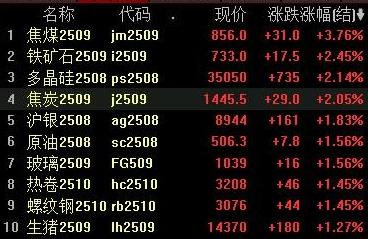
涨跌都能赚 盈利就能离场!点击开通期货"T+0、双向交易"特权!>>> "反内卷"政策持续发酵,黑色建材、能源金属等涨幅居前,铁矿、多晶硅、焦炭等涨超2%!多晶硅盘中一度涨超4%,但午后小幅 跳水,涨幅缩窄至2%附近。 继周三涨停之后,周四多晶硅涨幅收窄,盘中先跌后涨,截至发稿前涨幅在3%以上。光大期货分析称,现货企业报价同步上调, SMM多晶硅N型硅料价格涨至36000元/吨,最低交割品N型硅料价格涨至36000元/吨,现货对主力升水收至950元/吨。 从背后驱动因素来看,本周多晶硅大涨主要与政策提到的反内卷预期有关,市场普遍认为去产能行动大幕开启,多晶硅限产落地有 望提速,提振盘面价格。在短期情绪刺激下,多晶硅价格实现触底反弹,生产利润略得到修复。2.基本面来看,据SMM调研,7月 组件排产环比-2%至45-46GW基本符合预期,光伏终端订单走弱,下游电池片企业采购意愿依然偏弱,自下而上承压。而上游西南 部分企业月内有复产预期,预计硅料整体供给将小幅增长,行业累库风险或继续增长,价格的下行驱动依然较强。短期政策主导市 场情绪,且一时难以证伪,盘面或维持偏强表现。但在价格抬升给到企业套保利润后,中期价格或有 ...
国证国际港股晨报-20250703
Guosen International· 2025-07-03 05:58
Group 1: Market Overview - The Hong Kong stock market experienced a rebound, with the Hang Seng Index closing at 24,221 points, up 149 points or 0.62% [2] - The Hang Seng Technology Index declined by 0.64%, while the main board turnover exceeded HKD 240.2 billion, a decrease of 0.8% from the previous day [2][3] - Northbound trading continued to show a net inflow trend, with a net inflow of HKD 5.036 billion, down 3.5% from the previous day [2] Group 2: Sector Performance - Among the 12 Hang Seng Composite Industry Indices, only the Information Technology sector declined by 0.51%, while the other 11 sectors reported gains, with Materials, Real Estate & Construction, and Financials leading with increases between 1.13% and 2.72% [3] - The Materials sector surged due to market expectations of improved operating conditions from the "anti-involution" initiatives, with major reductions in production announced in the photovoltaic, steel, and cement industries [3] Group 3: Company Analysis - Lens Technology - Lens Technology, established in 2003 and listed in 2015, is a leading provider of precision manufacturing solutions across the entire supply chain for smart terminals, covering materials, functional components, and assembly [9] - The company holds a market share of 13.0% in the global consumer electronics precision components and module solutions industry, and 20.9% in the smart automotive interaction systems sector [9][10] - Revenue projections for 2022-2024 are HKD 467.0 billion, HKD 544.9 billion, and HKD 699.0 billion, with a compound annual growth rate (CAGR) of 22.3% [10] Group 4: Industry Outlook - The global market for consumer electronics precision components and module solutions is expected to reach USD 66.3 billion by 2024, with a CAGR of 53.4% for AI glasses/XR headsets from 2025 [11] - The smart automotive interaction systems market is projected to grow from USD 4 billion in 2024 to USD 9.3 billion by 2029, with a CAGR of 18.2% [11] Group 5: Competitive Advantages - Lens Technology's vertical integration capabilities across the entire supply chain, along with strong customer relationships with leading brands, position it favorably in the market [12] - The company has robust R&D capabilities, focusing on new materials and technologies, which enhances its competitive edge [12] Group 6: IPO Details - The IPO subscription period is from June 30 to July 4, 2025, with trading expected to commence on July 9 [14] - The company anticipates net proceeds of approximately HKD 4.59 billion from the global offering, with funds allocated for product expansion, overseas business growth, and enhancing manufacturing capabilities [17]

宝城期货资讯早班车-20250703
Bao Cheng Qi Huo· 2025-07-03 03:32
1. Report Industry Investment Rating No relevant content provided. 2. Core Viewpoints of the Report - The Chinese economy shows mixed trends with stable GDP growth, some improvement in manufacturing and non - manufacturing PMIs, and varying performance in other economic indicators. The capital market is undergoing reforms to optimize mechanisms and protect investors. Different industries such as metals, energy, and agriculture face diverse market situations [1][2][15] - The bond market in China has a strong performance recently, while the exchange rate of the RMB against the US dollar has some fluctuations. The stock market has sector - specific movements, with some traditional sectors showing strength and new开户 numbers increasing [21][26][29] 3. Summary by Directory 3.1 Macro Data - GDP in Q1 2025 had a 5.4% year - on - year growth, unchanged from the previous quarter but slightly higher than the same period last year. The manufacturing PMI in June 2025 was 49.7%, up from 49.5% in the previous month. The non - manufacturing PMI for business activities in June was 50.5%, also up from 50.3% in the previous month [1] - In May 2025, social financing scale increased, M0, M1, and M2 had different year - on - year growth rates, and financial institution RMB loans increased. CPI remained at - 0.1% year - on - year, while PPI decreased further to - 3.3% year - on - year. Fixed - asset investment growth slowed, while social consumer goods retail grew [1] - In May 2025, exports had a 4.8% year - on - year growth, down from 8.1% in the previous month, and imports decreased by 3.4% year - on - year [1] 3.2 Commodity Investment Reference 3.2.1 Comprehensive - The CSRC will optimize capital market mechanisms, protect investors, and promote reforms. The DCE will list pure benzene futures and options on July 8, which will provide risk - management tools for the industry [2] - The US ADP employment in June decreased by 33,000, the first negative growth since March 2023, and the market fully priced in a Fed rate cut in September [2] 3.2.2 Metals - Chinese lithium - battery industry chains are expanding to Southeast Asia. New regulations on anti - money - laundering reporting for large - scale precious - metal cash transactions have little impact on ordinary consumers [3] - On July 2, international gold prices declined slightly. However, with expectations of a Fed rate cut and strong central - bank gold purchases, gold prices are expected to remain stable. Multiple institutions are bullish on gold prices in 2026 [3][4] - On July 1, LME aluminum, copper, and nickel inventories increased, while zinc, lead, tin inventories decreased [4] 3.2.3 Coal, Coke, Steel, and Minerals - On July 2, A - share steel and photovoltaic sectors had a rally due to the "anti - involution" campaign. Tangshan is likely to intensify environmental protection - related production restrictions [6] - Vale lowered its 2025 iron ore pellet production forecast. Indonesia plans to shorten the mining quota validity period from three to one year [6][7] 3.2.4 Energy and Chemicals - OPEC's crude - oil production reached a four - month high in June due to Saudi Arabia's push to regain market share, increasing downward pressure on oil prices [9] - The US EIA crude - oil inventory in the week ending June 27 was 3.845 million barrels, higher than expected. US weekly crude imports increased, while exports and domestic production decreased slightly [9][10] 3.3 Financial News Compilation 3.3.1 Open Market - On July 2, the central bank conducted 98.5 billion yuan of 7 - day reverse - repurchase operations, resulting in a net withdrawal of 266.8 billion yuan. In June, the central bank had net liquidity injections through various tools [14] 3.3.2 Key News - Many foreign institutions have raised their forecasts for China's economic growth. The NDRC has allocated over 300 billion yuan for the third - batch of "two important" construction projects in 2025 [15] - The CSRC emphasizes capital - market reforms and risk prevention. The Ministry of Finance plans to issue and use special and special - purpose bonds earlier, and some super - long - term special bonds will be issued ahead of schedule in Q3 [15][16] - The "self - review and self - issuance" pilot for local government special bonds is progressing, and the issuance is expected to speed up in H2. The logistics industry index in June was 50.8%, up from the previous month [17] 3.3.3 Bond Market - China's bond market showed a strong performance, with yields of major interest - rate bonds in the inter - bank market falling and bond - futures prices rising. The money - market rates mostly declined [21][23] - In the exchange - bond market, some bonds rose, while others fell. The convertible - bond market had mixed performance. Overseas, European and US bond yields generally increased [22][24][25] 3.3.4 Foreign Exchange Market - The on - shore RMB against the US dollar closed at 7.1670 on July 2, down 52 points from the previous day. The US dollar index rose 0.14% in New York trading, and most non - US currencies fell [26] 3.3.5 Research Report Highlights - CITIC Securities believes that the RMB internationalization has room for improvement in investment and official reserves, and suggests several development directions. CICC Fixed Income recommends paying attention to REITs' allocation opportunities [27] - Fitch Ratings believes that using special bonds to purchase existing commercial housing for affordable housing can strengthen the policy function of Chinese urban - investment enterprises [27] 3.4 Stock Market News - On July 2, A - share steel and photovoltaic sectors had a rally due to the "anti - involution" campaign. In June, A - share new accounts increased by 5.84% month - on - month, and the H1 total was 32.77% higher than in 2024 [29][30] - The Hong Kong market has been rising this year, with the Hang Seng Index up 20% in H1 and significant south - bound capital inflows. The IPO outlook in Hong Kong has been upgraded [31][32]
大越期货螺卷早报-20250703
Da Yue Qi Huo· 2025-07-03 03:10
Group 1: Report General Information - Report Title: Spiral Steel and Hot - Rolled Steel Morning Report (2025 - 7 - 3) [1] - Author: Hu Yuxiu from Dayue Futures Investment Consulting Department [1] - Contact Information: Phone 0575 - 85226759 [1] Group 2: Investment Ratings - No specific industry investment rating is provided in the report. Group 3: Core Views - **For Threaded Steel (Rebar)**: Consider a volatile and slightly bullish approach. Demand is seasonally rising, inventory is slightly decreasing at a low level, but traders' purchasing willingness is still weak, and the downstream real - estate industry is in a downward cycle. The basis is positive, inventory is decreasing both month - on - month and year - on - year, the price is above the 20 - day line with the 20 - day line rising, but the main position is net short with a reduction in short positions. The real - estate market remains weak, future demand may cool down, and domestic capacity - reduction plans will impact the market [2]. - **For Hot - Rolled Coil**: Consider a volatile and slightly bullish approach. Both supply and demand are weakening, inventory is decreasing, exports are blocked, and domestic policies may come into play. The basis is positive, inventory is decreasing both month - on - month and year - on - year, the price is above the 20 - day line with the 20 - day line rising, but the main position is net short with an increase in short positions. Market supply and demand are weakening, exports are blocked, and domestic capacity - reduction plans will impact the market [6]. Group 4: Factors Affecting the Market For Threaded Steel - **Likely Positive Factors**: Low production and inventory levels, and the spot price is at a premium [3] - **Likely Negative Factors**: The downstream real - estate industry is in a continuous downward cycle, and terminal demand is weaker than the same period [3] For Hot - Rolled Coil - **Likely Positive Factors**: Fair demand, and the spot price is at a premium [8] - **Likely Negative Factors**: Downstream demand has entered a seasonal off - season, and the outlook is pessimistic [9] Group 5: Market Data Price Data - **Threaded Steel Spot Price**: 3130 yuan, basis 65 [2] - **Hot - Rolled Coil Spot Price**: 3200 yuan, basis 9 [6] - **Other Prices**: Including prices of rebar in Southeast Asia, hot - rolled coil in Southeast Asia, Tangshan billet, domestic scrap steel, etc. [16][19][23] Inventory Data - **Threaded Steel Inventory**: 363.4 million tons in 35 major cities nationwide, decreasing both month - on - month and year - on - year [2] - **Hot - Rolled Coil Inventory**: 262.94 million tons in 33 major cities nationwide, decreasing both month - on - month and year - on - year [6] Production and Consumption Data - **Production**: Data on weekly production of threaded steel and hot - rolled coil are presented [35][38] - **Consumption**: Data on apparent consumption, apparent consumption year - on - year, and inventory - to - consumption ratio of threaded steel and hot - rolled coil are provided [66][71][69] Other Related Data - Construction material trading volume, real - estate development investment and sales area (cumulative year - on - year), housing new construction, construction and completion area (cumulative year - on - year), manufacturing PMI, steel monthly export data, cement price, etc. [77][80][84]