
供应过剩

Search documents
刚刚宣布,今晚调油价!
Zhong Guo Ji Jin Bao· 2025-11-24 09:44
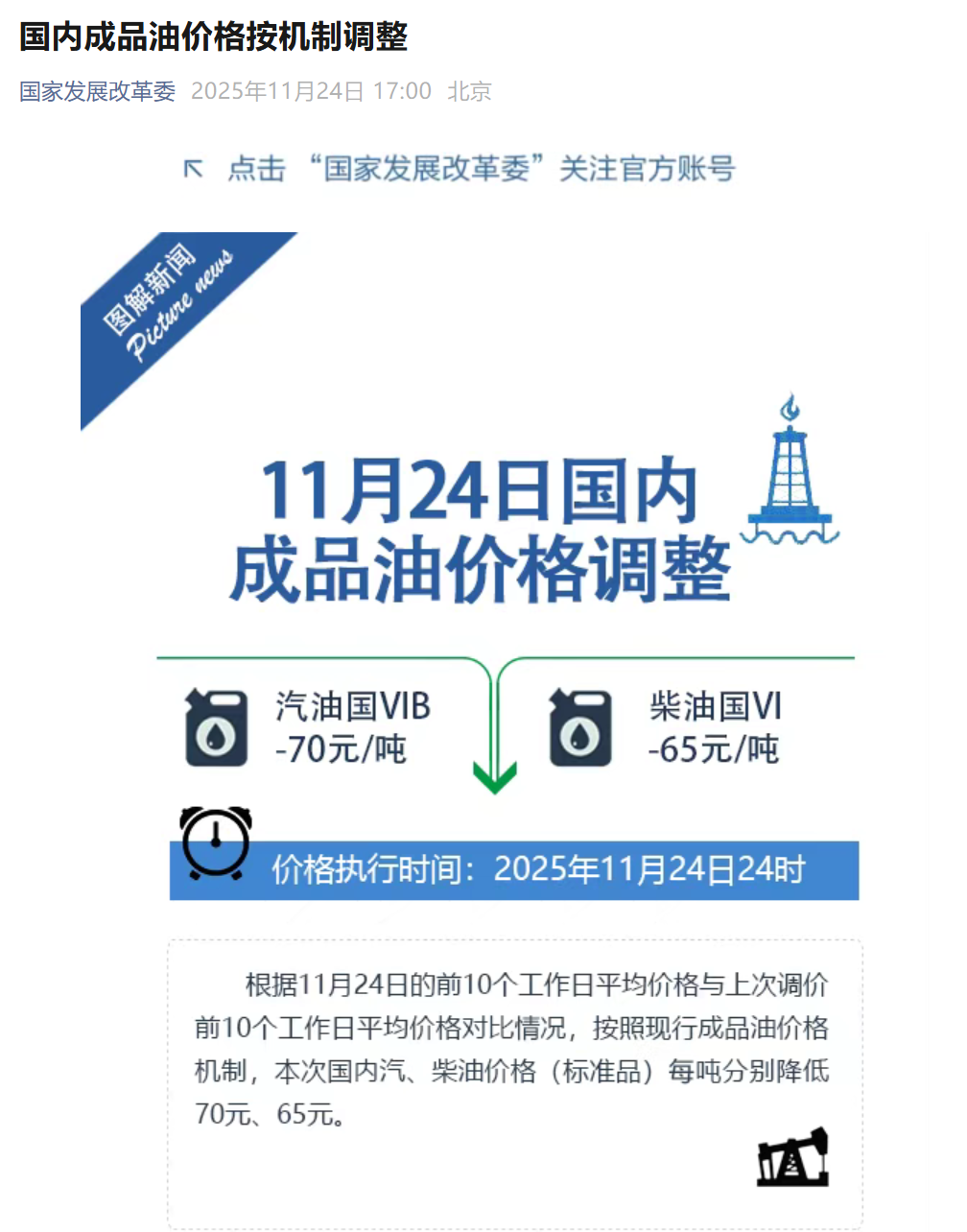
Core Points - Domestic gasoline and diesel prices will decrease by 70 yuan and 65 yuan per ton respectively, effective from November 24, 2025 [1] - The price drop translates to a reduction of 0.05 yuan for 92 gasoline, 0.06 yuan for 95 gasoline, and 0.06 yuan for 0 diesel per liter [4] - The cumulative price adjustments in 2023 have resulted in a total decrease of 690 yuan per ton for gasoline and 660 yuan per ton for diesel compared to the beginning of the year [5] Price Impact on Consumers - For a small private car with a monthly mileage of 2,000 kilometers and a fuel consumption of 8 liters per 100 kilometers, the fuel cost will decrease by 4 yuan over the next half month [4] - For a heavy truck with a monthly mileage of 10,000 kilometers and a fuel consumption of 38 liters per 100 kilometers, the fuel cost will decrease by approximately 106 yuan per vehicle before the next price adjustment [4] Market Analysis - The international oil market is expected to face oversupply in the coming years, with the International Energy Agency raising its 2026 oversupply forecast to 4.09 million barrels per day [5] - Geopolitical risk premiums have decreased, contributing to a downward trend in international oil prices [5] - Future negotiations in Eastern Europe may alleviate concerns over oil supply, suggesting a potential for continued price declines in the oil market [5]

刚刚宣布,今晚调油价!
中国基金报· 2025-11-24 09:33
Group 1 - The core viewpoint of the article is that domestic gasoline and diesel prices in China are set to decrease, with gasoline prices dropping by 70 yuan per ton and diesel by 65 yuan per ton, effective from November 24, 2025 [2] - The price reduction translates to a decrease of 0.05 yuan for 92 gasoline, 0.06 yuan for 95 gasoline, and 0.06 yuan for 0 diesel per liter, resulting in a savings of 2.5 yuan for a full 50L tank of 92 gasoline [5] - Overall, since the beginning of the year, domestic gasoline and diesel prices have decreased by 690 yuan per ton and 660 yuan per ton, respectively, after 23 rounds of adjustments [6] Group 2 - The international energy market is expected to face oversupply in the coming years, with the International Energy Agency raising its 2026 oversupply forecast to 4.09 million barrels per day [8] - Despite the oversupply outlook, recent decreases in U.S. crude oil inventories and the end of government shutdowns have provided some support for international oil prices [8] - The market sentiment indicates a potential for further price declines, with the possibility of consecutive price drops in the next adjustment cycle [8]

重要通知!今晚油价下调,加满一箱油将少花2.5元
Sou Hu Cai Jing· 2025-11-24 09:01
Core Points - Domestic gasoline and diesel prices will be reduced starting from November 24, 2023, due to the decline in international oil prices [1][3] - The price adjustments include a decrease of 70 yuan per ton for gasoline and 65 yuan per ton for diesel, translating to a reduction of 0.05 yuan per liter for 92-octane gasoline and 0.06 yuan per liter for both 95-octane gasoline and 0 diesel [3][4] - The logistics industry will benefit significantly, with estimated fuel cost savings of approximately 106 yuan per heavy truck running 10,000 kilometers before the next price adjustment [3][4] Industry Analysis - The National Development and Reform Commission (NDRC) indicates that international oil prices are expected to maintain a volatile trend due to oversupply and reduced geopolitical risk premiums [4][6] - Major institutions, including the International Energy Agency (IEA), U.S. Energy Information Administration (EIA), and OPEC, predict a supply surplus in the oil market for the next two years, with the IEA raising its 2026 surplus forecast to 4.09 million barrels per day [4][6] - Geopolitical developments, such as the U.S. pushing for a peace agreement between Ukraine and Russia, and increased military tensions in the Caribbean, may further impact oil supply risks and market sentiment [6]

商品市场整体承压,黑色系、能化领跌
2 1 Shi Ji Jing Ji Bao Dao· 2025-11-24 04:11
Market Overview - The overall market sentiment is bearish, with most commodities experiencing downward pressure, particularly in the energy, chemical, black metal, and agricultural sectors [1] - Energy and chemical sectors saw fuel prices drop by 2.73% and crude oil by 1.69%, while black metals like coking coal and coke fell by 7.67% and 3.89% respectively [1] Energy Sector - Oil prices exhibited a weak trend, fluctuating between a high of 460.4 yuan/barrel and a low of 445.6 yuan/barrel, closing down 1.67% at 447.4 yuan/barrel [2] - OPEC+ is set to pause production increases starting January, leading to an oversupply situation, while geopolitical factors are temporarily easing tensions [2][4] - Analysts predict continued pressure on oil prices due to oversupply expectations and potential easing of sanctions on Russian oil, resulting in a bearish outlook for the near term [4] Lithium Carbonate Market - Lithium carbonate futures experienced significant declines, with the main contract LC2601 dropping 9% to 91,020 yuan/ton [5] - Supply concerns are easing as the resumption of a key lithium mine is progressing, although current production costs are higher than market prices [5][6] - Demand has stagnated, with major lithium battery manufacturers adjusting their procurement strategies, indicating a potential for further price declines [5][7] Employment Data and Monetary Policy - The U.S. non-farm payroll data for September showed an increase of 119,000 jobs, surpassing expectations, while the unemployment rate rose to 4.4%, the highest since October 2021 [8] - The delay in the release of employment data may lead the Federal Reserve to adopt a cautious approach regarding interest rate cuts in December [9] - Analysts suggest that despite strong employment data, the uncertainty surrounding upcoming reports may lead to a pause in rate cuts, with potential for future reductions in early 2024 [9][10] Agricultural Sector - The apple production this year is expected to decline, with lower quality and increased storage difficulties, leading to predictions of lower cold storage inventory levels [11] - Current cold storage inventory for apples stands at 7.73 million tons, with an increase of 89,200 tons from the previous week, indicating a potentially strong market for apples due to lower expected inventory levels [11]
沥青周度报告-20251121
Zhong Hang Qi Huo· 2025-11-21 10:35
1. Report Industry Investment Rating - Not provided in the content 2. Core Viewpoints of the Report - This week, the asphalt futures market showed a narrow - range oscillation. After a previous sharp decline, there is a rebound repair momentum, and the downward momentum has weakened. The social inventory of asphalt continues to decline. Although demand has entered the off - season, more negative feedback from the demand side is needed for a unilateral decline in the futures market [8]. - In the future, the futures market lacks bullish drivers and is expected to continue a weak trend. As the asphalt downstream enters the off - season, the pressure of supply surplus is emerging. The expectation of crude oil supply surplus exerts long - term pressure on the futures market. Recently, the cease - fire negotiation between Russia and Ukraine is expected to continue, and the geopolitical risk premium has declined. In the short term, after a large decline, there is a rebound repair momentum, but the oil price is under pressure in the short term, and the cost - side support has weakened. It is expected that the futures market will continue a wide - range oscillation [8][51]. - It is recommended to focus on the range of 2900 - 3100 yuan/ton for the BU2601 contract [8][51] 3. Summary by Directory 3.1 Report Summary - Market focus: The cease - fire negotiation between Russia and Ukraine is expected to continue, and the geopolitical risk premium has declined; the US EIA crude oil inventory decreased this week; the asphalt cracking spread decreased month - on - month [7]. - Key data: As of November 19, the operating rate of domestic asphalt sample enterprises was 24.8%, a decrease of 4.2 percentage points from the previous statistical period; as of November 21, the weekly output of domestic asphalt was 44.1 tons, a decrease of 7.3 tons from last week; the factory inventory of domestic asphalt sample enterprises was 64.2 tons, a decrease of 0.5 tons from last week; the social inventory of domestic asphalt sample enterprises was 79.4 tons, a decrease of 3.1 tons from last week [7] 3.2 Multi - Empty Focus - Bullish factors for asphalt: Supply has decreased [11]. - Bearish factors for asphalt: Demand has weakened, and the oil price has declined [11] 3.3 Macro Analysis - The US and Russia are discussing a framework plan to end the conflict. The US envoy met with the Russian envoy in Miami last month to discuss the plan, which requires Ukraine to make major territorial concessions to Russia. The plan has been rejected by Kiev before. The US government is following the model of mediating the cease - fire in Gaza last month [12]. - Russia's response: The Russian Foreign Ministry spokesperson said that Russia has not received any relevant information from the US through official channels. Such news should be evaluated based on official communication rather than media reports [12]. - Zelensky has received the US peace plan draft. The US believes that this plan may bring a breakthrough to the stagnant diplomatic process. Zelensky is expected to talk with President Trump soon [12]. - The discussion between the US and Russia on ending the conflict conveys a short - term change in the US attitude towards Russia. The market expects that the improvement of US - Russia relations will lead to the relaxation of US sanctions on the Russian energy sector, driving the oil price down. However, due to the volatility of US - Russia relations, the driving force is not sustainable, and the oil price generally maintains a wide - range oscillation [12] 3.4 Supply - Demand Analysis Supply - As of November 21, the weekly output of domestic asphalt was 44.1 tons, a decrease of 7.3 tons from last week. Output from local refineries decreased, and that from PetroChina and Sinopec decreased slightly. The refinery operating rate is in a seasonal decline, and supply is expected to continue to decline [13]. - As of November 19, the operating rate of domestic asphalt sample enterprises was 24.8%, a decrease of 4.2 percentage points from the previous statistical period. The operating rates in East China and Shandong decreased significantly. As refineries enter the seasonal maintenance period, the operating rate is expected to decline, and the supply pressure will gradually weaken [22] Demand - As of November 21, the weekly shipment volume of domestic asphalt was 37 tons, an increase of 0.8 tons from the previous statistical date. The shipment volume is still at a low level this year. In the north, the low - temperature weather has led to the completion of downstream road construction, and the demand improvement in the south is not obvious. As demand enters the off - season, the shipment volume faces seasonal decline pressure [23]. - As of November 21, the weekly capacity utilization rate of domestic modified asphalt was 10.59%, a decrease of 0.63 percentage points from last week. The capacity utilization rate of modified asphalt is in a seasonal decline, and it still faces downward pressure as the downstream enters the off - season [26] Inventory - As of November 21, the factory inventory of domestic asphalt sample enterprises was 64.2 tons, a decrease of 0.2 tons from the previous week, mainly due to the decline in enterprise inventory in North China [33]. - As of November 21, the social inventory of domestic asphalt was 79.4 tons, a decrease of 3.1 tons from the previous week, continuing the downward trend since August. Attention should be paid to the subsequent inventory decline speed [40] Spread - As of November 21, the weekly profit of domestic asphalt processing dilution was - 571 yuan/ton, a month - on - month increase of 42 yuan/ton. The domestic asphalt basis was 182 yuan/ton. As of November 19, the asphalt - to - crude - oil ratio was 51.25 [49] 4. Market Outlook - The futures market lacks bullish drivers and is expected to continue a weak trend. As the asphalt downstream enters the off - season, the pressure of supply surplus is emerging. The expectation of crude oil supply surplus exerts long - term pressure on the futures market. Recently, the cease - fire negotiation between Russia and Ukraine is expected to continue, and the geopolitical risk premium has declined. In the short term, after a large decline, there is a rebound repair momentum, but the oil price is under pressure in the short term, and the cost - side support has weakened. It is expected that the futures market will continue a wide - range oscillation. It is recommended to focus on the range of 2900 - 3100 yuan/ton for the BU2601 contract [51]
港股异动 | 中国铝业(02600)现跌超5% 高盛认为铝价短期过高 供应增长将推动价格回落
Zhi Tong Cai Jing· 2025-11-21 08:04
Core Viewpoint - China Aluminum (02600) has seen a decline of over 5%, currently trading at HKD 10.58 with a transaction volume of HKD 787 million. Goldman Sachs maintains a bearish outlook on aluminum prices, predicting a drop to USD 2,350 per ton by Q4 2026, with recovery not expected until the early next decade [1][1][1]. Group 1: Market Outlook - Goldman Sachs expects the aluminum market to shift to oversupply due to new supply, despite demand benefiting from factors similar to copper and substitution effects. However, aluminum will not face the resource constraints that copper does [1][1][1]. - Morgan Stanley remains optimistic about the aluminum industry's prospects for next year, forecasting moderate oversupply from new supply in Indonesia by 2026. However, potential supply disruption risks and a slower restart of overseas capacity may lead to tighter market conditions than baseline predictions [1][1][1].

2025年9月全球精炼镍供应过剩1.71万吨
Xin Hua Cai Jing· 2025-11-20 03:09
Group 1: Nickel and Aluminum - In September 2025, global refined nickel production was 325,500 tons, with consumption at 308,400 tons, resulting in a surplus of 17,100 tons [1] - For the first nine months of 2025, global refined nickel production reached 2,876,900 tons, while consumption was 2,602,400 tons, leading to a surplus of 274,500 tons [1] - In September 2025, global primary aluminum production was 6,016,300 tons, with consumption at 6,208,400 tons, resulting in a shortage of 192,100 tons [1] - For the first nine months of 2025, global primary aluminum production totaled 54,549,900 tons, while consumption was 55,835,300 tons, leading to a shortage of 1,285,400 tons [1] Group 2: Lead and Tin - In September 2025, global refined lead production was 1,137,900 tons, with consumption at 4,800 tons, resulting in a surplus of 1,133,100 tons [1] - For the first nine months of 2025, global refined lead production reached 10,064,100 tons, while consumption was 9,122,700 tons, leading to a surplus of 941,400 tons [1] - In September 2025, global refined tin production was 32,500 tons, with consumption at 27,600 tons, resulting in a surplus of 4,900 tons [1] - For the first nine months of 2025, global refined tin production totaled 260,200 tons, while consumption was 269,500 tons, leading to a shortage of 9,200 tons [1] Group 3: Copper and Zinc - In September 2025, global refined copper production was 2,333,300 tons, with consumption at 2,414,500 tons, resulting in a shortage of 81,300 tons [2] - For the first nine months of 2025, global refined copper production reached 20,616,000 tons, while consumption was 20,491,400 tons, leading to a surplus of 124,600 tons [2] - In September 2025, global zinc production was 1,193,500 tons, with consumption at 1,229,200 tons, resulting in a shortage of 35,700 tons [2] - For the first nine months of 2025, global zinc production totaled 10,363,200 tons, while consumption was 10,736,900 tons, leading to a shortage of 373,700 tons [2]
宝城期货原油早报-20251120
Bao Cheng Qi Huo· 2025-11-20 01:57
Group 1: Report Industry Investment Rating - No industry investment rating is provided in the report. Group 2: Core Viewpoints of the Report - The short - term view of crude oil 2601 is weak, the medium - term view is oscillatory, and the intraday view is weak, with an overall expectation of weak operation [1][5]. - The imbalance between supply and demand in the oil market, where supply is in excess, is in a game with geopolitical sentiment. After digesting the positive factors of the rebound in European diesel prices, the oil market is facing renewed pressure from oversupply [5]. - It is expected that domestic crude oil futures on Thursday may maintain a weak trend [5]. Group 3: Summary According to the Directory Price and Market Conditions - For crude oil 2601, the short - term is weak, the medium - term is oscillatory, and the intraday is weak, with a reference view of weak operation [1]. - On Wednesday night, the domestic crude oil futures 2601 contract maintained an oscillatory and weak trend, with the futures price slightly closing lower [5]. Driving Logic - OPEC's latest quarterly report changed the global oil market in the third quarter from "supply shortage" to "a daily surplus of 500,000 barrels", amplifying the expectation of loose supply [5]. - With the prominence of geopolitical factors, the crude oil futures price showed an oscillatory and stabilizing trend under the boost of optimistic funds [5]. - After digesting the positive factors of the rebound in European diesel prices, the oil market is facing renewed pressure from oversupply [5].
俄乌和平进程信号下跌引发国际油价下跌
Ge Long Hui A P P· 2025-11-19 23:23
Core Insights - The U.S. is reportedly pushing to end the Russia-Ukraine conflict and has drafted a peace framework, leading to a decline in international oil prices [1] - Analysts suggest that the resolution of the conflict could increase Russian oil exports, raising concerns about oversupply in the market [1] Oil Price Movement - Both WTI and Brent crude oil prices fell over 2%, currently reported at $59.17 per barrel and $63.02 per barrel respectively [1] - Energy expert Scott Shelton from TPICAP indicated that if sanctioned Russian oil floods the market, prices could potentially drop to the lower end of the $50 range [1] Sanctions and Market Pressure - The U.S. announced sanctions against Russian oil giants Rosneft and Lukoil, with a deadline for companies to cease business with them set for November 21 [1] - Janiv Shah, Vice President at Rystad Energy, noted that as the sanctions deadline approaches, the market is under significant pressure, and the decline in geopolitical risk premium will shift investor focus to weak supply-demand fundamentals [1]
油价跌跌不休,欧佩克+会减产救市吗?多数交易员并不指望
Jin Shi Shu Ju· 2025-11-17 06:01
Core Viewpoint - Despite predictions of a global oil supply surplus leading to further price declines, oil traders do not expect OPEC+ to cut production next year [2][3] Group 1: OPEC+ Production Expectations - A survey of 25 brokers and analysts indicates that nearly two-thirds believe OPEC+ will not cut production next year, with less than one-third expecting any supply reductions [2] - Only 8 out of 25 respondents anticipate OPEC+ will limit output, while 12 expect no restrictions, suggesting that significant cuts are unlikely unless there is a drastic market downturn [3] - OPEC+ countries have already restored three-quarters of the 3.85 million barrels per day that were previously paused, ahead of schedule [3] Group 2: Market Dynamics and Price Pressure - The International Energy Agency (IEA) predicts a potential surplus of 4 million barrels per day, driven by weak demand and strong supply from the U.S., Brazil, and Guyana [4] - Oil prices have dropped 14% this year to nearly $64 per barrel, putting financial pressure on OPEC+ members, particularly Saudi Arabia, which faces a growing budget deficit [5] - Some forecasting institutions, like Goldman Sachs and HSBC, estimate that next year's supply surplus will be smaller than the IEA's predictions [5] Group 3: Strategic Shifts and Future Outlook - OPEC+ may be pausing further production increases as a precursor to a new reduction agreement, with the aim of preventing excessive inventory accumulation [4] - Analysts suggest that OPEC+ is focused on regaining market share lost to competitors, particularly U.S. shale producers, rather than prioritizing price support [3][5] - The potential for OPEC+ to cut production significantly may depend on geopolitical factors or drastic price drops, with some analysts believing that the alliance will not reduce output by 2026 [5]