
信用利差

Search documents
信用债周度观察(20250928-20251011):信用债发行量季节性下降,各行业信用利差涨跌互现-20251012
EBSCN· 2025-10-12 08:09
Report Industry Investment Rating - No industry investment rating is provided in the report. Core Viewpoints - The issuance volume of credit bonds decreased seasonally, and the credit spreads of various industries showed mixed trends [1][25]. Summary According to Relevant Catalogs 1. Primary Market 1.1 Issuance Statistics - From September 28 to October 11, 2025, a total of 119 credit bonds were issued, with a total issuance scale of 141.362 billion yuan, a month - on - month decrease of 75.82% [1][11]. - Among them, 39 industrial bonds were issued, with a scale of 64.185 billion yuan, a month - on - month decrease of 75.75%, accounting for 45.40% of the total credit bond issuance scale; 70 urban investment bonds were issued, with a scale of 43.777 billion yuan, a month - on - month decrease of 72.63%, accounting for 30.97%; 10 financial bonds were issued, with a scale of 33.4 billion yuan, a month - on - month decrease of 79.11%, accounting for 23.63% [1][11]. - The average issuance term of credit bonds was 2.44 years, with industrial bonds at 1.63 years, urban investment bonds at 2.80 years, and financial bonds at 3.16 years [2][14]. - The average issuance coupon rate of credit bonds was 2.34%, with industrial bonds at 2.12%, urban investment bonds at 2.45%, and financial bonds at 2.35% [2][18]. 1.2 Cancellation of Issuance Statistics - Three credit bonds were cancelled for issuance during the period [23]. 2. Secondary Market 2.1 Credit Spread Tracking - By industry, among Shenwan primary industries, the largest upward adjustment of AAA - rated industry credit spreads was in the building decoration industry, up 2.6BP, and the largest downward adjustment was in the media industry, down 4BP; for AA + - rated industry credit spreads, the largest upward adjustment was in the chemical industry, up 6.6BP, and the largest downward adjustment was in the non - ferrous metals industry, down 8.6BP; for AA - rated industry credit spreads, the largest upward adjustment was in the non - bank finance industry, up 6.7BP, and the largest downward adjustment was in the machinery and equipment industry, down 5BP [3][25]. - Coal credit spreads generally increased, while steel credit spreads generally decreased. The AAA and AA + - rated coal credit spreads increased by 0.3BP and 0.5BP respectively, and the AAA and AA + - rated steel credit spreads decreased by 1.1BP and 2.7BP respectively [25]. - The credit spreads of urban investment bonds of each rating showed mixed trends, while non - urban investment credit spreads generally increased. The credit spreads of the three - level urban investment bonds decreased by 0.2BP, increased by 0.6BP, and increased by 1.7BP respectively; the credit spreads of the three - level non - urban investment bonds increased by 0.1BP, increased by 2.3BP, and increased by 1.3BP respectively [25]. - The credit spreads of state - owned enterprises showed mixed trends, while those of private enterprises generally increased. The credit spreads of the three - level central state - owned enterprises decreased by 0.7BP, decreased by 0.3BP, and decreased by 1.1BP respectively; the credit spreads of the three - level local state - owned enterprises increased by 0.6BP, increased by 1.8BP, and increased by 2BP respectively; the AAA and AA + - rated private enterprise credit spreads increased by 10.9BP and 0.8BP respectively [25][26]. - Regionally, the credit spreads of urban investment bonds showed mixed trends. The regions with the highest AAA - rated credit spreads were Liaoning, Shaanxi, and Jilin, with spreads of 101, 94, and 91BPs respectively; for AA + - rated, they were Qinghai, Shaanxi, and Gansu, with spreads of 144, 131, and 125BPs respectively; for AA - rated, they were Shaanxi, Sichuan, and Guangxi, with spreads of 154, 154, and 153BPs respectively. In terms of month - on - month changes, the largest upward adjustment of AAA - rated credit spreads was in Henan, up 7.2BP, and the largest downward adjustment was in Shaanxi, down 4.7BP; for AA + - rated, the largest upward adjustment was in Hunan, up 8BP, and the largest downward adjustment was in Yunnan, down 4.9BP; for AA - rated, the largest upward adjustment was in Guangxi, up 26.8BP, and the largest downward adjustment was in Yunnan, down 5BP [25][27]. 2.2 Trading Volume Statistics - The total trading volume of credit bonds was 855.283 billion yuan, a month - on - month decrease of 47.12%. The top three in terms of trading volume were commercial bank bonds, corporate bonds, and medium - term notes. Specifically, the trading volume of commercial bank bonds was 254.914 billion yuan, a month - on - month decrease of 47.74%, accounting for 29.80% of the total credit bond trading scale; the trading volume of corporate bonds was 237.461 billion yuan, a month - on - month decrease of 52.14%, accounting for 27.76%; the trading volume of medium - term notes was 17.722 billion yuan, a month - on - month decrease of 45.30%, accounting for 20.72% [4][28]. 2.3 Actively Traded Bonds This Period - The report selects the top 20 urban investment bonds, industrial bonds, and financial bonds in terms of trading volume for investors' reference [30].
【财经分析】节后信用债弱势震荡 四季度投资如何布局?
Xin Hua Cai Jing· 2025-10-11 11:22
Core Viewpoint - Since July, long-end interest rates have been fluctuating upwards, leading to structural resilience in credit bond yields and significant declines in certain varieties, particularly under the influence of macroeconomic narratives and regulatory factors [1][2] Group 1: Market Performance - The credit bond market has shown structural resilience and significant declines in specific varieties since the third quarter, with short-term credit bonds experiencing minimal yield increases, generally within 10 basis points [2] - Long-end credit bonds, particularly perpetual bonds, have seen yield increases of over 30 to 50 basis points, indicating a more pronounced decline compared to ordinary credit bonds [2] - Historical data suggests that credit bonds typically perform better in the fourth quarter, with overall yields generally declining, except for 2022 when policy shifts caused adjustments [2] Group 2: Investment Strategy - Analysts recommend focusing on short-term credit bonds, particularly those with maturities of 2 to 3 years, as they have shown better performance during market adjustments [5] - For 4 to 5-year bank perpetual bonds, the current yield spread has exceeded the annual high, indicating a favorable entry point for institutions [5] - The current credit spreads for ultra-long credit bonds are nearing two-year highs, and there is an increasing interest from market participants, suggesting potential investment opportunities [6]
【固收】产业债发行规模持续增长,信用利差保持走阔态势——信用债月度观察(2025.09)(张旭/秦方好)
光大证券研究· 2025-10-09 23:08
Group 1 - The total outstanding credit bond balance in China reached 30.49 trillion yuan as of September 30, 2025, with a net financing of 139.89 billion yuan in September 2025 [4] - The outstanding local government financing bonds (城投债) amounted to 15.31 trillion yuan, with a September issuance of 503.91 billion yuan, reflecting a month-on-month increase of 0.84% and a year-on-year increase of 9.78% [4] - The outstanding industrial bonds (产业债) stood at 15.18 trillion yuan, with a September issuance of 731.63 billion yuan, showing a month-on-month increase of 17.85% and a year-on-year increase of 15.04% [4] Group 2 - In September 2025, the transaction volume of local government financing bonds was 1.021 trillion yuan, with a turnover rate of 6.67% [5] - The transaction volume of industrial bonds was 1.267 trillion yuan, with a turnover rate of 8.35% [5] - The credit spreads for both local government financing bonds and industrial bonds widened compared to the previous month [5]


产业债发行规模持续增长,信用利差保持走阔态势:——信用债月度观察(2025.09)-20251009
EBSCN· 2025-10-09 12:03
1. Report Industry Investment Rating No relevant content provided. 2. Core View of the Report - As of the end of September 2025, the balance of outstanding credit bonds in China was 30.49 trillion yuan. In September 2025, the issuance of credit bonds increased month - on - month, with a net financing of 1398.89 billion yuan. The issuance of industrial bonds showed significant growth, while the net financing of urban investment bonds was negative [1][9]. - In September 2025, the trading volume of urban investment bonds increased month - on - month but decreased year - on - year, and the trading volume of industrial bonds decreased both month - on - month and year - on - year. The credit spreads of both urban investment bonds and industrial bonds widened compared to the previous month [2][41]. 3. Summary According to the Directory 3.1 Credit Bond Issuance and Maturity 3.1.1 Credit Bond Issuance - As of the end of September 2025, the balance of outstanding credit bonds was 30.49 trillion yuan. From September 1 to 30, 2025, the issuance of credit bonds was 12355.38 billion yuan, a month - on - month increase of 10.27%, with a total repayment of 10956.49 billion yuan and a net financing of 1398.89 billion yuan [1][9]. - **Urban Investment Bonds**: As of the end of September 2025, the balance of outstanding urban investment bonds was 15.31 trillion yuan. In September 2025, the issuance was 5039.05 billion yuan, a month - on - month increase of 0.84% and a year - on - year increase of 9.78%. The net financing of urban investment entities was - 105.01 billion yuan. In terms of regions, Jiangsu had the highest issuance, and in terms of ratings, AA + and AAA - rated bonds accounted for a relatively high proportion [10][13][20]. - **Industrial Bonds**: As of the end of September 2025, the balance of outstanding industrial bonds was 15.18 trillion yuan. In September 2025, the issuance was 7316.33 billion yuan, a month - on - month increase of 17.85% and a year - on - year increase of 15.04%. The net financing of industrial entities was 1503.9 billion yuan. In terms of industries, the public utilities sector had the highest issuance, and in terms of ratings, AAA - rated bonds accounted for 90.52% [22][24][29]. 3.1.2 Credit Bond Maturity - **Urban Investment Bonds**: From October to December 2025, Jiangsu, Shandong, and Zhejiang had relatively large maturity scales of urban investment bonds, all exceeding 100 billion yuan [29]. - **Industrial Bonds**: From October to December 2025, the public utilities, non - banking finance, building decoration, transportation, and real estate industries had relatively large maturity scales of credit bonds, all exceeding 100 billion yuan [33]. 3.2 Credit Bond Trading and Spreads 3.2.1 Credit Bond Trading - **Urban Investment Bonds**: In September 2025, the trading volume of urban investment bonds was 10210.31 billion yuan, with a month - on - month increase and a year - on - year decrease. The turnover rate was 6.67% [37]. - **Industrial Bonds**: In September 2025, the trading volume of industrial bonds was 12677.1 billion yuan, with both month - on - month and year - on - year decreases. The turnover rate was 8.35% [41]. 3.2.2 Credit Bond Spreads - **Urban Investment Bonds**: In September 2025, the credit spreads of urban investment bonds of all levels widened compared to the previous month. For example, the average credit spread of AAA - rated urban investment bonds was 57bp, 6bp wider than in August 2025. Regionally, different regions showed different spread levels and changes [41][44]. - **Industrial Bonds**: In September 2025, the credit spreads of credit bonds of all levels of industrial entities widened compared to the previous month. For example, the average credit spread of AAA - rated industrial entities was 53bp, 3bp wider than in August 2025. By industry, different industries had different spread levels and changes [47][49].
固收专题报告:信用季度:信用季度利差难压,等待下行
CAITONG SECURITIES· 2025-10-09 05:07
Group 1: Report Industry Investment Rating - Not provided in the content Group 2: Core Views of the Report - In Q3, the bond market was mainly affected by anti - involution policies, the stock market, and new fund redemption rules, showing a continuous upward trend. The adjustment in Q3 was characterized by more long - end adjustments, fewer short - end adjustments, fewer low - grade credit adjustments, slightly more high - grade credit adjustments, more adjustments in secondary and perpetual bonds, and fewer adjustments in general credit bonds. In terms of investment returns, credit bonds with a maturity of 2 years or less performed well, while those with a maturity of 3 years or more mostly had negative returns [2]. - Currently, the interest rate may have fully priced in policy and fundamental disturbances. The pattern of weak fundamentals and weak financing demand remains unchanged, and the further upward space of the bond market may be limited [3]. - Historically, the bond market often declines in Q4, and credit spreads usually fluctuate. This year, due to weak bond fund returns and the importance of Q4 performance for the whole - year product performance, market gaming will be more intense, increasing market volatility. For credit bonds in Q4, it is still recommended to focus on coupons, be cautious about duration, and conduct periodic gaming [4][5]. - For different bond varieties, 2 - year short - term bonds are still a solid base and may perform well in the short - term after the holiday. Trading opportunities for secondary and perpetual bonds have emerged again, requiring quick entry and exit in the short - term, and depending on interest rate trends in the long - term. Institutions with unstable liability ends should be cautious about ultra - long - term credit bonds, but their trading volume has increased and shareholding banks have net - bought, indicating a recovery in allocation value, and trading strategies can be tried cautiously [6]. Group 3: Summary by Related Catalogs 1.1 How was the performance in Q3? - The bond market was affected by anti - involution policies, the stock market, and new fund redemption rules, showing a continuous upward trend. In July, anti - involution policies were further implemented, and the bond market rose significantly; in August, the stock market rose strongly, suppressing bond market sentiment; in September, new fund redemption rules were introduced, and various news such as good industrial enterprise profits in August, progress in Sino - US negotiations, and the cancellation of fund tax exemption impacted the market [13]. - The Q3 adjustment showed characteristics of more long - end adjustments, fewer short - end adjustments, fewer low - grade credit adjustments, slightly more high - grade credit adjustments, more adjustments in secondary and perpetual bonds, and fewer adjustments in general credit bonds [15]. - In terms of investment returns, 2 - year and shorter - term credit bonds performed well with positive returns, while bonds with a maturity of 3 years or more had poor investment returns, and the longer the maturity, the worse the performance. For example, the investment return of the 30 - year treasury bond in Q3 was only - 7.818% [19]. 1.2 Will the downward trend continue? - In August, the year - on - year growth rate of industrial enterprise profits was 20.4%, mainly driven by industries such as power, heat production and supply, and metal smelting and processing. However, the sustainability of the profit recovery is limited due to factors such as the continuous decline in futures prices and weak social demand. The growth rates of both social financing and core social financing are declining, and the further upward space of the social financing growth rate is limited [21]. - Currently, the market interest rate has fully reflected the marginal changes in fundamentals and inflation. Considering the term spread of interest - rate bonds and the comparison between long - term interest rates and certificates of deposit, the further upward space of interest rates is limited, and there may be a downward trend at the end of the year [22][31]. 1.3 How to view credit spreads? - If interest rates do not rise further, credit spreads will likely fluctuate. Historically, credit spreads in Q4 mostly fluctuate. If the capital interest rate can remain stable, the pricing logic system of capital - certificates of deposit - credit will be more stable. Currently, the comparison between medium - term notes and certificates of deposit has risen significantly but is expected to fall back, and the term spread of credit bonds has reached a relatively high level in the past two years and is expected to have limited further upward space [35][40]. 1.4 How to understand the seasonality of the bond market and institutional psychology? - The bond market tends to decline in Q4. In the past 9 years from 2016 to now, interest - rate bonds rose only in 2016, 2017, and 2022, and declined in other years. Credit bonds generally perform worse than interest - rate bonds of the same maturity in Q4. This year, due to the poor performance of medium - and long - term bond funds, market gaming in Q4 will be more intense, increasing market volatility. Products with good performance may focus on controlling drawdowns, while those under performance pressure may more aggressively play the long - duration strategy [43][47][49]. 1.5 How to construct a portfolio? - Medium - and short - term credit bonds should still focus on defense. Holding credit bonds with a maturity of less than 2 years until the end of Q4 can withstand an upward range of more than 30bp, and appropriate credit risk exposure can also lead to good coupon performance [52]. - Ultra - long - term credit bonds: Their credit spreads are close to the high point in the past two years, and their trading volume has increased, and shareholding banks have net - bought, indicating that they have allocation value. Currently, the comparison between secondary and perpetual bonds and general credit bonds has risen to a high level, presenting trading opportunities [56][58][59]. 2.1 It is recommended to focus on medium - and long - term secondary and perpetual bonds - At the end of September, the comparison between 5 - year secondary and perpetual bonds and medium - term notes rose rapidly. The comparison advantages of 5 - year secondary capital bonds of all grades over 5 - year medium - term notes increased significantly, and the comparisons of AAA, AA +, and AA grades are currently 9.96bp, 9.08bp, and 4.08bp respectively, still at a high level this year. The comparisons of 1 - year secondary bonds of all grades with medium - term notes are all negative [63]. - The comparison between short - end urban investment bonds and medium - term notes has declined significantly, breaking through the low point of the year, and the cost - performance of medium - and low - grade bonds is relatively low, so entry still needs to wait. The comparison between long - end weak - quality urban investment bonds and medium - term notes has increased [65]. 2.2 Focus on high - coupon assets with a maturity of about 2 years - Currently, the proportion of urban investment bonds with a valuation of over 2.3% is 38.0%, that of non - financial industrial bonds is 24.5%, and that of secondary and perpetual bonds is 33.3%. Bonds with a maturity of about 2 years and a valuation of over 2.3% have good value and are worth attention [67]. - For urban investment bonds, long - end bonds can combine coupon and band operations, and short - duration high - coupon varieties can still be participated in. It is recommended to focus on bonds with a maturity of about 2 years issued by companies such as Xi'an High - tech, Henan Aviation Port, and Zhuhai Huafa [68]. - For industrial bonds, among real - estate enterprises, it is recommended to focus on bonds of important local state - owned real - estate enterprises with a maturity of about 2 years, such as Shoukai, Jianfa, and CCCC Real Estate. Among non - real - estate industrial entities, focus on bonds with a maturity of less than 2 years issued by enterprises such as Jizhong Energy and AVIC Industry Finance, and bonds with a maturity of about 2 years issued by enterprises such as HBIS and Yunnan Investment [72]. 3.1 How was the market performance? - On September 29 - 30, credit bonds generally recovered, and spreads generally widened. Credit bond yields declined slightly, with short - end secondary and perpetual bonds performing more significantly, while 10Y secondary and perpetual bonds continued to rise. Credit spreads widened overall, and the spreads of secondary and perpetual bonds showed a differentiated trend, with short - end spreads declining and long - end spreads widening [74].
信用周报:四季度,票息性价比提升-20251006
China Post Securities· 2025-10-06 07:21
1. Report Industry Investment Rating No relevant content provided. 2. Core Views of the Report - In the fourth quarter, the cost - effectiveness of the coupon strategy is further enhanced against the backdrop of high uncertainty in the bond market direction. The 1 - 3 - year weak - qualification urban investment sinking strategy is recommended, and the yields of 1 - 2 - year AA(2), 2 - 3 - year AA, and AA(2) urban investment bonds are between 2.09% - 2.32%, with a large balance of outstanding bonds. Second, the super - decline feature of secondary perpetual (Er Yong) bonds is obvious, and the yields of 3 - year large - bank capital bonds and 2 - year AA perpetual bonds are between 2.0% - 2.07%, having fallen to a level with coupon value. The 4 - 5 - year large - bank capital bonds have a large decline in this round of adjustment, and the current yields are all above 2.1%, which are high - quality coupon assets for accounts with stable liability ends. For ultra - long - term bonds, although the cost - effectiveness of coupons continues to increase after adjustment, the liquidity has not seen marginal improvement, and it is still only recommended for allocation - type institutions to consider [3][35]. 3. Summary by Relevant Catalog Current Bond Market Situation - Last week, the bearish force in the bond market remained strong, but with the bond - buying by large banks and the central bank's liquidity support, interest rates generally stabilized, while the decline of credit bonds was relatively high, especially for Er Yong bonds and ultra - long - term credit bonds, showing an "over - decline" trend. From September 22 to September 26, 2025, the yields of 1Y, 2Y, 3Y, 4Y, 5Y treasury bonds decreased by 0.7BP, increased by 2.7BP, 2.8BP, 1.8BP, 0.5BP respectively, while the yields of AAA medium - term notes with the same maturities increased by 5.3BP, 6.5BP, 6.8BP, 9.0BP, 9.7BP respectively [1][10]. - The performance of ultra - long - term credit bonds continued to weaken, with the decline exceeding that of the same - maturity interest - rate bonds. The yields of 10Y AAA/AA + medium - term notes increased by 11.32BP and 10.32BP respectively, and the yields of 10Y AAA/AA + urban investment bonds increased by 11.90BP and 8.90BP respectively. The yield of 10Y AAA - bank secondary capital bonds increased by 16.19BP, while the yield of 10Y treasury bonds recovered by 0.21BP [1][12][13]. - The "volatility amplifier" feature of Er Yong bonds reappeared, with the decline of each maturity exceeding that of ordinary credit bonds. The yields of 1 - 5 - year, 7 - year, and 10 - year AAA - bank secondary capital bonds increased by 5.15BP, 8.94BP, 11.60BP, 12.29BP, 17.93BP, 18.31BP, 16.19BP respectively. The part of the curve above 2 - year is still 30BP - 63BP away from the lowest yield point since 2025, and the yields of maturities above 3 - year have exceeded the levels of the bear - flattening period in the first quarter [2][17]. Analysis of Trading Behavior - In terms of active trading, the bearish force of Er Yong bonds was strong overall, with the selling force of trading desks stronger than the buying force of allocation desks. From September 22 to September 26, the proportion of low - valuation transactions of Er Yong bonds was 92.50%, 0.00%, 0.00%, 10.00%, 100.00% respectively. Last week, trading desks represented by public funds strongly sold Er Yong bonds and only had net purchases of short - term credit products. At the same time, allocation desks such as wealth management and insurance institutions bought oversold Er Yong bonds at high prices, but the buying force was weaker than the selling force of public funds [2][19][20]. - The selling market of ultra - long - term credit bonds continued to strengthen throughout the week. From September 22 to September 26, the proportion of discount transactions of ultra - long - term credit bonds was 65.00%, 72.50%, 95.00%, 100.00%, 75.00% respectively. The discount range was not low, and about 25.5% of the discount transactions had a range of more than 4BP, indicating a strong selling willingness in the market [22]. Comparison of the Two Rounds of Bond Market Adjustments in 2025 - The bond market adjustment in the first quarter was mainly driven by the unexpected tightening of the capital market, resulting in weaker performance of the short - and medium - term credit bonds. The yields of 1 - 5 - year AAA urban investment bonds increased by more than 40bp, while the yields of long - term bonds increased by less than 35bp [26][29]. - The bond market adjustment since mid - July in the third quarter was mainly due to the strong performance of the commodity and equity markets, which increased institutional risk appetite. Institutions were very cautious about duration, and short - duration bonds had strong anti - decline properties. From July 18 to September 29, the yield increase of 1 - year urban investment bonds was within 15bp, while the yields of AAA and AA + urban investment bonds with maturities of 7 - year and above increased by more than 40bp [26][32].
信用利差周报:央行四举措促离岸人民币债市发展,信用利差全面走阔-20250929
Zhong Cheng Xin Guo Ji· 2025-09-29 11:11
1. Report Industry Investment Rating No relevant content provided. 2. Core Viewpoints of the Report - The central bank's four measures will promote the internationalization of the offshore RMB bond market, enhance the willingness of overseas funds to allocate and market liquidity, and inject lasting impetus into the internationalization of the bond market [2][9][10] - In August, the profits of large - scale industrial enterprises above the national level increased significantly year - on - year, driving the cumulative profit growth rate from January to August to turn positive, indicating a gradual recovery of micro - entity vitality [3][11][12] - In the money market, due to the approaching National Day holiday and end - of - quarter disturbances, most capital prices rose, and the central bank conducted net capital injections through open - market operations [4][14] - In the primary market of credit bonds, the issuance scale increased significantly last week, with different performance among industries and fluctuations in issuance costs [5][17] - In the secondary market of credit bonds, trading activity increased, bond yields mostly rose, credit spreads widened across the board, and rating spreads changed slightly [6][30] 3. Summary According to Relevant Catalogs Market Hotspots - On September 25th, the central bank announced four measures to accelerate the development of the offshore RMB market, including supporting overseas institutional investors' participation in the repurchase business of the domestic bond market, expanding the "Swap Connect" quotation dealer team and increasing the daily north - bound trading quota, increasing the supply of RMB assets such as treasury bonds in the Hong Kong market, and accelerating the listing of RMB treasury bond futures in Hong Kong. These measures will form a complete closed - loop of "asset supply - trading convenience - risk hedging" [2][9] Macroeconomic Data - In August, the profits of large - scale industrial enterprises above the national level increased by 20.4% year - on - year, driving the cumulative profit growth rate from January to August to turn from - 1.7% in January - July to 0.9%. Low base in the same period of 2024, "anti - involution" policies, and effective cost control contributed to this improvement. In terms of industries, the equipment manufacturing and raw material manufacturing industries performed well. At the enterprise level, private, medium - sized, and small enterprises showed good profit growth [3][11][12] Money Market - Last week, the central bank conducted a net capital injection of 1122.3 billion yuan through open - market operations. Affected by the approaching National Day holiday and end - of - quarter disturbances, most capital prices rose. Except for the 1 - day pledged repurchase rate, which decreased by 15bp, other term pledged repurchase rates increased by 2 - 18bp. The 3 - month and 1 - year Shibor slightly increased, and the spread between them narrowed [4][14] Primary Market of Credit Bonds - The issuance scale of credit bonds increased significantly last week, reaching 447.423 billion yuan, with an average daily issuance scale of 89.485 billion yuan. The cancellation scale of issuance also increased. In terms of bond types, the issuance scale of ultra - short - term financing bills and medium - term notes increased significantly. In terms of industries, the infrastructure investment and financing industry and the power production and supply industry in the industrial bond sector had large increases in issuance scale. The infrastructure investment and financing industry had a net capital outflow, while the power production and transportation industries in the industrial bond sector had large net inflows, and the light manufacturing industry had a large net outflow. The average issuance cost of credit bonds fluctuated, with changes ranging from 1bp to 59bp [5][17][26] Secondary Market of Credit Bonds - The trading volume of cash bonds in the secondary market last week was 9387.09 billion yuan, with an average daily trading volume increase of 2.5216 billion yuan. Trading activity continued to rise. Bond yields mostly rose. For interest - rate bonds, the yields of treasury bonds and policy - bank bonds mostly increased, with a maximum increase of 5bp, and the 10 - year treasury bond yield remained stable at 1.88%. For credit bonds, yields increased by 3 - 12bp. Credit spreads widened by 5 - 12bp across the board, and rating spreads changed within 3bp [6][30] Appendix - The report lists bond market credit risk events, including bond defaults, extensions, etc. of several companies [42] - It also summarizes regulatory and market innovation dynamics, such as policies to support digital consumption, sports industry, and debt financing of mature - layer enterprises, as well as measures to optimize market mechanisms and simplify procedures [43][44] - The monthly net financing amounts of major credit bond types from January 2024 to August 2025 are presented [45]
美联储降息风向,泰珀警示再降两次风险,中国市场潜力凸显
Sou Hu Cai Jing· 2025-09-28 14:00
Group 1 - David Tepper expressed concerns about current valuations, indicating a shift in sentiment compared to his previous preference for Chinese assets [1][2] - As of Q2 2025, Appaloosa Management held approximately $6.45 billion in U.S. equities, with Alibaba representing over 12% of the portfolio, while increasing Nvidia's position significantly [1][2] - Tepper highlighted the risks associated with multiple interest rate cuts, suggesting that a weakening dollar and rising inflation could disrupt market stability [2][3] Group 2 - Tepper noted that while Chinese companies have attractive price-to-earnings ratios, the uncertainty surrounding policies and liquidity poses significant risks [2][3] - He advised investors to diversify their portfolios and not to concentrate too heavily on any single investment, especially in the context of potential policy fluctuations [3][4] - Tepper's cautious approach reflects a balance between recognizing opportunities in Chinese assets and the historical lessons learned from past market volatility [4]
低利率和外部环境扰动下债券市场走势与投资策略
Xin Lang Cai Jing· 2025-09-28 01:29
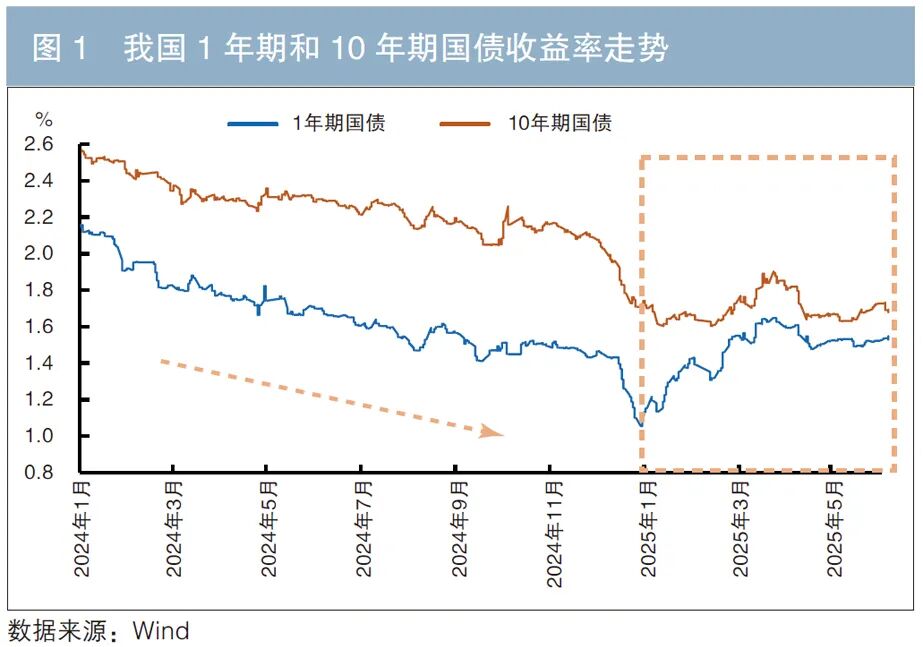
Core Viewpoint - The bond market in China has entered a bull market in 2024, driven by weak economic conditions, moderate monetary policy easing, and reduced bank funding costs, leading to declining interest rates and narrowing credit spreads [1][2][8]. Bond Market Performance Interest Rate Bonds - Since the beginning of 2024, the bond market has shown a bull market trend, with the 1-year government bond yield dropping to a low of 0.9307% on December 23, 2024, the lowest since June 3, 2009 [2][4]. - The 10-year government bond yield reached a historical low of 1.5958% on February 7, 2025, indicating a low interest rate environment [2][4]. Credit Bonds - The scale of credit bond defaults has continued to decline in 2024, with a notable decrease in the proportion of defaults from real estate companies and AAA-rated bonds [5][6]. - The number of defaulting companies decreased from 37 in 2021 to 23 in 2024, and the default scale dropped from 1,076 billion to 241 billion [6]. Factors Driving Bond Yield Decline - Economic slowdown is evident, with the manufacturing PMI below 50 for nine months, indicating weak production [8][9]. - Monetary policy has become more accommodative, with two interest rate cuts totaling 30 basis points and two reserve requirement ratio cuts of 1 percentage point in 2024 [8][9]. - The cost of bank liabilities has decreased due to various policy measures, increasing demand for bond investments [8][9]. - Institutional demand for bonds has surged amid a weak stock market and ample liquidity, leading to significant bond purchases [9][10]. Outlook for the Bond Market Interest Rate Bonds - The bond market may experience increased volatility due to ongoing U.S.-China trade negotiations and potential government policies aimed at stabilizing growth [11][12]. - The issuance of long-term special government bonds is expected to increase, with a total of 11.86 trillion yuan in new government debt planned for 2025 [11][12]. Credit Bonds - The default rate for credit bonds is expected to remain low, particularly in the real estate sector, due to improved sales and financing conditions [20][21]. - Credit spreads are likely to narrow, but the potential for further compression is limited due to already low levels [22]. Investment Strategy Recommendations - Investors should closely monitor the 1-year interbank certificate of deposit rates as they significantly influence the 10-year government bond yields [24][25]. - A strategy to go long on short-term bonds is recommended, as the yield curve is expected to steepen [26]. - Identifying structural opportunities in credit spreads is crucial, focusing on liquidity risk management and sector rotation [27]. - Enhancing trading capabilities and utilizing derivatives for hedging, along with diversifying into fixed-income-like assets, can optimize portfolio performance [28].
利率调整中信用利差大幅走高,二永债升幅较普信债更大
Xinda Securities· 2025-09-27 13:31
1. Report Industry Investment Rating No information provided in the content. 2. Core View of the Report - Interest rate adjustment led to significant widening of credit spreads, with second - tier and perpetual (Two - Yong) bonds rising more than ordinary credit bonds. Credit bonds were sold off, and spreads of all maturities widened significantly. [2][5] - Urban investment bond spreads increased by 6 - 7BP overall. [2][9] - Industrial bond spreads rose slightly less than urban investment bonds, and the spreads of mixed - ownership and private real - estate bonds increased synchronously. [2][18] - Two - Yong bond spreads increased more than ordinary credit bonds, and medium - and long - term varieties were sold off on a large scale. [2][28] - The excess spreads of industrial perpetual bonds remained flat, while those of urban investment perpetual bonds increased. [2][32] 3. Summary by Related Catalogs 3.1 Interest rate adjustment led to credit bond sell - off and significant widening of spreads across all maturities - Interest rate bonds recovered after a significant adjustment, with short - duration performing slightly better. The yield of 1Y China Development Bank bonds remained the same as last week, while the yields of 3Y and 5Y increased by 2BP, 7Y by 5BP, and 10Y Treasury bonds by 1BP. [2][5] - Credit bonds were sold off, and yields rose significantly, with medium - and long - end rising more. The yield of 1Y AA+ and above credit bonds rose 5 - 6BP, others 7BP; 3Y AA and above 7BP, AA - 5BP; 5Y AAA 10BP, others 7 - 10BP; 7Y all grades 9 - 10BP; 10Y all grades 10 - 11BP. [2][5] - Credit spreads of all maturities widened significantly. 1Y all grades 6 - 8BP, 3Y AA and above 5BP, AA - 3BP; 5Y AAA 7BP, others 4 - 5BP; 7Y all grades 5 - 6BP; 10Y all grades 9 - 10BP. [2][5] 3.2 Urban investment bond spreads increased by 6 - 7BP overall - External ratings: AAA, AA+, and AA platform spreads increased by 6BP, 7BP, and 6BP respectively compared to last week. [9] - Provincial, municipal, and county - level platform spreads all increased by 6BP. [15] 3.3 Industrial bond spreads rose slightly less than urban investment bonds, and the spreads of mixed - ownership and private real - estate bonds increased synchronously - Central and state - owned real - estate bond spreads increased by 4 - 5BP, mixed - ownership 14BP, and private real - estate 16BP. [18] - Coal bond spreads of all grades increased by 5BP; AAA steel 5BP, AA+ 3BP; chemical bonds of all grades 5BP. [18] 3.4 Two - Yong bond spreads increased more than ordinary credit bonds, and medium - and long - term varieties were sold off on a large scale - 1Y Two - Yong bond yields of all grades increased by 5 - 6BP, second - tier bond spreads 6BP, and perpetual bond yields 7BP. [29] - 3Y AAA second - tier bond yields increased by 12BP, spreads 10BP; other grades 10BP, spreads 7BP; perpetual bonds of all grades 12 - 13BP, spreads 10 - 11BP. [29] - 5Y second - tier capital bond yields of all grades increased by 16 - 18BP, spreads 14 - 16BP; perpetual bonds of all grades 12 - 14BP, spreads 10 - 12BP. [29] 3.5 The excess spreads of industrial perpetual bonds remained flat, while those of urban investment perpetual bonds increased - Industrial AAA3Y and AAA5Y perpetual bond excess spreads remained the same as last week at 14.52BP and 12.40BP, at the 36.98% and 25.46% quantiles since 2015 respectively. [32] - Urban investment AAA3Y perpetual bond excess spreads increased by 0.95BP to 7.58BP, at the 11.08% quantile; AAA5Y increased by 1.45BP to 8.96BP, at the 7.63% quantile. [32] 3.6 Credit spread database compilation instructions - Market credit spreads, Two - Yong spreads, and urban investment/industrial perpetual bond spreads are based on ChinaBond medium - and short - term notes and perpetual bonds data, with historical quantiles since early 2015. [38] - Industrial and urban investment individual bond spreads are calculated by subtracting the yield of the same - maturity China Development Bank bonds from the individual bond valuation, and then averaging. [38] - Excess spreads of bank second - tier capital bonds/perpetual bonds and industrial/urban investment perpetual bonds are calculated by subtracting the spreads of the same - grade and same - maturity ordinary bonds. [38] - Industrial and urban investment bonds select medium - term notes and public corporate bonds, excluding guaranteed and perpetual bonds. [38] - Bonds with a remaining maturity of less than 0.5 years or more than 5 years are excluded from the sample. [38] - Industrial and urban investment bonds use external subject ratings, while commercial banks use ChinaBond implicit bond ratings. [38]