
反内卷

Search documents
从规模竞争向质量竞争跨越 磷酸铁锂龙头纷纷提价
Shang Hai Zheng Quan Bao· 2025-12-02 23:43
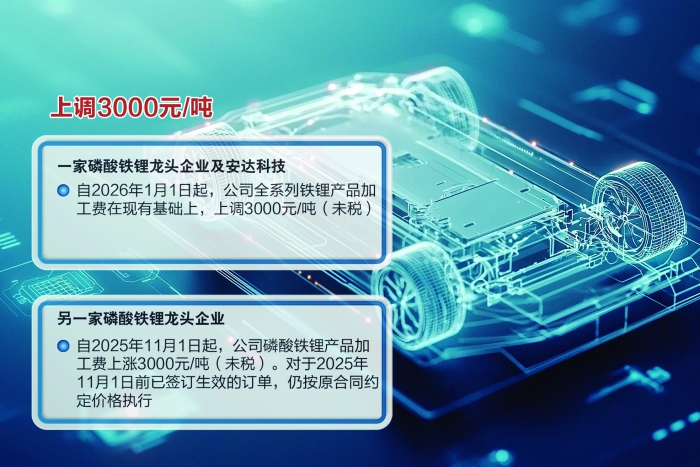
Core Viewpoint - Leading lithium iron phosphate (LFP) companies are seeking price increases due to rising costs and supply-demand imbalances in the industry [2][3][4] Price Adjustments - A leading LFP company announced a price increase of 3000 yuan/ton (excluding tax) for all its LFP products starting January 1, 2026 [2][3] - Another company implemented a price increase of 3000 yuan/ton (excluding tax) for its LFP products effective November 1, 2025, with existing contracts honored at previous prices [3] - The fluctuation in lithium carbonate prices, a key raw material for LFP, is directly impacting the sales prices of LFP products [3] Supply and Demand Dynamics - The LFP market is experiencing a supply shortage, with effective production capacity utilization exceeding 95% [4] - Some leading companies reported operating rates above 100% in the first three quarters, but supply has been insufficient since September [4] - The average debt ratio in the industry is around 67%, indicating significant financial pressure for expansion and supply maintenance [4] Industry Initiatives - The China Chemical and Physical Power Industry Association is advocating for a reconstruction of market pricing logic to curb "involution" and unhealthy competition [4][5] - The association's recent seminar revealed that the average cost of LFP materials ranges from 15,714.8 yuan/ton to 16,439.3 yuan/ton (excluding tax) [4] Shift in Competitive Strategy - Industry experts suggest a transition from "scale competition" to "quality competition" as a necessary step for sustainable development [5] - Companies are responding to market conditions by negotiating prices with clients, aiming to improve profitability and product competitiveness [5][6] Market Trends - The demand for LFP products is surging, particularly in the energy storage and electric vehicle sectors, with LFP batteries accounting for 81.5% of the power battery market in the first three quarters of the year [6][7] - The market share of Chinese companies in the global LFP supply chain is approximately 95% [7] Future Outlook - The LFP industry is expected to face structural challenges, with high-end capacity being scarce while low-end, outdated capacities may be phased out [8]

从“规模竞争”向“质量竞争”跨越 磷酸铁锂龙头企业纷纷提价
Shang Hai Zheng Quan Bao· 2025-12-02 18:09
Core Viewpoint - Recent price increase demands from leading lithium iron phosphate (LFP) companies indicate a shift towards rational pricing in the industry, driven by rising raw material costs and supply-demand imbalances [2][4][5]. Price Adjustments - Leading LFP companies are implementing price increases, with one company announcing a processing fee hike of 3000 yuan/ton (excluding tax) starting January 1, 2026 [2]. - Another company raised its processing fee by the same amount effective November 1, 2025, while existing contracts will maintain original pricing [3]. Raw Material Influence - The price of lithium carbonate, a key raw material for LFP, is currently on the rise, impacting the sales prices of LFP products [3]. - The fluctuation in lithium carbonate prices directly affects the revenue of LFP companies, depending on their ability to pass costs onto downstream customers [3]. Supply-Demand Dynamics - The LFP market is experiencing a tightening supply situation, with effective production capacity utilization exceeding 95% due to surging demand from the electric vehicle and energy storage sectors [4][6]. - Despite high operational rates, there has been a significant supply shortage since September, compounded by an average industry debt ratio of 67% [4][7]. Industry Initiatives - The industry is responding to calls for "anti-involution" measures, aiming to establish a healthier pricing logic based on cost indices to curb destructive price competition [4][5]. - The China Chemical and Physical Power Industry Association has urged LFP companies to avoid pricing below cost to prevent harmful low-price competition [4]. Market Trends - The demand for LFP products is increasing, particularly in the energy storage and power markets, driven by policy support and new market scenarios [6]. - LFP batteries accounted for 81.5% of the power battery installation volume in the first three quarters of this year, reflecting a 62.7% year-on-year growth [6]. Production Capacity Insights - By 2024, domestic LFP production capacity is expected to approach 4.7 million tons, with an actual output of over 2.3 million tons, resulting in a capacity utilization rate of about 50% [7]. - The price of LFP materials has seen a dramatic decline from 173,000 yuan/ton at the end of 2022 to 34,000 yuan/ton by August 2025, marking an 80.2% drop [7]. Future Outlook - The LFP industry faces structural overcapacity, with a potential for accelerated elimination of low-end, outdated production capacities, leading to a competitive landscape favoring high-quality producers [8].
A股轮动频繁 医药商业板块表现强势
Qi Huo Ri Bao· 2025-12-02 14:57
Group 1: Market Performance - The A-share market experienced rapid rotation of hot themes, with the Shanghai Composite Index down 0.42%, the Shenzhen Component Index down 0.68%, and the ChiNext Index down 0.69% at the close [1] - The total market turnover reached 1,607.3 billion [1] Group 2: Sector Performance - The pharmaceutical commercial sector showed strong performance, ranking first in the increase of sector shares, with Haiwang Biological achieving a "five consecutive limit-up" and over 290,000 sealed orders remaining at the limit-up price [1] - The Fujian sector also performed well, with stocks like Jiarong Technology and Haixin Food hitting limit-up prices [1] - Energy metals and film industry sectors, which performed well previously, experienced adjustments [1] Group 3: Market Outlook - The market is expected to remain in a phase of frequent style switching in December, primarily characterized by structural trends [1] - Key areas for potential deployment include technological innovation, domestic demand expansion, anti-involution, and stabilizing the real estate sector, with industry meetings likely to catalyze thematic trends [1] - External uncertainties, particularly the potential impact of the upcoming Federal Reserve meeting on global market liquidity, are also highlighted [1] Group 4: Health Sector Insights - The China CDC reported that the flu positivity rate among emergency and outpatient cases is close to 45%, indicating a rapid increase in flu cases, with some provinces reaching high epidemic levels [2] - According to Everbright Securities, the demand for cold medicines in Q4 is expected to exceed market expectations due to the rising trend of flu cases [2] - The introduction of multi-pathogen detection products and convenient diagnostic tools is anticipated to support the performance of related pharmaceutical companies [2]


开源晨会-20251202
KAIYUAN SECURITIES· 2025-12-02 14:43
Group 1: Macro Economic Outlook - The "14th Five-Year Plan" emphasizes three key points: continuity, technological strength, and expanding domestic demand [5][6] - The GDP growth target for 2026 is projected at around 5%, with an average annual growth rate of 4.17% needed over the next decade to meet the 2035 goals [5][6] - The macroeconomic policy is expected to be more proactive, with potential interest rate cuts and an expansion of the broad deficit [9][10] Group 2: Supply and Demand Dynamics - On the supply side, there is a focus on enhancing service supply to stimulate consumption, with a service trade restrictiveness index of 0.225, higher than the OECD average of 0.19 [6] - The demand side anticipates limited recovery in fixed asset investment, with manufacturing investment supported by equipment updates, while real estate investment is expected to narrow its decline [7][8] - CPI is projected to rise by approximately 0.7% in 2026, while PPI could range from -0.7% to 0.5% depending on various scenarios [8] Group 3: Manufacturing and PMI Insights - The manufacturing PMI for November 2025 is reported at 49.2%, indicating a slight recovery but still in the contraction zone [14][15] - The service sector PMI has dropped to 49.5%, reflecting a contraction influenced by seasonal factors and consumer behavior [16] - High-tech manufacturing continues to expand, with a PMI of 50.1%, while the overall manufacturing sector remains under pressure [17] Group 4: Financial Market Perspectives - The bond market is expected to see a slight upward trend in yields due to revised economic expectations [19] - The Hong Kong stock market faced pressure in November 2025, with the Hang Seng Index declining by 0.2% and the Hang Seng Tech Index dropping by 5.2% [21][22] - The CCASS selected 20 portfolio achieved a historical high in excess returns, with a 0.13% return in November compared to a -0.18% return for the Hang Seng Index [27][28]
苦熬三年 磷酸铁锂涨价已势不可挡?行业协会发起“反内卷”倡议 巨头集体涨加工费
Mei Ri Jing Ji Xin Wen· 2025-12-02 14:37
Core Viewpoint - The price increase of lithium iron phosphate (LFP) cathodes is driven by strong demand in the energy storage sector and the need for manufacturers to alleviate financial pressures, with major producers planning to raise processing fees by 3,000 yuan per ton starting in 2026 [1][2][10]. Group 1: Price Increase and Market Dynamics - Major LFP manufacturers are set to increase processing fees due to a combination of high demand and the need to address financial losses, with LFP cathodes accounting for over 40% of battery costs [1][10]. - Since November, LFP prices have been rising, primarily due to increased material costs, but the current price hike is more about manufacturers' financial recovery [1][2]. - The overall capacity utilization in the LFP industry is high, with leading manufacturers operating at 110% capacity, indicating a strong demand environment [3][4]. Group 2: Industry Challenges and Financial Health - The LFP industry has faced three years of poor performance, with many top manufacturers experiencing high debt levels and losses, making the current price increase necessary for sustainability [2][6]. - For instance, De Fang Nano reported significant losses in 2023 and 2024, highlighting the financial struggles within the industry [2]. - The industry association has called for a halt to irrational low-price competition, emphasizing the need for sustainable and high-quality development [5][10]. Group 3: Competitive Landscape and Future Outlook - The LFP market is increasingly competitive, with foreign manufacturers like LG Energy, Samsung SDI, and SK On ramping up investments in LFP technology, posing a potential threat to Chinese dominance [5][6]. - The association's cost research indicates that the average cost of LFP materials ranges from 15,714.8 yuan to 16,439.3 yuan per ton, which will serve as a reference for pricing strategies [4][5]. - The limited expansion of LFP production capacity, coupled with rising raw material costs, suggests that the upward price trend may continue, impacting downstream sectors like electric vehicles and energy storage systems [7][9][10].
炼化反内卷,行业加速头部化
21世纪经济报道· 2025-12-02 13:18
Core Viewpoint - The refining and chemical industry in China is expected to experience a significant turnaround by the second half of 2025, driven by policy changes and the consolidation of advanced capacities [1]. Group 1: Industry Policy and Capacity Allocation - In late November, China issued early crude oil import quotas for 2026, with major private refining companies like Hengli Petrochemical receiving substantial allocations, indicating a shift towards advanced capacities [1]. - The early allocation of quotas in 2026 was concentrated among a few leading companies, contrasting with the previous year's distribution among numerous smaller enterprises, highlighting a trend towards industry consolidation [5]. - The Ministry of Industry and Information Technology (MIIT) has initiated measures to prevent excessive competition in the PTA and bottle-grade polyester slice industries, signaling a favorable environment for leading firms while challenging smaller players [2]. Group 2: Industry Overcapacity and Structural Changes - The PTA industry has shifted from meeting domestic demand to facing overcapacity, prompting regulatory bodies to implement measures to address this issue, including energy consumption limits for refining and chemical processes [3]. - The implementation of energy consumption limits is expected to accelerate the exit of outdated and smaller production capacities from the market, thereby improving the overall industry structure [3]. - The recent policies aim to guide the planning and layout of major petrochemical projects, controlling new refining capacities and preventing overcapacity risks in related sectors [5]. Group 3: Market Dynamics and Economic Context - The global economic downturn since 2022 has impacted demand in the polyester industry, which is closely tied to macroeconomic conditions, leading to a phase of inventory competition [2]. - The refining industry is witnessing a clear pyramid structure, where the elimination of outdated capacities can be targeted effectively, contrasting with slower clearing processes in other sectors like solar and lithium [5]. - The geopolitical landscape has also influenced energy storage demands, reducing cost pressures on the refining industry and enhancing expectations for a market turnaround [6]. Group 4: Investment Trends and Future Outlook - As of mid-2025, the construction projects in the basic chemical sector have seen a decline in investment, indicating a potential end to the capital expenditure cycle and a gradual recovery in supply dynamics [7]. - The overall profit levels in the chemical industry remain low, prompting companies to seek improvements in competitive dynamics to achieve normal profitability levels amid the ongoing "anti-involution" trend [7].


内需外需均有改善,11月制造业PMI回升至49.2%
Hua Xia Shi Bao· 2025-12-02 12:36
Core Viewpoint - The manufacturing Purchasing Managers' Index (PMI) in November shows a slight recovery to 49.2%, indicating improvements in both domestic and overseas demand, although it remains in a contraction zone for the eighth consecutive month [2][5]. Economic Indicators - The November PMI reflects improvements in 11 sub-indices, including new orders and production expectations, with a composite PMI output index at 49.7%, suggesting overall economic stability [2][5]. - The new orders index increased by 0.4 percentage points to 49.2%, while the production index rose to the critical point of 50.0%, indicating a return to expansion after a contraction [5][6]. Policy Impact - Recent government policies, including the introduction of 500 billion yuan in new policy financial tools and an additional 500 billion yuan in special bonds, are expected to stimulate domestic market demand and infrastructure investment [5][8]. - The positive outcomes from recent US-China trade talks have also contributed to a marginal increase in export orders, with the new export orders index rising by 1.7 percentage points to 47.6%, marking the largest increase in six months [5][6]. Sector Performance - High-tech manufacturing sectors continue to show strong demand, with their PMIs remaining above the critical point for ten consecutive months, while traditional energy-intensive industries are still in contraction [6]. - Specific industries such as agricultural processing and non-ferrous metal smelting are experiencing active demand, whereas sectors like petroleum and chemical manufacturing are lagging [6][7]. Price Trends - The main raw material price index rose by 1.1 percentage points to 53.6%, indicating ongoing expansion since the implementation of "anti-involution" policies [7]. - The Producer Price Index (PPI) is expected to see a slight month-on-month increase, although year-on-year comparisons may still reflect a decline due to higher base effects from the previous year [7][8]. Future Outlook - The construction PMI is anticipated to rise into the expansion zone as the effects of the new policy financial tools and special bonds materialize [8]. - The overall industrial product prices remain subdued, influenced by weak consumer demand and declining real estate investments, with the long-term effects of "anti-involution" policies on prices still under observation [8].

炼化反内卷,行业加速头部化
2 1 Shi Ji Jing Ji Bao Dao· 2025-12-02 12:05
Core Viewpoint - The refining industry in China is expected to experience a significant turnaround by the second half of 2025, driven by policy changes and the concentration of production capacity among leading enterprises [1]. Group 1: Industry Developments - In late November, China issued early crude oil import quotas for 2026, with major private refining companies like Hengli Petrochemical, Rongsheng Petrochemical, and Dongfang Shenghong receiving substantial allocations [1]. - The early batch of quotas for 2026 was notably concentrated among a few leading companies, contrasting with the more fragmented distribution seen in 2025, indicating a shift towards advanced capacity and industry consolidation [1][6]. - The Ministry of Industry and Information Technology (MIIT) and industry associations have implemented policies to promote a trend of "anti-involution" in the refining sector, aiming to streamline operations and enhance efficiency [1][3]. Group 2: Policy Measures - A meeting organized by MIIT on October 29 focused on preventing excessive competition in the PTA and bottle-grade polyester slice industries, with major private enterprises required to submit data on production capacity and measures to avoid industry involution [3]. - Legal measures, including energy consumption limits for refining processes, have been introduced to address overcapacity and losses in the industry, with expectations that these will accelerate the exit of outdated and smaller-scale production facilities [4][5]. Group 3: Market Dynamics - The global economic downturn since 2022 has impacted demand in the polyester sector, which is closely tied to macroeconomic conditions, leading to a phase of inventory competition [3]. - The geopolitical landscape has influenced energy storage demands, reducing cost pressures on the refining industry and enhancing expectations for a market reversal [8]. - The overall investment in the chemical raw materials and products manufacturing sector has declined, indicating a nearing end to the capital expenditure cycle and a gradual recovery in supply dynamics [8].
专访联博基金投资总监朱良:国际资本转向“结构性配置”中国资产
2 1 Shi Ji Jing Ji Bao Dao· 2025-12-02 11:17
今年11月,联博基金在中国市场推出了首只运用指数增强型策略的权益类基金——联博中证500指数增 强型证券投资基金。对此,朱良分析称,中证500指数凭借其与新质生产力相匹配的行业结构、充满活 力的民营经济成分、坚实的制造业基础以及合理的估值水平,展现出较强的配置价值。 对于未来中国市场的机遇,朱良青睐那些能够将技术优势转化为长期盈利能力和现金流创造力的硬科技 企业,受益于"反内卷"政策的行业、高股息权益资产、新消费企业也值得密切关注。 南方财经 21世纪经济报道记者吴斌 上海报道 迈向不确定性时代,中国资产备受青睐。 联博基金副总经理兼投资总监朱良近日在接受21世纪经济报道记者专访时表示,在当前低利率与高不确 定性的全球背景下,中国资产已成为国际资金进行风险分散、寻求增长新动能的重要选择之一。全球主 要投资机构提升中国仓位,标志着国际资本对中国资产的认知正在发生深刻转变,逐渐转向长期的"结 构性配置"。 中国资产价值重估方兴未艾。在朱良看来,资金需要寻找新的配置方向。在政策提振信心和资本市场制 度不断完善的双重助力下,A股市场自然成为投资者的重要选择,"存款搬家"现象也印证了A股市场正 成为资金关注的重要领域。 ...
港股 12 月投资策略:11 月的回调为 2026 年赢得确定空间
Guoxin Securities· 2025-12-02 11:07
Group 1 - The report emphasizes that the adjustment in the Hong Kong stock market in November has created space for growth in 2026, with a focus on sectors such as AI, materials, and innovative pharmaceuticals [2][64][82] - The report highlights the importance of AI in driving productivity improvements across industries, particularly in the software sector, where per capita income has increased from 750,000 to 870,000 yuan over the past five years [1][59][61] - The report notes that the "anti-involution" trend is expected to positively impact PPI recovery and overall corporate profitability, with a significant reduction in losses for struggling companies [1][55][58] Group 2 - The report suggests that the AI sector remains a key focus for 2026, driven by the need for domestic hardware production and the expectation of more AI applications being implemented [2][82] - The materials and industrial sectors are expected to benefit from the anti-involution trend, with upstream metals and certain industrial enterprises poised to gain [2][82] - The report indicates that the innovative pharmaceutical sector is stable and worth holding, with potential for growth if new business development projects are released [2][82] Group 3 - The report discusses the performance of the Hong Kong stock market in November, noting a slight adjustment of 0.2% in the Hang Seng Index, with significant sector differentiation [64][66] - It highlights that the consumer and innovative pharmaceutical sectors showed positive performance, while technology and automotive sectors faced declines [64][66] - The report mentions that the inflow of southbound funds reached 117.2 billion yuan in November, indicating strong willingness from Chinese capital to invest in Hong Kong stocks despite market downturns [75][82]