
货币政策

Search documents
明年将根据形势出台实施增量政策
Zhong Guo Zheng Quan Bao· 2025-12-14 20:19
在财政政策方面,韩文秀表示,要继续实施更加积极的财政政策。要保持必要的财政赤字、债务总规模 和支出总量。要建立健全增收节支机制,增强地方自主财力,兜牢基层"三保"底线。要优化支出结构, 强化国家重大战略的财力保障,推动更多资金资源投资于人,统筹用好政府债券资金,更加注重惠民 生、扩内需、增后劲。要主动靠前发力,提高资金使用效率,推动尽快形成实际支出和实物工作量。 在货币政策方面,韩文秀表示,要继续实施适度宽松的货币政策。要灵活搭配、高效运用降准降息等多 种政策工具,保持流动性充裕,促进社会综合融资成本低位运行,使社会融资规模、货币供应量增长同 经济增长、物价总水平预期目标相匹配。要着力畅通货币政策传导机制,做好科技金融、绿色金融、普 惠金融、养老金融、数字金融五篇大文章,加力支持扩大内需、科技创新、中小微企业等重点领域,提 升金融服务实体经济的质效,保持人民币汇率在合理均衡水平上的基本稳定。 对于中央经济工作会议部署的"坚持内需主导,建设强大国内市场",韩文秀表示,下一步,要深入实施 提振消费专项行动,制定实施城乡居民增收计划,继续提高城乡居民基础养老金,要以新需求引领新供 给,以新供给创造新需求。适应消费结 ...
11月社融、M2增速维持高位
Bei Jing Shang Bao· 2025-12-14 15:39
新增信贷方面,数据显示,前11个月人民币贷款增加15.36万亿元。分部门看,住户贷款增加5333亿 元,其中,短期贷款减少7328亿元,中长期贷款增加1.27万亿元;企(事)业单位贷款增加14.4万亿 元,其中,短期贷款增加4.44万亿元,中长期贷款增加8.49万亿元,票据融资增加1.31万亿元;非银行 业金融机构贷款减少332亿元。 综合人民银行此前披露的数据,北京商报记者进一步统计发现,11月单月,人民币贷款增加3900亿元, 同比少增1883亿元。分项来看,11月企业贷款增加6100亿元,同比多增3600亿元,其中企业短期贷款增 加1000亿元,同比多增1100亿元,企业中长贷增加1700亿元,同比减少400亿元。 另在居民贷款方面,11月住户贷款减少2063亿元,同比多减4763亿元,环比增加1541亿元。其中,居民 短贷减少2158亿元,同比多减1788亿元,环比增加708亿元;居民中长贷增加100亿元,同比多减2900亿 元,环比增加800亿元。 11月金融数据出炉。12月12日,人民银行发布2025年11月金融统计数据报告。数据显示,2025年前11个 月,人民币贷款增加15.36万亿元;社会融 ...
11月末社融存量同比增长8.5%
Mei Ri Jing Ji Xin Wen· 2025-12-14 13:56
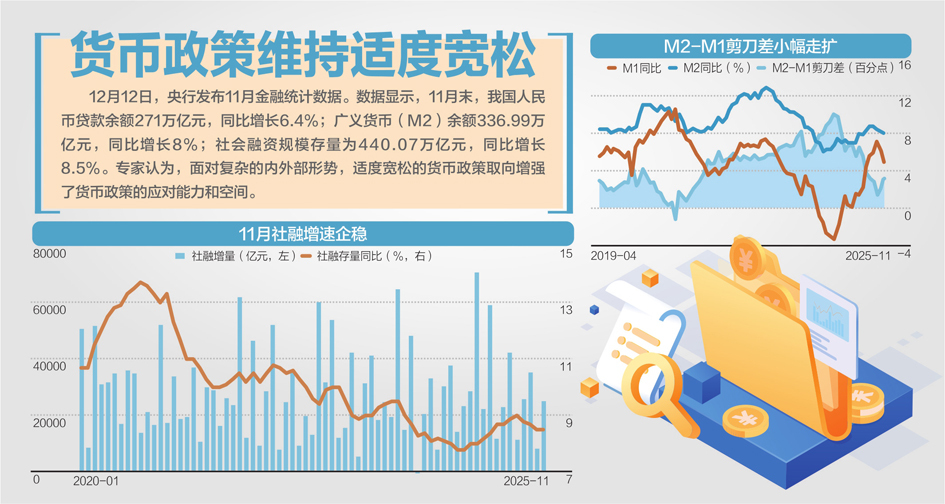
Group 1 - The core viewpoint of the article highlights the current state of China's financial statistics, indicating a stable growth in social financing and monetary supply, which supports economic development [1][3][7] - As of November 2025, the total social financing scale reached 440.07 trillion yuan, with a year-on-year growth of 8.5% [1][7] - The broad money (M2) balance stood at 336.99 trillion yuan, reflecting a year-on-year increase of 8%, which is 0.9 percentage points higher than the same period last year [3] Group 2 - In the first eleven months of the year, the increase in social financing was 33.39 trillion yuan, which is 3.99 trillion yuan more than the previous year [7] - The total amount of new government debt this year reached 1.186 trillion yuan, an increase of 290 billion yuan compared to last year, leading to a higher proportion of government bonds in the social financing scale [1] - The growth rate of loans has slightly decreased, with a total increase of 15.36 trillion yuan in RMB loans for the first eleven months, and a month-on-month increase of 390 billion yuan in November [4][6] Group 3 - The balance of RMB loans to the real economy accounted for 60.8% of the total social financing scale, which is a decrease of 1.3 percentage points year-on-year [5] - Experts indicate that the decline in loan growth reflects the transition of economic drivers from traditional investment to consumption, with reduced reliance on bank loans for new growth points [6] - The financial institutions' loan write-offs exceeded 1 trillion yuan this year, which also contributed to the downward pressure on loan growth, although these funds continue to support the real economy [4][6] Group 4 - The article emphasizes the need for a scientific and robust monetary policy framework, focusing on optimizing the mechanisms for basic currency issuance and maintaining reasonable growth in financial totals [8][10] - It suggests that a market-oriented approach should guide financial institutions in optimizing their financing structures, enhancing the quality and efficiency of financial services to the real economy [10] - Recent innovations in monetary policy tools, such as including government bond trading in the monetary policy toolbox, are expected to improve liquidity management in the financial system [10]

中央经济工作会议首提“新的认识”
Mei Ri Jing Ji Xin Wen· 2025-12-14 12:58
在具体行文中也有不少变化。例如:货币政策方面,从去年的"发挥好货币政策工具总量和结构双重功 能",调整为"把促进经济稳定增长、物价合理回升作为货币政策的重要考量";在消费能力方面,从去 年的"推动中低收入群体增收减负",转变为明确提出要"制定实施城乡居民增收计划";教育领域,新增 强调"增加普通高中学位供给";房地产领域,在控增量、去库存基础上,强调"优供给,鼓励收购存量 商品房重点用于保障性住房等";服务业方面,强调"制定服务业扩能提质行动方案"。 新的认识"新"在哪里? 与以往强调规律性认识不同,本次会议提出,"通过实践,我们对做好新形势下经济工作又有了新的认 识和体会"。 会议提及的认识"新"在哪里?对明年开展经济工作将有什么指导意义?会议强调必须充分挖掘经济潜 能,我国在哪些领域存在经济潜能? 中国建投投资研究院主任、研究员张志前在接受每经记者书面采访时表示,面对复杂的外部环境和内部 困难,在推动我国经济继续稳步发展的过程中,对这些规律有了新的认识和更加深切的体会,同时也发 现和提炼出了新的规律性东西。比如投资于物和投资于人要紧密结合,这是对投资理念、方向、重点的 提升和优化,对于实现经济质的提升和量 ...
流动性与机构行为周度跟踪251212:如何理解中央经济工作会议的货币政策基调-20251214
Huafu Securities· 2025-12-14 12:10
1. Report Industry Investment Rating - Not provided in the document 2. Core View of the Report - The central economic work conference shows increased confidence in the economy and a shift towards high - quality development. Fiscal and monetary policies will continue the 2024 tone. The 2026 deficit rate may remain at 4%, and government bond supply may only slightly increase. The central bank is cautious about the timing of interest rate cuts, and the implementation of reserve requirement ratio and interest rate cuts may require a change in the policy's perception of the fundamentals. If credit expansion is lower than expected, there may be an adjustment in policy orientation in Q1. The current bond market reaction is less active than in 2023, and the performance of the A - share market is also worthy of further observation. The year - end liquidity is expected to remain loose [4][5][31] 3. Summary by Relevant Catalogs 3.1 1.1 This Week's Fundamentals Review - The central bank's 7 - day reverse repurchase had a net injection of 4.7 billion yuan this week, with limited impact. Due to low initial - month capital demand and reduced government bond payment pressure, funds remained loose. The overnight anonymous lower limit dropped to 1.25%, and DR001 fell below 1.30% after Tuesday and continued to decline, reaching 1.27% on Friday, a new low since August 2023. The central bank will conduct a 600 - billion - yuan 6 - month repurchase operation on the 15th, with a net injection of 200 billion yuan [2][17] - The trading volume of pledged repurchase continued to rise, with the daily average volume increasing by 150 billion yuan to 8.08 trillion yuan compared to last week, reaching a new high since July. Banks' net lending increased compared to last week, with joint - stock banks having the largest increase; non - bank institutions' rigid borrowing scale continued to rise, with funds having the largest increase. The capital gap index fluctuated and declined, reaching - 716.3 billion yuan on Friday, lower than - 470.8 billion yuan last Friday [3][23] 3.2 1.2 Next Week's Fund Outlook - The scale of next week's 7 - day reverse repurchase maturity will slightly increase from 663.8 billion yuan to 668.5 billion yuan. The net payment scale of government bonds will drop from 14.8 billion yuan this week to - 3.9 billion yuan, mainly concentrated in the second half of the week, but the overall scale is relatively limited. On the 15th, the central bank will conduct a 600 - billion - yuan 6 - month repurchase operation, with a net injection of 200 billion yuan. The online issuance of Beijie Stock Exchange's new stock Jiangtian Technology on the 16th may disrupt the exchange's capital prices from Tuesday to Wednesday. The DR001 is expected to remain in the range of 1.3% - 1.4% and may slightly decline, and there may be some fluctuations in the second half of the month, but the year - end liquidity is expected to remain loose [10][68] - The scale of next week's national debt payment is about 304 billion yuan, and the local debt issuance scale of 6 regions is 40 billion yuan, with an actual payment scale of 56.3 billion yuan. The net payment scale of government bonds will drop to - 3.9 billion yuan. It is estimated that the national debt issuance scale in December will be about 1.8 trillion yuan and the net financing scale will be about 320 billion yuan; the local debt issuance scale will be about 350 billion yuan and the net financing scale will be about 230 billion yuan. The overall government bond issuance scale in December is expected to be about 2.15 trillion yuan, and the net financing will be about 54 billion yuan [6][58] 3.3 2. Inter - bank Certificates of Deposit - The 1 - year Shibor rate rose 0.1BP to 1.65% compared to December 5th. The secondary rate of 1 - year AAA - rated inter - bank certificates of deposit rose 0.5BP to 1.66% compared to last week [69] - This week, the increase in the issuance scale of inter - bank certificates of deposit was less than the maturity scale, and they turned to a net repayment of 119.6 billion yuan, a decrease of 128.9 billion yuan compared to last week. The net financing scales of state - owned banks, rural commercial banks, city commercial banks, and joint - stock banks were - 16.2 billion yuan, - 18.3 billion yuan, 3.4 billion yuan, and - 68.5 billion yuan respectively. The issuance proportion of 6 - month certificates of deposit was the highest at 43%, and the issuance proportion of 1 - year certificates of deposit decreased from 22% to 15%. The maturity scale of certificates of deposit next week is about 1.0648 trillion yuan, an increase of 3.4 billion yuan compared to this week [11][74] - The issuance success rates of state - owned banks, joint - stock banks, and city commercial banks increased compared to last week, while that of rural commercial banks decreased, and all banks were near the average level in recent years. The issuance spread of 1 - year certificates of deposit between city commercial banks and joint - stock banks narrowed. The relative supply - demand strength index of certificates of deposit fluctuated upward, mainly due to the significant increase in the willingness of money market funds to increase holdings. The index rose to 33.7% on Friday, an increase of 5.2 percentage points compared to last week. The supply - demand index of 1 - year varieties decreased, while those of other maturities increased [11][86] 3.4 3. Bill Market - Bill rates continued to rise after Wednesday. As of December 12th, the rates of 3 - month and 6 - month national bills rose 3BP and 9BP respectively compared to December 5th, reaching 0.45% and 0.90% [94] 3.5 4. Bond Trading Sentiment Tracking - The bond market fluctuated strongly this week, and the credit and perpetual bond spreads were generally stable. The willingness of large banks to increase bond holdings increased, especially for inter - bank certificates of deposit, short - term national bonds, and short - term policy financial bonds. Trading institutions tended to increase bond holdings, while the willingness of allocation institutions to increase bond holdings decreased significantly [12][96]
宏观政策“组合拳”协同发力 激活经济社会发展动能
Yang Shi Wang· 2025-12-14 12:02
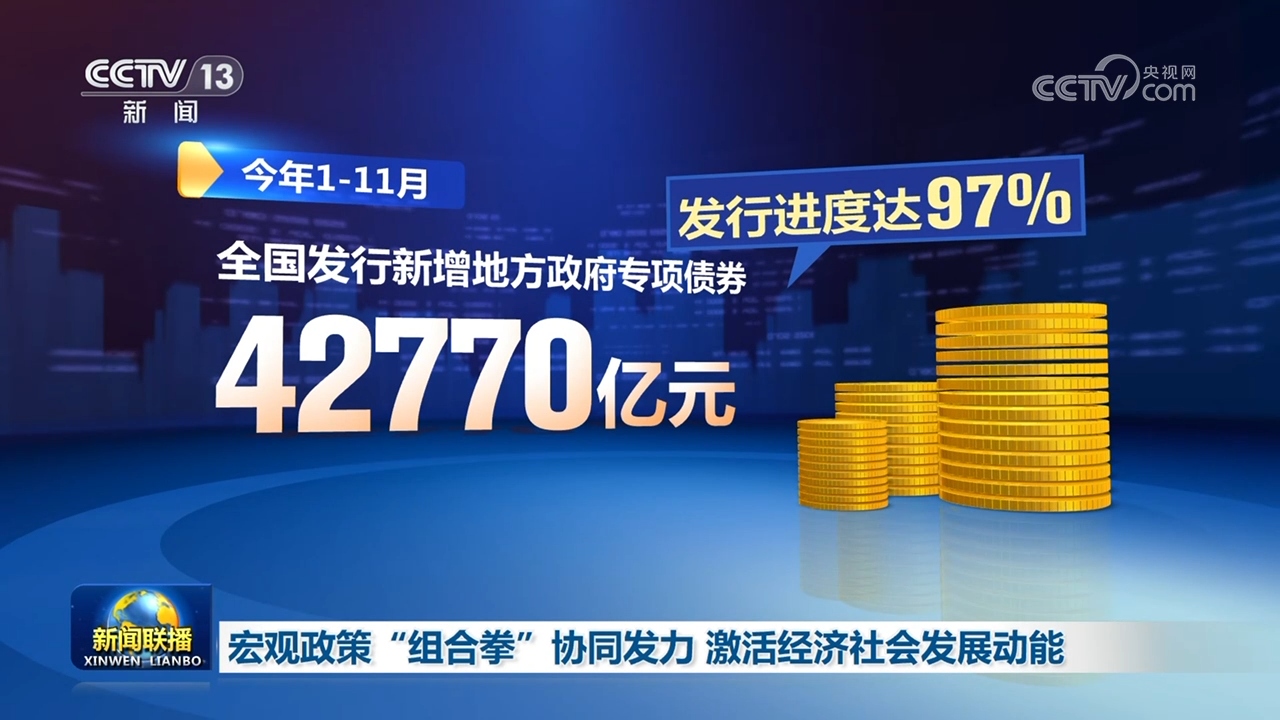
Group 1 - The Ministry of Finance reported that from January to November, a total of 42,770 billion yuan of new local government special bonds were issued, achieving a progress rate of 97%, effectively supporting the acceleration of construction projects across various regions [1] - The issuance of ultra-long-term special government bonds was completed in October, one month ahead of last year, providing timely support for the accelerated development of major infrastructure and livelihood projects [1] Group 2 - Fiscal policy has become more proactive this year, with direct benefits to individuals through subsidies for childcare, elderly services, and personal consumption loan interest [3] - In the first ten months, expenditures in science and technology, social security and employment, and energy conservation and environmental protection all increased by over 5% year-on-year, ensuring strong support for key areas [3] Group 3 - Monetary policy remains moderately loose, with new corporate loans and personal housing loan rates in November decreasing by approximately 30 basis points and 3 basis points year-on-year, respectively, while the overall financing costs remain low [5] - Structural monetary policy tools have been implemented rapidly, with 500 billion yuan of new policy-based financial instruments fully deployed, focusing on supporting over 2,300 projects in the digital economy and artificial intelligence [5] Group 4 - This year, policies in fiscal, monetary, employment, industry, technology, and environmental sectors have formed a synergistic effect, enhancing macroeconomic regulation and continuously activating the internal driving force of the economy [6]
爆料!下任美联储主席“头号候选人”,是他→
Sou Hu Cai Jing· 2025-12-14 11:19
Core Viewpoint - Kevin Warsh has emerged as the leading candidate for the next Federal Reserve Chair, with support from Trump and Jamie Dimon, increasing his nomination probability to 41% [1][5]. Group 1: Candidate Support and Probabilities - Trump stated that Warsh aligns with his views on monetary policy, particularly regarding interest rate cuts [3]. - Jamie Dimon, CEO of JPMorgan Chase, expressed strong support for Warsh, calling him a "great Federal Reserve Chair" [7]. - The probability of Kevin Hassett's nomination has decreased from approximately 71% to 52%, while Warsh's has risen to 41% [5]. Group 2: Background of Kevin Warsh - Warsh, 55, is currently a visiting scholar at Stanford University and has a background in investment banking at Morgan Stanley [9]. - He served as the Executive Secretary of the White House National Economic Council from 2002 to 2006 and was a Federal Reserve Governor from 2006 to 2011 [9]. - Warsh previously interviewed for the Federal Reserve Chair position during Trump's first term but was ultimately not selected [9].

流动性与同业存单跟踪:从央行党委学习会议通稿看2026年货币政策细微变化
ZHESHANG SECURITIES· 2025-12-14 11:09
Report Industry Investment Rating - Not provided in the report Core View - The market generally focuses on the changes in the description of monetary policy in the Central Economic Work Conference. The meeting minutes of the People's Bank of China Party Committee's study and implementation of the Central Economic Work Conference spirit are equally important, reflecting the central bank's specific thinking on monetary policy in 2026 [1]. Summary by Directory 1. From the Meeting Minutes of the Central Bank Party Committee's Study to See Subtle Changes in Monetary Policy in 2026 - The Central Economic Work Conference is an important institutional arrangement for the Party to govern the country. After the conference, various systems and ministries will convey, study, and deploy specific work for 2026. The People's Bank of China Party Committee will also study and clarify implementation measures [1][12]. - Comparing the 2025 and 2024 meeting minutes, four main changes were found: adding "grasp the intensity, rhythm, and timing of policy implementation", which may indicate a more moderate loose - monetary - policy; changing the description of social comprehensive financing costs from "stable and gradually decreasing" in 2024 to "operating at a low level" in 2025; making the description of the RMB exchange rate more concise, showing confidence in the recent appreciation trend of the RMB; and continuing to emphasize "coordination with fiscal policy" [2][12][13]. 2. Narrow - Sense Liquidity 2.1 Central Bank Operations - Short - term liquidity: In the past week (12/8 - 12/12), the central bank's net reverse - repurchase injection was 4.7 billion yuan. As of December 12, the central bank's reverse - repurchase balance was 668.5 billion yuan, at a relatively low level [15]. - Medium - term liquidity: In December, the due amount of the central bank's outright reverse - repurchase was 140 billion yuan (including 100 billion yuan for the 3 - month and 40 billion yuan for the 6 - month). On December 5, the central bank renewed the 3 - month outright reverse - repurchase of 100 billion yuan. On December 15, it will renew the 6 - month outright reverse - repurchase of 60 billion yuan, with a net injection of 20 billion yuan [16]. 2.2 Institutional Fund Inflow and Outflow: Large Banks' Net Outflow Reaches a New High - Fund supply: On December 12, large banks' net fund outflow was 4.2 trillion yuan (flow concept), up about 100.2 billion yuan from December 5. The net outflow balance was 4.8 trillion yuan, up about 130.2 billion yuan. The net outflow balance of money funds was 1.1 trillion yuan, down about 117.7 billion yuan from December 5. The net outflow of joint - stock banks was 28.96 billion yuan, up about 285.5 billion yuan from December 5 [18]. - Fund demand: On December 12, the balance of repurchase - to - be - bought bonds in the inter - bank market was about 12.4 trillion yuan, up 646.7 billion yuan from December 5. The leverage ratio of the whole market was 107%, up 0.40 pct from December 5, and the leverage ratio of non - legal person products was 112%, up 1.17 pct from December 5 [29]. 2.3 Repurchase Market Transaction Situation: Low Liquidity Friction - Fund volume and price: In the past week, the inter - bank pledged repurchase market had a large volume and stable prices. The median daily trading volume was about 8.1 trillion yuan, up 203.9 billion yuan from December 1 - 5. The median of R001 was 1.35%, down 1bp from last week. The median spread of R001 - DR001 was 7.0bp, up 0.6bp from last week, and the median spread of GC001 - R001 was 7.2bp, up 0.8bp from last week [32]. - Fund sentiment index: The overall fund situation was loose, and the financing difficulty was low. The sentiment index was mostly below 50 [36]. 2.4 Interest Rate Swaps: Basically Flat - The 1 - year FR007 IRS interest rate was basically the same as last week. This week, the median of the 1 - year FR007 IRS was 1.54%, at the 11% quantile since 2020 [38]. 3. Government Bonds: The Net Payment Pressure of Government Bonds Will Decrease in the Next Week 3.1 Next Week's Net Payment of Government Bonds - In the past week, the net payment of government bonds was 14.8 billion yuan, with a relatively small pressure. Among them, the net repayment of treasury bonds was 69.7 billion yuan, and the net payment of local bonds was 84.5 billion yuan. In the next week, the government bonds are expected to have a net repayment of 83.9 billion yuan, including a net repayment of 119.3 billion yuan for treasury bonds and a net payment of 35.3 billion yuan for local bonds. The net repayment is highly concentrated on Monday [39]. 3.2 Current Issuance Progress of Government Bonds - As of December 12, the net financing progress of treasury bonds was 96.7%, up 0.5% in the past week, with about 221 billion yuan of remaining net financing space in 2025. Local bonds have basically completed issuance [43]. 4. Inter - Bank Certificates of Deposit: Yields Fluctuated Slightly Higher 4.1 Absolute Yields - On December 12, the SHIBOR overnight, 7 - day, 1M, 3M, 6M, 9M, and 1Y quotes were 1.28%, 1.45%, 1.53%, 1.59%, 1.62%, 1.64%, and 1.65% respectively. The yields of 1M, 3M, 6M, 9M, and 1Y inter - bank certificates of deposit of AAA - rated commercial banks were 1.62%, 1.62%, 1.64%, 1.65%, and 1.66% respectively. Except for the 1M term, which increased by 4bp compared with December 5, the quotes of other terms remained unchanged [46]. 4.2 Issuance and Stock Situation - In the past week (December 8 - 12), the total issuance of inter - bank certificates of deposit was 941.78 billion yuan. In terms of issuance terms, the proportions of 1M, 3M, 6M, 9M, and 1Y were 9%, 27%, 43%, 6%, and 15% respectively. Among them, the proportion of 3M increased by 15 pcts, while those of 1M, 6M, 9M, and 1Y decreased by 4 pcts, 1 pct, 2 pcts, and 7 pcts respectively [51]. 4.3 Relative Valuation - On December 12, the spread between the 1 - year AAA - rated inter - bank certificate of deposit yield and R007 was 15bp, at the 34% quantile since 2020. The spread between the 10 - year treasury bond yield and the 1 - year AAA - rated inter - bank certificate of deposit was 18bp, at the 40% quantile since 2020 [54].

快报!快报 日本突然宣布了
Sou Hu Cai Jing· 2025-12-14 11:02
快报!快报 日本突然宣布了 12月12日消息,下周四和周五(12月18日至19日),日本央行将召开年内最后一场货币政策会议。 目前,市场几乎已经认定 ——利率要从0.5%上调至0.75%,或许是"板上钉钉"的事。 植田和男行长早就放话了,说"实际借贷成本还是负的",意思就是虽然现在利率是0.5%,但实际 还是负利率,所以还得继续加。这可是日本近18年来少有的一次"断奶"! 为啥这么急?主要是日元太弱了,从年初142兑1美元,一路跌到157,创10个月来 的新低。日本90%的能源靠进口,日元贬值让能源进口成本暴涨28%,老百姓的菜篮子都涨了。 更有趣的是,这和美联储的行动完全相反。美联储12月10日 刚宣布降息25个基点,而日本却要加息,全球货币政策史上都少见。日本这次加息,不光是为了自己,还可能是为了稳住日元,避免进一步贬值。但问题来 了,日本政府债务占GDP的260%,全球第一,加息对政府压力太大了。 现在市场早不关心"会不会加",而是开始琢磨会"加几次"。 日本央行行长植田和男 说的"恰当判断",恐怕是这十几年来最艰难的一次判断了。说白了,日本经济这"老汉",是该站起来了,还是会被自己的债务压垮,就看下周 ...

国债期货周报-20251214
Guo Tai Jun An Qi Huo· 2025-12-14 10:48
Report Summary 1. Investment Rating No investment rating for the industry is provided in the report. 2. Core View - The short - end of the treasury bond futures market recovered this week, while the ultra - long end had a slight correction. The TL contract closed down on Friday after recovering on Wednesday and Thursday. The yield curve flattened. - The tone of monetary policy remains unchanged after the Central Economic Work Conference. It will still support the real economy and consumption and boost inflation in the future, possibly using both structural and aggregate tools. Although there is still room for reserve requirement ratio cuts and interest rate cuts, their impact on the bond market may be limited. - In the medium term, due to the relatively restrained monetary policy of the central bank, the change in inflation expectations, the orientation of medium - and long - term capital inflows, and the inability to falsify the 14th Five - Year Plan policy expectations, the overall view is that the market will fluctuate with a slightly bearish trend [1]. 3. Section Summaries 3.1. Weekly Focus and Market Tracking - The short - end of the treasury bond futures market recovered, and the ultra - long end had a slight correction. The TL contract closed down on Friday after recovering on Wednesday and Thursday, and the yield curve flattened. - The Central Economic Work Conference further clarified the direction and tasks of next year's economic work. Traditional growth - stabilizing areas released many growth - stabilizing signals, exceeding market expectations. It mentioned "flexibly and efficiently using reserve requirement ratio cuts and interest rate cuts" and required "maintaining ample liquidity", which is positive for macro - assets in terms of liquidity. - Fiscal policy requires "maintaining necessary fiscal deficits, total debt scale, and total expenditure". It is expected that the deficit ratio will remain stable next year, and the total deficit scale will continue to expand moderately, which will positively guide the market's total demand expectations. - The long - end of the treasury bond futures market led the rise, and the short - end followed. The spread between 30 - year and 10 - year treasury bonds has risen to a nearly two - year high, indicating the value of the ultra - long end. The logic of asset shortage, the easing of deflation pressure, and the loose tone of monetary policy provide medium - and long - term bottom support for the bond market, but attention should be paid to the impact of equity market fluctuations and policy implementation rhythm on the long - end [4][6]. 3.2. Liquidity Monitoring and Curve Tracking No specific content is provided in the given text, only a figure title is mentioned [8]. 3.3. Seat Analysis - In terms of the daily change of net long positions by institutional type: private funds decreased by 0.67%; foreign capital decreased by 0.61%, and wealth management subsidiaries decreased by 1.44%. - In terms of the weekly change: private funds decreased by 1.91%; foreign capital increased by 1.9%, and wealth management subsidiaries increased by 1.11% [10].