量化宽松

Search documents
加息即是“绝响”?周五之后,日本央行或长时间关闭紧缩大门
Xin Lang Cai Jing· 2025-12-18 09:09
Core Viewpoint - The Bank of Japan is expected to raise short-term interest rates to 0.75%, the highest level since 1995, amid pressures from market forces and political dynamics [1][8]. Group 1: Interest Rate Changes - The anticipated interest rate hike is a response to rising bond yields, which have reached an 18-year high due to actions by "bond vigilantes" [1][8]. - This will be the second rate increase this year, with a 25 basis point adjustment [1][8]. Group 2: Economic Context - The economic plan of Prime Minister Sanna Hayashi, known as "Hayashi Economics," relies heavily on low interest rates and increased deficit spending [1][8]. - Japan's economy contracted by 2.3% year-on-year in the third quarter, highlighting the challenges faced by the government and the central bank [4][11]. Group 3: Historical Precedents - The current situation mirrors past experiences under former Bank of Japan governors, particularly Toshihiko Fukui, who faced similar dilemmas and had to reverse rate hikes after economic downturns [2][9]. - The previous governor, Haruhiko Kuroda, left a challenging legacy for the current governor, Kazuo Ueda, who has been cautious in policy adjustments [3][11]. Group 4: Future Risks - There are concerns that if GDP growth stagnates further by 2026, Ueda may face significant political backlash, as central bank leaders often become scapegoats for economic issues [5][12]. - Geopolitical tensions, including trade wars and regional conflicts, pose additional risks to Japan's economic stability [6][12]. Group 5: Long-term Implications - Experts acknowledge that over 25 years of zero interest rates have hindered necessary economic reforms and innovation in Japan [13]. - The current economic strategy does not adequately address competitiveness or the need for structural changes in the labor market and corporate governance [13].
张津镭:多因素共振推升避险 黄金高位整理不改上行底色
Xin Lang Cai Jing· 2025-12-18 05:42
Core Viewpoint - The gold market experienced a bullish fluctuation on December 18, with prices reaching a high of $4348 before closing at $4337, indicating a small upward trend despite market uncertainties driven by geopolitical tensions and monetary policy changes [1][6]. Market Analysis - Gold prices showed a rebound during the Asian session, testing support around $4300 before recovering [1][6] - The announcement by President Trump to "block" all oil tankers entering or leaving sanctioned Venezuela has heightened market uncertainty, leading to a surge in safe-haven investments [1][6] - The Federal Reserve's recent purchase of short-term government bonds, amounting to approximately $40 billion, is interpreted as a new form of quantitative easing, which is expected to suppress the dollar and alter the attractiveness of holding non-yielding gold assets [1][6] Technical Analysis - The gold market remains within a previously predicted triangular range, with potential resistance at $4340-$4350 and support around $4315-$4310 [2][7] - A failure to maintain above the 5-day moving average could lead to further testing of lower support levels at $4290 and possibly $4270 [2][7] - The market is currently in an "event-driven" mode, suggesting caution against blindly chasing highs or attempting to predict tops [2][7] Trading Recommendations - Suggested trading strategy includes buying gold at $4322-$4320 with a stop loss at $4310 and a target of $4350-$4360, while considering short positions if prices drop below $4300 [3][8] Key Economic Events - Important economic data to be released includes the U.S. November CPI report and the European Central Bank's interest rate decision, both scheduled for December 18 at 21:30 [4][9]
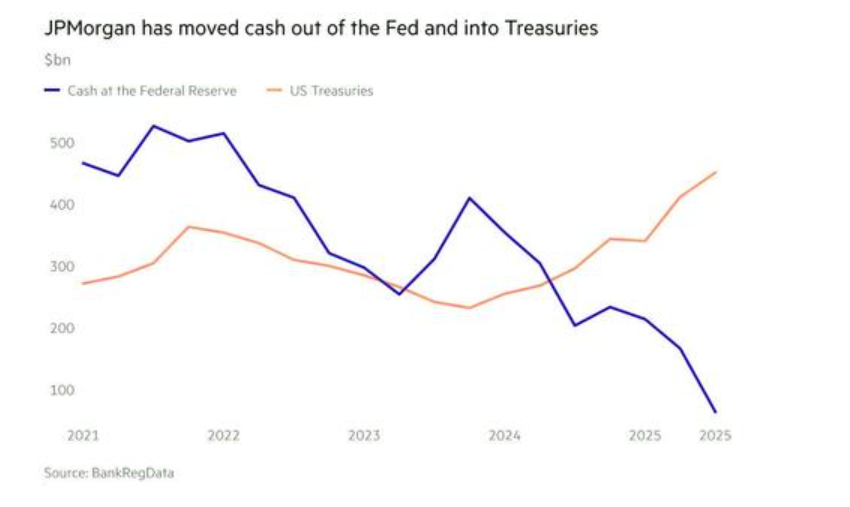
美国市场“流动性紧张”谜底揭晓?摩根大通从美联储账户提取近3500亿美元,投向美债
Hua Er Jie Jian Wen· 2025-12-18 01:56
Core Viewpoint - JPMorgan Chase's significant asset reallocation is revealing part of the recent market liquidity tightening, as the bank withdraws substantial cash reserves from the Federal Reserve to invest in U.S. Treasury bonds, raising concerns about potential liquidity issues similar to the 2019 repo crisis [1][8]. Group 1: JPMorgan's Actions and Market Impact - JPMorgan has reduced its deposits at the Federal Reserve from $409 billion at the end of 2023 to $63 billion in Q3 2024, withdrawing nearly $350 billion [1]. - The bank's holdings of U.S. Treasuries increased from $231 billion to $450 billion during the same period, indicating a strategic shift to hedge against declining interest rates [1][2]. - This withdrawal is significant enough to offset the total deposits of over 4,000 other banks at the Federal Reserve, leading to a net outflow of system reserves [1]. Group 2: Interest Rate Environment and Strategy - JPMorgan's asset allocation shift is a direct response to the changing interest rate environment, as the Federal Reserve is expected to lower its benchmark interest rates by the end of 2024 [3]. - The bank aims to lock in higher yields from Treasury bonds to protect its future profitability amid declining rates, contrasting its previous strategy during the low-rate period of 2020-2021 [2][3]. Group 3: Liquidity Concerns and Historical Context - The significant withdrawal of funds by JPMorgan has led to a contraction in the total reserve levels of the banking system, raising concerns about market liquidity [7]. - Observers are drawing parallels between JPMorgan's current actions and the 2019 repo crisis, where a similar withdrawal led to liquidity issues and prompted the Federal Reserve to initiate a form of quantitative easing [8]. Group 4: Controversy Over Reserve Interest Payments - The large sums received by JPMorgan from the Federal Reserve in interest payments on reserves have reignited debates about the effectiveness of this policy, with critics arguing it leads to idle funds rather than stimulating the real economy [9]. - In 2024, JPMorgan is projected to receive $15 billion in interest income, contributing to a total profit of $58.5 billion, highlighting the financial implications of the Fed's reserve interest policy [9].


没有商量的余地,我国继续抛售美债,美新发1.8万亿美债谁敢接盘
Sou Hu Cai Jing· 2025-12-17 17:28
Core Viewpoint - China is gradually reducing its holdings of US Treasury bonds, reflecting a shift in its foreign exchange reserve strategy and raising concerns about the implications for global economic stability [1][3][4]. Group 1: China's Actions - China, as the largest holder of US Treasury bonds, has been decreasing its holdings over the past few years, indicating a clear trend despite the decline not being drastic [3][4]. - The reasons for China's decision to sell US Treasuries include declining yields, currency risk associated with a depreciating dollar, and a desire for greater economic independence and strategic signaling to the US [4][6][8]. - The reduction in US Treasury holdings is part of China's broader strategy to diversify its foreign exchange reserves and establish a payment system based on the renminbi [7][10]. Group 2: US Treasury Situation - The US government announced the issuance of $1.8 trillion in new bonds to finance its substantial annual expenditures, which include military spending, social welfare, and infrastructure [6][8]. - The US public debt has surpassed its GDP, raising concerns about the sustainability of its debt levels and the reliability of the US government's creditworthiness [6][8]. - The challenge for the US is finding buyers for the new bonds, as traditional buyers, including foreign central banks and domestic investors, are becoming hesitant due to the increasing debt burden and declining attractiveness of US Treasuries [7][8]. Group 3: Global Implications - The issues surrounding US Treasuries are not only a concern for the US but also for the global economy, as many countries hold significant amounts of US debt in their foreign exchange reserves [7][10]. - There is a trend among various countries to reassess their foreign exchange reserve structures, with some increasing gold reserves and seeking alternative currencies for investment [7][10]. - The ongoing situation with US Treasuries could lead to broader changes in the global financial system, as trust in the US government and the dollar is being reevaluated [10].
西部证券:美股“AI泡沫论”担忧或将放大日本加息影响 建议多看少动
Ge Long Hui A P P· 2025-12-17 01:01
格隆汇12月17日|西部证券称,美股"AI泡沫论"担忧可能会放大日本加息的影响,如果美国连续出现2- 3次股债汇三杀,建议可以卖出资产,持有货币,等待流动性冲击倒逼美联储明确的量化宽松之后,再 相机增持资产。策略师曹柳龙团队在报告中指出,日本央行决策基本明牌,但资金的选择难以预测,这 种情况下建议多看少动不过,即便日本加息导致流动性冲击,也不会改变全球中长期宽松的趋势。大类 资产继续看好A和H股,中国国债把握修复机会,战略配置黄金,美股和美债或维持震荡。 ...

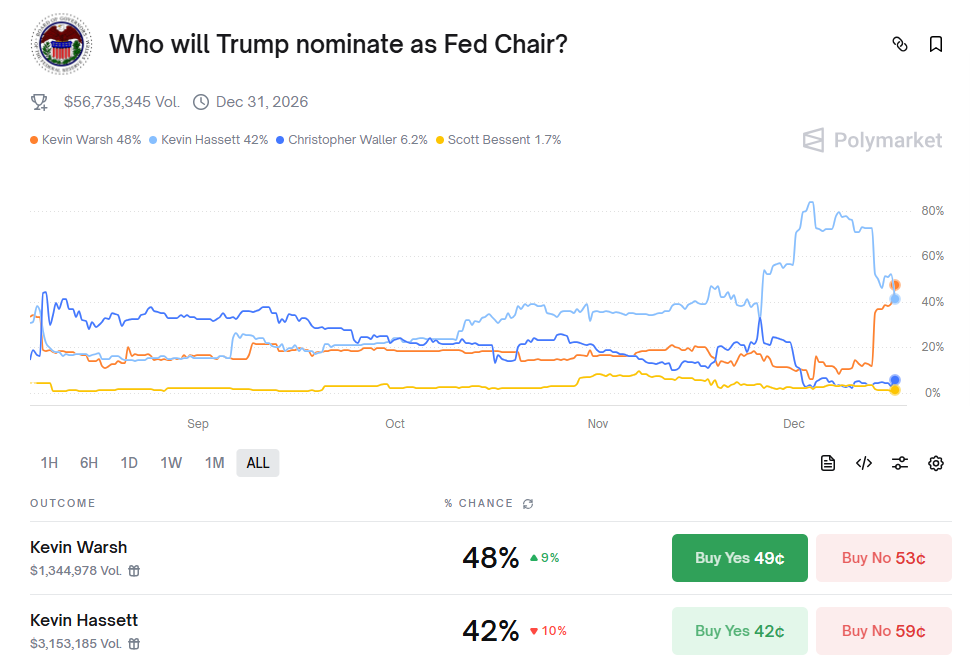
下一任美联储主席的头号候选人变了?沃什有何来头?
Sou Hu Cai Jing· 2025-12-16 12:56
Core Viewpoint - The next Federal Reserve Chair candidate is under intense competition, with Kevin Walsh emerging as the top contender according to President Trump's statements, while Kevin Hassett's chances have significantly decreased [1] Group 1: Candidate Profiles - Kevin Walsh is a prominent figure with a background in Wall Street and has served as the youngest Federal Reserve Governor in history [2] - Walsh has strong connections with notable investors like Peter Thiel and Marc Andreessen, which have influenced his investment strategies, including in cryptocurrencies [2] - His educational background includes a degree from Stanford University and a JD from Harvard Law School, and he has held significant roles in both the Bush administration and the Federal Reserve [2] Group 2: Criticism of Current Federal Reserve Policies - Walsh has been a vocal critic of current Federal Reserve Chair Jerome Powell, arguing that the Fed has failed in its dual mandate of managing interest rates and maintaining transparency [3] - He attributes the high inflation in the U.S. to policy missteps by the Federal Reserve rather than external factors like the pandemic or geopolitical tensions [3] - Walsh believes that the Fed's role has expanded unnecessarily, leading to a dilution of its core mission and independence [4] Group 3: Proposed Policy Changes - Walsh advocates for a "contraction" approach for the Federal Reserve, emphasizing the need to reduce its balance sheet and refocus on its primary function of price stability [5] - He argues that the Fed's extensive asset purchases since the 2008 financial crisis have distorted market dynamics and that it should revert to its original boundaries post-crisis [5] - Walsh suggests that the Fed should adopt an "institutional neutrality principle" to avoid taking stances on social and political issues unless they directly threaten its core mission [5][6]
美联储候选主席沃什与哈塞特,谁对我们更有利?
阿尔法工场研究院· 2025-12-16 05:23
Core Viewpoint - The article discusses the potential successors to the Federal Reserve Chair position, focusing on Kevin Warsh and Kevin Hassett, highlighting their differing monetary policy philosophies and the implications for the U.S. economy in 2025 amid inflation pressures, geopolitical uncertainties, and technological changes [4][5][15]. Candidate Backgrounds - Kevin Warsh, a former Federal Reserve governor, is known for his hawkish stance and experience in managing financial crises, advocating for market discipline and fiscal sustainability [10]. - Kevin Hassett, a former White House economic advisor, is recognized for his dovish perspective and pro-growth policies, emphasizing tax incentives and regulatory certainty [10]. Monetary Policy Perspectives - Warsh believes inflation is a result of policy choices rather than just economic growth, advocating for a reduction in the Fed's balance sheet and a return to market discipline [12]. - Hassett supports a more aggressive monetary policy, suggesting rapid interest rate cuts to stimulate economic growth, while criticizing the Fed for potential partisan biases [13]. Market Implications - If Warsh is appointed, the Fed may adopt a more cautious monetary policy, potentially leading to slower economic growth and increased market volatility, but promoting healthier long-term valuations [14]. - Conversely, Hassett's leadership could result in quicker interest rate cuts, benefiting sectors sensitive to borrowing, such as technology and real estate, but risking higher deficits and inflation expectations [14]. Public Sentiment and Predictions - As of December 13, 2025, public sentiment shows Hassett initially leading, but Warsh's chances increased significantly following Trump's endorsement, with Warsh's probability rising from 15% to 37-40% [16]. - Prediction markets indicate Hassett's probability at around 49%, though the gap is narrowing [16]. Conclusion - The appointment of the new Federal Reserve Chair will significantly impact the U.S. economic trajectory, with Warsh potentially ushering in a period of disciplined stability, while Hassett may lead to more aggressive growth-oriented policies [22].

降息与经济工作会议之后
2025-12-16 03:26
Summary of Key Points from Conference Call Records Industry and Company Overview - The conference call discusses the implications of recent monetary policy changes by the Federal Reserve and the economic work conference in China, focusing on the financial markets, particularly the Hong Kong, U.S., and A-share markets. Core Insights and Arguments Federal Reserve Policy - The Federal Reserve announced a hawkish rate cut and a $40 billion expansion of its balance sheet aimed at addressing liquidity issues in the repo market, rather than initiating quantitative easing (QE) [1][2] - The Fed's dot plot indicates only one rate cut in 2026, which is lower than market expectations, suggesting a cautious approach to future monetary policy [2] - The new Fed chair nominee, Set, is perceived as dovish, which could lead to lower long-term interest rates [2] Economic Conditions in China - The Chinese economic work conference indicates a weakening stance in fiscal and monetary policy, with a shift towards cross-cycle policies rather than total volume policies [1][3] - The credit cycle in China may be at a turning point, with weak domestic demand and real estate market challenges expected to persist into 2026 [1][3] Market Performance - Hong Kong stocks outperformed in Q1 2025 due to internet asset revaluation but lagged behind A-shares and U.S. stocks since November, influenced by external factors like Fed rate cuts and local economic conditions [1][4] - The fourth quarter saw Hong Kong stocks underperform due to liquidity sensitivity and a lack of optimistic external and internal funding factors [1][6] Investment Strategies - Future market allocation strategies should consider liquidity, fundamentals, and structural advantages across the U.S., Hong Kong, and A-share markets [1][5] - The outlook for the three markets suggests that while U.S. stocks have room for growth, Hong Kong requires cautious observation due to uncertainties, and A-shares have advantages under domestic policy support [5][9] Economic Signals and Policy Directions - The economic work conference highlighted the need for policies to stabilize the real estate market and boost domestic consumption, with a focus on balancing internal and external demands [12][11] - Fiscal policy is expected to shift from investment to consumption and livelihood, with an emphasis on stimulating domestic demand [12][15] Future Market Outlook - The anticipated economic recovery in the U.S. and the potential for a prolonged bull market depend on the interplay of liquidity, economic fundamentals, and structural market characteristics [24][25] - The Japanese central bank's expected rate hike is aimed at curbing yen depreciation and is not anticipated to cause significant market volatility due to prior market pricing [26][28] Other Important but Potentially Overlooked Content - The conference discussed the importance of monitoring macroeconomic indicators, policy signals, and investor behavior to assess market peaks and potential risks [20][21] - The potential for breaking the bull-bear cycle hinges on the demand for high-return assets and regulatory support for long-term capital inflows into the stock market [25][34] - Japan's fiscal health is projected to remain stable despite rising interest rates, with tax revenue growth expected to outpace interest expenses [35]
美联储2026年或放缓降息步伐
Qi Huo Ri Bao Wang· 2025-12-16 02:09
Core Viewpoint - The Federal Reserve's recent decision to lower the benchmark interest rate by 25 basis points aligns with market expectations, indicating a potential slowdown in future rate cuts compared to this year [1][2][5] Group 1: Federal Reserve's Actions - The Federal Reserve has cut the benchmark interest rate to a range of 3.50% to 3.75%, marking a total reduction of 75 basis points this year [2] - The decision faced internal dissent, with three officials voting against the rate cut, indicating a higher level of disagreement within the Fed than previously anticipated [2][3] - The Fed has also announced the end of its balance sheet reduction and the initiation of asset purchases to maintain adequate reserves, reflecting liquidity pressures in the banking system [5][6] Group 2: Economic Indicators - The Fed's economic outlook has been adjusted, with GDP growth forecasts for 2025 and 2026 raised to 1.7% and 2.3% respectively, while inflation expectations have been slightly lowered [6] - The unemployment rate has risen to 4.4%, the highest in four years, indicating a cooling labor market, which may increase the necessity for further rate cuts [8][10] - Core service inflation has decreased from 4.3% to 3.5%, suggesting that overall inflation levels may remain subdued [9] Group 3: Market Implications - The market is currently pricing in a cautious approach from the Fed, with expectations of potential rate cuts in early 2026, but also a possibility of pausing cuts depending on economic data [7][10] - The global monetary policy landscape is diverging, with the Fed in a rate-cutting cycle while other major central banks are on hold, reflecting varying economic conditions [12] - Risk assets, particularly equities, are expected to perform well due to improved market sentiment and liquidity conditions, despite concerns over potential bubbles in sectors like AI [14][15]

美联储下一任主席生变!沃什的政策主张:降息+缩表
Hua Er Jie Jian Wen· 2025-12-16 01:57
Core Viewpoint - Deutsche Bank analyzes that if Kevin Warsh is elected as the next Federal Reserve Chairman, his policy stance may present a unique combination of "simultaneous rate cuts and balance sheet reduction" [1][3]. Group 1: Warsh's Candidacy and Market Reactions - President Trump has indicated that Kevin Warsh is a leading candidate for the Federal Reserve Chair, alongside Kevin Hassett, which has led to a significant drop in Hassett's odds in prediction markets [1]. - As of the latest data, prediction markets suggest that Warsh has a higher probability of becoming the next Fed Chair compared to Hassett [1]. Group 2: Warsh's Policy Proposals - Deutsche Bank's report highlights that if Warsh is elected, he would support interest rate cuts while also advocating for a reduction in the balance sheet [3]. - The feasibility of "simultaneous rate cuts and balance sheet reduction" hinges on regulatory reforms that lower banks' reserve requirements, which is currently uncertain [3]. Group 3: Warsh's Background and Criticism of Fed Policies - Warsh, a lawyer by training, has extensive experience in both public and private sectors, having served as a Federal Reserve Governor from 2006 to 2011 during the global financial crisis [4]. - He has been a strong critic of the Fed's aggressive balance sheet operations over the past 15 years, arguing that quantitative easing (QE) has deviated from the central bank's core responsibilities [5][6]. - Warsh has expressed concerns that continued QE could lead to inflation and financial stability risks, suggesting that the Fed's actions may distort market signals [6][7]. Group 4: Warsh's Views on Forward Guidance and Monetary Policy - Warsh has criticized the Fed for over-relying on data and lacking forward guidance, stating that the forward guidance tool introduced during the financial crisis has little effect in normal times [9]. - He questions the Fed's understanding of monetary policy, suggesting misconceptions about the relationship between monetary policy and money supply [9][10]. Group 5: Implications for Future Fed Leadership - Deutsche Bank emphasizes that regardless of who is chosen as the next Fed Chair, the market will likely test the new leader's independence and credibility in achieving inflation targets [13]. - The report expresses skepticism about significant policy changes following the leadership transition in June, especially given the divided committee dynamics [13].