
原油价格

Search documents
原油周报:寒潮驱动,关税扰动,油价整体小幅走强-20260125
Xinda Securities· 2026-01-25 12:03
Investment Rating - The report maintains a "Positive" investment rating for the oil processing industry [1] Core Insights - As of January 23, 2026, international oil prices have seen a slight increase due to multiple favorable factors, including temporary production halts in Kazakhstan, an upward revision of global economic growth forecasts, the cancellation of tariffs on eight European countries by Trump, and extreme cold weather potentially affecting supply and demand [2][9] - Brent and WTI crude oil prices were reported at $65.07 and $61.07 per barrel, respectively, marking increases of 1.47% and 2.92% from the previous week [2][20] - The oil and petrochemical sector outperformed, with a 7.71% increase, while the broader Shanghai and Shenzhen 300 index fell by 0.62% [10][13] Summary by Sections Oil Price Review - Brent crude futures settled at $65.07 per barrel, up $0.94 (+1.47%) from the previous week, while WTI crude futures rose to $61.07 per barrel, an increase of $1.73 (+2.92%) [2][20] Offshore Drilling Services - As of January 19, 2026, the number of global offshore self-elevating drilling platforms was 376, a decrease of 1 from the previous week, while floating drilling platforms increased by 3 to a total of 133 [29] Oil Supply - U.S. crude oil production was reported at 13.732 million barrels per day as of January 16, 2026, a decrease of 21,000 barrels from the previous week [39] - The number of active drilling rigs in the U.S. increased by 1 to 411 as of January 23, 2026 [39] Oil Demand - U.S. refinery crude oil processing volume was 16.604 million barrels per day as of January 16, 2026, down by 354,000 barrels from the previous week, with a refinery utilization rate of 93.30%, a decrease of 2.0 percentage points [47] Oil Inventory - As of January 16, 2026, total U.S. crude oil inventories stood at 841 million barrels, an increase of 4.408 million barrels (+0.53%) from the previous week [48] Related Stocks - Key stocks in the sector include China National Offshore Oil Corporation (CNOOC), PetroChina, Sinopec, and China Oilfield Services [3]






供需格局偏好 对二甲苯期货行情呈现震荡上行走势
Jin Tou Wang· 2026-01-22 07:00
Core Viewpoint - The domestic futures market for xylene is showing a strong upward trend, with the main contract experiencing fluctuations and a price increase of approximately 2.10% [1][2]. Group 1: Market Performance - The main contract for xylene opened at 7234.0 CNY/ton and reached a high of 7414.0 CNY, with a low of 7180.0 CNY during the trading session [1]. - The overall market performance for xylene is characterized by a strong upward trend, indicating positive sentiment among traders [2]. Group 2: Supply and Demand Analysis - Newhu Futures reports that the recent rise in crude oil prices and tight supply expectations for PX have led to strong price performance and profit expansion [2]. - Despite a recent recovery in PX supply and weakening downstream demand, the overall supply-demand balance remains favorable until new production capacities are introduced in the third quarter [2]. - New Century Futures highlights that geopolitical instability and lower-than-expected crude oil exports from Venezuela are contributing to the upward pressure on oil prices, while PX supply remains relatively loose [2]. Group 3: Future Outlook - Wuzhou Futures indicates that high PX operating rates and seasonal maintenance in downstream PTA are expected to maintain a stockpiling trend for PX [2]. - The mid-term outlook for PX remains optimistic, with expectations of strong demand from downstream PTA after the Spring Festival, despite short-term volatility [2].
ETO Markets外汇:受油价上涨影响,美元/加元回落至1.3900下方
Sou Hu Cai Jing· 2026-01-16 05:32
Group 1 - The Canadian dollar (CAD) strengthened against the US dollar (USD) primarily due to the rebound in oil prices, which directly impacts Canada's economy as a major oil exporter [3] - The recent strong performance of US economic data, particularly retail sales and improvements in the labor market, has provided support for the USD, reinforcing expectations that the Federal Reserve will maintain interest rates in the short term [3] - Morgan Stanley analysts have adjusted their expectations for Federal Reserve rate cuts, delaying them from January and April to June and September, based on stable employment data, which influences the short-term outlook for the USD [3] Group 2 - The upcoming US industrial production report is crucial for assessing the health of the US industrial sector, with strong data likely to bolster USD support, while weaker data could increase downward pressure on the USD/CAD pair [4] - Future public statements from Federal Reserve officials regarding inflation, employment, and interest rate policies may significantly impact market expectations and lead to fluctuations in currency pairs [4]


银河期货沥青日报-20260114
Yin He Qi Huo· 2026-01-14 09:57
Group 1: Investment Rating - No investment rating information provided in the report. Group 2: Core Viewpoints - The situation in Iran continues to escalate, and oil prices are strong. However, the market has gradually digested the impact of Venezuela on oil prices, and the expectation of tight asphalt raw material supply has eased. The increase in raw material discounts has not been fully traded, and the market shows high - level fluctuations. At the beginning of the year, the off - season has arrived as scheduled. The weekly supply and demand have decreased simultaneously on a month - on - month basis. The industrial chain inventory remains at a low level, and the spot price is relatively firm. The short - term disk is expected to fluctuate at a high level [8]. Group 3: Summary by Directory Part 1: Related Data - **Futures Prices and Positions**: On January 14, 2026, the price of BU2603 (the main contract) was 3168 yuan, up 28 yuan or 0.89% from the previous day; BU2604 was 3172 yuan, up 28 yuan or 0.89%; BU2605 was 3175 yuan, up 94 yuan or 3.05%; SC2602 was 445.5 yuan, down 0.1 yuan or - 0.02%; the price of Brent's first - line contract was 65.22 US dollars, up 1.1 US dollars or 1.68%. The main contract's position was 20.3 million lots, down 0.5 million lots or - 2.20%; the main contract's trading volume was 19.9 million lots, down 8.1 million lots or - 28.99%. The warehouse receipt quantity was 46450 tons, up 5800 tons or 14.27% [3]. - **Basis and Spread**: The BU04 - 05 spread was - 3.00 yuan, down 66.00 yuan or - 104.76%; the BU04 - 03 spread was - 4.00 yuan, unchanged; the Shandong - main contract basis was 58.00 yuan, down 8.00 yuan or - 12.12%; the East China - main contract basis was - 22.00 yuan, down 28.00 yuan or - 466.67%; the South China - main contract basis was 8.00 yuan, down 28.00 yuan or - 77.78% [3]. - **Industrial Chain Spot Prices**: The Shandong market price was 3100 yuan, up 20 yuan or 0.65%; the East China market price was 3150 yuan, unchanged; the South China market price was 3180 yuan, unchanged; Shandong gasoline was 7087 yuan, up 41 yuan or 0.58%; Shandong diesel was 5832 yuan, up 54 yuan or 0.93%; Shandong petroleum coke was 2970 yuan, unchanged; the diluted asphalt discount was - 13.2, unchanged; the central parity rate of the exchange rate was 7.0120, up 0.0017 or 0.02% [3]. - **Spread and Profit**: The asphalt refinery profit was - 2.93 yuan, down 22.82 yuan or 114.73%; the refined oil comprehensive profit was 68.66 yuan, down 14.11 yuan or - 17.05%; the BU - SC cracking spread was - 445.07 yuan, up 25.51 yuan or 5.42%; the gasoline spot - Brent spread was 730.76 yuan, down 21.33 yuan or - 2.84%; the diesel spot - Brent spread was 310.14 yuan, down 9.83 yuan or - 3.07% [3]. Part 2: Market Analysis - **Market Overview**: On January 14, the average price of the domestic asphalt market was 3239 yuan/ton, up 1 yuan/ton or 0.03% from the previous day. In the Shandong market, the supply decreased slightly, and the prices of crude oil and asphalt futures rose, which boosted market sentiment. Traders slightly raised their shipping prices. In the East China market, the high - priced resources in the social inventory were not sold well, but the main refineries' road and shipping deliveries were good, and the asphalt price was stable. In the South China market, some main refineries limited their shipments, and the local price remained firm [6]. - **Market in Different Regions**: In the Shandong market, the mainstream transaction price rose to 3130 - 3220 yuan/ton. The rise in crude oil prices drove up the asphalt futures price, and most traders slightly raised their shipping prices. However, the terminal demand was weak, and the mainstream transaction price was still at the lower end. In the Yangtze River Delta market, the mainstream transaction price remained stable at 3210 - 3210 yuan/ton. The main refineries produced asphalt stably, and the road and shipping deliveries were smooth, which reduced the refinery inventory. In the South China market, the mainstream transaction price remained stable at 3080 - 3150 yuan/ton. The supply and demand were balanced, and some resources were sold at a premium due to limited shipments from some main refineries [6][7]. - **Market Outlook**: The situation in Iran is escalating, and oil prices are strong. The impact of Venezuela on oil prices has been digested, and the expectation of tight asphalt raw material supply has eased. The market shows high - level fluctuations. At the beginning of the year, the off - season has arrived, with simultaneous month - on - month decreases in supply and demand. The inventory is low, the spot price is firm, and the short - term disk is expected to fluctuate at a high level [8]. Part 3: Related Attachments - The report includes figures such as the closing price of the BU main contract, the position of the BU main contract, the market price of asphalt in East China, the market price of asphalt in Shandong, the price of Shandong local refinery gasoline, and the price of Shandong local refinery diesel [10].
博弈升级!加元关键区间震荡待政策油价指引
Jin Tou Wang· 2026-01-13 02:28
Group 1 - The USD/CAD exchange rate is currently experiencing a slight decline, trading at 1.3879, with a cautious market outlook due to multiple factors [1] - The Bank of Canada has maintained its benchmark interest rate, indicating resilience in the Canadian economy despite U.S. tariff impacts, leading to expectations of a potential end to the rate-cutting cycle [1] - The Federal Reserve is expected to continue its rate-cutting process in 2026, but there are significant internal disagreements regarding the pace of easing, which is limiting the downward trend of the USD [1] Group 2 - The Canadian dollar is closely tied to international oil prices, with recent geopolitical tensions and supply chain issues supporting oil prices, thereby enhancing the attractiveness of Canadian assets [2] - The Canadian economy is showing signs of recovery, with stable core inflation, but faces challenges from U.S. tariff uncertainties and a loosening labor market, which may restrict the appreciation of the Canadian dollar [2] - The USD/CAD exchange rate is expected to maintain a weak and volatile pattern, having broken below the key support level of 1.3750, currently fluctuating between 1.38 and 1.39 [2] Group 3 - The RSI indicator is currently around 45, indicating a neutral state with no clear overbought or oversold signals, suggesting that the current oscillation pattern may continue until key data or events emerge [3] - Key support levels for the USD/CAD exchange rate are focused on the 1.3800 level, with 1.3750 as a critical support level; a breach could lead to further declines towards 1.3600 [3] - Resistance levels are concentrated in the 1.3820-1.3850 range, with potential upward movement towards the 1.3900 level if this range is maintained [3]
特朗普:对伊朗贸易伙伴征收25%关税!鲍威尔“遭查”引爆金属市场,十余名美前财经要员联名批评并警告
Jin Rong Jie· 2026-01-12 23:56
Group 1: Market Performance - The US stock market saw a slight increase on Monday, with the S&P 500 and Dow Jones indices reaching all-time highs, closing at 69,777.27 and 49,590.20 points respectively [1] - The Nasdaq China Golden Dragon Index rose by 4.26%, with notable gains in Chinese stocks such as Alibaba, which increased by over 10% [1] Group 2: Precious Metals - Precious metals prices surged to record highs, with spot gold exceeding $4,600 per ounce and silver prices rising over 8% to surpass $86 per ounce [1][7] - The increase in precious metals is attributed to concerns over the independence of the Federal Reserve and uncertainty in monetary policy, which are expected to provide long-term support for gold and silver prices [7][9] Group 3: Oil Prices - Oil prices reached their highest levels since December 2025, with WTI crude oil futures closing at $59.50 per barrel, marking a 0.64% increase [1] - The rise in oil prices is driven by investor concerns regarding potential supply disruptions from Iran amid ongoing geopolitical tensions [1] Group 4: Federal Reserve and Political Influence - The Trump administration's threat of a criminal investigation against Federal Reserve Chairman Jerome Powell has raised concerns about the Fed's independence, potentially impacting monetary policy and market confidence [5][6] - A group of former financial officials criticized the investigation, emphasizing the importance of the Fed's independence for economic stability [6] Group 5: Future Outlook for Precious Metals - Analysts predict that the weakening of the Fed's independence and expectations of monetary easing will likely lead to a decline in the dollar's value, further boosting demand for gold as an inflation hedge [8][9] - The upcoming appointment of a new Fed chairman could significantly influence future monetary policy and the market's perception of the Fed's independence [9]
纯苯、苯乙烯周报:市场情绪反复,纯苯苯乙烯跟随-20260112
Guo Mao Qi Huo· 2026-01-12 07:05
1. Report Industry Investment Rating - Not provided in the document 2. Core Viewpoints of the Report - The commodity market has large sentiment fluctuations, and it is expected that benzene and styrene will mainly fluctuate [3]. - The Asian benzene market is affected by factors such as the strength of US benzene prices, downstream styrene market support, and market sentiment, maintaining a volatile state. The supply can meet the demand, and the overall demand is stable while overseas demand is weak [77]. - The Asian styrene market has rebounded, but high inventory and weak overseas demand still limit its upward space [126]. - The overseas benzene and styrene markets are both facing the dual pressures of improved supply and weak demand in the short - term, and the profitability is under pressure [68][87]. 3. Summary by Relevant Catalogs 3.1 Main Viewpoints and Strategy Overview - **Supply**: The economic situation of styrene producers in Asia has recovered but remains negative. The spread between styrene and naphtha is $290, and the spread between styrene and benzene is stable at $165 [3]. - **Demand**: As of January 5, 2026, the commercial inventory of pure benzene in Jiangsu ports was 318,000 tons, a month - on - month increase of 6.00% and a year - on - year increase of 71.71%. From December 29 to January 4, the estimated arrival was about 25,000 tons and the pick - up was about 7,000 tons [3]. - **Inventory**: As of January 5, 2026, the inventory of styrene in Jiangsu ports was 132,300 tons, a decrease of 4.68% from the previous period. The commercial inventory was 77,300 tons, a decrease of 7.20% from the previous period [3]. - **Basis**: The styrene basis has slightly strengthened. Overseas demand for blending oil has weakened, and Trump's foreign policy significantly affects oil prices. Attention should be paid to changes in cost support [3]. - **Profit**: The spread between styrene and naphtha is $290, and the spread between styrene and benzene is stable at $165. Styrene profit has slightly recovered [3]. - **Valuation**: The prices of pure benzene and styrene are at historical lows. Overseas export demand is driving up prices, and the market is paying attention to the strengthening of basis and monthly spread performance [3]. - **Macro Policy**: Trump is planning to dominate the Venezuelan oil industry, which may lower oil prices. If successful, the US will control most of the oil reserves in the Western Hemisphere and gain an important say in the final flow of crude oil [3]. - **Investment Viewpoint**: The commodity market sentiment fluctuates greatly, and it is expected to be mainly in a volatile state [3]. - **Trading Strategy**: For unilateral trading, adopt a wait - and - see approach. Pay attention to geopolitical risks [3]. 3.2 Fundamentals Overview of Pure Benzene and Styrene - **Crude Oil**: Trump's policy changes significantly affect oil prices [5]. - **Styrene**: Non - integrated styrene unit profits are average, and styrene profits have relatively expanded [14][23]. - **Pure Benzene**: Pure benzene inventory remains at a high level [32]. 3.3 Polymer Demand Overview - **Styrene Downstream - ABS**: In the off - season, demand is weak, and ABS profits are shrinking [46]. - **Styrene Downstream - PS**: PS production margins are weak, and demand is difficult to follow up [59]. - **Styrene Downstream - EPS**: EPS prices are at a low level, and inventory continues to accumulate [69]. - **Pure Benzene - Aniline**: Aniline production has declined, and margins have rebounded [79]. - **Styrene Overseas**: The overseas styrene market is in a post - holiday slump. Profits are expected to be negative in early 2026, and production is restricted by cost pressure [87]. - **Phenol**: Phenol port inventory remains at a low level [88]. - **Adipic Acid**: Adipic acid profits are low [99]. - **Caprolactam**: Caprolactam production load has declined, and inventory has been depleted [111]. - **Appliance Production**: Refrigerator and freezer production schedules and household air - conditioner production schedules are provided, but no specific analysis is given [122][124].
美股在节日中回调,原油价格或短期利好
Xin Lang Cai Jing· 2026-01-07 08:16
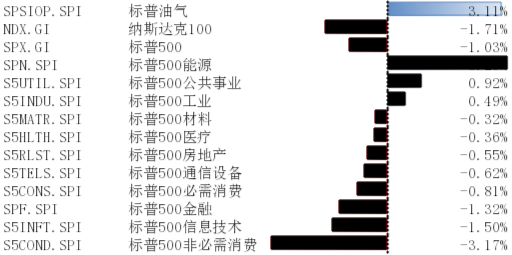
Macroeconomic Indicators - The FHFA house price index in the US increased by 0.4% month-on-month in October, surpassing the expected 0.1% and the previous value of -0.1% [1][10] - The number of initial jobless claims in the US dropped significantly to 199,000 for the week ending December 20, falling below 200,000 and approaching historical lows, compared to the previous value of 215,000 and an expectation of 218,000 [1][10] - The US refinery utilization rate slightly increased to 94.7% for the week ending December 26, up from 94.6% the previous week [1][10] - The US crude steel production continued to decline year-on-year, with a decrease of 1.8% compared to a previous decline of 3.6% [1][10] Major Index Performance - The S&P Oil & Gas Index rose by 3.11% over the week from December 29, 2025, to January 2, 2026, while the Nasdaq 100 Index fell by 1.71% and the S&P 500 Index decreased by 1.03% [2][12] - Among the 11 sectors covered by the S&P 500, three sectors saw gains, with the S&P 500 Energy sector leading with a rise of 3.29%, while the S&P 500 Consumer Discretionary sector lagged with a decline of 3.17% [2][12] Investment Products - The Bosera S&P 500 ETF (513500) is designed to track the US S&P 500 Index, providing a low-cost investment tool for domestic investors to capture growth in US stocks [4][13] - The Bosera Nasdaq 100 ETF (513390) tracks the Nasdaq 100 Index, with a significant portion (57.87%) of its composition in the information technology sector, along with exposure to consumer services, consumer goods, and healthcare [4][13]
沥青月报:地缘驱动估值-20260104
Wu Kuang Qi Huo· 2026-01-04 13:23
Report Industry Investment Rating No relevant content provided. Core Viewpoints of the Report - In the medium - term, it is likely that the valuation of asphalt will decline in the second half of the year. The return of major refinery production capacity and the seasonal off - peak valuation period will limit the upward space of asphalt valuation (asphalt/crude oil), and the weak shock of crude oil at the cost end will also limit the upward space of asphalt's single - side price [15]. - In the short - term, considering that most of the crude oil is in maritime inventory and mostly distributed in the Asia - Pacific region, the upward range of oil prices due to geopolitical situations is limited, but the valuations of heavy oil and asphalt will significantly benefit. It is recommended to go long on the asphalt cracking spread during the period when the maritime inventory cannot be fully released [16]. Summary by Directory 1. Monthly Assessment and Strategy Recommendation - **Market Review**: The price trend of the asphalt main contract from January 2025 to December 2025 is affected by supply - demand and cost factors. There are situations of supply - demand increase, cost decrease, etc. [13][14]. - **Medium - term Impact Factor Assessment**: In terms of supply, imports are expected to remain low, and major refineries are expected to resume a certain level of operation, which will limit the upward movement of asphalt valuation. In terms of demand, the start - up rate of road - modified asphalt and waterproofing membranes has improved, but overall demand is expected to be flat after the infrastructure peak season. In terms of cost, the upward space of oil prices in the second half of the year is limited, and the wide - range shock center of oil prices is expected to move down slightly [15]. - **Short - term Factor Assessment**: Supply is neutral - bearish as the start - up rate of heavy - traffic asphalt is rising and overall imports remain strong. Demand is bearish as the start - up rates of all demand segments are weak and downstream shipments are flat. Inventory is neutral - bearish (partially priced in) as there is a problem of weak de - stocking and domestic total inventory exceeds expectations. The cost of crude oil is expected to stop falling and stabilize, and is in a weak shock process. The previous month's view was to wait and see, while this month's view is to go long on the asphalt cracking spread [16]. 2. Spot and Futures Market - **Spot Price**: The report shows the price trends of heavy - traffic asphalt in Shandong, Northeast, North China, and East China regions [19][21][23]. - **Basis Trend**: It presents the basis trends of asphalt in Shandong and East China regions from 2021 to 2025 [31]. - **Term Structure**: It shows the term structure of asphalt and the price differences between different contracts such as 03 - 05, 04 - 05, and 03 - 06 [34][35]. 3. Supply Side - **Capacity Utilization and Profit**: It shows the capacity utilization rate of heavy - traffic asphalt and the production profit of Shandong asphalt from 2021 to 2025, as well as the relationship between asphalt start - up, profit, and crude oil price [41][44][46]. - **Imports**: It includes the import volume of asphalt and diluted asphalt, the import profit from different regions, and the cumulative import volume from countries such as South Korea, Singapore, and Malaysia [51][54]. - **Valuation Ratio**: It shows the ratio trends of fuel oil/asphalt and asphalt/Brent from 2021 to 2025 [57]. - **Refinery Profit**: It presents the refining profits of major refineries and Shandong local refineries, as well as the start - up rate and production profit of petroleum coke [60][63]. 4. Inventory - **Domestic Inventory**: It shows the trends of domestic factory inventory, social inventory, total inventory, and diluted asphalt port inventory from 2021 to 2025 [68]. - **Warehouse Receipts**: It shows the asphalt warehouse receipts and the virtual - to - real ratio of the asphalt main contract from 2021 to 2025 [71]. - **Relationship between Inventory, Profit, and Price**: It shows the relationships between inventory and profit, and between profit and price [74]. 5. Demand Side - **Enterprise Shipment Volume**: It shows the asphalt shipment volumes of Chinese, Shandong, East China, and North China sample enterprises from 2023 to 2025 [78][80][84]. - **Downstream Start - up Rate**: It shows the start - up rates of rubber shoe materials, road - modified asphalt, and waterproofing membranes from 2021 to 2025 [89][92]. - **Highway Investment**: It shows the cumulative value of highway construction investment in China's transportation fixed - asset investment, the monthly year - on - year and monthly value of transportation public fiscal expenditure, and the relationship between asphalt demand and transportation fiscal expenditure [94][97][104]. - **Road - related Machinery**: It shows the monthly sales volume of road rollers and excavators, the monthly working hours of excavators, and the cumulative value of highway construction investment in China's transportation fixed - asset investment [105][109]. - **Related Consumption**: It shows the cumulative year - on - year growth rates of fixed - asset investment in railway transportation, road transportation, and water conservancy management industries, as well as the cumulative value of local government special bond issuance [112][113]. 6. Related Indicators - **Position, Trading Volume, and Price Volatility**: It shows the trading volume, position, and 20 - day historical volatility of asphalt futures from 2021 to 2025 [123][121]. 7. Industrial Chain Structure Diagram - **Crude Oil Industrial Chain**: It includes exploration and extraction links [127][128]. - **Asphalt Industrial Chain**: From the production process perspective, asphalt can be divided into straight - run asphalt, oxidized asphalt, blended asphalt, modified asphalt, and emulsified asphalt, with straight - run asphalt accounting for over 80% and mostly used in road construction. By use, it is divided into road asphalt, building asphalt, and special - purpose asphalt, mainly used for waterproofing, anti - corrosion, and road construction [131].
原油月报:2026年原油平均累库或超200万桶、日-20251221
Xinda Securities· 2025-12-20 23:30
Investment Rating - The report does not explicitly state an investment rating for the oil processing industry Core Insights - The average global crude oil inventory change for 2026 is projected to be +204.90 thousand barrels per day according to IEA, EIA, and OPEC [2] - For Q4 2025, the average inventory change is expected to be +162.53 thousand barrels per day, showing a revision from previous forecasts [2] - Global crude oil supply for 2025 is forecasted at 10617.36, 10607.84, and 10470.71 thousand barrels per day by IEA, EIA, and OPEC respectively, indicating a year-on-year increase [2] - The global crude oil demand for 2025 is estimated at 10392.25, 10393.68, and 10513.66 thousand barrels per day by IEA, EIA, and OPEC respectively, reflecting a modest increase from 2024 [2] Summary by Sections Oil Supply - IEA, EIA, and OPEC predict global crude oil supply for 2026 to be 10865.02, 10742.59, and 10654.18 thousand barrels per day respectively, with increases from 2025 [2][35] - The Q4 2025 supply increase is projected at +414.30, +385.36, and +254.12 thousand barrels per day by IEA, EIA, and OPEC respectively [35] Oil Demand - The demand for 2026 is forecasted at 10478.51, 10516.87, and 10651.70 thousand barrels per day by IEA, EIA, and OPEC respectively, indicating a growth from 2025 [2][35] - The demand increase for Q4 2025 is expected to be +108.72, +130.72, and +152.22 thousand barrels per day by IEA, EIA, and OPEC respectively [4] Oil Prices - As of December 18, 2025, Brent crude, WTI, Russian ESPO, and Russian Urals prices are reported at 59.82, 56.00, 47.94, and 65.49 USD per barrel respectively, with significant declines observed over the year [9][10] - Year-to-date price changes show Brent down by -21.22%, WTI by -23.42%, and Russian ESPO by -33.37% [9][10] Oil Inventory - The global crude oil inventory change for 2025 is projected at +225.11, +214.16, and -42.95 thousand barrels per day by IEA, EIA, and OPEC respectively, with an average increase of +132.11 thousand barrels per day [26] - The U.S. total crude oil inventory as of December 12, 2025, stands at 83658.8 thousand barrels, reflecting a slight increase [19][20]